Giredestrant (oral SERD) + everolimus vs physician's choice endocrine therapy + everolimus in ER+/HER2- advanced breast cancer after CDK4/6 inhibition — Roche/Genentech
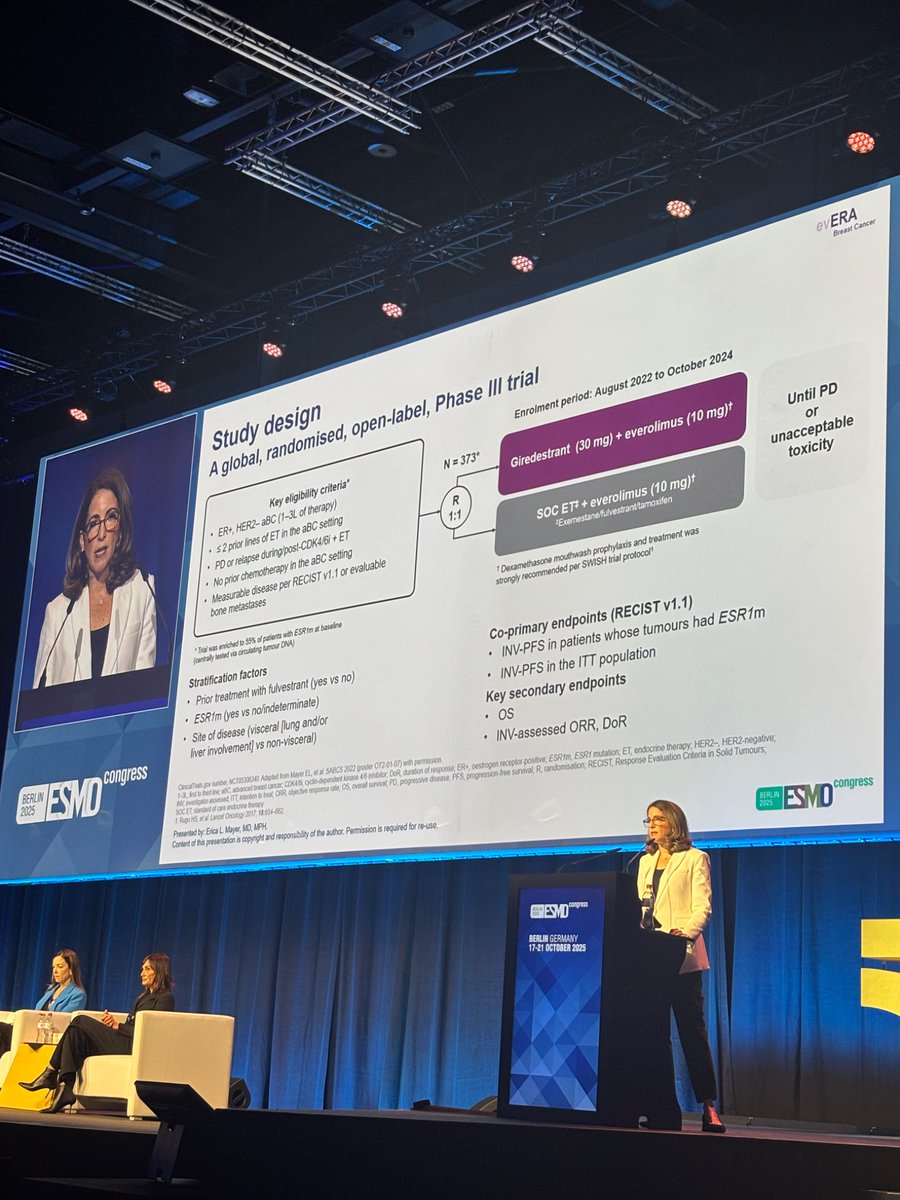
Discover KOL Sentiment on EVERA →Read the NEJM Publication →Design - Phase 3 randomized, open-label trial of giredestrant (oral SERD) + everolimus vs physician's-choice endocrine therapy + everolimus in ER+/HER2- advanced breast cancer post-CDK4/6i, enriched for ESR1 mutations (NCT05306340; Roche/Genentech). N=373 randomized (giredestrant + everolimus n=183; SOC ET + everolimus n=190); ESR1-mutated n=207 (102 vs 105), ~55% of the trial.
Publication - Primary results published in the New England Journal of Medicine on October 1, 2026 (Mayer EL, et al. N Engl J Med. 2026 Oct 1;395(13):1285-1298).
PFS - ITT (co-primary, MET) - Median 8.77 vs 5.49 months, HR 0.56 (95% CI 0.44-0.71), p<0.0001.
PFS - ESR1-mutated (co-primary, MET) - Median 9.99 vs 5.45 months, HR 0.38 (95% CI 0.27-0.54).
PFS - ESR1 wild-type (exploratory, NOT a co-primary endpoint) - Median 5.72 vs 5.52 months, HR 0.84 (95% CI 0.59-1.18) in the 81 vs 85 patients with no detectable ESR1 mutation. The confidence interval crosses 1 - no significant PFS separation in ESR1 wild-type disease. Trial investigator Erica Mayer described this subgroup as showing “no difference in PFS between the 2 arms,” with signals confined to response rate and duration of response.
Overall survival (secondary) - Immature but positive trend: ITT HR 0.69 (95% CI 0.47-1.00, p=0.0473); ESR1-mutated HR 0.62 (95% CI 0.38-1.02, p=0.0566).
Safety - Well tolerated with no new safety signals and no added toxicity beyond the everolimus backbone; notably no photopsia (a class effect of some oral SERDs).
Regulatory / sponsor - Investigational; NDA accepted, PDUFA December 18, 2026. Roche/Genentech; giredestrant + everolimus (Afinitor).
Compiled and reviewed by the KOL Pulse research team, led by Brian Shields, Founder, KOL Pulse. Last updated October 1, 2026.


evERA Breast Cancer is a randomized, open-label Phase 3 trial from Roche/Genentech evaluating giredestrant (oral SERD) + everolimus vs physician's choice endocrine therapy + everolimus in patients with ER+/HER2-negative locally advanced or metastatic breast cancer that has progressed after a CDK4/6 inhibitor. The study was enriched for ESR1-mutated patients and built ESR1-mutation status into its co-primary analysis. At ESMO 2025 the trial met its co-primary PFS endpoints in both the ITT and ESR1-mutated populations; updated subgroup data followed at SABCS 2025, post-progression (PFS2/OS) analyses at ASCO 2026, and patient-reported outcomes at ESMO Breast 2026. evERA sits within the broader giredestrant program alongside lidERA (early breast cancer), pionERA (CDK4/6-resistant), and persevERA (1L — which did not meet its primary PFS endpoint).
Adults with ER+/HER2-negative locally advanced or metastatic breast cancer previously treated with a CDK4/6 inhibitor plus endocrine therapy. The trial was enriched for ESR1-mutated patients, with ESR1-mutation status built into the co-primary analysis. 373 patients were randomized 1:1 from August 2022 to October 2024 (giredestrant + everolimus n=183; physician's-choice ET + everolimus n=190), of whom 207 had an ESR1 mutation on circulating tumor DNA (102 vs 105, ~55% - recruitment was deliberately enriched). Randomized open-label, stratified by ESR1-mutation status, visceral disease, and prior endocrine-therapy duration.
Experimental: Giredestrant (oral SERD) + everolimus 10 mg daily.
Control: Physician's choice endocrine therapy + everolimus 10 mg daily.
Patients continued until disease progression or unacceptable toxicity.
The co-primary investigator-assessed PFS endpoints were met in both populations. In the ITT population, median PFS was 8.77 vs 5.49 months — HR 0.56 (95% CI 0.44–0.71); p<0.0001. In the ESR1-mutated population, median PFS was 9.99 vs 5.45 months — HR 0.38 (95% CI 0.27–0.54); p<0.0001. The benefit was largest in ESR1-mutated tumors. In the ESR1 wild-type subgroup (exploratory, not a co-primary endpoint; 81 vs 85 patients), median PFS was 5.72 vs 5.52 months - HR 0.84 (95% CI 0.59-1.18). The confidence interval crosses 1, so this is not a statistically significant PFS benefit; response rate and duration of response still favored giredestrant.
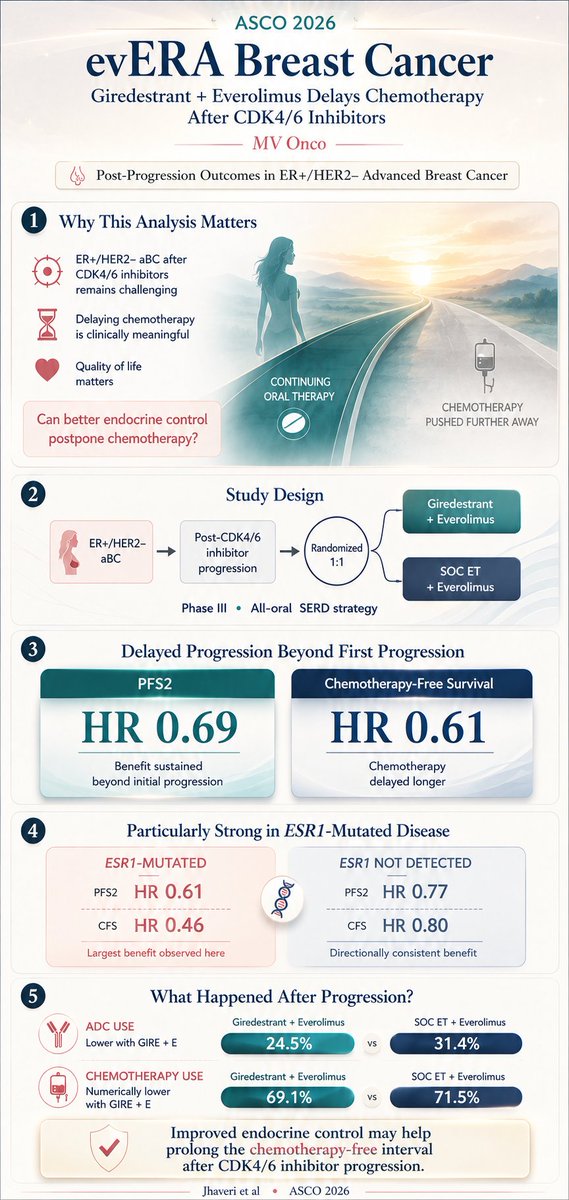
Exploratory post-progression analyses presented at ASCO 2026 by Komal L. Jhaveri, MD (MSK / Weill Cornell) showed longer PFS2 (time to second progression) and longer chemotherapy-free survival (CFS) with giredestrant + everolimus vs SoC ET + everolimus, with the greatest benefit in the ESR1-mutated population. PFS2 HR 0.69 (ITT) and 0.61 (ESR1-mut); CFS HR 0.61 (ITT) and 0.46 (ESR1-mut). These data support durability of benefit beyond the first progression.
OS data remain immature but show a clear positive trend in both populations: ITT HR 0.69 (95% CI 0.47–1.00, p=0.0473) and ESR1-mutated HR 0.62 (95% CI 0.38–1.02, p=0.0566) at the primary analysis. Follow-up for OS continues to the next analysis.
Response. ORR roughly doubled: 26.6% vs 13.8% in the ESR1-mutated population and 23.8% vs 11.7% in the ITT population. Duration of response was prolonged across subgroups (ESR1-mutated: ~15 vs ~7 months).
Subgroups. SABCS 2025 subgroup analyses (presented by Hope Rugo) showed PFS benefit maintained across clinical and genomic subgroups in the ITT and ESR1-mutated populations — including PI3K-pathway alterations (PIK3CA, AKT1, PTEN), visceral vs non-visceral disease, and prior endocrine-therapy duration. The magnitude was greatest in ESR1-mutated tumors, and the exploratory ESR1 wild-type PFS comparison was not significant (HR 0.84, 95% CI 0.59-1.18) — ORR and DoR, not PFS, are what improved in that subgroup.
PIK3CA footnote. PI3K-pathway co-alteration is common in this population and was not balanced between arms: PIK3CA mutations were present in 35.0% of the giredestrant arm vs 26.8% of the control arm (trial investigator Erica Mayer described the overall rate as “about 30% of patients.”) KOL commentary on this page cites a figure of 31% for the overall population; the per-arm split above is the reported breakdown. The imbalance is one reason KOLs have asked whether a biomarker-matched comparator would better define the regimen’s role in ESR1/PIK3CA co-mutant disease.
Giredestrant + everolimus was well tolerated with no new safety signals and no added toxicity beyond the everolimus backbone — adverse events were consistent with the known profiles of the individual medicines. Notably there was no photopsia — a class effect seen with some other oral SERDs. Pneumonitis events were low-grade and reversible, at incidence rates consistent with prior everolimus studies. The dominant tolerability issue is stomatitis from everolimus; the ESMO Breast Cancer 2026 safety/PRO update (Miguel Martin) showed that prophylactic dexamethasone mouth rinse (used by 62.5% of patients) reduced clinically significant stomatitis — grade 2: 14.4% with prophylaxis vs 21.1% without; grade 3: 1.8% vs 4.2%; no grade 4/5 — and delayed onset. AE-related discontinuation was low (5.3% giredestrant vs 8.2% control).
The central interpretive tension is biomarker selection. Erika Hamilton flagged it directly: "No benefit among those patients WITHOUT ESR1m. Although ITT was significant with high % of pts with ESR1m, benefit is NOT in all-comers." Hope Rugo — on the discussant side of the ESMO 2025 presentation by Erica Mayer — described "very nice data from EVERA combining giredestrant/everolimus vs SOC ET/everolimus with marked improvement in PFS and ORR in mESR1 and ITT," adding at SABCS 2025: "Note PFS in non-ESR1m subgroup similar. ORR better." Sarah Sammons summarized the topline: giredestrant + everolimus "doubled PFS vs SOC ET + everolimus … 10 mo vs 5.4 mo in ESR1-mut tumors." Virginia Kaklamani placed evERA next to EMBER-3: "Combo benefit similar to evera trial although here benefit regardless of esr1m. Would love to see the combo approved." Luca Recco noted the SABCS 2025 subgroup picture (consistent benefit, particularly in PI3K-pathway alterations), and Abi Siva flagged the practical PRO detail — dexamethasone mouth rinse for all patients.
On publication day (October 1, 2026) the same biomarker question dominated. Paolo Tarantino (Dana-Farber) framed the readout as practice-ready: “Giredestrant outperformed SoC ET when combined with everolimus in HR+/HER2- MBC, particularly in ESR1 mutant disease. Looking forward to having this highly active combo available in clinic.” Trial presenter Erica Mayer called it “Wonderful news for breast cancer patients and clinicians!” and Sara Tolaney (Chief, Breast Oncology, Dana-Farber) added: “Hoping we get approval for giredestrant + everolimus in the near future -- this would be wonderful for our patients with HR+ MBC!” Others pushed on the limits: Mustafa Özdoğan noted plainly that “OS remains immature, and the combination is not yet FDA-approved,” while Elvina Almuradova asked whether “a biomarker-matched comparator—such as alpelisib + fulvestrant—[would] better clarify its clinical role” given the PIK3CA co-mutation rate, and Phil Doc argued the wild-type result makes testing non-optional: “HR 0.84 in ESR1-wildtype tumors makes ctDNA-based ESR1 testing a prerequisite before using this combo, in my view.” Yakup Ergün revisited the “6-month PFS ceiling” framing from ESMO 2025 in light of the full publication.
⚠ evERA positions giredestrant + everolimus as an all-oral post-CDK4/6i option in ER+/HER2- advanced breast cancer, with the largest benefit in ESR1-mutated disease — sharpening the case for ESR1 testing at progression to guide sequencing. The contrast with persevERA (negative in the 1L AI-replacement setting) reinforces that the value of oral SERDs lies after endocrine resistance rather than as a frontline AI substitute. Comparisons against EMBER-3 (imlunestrant), SERENA-6 (camizestrant, ctDNA-guided), INAVO120 (inavolisib), and CAPItello-291 (capivasertib) frame how SERD- and PI3K/AKT-pathway strategies will be sequenced in this space.
evERA (NCT05306340) is a Phase 3, Roche/Genentech-sponsored randomized trial comparing the oral selective estrogen-receptor degrader (SERD) giredestrant plus everolimus against physician's-choice endocrine therapy plus everolimus in patients with ER-positive, HER2-negative advanced breast cancer previously treated with a CDK4/6 inhibitor. The trial was enriched for ESR1-mutated disease, with ESR1 status built into the co-primary analysis.
Both co-primary progression-free survival endpoints were met. In the ITT population, median PFS was 8.77 versus 5.49 months (hazard ratio 0.56, p<0.0001), and in the ESR1-mutated population it was 9.99 versus 5.45 months (hazard ratio 0.38). Overall survival was immature but showed a positive trend (ITT hazard ratio 0.69). The largest benefit was in ESR1-mutated disease.
Not yet. evERA is a positive Phase 3 trial, but the giredestrant-plus-everolimus regimen is investigational and awaiting an FDA decision, with a New Drug Application accepted and a PDUFA target date of December 18, 2026. Everolimus (Afinitor) is separately approved in HR-positive breast cancer; giredestrant remains investigational.
The combination was well tolerated with no new safety signals and no added toxicity beyond the known everolimus backbone - adverse events were consistent with the individual medicines. Notably, there was no photopsia (visual disturbance), a class effect seen with some other oral SERDs.
The largest and most robust benefit was in ESR1-mutated disease (hazard ratio 0.38), and In the exploratory ESR1 wild-type subgroup (81 vs 85 patients) median PFS was 5.72 versus 5.52 months with a hazard ratio of 0.84 (95% CI 0.59–1.18) — the confidence interval crosses 1, so there is no statistically significant PFS benefit in ESR1 wild-type disease, and trial investigator Erica Mayer described that subgroup as showing no difference in PFS between the two arms. KOLs including Erika Hamilton have flagged that the benefit is not clearly present in ESR1-wildtype patients despite a significant ITT result driven by a high proportion of ESR1-mutated patients. This sharpens the case for ESR1 testing at progression to guide sequencing - an interpretive debate featured on the page.