Shrinking sample sizes in lung
cancer trials: various
explanations, open questions.
Timothée Olivier
j
Alfredo Addeo
Published: January 06, 2024
DOI: https://doi.org/10.1016/j.ejca.2024.113527
6
LUNAR Phase 3 Study Design
Objective: To evaluate safety and efficacy of TTFields therapy with standard of care (SOC) compared to SOC alone
in metastatic NSCLC progressing on or after platinum-based therapy
TTFields therapy*
and SOC
Q6W follow-up
N=276
(Investigator's choice
until progression
Key eligibility criteria
3 post-
ICIt or docetaxel)
≥22 years of age
progression
Randomized
follow-up visits
Metastatic NSCLC
Survival
Progression on/after
Baseline
(1:1)
follow-up
platinum-based therapy
evaluation
ECOG PS 0-2
(incl. MRI)
Stratified by region,
SOC treatment, and
SOC
histology
Q6W follow-up
(Investigator's choice
until progression
ICIf or docetaxel)
Data cut-off: November 26, 2022
Study sites: 124 in 17 countries (North America, Europe, Asia)
*150 kHz; >18 h/day; pembrolizumab, nivolumab, or atezolizumab.
ECOG PS, Eastern Cooperative Oncology Group performance status; ICI, immune checkpoint inhibitor; MRI, magnetic resonance imaging; NSCLC, non-small cell lung cancer; Q6W, every 6 weeks;
SOC, standard of care; TTFields, Tumor Treating Fields.
2023
ASCO
#ASCO23
PRESENTED BY: Ticiana Leal, MD, Winship Cancer Institute Emory University
Scan for presentation slides
ASCO
AMERICAN SOCIETY OF
CLINICAL ONCOLOGY
ANNUAL MEETING
Presentation is property of the author and ASCO Permission required for reuse, contact permissions@asco.org
KNOWLEDGE CONQUERS CANCER
6
LUNAR Phase 3 Study Design
Objective: To evaluate safety and efficacy of TTFields therapy with standard of care (SOC) compared to SOC alone
in metastatic NSCLC progressing on or after platinum-based therapy
TTFields therapy*
and SOC
Q6W follow-up
Key eligibility criteria
N=276
(Investigator's choice
until progression
3 post-
ICIt or docetaxel)
progression
≥22 years of age
Randomized
follow-up visits
Metastatic NSCLC
Survival
Progression on/after
Baseline
(1:1)
follow-up
platinum-based therapy
evaluation
ECOG PS 0-2
(incl. MRI)
Stratified by region,
SOC treatment, and
SOC
histology
Q6W follow-up
(Investigator's choice
until progression
ICIf or docetaxel)
Data cut-off: November 26, 2022
Study sites: 124 in 17 countries (North America, Europe, Asia)
*150 kHz; z18 h/day; Tpembrolizumab, nivolumab, or atezolizumab.
ECOG PS, Eastern Cooperative Oncology Group performance status; ICI, immune checkpoint inhibitor; MRI, magnetic resonance imaging; NSCLC, non-small cell lung cancer; Q6W, every 6 weeks;
SOC, standard of care; TTFields, Tumor Treating Fields.
ASCO
PRE SENTED BY: Ticiana Leal, MD, Winship Cancer Institute - Emory University
2023
#ASCO23
Scan for presentation slides
ASCO
AMERICAN SOCIETY OF
CLINICAL ONCOLOGY
ANNUAL MEETING
Presentation is property of the author and ASCO Permission required for reuse; contact permissions@asco.org
KNOWLEDGE CONQUERS CANCER
3
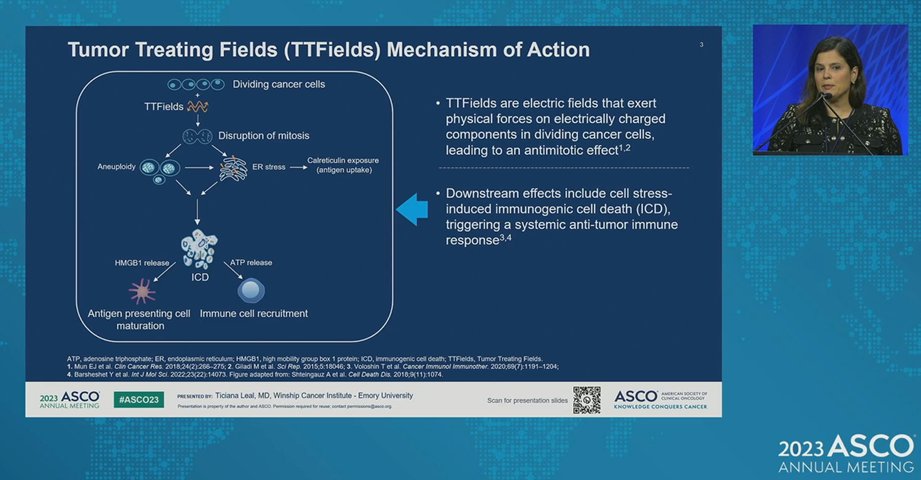
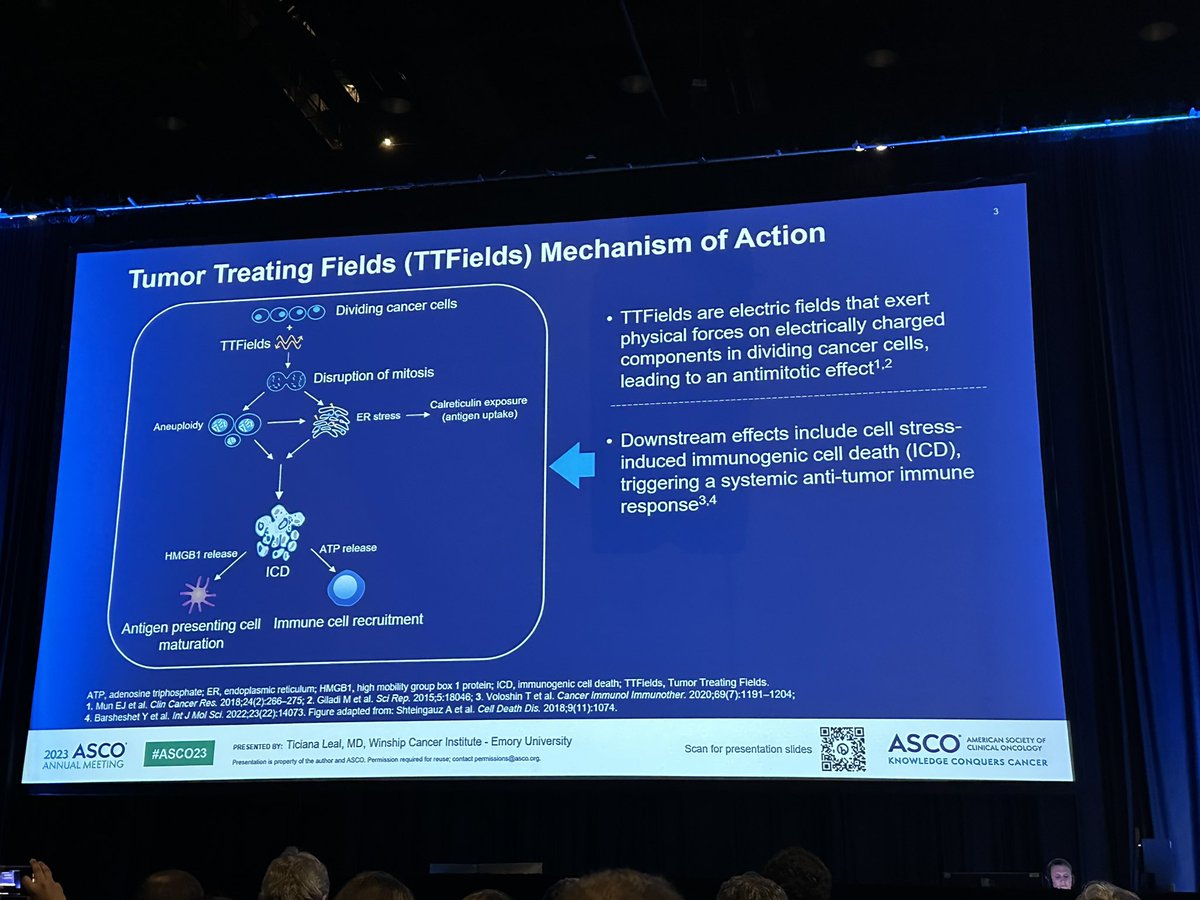
Tumor Treating Fields (TTFields) Mechanism of Action
Dividing cancer cells
TTFields
TTFields are electric fields that exert
physical forces on electrically charged
Disruption of mitosis
components in dividing cancer cells,
leading to an antimitotic effect1.2
Calreticulin exposure
Aneuploidy
ER stress
(antigen uptake)
Downstream effects include cell stress-
induced immunogenic cell death (ICD),
triggering a systemic anti-tumor immune
response³.⁴
HMGB1 release
ATP release
ICD
Antigen presenting cell Immune cell recruitment
maturation
ATP, adenosine triphosphate; ER, endoplasmic reticulum; HMGB1, high mobility group box 1 protein; ICD, immunogenic cell death; TTFields, Tumor Treating Fields.
1. Mun EJ et al. Clin Cancer Res. 2018;24(2):266-275;2 2. Giladi M et al. Scl Rep. 2015;5:18046; 3. Voloshin T et al. Cancer Immunol Immunother. 2020;69(7):1191-1204;
4. Barsheshet Y et al. Int J Mol Scl. 2022;23(22):14073. Figure adapted from: Shteingauz A et al. Cell Death Dis. 2018;9(11):1074.
2023 ASCO
PHL SENTED BY: Ticiana Leal, MD, Winship Cancer Institute Emory University
#ASCO23
ASCO
AMERICAN SOCIETY OF
Scan for presentation slides
CLINICAL ONCOLOGY
ANNUAL MEETING
Presentation property of the author and ASCO Permission required for reuse, contact permissions@asco.org
KNOWLEDGE CONQUERS CANCER
Tumor Treating Fields (TTFields) Mechanism of Action
Dividing cancer cells
TTFields
TTFields are electric fields that exert
physical forces on electrically charged
Disruption of mitosis
components in dividing cancer cells,
leading to an antimitotic effect1.2
Calreticulin exposure
Aneuploidy
ER stress
(antigen uptake)
Downstream effects include cell stress-
induced immunogenic cell death (ICD),
triggering a systemic anti-tumor immune
response³.⁴
HMGB1 release
ATP release
ICD
Antigen presenting cell Immune cell recruitment
maturation
ATP. adenosine triphosphate; ER, endoplasmic reticulum; HMGB1, high mobility group box 1 protein; ICD, immunogenic cell death; TTFields, Tumor Treating Fields
1. Mun et al. Can Cancer Res 2018,24(2)206-275; 2. Giladi Met al. Sci Rep. 2015,5:18046; 3. Voloshin T et al. Cancer Immunol Immunother. 2020;69(7): 1191-1204;
4. Barsheshet Y et al. Int / Mol Sci. 2022;23(22);14073. Figure adapted from: Shteingauz A et at Cell Death Dis. 2018,9(11):1074.
2023 ASCO
#ASCO23
PRESENTED RY Ticiana Leal, MD, Winship Cancer Institute Emory University
Scan for presentation slides
ASCO
ANNUAL MEE TING
I
who
and
A00
Permission
-
-
contact
KNOWLEDGE CONQUERS CANCER
2023 ASC
-
The 3 Lung Studies that I am Waiting for
at #ASCO23
KEYNOTE-671
June 3
L
8am- 9:30am
Hall D1
LeiDeng3
Context:
Neoadjuvant
Adjuvant
pCR
1-Yr EFS
No Surgery
CM816
Nivo + Chemo X 3 cycles
No mandatory Nivo
24.0%
76.1%
16.8%
AEGEAN
Durva + Chemo X 4 cycles
Durva X 12 cycles
17.2%
73.4%
19.4%
Study design: Neoadj Pembro (or Placebo) + Chemo X 4 cycles
Surgery
Adj Pembro
(Placebo) X 13 cycles among stage II, IIIA, IIIB(T3-4N2)
What to look for: 1) Proportion not going to surgery; 2) pCR & 1-year PFS rate in relevant to
CM816 & AEGEAN
ADAURA
June 4
0
1pm 4pm
Hall B1
Context:
Adj Osi X 3 years approved for resected NSCLC based on DFS benefit;
OS benefit is unknown
Study design: Adj Osi (or placebo) X 3 years for resected stage IB-IIIA(7th ed) EGFR mutants
w/ or w/o prior adj chemo
What to look for: 1) Proportion of Osi in placebo arm after recurrence; 2) OS gap magnitude
and closure after 3 years? 3) Subgroup w/o adj chemo
LUNAR
June 6
3
9:45am- 12:45am
Hall D1
Context:
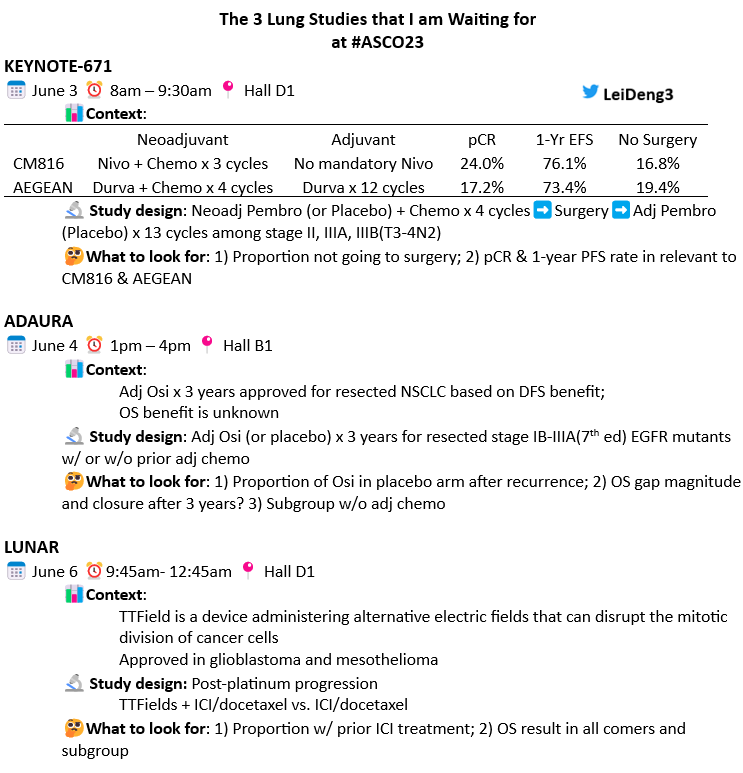
TTField is a device administering alternative electric fields that can disrupt the mitotic
division of cancer cells
Approved in glioblastoma and mesothelioma
Study design: Post-platinum progression
TTFields + ICI/docetaxel VS. ICI/docetaxel
What to look for: 1) Proportion w/ prior ICI treatment; 2) OS result in all comers and
subgroup
Tumor Treating Fields (TTFields) Mechanism of Action
3
Dividing cancer cells
TTFields
TTFields are electric fields that exert
physical forces on electrically charged
Disruption of mitosis
components in dividing cancer cells,
leading to an antimitotic effect1.2
Calreticulin exposure
Aneuploidy
ER stress
(antigen uptake)
Downstream effects include cell stress-
induced immunogenic cell death (ICD),
triggering a systemic anti-tumor immune
response³.⁴
HMGB1 release
ATP release
ICD
Antigen presenting cell Immune cell recruitment
maturation
ATP, adenosine triphosphate; ER, endoplasmic reticulum; HMGB1, high mobility group box 1 protein; ICD, immunogenic cell death; TTFields, Tumor Treating Fields.
1. Mun EJ et al. Clin Cancer Res. 2018;24(2):266-275; 2. Giladi M et al. Sci Rep. 2015;5:18046; 3. Voloshin T et al. Cancer Immunol Immunother. 2020;69(7):1191-1204;
4. Barsheshet Y et al. Int J Mol Sci. 2022;23(22):14073. Figure adapted from: Shteingauz A et al. Cell Death Dis. 2018;9(11):1074.
DATE
ASCO
PRE SENTED BY: Ticiana Leal, MD, Winship Cancer Institute Emory University
2023
#ASCO23
Scan for presentation slides
ASCO
AMERICAN SOCIETY OF
CLINICAL ONCOLOGY
ANNUAL MEETING
Presentation a property of the author and ASCO. Permission required for reuse, contact permissions@asco.org
KNOWLEDGE CONQUERS CANCER
LUNAR is a Phase III, randomized, open-label trial (NCT02973789) that evaluated Tumor Treating Fields (TTFields) therapy delivered by the NovoTTF-200T device in combination with standard systemic therapies for patients with metastatic non-small cell lung cancer (NSCLC) that progressed during or after platinum-based therapy. The trial randomized 276 patients across sites in North America, Western Europe, Eastern Europe, and East Asia. LUNAR is the first Phase III trial in more than seven years to demonstrate a statistically significant improvement in overall survival in metastatic NSCLC post-platinum therapy.
FDA APPROVED Optune Lua (TTFields, NovoTTF-200T) — In combination with docetaxel or PD-L1 inhibitors for patients with metastatic NSCLC that has progressed during or following platinum-based therapy
In October 2024, the FDA approved Tumor Treating Fields (TTFields; Optune Lua) for metastatic NSCLC post-platinum therapy based on the Phase III LUNAR trial. This is the first non-pharmacological therapy approved for metastatic NSCLC and the third cancer indication for TTFields (after glioblastoma and mesothelioma).
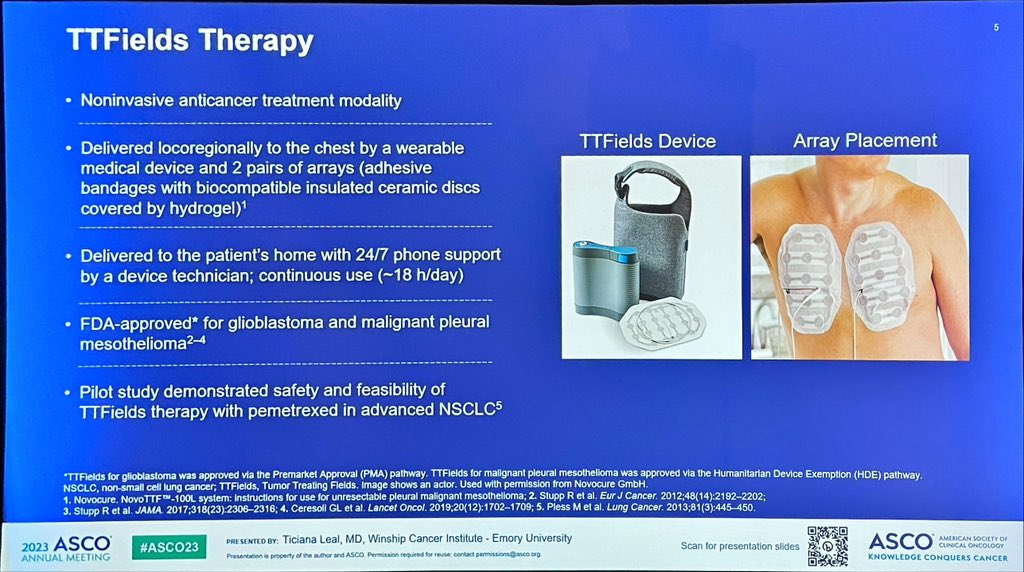
Phase III, randomized (1:1), open-label, pivotal trial. Patients received TTFields (150 kHz delivered continuously via thoracic arrays) plus physician's choice of immune checkpoint inhibitor (nivolumab or pembrolizumab) or docetaxel, versus ICI or docetaxel alone.
Population
Adults with metastatic NSCLC (stage IV) whose disease progressed during or after platinum-based chemotherapy, with ECOG performance status 0-2 and radiologically evaluable thoracic disease. 276 patients enrolled: 137 TTFields + SOC, 139 SOC alone. Median age 64 years, 65% male.
Interventions
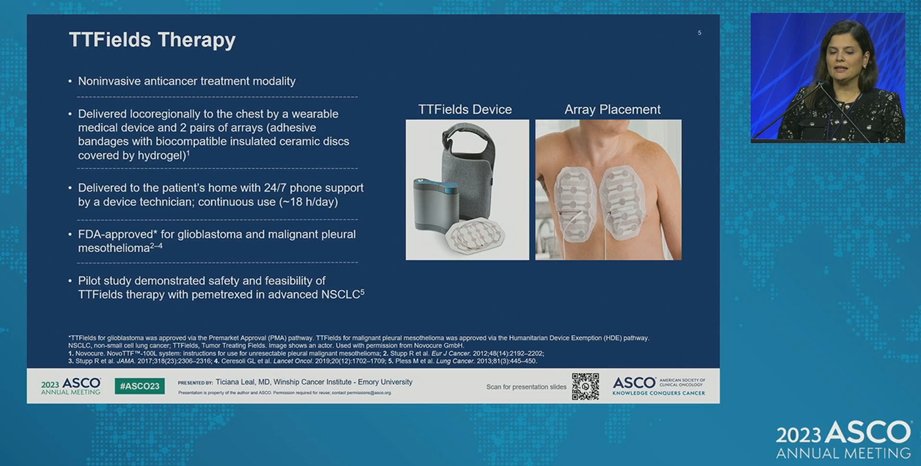
Continuous TTFields therapy at 150 kHz delivered via the NovoTTF-200T device (arrays worn on chest/back at least 18 hours/day) combined with either an immune checkpoint inhibitor or docetaxel, versus ICI or docetaxel alone.
Primary Endpoints
Primary endpoint: overall survival (OS). Key secondary endpoints: OS in ICI subgroup, OS in docetaxel subgroup, progression-free survival (PFS), adverse events.
Progression-Free Survival (PFS)
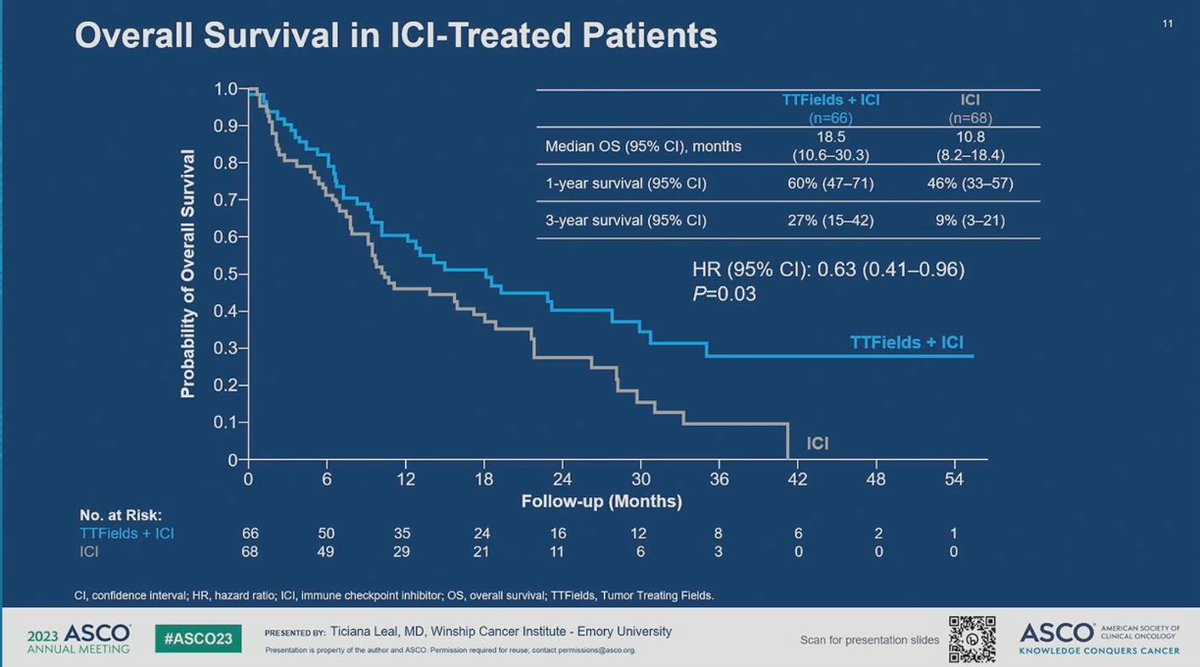
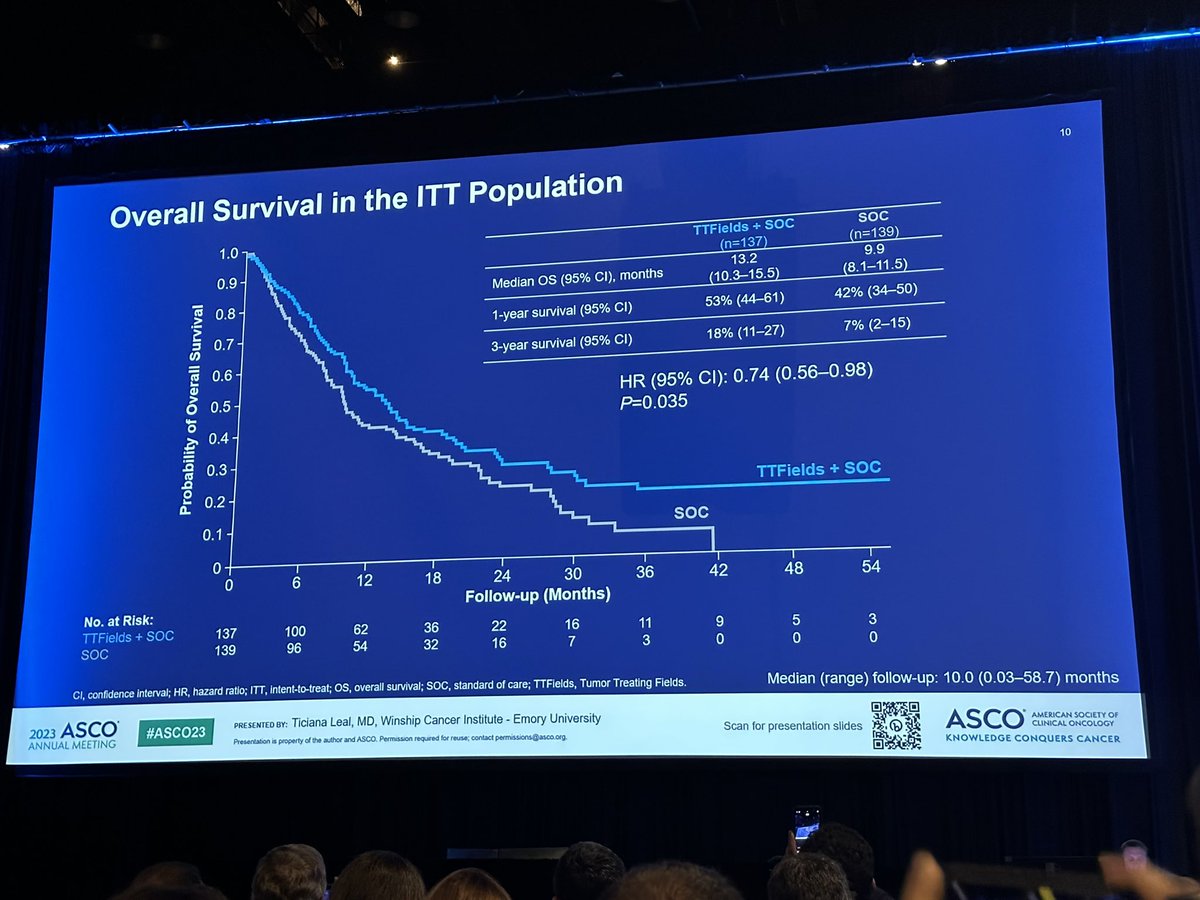
TTFields combined with standard therapies demonstrated a statistically significant OS improvement with median OS of 13.2 months versus 9.9 months for SOC alone (HR 0.74; p=0.035). In the ICI subgroup, TTFields + ICI achieved median OS of 18.5 months versus 10.8 months for ICI alone (HR 0.63; p=0.03). The 1-year OS rate was 53% versus 42%, and the 3-year OS rate was 18% versus 7% (p=0.015).
The overall survival benefit was driven primarily by the ICI subgroup, where TTFields provided an unprecedented 8-month improvement in median OS (18.5 vs 10.8 months). The docetaxel subgroup showed a positive trend (median OS 11.1 vs 8.7 months) but did not reach statistical significance individually. The FDA approved TTFields (Optune Lua) for metastatic NSCLC in October 2024 based on these results.
TTFields therapy was well-tolerated with no added systemic toxicities. Device-related adverse events occurred in 71% of patients, predominantly grade 1-2 local skin irritation including dermatitis (39%), pruritus (12%), rash (9%), and skin ulcer (8%). Few grade 3 device-related AEs were reported, with no grade 4 or 5 device-related events. 14% of patients in the TTFields arm discontinued due to device-related toxicity.
LUNAR established TTFields as the first non-systemic therapy to improve OS in metastatic NSCLC post-platinum. The pronounced benefit in the ICI subgroup (HR 0.63) has generated significant interest in combining TTFields with immunotherapy, leading to the LUNAR-2 trial evaluating TTFields with first-line pembrolizumab + chemotherapy. Critics have raised concerns about the open-label design (no sham control), the modest PFS benefit (4.8 vs 4.1 months), compliance burden of wearing the device 18+ hours/day, and the cost of TTFields therapy.