KOL Pulse - Trial Profile

PERSEUS Trial

TE-NDMM D-VRd - Janssen

TE-NDMM D-VRd Darzalex Faspro + VRd ASH 2023 FDA Approved
Explore Trial Data

Top KOLs Discussing PERSEUS

NEJM
NEJM
@NEJM
67.7K impressions
Saad Z. Usmani MD MBA FACP
@szusmani
66.0K impressions
Eddie Cliff
Eddie Cliff
@Eddie_Cliff
31.2K impressions
Vincent Rajkumar
Vincent Rajkumar
@VincentRK
30.0K impressions
Raj Chakraborty
Raj Chakraborty
@rajshekharucms
20.0K impressions
Samer Al Hadidi, MD,MS,FACP
@HadidiSamer
13.5K impressions

PERSEUS Key Slides & Visuals

Official trial slides and relevant visuals shared by KOLs at ASH 2023. Click any image to expand.

Eddie Cliff
Eddie Cliff @Eddie_Cliff
PERSEUS Data
31.2K impressions · 68 likes · Nov 21, 2023
View on X ↗
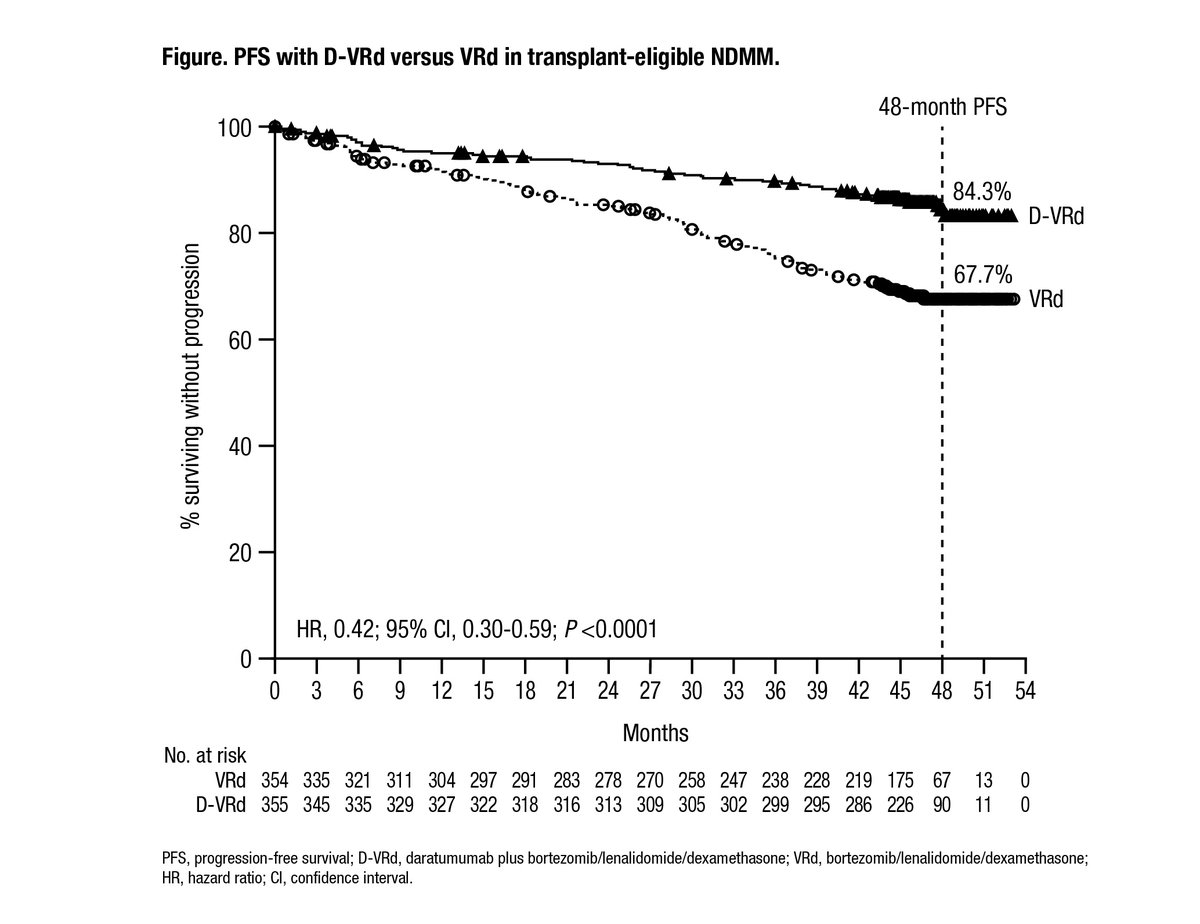
[Slide 1] Figure. PFS with D-VRd versus VRd in transplant-eligible NDMM. 48-month PFS 100 84.3% D-VRd 80 67.7% VRd % surviving without progression 60 40 20 HR, 0.42; 95% CI, 0.30-0.59; P <0.0001 0 0 3 6 9 12 15 18 21 24 27 30 33 36 39 42 45 48 51 54 Months No. at risk VRd 354 335 321 311 304 297 291 283 278 270 258 247 238 228 219 175 67 13 0 D-VRd 355 345 335 329 327 322 318 316 313 309 305 302 299 295 286 226 90 11 0 PFS, progression-free survival; D-VRd, daratumumab plus bortezomib/lenalidomide/dexamethasone; VRd, bortezomib/lenalidomide/dexamethasone; HR, hazard ratio; CI, confidence interval.
Vincent Rajkumar
Vincent Rajkumar @VincentRK
PERSEUS Data
18.7K impressions · 165 likes · Sep 14, 2024
View on X ↗
[Slide 1] Newly Diagnosed Transplant Eligible Standard Risk High Risk Dara-VRd or Isa-VRd X 3-4 cycles Dara-VRd or Isa-VRd X 3-4 cycles Cryopreserve stem cells Early ASCT and continue induction X 5- Early ASCT 8 cycles Lenalidomide maintenance Lenalidomide maintenance Bortezomib plus Lenalidomide maintenance Rajkumar SV c AJH 2024 Newly Diagnosed Transplant Ineligible Standard Risk High Risk Frail Not Frail Frail Not Frail VRd X 8-12 cycles Dara-VRd or Isa- VRd X 8-12 cycles Dara-VRd or Isa- and lenalidomide VRd 8-12 cycles and lenalidomide VRd 8-12 cycles maintenance, or and lenalidomide plus bortezomib and lenalidomide maintenance maintenance plus bortezomib DRd maintenance Rajkumar SV © AJH 2024
Mohamad Mohty
Mohamad Mohty @Mohty_EBMT
PERSEUS Data
8.6K impressions · 56 likes · Nov 22, 2023
View on X ↗
[Slide 1] Figure. PFS with D-VRd versus VRd in transplant-eligible NDMM. 48-month PFS 100 () 84.3% D-VRd 80 67.7% VRd % surviving without progression 60 40 20 HR, 0.42; 95% CI, 0.30-0.59; P<0.0001 0 0 3 6 9 12 15 18 21 24 27 30 33 36 39 42 45 48 51 54 Months No. at risk VRd 354 335 321 311 304 297 291 283 278 270 258 247 238 228 219 175 67 13 0 D-VRd 355 345 335 329 327 322 318 316 313 309 305 302 299 295 286 226 90 11 0 PFS, progression-free survival; D-VRd, daratumumab plus bortezomib/lenalidomide/dexamethasone; VRd, bortezomib/lenalidomide/dexamethasone; HR, hazard ratio; CI, confidence interval.
Raj Chakraborty
Raj Chakraborty @rajshekharucms
PERSEUS Data
8.0K impressions · 38 likes · Dec 12, 2023
View on X ↗
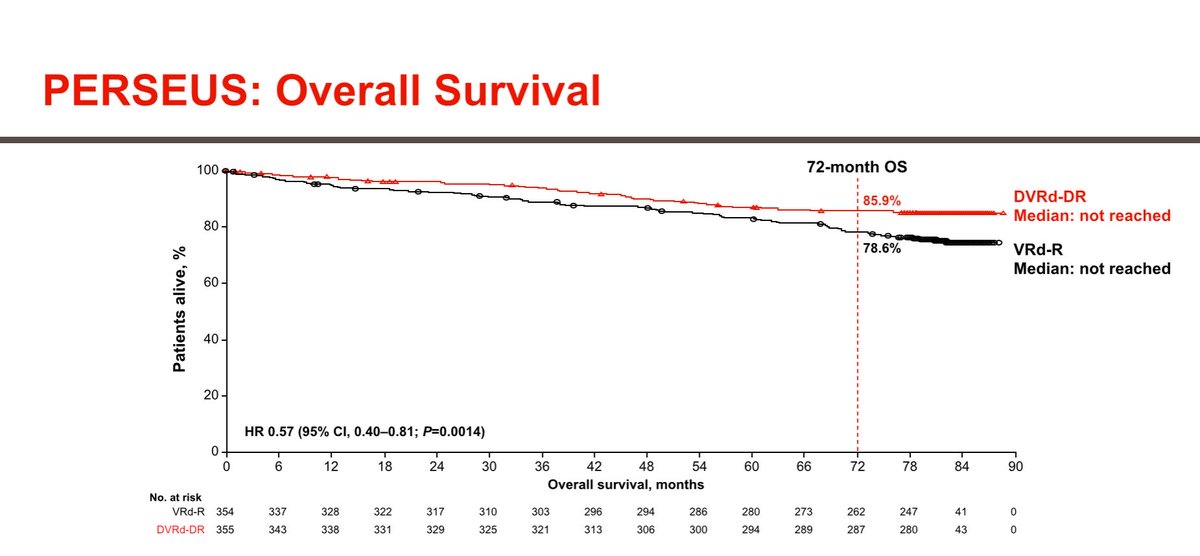
[Slide 1] LIVE PERSEUS: Patient Dispositiona Median follow-up: 47.5 months D-VRd VRd 100 89.5% 89.7% 91.7% (n 351) (n 347) 90 86.2% 87.0% 86.5% Patients who discontinued study treatment, n (%) 91 (25.9) 188 (54.2) 80 Reason for discontinuation, n (%) 70 32 (9.1) 78 (22.5) % of patients 60 Adverse event 50 Progressive disease 29 (8.3) 72 (20.7) 40 Patient refused further study treatment 10 (2.8) 14 (4.0) 30 Death 9 (2.6) 11 (3.2) 20 Physician decision 8 (2.3) 9 (2.6) 10 Lost to follow-up 3 (0.9) 2 (0.6) 0 0 1 (0.3) Completed Received Entered Non-compliance with study drug induction + ASCT maintenance Other 0 1 (0.3) consolidation D-VRd VRd Among patients receiving maintenance (D-VRd, n = 322; VRd, n = 300), 81 (25.2%) patients in the D-VRd group and 58 (19.3%) patients in the VRd group discontinued lenalidomide during maintenance in the safety population which included all patients who received 21 dose of study treatment 5 Presented by P Sonneveld at the 65th American Society of Hematology (ASH) Annual Meeting December 5-12.2023 San Diego, CA, USA 65th ASH® Annual Meeting and Exposition --- [Slide 2] LIVE PERSEUS: Overall Survival 100 D-VRd VRd 80 surviving % 60 40 D-VRd VRd 20 (n 355) (n 354) HR, 0.73 Events, n (%) 34 (9.6) 44 (12.4) 0 0 3 6 9 12 15 18 21 24 27 30 33 36 39 42 45 48 51 54 57 Months No. at risk VRd 354 343 337 334 328 322 322 319 317 315 310 307 303 298 296 263 127 27 1 0 D-VRd 355 347 343 341 338 335 331 329 329 326 325 323 321 316 312 284 135 21 1 0 os data trend favorably for D-VRd 12 Presented by P Sonneveld at the 65th American Society of Hematology (ASH) Annual Meeting: December 5-12.2023 San Diego CA, USA 65th ASH® Annual Meeting and Exposition
Raj Chakraborty
Raj Chakraborty @rajshekharucms
PERSEUS Data
7.8K impressions · 38 likes · Dec 12, 2023
View on X ↗
Ben Derman
Ben Derman @bdermanmd
PERSEUS Data
7.6K impressions · 53 likes · Jun 03, 2024
View on X ↗
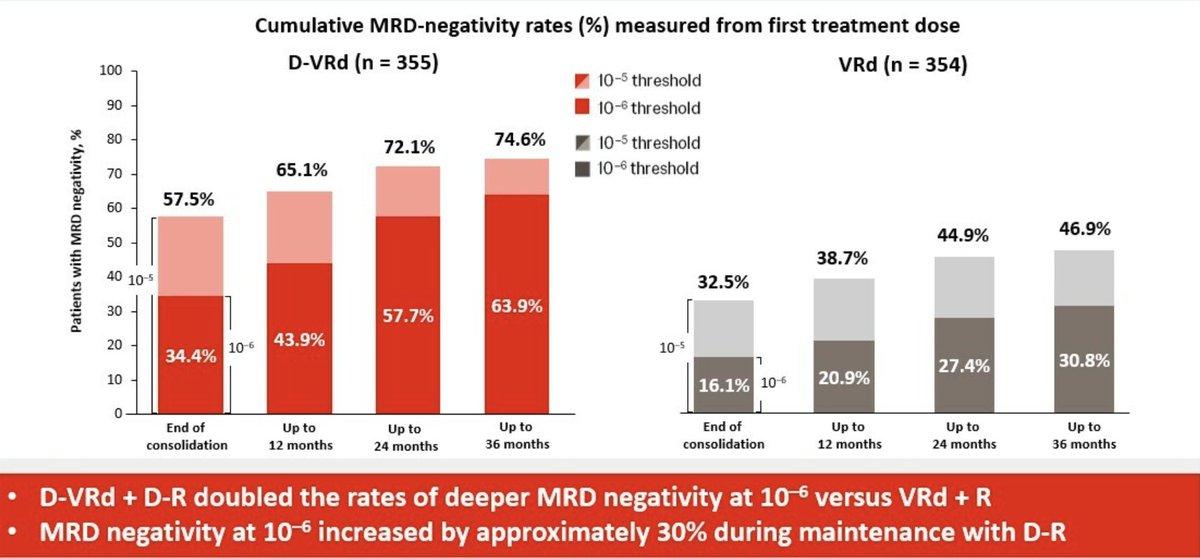
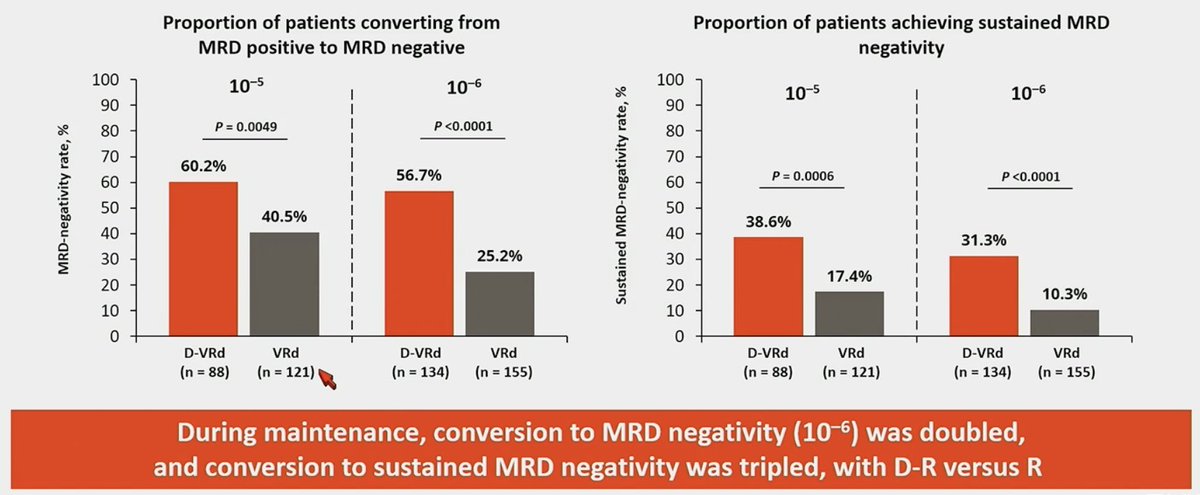
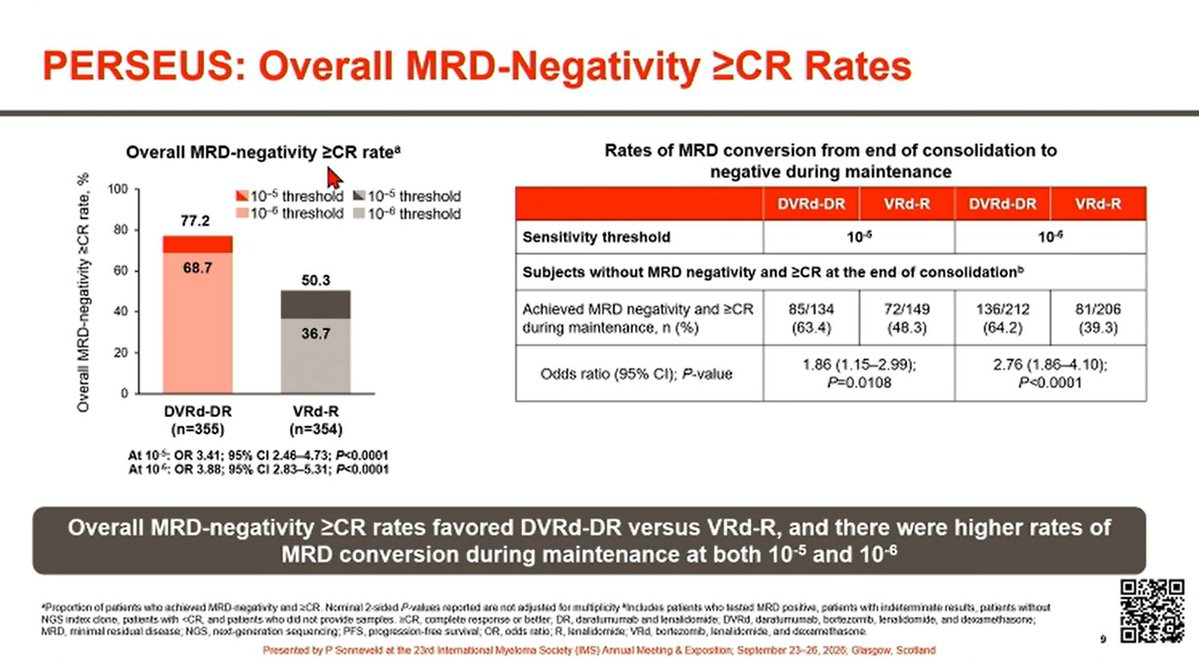
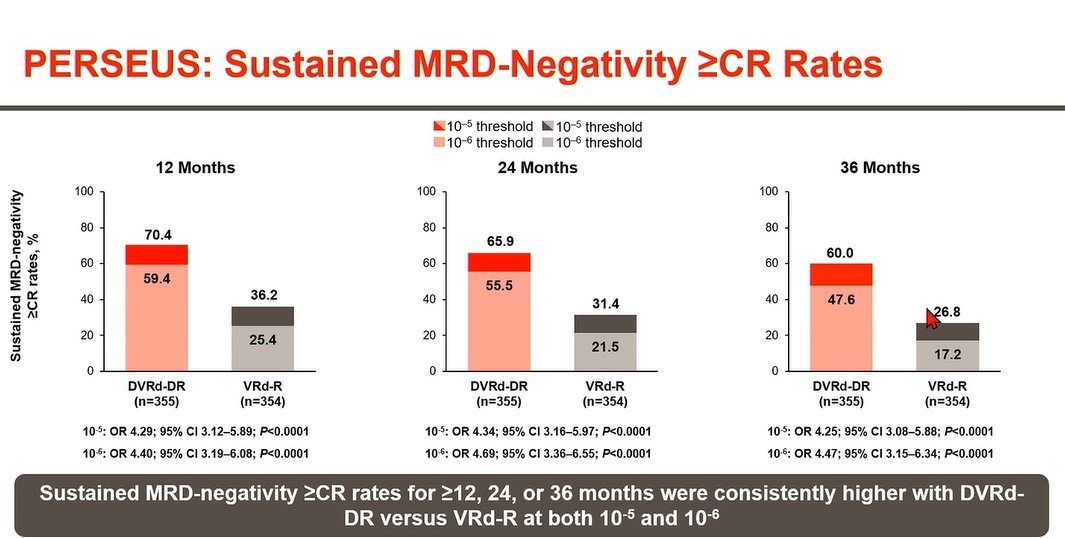
[Slide 1] Cumulative MRD-negativity rates (%) measured from first treatment dose 100 D-VRd (n = 355) VRd (n = 354) 10⁻⁵ threshold 90 10⁻⁶ threshold 80 72.1% 74.6% 10⁻⁵ threshold 70 10⁻⁶ threshold Patients with MRD negativity, % 65.1% 57.5% 60 50 44.9% 46.9% 38.7% 40 10⁻⁵ 32.5% 30 63.9% 57.7% 20 10⁻⁶ 43.9% 10⁻⁵ 34.4% 1 27.4% 30.8% 10 16.1% 10⁻⁶ 20.9% 0 End of Up to Up to Up to End of Up to Up to Up to consolidation 12 months 24 months 36 months consolidation 12 months 24 months 36 months D-VRd + D-R doubled the rates of deeper MRD negativity at 10⁻⁶ versus VRd + R MRD negativity at 10⁻⁶ increased by approximately 30% during maintenance with D-R --- [Slide 2] Proportion of patients converting from Proportion of patients achieving sustained MRD MRD positive to MRD negative negativity 100 10⁻⁵ 10⁻⁶ 100 10⁻⁵ 10⁻⁶ 90 90 80 P = 0.0049 P <0.0001 80 MRD-negativity rate, % 70 60.2% 60 56.7% 40.5% Sustained MRD-negativity rate, % 70 60 P = 0.0006 P <0.0001 50 50 38.6% 40 40 31.3% 30 25.2% 30 17.4% 20 20 10.3% 10 10 0 0 D-VRd VRd D-VRd VRd D-VRd VRd D-VRd VRd (n=88) (n = 121) (n = 134) (n = 155) (n=88) (n = 121) (n = 134) (n = 155) During maintenance, conversion to MRD negativity (10⁻⁶) was doubled, and conversion to sustained MRD negativity was tripled, with D-R versus R --- [Slide 3] PFS according to MRD status (10⁻⁶) Overall MRD negativity (10⁻⁶) 100 D-VRd: MRD neg 100 90 80 VRd: MRD neg MRD pos % surviving without progression 80 34.9% 60 D-VRd: MRD pos 70 MRD pos VRd: MRD pos 67.8% 40 % Patients, 60 50 20 40 MRD neg 30 65.1% 0 20 MRD neg 0 3 6 9 12 15 18 21 24 27 30 33 36 39 42 45 48 51 54 32.2% Months 10 No. at risk VRd: MRD neg 114 114 114 114 114 112 111 108 107 104 103 102 101 101 98 87 34 9 0 0 D-VRd: MRD neg 231 231 230 230 230 226 226 225 223 222 221 221 219 216 210 169 70 10 0 D-VRd VRd VRd: MRD pos 240 221 207 197 190 185 180 175 171 166 155 145 137 127 121 88 33 4 0 (n = 355) (n 354) D-VRd: MRD pos 124 114 105 99 97 96 92 91 90 87 84 81 80 79 76 57 20 1 0 MRD negativity at 10⁻⁶ was associated with improved long-term outcomes Twice as many patients achieved MRD negativity at 10⁻⁶ with D-VRd + D-R versus VRd + R Patients remaining MRD positive had improved PFS with D-R maintenance versus R alone
Vincent Rajkumar
Vincent Rajkumar @VincentRK
PERSEUS Data
4.7K impressions · 71 likes · Jun 10, 2025
View on X ↗
Samer Al Hadidi, MD,MS,FACP
PERSEUS Data
4.6K impressions · 3 likes · Dec 12, 2023
View on X ↗
[Slide 1] AMERICANT The NEW ENGLAND JOURNAL of MEDICINE ORIGINAL ARTICLE Daratumumab, Bortezomib, Lenalidomide, and Dexamethasone for Multiple Myeloma P. Sonneveld, M.A. Dimopoulos, M. Boccadoro, H. Quach, P.J. Ho, M. Beksac, C. Hulin, E. Antonioli, X. Leleu, S. Mangiacavalli, A. Perrot, M. Cavo, A. Belotti, A. Broijl, F. Gay, R. Mina, I.S. Nijhof, N.W.C.J. van de Donk, E. Katodritou, F. Schjesvold, A. Sureda Balari, L. Rosiñol, M. Delforge, W. Roeloffzen, T. Silzle, A. Vangsted, H. Einsele, A. Spencer, R. Hajek, A. Jurczyszyn, S. Lonergan, T. Ahmadi, Y. Liu, J. Wang, D. Vieyra, E.M.J. van Brummelen, V. Vanquickelberghe, A. Sitthi-Amorn, C.J. de Boer, R. Carson, P. Rodriguez-Otero,J. Bladé, and P. Moreau, for the PERSEUS Trial Investigators*

PERSEUS Top Tweets

Top 10 by impressions - click to view on X

NEJM
NEJM@NEJM

Late breaking at #ASH23: The addition of subcutaneous daratumumab to bortezomib, lenalidomide, and dexamethasone therapy and lenalidomide maintenance therapy had a significant...

👁 67.7K ♡ 298 ↻ 105 Dec 12, 2023
Eddie Cliff
Eddie Cliff@Eddie_Cliff

#ASH23 Late Breaking Abstract 1 PERSEUS Newly-Diagnosed Myeloma RCT 709 patients Dara-VRd vs VRd - 48-month PFS rates 84.3% vs 67.7%, HR 0.42, p&lt;0.001 - OS: D-VRd 34 deaths...

👁 31.2K ♡ 68 ↻ 28 Nov 21, 2023
Saad Z. Usmani MD MBA FACP
Saad Z. Usmani MD MBA FACP@szusmani

As promised, here is my best of #mmsm #ASH23 picks. *Clinical Abstracts* Validation of GRIFFIN trial by Phase III Perseus Trial in transplant eligible NDMM:...

👁 28.7K ♡ 106 ↻ 29 Nov 25, 2023
Saad Z. Usmani MD MBA FACP
Saad Z. Usmani MD MBA FACP@szusmani

As promised, here is my best of #mmsm #ASH23 picks. *Clinical Abstracts* Validation of GRIFFIN trial by Phase III Perseus Trial in transplant eligible NDMM:...

👁 28.7K ♡ 107 ↻ 30 Nov 25, 2023
Vincent Rajkumar
Vincent Rajkumar@VincentRK

Thanks @Dr_AmerZeidan for inviting me to present on current treatment of myeloma at the New England Hematologic Malignancies Symposium. A simplified algorithm of frontline therapy today....

👁 18.7K ♡ 165 ↻ 46 Sep 14, 2024
Mohamad Mohty
Mohamad Mohty@Mohty_EBMT

Summary of the PERSEUS trial to be presented at #ASH23 These results further support the use of this regimen. (LBA-1 Phase 3 Randomized Study of DARA+VRd Vs Vrd Alone in Pts with...

👁 8.6K ♡ 56 ↻ 27 Nov 22, 2023
Raj Chakraborty
Raj Chakraborty@rajshekharucms

PERSEUS➡️Important to note that NO signal for increased early mortality from toxicity with Dara-VRd compared to VRd. OS curves trending in the right direction (similar to CASSIOPEIA)! These data...

👁 8.0K ♡ 38 ↻ 18 Dec 12, 2023
Raj Chakraborty
Raj Chakraborty@rajshekharucms

PERSEUS➡️Important to note that NO signal for increased early mortality from toxicity with Dara-VRd compared to VRd. OS curves trending in the right direction (similar to CASSIOPEIA)! These data...

👁 7.8K ♡ 38 ↻ 18 Dec 12, 2023
Al-Ola A Abdallah MD (USMIRC)
Al-Ola A Abdallah MD (USMIRC)@Abdallah81MD

🚨New update of our New algorithm ; How I treat Newly diagnosed Myeloma: If Fit/Transplant Eligible (Both High &amp; Standard Risk): Dara/RVD x 4 cycles followed by Mel/ASCT followed by...

👁 7.7K ♡ 38 ↻ 9 Apr 25, 2024
Ben Derman
Ben Derman@bdermanmd

PERSEUS MRD Data: Maintenance upgraded MRD(-) responses up to 2-3 years later, and appears to be more profound with Dara-R maintenance. Dara-VRd/Dara-R doubled chances of reaching MRD negativity...

👁 7.6K ♡ 53 ↻ 11 Jun 03, 2024

About the PERSEUS Trial

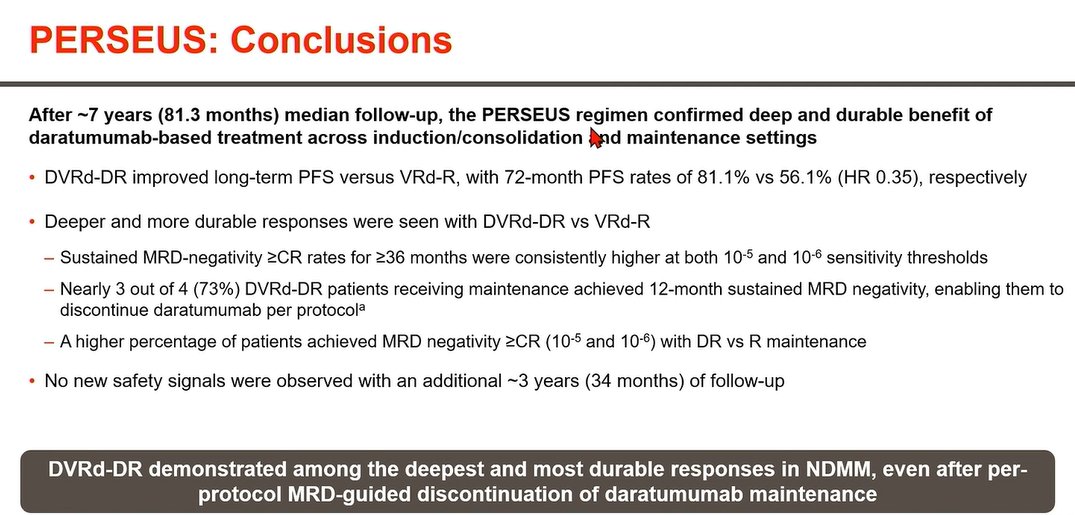
PERSEUS is a landmark Phase III, open-label, randomized trial that established subcutaneous daratumumab (Darzalex Faspro) plus bortezomib, lenalidomide, and dexamethasone (D-VRd) as a new standard of care for transplant-eligible patients with newly diagnosed multiple myeloma. The trial randomized 709 patients across 14 countries in Europe and Australia to D-VRd induction/consolidation followed by daratumumab-lenalidomide (D-R) maintenance versus VRd induction/consolidation followed by lenalidomide (R) maintenance alone. PERSEUS is the first Phase III trial to demonstrate that adding subcutaneous daratumumab to VRd with MRD-guided maintenance confers an unprecedented PFS benefit in transplant-eligible NDMM.

FDA Approval

FDA APPROVED Darzalex Faspro (daratumumab and hyaluronidase-fihj) — In combination with bortezomib, lenalidomide, and dexamethasone for induction and consolidation in patients with newly diagnosed multiple myeloma who are eligible for autologous stem cell transplant (ASCT)

On July 30, 2024, the FDA approved Darzalex Faspro in combination with VRd for transplant-eligible NDMM based on PERSEUS results demonstrating a 60% reduction in the risk of disease progression or death. The recommended dose is 1,800 mg/30,000 units subcutaneously. This expanded the approved indications for Darzalex Faspro in newly diagnosed myeloma alongside its existing approvals with VTd (CASSIOPEIA) and VMP (ALCYONE).

Source: FDA Press Release

Trial Methodology & Results

Study Design

Phase III, multicenter, international, open-label, 1:1 randomized, active-controlled trial (NCT03710603; EMN-17) in transplant-eligible patients with NDMM ages 18-70. Patients were stratified by ISS stage and cytogenetic risk. MRD was assessed using the clonoSEQ NGS assay (Adaptive Biotechnologies) at 10^-5 and 10^-6 sensitivity thresholds.

Population

Adults aged 18-70 with newly diagnosed multiple myeloma eligible for autologous stem cell transplant (ASCT), with ECOG performance status 0-2. A total of 709 patients were randomized (D-VRd n=355; VRd n=354). 14.8% had ISS stage III disease and 21.7% had high cytogenetic risk (t[4;14], t[14;16], or del[17p]).

Interventions

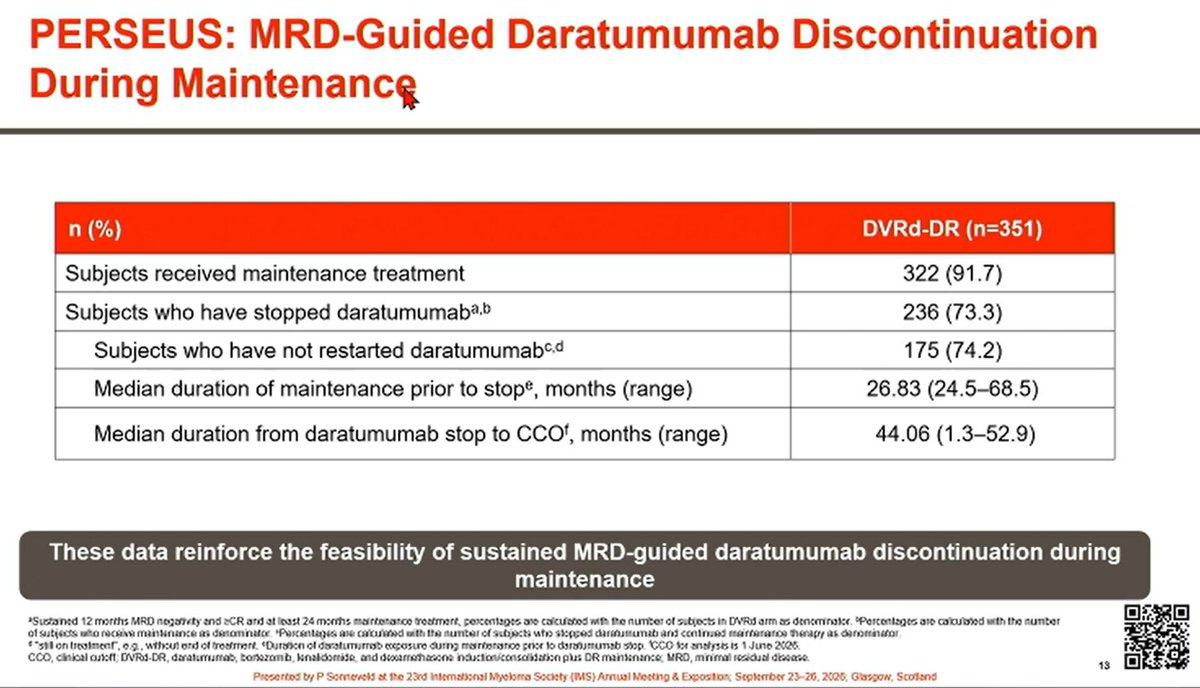
Experimental arm: 4 cycles D-VRd induction (SC daratumumab 1800 mg weekly cycles 1-2, Q2W cycles 3-4, plus VRd), single ASCT, 2 cycles D-VRd consolidation, then D-R maintenance (daratumumab Q4W + lenalidomide 10 mg) for minimum 2 years with MRD-guided daratumumab stopping. Control arm: 4 cycles VRd induction, single ASCT, 2 cycles VRd consolidation, then lenalidomide maintenance until progression.

Primary Endpoints

Primary endpoint: progression-free survival (PFS) assessed by IRC per IMWG criteria. Key secondary endpoints: overall complete response or better rate, overall MRD-negativity rate (10^-5 threshold), and overall survival (OS).

Progression-Free Survival (PFS)

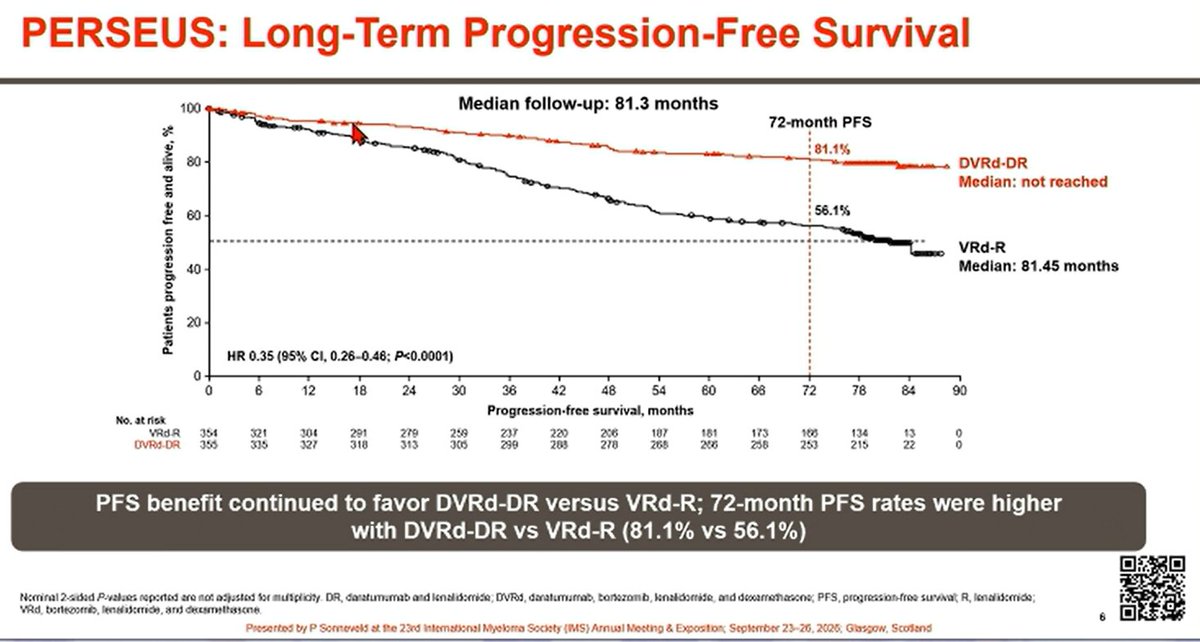
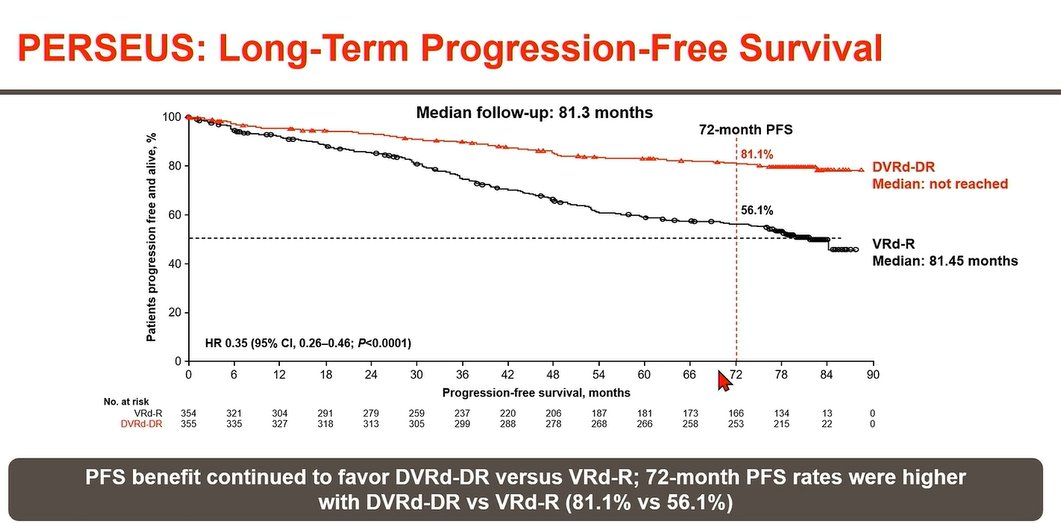
At a median follow-up of 47.5 months, D-VRd significantly improved PFS versus VRd alone. The PFS HR was 0.42 (95% CI: 0.30-0.59; P<0.0001), representing a 58% reduction in the risk of disease progression or death. The FDA label cites HR 0.40 (95% CI: 0.29-0.57; P<0.0001), a 60% risk reduction. Estimated 48-month PFS rates were 84.3% for D-VRd versus 67.7% for VRd. Median PFS was not reached in either arm. Subgroup analyses showed consistent PFS benefit across ISS stage III and high cytogenetic risk patients.

PFS HR 0.42 — 58% risk reduction

Source: NEJM Publication (Jan 2024)

Overall Survival (OS)

Overall survival data remain immature. At the time of the primary analysis, 78 deaths had occurred (D-VRd: 34 [9.6%]; VRd: 44 [12.4%]). A trend favoring D-VRd is emerging but has not yet reached statistical significance. The trial remains ongoing with OS as a key secondary endpoint.


Source: NEJM - OS Immature

Safety & Tolerability

The safety profile was consistent with known daratumumab and VRd toxicity, with no new safety concerns. Grade 3-4 AEs occurred in 91.5% of D-VRd patients vs 85.6% of VRd patients. The most common Grade 3-4 hematologic AEs were neutropenia (62.1% vs 51.0%), thrombocytopenia (29.1% vs 17.3%), and febrile neutropenia (9.4% vs 10.1%). Any-grade infusion-related reactions occurred in 6.0% with D-VRd (Grade 3-4: 0.9%). The most common overall AEs (20% or more) included peripheral neuropathy, fatigue, edema, pyrexia, upper respiratory infection, constipation, diarrhea, musculoskeletal pain, insomnia, and rash. Serious AEs occurred in 57.0% vs 49.3%.

Manageable safety — consistent with known dara/VRd profile

Source: FDA Approval (Jul 2024)

Clinical Implications

PERSEUS established D-VRd followed by MRD-guided D-R maintenance as a new standard of care for transplant-eligible NDMM, representing a major advance over VRd alone. The MRD-guided maintenance approach allows patients who achieve sustained deep responses to stop daratumumab while continuing lenalidomide, potentially improving long-term quality of life. Key clinical debates include D-VRd versus D-VTd backbone selection (CASSIOPEIA used thalidomide), the optimal duration of daratumumab maintenance, whether MRD-guided treatment discontinuation can be extended further, and the role of quadruplet therapy in elderly patients (aged 65-70 subgroup).

PERSEUS in the News

Key KOL Sentiments - PERSEUS

DoctorSentimentComment
Vincent Rajkumar
@VincentRK
● POSITIVE Thanks @Dr_AmerZeidan for inviting me to present on current treatment of myeloma at the New England Hematologic Malignancies Symposium. A simplified algorithm of frontline therapy today. Big changes. https://t.co/nvGcCtm5Sk
● POSITIVE 🚨New update of our New algorithm ; How I treat Newly diagnosed Myeloma: If Fit/Transplant Eligible (Both High &amp; Standard Risk): Dara/RVD x 4 cycles followed by Mel/ASCT followed by consolidation Dara/RVd X 2 cycles followed by maintenance Dara/L
● POSITIVE Blast from the past, GRIFFIN remains the standout practice changing study — being validated at #ASH23 now with PERSEUS. #mmsm https://t.co/2HOmwA6B2j
Noopur Raje
@NoopurRajeMD
● POSITIVE Unprecedented results with a Quad upfront as shown in the Perseus study.. a new standard of care for #mmsm https://t.co/9N2qfyCKoI
Daniel Sherbenou, MD, PhD
@DanielSherbenou
● POSITIVE Thanks for sharing Ben, not convinced by this - the rate of MRD negativity improves over time in both arms to very similar percentages (first graph), just like Griffin. The Dara benefit appears to happen early…Rev maintenance improves MRD rate over t
● POSITIVE PERSEUS by cytogenetic risk. All subsets benefit but greater in standard risk. A reminder that if something is good the benefit will be maximal in not high risk patients. PFS for std risk is quite impressive for dara arm. #IMS24RF #mmsm
Mohamad Mohty
@Mohty_EBMT
● POSITIVE Another myeloma keyword not to be missed as part of the Late Breaking Abstracts session : PERSEUS. #ASH23 @ASH_hematology @EMN_EuMMnet @TheIACH @Mohty_EBMT
Manni Mohyuddin
@ManniMD1
● POSITIVE Bortezomib+len maintenance has never had good data, and I would much rather now offer dara+len as per PERSEUS (for those who I wonder need more maintenance such as +1q with residual dis etc) rather than bortezomib+len (with all the toxicity/neuropath
Rmy Dulry
@RemyDulery
● POSITIVE #ASH23 Late-breaking abstract LBA-1 - Pieter Sonneveld et al. Important results of the PERSEUS trial just published @NEJM These randomized phase 3 results support D-VRd followed by D-R maintenance as a new standard of care for transplant-eligible p
● POSITIVE Great discussion by @DrOlaLandgren at #ASCO24 of IMROZ, BENEFIT, &amp; PERSEUS. Quads=higher rates of MRD and longer PFS vs triplets, regardless of age and ASCT eligibility. New SOC in #NDMM. Time to retire transplant eligible and ineligible terminol
Binod Dhakal
@bhemato
● POSITIVE @End_myeloma @HealthTree @PlasmaCellPete Great analysis as always by @End_myeloma ! While we await the granular data from those trials, both PERSEUS and LTFU of Cassiopea confirms the benefit of dara during induction, and if not on induction, def dur
NEJM
@NEJM
● NEUTRAL Late breaking at #ASH23: The addition of subcutaneous daratumumab to bortezomib, lenalidomide, and dexamethasone therapy and lenalidomide maintenance therapy had a significant benefit on progression-free survival among patients with multiple myelom
Eddie Cliff
@Eddie_Cliff
● NEUTRAL #ASH23 Late Breaking Abstract 1 PERSEUS Newly-Diagnosed Myeloma RCT 709 patients Dara-VRd vs VRd - 48-month PFS rates 84.3% vs 67.7%, HR 0.42, p&lt;0.001 - OS: D-VRd 34 deaths [9.6%]; VRd, 44 deaths [12.4%] (immature) https://t.co/lLudIrZTP0 #mms
Blood Cancer Talks
@BloodCancerTalk
● NEUTRAL 🔥🔥 Tune in for our #ASH23 #Myeloma recap with @bdermanmd! We discuss: PERSEUS ISKIA GMMG ReLApsE KarMMa-3 OS data @iStopMM serum FLC ratio GEM2017FIT And many clinical pearls on MRD! #mmsm #bmtsm https://t.co/t24N0TuZR8 https://t.co/LziqDB54Vr
● NEUTRAL UPDATE: US FDA Priority Review received for Phase 3 PERSEUS submission https://t.co/1buq4eP8sc
Joshua Richter, MD, FACP
@JoshuaRichterMD
● NEUTRAL AEs &amp; QOL Key takeaway: manageable AE profiles w/ quads → preserved QOL Safety analysis: Tolerable AE profiles support use of upfront quad tx for appropriate pts w/ TE NDMM NCCN GLs #MMBrief #MMSM. ⁦@SoMeCME⁩ https://t.co/PlvT6aLhn3
Bertrand Delsuc
@BertrandBio
● NEUTRAL Daratumumab, Bortezomib, Lenalidomide, and Dexamethasone for Multiple Myeloma | NEJM (PERSEUS) #ASH23 https://t.co/keZlwI0IZd https://t.co/GQIkohZD7c
● NEUTRAL Late breaking abstract session on Perseus PH 3 EMN trial. Darzalex- Velcade-Revlimid-Dex (DVRd) vs VRd in transplant eligible newly diagnosed #myeloma. Impressive results with DVRd in PFS and MRD negativity, questions of Darzalex sequencing and cost
Chan Cheah
@chanyooncheah
● NEUTRAL The only time I see myeloma abstracts: late breakers. This one looks pretty good though Peter Sonneveld reports the PERSEUS RCT of data-VRd vs VRd followed by transplant - improved PFS, CR and MRD negativity rates - a new SOC? Another sequencing que
● NEUTRAL #ASCO24 #mmsm #IDonc @DrOlaLandgren reviews IMROZ BENEFIT PERSEUS #PrecisionMedicine #mmMRD https://t.co/NONZOdSE4i
Elias K. Mai MD
@EliasKarlMai
● NEUTRAL @RahulBanerjeeMD @RaabMarc @szusmani @SurbhiSidanaMD Not to speak about the centers (mostly academic in PERSEUS vs. small+large sites in Germany in HD7) which brings us finally to differences between patient populations in these two studies.
Hamza Hashmi
@hhashmi87
● NEUTRAL #IMS25: late breaking abstract: PRO and HRQOL better in patients achieving MRD neg responses in Perseus and Cephesus for NDMM; there is value in pushing quads in these patients. Can we apply the same for DaraTecVR in MAJesTEC-5 w G3 infection 33%? h
Meral Beksac
@mbeksac56
● NEUTRAL @bdermanmd Watch out for long term results of CASSIOPEA with specific data on Dara maintenance arm soon to be published
OncLive.com
@OncLive
● NEUTRAL Jesús San Miguel, MD, PhD, of @unav joined us at #IMS25 to discuss patient-reported outcomes and safety in patients with NDMM achieving MRD negativity and ≥CR in the phase 3 PERSEUS and CEPHEUS trials 🧬📊 Stay tuned in for more updates from the meeti
Jess G Lugo
@LugoMd
● NEUTRAL Starting strong the late breaking abstract session, Pieter Sonnenveld presenting the PERSEUS trial in NDMM for pts eligible for ASCT, stating that Dara-VRd is the new standard of care #ASH23 curious to know what my myeloma friends think @Abdallah81MD
Myeloma Society
@Myeloma_Society
● NEUTRAL MRD-negativity was associated with favorable patient-reported outcomes and safety, according to an analysis of PERSEUS and CEPHEUS trials shared by Jesus San-Miguel, MD, PhD, which should reassure physicians about pursuing MRD-negativity. #IMS25 http
● NEUTRAL PRO’s and safety in NDMM patients achieving MRD negativity in PERSEUS and CEPHEUS! #IMS2025 https://t.co/xLN3zCr2D1
Robin Tuohy
@IMFsupport
● NEUTRAL Efficacy of Induction in NDMM SCT eligible @Dr_AdrianaRossi great slide/info! #ASH25 #IMFASH25 https://t.co/AyoMlTPkHK
Juan Esteban Vlez, MD
@JuanesVelezMD
● NEUTRAL Perseus subanalysis for on deepening the response and MED negativity during maintenance DVRd vs VRd, maintenance with DR Both in high risk MM &amp; regular risk MRD positive, PFS was better with DR maintenance ➡️ era of dual maintenance? https://t
Blood Cancers Today
@Blood_Cancers
● NEUTRAL Jesús San-Miguel, MD, PhD (@ClinicaNavarra) shared efficacy and safety data from the PERSEUS and CEPHEUS trials, the differences between quadruplet and triplet therapy for #myeloma, and alternate quadruplet therapies being explored. ➡️ Watch here! h
Teresa Miceli. &4
@IMFnurseMyeloma
● NEUTRAL Perseus Ph3 trial reaffirming what Griffin showed with Quad induction for TE #myeloma #ASH23 #mmsm https://t.co/nIrSJOIp7e
● NEUTRAL For US #HCPs at #ASCO25: see Dr. Philippe Moreau share analysis from the Phase 3 PERSEUS trial of sustained minimal residual disease negativity in transplant-eligible patients with newly diagnosed #MultipleMyeloma.
● NEUTRAL CONGRESS | #ASH24 | PRESENTATION @LucaBertamini @erasmusmcblood presents results from a circulating tumor cell sub-study of the phase III PERSEUS trial. High circulating tumor cells were associated with a worse prognosis in patients with NDMM. The ad
● NEGATIVE #ASH23 #mmsm LBA PERSEUS study My interpretation is Dara-RVD for induction and transplant is the way to go for most young (&lt;65 yrs) pts with slightly increased risk of infection I don’t think this data support Dara-R maintenance as mentioned i
Ben Derman
@bdermanmd
● NEGATIVE @RahulBanerjeeMD @EliasKarlMai @rajshekharucms @PlasmaCellPete @ninashah33 @ldandersonjr @Ccostello7 @ChaulagainMD @AlfredChung11 For people without frontline Dara and mrd pos, absolutely this trial supports. I found Perseus and Cassiopeia more infor
Rahul Banerjee, MD, FACP
@RahulBanerjeeMD
● NEGATIVE @bdermanmd @DanielSherbenou I agree - I wrestle with this too. @AjaiChari has also brought up timing of the curves separating, but both this and MRD neg could just be tincture of time. I’m with Dan - still not adding dara to len by default yet. Tha
Raj Chakraborty
@rajshekharucms
● NEGATIVE @Timothee_MD @ManniMD1 @AaronGoodman33 @VPrasadMDMPH Yes, agree. I hope to see a high % of pts getting Dara at 1st relapse in the control arm, but time will tell. Also, lack of 2nd randomization at maintenance was a missed opportunity, and we don’t k