LIVE EHA 2026 Live from Stockholm — KOL insights, late-breaker trials & top physician voices View Live Updates →
Live Update  ·  Day 4 of 4

EHA 2026 Conference Intelligence

Real-time KOL buzz, top themes, and trial signals from the EHA Congress — Stockholm, Sweden · June 11–14, 2026

Jun 11 (Day 1) Day 4 of 4 Jun 14 (Day 4)
1,535
Tweets Captured
320
Unique KOLs
908.7K
Total Impressions
0
Days Remaining
Last updated: June 15, 2026 17:47 UTC
×

Top Themes at EHA 2026

Most-discussed scientific topics across 1,535 curated tweets from 320 hematologists and researchers. Tap any card to see the tweets.

130
CAR-T & Cell Therapy
64.0K impressions
tap to see tweets
88
MPN / Myelofibrosis
43.6K impressions
tap to see tweets
83
BCMA & Myeloma Bispecifics
74.9K impressions
tap to see tweets
68
Venetoclax Combinations
85.7K impressions
tap to see tweets
50
MRD Monitoring
17.4K impressions
tap to see tweets
44
BTK Inhibitors & Degraders
16.5K impressions
tap to see tweets
42
CD20 Bispecifics
19.4K impressions
tap to see tweets
38
Transplant & GvHD
9.8K impressions
tap to see tweets
36
Menin Inhibitors (AML)
21.4K impressions
tap to see tweets
36
MDS & Anemia
13.2K impressions
tap to see tweets
14
Gene Therapy & Sickle Cell
23.4K impressions
tap to see tweets
1
AI in Hematology
466 impressions
tap to see tweets

Key Tweets from the Floor

Hand-picked slides and standout posts curated by the KOL Pulse team from the EHA 2026 floor. Click any image to expand.


This image contains two Kaplan-Meier graphs comparing progression-free survival between different treatments over 36 months. Graph A shows "Tal-DP" and "DPd" treatment groups. Graph B shows "Tal-D" and "DPd" treatment groups. Both graphs display confidence intervals. The number of patients at risk is listed below each graph at different time points.
NEJM @NEJM

Original Article: Talquetamab–Daratumumab in Relapsed or Refractory Myeloma (phase 3 MonumenTAL-3 trial)

8.4K impressions · View on X →
[Slide 1] A Progression-free Survival, Tal-DP vs. DPd 24-mo Progression-free survival 100 90 Tal-DP 80 81.3 (95% CI, Percentage of Patients Alive without Disease Progression 70 75.8-85.7) 60 50 DPd 40 51.2 (95% CI, 44.8-57.1) 30 20 Hazard ratio for disease progression 10 or death, 0.28 (95% CI, 0.20-0.40) P<0.001 0 0 3 6 9 12 15 18 21 24 27 30 33 36 Months No. at Risk Tal-DP 287 266 255 240 229 218 212 169 116 74 32 8 0 DPd 290 249 223 198 175 158 146 113 81 44 22 2 0 B Progression-free Survival, Tal-D vs. DPd 24-mo Progression-free survival 100 90 77.6 (95% CI, 71.7-82.5) 80 Tal-D Percentage of Patients Alive without Disease Progression 70 60 50 DPd 40 51.2 (95% CI, 44.8-57.1) 30 20 Hazard ratio for disease progression 10 or death, 0.33 (95% CI, 0.24-0.46) P<0.001 0 0 3 6 9 12 15 18 21 24 27 30 33 36 Months No. at Risk Tal-D 287 262 256 238 225 216 207 159 98 62 30 8 0 DPd 290 249 223 198 175 158 146 113 81 44 22 2 0 --- [Slide 2] A Overall Survival, Tal-DP VS. DPd 24-mo Overall survival 100 89.2 (95% CI, 84.9-92.4) 90 Tal-DP 80 70 79.1 (95% CI, DPd Percentage of Patients Alive 73.7-83.6) 60 50 40 30 20 10 Hazard ratio for death, 0.47 (95% CI, 0.30-0.73) 0 0 3 6 9 12 15 18 21 24 27 30 33 36 Months No. at Risk Tal-DP 287 277 276 269 262 248 238 200 141 94 48 10 0 DPd 290 278 264 255 245 226 217 173 125 78 37 4 0 B Overall Survival, Tal-D vs. DPd 24-mo Overall survival 100 87.9 (95% CI, 83.0-91.5) 90 Tal-D 80 70 79.1 (95% CI, DPd Percentage of Patients Alive 73.7-83.6) 60 50 40 30 20 10 Hazard ratio for death, 0.51 (95% CI, 0.33-0.78) 0 0 3 6 9 12 15 18 21 24 27 30 33 36 Months No. at Risk Tal-D 287 276 275 268 264 256 251 199 130 77 40 10 0 DPd 290 278 264 255 245 226 217 173 125 78 37 4 0 --- [Slide 3] A Progression-free Survival, Tal-DP vs. DPd 24-mo Progression-free survival 100 90 Tal-DP 80 81.3 (95% CI, Percentage of Patients Alive without Disease Progression 70 75.8-85.7) 60 50 DPd 40 51.2 (95% CI, 44.8-57.1) 30 20 Hazard ratio for disease progression 10 or death, 0.28 (95% CI, 0.20-0.40) P<0.001 0 0 3 6 9 12 15 18 21 24 27 30 33 36 Months No. at Risk Tal-DP 287 266 255 240 229 218 212 169 116 74 32 8 0 DPd 290 249 223 198 175 158 146 113 81 44 22 2 0 B Progression-free Survival, Tal-D vs. DPd 24-mo Progression-free survival 100 90 77.6 (95% CI, 71.7-82.5) 80 Tal-D Percentage of Patients Alive without Disease Progression 70 60 50 DPd 40 51.2 (95% CI, 44.8-57.1) 30 20 Hazard ratio for disease progression 10 or death, 0.33 (95% CI, 0.24-0.46) P<0.001 0 0 3 6 9 12 15 18 21 24 27 30 33 36 Months No. at Risk Tal-D 287 262 256 238 225 216 207 159 98 62 30 8 0 DPd 290 249 223 198 175 158 146 113 81 44 22 2 0 --- [Slide 4] A Overall Survival, Tal-DP VS. DPd 24-mo Overall survival 100 89.2 (95% CI, 84.9-92.4) 90 Tal-DP 80 70 79.1 (95% CI, DPd Percentage of Patients Alive 73.7-83.6) 60 50 40 30 20 10 Hazard ratio for death, 0.47 (95% CI, 0.30-0.73) 0 0 3 6 9 12 15 18 21 24 27 30 33 36 Months No. at Risk Tal-DP 287 277 276 269 262 248 238 200 141 94 48 10 0 DPd 290 278 264 255 245 226 217 173 125 78 37 4 0 B Overall Survival, Tal-D vs. DPd 24-mo Overall survival 100 87.9 (95% CI, 83.0-91.5) 90 Tal-D 80 70 79.1 (95% CI, DPd Percentage of Patients Alive 73.7-83.6) 60 50 40 30 20 10 Hazard ratio for death, 0.51 (95% CI, 0.33-0.78) 0 0 3 6 9 12 15 18 21 24 27 30 33 36 Months No. at Risk Tal-D 287 276 275 268 264 256 251 199 130 77 40 10 0 DPd 290 278 264 255 245 226 217 173 125 78 37 4 0
Samer Al Hadidi, MD,MS,FACP
Samer Al Hadidi, MD,MS,FACP @HadidiSamer

#mmsm #EHA26 MajesTEC-3 high risk post hoc analysis @RahulBanerjeeMD Tec-Dara worked well in patients with 2HRCA or more as well as functionally high risk Really goo

6.6K impressions · View on X →
[Slide 1] MajesTEC-3: PFS by Number of Expandedᵃ HRCAs 0 HRCAs 1 HRCA ≥2 HRCAs Estimated Estimated Estimated 36-mo PFS rate 36-mo PFS rate 36-mo PFS rate 100 100 100 90.1% Tec-Dara, 0 HRCAs 82.0% 80 80 Tec-Dara, 80 76.4% 1 HRCA Tec-Dara, % surviving without progression >2 HRCAs 60 60 60 40 31.9% 40 40 30.7% DPd/DVd, 0 HRCAs DPd/DVd, 20 Tec-Dara, n=52 20 Tec-Dara, n=105 1 HRCA 20 Tec-Dara, n=64 13.7% DPd/DVd, n=55 DPd/DVd. n=111 DPd/DVd, n=69 DPd/DVd, HR, 0.12 (95% CI, 0.04-0.30) HR, 0.19 (95% CI, 0.11-0.32) HR, 0.16 (95% CI, 0.08-0.29) >2 HRCAs 0 0 0 0 3 6 9 12 15 18 21 24 27 30 33 36 39 42 45 0 3 6 9 12 15 18 21 24 27 30 33 36 39 42 45 48 0 3 6 9 12 15 18 21 24 27 30 33 36 39 42 45 Months Months Months No. at risk No. at risk No. at risk Tec-Dara 52 50 46 45 45 45 44 44 44 43 42 28 15 8 3 0 Tec-Dara 105 93 87 84 84 82 81 79 79 78 78 54 34 13 3 0 0 Tec-Dara 64 54 52 49 49 47 46 45 44 43 41 26 19 6 3 0 DPd/DVd 55 51 46 39 34 32 32 29 26 22 19 12 8 3 0 0 DPd/DVd 111 97 82 71 61 55 49 47 44 41 34 20 10 7 2 1 0 DPd/DVd 69 56 47 39 34 29 22 17 13 11 11 7 1 1 1 0 Tec-Dara consistently improved PFS vs DPd/DVd, including in patients with ultra high-risk RRMM PHRCA number is defined as the number of abnormalities present from the following: del(17p). t(4;14), t(14;16), amp(1q21). or gain(1q21). 11 Presented by R Banerjee at the 31st European Hematology Association (EHA) Annual Meeting: June 11-14, 2026; Stockholm, Sweden --- [Slide 2] MajesTEC-3: PFS by Functional High-Risk Statusᵃ Estimated 100 36-mo PFS rate 89.9% Tec-Dara, not FHR after 1 prior LOT % surviving without progression 80 77.3% Tec-Dara, FHR after 1 prior LOT 60 40 35.9% & DPd/DVd, not FHR Not FHR after 1 prior LOT: Tec-Dara, n=82; DPd/DVd, n=94 after 1 prior LOT 20 HR, 0.11 (95% CI, 0.05-0.23) 0% FHR after 1 prior LOT: Tec-Dara, n=26; DPd/DVd, n=20 DPd/DVd, FHR after 1 prior LOT HR, 0.22 (95% CI, 0.08-0.62) 0 0 3 6 9 12 15 18 21 24 27 30 33 36 39 42 45 48 Months No. at risk Tec-Dara, not FHR after 1PL 82 78 78 77 77 74 74 72 71 70 69 46 30 15 3 0 0 DPd/DVd, not FHR after 1PL 94 86 73 65 59 53 47 45 39 38 36 24 13 7 2 1 0 Tec-Dara, FHR after 1PL 26 20 18 18 18 17 17 17 17 16 16 8 6 2 1 0 0 DPd/DVd, FHR after 1 PL 20 16 14 12 12 11 10 9 8 5 4 1 0 0 0 0 0 Tec-Dara substantially prolonged PFS vs DPd/DVd in patients with FHR MM, surpassing inferior outcomes historically seen with traditional therapies¹ 1PL, 1 prior LOT; MM, multiple myeloma. *Functional high-risk status defined as patients with 1 prior LOT and progressive disease within 18 months of ASCT or start of initial therapy. 1. Banerjee R, et al. Frontiers Oncol. 2023;13:1240966. 13 Presented by R Banerjee at the 31st European Hematology Association (EHA) Annual Meeting: June 11-14, 2026; Stockholm, Sweden --- [Slide 3] MajesTEC-3: PFS By Risk Status (ITT) Tec-Dara DPd/DVd Events Median Events Median n/N n/N HR (95% CI) PFS (mo) PFS (mo) Functional high risk 5/26 NE 14/20 23.2 0.22 (0.08-0.62) Non-functional high risk 8/82 NE 57/94 20.8 0.11 (0.05-0.23) Prespecified std. risk 15/126 NE 84/145 24.7 0.16 (0.09-0.27) Prespecified high risk 20/104 NE 78/104 14.4 0.15 (0.09-0.25) Expanded std. riskᵇ 5/52 NE 34/55 24.2 0.12 (0.04-0.30) Expanded high riskb 30/169 NE 122/180 15.8 0.18 (0.12-0.26) 1 HRCA 17/105 NE 69/111 17.9 0.19 (0.11-0.32) ≥2 HRCAs 13/64 NE 53/69 14.4 0.16 (0.08-0.29) 0.01 0.1 1 10 Tec-Dara better DPd/DVd better Tec-Dara consistently improved PFS vs DPd/DVd regardless of disease biology CI, confidence interval; HR hazard ratio; ITT, intent-to-treat; NE, not estimable; Std., standard Prespecified standard risk: none of del(17p), t(4;14), or t(14;16). Prespecified high risk: >1 of del(17p), t(4;14), or t(14;16). Expanded standard risk: none of del(17p), t(4;14), t(14;16), amp(1q21), or gain(1q21). Expanded high risk: >1 of del(17p), t(4;14), t(14;16), amp(1q21), or gain(1q21). 6 Presented by R Banerjee at the 31st European Hematology Association (EHA) Annual Meeting; June 11-14, 2026; Stockholm, Sweden --- [Slide 4] MajesTEC-3: PFS by Number of Expandedᵃ HRCAs 0 HRCAs 1 HRCA ≥2 HRCAs Estimated Estimated Estimated 36-mo PFS rate 36-mo PFS rate 36-mo PFS rate 100 100 100 90.1% Tec-Dara, 0 HRCAs 82.0% 80 80 Tec-Dara, 80 76.4% 1 HRCA Tec-Dara, % surviving without progression >2 HRCAs 60 60 60 40 31.9% 40 40 30.7% DPd/DVd, 0 HRCAs DPd/DVd, 20 Tec-Dara, n=52 20 Tec-Dara, n=105 1 HRCA 20 Tec-Dara, n=64 13.7% DPd/DVd, n=55 DPd/DVd. n=111 DPd/DVd, n=69 DPd/DVd, HR, 0.12 (95% CI, 0.04-0.30) HR, 0.19 (95% CI, 0.11-0.32) HR, 0.16 (95% CI, 0.08-0.29) >2 HRCAs 0 0 0 0 3 6 9 12 15 18 21 24 27 30 33 36 39 42 45 0 3 6 9 12 15 18 21 24 27 30 33 36 39 42 45 48 0 3 6 9 12 15 18 21 24 27 30 33 36 39 42 45 Months Months Months No. at risk No. at risk No. at risk Tec-Dara 52 50 46 45 45 45 44 44 44 43 42 28 15 8 3 0 Tec-Dara 105 93 87 84 84 82 81 79 79 78 78 54 34 13 3 0 0 Tec-Dara 64 54 52 49 49 47 46 45 44 43 41 26 19 6 3 0 DPd/DVd 55 51 46 39 34 32 32 29 26 22 19 12 8 3 0 0 DPd/DVd 111 97 82 71 61 55 49 47 44 41 34 20 10 7 2 1 0 DPd/DVd 69 56 47 39 34 29 22 17 13 11 11 7 1 1 1 0 Tec-Dara consistently improved PFS vs DPd/DVd, including in patients with ultra high-risk RRMM PHRCA number is defined as the number of abnormalities present from the following: del(17p). t(4;14), t(14;16), amp(1q21). or gain(1q21). 11 Presented by R Banerjee at the 31st European Hematology Association (EHA) Annual Meeting: June 11-14, 2026; Stockholm, Sweden --- [Slide 5] MajesTEC-3: PFS by Functional High-Risk Statusᵃ Estimated 100 36-mo PFS rate 89.9% Tec-Dara, not FHR after 1 prior LOT % surviving without progression 80 77.3% Tec-Dara, FHR after 1 prior LOT 60 40 35.9% & DPd/DVd, not FHR Not FHR after 1 prior LOT: Tec-Dara, n=82; DPd/DVd, n=94 after 1 prior LOT 20 HR, 0.11 (95% CI, 0.05-0.23) 0% FHR after 1 prior LOT: Tec-Dara, n=26; DPd/DVd, n=20 DPd/DVd, FHR after 1 prior LOT HR, 0.22 (95% CI, 0.08-0.62) 0 0 3 6 9 12 15 18 21 24 27 30 33 36 39 42 45 48 Months No. at risk Tec-Dara, not FHR after 1PL 82 78 78 77 77 74 74 72 71 70 69 46 30 15 3 0 0 DPd/DVd, not FHR after 1PL 94 86 73 65 59 53 47 45 39 38 36 24 13 7 2 1 0 Tec-Dara, FHR after 1PL 26 20 18 18 18 17 17 17 17 16 16 8 6 2 1 0 0 DPd/DVd, FHR after 1 PL 20 16 14 12 12 11 10 9 8 5 4 1 0 0 0 0 0 Tec-Dara substantially prolonged PFS vs DPd/DVd in patients with FHR MM, surpassing inferior outcomes historically seen with traditional therapies¹ 1PL, 1 prior LOT; MM, multiple myeloma. *Functional high-risk status defined as patients with 1 prior LOT and progressive disease within 18 months of ASCT or start of initial therapy. 1. Banerjee R, et al. Frontiers Oncol. 2023;13:1240966. 13 Presented by R Banerjee at the 31st European Hematology Association (EHA) Annual Meeting: June 11-14, 2026; Stockholm, Sweden --- [Slide 6] MajesTEC-3: PFS By Risk Status (ITT) Tec-Dara DPd/DVd Events Median Events Median n/N n/N HR (95% CI) PFS (mo) PFS (mo) Functional high risk 5/26 NE 14/20 23.2 0.22 (0.08-0.62) Non-functional high risk 8/82 NE 57/94 20.8 0.11 (0.05-0.23) Prespecified std. risk 15/126 NE 84/145 24.7 0.16 (0.09-0.27) Prespecified high risk 20/104 NE 78/104 14.4 0.15 (0.09-0.25) Expanded std. riskᵇ 5/52 NE 34/55 24.2 0.12 (0.04-0.30) Expanded high riskb 30/169 NE 122/180 15.8 0.18 (0.12-0.26) 1 HRCA 17/105 NE 69/111 17.9 0.19 (0.11-0.32) ≥2 HRCAs 13/64 NE 53/69 14.4 0.16 (0.08-0.29) 0.01 0.1 1 10 Tec-Dara better DPd/DVd better Tec-Dara consistently improved PFS vs DPd/DVd regardless of disease biology CI, confidence interval; HR hazard ratio; ITT, intent-to-treat; NE, not estimable; Std., standard Prespecified standard risk: none of del(17p), t(4;14), or t(14;16). Prespecified high risk: >1 of del(17p), t(4;14), or t(14;16). Expanded standard risk: none of del(17p), t(4;14), t(14;16), amp(1q21), or gain(1q21). Expanded high risk: >1 of del(17p), t(4;14), t(14;16), amp(1q21), or gain(1q21). 6 Presented by R Banerjee at the 31st European Hematology Association (EHA) Annual Meeting; June 11-14, 2026; Stockholm, Sweden
Raj Chakraborty
Raj Chakraborty @rajshekharucms

Based on a recent slew of RCTs & updates at #ASCO26 and #EHA26 in relapsed #MultipleMyeloma, here is my framework for approaching 1st relapse (assuming access to all of t

3.2K impressions · View on X →
[Slide 1] Multiple Myeloma 1st Relapse [06.2026] Anti-CD38 mAb-naive Anti-CD38 mAb-exposed Anti-CD38 mAb-refractory Lenalidomide-exposed/refractory Lenalidomide-exposed/refractory Lenalidomide-exposed/refractory Preferred: Preferred: Preferred: 1st choice: Tec-Dara* 1st choice: Tec-Dara* Cilta-cel [CARTITUDE-4] or [MajesTEC-3] [MajesTEC-3] Teclistamab [MajesTEC-9] 2nd choice: Cilta-cel 2nd choice: Cilta-cel [CARTITUDE-4] [CARTITUDE-4] Alternatives/Less Preferred: 3rd choice: Tal-Dara* (Pom) 3rd choice: Tal-Dara* (Pom) Mezi-Kd [SUCCESSOR-2] [MonumenTAL-3] [MonumenTAL-3] Bela-Pd [DREAMM-8] Alternatives/Less Preferred: Alternatives/Less Preferred: Bela-Vd [DREAMM-7] Bela-Vd [DREAMM-7] Bela-Pd [DREAMM-8] Bela-Pd [DREAMM-8] Dara-Kd [CANDOR] Dara-Kd [CANDOR] Isa-Kd [IKEMA] Isa-Kd [IKEMA] * While BsAbs have been approved as continuous therapy until progression, it is reasonable to discontinue after Made with Biorender 12-18 months in responding patients. --- [Slide 2] Multiple Myeloma 1st Relapse [06.2026] Anti-CD38 mAb-naive Anti-CD38 mAb-exposed Anti-CD38 mAb-refractory Lenalidomide-exposed/refractory Lenalidomide-exposed/refractory Lenalidomide-exposed/refractory Preferred: Preferred: Preferred: 1st choice: Tec-Dara* 1st choice: Tec-Dara* Cilta-cel [CARTITUDE-4] or [MajesTEC-3] [MajesTEC-3] Teclistamab [MajesTEC-9] 2nd choice: Cilta-cel 2nd choice: Cilta-cel [CARTITUDE-4] [CARTITUDE-4] Alternatives/Less Preferred: 3rd choice: Tal-Dara* (Pom) 3rd choice: Tal-Dara* (Pom) Mezi-Kd [SUCCESSOR-2] [MonumenTAL-3] [MonumenTAL-3] Bela-Pd [DREAMM-8] Alternatives/Less Preferred: Alternatives/Less Preferred: Bela-Vd [DREAMM-7] Bela-Vd [DREAMM-7] Bela-Pd [DREAMM-8] Bela-Pd [DREAMM-8] Dara-Kd [CANDOR] Dara-Kd [CANDOR] Isa-Kd [IKEMA] Isa-Kd [IKEMA] * While BsAbs have been approved as continuous therapy until progression, it is reasonable to discontinue after Made with Biorender 12-18 months in responding patients.
Eddie Cliff
Eddie Cliff @Eddie_Cliff

Enticing early data for the first in vivo CAR T in B cell lymphomas from Legend biotech #EHA2026 #EHA26

1.7K impressions · View on X →
[Slide 1] Efficacy DL1 DL2 Total Response Rate At DL2, 100% ORR and 83.3% CR achieved across DLBCL, MCL, and (N=6) (N=6) (N=12) FL 6 (100) 6 (50.0) ORR, n (%) [95% CI] 0 [54.1-100] [21.1-78.9] Deepening response observed CR, n (%) 5 (83.3) 5 (41.7) 0 [95% CI] [35.9-99.6] [15.2-72.3] By data cutoff, all responses were ongoing Percent Change from Baseline in SPD for Best Response (DL2) Duration of Responses in Patients (DL2) 40 Pt 7: FL 20 Pt 8: FL Change in target lesions from baseline (%) 0 Pt 9: DLBCL -20 Pt 10: DLBCL -40 Preevaluation Pt 11: DLBCL CR -60 PR Pt 12: MCL Still being followed -80 CR CR CR -100 CR CR 0 1 2 3 4 PR Pt 10 Pt 11 Pt 8 Pt 12 Pt 7 Pt9 Months since infusion DLBCL DLBCL FL MCL FL DLBCL The median follow-up for DL2 was 2.3 months (range, 2.0 to 4.5); The Lugano 2014 criteria were used to assess the response at each prespecified time Pt 8 had prior TCE with washout of 2.7 months 10 point in patients with NHL --- [Slide 2] Efficacy DL1 DL2 Total Response Rate At DL2, 100% ORR and 83.3% CR achieved across DLBCL, MCL, and (N=6) (N=6) (N=12) FL 6 (100) 6 (50.0) ORR, n (%) [95% CI] 0 [54.1-100] [21.1-78.9] Deepening response observed CR, n (%) 5 (83.3) 5 (41.7) 0 [95% CI] [35.9-99.6] [15.2-72.3] By data cutoff, all responses were ongoing Percent Change from Baseline in SPD for Best Response (DL2) Duration of Responses in Patients (DL2) 40 Pt 7: FL 20 Pt 8: FL Change in target lesions from baseline (%) 0 Pt 9: DLBCL -20 Pt 10: DLBCL -40 Preevaluation Pt 11: DLBCL CR -60 PR Pt 12: MCL Still being followed -80 CR CR CR -100 CR CR 0 1 2 3 4 PR Pt 10 Pt 11 Pt 8 Pt 12 Pt 7 Pt9 Months since infusion DLBCL DLBCL FL MCL FL DLBCL The median follow-up for DL2 was 2.3 months (range, 2.0 to 4.5); The Lugano 2014 criteria were used to assess the response at each prespecified time Pt 8 had prior TCE with washout of 2.7 months 10 point in patients with NHL
Joshua Zeidner MD
Joshua Zeidner MD @LeukDocJZ

Congratulations to @Dr_AmerZeidan & KOMET-007 investigators. Great presentation showing excellent outcomes particularly in ND NPM1m AML pts Tx w/ 7+3+Ziftomenib supportin

1.6K impressions · View on X →
[Slide 1] Safety and Tolerability of Ziftomenib with 7+3 Grade ≥3 TEAEs in ≥10% of All Patients Grade >3 NPM1-m KMT2A-r All Patients Grade ≥3 AEs of Interest Ziftomenib-related n (%) (N=49) (N=50) (N=99) (N=99) Differentiation syndrome (DS): Any grade >3 46 (94) 49 (98) 95 (96) 52 (53) 4 Gr3 DS cases (4%; 1 NPM1-m, Febrile neutropenia 29 (59) 33 (66) 62 (63) 13 (13) 3 KMT2A-r); no Gr4 Thrombocytopenia® 31 (63) 28 (56) 59 (60) 21 (21) All DS events successfully resolved with protocol-specified mitigation and 3 Anemia 20 (41) 17 (34) 37 (37) 15 (15) continued ziftomenib treatment Neutropenia 16 (33) 15 (30) 31 (31) 13 (13) Amer M. Zeidan Leukopenia 12 (24) 16 (32) 28 (28) 9 (9) QTc prolongation: ZIFTOMENIB COMBINED WITH INTENSIVE Hypokalemia 5 (10) 10 (20) 15 (15) 1 (1) 3 Gr3 investigator-assessed QTc INDUCTION (7+3) FOR NEWLY DIAGNOSED Sepsis 6 (12) 7 (14) 13 (13) 4 (4) prolongation cases (3%; 1 NPM1-m, NPM1-M OR KMT2A-R ACUTE MYELOID 2 KMT2A-r; none ziftomenib-related); Lymphopenia® 5 (10) 9 (18) 14 (14) 4 (4) no Gr4 LEUKEMIA (AML): LONG-TERM RESULTS FROM ALT increased 6 (12) 5 (10) 11 (11) 4 (4) All QTc events successfully resolved and THE KOMET-007 TRIAL Pruritus 6 (12) 4 (8) 10 (10) 10 (10) continued ziftomenib treatment *Includes PTs platolet count decreased and thrombocytopenia *Includes PTs hemoglobin decreased red blood coll count decreased and anoma, includes neutrophil count decreased and neutropenia, *Includes while blood cell count decreased and leukoponia, "Includes hymphocyte count decreased and tymphopenia Prunts was generally managed with gabapentin based (n-8) or antihistamine based (n-2) therapy All 3 patients were on other medications at time of QT assessment (posaconazole, ciprofloxacin, levofloxacin, hydroxyzine, metronidazole): 1 patient had ongoing hypokalomia and hypomagnesemia Data cutoff Apr 10. 2026 Gr, grade PT. preferred term QTc. corrected QT interval EHA2026 eha Congress --- [Slide 2] Clinical Activity of Ziftomenib with 7+3 NPM1-m KMT2A-Γ All Patients n (%) (N=49) (N=50) (N=99) CRc 47 (96) 45 (90) 92 (93) ORR 48 (98) 46 (92) 94 (95) CR 46 (94) 41 (82) 87 (88) CRh 1 (2) 1 (2) 2 (2) CRi 0 3 (6) 3 (3) MLFS 1 (2) 1 (2) 2 (2) Amer M. Zeidan PR 0 0 0 ZIFTOMENIB COMBINED WITH INTENSIVE NR 1 (2) 3 (6) 4 (4) INDUCTION (7+3) FOR NEWLY DIAGNOSED NE 0 1 (2) 1 (1) NPM1-M OR KMT2A-R ACUTE MYELOID CR MRD negativity (local), n/m (%)a 39/46 (85) 30/35 (86) 69/81 (85) LEUKEMIA (AML): LONG-TERM RESULTS FROM CRc MRD negativity (local), n/m (%)a THE KOMET-007 TRIAL 40/47 (85) 32/39 (82) 72/86 (84) Median time to CR MRD negativity, months (range) 1.5 (0.5-12.2) 0.9 (0.5-2.8) 1.2 (0.5-12.2) Median time to CRc MRD negativity, months (range) 1.5 (0.5-12.2) 0.9 (0.5-2.8) 1.1 (0.5-12.2) Among evaluable responders tasted for MRD per local assay (NGS RT qPCR flow cytometry or FISH (KMT2A only]) Data cutoff Apr 10. 2026 FISH fluorescence in situ hybridization MRD. measurable residual disease, NE, not estimable NGS, next generation sequencing NR no response PR, partial remission RT qPCR quantitative reverse transcription polymerase chain reaction EHA2026 eha Congress --- [Slide 3] Overall Survival NPM1-m 1.0 After a median follow-up of 17.6 months 0.9 (range 1.0-23.5): 0.8 NPM1-m Probability of overall survival Median OS was not reached 0.7 0.6 - NPM1-m: 94% OS rate at 12 months 0.5 Median age was 60 years 0.4 Amer M. Zeidan 0.3 90% (44/49) of NPM1-m patients remained 0.2 alive and continued on study ZIFTOMENIB COMBINED WITH INTENSIVE Median OS, months (95% CI) INDUCTION (7+3) FOR NEWLY DIAGNOSED 0.1 NPM1-m: Not reached (NE-NE) - 60-day mortality: 2% (1/49) O Censored NPM1-M OR KMT2A-R ACUTE MYELOID 0.0 LEUKEMIA (AML): LONG-TERM RESULTS FROM 0 3 6 9 12 15 18 21 24 12-month OS with intensive chemotherapy-based THE KOMET-007 TRIAL Months regimens varied from ~70-80% in younger/fit patients Patients at Risk to -45-55% in older adults1-5 NPM1-m 49 48 46 46 45 37 21 8 0 Patients on treatment or in long term follow up Data cutoff Apr 10, 2026 os, overall survival 1. Othus of at Leukemia 2019. (3(2) 371-378 2. Othman et at Blood 2024 144(7) 714-728 3. Lachowiez et al Blood Adv 2020. 4(7) 1311-1320 4. Hemandez Sanchez et at. Leukemia 2026; 40(2) 418-428 5. Recher et at Leukemia 2022 36(4)913-922 EHA2026 eha Congress --- [Slide 4] Overall Survival KMT2A-r 1.0 After a median follow-up of 11.0 months 0.9 D (range 0.9-21.9): 0.8 Probability of overall survival Median OS was not reached 0.7 0.6 - KMT2A-r: 71% OS rate at 12 months KMT2A-r 0.5 Median age was 43 years 0.4 Amer M. Zeidan 0.3 62% (31/50) of KMT2A-r patients remained 0.2 alive and continued on study ZIFTOMENIB COMBINED WITH INTENSIVE Median OS, months (95% CI) 0.1 KMT2A-r: Not reached (12.8-NE) INDUCTION (7+3) FOR NEWLY DIAGNOSED - 60-day mortality: 4% (2/50) O Censored NPM1-M OR KMT2A-R ACUTE MYELOID 0.0 LEUKEMIA (AML): LONG-TERM RESULTS FROM 0 3 6 9 12 15 18 21 24 THE KOMET-007 TRIAL Months Patients at Risk KMT2A-Γ 50 47 38 33 23 13 3 1 0 Patients on treatment or in long term follow up Data cutoff Apr 10, 2026 os, overall survival EHA2026 eha Congress --- [Slide 5] Safety and Tolerability of Ziftomenib with 7+3 Grade ≥3 TEAEs in ≥10% of All Patients Grade >3 NPM1-m KMT2A-r All Patients Grade ≥3 AEs of Interest Ziftomenib-related n (%) (N=49) (N=50) (N=99) (N=99) Differentiation syndrome (DS): Any grade >3 46 (94) 49 (98) 95 (96) 52 (53) 4 Gr3 DS cases (4%; 1 NPM1-m, Febrile neutropenia 29 (59) 33 (66) 62 (63) 13 (13) 3 KMT2A-r); no Gr4 Thrombocytopenia® 31 (63) 28 (56) 59 (60) 21 (21) All DS events successfully resolved with protocol-specified mitigation and 3 Anemia 20 (41) 17 (34) 37 (37) 15 (15) continued ziftomenib treatment Neutropenia 16 (33) 15 (30) 31 (31) 13 (13) Amer M. Zeidan Leukopenia 12 (24) 16 (32) 28 (28) 9 (9) QTc prolongation: ZIFTOMENIB COMBINED WITH INTENSIVE Hypokalemia 5 (10) 10 (20) 15 (15) 1 (1) 3 Gr3 investigator-assessed QTc INDUCTION (7+3) FOR NEWLY DIAGNOSED Sepsis 6 (12) 7 (14) 13 (13) 4 (4) prolongation cases (3%; 1 NPM1-m, NPM1-M OR KMT2A-R ACUTE MYELOID 2 KMT2A-r; none ziftomenib-related); Lymphopenia® 5 (10) 9 (18) 14 (14) 4 (4) no Gr4 LEUKEMIA (AML): LONG-TERM RESULTS FROM ALT increased 6 (12) 5 (10) 11 (11) 4 (4) All QTc events successfully resolved and THE KOMET-007 TRIAL Pruritus 6 (12) 4 (8) 10 (10) 10 (10) continued ziftomenib treatment *Includes PTs platolet count decreased and thrombocytopenia *Includes PTs hemoglobin decreased red blood coll count decreased and anoma, includes neutrophil count decreased and neutropenia, *Includes while blood cell count decreased and leukoponia, "Includes hymphocyte count decreased and tymphopenia Prunts was generally managed with gabapentin based (n-8) or antihistamine based (n-2) therapy All 3 patients were on other medications at time of QT assessment (posaconazole, ciprofloxacin, levofloxacin, hydroxyzine, metronidazole): 1 patient had ongoing hypokalomia and hypomagnesemia Data cutoff Apr 10. 2026 Gr, grade PT. preferred term QTc. corrected QT interval EHA2026 eha Congress --- [Slide 6] Clinical Activity of Ziftomenib with 7+3 NPM1-m KMT2A-Γ All Patients n (%) (N=49) (N=50) (N=99) CRc 47 (96) 45 (90) 92 (93) ORR 48 (98) 46 (92) 94 (95) CR 46 (94) 41 (82) 87 (88) CRh 1 (2) 1 (2) 2 (2) CRi 0 3 (6) 3 (3) MLFS 1 (2) 1 (2) 2 (2) Amer M. Zeidan PR 0 0 0 ZIFTOMENIB COMBINED WITH INTENSIVE NR 1 (2) 3 (6) 4 (4) INDUCTION (7+3) FOR NEWLY DIAGNOSED NE 0 1 (2) 1 (1) NPM1-M OR KMT2A-R ACUTE MYELOID CR MRD negativity (local), n/m (%)a 39/46 (85) 30/35 (86) 69/81 (85) LEUKEMIA (AML): LONG-TERM RESULTS FROM CRc MRD negativity (local), n/m (%)a THE KOMET-007 TRIAL 40/47 (85) 32/39 (82) 72/86 (84) Median time to CR MRD negativity, months (range) 1.5 (0.5-12.2) 0.9 (0.5-2.8) 1.2 (0.5-12.2) Median time to CRc MRD negativity, months (range) 1.5 (0.5-12.2) 0.9 (0.5-2.8) 1.1 (0.5-12.2) Among evaluable responders tasted for MRD per local assay (NGS RT qPCR flow cytometry or FISH (KMT2A only]) Data cutoff Apr 10. 2026 FISH fluorescence in situ hybridization MRD. measurable residual disease, NE, not estimable NGS, next generation sequencing NR no response PR, partial remission RT qPCR quantitative reverse transcription polymerase chain reaction EHA2026 eha Congress --- [Slide 7] Overall Survival NPM1-m 1.0 After a median follow-up of 17.6 months 0.9 (range 1.0-23.5): 0.8 NPM1-m Probability of overall survival Median OS was not reached 0.7 0.6 - NPM1-m: 94% OS rate at 12 months 0.5 Median age was 60 years 0.4 Amer M. Zeidan 0.3 90% (44/49) of NPM1-m patients remained 0.2 alive and continued on study ZIFTOMENIB COMBINED WITH INTENSIVE Median OS, months (95% CI) INDUCTION (7+3) FOR NEWLY DIAGNOSED 0.1 NPM1-m: Not reached (NE-NE) - 60-day mortality: 2% (1/49) O Censored NPM1-M OR KMT2A-R ACUTE MYELOID 0.0 LEUKEMIA (AML): LONG-TERM RESULTS FROM 0 3 6 9 12 15 18 21 24 12-month OS with intensive chemotherapy-based THE KOMET-007 TRIAL Months regimens varied from ~70-80% in younger/fit patients Patients at Risk to -45-55% in older adults1-5 NPM1-m 49 48 46 46 45 37 21 8 0 Patients on treatment or in long term follow up Data cutoff Apr 10, 2026 os, overall survival 1. Othus of at Leukemia 2019. (3(2) 371-378 2. Othman et at Blood 2024 144(7) 714-728 3. Lachowiez et al Blood Adv 2020. 4(7) 1311-1320 4. Hemandez Sanchez et at. Leukemia 2026; 40(2) 418-428 5. Recher et at Leukemia 2022 36(4)913-922 EHA2026 eha Congress --- [Slide 8] Overall Survival KMT2A-r 1.0 After a median follow-up of 11.0 months 0.9 D (range 0.9-21.9): 0.8 Probability of overall survival Median OS was not reached 0.7 0.6 - KMT2A-r: 71% OS rate at 12 months KMT2A-r 0.5 Median age was 43 years 0.4 Amer M. Zeidan 0.3 62% (31/50) of KMT2A-r patients remained 0.2 alive and continued on study ZIFTOMENIB COMBINED WITH INTENSIVE Median OS, months (95% CI) 0.1 KMT2A-r: Not reached (12.8-NE) INDUCTION (7+3) FOR NEWLY DIAGNOSED - 60-day mortality: 4% (2/50) O Censored NPM1-M OR KMT2A-R ACUTE MYELOID 0.0 LEUKEMIA (AML): LONG-TERM RESULTS FROM 0 3 6 9 12 15 18 21 24 THE KOMET-007 TRIAL Months Patients at Risk KMT2A-Γ 50 47 38 33 23 13 3 1 0 Patients on treatment or in long term follow up Data cutoff Apr 10, 2026 os, overall survival EHA2026 eha Congress
Benlazar S M A
Benlazar S M A @smbenlazar

Comorbidity and TKIs choice #EHA2026

1.4K impressions · View on X →
[Slide 1] Major safety signals, comorbidities and TKI choice TKI Safety signals Guidance base on comorbidities Rare or very rare: toxic/immune hepatitis, Imatinib Might help type 2 diabetes control rhabdomyolysis, Stevens-Johnson syndrome Low risk of arterial occlusive events Frequent: long-term creatinine increase Very frequent: diarrhea, hepatic cytolysis Bosutinib Frequent: pleural effusion, long-term creatinine increase Avoid if kidney, GI or liver disease Rare: precapillary PAH Very frequent: Pleural (+/- pericardial) effusion Dasatinib Less frequent: lymph node hyperplasia, dysimmunity Avoid if severe lung disease Rare: precapillary PAH Frequent: excess risk of ischemic CVE, diabetes, Avoid if high CVD risk or established Nilotinib hypercholesterolemia CVD, poorly controlled type 2 diabetes, Less frequent: pancreatitis recent or chronic pancreatitis Rare: pericardial effusion Asciminib Less frequent: pancreatitis Avoid if recent or chronic pancreatitis Shah N, et al. JCO 2008; 26: 3204-3212 Giles et al. Leukemia 2013; 27: 1310-1315. Kantarjian H, et al. NEJM 2010; 362: 2260-2270. Saglio G, et al. Blood (ASH) 2013; 122: abstract 92. Apperley JF, et al. Leukemia 2025; 39: 1797-1813. Aichberger et al. Am J Hematol 2011; 86: 533-539. Cortes JE, et al. NEJM 2013; 369: 1783-1796. Le Coutre P, et al. JNCI 2011; 103: 1347-1348 Kantarjian H et al. Blood 2014; 123: 1309-1318. Montani D, et al. Circulation 2012; 125: 2128-2137. Rea D, et al. Ann Hematol 2015; 94 Suppl 2: S149-S158. Kim D, et al. Leukemia 2013; 27: 1316-1321. Valent P, et al. Blood 2015; 125: 901-906. --- [Slide 2] Major safety signals, comorbidities and TKI choice TKI Safety signals Guidance base on comorbidities Rare or very rare: toxic/immune hepatitis, Imatinib Might help type 2 diabetes control rhabdomyolysis, Stevens-Johnson syndrome Low risk of arterial occlusive events Frequent: long-term creatinine increase Very frequent: diarrhea, hepatic cytolysis Bosutinib Frequent: pleural effusion, long-term creatinine increase Avoid if kidney, GI or liver disease Rare: precapillary PAH Very frequent: Pleural (+/- pericardial) effusion Dasatinib Less frequent: lymph node hyperplasia, dysimmunity Avoid if severe lung disease Rare: precapillary PAH Frequent: excess risk of ischemic CVE, diabetes, Avoid if high CVD risk or established Nilotinib hypercholesterolemia CVD, poorly controlled type 2 diabetes, Less frequent: pancreatitis recent or chronic pancreatitis Rare: pericardial effusion Asciminib Less frequent: pancreatitis Avoid if recent or chronic pancreatitis Shah N, et al. JCO 2008; 26: 3204-3212 Giles et al. Leukemia 2013; 27: 1310-1315. Kantarjian H, et al. NEJM 2010; 362: 2260-2270. Saglio G, et al. Blood (ASH) 2013; 122: abstract 92. Apperley JF, et al. Leukemia 2025; 39: 1797-1813. Aichberger et al. Am J Hematol 2011; 86: 533-539. Cortes JE, et al. NEJM 2013; 369: 1783-1796. Le Coutre P, et al. JNCI 2011; 103: 1347-1348 Kantarjian H et al. Blood 2014; 123: 1309-1318. Montani D, et al. Circulation 2012; 125: 2128-2137. Rea D, et al. Ann Hematol 2015; 94 Suppl 2: S149-S158. Kim D, et al. Leukemia 2013; 27: 1316-1321. Valent P, et al. Blood 2015; 125: 901-906.
Benlazar S M A
Benlazar S M A @smbenlazar

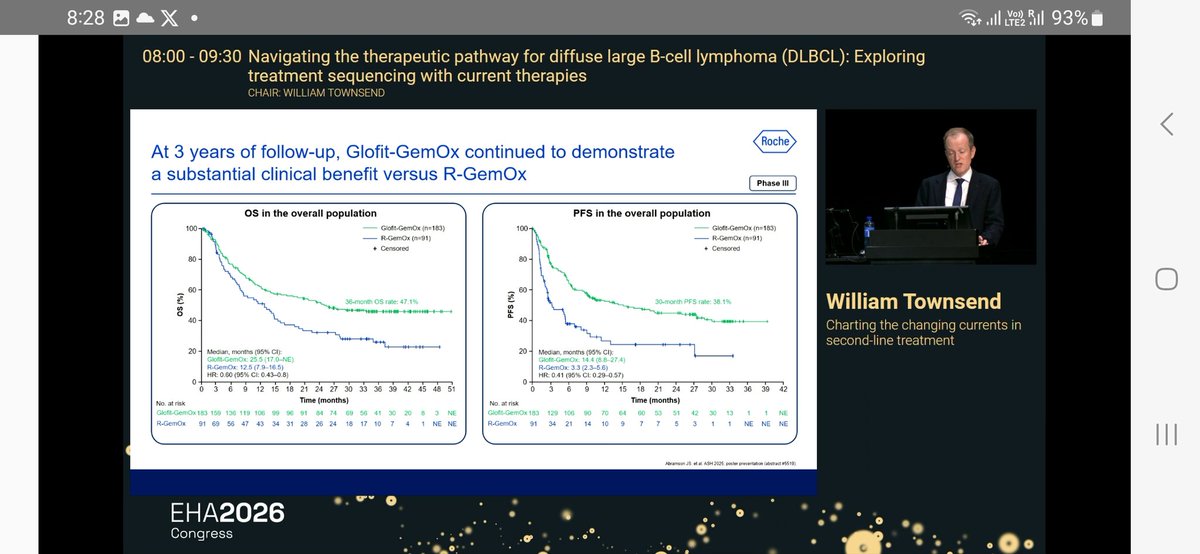
Management of R/R DLBCL #EHA26

1.1K impressions · View on X →
Daniel Auclair
Daniel Auclair @AuclairDan

Dr. Niels van de Donk updating MajesTEC-4 at #EHA26 #EHA2026 #mmsm

990 impressions · View on X →
[Slide 1] EMN30/MajesTEC-4 SRI: Cumulative Incidence of Grade 3/4 Infections 1.0 0.9 0.8 0.7 Cumulative incidence of 0.6 Tec Q4W + Len Q4W + Len grade 3/4 infections Tec QW 0.5 0.4 0.3 0.2 0.1 Tec Q4W 0 0 3 6 9 12 15 18 21 24 27 30 33 36 Study month Number at risk 6 5 4 0 32 28 25 25 23 19 14 14 Tec QW > Q4W + Len Tec Q4W + Len 32 27 24 17 14 12 2 0 0 0 0 27 Tec Q4W 30 24 22 22 22 22 21 1 0 0 0 0 Cumulative incidence of grade 3/4 infections plateaued with Tec Q4W from ~6 months 10 Presented by NWCJ van de Donk at the 31st European Hematology Association (EHA) Annual Meeting; June 11-14, 2026; Stockholm, Sweden --- [Slide 2] EMN30/MajesTEC-4 SRI: Response Rates Post-ASCT and During Maintenance Efficacy data cutoff: December 8, 2025 60.0% 96.7% 100% 40.6% 96.9% >CR rate 46.9% 10.0 sCR 100 12.5 CR 31.3 80 VGPR 28.1 50.0 75.0 76.7 PR 60 15.6 Patients (%) 93.8 40 43.8 34.4 23.3 20 21.9 20.0 18.8 15.6 3.1 16.7 3.3 6.3 0 Response Best response Response Best response Response Best response post-ASCT on maintenance post-ASCT on maintenance post-ASCT on maintenance Tec QW > Q4W + Len (n=32) Tec Q4W + Len (n=32) Tec Q4W (n=30) Median follow-up, 35.3 mo Median follow-up, 23.7 mo Median follow-up, 23.7 mo >CR was reached in nearly 100% of patients during maintenance across cohorts sCR, stringent complete response; VGPR, very good partial response. Response based on investigator assessment *Post-ASCT consolidation. 11 Presented by NWCJ van de Donk at the 31st European Hematology Association (EHA) Annual Meeting: June 11-14, 2026; Stockholm, Sweden --- [Slide 3] EMN30/MajesTEC-4 SRI: Progression-Free Survival Estimated 18-mo Estimated 24-mo 96.4% 96.6% 100 Cohort 3: Median PFS was not 90 Cohort 2: Tec Q4W 93.8% Cohort 1: Tec Q4W +Len Tec QW > Q4W + reached in any cohort 80 Len % of patients progression 70 Only 3 patients progressed free and alive 60 - 2 in Cohort 1 50 40 - 1 in Cohort 3 30 20 10 0 0 3 6 9 12 15 18 21 24 27 30 33 Number at risk PFS (months) Tec QW + Q4W + Len 32 32 32 32 31 29 28 28 28 25 2 0 31 31 31 31 26 5 0 0 0 0 0 Tec Q4W + Len 32 Tec Q4W 30 29 28 27 26 26 6 0 0 0 0 0 Estimated 18- and 24-month PFS rates were 94%-97%, with only 3 progression events Clinical cutoff date: May 7, 2025. 13 Presented by NWCJ van de Donk at the 31st European Hematology Association (EHA) Annual Meeting; June 11-14, 2026; Stockholm, Sweden --- [Slide 4] EMN30/Majes TEC-4 SRI: Tec ± Len as Maintenance Therapy Post-ASCT in NDMM Tec and Tec-Len were safety administered as 2-year fixed-duration post-ASCT maintenance, with convenient Tec Q4W dosing after cycle 1 (median follow-up ~2-3 years) CRS and infections were manageable via established protocols, supporting use across practice settings Tec-based maintenance delivered remarkable depth of response post-ASCT, which deepened over time: - -97%-100% of patients achieved >CR post-ASCT - 90%-100% of evaluable patients achieved MRD-negative CR at 12 months Estimated 18- and 24-mo PFS rates were 94%-97%, with only 3 progression events The randomized portion is open and evaluating Tec-Len, Tec, and Len as maintenance with monthly Tec dosing Tec + Len as post-ASCT maintenance in NDMM is a promising new maintenance approach Presented by NWCJ van de Donk at the 31st European Hematology Association (EHA) Annual Meeting: June 11-14, 2026; Stockholm, Sweden 14 --- [Slide 5] EMN30/MajesTEC-4 SRI: Cumulative Incidence of Grade 3/4 Infections 1.0 0.9 0.8 0.7 Cumulative incidence of 0.6 Tec Q4W + Len Q4W + Len grade 3/4 infections Tec QW 0.5 0.4 0.3 0.2 0.1 Tec Q4W 0 0 3 6 9 12 15 18 21 24 27 30 33 36 Study month Number at risk 6 5 4 0 32 28 25 25 23 19 14 14 Tec QW > Q4W + Len Tec Q4W + Len 32 27 24 17 14 12 2 0 0 0 0 27 Tec Q4W 30 24 22 22 22 22 21 1 0 0 0 0 Cumulative incidence of grade 3/4 infections plateaued with Tec Q4W from ~6 months 10 Presented by NWCJ van de Donk at the 31st European Hematology Association (EHA) Annual Meeting; June 11-14, 2026; Stockholm, Sweden --- [Slide 6] EMN30/MajesTEC-4 SRI: Response Rates Post-ASCT and During Maintenance Efficacy data cutoff: December 8, 2025 60.0% 96.7% 100% 40.6% 96.9% >CR rate 46.9% 10.0 sCR 100 12.5 CR 31.3 80 VGPR 28.1 50.0 75.0 76.7 PR 60 15.6 Patients (%) 93.8 40 43.8 34.4 23.3 20 21.9 20.0 18.8 15.6 3.1 16.7 3.3 6.3 0 Response Best response Response Best response Response Best response post-ASCT on maintenance post-ASCT on maintenance post-ASCT on maintenance Tec QW > Q4W + Len (n=32) Tec Q4W + Len (n=32) Tec Q4W (n=30) Median follow-up, 35.3 mo Median follow-up, 23.7 mo Median follow-up, 23.7 mo >CR was reached in nearly 100% of patients during maintenance across cohorts sCR, stringent complete response; VGPR, very good partial response. Response based on investigator assessment *Post-ASCT consolidation. 11 Presented by NWCJ van de Donk at the 31st European Hematology Association (EHA) Annual Meeting: June 11-14, 2026; Stockholm, Sweden --- [Slide 7] EMN30/MajesTEC-4 SRI: Progression-Free Survival Estimated 18-mo Estimated 24-mo 96.4% 96.6% 100 Cohort 3: Median PFS was not 90 Cohort 2: Tec Q4W 93.8% Cohort 1: Tec Q4W +Len Tec QW > Q4W + reached in any cohort 80 Len % of patients progression 70 Only 3 patients progressed free and alive 60 - 2 in Cohort 1 50 40 - 1 in Cohort 3 30 20 10 0 0 3 6 9 12 15 18 21 24 27 30 33 Number at risk PFS (months) Tec QW + Q4W + Len 32 32 32 32 31 29 28 28 28 25 2 0 31 31 31 31 26 5 0 0 0 0 0 Tec Q4W + Len 32 Tec Q4W 30 29 28 27 26 26 6 0 0 0 0 0 Estimated 18- and 24-month PFS rates were 94%-97%, with only 3 progression events Clinical cutoff date: May 7, 2025. 13 Presented by NWCJ van de Donk at the 31st European Hematology Association (EHA) Annual Meeting; June 11-14, 2026; Stockholm, Sweden --- [Slide 8] EMN30/Majes TEC-4 SRI: Tec ± Len as Maintenance Therapy Post-ASCT in NDMM Tec and Tec-Len were safety administered as 2-year fixed-duration post-ASCT maintenance, with convenient Tec Q4W dosing after cycle 1 (median follow-up ~2-3 years) CRS and infections were manageable via established protocols, supporting use across practice settings Tec-based maintenance delivered remarkable depth of response post-ASCT, which deepened over time: - -97%-100% of patients achieved >CR post-ASCT - 90%-100% of evaluable patients achieved MRD-negative CR at 12 months Estimated 18- and 24-mo PFS rates were 94%-97%, with only 3 progression events The randomized portion is open and evaluating Tec-Len, Tec, and Len as maintenance with monthly Tec dosing Tec + Len as post-ASCT maintenance in NDMM is a promising new maintenance approach Presented by NWCJ van de Donk at the 31st European Hematology Association (EHA) Annual Meeting: June 11-14, 2026; Stockholm, Sweden 14
Breno Moreno de Gusmão
Breno Moreno de Gusmão @morenodegusmao

SUCCESSOR-2 #EHA2026 MeziKd vs Kd in anti-CD38 + LEN-exposed RRMM: 📊 PFS 18.0 vs 8.3 months (HR 0.48 | p<0.0001) ✅ ORR 80% | ≥CR 27% | VGPR doubled, CR tripled Not com

900 impressions · View on X →
[Slide 1] SUCCESSOR-2: Treatment Response ORR 80.2% MeziKd Kd 2 CR ORR (N 288) (N 191) 80 26.7 53.4% CR Time to response, median 1.1 1.1 25 (range), monthsa (0.7-7.4) (0.9-7.9) IV CR CR 72 54 8.9 VGPR 12-month DoR, % (95% CI) (65-78) (41-66) 8,4 2 VGPR 40 2 VGPR PR 33.3 60.1 22 30.9 Minimal residual disease analysis is ongoing, and results will be reported in future presentations 20.1 22.5 0 MeziKd Kd (N 288) (N = 191) With a median follow up of 10.6 months, the addition of Mezi to Kd deepened response, doubling the rate of VGPR or better and tripling the rate of CR or better Data cuterf January 15, 2026. in the confirmatory analysis proup, defined as all patients from stages and randomized to mg Megi plus Kd or Kd. test overall response was evaluated by an independent review committee Percentages may not total 100 due to rounding. aTime to response defined as the time from randomization the first unentation response PR better). Dimopoutos MA, et al. EMA 2026, Presentation L85004 SUCCESSOR-2 SUCCESSOR-2: PFS2 Median PFS2 Hazard ratio 1.0 23.6 months HR 0.53 antimyeloma MeziKd Kd 0.9 therapy, - (N 288) (N 191) 13.0 months (95% CI, 0.39-0.72) 0.8 Any subsequent therapy 24.0 49.7 P 0.7 Bispecific antibodies 10.1 21.5 r IMIDs 6.9 20.4 0 0.6 MeziKd b POM 5.6 18.3 0.5 a LEN 0.3 1.0 b 0.4 Pls 6.6 11.0 0.3 Kd Standard chemotherapyb 6.6 12.6 0.2 t Other 4.9 8.9 y 0.1 Median follow-up: 10.6 months Anti-CD38 mAbs 4.2 7.3 0 f 0 Investigational drugs 2.8 7.3 P 0 3 6 9 12 15 18 21 24 27 30 33 Anti-SLAME7 mAbs 1.4 5.8 F Time (months) No. risk CAR-T cell therapiesc 1.4 4.7 Mezikd 288 273 238 173 116 72 39 30 19 9 3 0 Antibody-drug conjugates 0.3 3.1 Kd 191 171 143 101 63 31 19 12 5 2 0 0 Superior PFS2 with MeziKd demonstrates sustained clinical benefit beyond first progression Data cuteff: January 15. 2026. in the confirmatory analysis group, defined as all patients from stages and randomized to mg MO Kd or Kd. PF52 - per investigator assessment. aircludes subsequent antimyeloma therapies that were received by of patients either treatment arm the confirmatory analysis paup, bistandard chemotherapy includes: nitrogen mustard analogs, anthracyclines and related substances, podophyllotoxin derivatives, platinum compounds, purine analogs, and vinca alkaloids and analogs: cRefers to the output of "Cell and Gene therapies" CAR, chameric antigen receptor. Dimopoutos MA, et at. DIA 2026, Presentation L85004 SUCCESSOR-2 SUCCESSOR-2: Overall Survival 1.0 000 0.9 0.8 P 0.7 O 0000 MeziK r - OODO 0.6 0 DO 000 0000 00 0 - Kd b 0.5 No. of Hazard ratio a 0.4 62/288 (21.5%) HR 0.79 b il 0.3 51/191 (26.7%) (95% CI, 0.54-1.15) it 0.2 y Median follow-up: 10.6 months 0.1 0 f 0 0 0 3 6 9 12 15 18 21 24 27 30 33 No. at visk Time (months) MeziK 28 27 24 18 12 79 45 35 25 12 5 0 Kd B) 137 15 a 84 44 31 24 12 5 0 0 1 5 7 8 Planned futility analysis demonstrates a positive os trend favoring MeziKd with no cross over of the curves Data cuteff: January 15, 2026. in the confirmatory analysis group, defined as all patients from stages and randomized to mg - plus Kd or Kd. Deaths occurred - 21.5% Mezikd) and 26.7% (Kd) of patients Dimopoulos MA, et al. EHA 2026, Presentation LB5004 --- [Slide 2] SUCCESSOR-2: Treatment Response ORR 80.2% MeziKd Kd 2 CR ORR (N 288) (N 191) 80 26.7 53.4% CR Time to response, median 1.1 1.1 25 (range), monthsa (0.7-7.4) (0.9-7.9) IV CR CR 72 54 8.9 VGPR 12-month DoR, % (95% CI) (65-78) (41-66) 8,4 2 VGPR 40 2 VGPR PR 33.3 60.1 22 30.9 Minimal residual disease analysis is ongoing, and results will be reported in future presentations 20.1 22.5 0 MeziKd Kd (N 288) (N = 191) With a median follow up of 10.6 months, the addition of Mezi to Kd deepened response, doubling the rate of VGPR or better and tripling the rate of CR or better Data cuterf January 15, 2026. in the confirmatory analysis proup, defined as all patients from stages and randomized to mg Megi plus Kd or Kd. test overall response was evaluated by an independent review committee Percentages may not total 100 due to rounding. aTime to response defined as the time from randomization the first unentation response PR better). Dimopoutos MA, et al. EMA 2026, Presentation L85004 SUCCESSOR-2 SUCCESSOR-2: PFS2 Median PFS2 Hazard ratio 1.0 23.6 months HR 0.53 antimyeloma MeziKd Kd 0.9 therapy, - (N 288) (N 191) 13.0 months (95% CI, 0.39-0.72) 0.8 Any subsequent therapy 24.0 49.7 P 0.7 Bispecific antibodies 10.1 21.5 r IMIDs 6.9 20.4 0 0.6 MeziKd b POM 5.6 18.3 0.5 a LEN 0.3 1.0 b 0.4 Pls 6.6 11.0 0.3 Kd Standard chemotherapyb 6.6 12.6 0.2 t Other 4.9 8.9 y 0.1 Median follow-up: 10.6 months Anti-CD38 mAbs 4.2 7.3 0 f 0 Investigational drugs 2.8 7.3 P 0 3 6 9 12 15 18 21 24 27 30 33 Anti-SLAME7 mAbs 1.4 5.8 F Time (months) No. risk CAR-T cell therapiesc 1.4 4.7 Mezikd 288 273 238 173 116 72 39 30 19 9 3 0 Antibody-drug conjugates 0.3 3.1 Kd 191 171 143 101 63 31 19 12 5 2 0 0 Superior PFS2 with MeziKd demonstrates sustained clinical benefit beyond first progression Data cuteff: January 15. 2026. in the confirmatory analysis group, defined as all patients from stages and randomized to mg MO Kd or Kd. PF52 - per investigator assessment. aircludes subsequent antimyeloma therapies that were received by of patients either treatment arm the confirmatory analysis paup, bistandard chemotherapy includes: nitrogen mustard analogs, anthracyclines and related substances, podophyllotoxin derivatives, platinum compounds, purine analogs, and vinca alkaloids and analogs: cRefers to the output of "Cell and Gene therapies" CAR, chameric antigen receptor. Dimopoutos MA, et at. DIA 2026, Presentation L85004 SUCCESSOR-2 SUCCESSOR-2: Overall Survival 1.0 000 0.9 0.8 P 0.7 O 0000 MeziK r - OODO 0.6 0 DO 000 0000 00 0 - Kd b 0.5 No. of Hazard ratio a 0.4 62/288 (21.5%) HR 0.79 b il 0.3 51/191 (26.7%) (95% CI, 0.54-1.15) it 0.2 y Median follow-up: 10.6 months 0.1 0 f 0 0 0 3 6 9 12 15 18 21 24 27 30 33 No. at visk Time (months) MeziK 28 27 24 18 12 79 45 35 25 12 5 0 Kd B) 137 15 a 84 44 31 24 12 5 0 0 1 5 7 8 Planned futility analysis demonstrates a positive os trend favoring MeziKd with no cross over of the curves Data cuteff: January 15, 2026. in the confirmatory analysis group, defined as all patients from stages and randomized to mg - plus Kd or Kd. Deaths occurred - 21.5% Mezikd) and 26.7% (Kd) of patients Dimopoulos MA, et al. EHA 2026, Presentation LB5004
Mostafa Faisal
Mostafa Faisal @MostafaFaisal14

MajesTEC-3 vs MonumenTAL-3

896 impressions · View on X →
Benlazar S M A
Benlazar S M A @smbenlazar

Blast phase CML : conclusion and messages #EHA26

797 impressions · View on X →
[Slide 1] Lessons Learned Thus Far Overall survival remains extremely poor in BP-CML There is tremendous heterogeneity in the biology and clinical presentation of BP-CML No standard chemotherapy regimen has been identified AlloSCT results in deeper molecular responses and improved OS and should be employed whenever possible in patients in second CP Data is conflicting on the need for chemotherapy plus TKI VS TKI monotherapy in patients It appears that this is less relevant as long as patients are consolidated with alloSCT in second CP More collaborative efforts are need to build larger data sets to assess ideal chemotherapy regimens and preferred TKI ELN BP-CML prognostic scoring system is predictive of outcomes and has been validated by the H Jean Khoury Cure CML Consortium data set Clinical trials are crucial in this space in order to develop better therapeutic options We have a long way to go in order to improve outcomes for this group of patients. --- [Slide 2] Lessons Learned Thus Far Overall survival remains extremely poor in BP-CML There is tremendous heterogeneity in the biology and clinical presentation of BP-CML No standard chemotherapy regimen has been identified AlloSCT results in deeper molecular responses and improved OS and should be employed whenever possible in patients in second CP Data is conflicting on the need for chemotherapy plus TKI VS TKI monotherapy in patients It appears that this is less relevant as long as patients are consolidated with alloSCT in second CP More collaborative efforts are need to build larger data sets to assess ideal chemotherapy regimens and preferred TKI ELN BP-CML prognostic scoring system is predictive of outcomes and has been validated by the H Jean Khoury Cure CML Consortium data set Clinical trials are crucial in this space in order to develop better therapeutic options We have a long way to go in order to improve outcomes for this group of patients.
Daniel Auclair
Daniel Auclair @AuclairDan

MajesTEC-9 at #EHA26 #EHA2026 #mmsm

632 impressions · View on X →
Benlazar S M A
Benlazar S M A @smbenlazar

BTKi frontline trials in elderly MCL #EHA26

497 impressions · View on X →
Benlazar S M A
Benlazar S M A @smbenlazar

Treatment sequencing and role of transplant and cellular therapies in HL : Summary #EHA26 #EHA2026

488 impressions · View on X →
[Slide 1] Summary BV and PD-1i proven to be efficacious with manageable toxicity Desire is to use as early as possible in treatment pathway At relapse, targeted agents, particularly PD-1i, are of benefit Autograft still provides a curative approach Cathy Burton Treatment sequencing an Probably can omit autograft for selected patients transplant and cellular the HL Allografting limited to relapse after autograft Retreatment is feasible especially if later relapse CD30-directed CAR-T cells remain in clinical trial setting --- [Slide 2] Summary BV and PD-1i proven to be efficacious with manageable toxicity Desire is to use as early as possible in treatment pathway At relapse, targeted agents, particularly PD-1i, are of benefit Autograft still provides a curative approach Cathy Burton Treatment sequencing an Probably can omit autograft for selected patients transplant and cellular the HL Allografting limited to relapse after autograft Retreatment is feasible especially if later relapse CD30-directed CAR-T cells remain in clinical trial setting
Benlazar S M A
Benlazar S M A @smbenlazar

Summary of 2L+ treatment of HL #EHA26 #EHA2026

477 impressions · View on X →
[Slide 1] Summary of 2L+ treatment Aiming for ASCT remains standard approach at 2L Aiming for CMR (achieving very good PR may be satisfactory) Ideally PD-1i used either as monotherapy or concomitantly or sequentially with chemotherapy if response to single agent is insufficient Alternatively, if PD-1i not available, BV in combination with chemotherapy --- [Slide 2] Summary of 2L+ treatment Aiming for ASCT remains standard approach at 2L Aiming for CMR (achieving very good PR may be satisfactory) Ideally PD-1i used either as monotherapy or concomitantly or sequentially with chemotherapy if response to single agent is insufficient Alternatively, if PD-1i not available, BV in combination with chemotherapy
Benlazar S M A
Benlazar S M A @smbenlazar

Options post auto SCT in R/R HL #EHA26 #EHA2026

396 impressions · View on X →
[Slide 1] Options post autograft: PD-1i Nivolumab for R/R HL: CheckMate 205 study Ansell et al. Blood Adv 2023 Allogeneic transplantation after PD-1 blockade Nivo every 2 weeks until progression or toxicity Merryman et al Leukaemia 2021 After prior BV or ASCT or ASCT/BV 209 patients Improved outcomes from 2yr os of 65% to 82% Pembrolizumab for R/R HL: KEYNOTE-087 study Caution re GVHD Armand et al Blood 2023 Post-transplant cyclophosphamide GVHD Every 3 weeks for up to 2 years prophylaxis associated with improved PFS After prior ASCT/BV or salvage chemo/BV or ASCT 200+ patients Checkpoint blockade sensitisation ORR 71%, CRR approx. 25% Carreau et al Oncologist 2020 Median DoR 16-18 months, PFS 13-15 months 5 year OS 71% --- [Slide 2] Options post autograft: PD-1i Nivolumab for R/R HL: CheckMate 205 study Ansell et al. Blood Adv 2023 Allogeneic transplantation after PD-1 blockade Nivo every 2 weeks until progression or toxicity Merryman et al Leukaemia 2021 After prior BV or ASCT or ASCT/BV 209 patients Improved outcomes from 2yr os of 65% to 82% Pembrolizumab for R/R HL: KEYNOTE-087 study Caution re GVHD Armand et al Blood 2023 Post-transplant cyclophosphamide GVHD Every 3 weeks for up to 2 years prophylaxis associated with improved PFS After prior ASCT/BV or salvage chemo/BV or ASCT 200+ patients Checkpoint blockade sensitisation ORR 71%, CRR approx. 25% Carreau et al Oncologist 2020 Median DoR 16-18 months, PFS 13-15 months 5 year OS 71%
Ahmed Kotb
Ahmed Kotb @AhmedKo45911157

📌 #EHA26 Infection Sources in HSCT 🔹Air, water, food, catheters, and close contacts are major infection sources. 🔹Common pathogens include Aspergillus, Candida, Pseudomon

348 impressions · View on X →
[Slide 1] 8:49 Bill LTE2 Vo)) Bill 86% 08:00 - 09:30 From Conventional to Emerging Approaches: Evolving Infection Prevention Strategies in Allogeneic Haematopoietic stem cell transplantation (HSCT) and Cellular Therapies CHAIR: ALESSANDRO BUSCA Endogenous and exogenous micro-organisms Air Catheters Ventilation systems, air conditioners, IV solutions, blood Fungi building materials products, indwelling Aspergillus catheters, drainage tubes, Water Fusarium endoscopes, tapes, plasters Candida Johan Maertens Tap water, ice, vaporizers, humidifiers, sink drains, toilets, Bacteria Prophylaxis-Led Infection Contacts baths, showers, cut flowers Enterobacteriaceae Prevention Pseudomonas aeruginosa Health care workers, other Staphylococcus aureus patients, visitors, objects Food Enterococcus including thermometers & Clostridium difficile toiletries, bed linen Dairy products, fresh fruits & vegetables, uncooked/unprocessed Viruses foods, dried foodstuffs, meats HSV-CMV VZV CMV, cytomegalovirus; EBV, Epstein Barr virus, HIV, RSV human immunodeficiency virus, HSV, herpes simplex Hepatitis B virus, IV, intravenous; RSV, respiratory syncytial virus, HIV SARS-COVID-19 severe acute respiratory syndrome coronavirus disease 2019; VZV, varicella coster virus SARS-CoV-2 Maertens personal creation EHA2026 Congress --- [Slide 2] 8:49 Bill LTE2 Vo)) Bill 86% 08:00 - 09:30 From Conventional to Emerging Approaches: Evolving Infection Prevention Strategies in Allogeneic Haematopoietic stem cell transplantation (HSCT) and Cellular Therapies CHAIR: ALESSANDRO BUSCA Endogenous and exogenous micro-organisms Air Catheters Ventilation systems, air conditioners, IV solutions, blood Fungi building materials products, indwelling Aspergillus catheters, drainage tubes, Water Fusarium endoscopes, tapes, plasters Candida Johan Maertens Tap water, ice, vaporizers, humidifiers, sink drains, toilets, Bacteria Prophylaxis-Led Infection Contacts baths, showers, cut flowers Enterobacteriaceae Prevention Pseudomonas aeruginosa Health care workers, other Staphylococcus aureus patients, visitors, objects Food Enterococcus including thermometers & Clostridium difficile toiletries, bed linen Dairy products, fresh fruits & vegetables, uncooked/unprocessed Viruses foods, dried foodstuffs, meats HSV-CMV VZV CMV, cytomegalovirus; EBV, Epstein Barr virus, HIV, RSV human immunodeficiency virus, HSV, herpes simplex Hepatitis B virus, IV, intravenous; RSV, respiratory syncytial virus, HIV SARS-COVID-19 severe acute respiratory syndrome coronavirus disease 2019; VZV, varicella coster virus SARS-CoV-2 Maertens personal creation EHA2026 Congress
Raul Cordoba, MD, PhD #EHA2026
Raul Cordoba, MD, PhD #EHA2026 @DrRaulCordoba

Very well presented by @DrMDavids #EHA2026 #CLL #lymsm

331 impressions · View on X →
[Slide 1] 09:15 - 10:45 Late-Breaking Oral Session CHAIRS: MERITXELL ALBERICH JORDA, KONSTANZE DOHNER Conclusions BRUIN CLL-322 is the first randomized, phase 3 study to assess a fixed-duration targeted therapy regimen in a CLL patient population with prior cBTKi exposure; results are from a prespecified interim analysis PVR demonstrated superiority in IRC-assessed PFS compared with VR (HR = 0.547) with 24- month rates of PVR 86.9% VS VR 71.8% The VR 24-month PFS rate is notably lower than that reported in MURANO (84.9%), reflecting the mostly BTKi-pretreated population enrolled here Matthew Davids Consistent PVR PFS benefit across prespecified subgroups, including post-cBTKi, second-line, and FIXED-DURATION PIRTOBRUTINIB PLUS high-risk disease (unmutated IGHV, Del(17p) and/or TP53 mutation, complex karyotype) VENETOCLAX-RITUXIMAB VERSUS VENETOCLAX- RITUXIMAB FOR PATIENTS WITH PREVIOUSLY Among patients with evaluable EOT samples, the uMRD4 rate was higher with PVR compared with TREATED CLL/SLL: A PHASE 3, RANDOMIZED TRIAL VR (86% [101/117] VS 61% [71/117]; P< 0.0001) (BRUIN CLL-322) PVR was well-tolerated with a safety profile consistent with the individual agents and no new safety signals These results establish PVR as a potential new standard of care option for patients with previously treated CLL EHA2026 eha Congress --- [Slide 2] 09:15 - 10:45 Late-Breaking Oral Session CHAIRS: MERITXELL ALBERICH JORDA, KONSTANZE DOHNER Conclusions BRUIN CLL-322 is the first randomized, phase 3 study to assess a fixed-duration targeted therapy regimen in a CLL patient population with prior cBTKi exposure; results are from a prespecified interim analysis PVR demonstrated superiority in IRC-assessed PFS compared with VR (HR = 0.547) with 24- month rates of PVR 86.9% VS VR 71.8% The VR 24-month PFS rate is notably lower than that reported in MURANO (84.9%), reflecting the mostly BTKi-pretreated population enrolled here Matthew Davids Consistent PVR PFS benefit across prespecified subgroups, including post-cBTKi, second-line, and FIXED-DURATION PIRTOBRUTINIB PLUS high-risk disease (unmutated IGHV, Del(17p) and/or TP53 mutation, complex karyotype) VENETOCLAX-RITUXIMAB VERSUS VENETOCLAX- RITUXIMAB FOR PATIENTS WITH PREVIOUSLY Among patients with evaluable EOT samples, the uMRD4 rate was higher with PVR compared with TREATED CLL/SLL: A PHASE 3, RANDOMIZED TRIAL VR (86% [101/117] VS 61% [71/117]; P< 0.0001) (BRUIN CLL-322) PVR was well-tolerated with a safety profile consistent with the individual agents and no new safety signals These results establish PVR as a potential new standard of care option for patients with previously treated CLL EHA2026 eha Congress
CLL Ireland
CLL Ireland @CllIreland

Maybe a new #CLL treatment option presented at #EHA2026 as the results of clinical trial BRUIN CLL-322 show the drug combination PVR could change the standard of care fo

192 impressions · View on X →
[Slide 1] 09:15 - 10:45 Late-Breaking Oral Session CHAIRS: MERITXELL ALBERICH JORDA, KONSTANZE DOHNER Conclusions BRUIN CLL-322 is the first randomized, phase 3 study to assess a fixed-duration targeted therapy regimen in a CLL patient population with prior cBTKi exposure; results are from a prespecified interim analysis PVR demonstrated superiority in IRC-assessed PFS compared with VR (HR = 0.547) with 24- month rates of PVR 86.9% VS VR 71.8% The VR 24-month PFS rate is notably lower than that reported in MURANO (84.9%), reflecting the mostly BTKi-pretreated population enrolled here Matthew Davids Consistent PVR PFS benefit across prespecified subgroups, including post-cBTKi, second-line, and FIXED-DURATION PIRTOBRUTINIB PLUS high-risk disease (unmutated IGHV, Del(17p) and/or TP53 mutation, complex karyotype) VENETOCLAX-RITUXIMAB VERSUS VENETOCLAX- RITUXIMAB FOR PATIENTS WITH PREVIOUSLY Among patients with evaluable EOT samples, the uMRD4 rate was higher with PVR compared with TREATED CLL/SLL: A PHASE 3, RANDOMIZED TRIAL VR (86% [101/117] VS 61% [71/117]; P< 0.0001) (BRUIN CLL-322) PVR was well-tolerated with a safety profile consistent with the individual agents and no new safety signals These results establish PVR as a potential new standard of care option for patients with previously treated CLL EHA2026 eha Congress --- [Slide 2] 09:15 - 10:45 Late-Breaking Oral Session CHAIRS: MERITXELL ALBERICH JORDA, KONSTANZE DOHNER Conclusions BRUIN CLL-322 is the first randomized, phase 3 study to assess a fixed-duration targeted therapy regimen in a CLL patient population with prior cBTKi exposure; results are from a prespecified interim analysis PVR demonstrated superiority in IRC-assessed PFS compared with VR (HR = 0.547) with 24- month rates of PVR 86.9% VS VR 71.8% The VR 24-month PFS rate is notably lower than that reported in MURANO (84.9%), reflecting the mostly BTKi-pretreated population enrolled here Matthew Davids Consistent PVR PFS benefit across prespecified subgroups, including post-cBTKi, second-line, and FIXED-DURATION PIRTOBRUTINIB PLUS high-risk disease (unmutated IGHV, Del(17p) and/or TP53 mutation, complex karyotype) VENETOCLAX-RITUXIMAB VERSUS VENETOCLAX- RITUXIMAB FOR PATIENTS WITH PREVIOUSLY Among patients with evaluable EOT samples, the uMRD4 rate was higher with PVR compared with TREATED CLL/SLL: A PHASE 3, RANDOMIZED TRIAL VR (86% [101/117] VS 61% [71/117]; P< 0.0001) (BRUIN CLL-322) PVR was well-tolerated with a safety profile consistent with the individual agents and no new safety signals These results establish PVR as a potential new standard of care option for patients with previously treated CLL EHA2026 eha Congress
Myeloma Patients Europe
Myeloma Patients Europe @MyelomaEurope

“There is heterogeneity in approvals of important and innovative myeloma drugs across Europe.” Prof Pieter Sonneveld opens the #EHA26 #myeloma access session.

92 impressions · View on X →
[Slide 1] Current EU Public Reimbursement Status of BCMA and GPRC5D targeting treatments NL Germany France Spain Italy UK Cilta-cel No Yes, 2L+ No Yes, 2L+ Yes, 2L+ No (Carvykti®) Teclistamab No Yes, 4L+ Yes, 4L+ Yes, 4L+ Yes, 4L+ Yes, 4L+ (Tecvayli®) Talquetamab No Yes, 4L+ No Yes, 4L+ Yes, 4L+ Yes, 4L+ Pieter Sonneveld (Talvey) Elranatamab Yes, 4L+ Yes, 4L+ Yes, 4L+ Yes, 4L+ Yes, 4L+ Yes, 4L+ (Elrexfio®) Ide-cel No Yes, 2L+ Yes, 2L+ Yes, 2L+ Yes, 2L+ Yes, 2L+ (Abecma) eha --- [Slide 2] Current EU Public Reimbursement Status of BCMA and GPRC5D targeting treatments NL Germany France Spain Italy UK Cilta-cel No Yes, 2L+ No Yes, 2L+ Yes, 2L+ No (Carvykti®) Teclistamab No Yes, 4L+ Yes, 4L+ Yes, 4L+ Yes, 4L+ Yes, 4L+ (Tecvayli®) Talquetamab No Yes, 4L+ No Yes, 4L+ Yes, 4L+ Yes, 4L+ Pieter Sonneveld (Talvey) Elranatamab Yes, 4L+ Yes, 4L+ Yes, 4L+ Yes, 4L+ Yes, 4L+ Yes, 4L+ (Elrexfio®) Ide-cel No Yes, 2L+ Yes, 2L+ Yes, 2L+ Yes, 2L+ Yes, 2L+ (Abecma) eha

Top Voices by Impressions

Ranked by total impressions across all EHA 2026 tweets captured. Switch tabs to view physicians, institutions, and media separately.

#1 @smbenlazar
Benlazar S M A @smbenlazar
85.8K 123 tweets
#2 @laura_korin
Laura Korin @laura_korin
36.9K 13 tweets
#3 @dr_amerzeidan
32.5K 12 tweets
#4 @rahulbanerjeemd
Rahul Banerjee, MD, FACP @rahulbanerjeemd
31.3K 33 tweets
#5 @hadidisamer
25.8K 23 tweets
#6 @doctorpemm
Naveen Pemmaraju, MD @doctorpemm
18.9K 20 tweets
#7 @drraulcordoba
16.2K 50 tweets
#8 @henrychihangfu1
15.4K 12 tweets
#9 @eddie_cliff
Eddie Cliff @eddie_cliff
14.6K 6 tweets
#10 @talhabadarmd
Talha Badar @talhabadarmd
13.5K 26 tweets
#11 @joshuarichtermd
Joshua Richter, MD, FACP @joshuarichtermd
13.3K 6 tweets
#12 @guiperinimd
Guilherme Perini, MD @guiperinimd
13.3K 3 tweets
#1 @eha_hematology
11.4K 18 tweets
#2 @ash_hematology
ASH @ash_hematology
4.0K 3 tweets
#3 @moffittnews
Moffitt Cancer Center @moffittnews
1.2K 6 tweets
#4 @blood_cancers
Blood Cancers Today @blood_cancers
959 9 tweets
#5 @myeloma_society
Myeloma Society @myeloma_society
774 2 tweets
#6 @societyofhemonc
415 1 tweet
#1 @nejm
NEJM @nejm
101.0K 6 tweets
#2 @biotechtv
BiotechTV @biotechtv
24.4K 11 tweets
#3 @jacobplieth
Jacob Plieth @jacobplieth
23.0K 7 tweets
#4 @lymphomahub
Lymphoma Hub @lymphomahub
18.6K 42 tweets
#5 @adamfeuerstein
Adam Feuerstein ✡️ @adamfeuerstein
17.4K 1 tweet
#6 @mm_hub
13.5K 42 tweets
#7 @onclive
OncLive.com @onclive
11.3K 32 tweets
#8 @aml_hub
AML Hub @aml_hub
9.7K 34 tweets

Top Tweets by Disease Area

Highest-impact physician tweets by blood cancer subtype. Expand the Clinical Trials section under each disease area to drill into trial-specific discussion.

🟣Multiple Myeloma249 tweets captured
@smbenlazar
Benlazar S M A @smbenlazar
TECLISTAMAB IMPROVES DEPTH OF RESPONSE AND PFS VERSUS LENALIDOMIDE-DEXAMETHASONE IN HIGH-RISK SMOLDERING MULTIPLE MYELOMA https://t.co/kcMXGzYpiJ #mmsm #EHA26 https://t.co/DNFDW7wX0G
👁 11.5K ❤ 27 🔁 10
@eddie_cliff
Eddie Cliff @eddie_cliff
Do you need to get your patient with myeloma into CR prior to autologous transplant? Answers to this and many other key questions in newly diagnosed myeloma with the eloquent and wise @VincentRK on @BloodCancerTalk - wherever you get your podcasts #mmsm #myeloma @rajshekharucms https://t.co/jP59PVdkx4
👁 7.7K ❤ 52 🔁 12
@rahulbanerjeemd
Rahul Banerjee, MD, FACP @rahulbanerjeemd
I’ve looked at this #EHA2026 slide 100x but it still always makes me pause. Unexpected early relapses so scary for patients with myeloma, and historically post-PD OS in FHRMM ≤ 2 years no matter what we do. Here, off-the-shelf Tx boosted 3-yr PFS from 0% to 77%. Giving these https://t.co/Idv0PXsxe1
👁 6.2K ❤ 75 🔁 17
@joshuarichtermd
Joshua Richter, MD, FACP @joshuarichtermd
@NoopurRajeMD is simply a world class myeloma doctor and a world class human being. One of the most influential doctors in this space and an inspiration to patients and colleagues alike. Such a well deserved award @IMFmyeloma #mmsm https://t.co/i83tvG3X88
👁 5.0K ❤ 76 🔁 9
@bdermanmd
Ben Derman @bdermanmd
4) LINKER-AL2: Linvoseltamab in relapsed AL amyloidosis. (Wechalekar, Lee, 7502) BCMA bispecifics are like magic in this population. In 20 pts: ✅ No DLTs or ICANS ✅ CRS/IRR were Grade 1–2, mostly during step-up dosing ✅ heme OR: 100% with 80 mg; 92% with 240 mg ✅ Median time
👁 4.5K ❤ 15 🔁 3
@HenrychihangFu1
Henry C Fung| MM, lymphoma, leukemia & CART @HenrychihangFu1
🧬 Can you predict the cytogenetics before the FISH returns? After seeing thousands of myeloma patients, certain morphology and clinical phenotypes start to become familiar. Myeloma often whispers its biology before the genomic report arrives. More to see in the figure 👇 https://t.co/caYd9HxCO0
👁 4.1K ❤ 78 🔁 38
Clinical Trials22 trials with discussion
MonumenTAL-3 Talquetamab + Dara +/- Pom · R/R MM
17.1K imp  ·  17 tweets
@nejm
NEJM @nejm
Original Article: Talquetamab–Daratumumab in Relapsed or Refractory Myeloma (phase 3 MonumenTAL-3 trial) https://t.co/rVgRU4aERe #EHA2026 | @EHA_Hematology https://t.co/GicKuL8Pu0
👁 8.4K ❤ 29 🔁 10
@HenrychihangFu1
Henry C Fung| MM, lymphoma, leukemia & CART @HenrychihangFu1
🧬 T-Cell Fitness vs Target As EHA 2026 unfolds, one of the strongest signals in myeloma may not be which antigen we target. It may be when we engage the immune system. MajesTEC-3 (BCMA) and MonumenTAL-3 (GPRC5D) used different targets, yet both produced remarkably similar https://t.co/vLyyvVLgi1 https://t.co/RzTkftass8
👁 2.6K ❤ 26 🔁 12
@hadidisamer
Samer Al Hadidi, MD,MS,FACP @hadidisamer
#mmsm #EHA26 MonumenTAL-3 Published @NEJM 🛑Ataxia/balance disorders: Tal-DP 15%, Tal-D 12%, DPd 0.4%. 🛑Onset is late: median ~292–326 days, increasing from cycle 7 onward (11% Tal-DP, 10% Tal-D)-Led to talquetamab discontinuation: 5% (Tal-DP) vs 2% (Tal-D) The major issue https://t.co/U9WE9EXgcZ
👁 2.3K ❤ 5 🔁 0
@vincentrk
Vincent Rajkumar @vincentrk
Just out: presented at #EHA26 and published @NEJM Randomized trial of 2 talquetamab combinations vs DPd in relapsed myeloma. The Monumental-3 trial. Both Talq-Dara-Pom and Talq-Dara beat DPd in PFS and OS. Choice of a Talq combination vs Tec or Tec-Dara in relapsed myeloma https://t.co/mgSlY8T8cu
👁 917 ❤ 17 🔁 9
@rahulbanerjeemd
Rahul Banerjee, MD, FACP @rahulbanerjeemd
@Dr_AmerZeidan @EHA_Hematology In myeloma - @PlasmaCellPete will be presenting MonumenTAL-3 Ph3 RCT of talquetamab +/- Dara/pom in earlier lines #MMsm. We have gotten a bit too hooked on BCMA as a field… So a BCMA-sparing PI-sparing dex-sparing bsAb regimen in earlier lines is a big #EHA2026 plenary win!
👁 810 ❤ 23 🔁 4
@JanakiramMurali
Murali Janakiram @JanakiramMurali
Now lets look at MONUMENTAL-3- Table S19 -captured ataxia and balance disorders -12.4 &14.5%, 2.9 & 2.2% Grade 3 -8% dose delays/skips -time to onset- 73 wks -81 wks -earliest is 3 and 24 days -quite different/delayed to what we are seeing in RWE -10-16% resolution, 68-88% no
👁 482 ❤ 6 🔁 1
@auclairdan
Daniel Auclair @auclairdan
MonumenTAL-3 study is out published simultaneously with presentation here at #EHA26 #EHA2026 by @PlasmaCellPete Congrats! #mmsm https://t.co/it0zv1Jr15
👁 418 ❤ 6 🔁 7
@mawildgust
Mark Wildgust (he/him) @mawildgust
Excited to see the #Monumental3 data being presented here @EHA_Hematology meeting #EHA2026 and now published in the @NEJM. Congratulations #PeterVoorhees. https://t.co/1QPVeU9ffQ
👁 237 ❤ 7 🔁 5
@mbeksac56
Meral Beksac @mbeksac56
@EHA_Hematology @RobertoMinaMD @gdnsvl @ninashah33 Happy to participate in MONUMENTAL-3 being launched at #EHA2026 and NEJM simultaneously https://t.co/fOHiyBFl46 another TCE and antiCD38 combo in RRMM
👁 224 ❤ 10 🔁 3
@oncodaily
OncoDaily @oncodaily
Presented by Peter Voorhees at the #EHA2026 Plenary Session, #MonumenTAL-3 evaluated whether introducing talquetamab-based combinations earlier in the treatment course could improve outcomes for patients with relapsed/refractory multiple myeloma. The study demonstrated https://t.co/tw8fmkR2ph
👁 217 ❤ 5 🔁 0
@myelomaeurope
Myeloma Patients Europe @myelomaeurope
Dr. Albert Orial explains the results from the phase III MONUMENTAL-3 clinical trial, explaining the benefits of talquetamab plus daratumumab for relapsed/refactory myeloma patients. #EHA2026 https://t.co/KZRzgAXDSU
👁 130 ❤ 0 🔁 1
@mtmdphd
Mike Thompson, MD, PhD, FASCO @mtmdphd
MonumenTAL BsA in MM - @PlasmaCellPete #EHA2026 #mmsm weight loss https://t.co/Q2MsYVUw7z
👁 92 ❤ 3 🔁 2
@cancernetwrk
CancerNetwork® @cancernetwrk
🩸 Talquetamab plus daratumumab, with or without pomalidomide, improved PFS among patients with relapsed/refractory multiple myeloma. Data from the MonumenTAL-3 trial highlighted at #EHA2026 support these regimens as new standards of care for patients as early as first relapse.
👁 87 ❤ 0 🔁 0
@mm_hub
Multiple Myeloma Hub @mm_hub
CONGRESS | #EHA2026 | PRESENTATION Peter Voorhees presents results from the phase III MonumenTAL-3 study evaluating talquetamab plus daratumumab ± pomalidomide (TalDP; TalD), versus daratumumab plus pomalidomide, and dexamethasone (DPd) for the treatment of RRMM. TalDP and TalD https://t.co/mL9LwXFykR
👁 81 ❤ 1 🔁 0
@morenodegusmao
Breno Moreno de Gusmão @morenodegusmao
🚨 MonumenTAL-3 #EHA2026 Talquetamab moves earlier in RRMM Phase 3 MonumenTAL3 met its primary endpoint, showing significant PFS improvement versus DPd in patients with relapsed/refractory multiple myeloma after ≥1 prior line #mmsm https://t.co/GWMbdgv2VW
👁 71 ❤ 1 🔁 1
@gjmccaughan
Georgia McCaughan @gjmccaughan
MonumenTAL3 @PlasmaCellPete #EHA2026 RCT Tal-DP vs Tal-D vs DPd RRMM. Median prior lines 2 Tal-DP & Tal-D sig. improved PFS. 2 year PFS: Tal-DP 81.3, Tal-D 77.6, DPd 51.2% Weight loss stabilises after first 6m Pts with 1+ grade 3 infection Tal-DP 37.7, Tal-D 29.2, DPd 42.4% https://t.co/xsvUhuAGqq
👁 47 ❤ 0 🔁 2
@jj_immedaffairs
J&J Innovative Medicine Global Medical Affairs @jj_immedaffairs
For US #HCPs at #EHA2026: watch Dr. Peter Voorhees present efficacy and safety results from Phase 3 MonumenTAL-3 study in patients with relapsed or refractory #MultipleMyeloma.​ https://t.co/7Kmy8dQBk4 https://t.co/aqkFiTh6oi
👁 42 ❤ 1 🔁 0
SUCCESSOR-2 Mezigdomide + Kd vs Kd · RRMM (LB5004, P3)
5.9K imp  ·  8 tweets
@johnntanasis
JohnNtan @johnntanasis
Late-breaking SUCCESSOR-2 results presented by @thanosdimop @UoATherapeutics #EHA2026 https://t.co/o5S1Y04Dll https://t.co/gbd3eVbb2T
👁 1.5K ❤ 17 🔁 7
@mm_hub
Multiple Myeloma Hub @mm_hub
CONGRESS | #EHA2026 | PRESENTATION Meletios Dimopoulos presents results from the phase III SUCCESSOR-2 trial evaluating mezigdomide plus carfilzomib and dexamethasone (MeziKd) versus Kd for the treatment of RRMM. MeziKd was associated with improved PFS versus Kd, with a median https://t.co/AMDu2qLbxD
👁 993 ❤ 16 🔁 8
@morenodegusmao
Breno Moreno de Gusmão @morenodegusmao
SUCCESSOR-2 #EHA2026 MeziKd vs Kd in anti-CD38 + LEN-exposed RRMM: 📊 PFS 18.0 vs 8.3 months (HR 0.48 | p<0.0001) ✅ ORR 80% | ≥CR 27% | VGPR doubled, CR tripled Not competing with bispecifics or CAR-T. Complementing them :earlier, broader, more scalable #mmsm https://t.co/3o87m4Ieep
👁 898 ❤ 10 🔁 6
@drrishabhonco
Dr Rishabh Jain @drrishabhonco
Mezigdomide, carfilzomib, and dexamethasone versus carfilzomib and dexamethasone in patients with relapsed or refractory multiple myeloma (SUCCESSOR-2): a phase 3, open-label, randomised controlled trial - The Lancet https://t.co/FPcbN5JV6x
👁 869 ❤ 2 🔁 0
@yleyfman
Yan Leyfman, MD @yleyfman
Mezigdomide moves to Phase 3 success in early relapsed myeloma. The phase 3 SUCCESSOR-2 trial met its primary endpoint, showing that mezigdomide + carfilzomib/dexamethasone (MeziKd) significantly improved outcomes versus Kd alone in patients with relapsed/refractory multiple
👁 828 ❤ 6 🔁 3
@auclairdan
Daniel Auclair @auclairdan
@MyelomaOslo revisiting SUCCESSOR-2 data here at #EHA26 #EHA2026 this morning. Interesting positive signal in hard-to-treat EMD. #mmsm https://t.co/dff1raYMoi
👁 582 ❤ 8 🔁 3
@myelomaeurope
Myeloma Patients Europe @myelomaeurope
The SUCCESSOR-2 trial results evaluating mezigdomide, carfilzomib and dexamethasone (mezikd) vs carfilzomib and dexamethasone (kd) in relapsed/refractory myeloma have been presented at #EHA2026
👁 150 ❤ 2 🔁 0
@oncoassist
ONCOassist® | The go-to oncology app @oncoassist
🚨 Latest #Oncology Update! 🔷 The Phase III SUCCESSOR-2 trial showed that Mezigdomide + Carfilzomib + Dexamethasone (MeziKd) significantly improved outcomes in relapsed/refractory multiple myeloma, reducing the risk of disease progression or death by 52% versus Carfilzomib + https://t.co/RIjwYRoYS9
👁 99 ❤ 0 🔁 0
ERASMM (EMN34) Elranatamab · early intervention high-risk smoldering MM (S205)
2.0K imp  ·  6 tweets
@bdermanmd
Ben Derman @bdermanmd
2) ERASMM (EMN34, Touzeau) - 50 pts with high-risk smoldering myeloma were treated with elranatamab for up to 24 cycles. 10 months of follow-up. Top-line: 92% ORR, 45% ≥CR. 9-month PFS rate 95% 14% Gr3+ infection rate (thus far). 20% neuropathy My take: While I still am not
👁 864 ❤ 8 🔁 2
@kansagramd
Ankit kansagra @kansagramd
First Phase 2 ERASMM (EMN34) results: safety and efficacy of elranatamab as early intervention in high-risk smoldering myeloma. Excellent work by Touzeau et all and entire EMN team. We have seen BCMA directed therapies - bispecific and CART in #SmolderingMM; we already seeing https://t.co/PJiOgRG9eI
👁 518 ❤ 6 🔁 1
@myelomaeurope
Myeloma Patients Europe @myelomaeurope
Results from the EMN34 trial on elranatamab in high-risk smouldering myeloma were just presented at #EHA2026 by Dr Cyrille Touzeau and we spoke to him before to find out what they could mean for patients. ▶️ Watch our interview: https://t.co/zVu9mEoBoR #myeloma #SM
👁 283 ❤ 0 🔁 0
@rahulbanerjeemd
Rahul Banerjee, MD, FACP @rahulbanerjeemd
#EHA2026 one of the biggest takeaways of any SMM trial is the importance of ruling out active MM to avoid undertreatment. #cyrilletouzeau presenting ERASMM now. Of 76 screened patients, 16 actually had active MM lesion on PET or MRI. Make sure you rule out active myeloma! https://t.co/AlgfDOSm7Y
👁 187 ❤ 4 🔁 2
@mm_hub
Multiple Myeloma Hub @mm_hub
CONGRESS | #EHA2026 | PRESENTATION Cyrille Touzeau presents first results from the phase II ERASMM study evaluating elranatamab administered for a fixed duration of 2 years as an early intervention strategy in high-risk smoldering multiple myeloma (n = 50). At a median FU of 14 https://t.co/rtET6Pe9ff
👁 95 ❤ 1 🔁 0
@morenodegusmao
Breno Moreno de Gusmão @morenodegusmao
(S205) Promising results from the ERASMM (EMN34) study on Elranatamab for High-Risk Smoldering Myeloma (HR SMM) ✅ ORR: 92% ✅ ≥CR: 45% ✅ 9-month PFS: 95% Early intervention with T-cell engagers shows robust efficacy and a manageable safety profile. #EHA2026 #mmsm
👁 78 ❤ 1 🔁 0
MajesTEC-3 Teclistamab + Daratumumab · R/R MM
9.9K imp  ·  5 tweets
@smbenlazar
Benlazar S M A @smbenlazar
TECLISTAMAB PLUS DARATUMUMAB (TEC-DARA) IN PATIENTS (PTS) WITH RELAPSED REFRACTORY MULTIPLE MYELOMA (RRMM): ANALYSIS OF MAJESTEC-3 BASED ON CYTOGENETIC AND FUNCTIONAL RISK https://t.co/MCb33znS4i #mmsm #EHA26 https://t.co/PB0FaSBHph
👁 4.3K ❤ 34 🔁 14
@HenrychihangFu1
Henry C Fung| MM, lymphoma, leukemia & CART @HenrychihangFu1
🇸🇪 There are hundreds of abstracts at #EHA2026. You cannot read them all. For myeloma & cellular therapy only, I grouped the meeting into 5 buckets: 🏆 Practice-changing 🚀 Breakthroughs ⏳ Mature data 🧬 Novel biology 🌱 Future horizons My top sessions include MAJESTEC-3, https://t.co/et8BsQaPm9
👁 2.9K ❤ 37 🔁 18
@hadidisamer
Samer Al Hadidi, MD,MS,FACP @hadidisamer
#mmsm #EHA26 MajesTEC-3 high risk post hoc analysis @RahulBanerjeeMD Tec-Dara worked well in patients with 2HRCA or more as well as functionally high risk Really good results in hard to treat patients https://t.co/A2zYezcsXA
👁 2.3K ❤ 16 🔁 7
@mawildgust
Mark Wildgust (he/him) @mawildgust
Phenomenal presentation by @RahulBanerjeeMD here at @EHA_Hematology #EHA2026! Drop the 🎤 moment with the high risk data! @End_myeloma and @mvmateos broke the MajesTEC-3 data at #ASH25 and these data provide important information for 2L+ high risk patients. #MyCompany https://t.co/vzKW4UQgv0
👁 321 ❤ 15 🔁 5
@mm_hub
Multiple Myeloma Hub @mm_hub
CONGRESS | #EHA2026 | PRESENTATION Rahul Banerjee presents results from an analysis of the phase III MajesTEC-3 study evaluating teclistamab plus daratumumab (Tec-Dara) in patients with RRMM, stratified by cytogenetic and functional risk. Tec-Dara improved PFS versus DPd/DVd https://t.co/IeLHTkAcOw
👁 136 ❤ 2 🔁 1
LINKER-AL2 Linvoseltamab monotherapy · R/R AL amyloidosis (S208)
6.0K imp  ·  5 tweets
@bdermanmd
Ben Derman @bdermanmd
4) LINKER-AL2: Linvoseltamab in relapsed AL amyloidosis. (Wechalekar, Lee, 7502) BCMA bispecifics are like magic in this population. In 20 pts: ✅ No DLTs or ICANS ✅ CRS/IRR were Grade 1–2, mostly during step-up dosing ✅ heme OR: 100% with 80 mg; 92% with 240 mg ✅ Median time
👁 4.5K ❤ 15 🔁 3
@gjmccaughan
Georgia McCaughan @gjmccaughan
LINKER-AL2 presented at #EHA2026 by @awechalekar Phase I Linvoseltamab in relapsed AL. Median number of therapies 1. CRS 50%, all grade 1 or 2 Grade 3+ infections 25% 100% >/= VGPR Median time to CR 1.5m No progressions on study 73% renal response. 50% cardiac response. https://t.co/sVJQSmrv5t
👁 699 ❤ 12 🔁 6
@mm_hub
Multiple Myeloma Hub @mm_hub
CONGRESS | #EHA2026 | PRESENTATION Ashutosh Wechalekar presents initial efficacy and safety data from the phase I/II LINKER-AL2 study evaluating linvoseltamab monotherapy for relapsed/refractory systemic AL amyloidosis (N = 20). Linvoseltamab was associated with hematologic https://t.co/lSDq0LoRz1
👁 429 ❤ 3 🔁 3
@chandrakanthmv
MV Chandrakanth @chandrakanthmv
🧬 BCMA-directed therapy may be entering a new disease space. Early results from LINKER-AL2 suggest linvoseltamab can produce rapid and deep hematologic responses in relapsed/refractory AL amyloidosis—even after prior daratumumab exposure. Key question remains: Will light-chain https://t.co/B0tJnQILlN
👁 266 ❤ 1 🔁 0
@morenodegusmao
Breno Moreno de Gusmão @morenodegusmao
#EHA2026 Linvoseltamab in R/R AL #amylodosis LINKER-AL2 study: 🔹 100% ≥VGPR 🔹 90% CR 🔹 Rapid reduction of involved 🔹 Renal response: 73% 🔹 Cardiac response: 50% 🔹 No hematologic progression 🔹 No DLTs reported ✅ CRS: 50% ✅ ICANS: 5% (G 1) ⚠️ Infections: 85% (G≥3: 25%)
👁 118 ❤ 0 🔁 2
inMMyCAR KLN-1010 in vivo CAR-T (no lymphodepletion) · R/R MM (FIH Ph1)
1.8K imp  ·  5 tweets
@jitcancer
Journal for ImmunoTherapy of Cancer @jitcancer
Multiple myeloma treatment continues to evolve as P. Joy Ho, PhD, MBBS shares, “Updated results from inMMyCAR, the ongoing first-in-human phase 1 study of KLN-1010 in patients with relapsed and refractory multiple myeloma (RRMM)”. Complementing this work, a recent #JITC piece https://t.co/9KiWVgYDFy
👁 712 ❤ 7 🔁 2
@doctorpemm
Naveen Pemmaraju, MD @doctorpemm
👏Fascinating talk by Professor Andrew Spencer from Australia 🇦🇺 at #EHA26 #EHA2026 on #InVivoCART #inMMyCAR first-in-human ph1 KLN-1010 for patients R/R MM #mmsm https://t.co/shmqL8qaXP
👁 521 ❤ 16 🔁 6
@auclairdan
Daniel Auclair @auclairdan
Revisiting here at #EHA26 #EHA2026 the KLN-1010 inMMyCAR in vivo CAR (no lymphodepletion needed). Looking good so far. 100% MRD negative responses, all CRSs where grade I-II (one ICANS grade 3), cytopenias and infections notably limited. Also good to hear the subject who https://t.co/VPBOzcDldZ
👁 414 ❤ 11 🔁 9
@targetedonc
Targeted Oncology @targetedonc
🚨 Breakthrough in #MultipleMyeloma treatment: KLN-1010, an in vivo anti-BCMA CAR T therapy, achieves 100% MRD negativity in relapsed/refractory patients, with some remaining progression free beyond 9 months. 🔬 #EHA2026 Read the full data 👉 https://t.co/tXcyzOBkXa
👁 85 ❤ 0 🔁 0
@gjmccaughan
Georgia McCaughan @gjmccaughan
🇦🇺 Andrew Spencer presents update of KLN-1010 in vivo BCMA CAR-T #EHA2026 N=18 Median prior lines 3.5. 56% TC refractory. Median time consent to infusion 13d. Median FU 2.8m 100% MRD neg. 1 early PD & 1 early MRD resurgence. No grade 3 CRS. 1 grade 3 ICANS. Cytopenias short lived https://t.co/Rr5JUxIkCk
👁 72 ❤ 0 🔁 0
🎗️Lymphoma212 tweets captured
@smbenlazar
Benlazar S M A @smbenlazar
HIGH-DOSE METHOTREXATE DOES NOT REDUCE RISK OF CNS RELAPSE IN ULTRA HIGH-RISK LARGE B-CELL LYMPHOMA https://t.co/SoGvtevT48 #EHA26 https://t.co/8mNkeSY1xY
👁 14.6K ❤ 58 🔁 18
@laura_korin
Laura Korin @laura_korin
POLA-R-ICE vs R-ICE in r/r LBCL Adding pola to R-ICE missed its 1ary endpoint overall. Subgroup winners: DLBCL, relapsed, bulky disease & ⬆️ LDH all showed meaningful OS benefit. 1ary refractory disease? Pola won't save it. Perhaps BsAb-chemo combos are the answer there? #EHA2026
👁 12.5K ❤ 48 🔁 9
@charles_herbaux
Charles Herbaux @charles_herbaux
frontMIND: a new first-line regimen for high-risk DLBCL? The phase III frontMIND trial (Lenz et al., Lancet) adds tafasitamab (an Fc-enhanced anti-CD19 antibody) + lenalidomide to R-CHOP, in 899 patients with high-intermediate or high-risk DLBCL/HGBL (IPI 3-5 or aaIPI 2-3). The
👁 9.6K ❤ 27 🔁 8
@guiperinimd
Guilherme Perini, MD @guiperinimd
Will you stop giving CNS prophylaxis for testicular lymphoma after #EHA2026?
👁 6.6K ❤ 2 🔁 1
@dgermain21
David Russler-Germain, MD/PhD @dgermain21
My impression of the cumulative data: CNS prophylaxis is only warranted when following a specific protocol. Burkitts regimens (EPOCH or modified Magrath)? Check. DHL regimens (EPOCH or HyperCVAD)? Testicular regimens (IELSG10/30)? Check. Run of the mill DLBCL strategies? Nope, https://t.co/QsWL2lk2E9
👁 6.0K ❤ 33 🔁 3
@eddie_cliff
Eddie Cliff @eddie_cliff
Informative molecular analyses from TRIANGLE trial in mantle cell lymphoma, showing that the benefit for ibrutinib arms is driven by the TP53mut cohort. Promising outcomes for TP53mut disease treated w TRIANGLE (2yr PFS ~75%) ?comparable to BOVen? #EHA26 #EHA2026 #lymsm https://t.co/L5efAslVz1
👁 2.9K ❤ 44 🔁 20
Clinical Trials17 trials with discussion
frontMIND Tafasitamab + Len + R-CHOP · newly diagnosed DLBCL (Ph3, S101)
11.3K imp  ·  13 tweets
@charles_herbaux
Charles Herbaux @charles_herbaux
frontMIND: a new first-line regimen for high-risk DLBCL? The phase III frontMIND trial (Lenz et al., Lancet) adds tafasitamab (an Fc-enhanced anti-CD19 antibody) + lenalidomide to R-CHOP, in 899 patients with high-intermediate or high-risk DLBCL/HGBL (IPI 3-5 or aaIPI 2-3). The
👁 9.6K ❤ 27 🔁 8
@onclive
OncLive.com @onclive
WATCH: @SoniSmithMD of @UChicagoHemOnc shares implications of data from the phase 3 frontMIND trial evaluating frontline tafasitamab plus lenalidomide/R-CHOP in high-risk DLBCL #lymsm #oncology https://t.co/SGlKlHKrWZ
👁 445 ❤ 3 🔁 1
@profchrispfox
Chris Fox @profchrispfox
frontMIND Ph3 in newly diagnosed high risk LBCL First data presented #ASCO26 by DrGeorgLenz 🇩🇪 with simultaneous publication @TheLancet Look out for plenary at #EHA2026 https://t.co/SOnRrDVahJ
👁 311 ❤ 4 🔁 0
@HenrychihangFu1
Henry C Fung| MM, lymphoma, leukemia & CART @HenrychihangFu1
@nlindenberg Agree The frontMIND results are statistically positive, but the clinical impact appears modest. ~6-7% improvement in 3-year PFS, no significant OS benefit, more toxicity, and greater treatment complexity. For ABC/non-GCB disease, there is at least a biologic rationale for
👁 286 ❤ 2 🔁 1
@graham74gc
Graham Collins @graham74gc
FrontMIND data interesting (Lenz et al) • tafa-len-RCHOP v RCHOP IPI3-5 LBCL • 3y PFS ⬆️ 6-7% • higher in centrally r/v DLBCL • no signif OS • more tox: haem & GI • no COO difference • tafa weekly for all 6 cycles Does benefit overcome tox & logistic impact. #EHA2026 https://t.co/Z1qCO1ivaV
👁 185 ❤ 1 🔁 0
@riskcentre
The Global Centre for Risk and Innovation (GCRI) @riskcentre
Incyte’s Pivotal frontMIND Trial Showed Tafasitamab (Monjuvi®/Minjuvi®) Combination Significantly Prolonged Progression-free Survival, Reducing the Risk of Disease Progression or Death by 25%… https://t.co/vzHVOWiF5K #Tafasitamab #Monjuvi #DLBCL #CancerResearch #ClinicalTrials
👁 137 ❤ 1 🔁 0
@oncoassist
ONCOassist® | The go-to oncology app @oncoassist
🚨 Latest #Oncology Update 🔷 Incyte’s pivotal frontMIND trial demonstrated that a Tafasitamab (Monjuvi®/Minjuvi®)-based combination significantly prolonged progression-free survival in patients with previously untreated, high-risk diffuse large B-cell lymphoma (DLBCL). The https://t.co/2g842QtqMb
👁 106 ❤ 0 🔁 0
@mtmdphd
Mike Thompson, MD, PhD, FASCO @mtmdphd
Lymphoma - New Agents - DLBCL - Lenz - #EHA2026 #lymsm #caxtx frontMIND #NCT04824092 https://t.co/0JSttNZctW
👁 68 ❤ 0 🔁 0
@isrubens
Rubens⚡️ @isrubens
#frontMIND: tafasitamab + lenalidomide + R-CHOP reduced the risk of progression/death by 25% in frontline high-risk DLBCL/HGBL.
👁 66 ❤ 0 🔁 0
@lymphomahub
Lymphoma Hub @lymphomahub
CONGRESS | #EHA2026 | PRESENTATION Georg Lenz presents results from the phase III frontMIND trial assessing the efficacy and safety of tafasitamab + lenalidomide + R-CHOP in patients with newly diagnosed DLBCL or HGBL (N = 899). Tafasitamab + lenalidomide + R-CHOP results in a https://t.co/kFC5teYAX5
👁 48 ❤ 1 🔁 0
@ajmc_journal
AJMC @ajmc_journal
As presented at #EHA2026 during the plenary abstracts session, the phase 3 #frontMIND trial showed tafasitamab plus lenalidomide with R-CHOP reduced risk of disease progression or death in high-risk #DLBCL. Watch our interview with an investigator here: https://t.co/vpRYDiZoZX https://t.co/da3SP59hGi
👁 47 ❤ 0 🔁 0
@oncologynewspro
Oncology News @oncologynewspro
🎙️ “High-risk DLBCL remains an area of unmet need.” Prof. Umberto Vitolo shares insights on the positive phase III #frontMIND study at #EHA2026: 25% lower risk of progression/death and +8.2% absolute improvement in 24-month PFS. Watch ↓ @EHA_Hematology #DLBCL #Lymphoma https://t.co/LgIFU76G7w
👁 46 ❤ 0 🔁 0
@ixazebe
Izaskun Zeberio @ixazebe
Phase III FrontMIND Study for high risk DLBCL: significant improvement in PFS in all prespecified subgroup analysis with higher toxicity profile. Interesting data of EOT by ctDNA. #EHA2026 https://t.co/qeHfHZHTxC
👁 32 ❤ 0 🔁 0
LB2501 (CAR-T) In vivo CD19/CD20 dual CAR-T · R/R B-NHL
2.1K imp  ·  5 tweets
🩸Leukemia (AML · ALL · CLL · CML)391 tweets captured
@gomezdleonmd
Andres Gomez @gomezdleonmd
How would you treat a person with a hairy cell leukemia without these drugs: - Cladribine - Pentostatin - Interferon - Vemurafenib None available in 🇲🇽 as big pharma is not interested in selling them here (despite 3/4 having regulatory authorization!). #Leusm #Lymsm
👁 9.6K ❤ 40 🔁 3
@dr_amerzeidan
Amer Zeidan عامر زيدان @dr_amerzeidan
🚨 breaking news from #EHA2026 GILTERITINIB did NOT improve OS over MIDOSTAURIN IN 760-patient randomized phase 3 trial of their combinations with intensive chemo for newly diagnosed FLT3Mut #AMLsm trial EHA Library; Jun 02 2026; 4214972 https://t.co/jSa9RgSKue
👁 6.5K ❤ 88 🔁 25
@guiperinimd
Guilherme Perini, MD @guiperinimd
I believe I'll keep doing HD-MTX even after #EHA2026. Old habits die hard. Eager to see all data to help me change practice. https://t.co/kya1IZ1tiu
👁 5.9K ❤ 14 🔁 0
@beatalleukemia
Dr. Uma Borate: Professor @beatalleukemia
Excited to head to #EHA2026 where I will present results of the much anticipated OPTI-AML study on behalf of the BEAT AML investigators @bcutd_research Master Trial ,Thurs Jun 11-see details 👇🏾. Hope to see many of you there ! In the words of ABBA seeing as we are in Stockholm. https://t.co/si0GNJ6Ict
👁 4.9K ❤ 67 🔁 10
@drraulcordoba
Raul Cordoba, MD, PhD #EHA2026 @drraulcordoba
#EHA2026 EHA Guidelines on management of chronic lymphocytic leukemia and Richter transformation @Hemasphere_EHA https://t.co/S3IztQMdu9 #lymsm #leusm #hematology https://t.co/xwj1CzSe7O
👁 2.8K ❤ 66 🔁 20
@tobyeyre82
Toby Eyre @tobyeyre82
#EHA2026 LBA Primary results of BRUIN CLL322 FD Pirto-VenR vs VenR 80% cBTKi exposed 2Y PFS PVR 86.9% vs VR 71.8% Subgroups of TP53 & PD on cBTKi marked ⬆️PFS Substantial ⬆️ in PFS with little added tox. Practice changing trial in R/R #CLL #pirtobrutinib #BRUINCLL322 #EHA2026 https://t.co/K4dAqe9QY0
👁 2.5K ❤ 43 🔁 12
Clinical Trials21 trials with discussion
KOMET-007 Ziftomenib + 7+3 induction · NPM1m/KMT2Ar NDAML (S130)
8.8K imp  ·  8 tweets
@dr_amerzeidan
Amer Zeidan عامر زيدان @dr_amerzeidan
A packed hall before our presentations in #EHA2026 on novel #AMLsm therapies where I am opening the session with our #KOMET007 study combination of #Ziftomenib with 7+3 & later my @YaleCancer colleague Nikolai Podoltsev will present Ph1 of Tuspetinib with aza-ven @YaleHematology https://t.co/OXXyWI2Xw3 https://t.co/AImRf1PrgI
👁 2.9K ❤ 50 🔁 5
@leukdocjz
Joshua Zeidner MD @leukdocjz
Congratulations to @Dr_AmerZeidan & KOMET-007 investigators. Great presentation showing excellent outcomes particularly in ND NPM1m AML pts Tx w/ 7+3+Ziftomenib supporting the design of KOMET-017 & other RP3 studies of menin inhibitors with 1L IC. Hopeful for a new SOC #EHA26 https://t.co/FZJOOUuCTZ
👁 1.6K ❤ 45 🔁 12
@talhabadarmd
Talha Badar @talhabadarmd
Excited to see the updated results from KOMET-007 presented by Dr. Zeidan @Dr_AmerZeidan at #EHA2026 and grateful to have contributed to this important study. Ziftomenib + intensive chemotherapy (7+3) demonstrated encouraging activity in newly diagnosed NPM1-mutated and https://t.co/M1VIwpWb3H
👁 1.4K ❤ 20 🔁 10
@smbenlazar
Benlazar S M A @smbenlazar
ZIFTOMENIB COMBINED WITH INTENSIVE INDUCTION (7+3) FOR NEWLY DIAGNOSED NPM1‑M OR KMT2A-R ACUTE MYELOID LEUKEMIA (AML): LONG-TERM RESULTS FROM THE KOMET-007 TRIAL https://t.co/1q7UGo6OmK #EHA26 https://t.co/jP7ShUlbo8
👁 964 ❤ 13 🔁 3
@aml_hub
AML Hub @aml_hub
CONGRESS | #EHA2026 | PRESENTATION Amer Zeidan, Yale School of Medicine, presents long-term results from the KOMET-007 trial of ziftomenib + intensive induction (7 + 3) in patients with ND NPM1-mutated (n = 49) or KMT2A-rearranged (n = 50) AML. The safety profile of ziftomenib https://t.co/8cRlKQG21c
👁 825 ❤ 17 🔁 5
@drbattiwalla
Dr. Minoo Battiwalla @drbattiwalla
KOMET-007 ziftomenib + ven/aza in R/R NPM1-m AML: CRc 46%. But ven-naïve = 70% CRc, 75% MRD-neg. Ven-exposed = 24% CRc. @SAStricklandMD Personally, I'm a big fan of Menin-inh and its potential broad role in AML. https://t.co/ur3sPgUoJu
👁 427 ❤ 3 🔁 0
@cancernetwrk
CancerNetwork® @cancernetwrk
🧬 Ziftomenib plus intensive induction chemotherapy produced high rates of complete remission and MRD negativity among patients with AML. Data presented at #EHA2026 showed potential benefits among patients with NPM1-mutated and KMT2A-rearranged disease. Check out the full
👁 359 ❤ 5 🔁 1
@onclive
OncLive.com @onclive
Update: @EHA_Hematology #EHA2026: Long-term results from KOMET-007 trial highlight the potential of ziftomenib plus 7+3 in newly diagnosed #AML w/ NPM1 mutations or KMT2A rearrangements. ✅ CR rates ranging from 82% to 94% ✅ MRD negativity achieved in > 80% of patients ✅
👁 315 ❤ 2 🔁 0
BRUIN CLL-322 Pirtobrutinib + Ven-Rituximab · R/R CLL/SLL (LB5001)
4.9K imp  ·  6 tweets
@tobyeyre82
Toby Eyre @tobyeyre82
#EHA2026 LBA Primary results of BRUIN CLL322 FD Pirto-VenR vs VenR 80% cBTKi exposed 2Y PFS PVR 86.9% vs VR 71.8% Subgroups of TP53 & PD on cBTKi marked ⬆️PFS Substantial ⬆️ in PFS with little added tox. Practice changing trial in R/R #CLL #pirtobrutinib #BRUINCLL322 #EHA2026 https://t.co/K4dAqe9QY0
👁 2.5K ❤ 43 🔁 12
@talhabadarmd
Talha Badar @talhabadarmd
📢 Late-Breaking Abstract #EHA2026 The phase 3 BRUIN CLL-322 trial demonstrated superior IRC-assessed PFS with fixed-duration pirtobrutinib + venetoclax + rituximab versus venetoclax + rituximab in previously treated CLL/SLL. ▪️ HR 0.547 ▪️ 24-mo PFS: 86.9% vs 71.8% ▪️ https://t.co/pmG6eSQU5n
👁 906 ❤ 16 🔁 6
@lymphomahub
Lymphoma Hub @lymphomahub
CONGRESS | #EHA2026 | PRESENTATION Matthew Davids presents results from the phase III BRUIN CLL-322 trial of fixed-duration pirtobrutinib + venetoclax + rituximab (PVR) vs venetoclax + rituximab (VR) for patients with R/R CLL/SLL (n = 639). PVR improved PFS vs VR, with higher https://t.co/vRAWBVUZYs
👁 846 ❤ 13 🔁 6
@danafarbernews
Dana-Farber News @danafarbernews
At #EHA26, @DrMDavids @danafarber presented Phase 3 results from the BRUIN CLL-322 trial during the Late Breaking Oral Abstract Session. For patients whose #CLL has returned or stopped responding to treatment, this time-limited 3-drug approach kept the cancer under control longer https://t.co/8nvEY67CJ0
👁 365 ❤ 7 🔁 5
@cllireland
CLL Ireland @cllireland
Maybe a new #CLL treatment option presented at #EHA2026 as the results of clinical trial BRUIN CLL-322 show the drug combination PVR could change the standard of care for previously treated patients. https://t.co/NS3hMDMz27 https://t.co/YAQsCJBIhK
👁 192 ❤ 0 🔁 1
@lillyoncmed
Lilly Oncology Medical @lillyoncmed
Oral presentation at #EHA2026 — June 14, 9:15–9:30, Nobel Hall: BRUIN CLL-322 phase 3 trial in previously treated CLL/SLL (fixed-duration noncovalent BTK inhibitor + venetoclax–rituximab vs venetoclax–rituximab). Details in the program: https://t.co/9B3wkfeiZv #CLL https://t.co/4fQJp7haGv
👁 92 ❤ 0 🔁 0
HOVON156 / PASHA Gilteritinib vs Midostaurin · FLT3-mut NDAML (LB5005, P3)
11.1K imp  ·  5 tweets
@dr_amerzeidan
Amer Zeidan عامر زيدان @dr_amerzeidan
🚨 breaking news from #EHA2026 GILTERITINIB did NOT improve OS over MIDOSTAURIN IN 760-patient randomized phase 3 trial of their combinations with intensive chemo for newly diagnosed FLT3Mut #AMLsm trial EHA Library; Jun 02 2026; 4214972 https://t.co/jSa9RgSKue
👁 6.5K ❤ 88 🔁 25
@talhabadarmd
Talha Badar @talhabadarmd
#EHA2026 LBA: HOVON156/AMLSG28-18/PASHA compared gilteritinib vs midostaurin with intensive chemotherapy in newly diagnosed FLT3-mutated AML. ❌ Primary endpoint not met: OS was comparable (HR 1.02; p=0.864) ✅ Relapse-free survival favored gilteritinib (HR 0.68; p=0.003) with https://t.co/EuUWv7vKiV
👁 1.7K ❤ 23 🔁 12
@leukdocjz
Joshua Zeidner MD @leukdocjz
PASHA Trial- RP3 study of 7+3+Gilt or Mido for ND FLT3m AML. No difference in OS or CR but significant EFS & RFS improvement with Gilt given lots of crossover on Mido arm receiving Gilt salvage. Interesting results but hard to see where Gilt would fit in induction. #EHA26 https://t.co/YclG0IrnQK
👁 1.6K ❤ 32 🔁 5
@smbenlazar
Benlazar S M A @smbenlazar
GILTERITINIB VERSUS MIDOSTAURIN IN PATIENTS WITH NEWLY DIAGNOSED FLT3-MUTATED ACUTE MYELOID LEUKEMIA ELIGIBLE FOR INTENSIVE THERAPY: RESULTS FROM THE PHASE 3 HOVON156/AMLSG28-18/PASHA TRIAL https://t.co/QDCXtWufWn #EHA26 #AML #FLT3 https://t.co/ZpvXtVpMxl
👁 860 ❤ 18 🔁 8
@onclive
OncLive.com @onclive
Although it drove comparable OS outcomes, gilteritinib failed to reach its primary end point in the phase 3 HOVON156/AMLSG28-18/PASHA trial in newly diagnosed, FLT3-mutated AML @EHA_Hematology #EHA2026 #leusm #oncology Read more: https://t.co/U1xyeylFqA https://t.co/2JsY10DTKk
👁 362 ❤ 2 🔁 2
OPTI-AML Aza + Ven, 28- vs 14-day schedule · NDAML >=60y (Ph2, S126)
5.6K imp  ·  5 tweets
@beatalleukemia
Dr. Uma Borate: Professor @beatalleukemia
Excited to head to #EHA2026 where I will present results of the much anticipated OPTI-AML study on behalf of the BEAT AML investigators @bcutd_research Master Trial ,Thurs Jun 11-see details 👇🏾. Hope to see many of you there ! In the words of ABBA seeing as we are in Stockholm. https://t.co/si0GNJ6Ict
👁 4.9K ❤ 67 🔁 10
@smbenlazar
Benlazar S M A @smbenlazar
OPTI-AML: PROSPECTIVE RANDOMIZED PHASE 2 TRIAL OF 28 VERSUS 14 DAY SCHEDULE OF VENETOCLAX AND AZACITIDINE FOR 2 CYCLES IN NEWLY DIAGNOSED GENOMICALLY AGNOSTIC ACUTE MYELOID LEUKEMIA PATIENTS ≥60 YEARS https://t.co/2Z9lgkHe8Q #EHA26 #AML #leusm https://t.co/lPDB3ADqSx
👁 456 ❤ 3 🔁 1
@aml_hub
AML Hub @aml_hub
CONGRESS | #EHA2026 | PRESENTATION Uma Borate, Ohio State University, US, presents findings from the phase II OPTI-AML trial of 28- vs 14-day schedules of venetoclax + azacitidine for 2 cycles in patients aged ≥60 years with ND, genomically agnostic AML (N = 169). After 2 https://t.co/jRAIHvdAMj
👁 181 ❤ 4 🔁 1
@ashleyyocumphd
Ashley Yocum @ashleyyocumphd
I couldn’t be more proud to have @beatalleukemia lead the amazing Opti-AML trial for #BeatAML and for the amazing presentation at #EHA2026! @bcutd_research https://t.co/qLolR1YbSw
👁 51 ❤ 1 🔁 0
@talhabadarmd
Talha Badar @talhabadarmd
#EHA2026 #AML #leusm Dr. Barote: OPTI-AML: the first prospective RCT of Ven 14d vs 28d + Aza ×2 cycles in older AML — and it reframes the whole “shorter is fine” debate. AV14 did NOT meet non-inferiority for CR (43% vs 49% AV28; ΔCI –8% to +21%, upper bound >10%). Key https://t.co/DyY5d2kTuV
👁 25 ❤ 0 🔁 0
🧬MDS / MPN & Other Heme258 tweets captured
@dr_amerzeidan
Amer Zeidan عامر زيدان @dr_amerzeidan
I look forward to this very important presentation in #EHA2026 about value of transplant in TP53 mutated #MDSsm and #AMLsm. The results clearly indicate a tail at end of curve and around 20% 23-year OS even among biallelic TP53mut patients, and especially in those with lower https://t.co/AmGaqgHQsa
👁 6.5K ❤ 85 🔁 26
@smbenlazar
Benlazar S M A @smbenlazar
IMPACT OF RUSFERTIDE ON POLYCYTHEMIA VERA (PV)-RELATED SYMPTOMS AND PATIENT-REPORTED OUTCOME-RELATED ITEMS IN THE RANDOMIZED, DOUBLE-BLIND PHASE 3 VERIFY STUDY https://t.co/uLdWLs3be1 #mpnsm #EHA26 https://t.co/Dx4RiQPuev
👁 1.9K ❤ 15 🔁 5
@davidsteensma
David Steensma, MD @davidsteensma
Great to seen John Mascarenhas from @IcahnMountSinai presenting first clinical data from our @AjaxThx AJX-101 trial at #EHA26. A highly active agent for patients with myelofibrosis, based on @rosslevinemd & collaborators science. AJ1-11095 is now part of @EliLillyandCo pipeline https://t.co/Kv1J84k3tu
👁 1.8K ❤ 16 🔁 5
@talhabadarmd
Talha Badar @talhabadarmd
#EHA2026 LBA: The phase 3 SENTRY trial evaluated selinexor + ruxolitinib in JAK inhibitor–naïve myelofibrosis. ✅ Higher SVR35 at week 24: 49.8% vs 28.0% (OR 2.58, p<0.0001) ✅ Consistent benefit across prespecified subgroups ✅ Greater reduction in variant allele frequency ✅ https://t.co/jhZ8JWDC3v
👁 1.2K ❤ 20 🔁 6
@mohty_ebmt
Mohamad Mohty @mohty_ebmt
Just published in Nature Reviews Disease Primers during #EHA26 Chronic GvHD remains one of the greatest unmet needs after allogeneic transplantation. The mission is no longer just to help patients survive transplantation, but to help them live well after it. @TheIACH https://t.co/fGk5atXBwz
👁 1.2K ❤ 42 🔁 16
@elilillyandco
Eli Lilly and Company @elilillyandco
In an oral presentation at #EHA2026, initial clinical results will be shared from a Phase 1 study evaluating a first-in-class therapy in previously treated myelofibrosis. Learn more here: https://t.co/3ylZ3ZWTrr https://t.co/4ZETvgbeaZ
👁 1.2K ❤ 13 🔁 3
Clinical Trials10 trials with discussion
AJX-101 AJ1-11095 Type II JAK2i · MF failed by Type I JAK2i (Ph1, S218)
10.3K imp  ·  7 tweets
@doctorpemm
Naveen Pemmaraju, MD @doctorpemm
👉👉👉****Very important oral presentation #EHA26 #EHA2026 | John Mascarhenas | @EHA_Hematology AJX-101 ph1 results Type II JAK2i in patients with prior JAK2i | n=23 | #DiseaseModification with Both high SVR35 and TSS50 reductions in R/R setting| ********| @mpdrc #MPNSM https://t.co/ff6ad2NraQ
👁 6.0K ❤ 28 🔁 10
@mpn_hub
MPN_Hub @mpn_hub
CONGRESS | #EHA2026 | PRESENTATION John Mascarenhas, Icahn School of Medicine, presents findings from the phase I AJX-101 trial of AJ1-11095m a type II JAK2 inhibitor, in patients with myelofibrosis who have been failed by a type I JAK2 inhibitor (N = 23). No DLTs or https://t.co/hioA4xWd1f
👁 2.0K ❤ 8 🔁 4
@davidsteensma
David Steensma, MD @davidsteensma
Great to seen John Mascarenhas from @IcahnMountSinai presenting first clinical data from our @AjaxThx AJX-101 trial at #EHA26. A highly active agent for patients with myelofibrosis, based on @rosslevinemd & collaborators science. AJ1-11095 is now part of @EliLillyandCo pipeline https://t.co/Kv1J84k3tu
👁 1.8K ❤ 16 🔁 5
@jvalentingg
Valentin Garcia #EHA2026 @jvalentingg
“A new era in JAK inhibition?” Excellent presentation by Dr Mascarenhas on AJ1-11095, the first selective Type II JAK2 inhibitor. Durable responses, symptom and spleen benefits, plus evidence of molecular activity with VAF reductions. One to watch closely. #EHA2026 #HEMandNET https://t.co/7O8Zi3YmSR
👁 249 ❤ 6 🔁 2
@alkalidr
Aref Al-Kali @alkalidr
#AJ1_11095 a type II JAk2 inhibitor that shows excellent response in JAKi failure in MF. #eha2026 One of the best drugs presentations until now. 👏 👏 https://t.co/IIkKRuc7MB
👁 162 ❤ 3 🔁 1
@onclive
OncLive.com @onclive
The type II JAK2 inhibitor AJ1-11095 produced SVRs, deep symptom responses, and mutation VAF reductions in type I JAK inhibitor–exposed myelofibrosis. @TischCancer @IcahnMountSinai @EHA_Hematology #EHA2026 #hematology #oncology https://t.co/vPFoxnaLVQ
👁 89 ❤ 1 🔁 0
@pharmashot
PharmaShots | Iluminate.Innovate.Inspire @pharmashot
@EliLillyandCo Reports P-I (AJX-101) Trial Data on AJ1-11095 in Previously Treated Myelofibrosis #elililly #pi #ajx101 #clinicaltrial #aj111095 #myelofibrosis #eha2026 #hematology https://t.co/Uh3UgyReUX
👁 9 ❤ 0 🔁 0
SENTRY Selinexor + Ruxolitinib · JAKi-naive myelofibrosis (LB5002, P3)
2.5K imp  ·  5 tweets
@talhabadarmd
Talha Badar @talhabadarmd
#EHA2026 LBA: The phase 3 SENTRY trial evaluated selinexor + ruxolitinib in JAK inhibitor–naïve myelofibrosis. ✅ Higher SVR35 at week 24: 49.8% vs 28.0% (OR 2.58, p<0.0001) ✅ Consistent benefit across prespecified subgroups ✅ Greater reduction in variant allele frequency ✅ https://t.co/jhZ8JWDC3v
👁 1.2K ❤ 20 🔁 6
@mpn_hub
MPN_Hub @mpn_hub
CONGRESS | #EHA2026 | PRESENTATION Claire Harrison presents results from the phase III SENTRY trial evaluating selinexor plus ruxolitinib (SR; n = 235) versus placebo plus ruxolitinib (R; n = 118) in JAKi–naïve patients with myelofibrosis. Week 24 SVR35 rates were higher with SR https://t.co/a9kNFGpoFL
👁 819 ❤ 12 🔁 6
@targetedonc
Targeted Oncology @targetedonc
The phase 3 SENTRY trial showed selinexor plus ruxolitinib achieved SVR35 in 50% of patients vs 28% with ruxolitinib alone in frontline myelofibrosis, with a promising OS signal, though the total symptom score coprimary end point was not met. https://t.co/hKmF632cy8
👁 261 ❤ 3 🔁 0
@stemline
Menarini Stemline @stemline
The Menarini Group reports data from the Phase 3 SENTRY trial in myelofibrosis at the European Hematology Association (EHA) 2026 Congress. Read today’s press release here: https://t.co/fp8ywgdR2s #MenariniStemline #EHA2026 https://t.co/CSh1TbXatP
👁 178 ❤ 2 🔁 1
@laszlodanko
Laszlo @laszlodanko
Biggest myelofibrosis story at #EHA2026: Selinexor + ruxolitinib (SENTRY) — first frontline rux-combo to show an OS signal. HR 0.43. Visual built with one prompt from Bioloupe. Cross-trial, not H2H. #MPNsm #hematology #myelofibrosis https://t.co/RTKq6OlPCB
👁 6 ❤ 1 🔁 0

Top KOL Threads

The deepest single-author breakdowns of EHA 2026 — select a thread to read the full multi-post analysis.

GPRC5D Ataxia Syndrome — Deep Dive17 comments · 4 accounts · 13.4K impressions
Kate Sears@MedwatchKate
Agree with Simon. You should post on @OpenMedicineHQ 🙂2026-06-14 · 33 impressions
Simon C@scserendipity1
Wrong Allyson @drallysonocean 🏀⛹️‍♂️ Not Felix2026-06-14 · 26 impressions
ASCT in Myeloma — Transplant Debate9 comments · 6 accounts · 5.1K impressions
Raj Chakraborty@rajshekharucms
Perhaps ASCT can be skipped too without any detriment in OS!2026-06-13 · 585 impressions
Hira Mian@HiraSMian
Oh, I hear you. It might be time to switch over into leukaemia research.2026-06-13 · 217 impressions
Hira Mian@HiraSMian
No way to answer the question without a trial2026-06-14 · 36 impressions
MonumenTAL-38 comments · 1 account · 5.3K impressions
MonumenTAL-35 comments · 1 account · 2.2K impressions

Finance & Market Buzz

$cashtag commentary from credible biotech analysts and journalists on EHA 2026 readouts. Tickers in play:

$LEGN$ELVN$MRK$ABBV$RHHBY$COGT$SNDX$JNJ
@adamfeuerstein
Adam Feuerstein ✡️ @adamfeuerstein
New $ELVN data at #EHA26 Enliven Therapeutics’ leukemia drug shows promise in new study https://t.co/lTp83y4Srz $MRK
👁 17.4K ❤ 16 🔁 3
@jacobplieth
Jacob Plieth @jacobplieth
$LEGN in vivo CD19 x CD20 Car-T LB2501: 0% ORR at dose level 1, 100% ORR (6/6), 83% CR rate (5/6) at dose level 2 #EHA2026 https://t.co/AjbY4Ja75a
👁 7.3K ❤ 20 🔁 4
@bradloncar
Brad Loncar @bradloncar
🇸🇪 I’m going to be in Sweden all next week, why not. Will be visiting the biotech town of Lund on Tuesday and then up to Stockholm for #EHA2026 Thursday - Saturday.
👁 6.5K ❤ 50 🔁 0
@pearlf
Pearl Freier @pearlf
A notable hematology breakthru: all-oral regimen of Inqovi (oral decitabine-cedazuridine by Taiho Onc) & Venclexta (venetoclax by $ABBV $RHHBY) may allow newly diagnosed acute myeloid leukemia patients age 75+ 2b treated @ home w/ 2 daily pills instead of injections #AML #EHA26. https://t.co/CGk7IKEaPd
👁 4.7K ❤ 20 🔁 6
@biostocks
Bio Stocks™ @biostocks
$COGT Announces Detailed Data from APEX Pivotal Trial of Bezuclastinib in Patients with Advanced Systemic Mastocytosis at #EHA26 https://t.co/1g1bLf76uZ
👁 4.6K ❤ 4 🔁 0
@jfais20
Jonathan Faison @jfais20
$SNDX - seems we've been underestimating the chemo combination for Revuforj in 1st line AML #EHA2026 https://t.co/r6DgwXtYaw
👁 3.1K ❤ 24 🔁 3
@bymadeleinea
Madeleine Armstrong @bymadeleinea
$LEGN detailing an ORR of 100% (6/6) at DL2 with LB2501 (CD19/20-targeting in vivo Car-T) #EHA2026 https://t.co/BZjjThUgem https://t.co/Lxd3fNXZCl
👁 2.1K ❤ 8 🔁 5
@fwpharma
FirstWord Pharma @fwpharma
J&J details data backing Imaavy's bid in warm autoimmune haemolytic anaemia $JNJ #EHA2026 https://t.co/BUloAdgAS3
👁 367 ❤ 1 🔁 0

Major Media Coverage at EHA 2026

Key stories, publications, and press coverage from the EHA Congress — curated from major oncology media and the hematology newsroom.

Press Release
Cogent ($COGT): Bezuclastinib APEX Pivotal Data in Advanced Systemic Mastocytosis
Registration-directed APEX trial (DeAngelo, Dana-Farber): 65% ORR per mIWG (81% per PPR) in advanced systemic mastocytosis, with 91% of patients achieving >=50% KIT D816V VAF reduction and 89% >=50% marrow mast-cell reduction; 12-month OS 87%. NDA submission planned this month.
GlobeNewswire / Cogent BiosciencesJun 12, 2026
Press Release
Caribou ($CRBU): Off-the-Shelf BCMA CAR-T CB-011 Posts 83% CR in R/R Myeloma
CaMMouflage phase 1 (Dhakal, S201): a single dose of allogeneic anti-BCMA CB-011 drove 92% ORR, 83% >=CR, and 91% MRD-negativity in heavily pretreated BCMA-naive r/r MM, with 50% still in >=CR at 15 months. A patient previously treated with autologous BCMA CAR-T achieved an early ongoing CR.
GlobeNewswire / Caribou BiosciencesJun 11, 2026
Press Release
Kura/Kyowa Kirin: Ziftomenib + 7+3 (KOMET-007) Posts 96% CRc in Frontline NPM1-m AML
Long-term KOMET-007 data in 99 newly diagnosed NPM1-m or KMT2A-r AML patients: composite CR 96% (NPM1-m) and 90% (KMT2A-r), MRD-negativity 85%/82%, and 1-year OS of 94% (NPM1-m), outpacing historical 7+3 benchmarks.
Blood Cancers Today / Kura OncologyJun 11, 2026
Press Release
AbbVie: CLL14 Nine-Year Data — Fixed-Duration Venetoclax + Obinutuzumab in 1L CLL
Final Phase 3 CLL14 analysis at 9.2-year median follow-up: median PFS 6.4 vs 3.2 years (HR 0.50) and median time-to-next-treatment of 7.6 years for one year of fixed-duration venetoclax-obinutuzumab vs chlorambucil-obinutuzumab in previously untreated, unfit CLL.
BioSpace / AbbVieJun 12, 2026
Press Release
Karyopharm: SENTRY — Selinexor + Ruxolitinib Nearly Doubles SVR35 in Frontline Myelofibrosis
Phase 3 SENTRY (LB5002): selinexor + ruxolitinib achieved a week-24 SVR35 of 49.8% vs 28.0% with ruxolitinib alone in JAKi-naive myelofibrosis, with an early OS signal — though the co-primary total-symptom-score endpoint was not met.
Targeted Oncology / KaryopharmJun 2026
Media Coverage
frontMIND: Tafasitamab + Lenalidomide + R-CHOP Cuts Progression Risk 25% in 1L High-Risk DLBCL
Phase 3 frontMIND met its primary endpoint: PFS HR 0.75 (P=0.019) vs R-CHOP, with 24-month PFS 72.7% vs 62.2%. Benefit held across cell-of-origin subtypes of DLBCL and HGBL — a potential new 1L standard for high-risk aggressive B-cell lymphoma.
Blood Cancers Today / IncyteJun 11, 2026
Press Release
Syndax: Revuforj (Revumenib) Shows Activity Across Acute Leukemia Subtypes — SAVE Trial 88% ORR
12 abstracts on the first-in-class menin inhibitor at EHA 2026. Ph 2 SAVE (revumenib + venetoclax + decitabine/cedazuridine) showed 88% ORR and 68% MRD-negativity in R/R NPM1m/KMT2Ar/NUP98r AML; frontline combo reached 97% CRc.
BioSpace / SyndaxJun 11, 2026
Press Release
AbbVie Presents New Data Across Its Blood Cancer Portfolio at EHA 2026
21 oral and poster presentations spanning MM, FL, CLL, DLBCL, AML and AL amyloidosis — featuring EPKINLY (epcoritamab), VENCLEXTA (venetoclax), investigational BCMA bispecific etentamig (ABBV-383), and pivekimab sunirine.
BioSpace / AbbVieJun 8, 2026
Press Release
BeOne: Landmark Phase 3 BRUKINSA (Zanubrutinib) Data in CLL Patients Aged 80+
One of the largest datasets of older treatment-naive CLL patients — sustained benefit with BRUKINSA after nearly 6.5 years of follow-up, reinforcing its role as the foundational BTK inhibitor (only BTKi superior to ibrutinib in a Ph 3 trial).
BioSpace / BeOneJun 2026
Press Release
Nurix: Updated Phase 1a/b Data for BTK Degrader Bexobrutideg (NX-5948) in R/R CLL/SLL
Durable responses with the CNS-penetrant oral BTK degrader across difficult-to-treat CLL subgroups — including high-risk features, BTK resistance mutations, and CNS involvement — supporting a broad Phase 3 monotherapy program.
BioSpace / NurixJun 11, 2026
Press Release
BlossomHill: First Clinical Data for CLK Inhibitor BH-30236 in R/R AML / HR-MDS
Initial dose-escalation data from the first-in-human Phase 1/1b of BH-30236, an oral macrocyclic CDC-like kinase (CLK) inhibitor that modulates aberrant mRNA splicing, in relapsed/refractory AML and higher-risk MDS.
BioSpace / BlossomHillJun 11, 2026
Media Coverage
EHA 2026 | Top Abstracts: What's Hot in Lymphoma and CLL
Steering-committee picks for Stockholm: BRUIN CLL-322 (pirtobrutinib + ven-rituximab), final CLL14 (ven-obinutuzumab), sonrotoclax + zanubrutinib frontline (>90% uMRD), and first-in-human in vivo dual CD19/CD20 CAR-T (LB2501).
Lymphoma HubJun 5, 2026
Media Coverage
An Early Look at EHA 2026: 10 Key Studies Heading to Stockholm
A sneak peek at the heme-onc agenda: CLL triplets, frontline menin inhibition in AML, earlier myeloma bispecifics, and post-JAK myelofibrosis combinations.
Targeted OncologyJun 2026
Media Coverage
Previewing Key Myeloma Presentations to Watch at EHA 2026
Joshua Richter, MD previews the most anticipated multiple myeloma presentations ahead of the 2026 EHA Congress — bispecifics moving earlier, CAR-T subgroup analyses, and smoldering myeloma data.
OncLiveJun 2026
Media Coverage
EHA 2026: Hematology Comes to Stockholm With Patients at the Forefront
The 31st EHA Congress (June 11–14, Stockholmsmässan) convenes the global hematology community for four days of plenary and late-breaking science across myeloma, leukemia, lymphoma, and other blood cancers.
AJMCJun 2026
Media Coverage
BostonGene: AI Models and Biomarker Frameworks for Blood Cancers at EHA 2026
Six abstracts (with MSK, Weill Cornell, Miami, MD Anderson) applying predictive multiomics to risk-stratify newly diagnosed myeloma, define CAR-T resistance phenotypes, and optimize frontline decisions in blood cancers.
BioSpace / BostonGeneJun 2026
Media Coverage
EHA 2026 | Top AML Abstracts: REVSTAR-123, HOVON/PASHA, KOMET-007
AML Hub Steering Committee picks: switchable allo CD123 CAR-T (REVSTAR-123, Wermke), gilteritinib vs midostaurin in FLT3-mut NDAML (HOVON156/AMLSG28-18/PASHA, Raaijmakers), and long-term ziftomenib + 7+3 from KOMET-007 (Zeidan).
AML HubJun 2026
Media Coverage
EHA 2026 | Top Myeloma Abstracts: SUCCESSOR-2, DREAMM-7, CAMMA-2
Late-breaker MeziKd vs Kd in RRMM (SUCCESSOR-2 / LB5004, Dimopoulos), 4-year DREAMM-7 (belantamab) update, and cevostamab after prior BCMA CAR-T (CAMMA-2, Kumar) headline the plasma-cell program.
Multiple Myeloma HubJun 2026
Media Coverage
MPN & AML Preview: Type II JAK Inhibitors and Post-JAK Myelofibrosis Combos
Experts preview key MPN/AML data for Stockholm — including the Phase 3 SENTRY trial of selinexor + ruxolitinib in JAK-inhibitor-naive myelofibrosis (SVR35 ~50% vs 28%) and emerging Type II JAK inhibitor data.
OncLiveJun 2026