ADAURA Key Takeaways
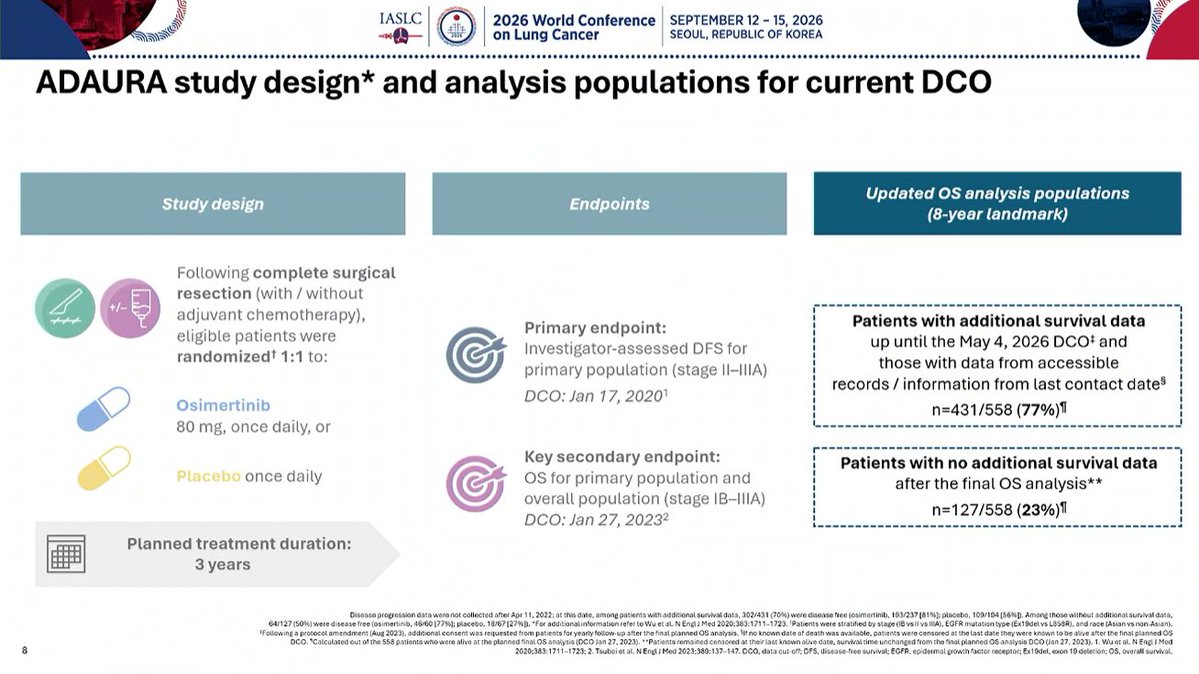
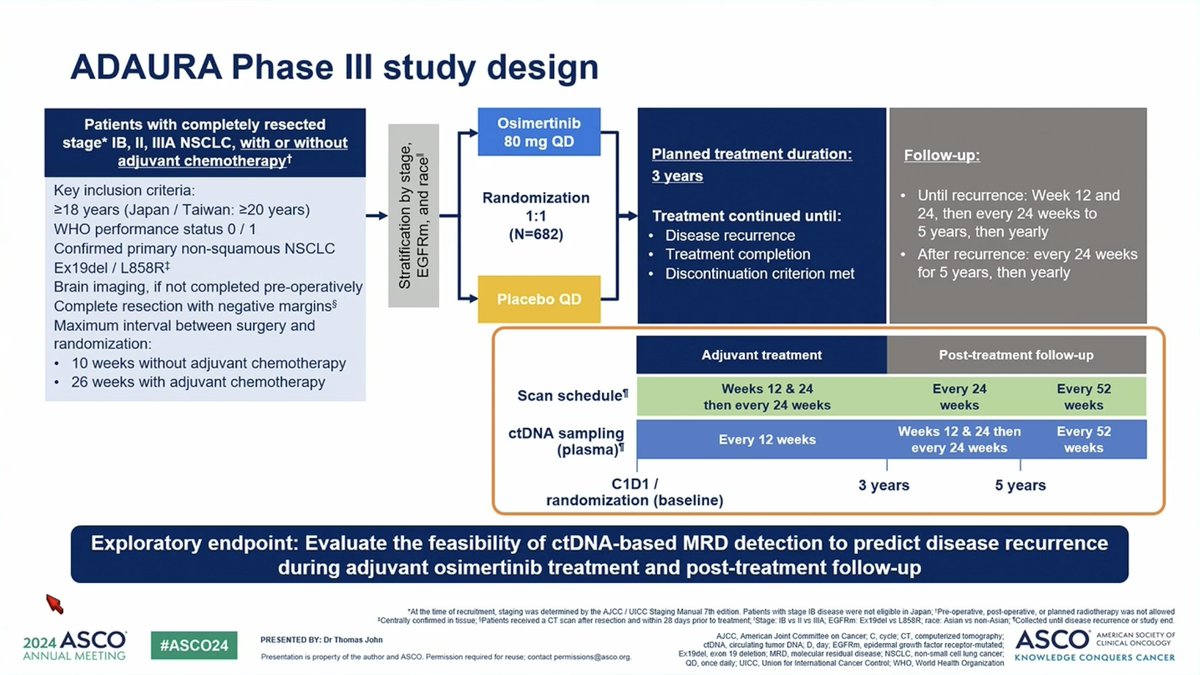
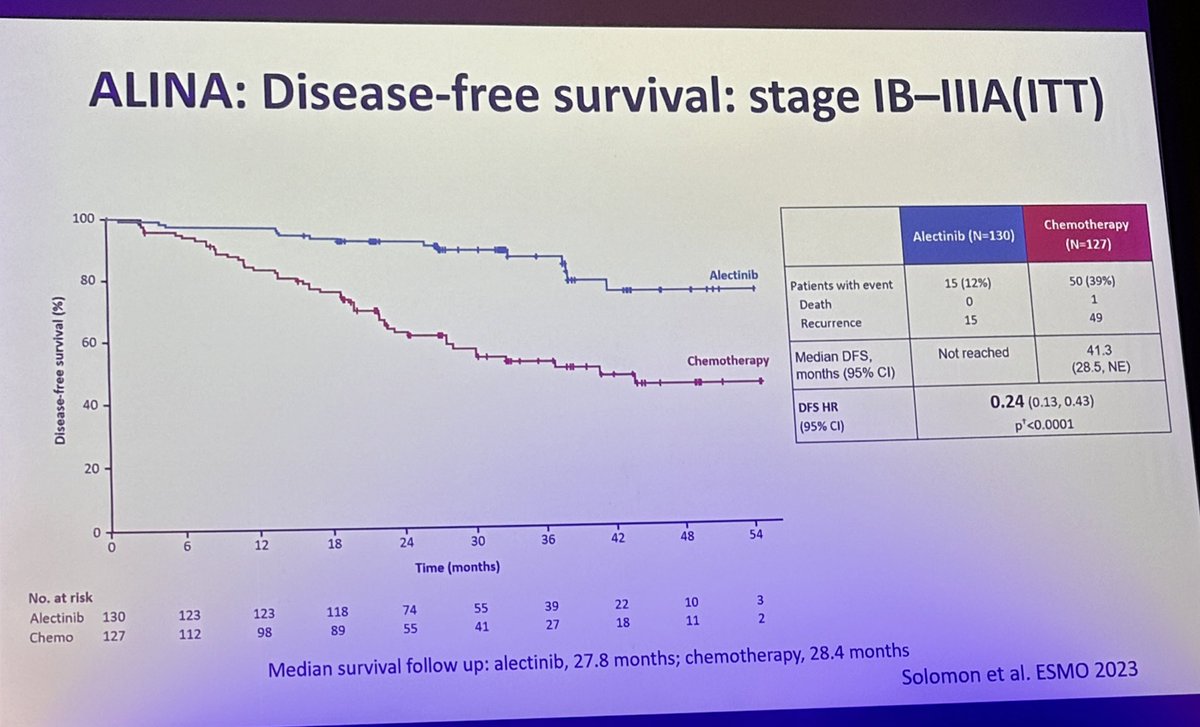
Design — Phase III, double-blind: adjuvant osimertinib 80 mg daily for up to 3 years vs placebo in completely resected stage IB–IIIA EGFR-mutated (ex19del/L858R) NSCLC, ± adjuvant chemotherapy (N=682, 1:1; NCT02511106).
DFS (primary) — HR 0.20 overall; HR 0.17 in stage II–IIIA (NEJM 2020). Updated: median DFS 65.8 vs 28.1 months, HR 0.27 (ASCO 2024).
OS (final) — HR 0.49; 5-year OS 88% vs 78% overall (18% maturity), 85% vs 73% in stage II–IIIA (NEJM 2023).
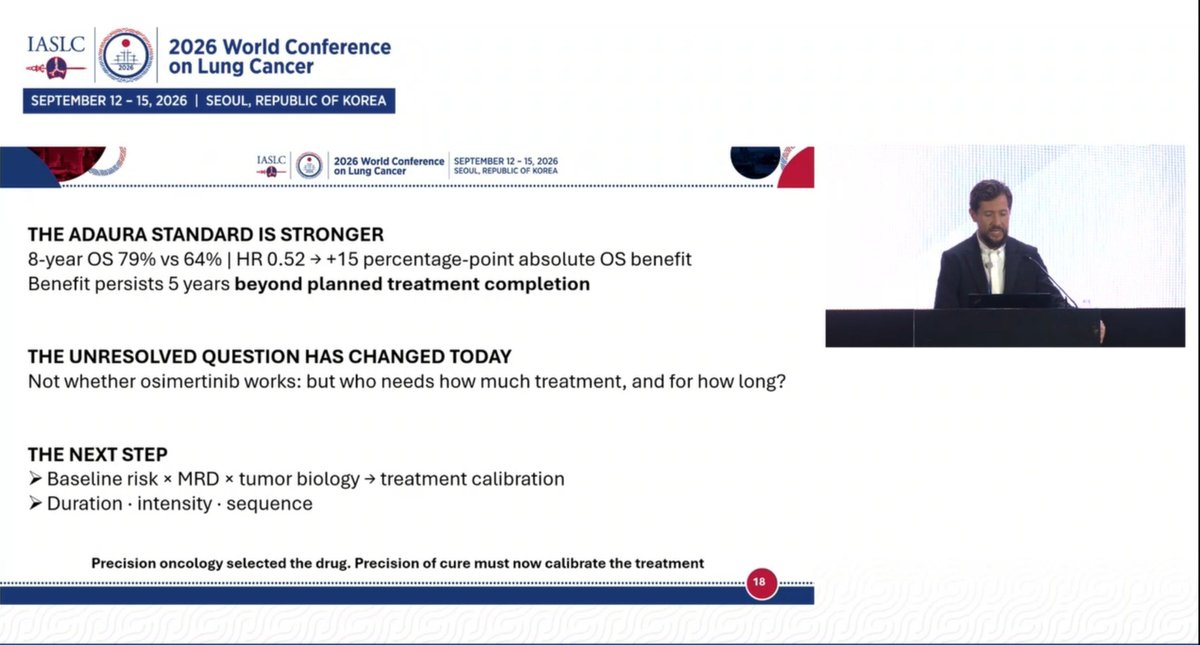
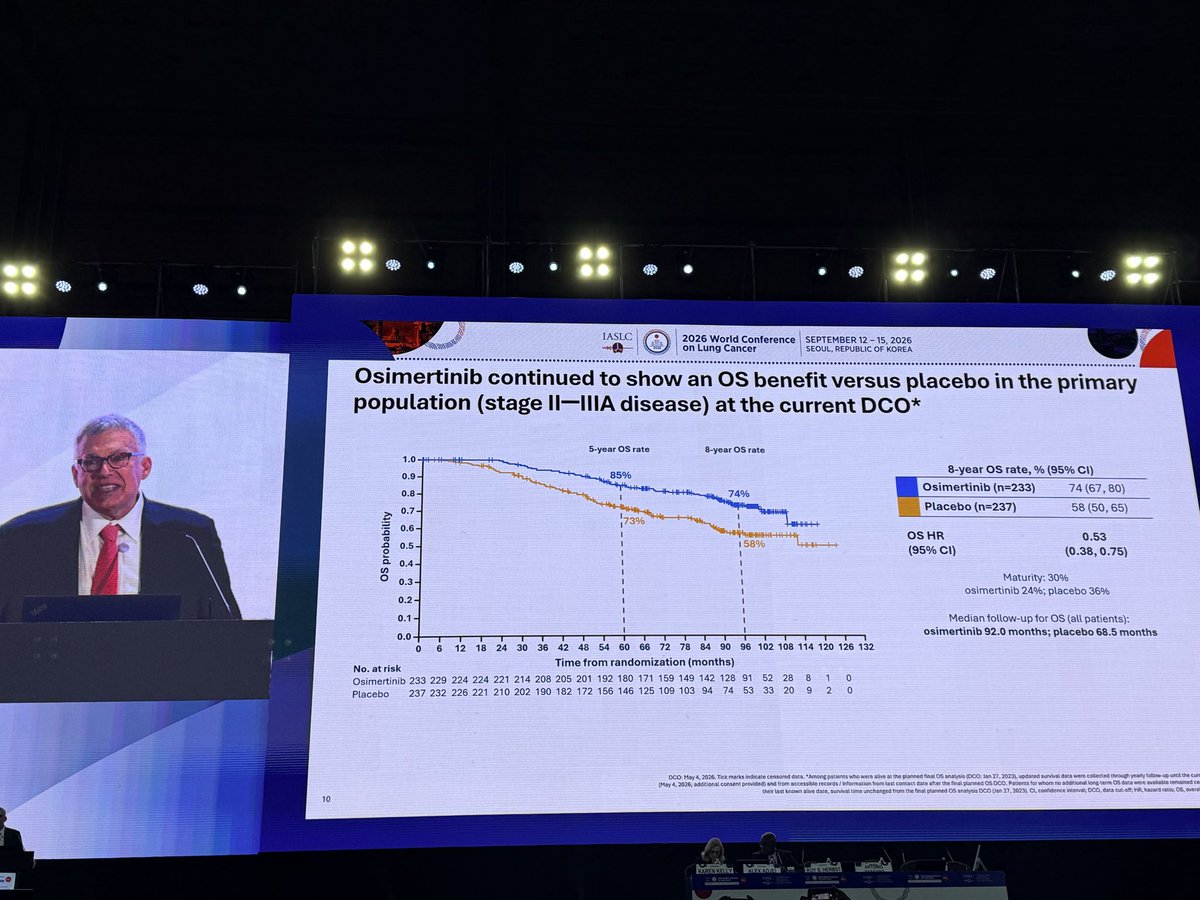
OS (8-year landmark) — 8-year OS 74% vs 58% in stage II–IIIA (HR 0.53; 95% CI 0.38–0.75) and 79% vs 64% overall IB–IIIA (HR 0.52; 95% CI 0.39–0.71) — exploratory landmark analysis, sustained benefit at ~8 years of follow-up. (WCLC 2026 Presidential Symposium / JTO, DCO 4-May-2026)
Safety — Grade ≥3 AEs 20% vs 13%; ILD 3% vs 0%, all grade 1–2, all recovered (NEJM 2020).
The debate — crossover (54% of placebo patients received subsequent treatment), cost-effectiveness (cleared at OS HR ≤0.7 per Pennell/Lemmon), and duration (most events occur after stopping) — resolved into the West–Pennell "surprising consensus" commentary.
Regulatory / sponsor — FDA-approved in the adjuvant setting · AstraZeneca.
WCLC 2026: 8-Year Overall Survival Landmark
Exploratory 8-year OS — primary population (stage II–IIIA)
At the exploratory 8-year landmark analysis, adjuvant osimertinib sustained its overall survival benefit: 8-year OS 74% (95% CI 67–80) vs 58% (95% CI 50–65) with placebo; OS HR 0.53 (95% CI 0.38–0.75) — a 47% reduction in the risk of death. Median follow-up 92 months (osimertinib) vs 68.5 months (placebo). (AZ press release / JTO, DCO 4-May-2026)
8-year OS 74% vs 58% · HR 0.53Overall population (stage IB–IIIA)
8-year OS 79% (95% CI 74–83) vs 64% (95% CI 58–70); OS HR 0.52 (95% CI 0.39–0.71) — a 48% reduction in the risk of death. Median follow-up 93.3 vs 79.6 months. Nearly 4 in 5 patients treated with adjuvant osimertinib were alive at eight years. (AZ press release / JTO, DCO 4-May-2026)
Presentation
Presented by Dr. Roy Herbst at the WCLC 2026 Presidential Symposium (PL03.01), Seoul, with simultaneous publication in the Journal of Thoracic Oncology — an exploratory landmark update following the protocol-specified final OS analysis (NEJM 2023: HR 0.49). The plenary deck is in the Key Slides section below.
Source: AstraZeneca press release, Sept 13, 2026 ↗Across stages and subgroups (WCLC 2026 slides, DCO 4-May-2026)
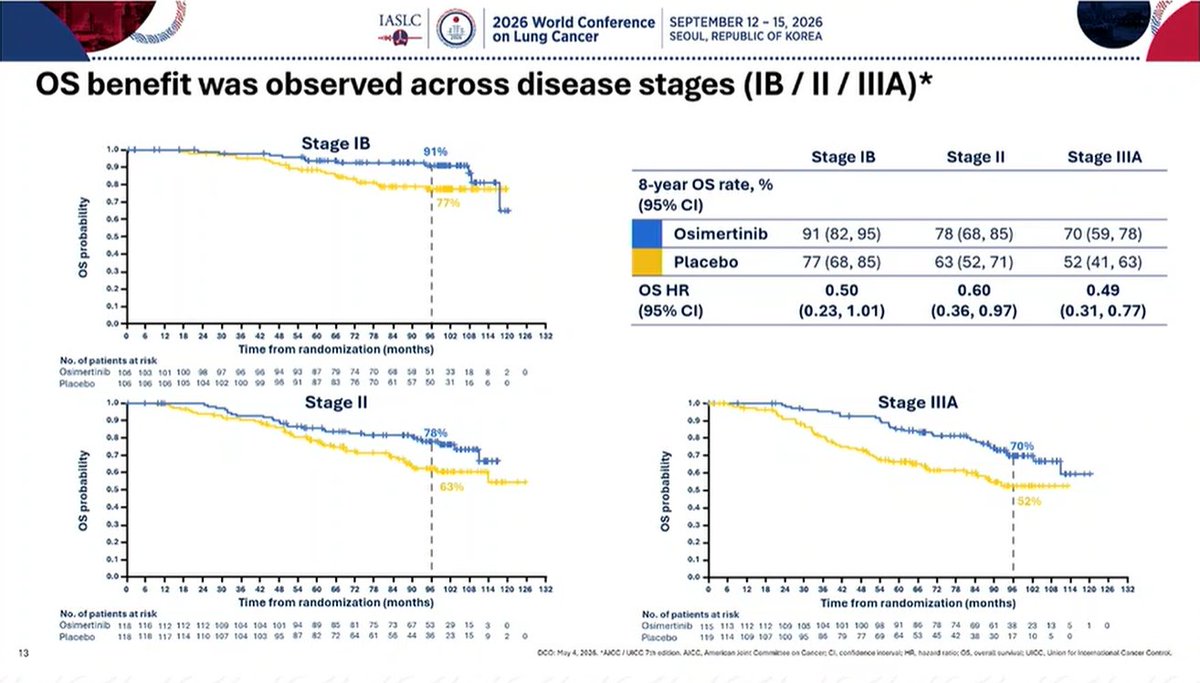
8-year OS by stage: IB 91% vs 77% (HR 0.50; 95% CI 0.23–1.01) · II 78% vs 63% (HR 0.60; 0.36–0.97) · IIIA 70% vs 52% (HR 0.49; 0.31–0.77). By EGFR mutation: Ex19del HR 0.45 (0.29–0.68); L858R HR 0.72 (0.46–1.11). OS maturity: 30% primary population / 26% overall. Values transcribed from the presented slides (Key Slides section below).
WCLC 2026: Live KOL Reaction
Physician posts about this trial captured live during the IASLC 2026 World Conference on Lung Cancer (Seoul, September 12–15). Quotes are verbatim; each card links to the original post. Last updated 2026-09-15.

🆙#WCLC26 #LCSM Plenary Session 🔥ADAURA: Adjuvant Osimertinib in Resected EGFR-Mutated Stage IB-IIIA NSCLC: Exploratory 8-Year Overall Survival Landmark Update 🎙️ @DrRoyHerbst 🔢PL03.01 ☑️NCT02511106 🔗 https://t.co/mYsNwaWQUZ @OncoAlert @Larvol @IASLC @EGFRResisters https://t.co/qu6lBMcccp https://t.co/oAUtRXpr9u

2/6 ADAURA — 8-year update We already know that 3 years of adjuvant osimertinib improves DFS and OS after resection of EGFR-mutant NSCLC. Now comes the fascinating long-term question: Does that benefit remain durable years after osimertinib has stopped? At WCLC: the 8-year OS landmark and the shape of those survival curves. This is less about establishing the standard — and more about understanding how durable that standard really is.

As we await the 8-year ADAURA update at #WCLC26, our study adds another piece of the story: Long-term outcomes matter. So does what happens during those 3 years of treatment… A thread… @IASLC @EGFRResisters https://t.co/Zwy0G85WTW

Dr. Beung Chul Ahn at #WCLC26 presents results from RAPHAEL trial (KM-07, LU15-12): a phase III study of adjuvant gefitinib intercalated with chemotherapy vs chemotherapy alone for resected EGFR+ NSCLC. Improved DFS (59m vs 42m) with greatest signal in stage III and del19. Will not impact SOC with ADAURA in place, but interesting strategy and will yield important correlative results in the future.
2/ We know ADAURA recommends a 3 year duration of osimertinib, but are patients really able to stay on for the whole time? https://t.co/mvYtj9uU5m
🆙#WCLC26 #LCSM Plenary Session 🔥ADAURA: Adjuvant Osimertinib in Resected EGFR-Mutated Stage IB-IIIA NSCLC: Exploratory 8-Year Overall Survival Landmark Update 🎙️ @DrRoyHerbst 🔢PL03.01 ☑️NCT02511106 🔗 https://t.co/mYsNwaWQUZ @OncoAlert @Larvol @IASLC @EGFRResisters https://t.co/oAUtRXpr9u

@IDEOlogyHealth Looking forward to small cell and ADAURA longer term follow up plenaries
🔥ADAURA: Adjuvant osimertinib — exploratory 8-year OS landmark update #WCLC2026 🆙 @JTOonline 🎯8-y OS 74% (osimertinib) vs 58% (placebo; HR 0.53); IB-IIIA: 79% vs 64% (HR 0.52) 🎯Ex19del shows stronger OS benefit (HR 0.45) vs L858R (HR 0.72) 🎯Llongest OS follow-up in adjuvant EGFR NSCLC trial 🎙Dr. Yi-Long Wu @ThomasW35874311 @DrRoyHerbst #LCSM @OncoAlert @Larvol @EGFRResisters https://t.co/SCnLwLPul0

@BalazsHalmosMD @KolPulseAI @BalazsHalmosMD waiting for ADAURA data like… https://t.co/z46iTY3KWa
It’s time- the EIGHT year overall survival update for ADAURA here at #WCLC26 https://t.co/aGPLYTqtZS https://t.co/EwMuPW0jct

#WCLC26 | ADAURA 8-year OS update 📚 JTO full text: https://t.co/NPr2K3lxYi 🧬 Exploratory long-term follow-up of adjuvant osimertinib ×3 years after complete resection of EGFR-mutated stage IB–IIIA NSCLC (n=682) 🏆 Stage IB–IIIA: • 8-y OS: 79% vs 64% • HR 0.52 (95% CI 0.39–0.71) → 15% absolute OS gain 📊 Stage II–IIIA: • 8-y OS: 74% vs 58% • HR 0.53 (95% CI 0.38–0.75) → 16% absolute gain 🔎 Benefit remained consistent by stage: • IB: 91% vs 77% | HR 0.50 • II: 78% vs 63% | HR 0.60 • IIIA: 70% vs 52% | HR 0.49 ⏳ Longest OS follow-up reported from a global adjuvant Ph3 trial in EGFR-mutated early-stage NSCLC

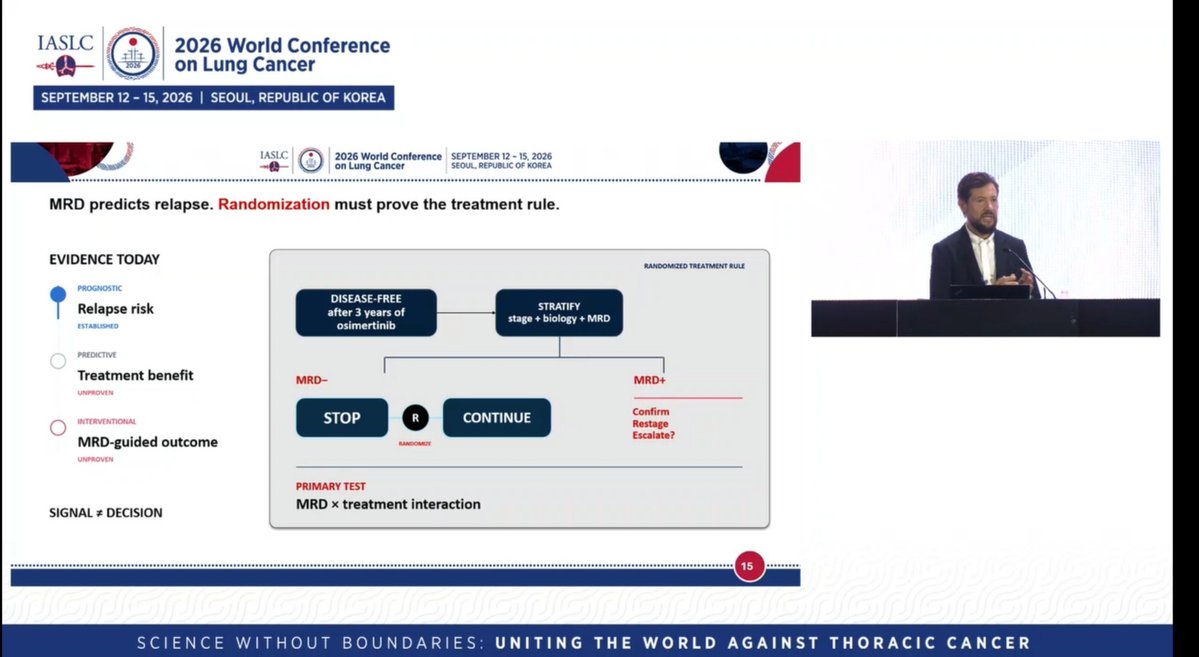
Incredible and meaningful ADAURA data. NOW we need future research to focus on: 👉 Who is under the curve and why? 👉 Who needs a different strategy? 👉 Who may be already cured by could avoid 3 years of avoidable side effects of treatment? 👉 Dosing, what is the minimal biological effective dose for each patient 👉 JUST AS IMPORT how do we better support the side effects and burden of long-term therapy? Celebrating progress and pushing for better can and should happen at the same time. #WCLC26 #EGFR @EGFRResisters

8-year follow-up from ADAURA at #WCLC26 Adjuvant osimertinib continues to show a sustained OS benefit in resected EGFR-mutated NSCLC. • Stage IB–IIIA: 8-year OS 79% vs 64%; HR 0.52 • Stage II–IIIA: 8-year OS 74% vs 58%; HR 0.53 The OS benefit remained consistent across predefined subgroups, reinforcing the long-term survival benefit of adjuvant osimertinib. @OncoAlert @ManuelDomine @GlopesMd @weoncologists @OpenMedKate @Lung_Cancers

8 years OS update on ADAURA The longest OS follow-up from any global adjuvant Phase III trial in the EGFR-mutated early-stage NSCLC setting #WCLC26 @IASLC #LCSM Osimertinib continued to show a consistent OS benefit versus placebo in both the primary population (stage ||-IIIA; OS HR 0.53; 95% CI 0.38, 0.75), and in the overall population (stage IB-IIIA; OS HR 0.52; 95% CI 0.39, 0.71), with 8-year landmark OS rates increased by 16 and 15 percentage points, respectively Consistent with the final OS analysis (2023),' OS benefit with osimertinib was observed across predefined subgroups, including by disease stage (IB / II / IIIA)

8 year update for ADAURA OS . Looks good . @IASLC @StephenVLiu @RManochakian https://t.co/nDoxeVNnrF

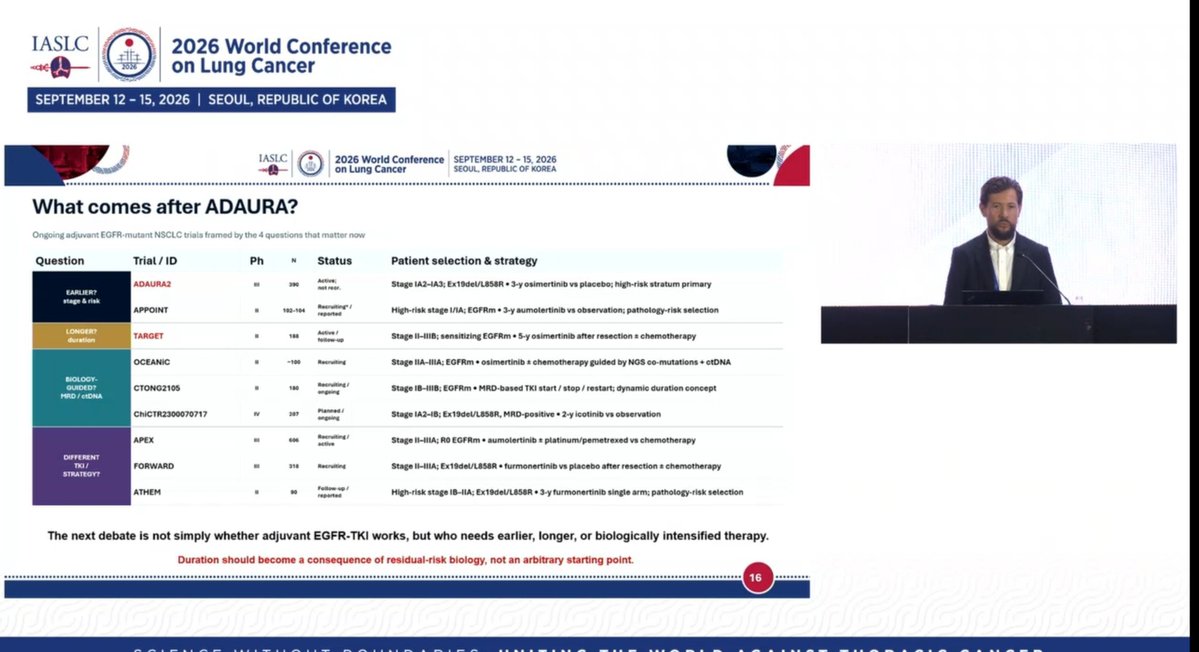
ADAURA 8-year OS @DrRoyHerbst at #WCLC26 in EGFR-mutated early-stage NSCLC. Take: 8-yr OS 74% vs 58% (HR 0.53, 95% CI 0.38–0.75) in stage II–IIIA. The gap keeps opening after the 5yr report. Interesting to think the cure % now the TARGET study will start answering the duration. I wonder if it will be 3 vs 5 year vs forever? #LCSM #lungcancer

ADAURA at 8 years: does the survival benefit last? After just 3 years of adjuvant osimertinib, the survival advantage remains evident years after treatment completion. Stage IB–IIIA: 8-year OS 79% vs 64% | HR 0.52 → +15 percentage points Stage II–IIIA: 8-year OS 74% vs 58% | HR 0.53 → +16 percentage points The direction of benefit favored osimertinib across stages and predefined subgroups, including patients with or without adjuvant chemotherapy. One important subgroup lesson: a CI crossing 1 means greater uncertainty—not proof of no benefit. Subgroup differences require interaction testing. 3 years of treatment. An OS advantage still evident at 8 years. ADAURA exploratory long-term OS analysis • WCLC 2026 • DCO 4 May 2026 #MVOnco #ADAURA #Osimertinib #EGFR #EGFRm #NSCLC #LungCancer #ThoracicOncology #AdjuvantTherapy #WCLC2026

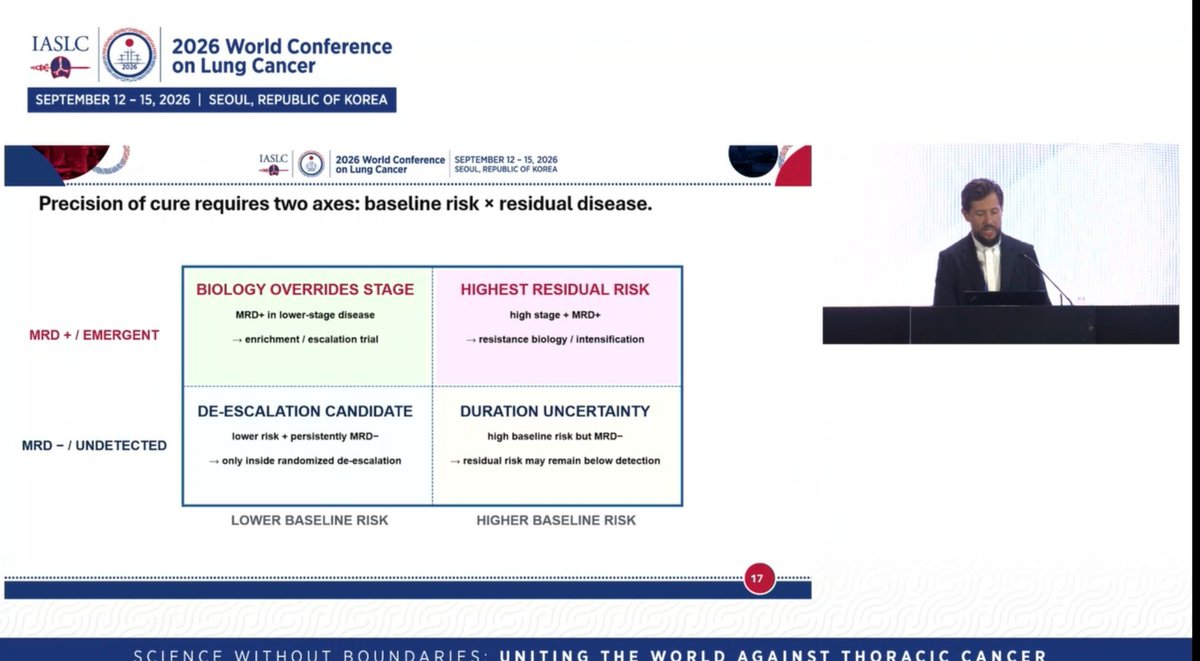
#WCLC26 excellent discussion of ADAURA data from @Tony_Calles. Incorporating escalation and deescalation. “Precision oncology selected the drug, but precision cure must now calibrate the treatment!”@TOGAANZ OCEANiC on the list of trials to help escalate! https://t.co/NimMnl1e8A

#WCLC26 #ADAURA 8-yr OS update continues to show an OS benefit 92 mo vs 68.5 mo, HR 0.53, with significant benefit in stage IIIA Questions unanswered: 📈optimum duration 🧪how to utilise MRD ⏬descalation strategies 💉can we do away with chemo https://t.co/kw3pEgR2vk

Five trials and one practice map from #WCLC26 Presidential 2 ADAURA’s OS benefit endures EGFR exon 20 combinations win PFS but leave OS questions Zidesamtinib raises the ROS1 bar First-line T-DXd in HER2-mutant NSCLC remains unsettled #NSCLC #LungCancer https://t.co/J7bAsb4jZA

PL03: Adjuvant Osimertinib in Resected EGFR-Mutated Stage IB-IIIA NSCLC: ADAURA Exploratory 8-year Overall Survival Landmark Update Very proud to have been the first maximum recruiter in Spain of this trial #WCLC26 Seoul @Hospital_FJD @quironsalud @UAM_Madrid #IIS-FJD @OncoAlert https://t.co/hmoj19jfnc

ADAURA 8-yr OS update continues to show an OS benefit 92 mo vs 68.5 mo, HR 0.53, with most profound benefit in stage IIIA. @IASLC @EGFRResisters #WCLC26 @DrRoyHerbst https://t.co/yBK0Ld6xwJ

ADAURA update; exploratory long term OS; at 8y OS HR 0.53; 16% absolute benefit in OS at 8y; interesting to see del19 better; OS point estimate for those given adj chemo same as those not….. can we jettison adjuvant chemo? #WCLC26 https://t.co/VEX9HdcLHR

8yr ADAURA update 🔥 informs cure vs delay-relapse debate 👉 77% pts surv data Overall: 8yr OS 79 v 64% HR 0.52 II-IIIA: 8yr OS 74 v 58% HR 0.53 🤔 Durable OS benefit ➡️ cure for some, albeit not for all ❓optimal Osi duration ❓risk stratification w MRD ❓sequencing #WCLC26 https://t.co/jURaQRb4iE

ADAURA shows OSimertinib strong after 8y in OS #WCLC26 @IASLC @OncoAlert @OncBrothers @oncodaily https://t.co/UR4y1uhnGG

ADAURA Trial 8-Year Overall Survival Update Overall Population (IB–IIIA): 79% vs 64% (HR 0.52) — 48% lower risk of death Stage II–IIIA: 74% vs 58% (HR 0.53) — 47% lower risk of death Absolute Benefit: +15% to +16% OS gain at 8 years @OncoAlert @Larvol https://t.co/T8ESyZ85zo

🫁 ADAURA: 8y OS with adjuvant osimertinib. @DrRoyHerbst @IASLC In II-IIIA disease, the primary population: • OS HR: 0.53 (95% CI, 0.38-0.75) • 8-year OS: 74% vs 58% with placebo • Absolute improvement: 16 percentage points In the overall IB-IIIA population: • OS HR: 0.52 (95% CI, 0.39-0.71) • 8-year OS: 79% vs 64% • Absolute improvement: 15 percentage points These data reinforce 3 years of adjuvant osimertinib as a standard approach after complete resection. #CánCare #thoraciconcology #NSCLC #EGFR #WCLC26

Great data on ADAURA today at @IASLC #WCLC26 presented by @DrRoyHerbst & discussant @APassaroMD. @jillfeldman4 asks about those patients below the line. https://t.co/p769c0dRtq

Adjuvant Osimertinib Following complete resection R0 (+/- adjuvant chemo) in Early Stage EGFR+ve NSCLC OS=0.53 (II-IIIA) | OS=0.52 (St Ib-IIIA) at 8yrs ADAURA data with consistent Osimertinib OS data ✅ #WCLC26 https://t.co/ipQlSUagpk

#WCLC26 | ADAURA 8-year update Adjuvant osimertinib continues to deliver durable OS benefit in resected EGFR-mutant NSCLC: 8-year OS: 79% vs 64% (HR 0.52) Stage II–IIIA: 74% vs 58% (HR 0.53) A 15–16% absolute OS gain at 8 years. @OncoAlert https://t.co/22ozRVzcCJ

#WCLC26 Presidential Symposium Day 2 #ADAURA: Adjuvant osimertinib — exploratory 8-year OS landmark update 🎙@DrRoyHerbst 🎯8-y OS 74% (osimertinib) vs 58% (placebo; HR 0.53); Stage IB-IIIA: 79% vs 64% (HR 0.52) 🎯Ex19del shows stronger OS benefit (HR 0.45) vs L858R (HR 0.72) 👉🏽remaining questions❓ -what is role of chemo -can we de-escalate treatment @iaslc @EGFRSummit @EGFRResisters

#ADAURA 8 year OS data by @DrRoyHerbst ✅️ significant OS data: HR 0.52 ✅️seen across all subgroups Something to look forward to: #ADAURA2 #WCLC26 https://t.co/yjI67B5WI3

@DrRoyHerbst presents the 8-year OS update from ADAURA at @IASLC #WCLC26. Impressive curves and and a clear re-affirmation of the current SoC. I do think that they’d be closer if more than 43% of patients in the placebo arm had had access to osimertinib at disease recurrence. https://t.co/lG4c4Jrpvj

8-year OS update from ADAURA @WCLC2026 Still such an amazing story! https://t.co/JhOa2qZFgt

📝ADAURA 👏DFSの差がOSベネフィットに反映 ➔再発後のOsime介入では追いつけない?(今回はcross-over非許容にて不明😕) 👀K-M曲線の後半の落ちが気になる ➔Osime後の治療開発急務か 🤔全例に術後Osimeが必要? ➔術後MRDやctDNAの経時的変化で、介入の有無や継続期間を個別化できない? #WCLC26 https://t.co/fp5AUdKsKo

@DrRoyHerbst provided excellent updated analysis of ADAURA - Stage IB-IIIA (8yr OS Osi 79% vs placebo 64%). No late convergence of curves - Continued OS benefit across all predefined subgroups - Highlights using best drugs first - Touching acknowledgement of Prof Tsuboi #WCLC26 https://t.co/vdnt6qZ24n
Fierce patient advocate and lung cancer survivor @jillfeldman4 asking key questions on the implementation of ADAURA at @IASLC #WCLC26 @EGFRResisters @EgfrUk @EGFRSummit @LUNGevity @lcrf_org @DrRoyHerbst @lungoncdoc @StephenVLiu @NarjustFlorezMD https://t.co/2racmdz8SC

ADAURA keeps delivering. Now with 8-year survival data. 🔥 In resected EGFR-mutated NSCLC, 3 years of adjuvant osimertinib continues to translate into a major overall survival benefit. Stage II–IIIA 8-year OS: 74% vs 58% HR 0.53 (95% CI 0.38–0.75) Overall population, Stage IB–IIIA 8-year OS: 79% vs 64% HR 0.52 (95% CI 0.39–0.71) And the benefit remains clearly separated years after completion of planned therapy. Clinical verdict: ADAURA is no longer just a DFS story. The long-term OS signal firmly reinforces adjuvant osimertinib as a standard of care after resection of EGFR-mutated NSCLC. #WCLC26 #LungCancer #EGFR @IASLC @OncoAlert
ADAURA — 8 years later, what really matters? Only 3 years of adjuvant osimertinib — yet the survival advantage remains evident at 8 years. The long-term story is reassuring: ✓ Benefit points in the same direction across stages ✓ Osimertinib favored with or without adjuvant chemotherapy ✓ Ex19del shows a clearly favorable estimate ✓ L858R also points toward benefit — but with greater uncertainty Important nuance: CI crossing 1 ≠ proof of no benefit. And benefit without chemotherapy does not mean indicated adjuvant chemotherapy can be omitted. The big message from the exploratory WCLC 2026 update? The ADAURA story is increasingly a story of DURABILITY. #MVOnco #ADAURA #Osimertinib #EGFR #EGFRNSCLC #LungCancer #NSCLC #ThoracicOncology #AdjuvantTherapy #PrecisionOncology #WCLC2026
Total respect; ADAURA #WCLC26 May his memory be a blessing https://t.co/GdjOzSV76t
Baseline risk assessment, MRD, tumor biology, and optimal treatment duration are important factors to consider, as highlighted by @APassaroMD following the discussion on ADAURA. https://t.co/lUnJB1Aw8C
But ADAURA is just the beginning. ▫️Can MRD guide escalation, or de-escalation? ▫️Is 3 years of osimertinib enough? ▫️Can we move treatment even earlier? ▫️What happens with resistance after adjuvant osimertinib? NeoADAURA. ADAURA2. TARGET. #WCLC26 @IASLC https://t.co/4UrSNGYjzw
#ADAURA 8 yr update concurrent @JTOonline publication-https://t.co/lT0xSVxZEF
@DrRoyHerbst Dr @APassaroMD discussion on #ADAURA • postponement of recurrence, no longer just delaying it ➡️ are we closer to cure? • role of MRD is more important now (who needs more treatment and hoe long?) #WCLC26 https://t.co/BX7BZioXt5

EGFR mutated lung cancer is teaching us an important lesson. At 8 years, ADAURA continues to show a survival benefit with adjuvant osimertinib after surgery. Precision oncology should not begin when cancer becomes metastatic. Test early. Identify the driver. Treat the biology. Sometimes the best way to treat metastatic cancer is to prevent it from becoming metastatic. Educational information only.
Dr. Roy Herbst @DrRoyHerbst @dartmouth presents the updated 8Y OS follow up analysis of ADAURA for 3Y of adjuvant osimertinib in EGFR mutant NSCLC. Benefit in OS across all stages investigated IB-IIIA. Supportive management of toxicities and quality of life are key factors to ensuring patients can stay on therapy for 3Y. @EGFRResisters @EgfrUk @jillfeldman4 @lungoncdoc @LUNGevity @RManochakian @LauraAlderMD

Congratulations @DrRoyHerbst and team on these great ADAURA results! Often we question the value of adjuvant therapy in stage IB and I am particularly encouraged by the stage breakdown and the great IB data. These long-term follow up data are so important to see!! Thank you! https://t.co/eKzPU4gAls

1. #ADAURA: Ph3, resectable NSCLC w/ mEGFR, adj 3yrs of #osimertinib Vs placebo. 8yr update: - Approved in 2020 - OS today Stage IB-IIIA 8yr OS 79% vs 64% (HR 0.52) - This remains the SoC for this pt population. Who should get longer than 3yrs? 2/8 https://t.co/YMFSzqYDA2 https://t.co/UOqBC0iJgO
ADAURA; stopping at 3 y entirely justified given sustained benefit seen in 3-8y window
Adjuvant Osimertinib Following complete resection R0 (+/- adjuvant chemo) in Early Stage EGFR+ve NSCLC OS=0.53 (II-IIIA) | OS=0.52 (St Ib-IIIA) at 8yrs ADAURA data favoring Osimertinib ✅ #WCLC26 https://t.co/1csM6isJGD