
KOL Pulse - Trial Profile

KarMMa-3 Trial

RRMM 2L+ CAR-T - BMS/2seventy

RRMM 2L+ CAR-T Abecma (ide-cel) AACR 2024 FDA Approved
Explore Trial Data

Top KOLs Discussing KarMMa-3

Luciano J Costa
Luciano J Costa
@End_myeloma
6.4K impressions
Beth Faiman PhD
Beth Faiman PhD
@Bethfaiman
4.7K impressions
Robert Z. Orlowski
Robert Z. Orlowski
@Myeloma_Doc
4.5K impressions
Manni Mohyuddin
Manni Mohyuddin
@ManniMD1
3.1K impressions
Elias K. Mai MD
Elias K. Mai MD
@EliasKarlMai
2.2K impressions
Rahul Banerjee, MD, FACP
@RahulBanerjeeMD
2.1K impressions

KarMMa-3 Key Slides & Visuals

Official trial slides and relevant visuals shared by KOLs at AACR 2024. Click any image to expand.

Luciano J Costa
Luciano J Costa @End_myeloma
KarMMa-3 Data
5.7K impressions · 52 likes · Aug 25, 2023
View on X ↗
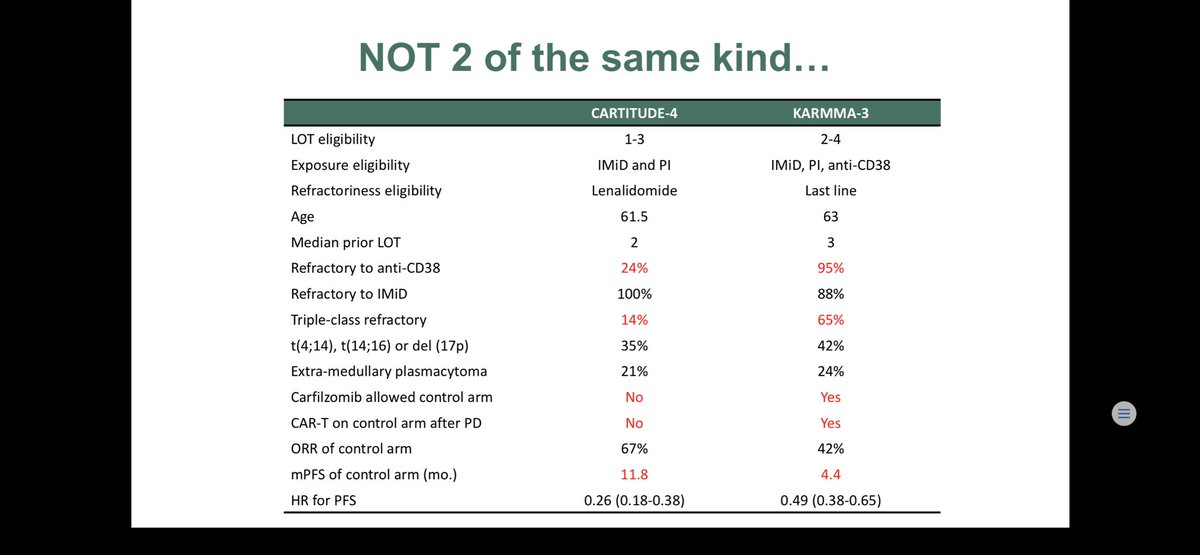
[Slide 1] NOT 2 of the same kind CARTITUDE-4 KARMMA-3 LOT eligibility 1-3 2-4 Exposure eligibility IMiD and PI IMiD, PI, anti-CD38 Refractoriness eligibility Lenalidomide Last line Age 61.5 63 Median prior LOT 2 3 Refractory to anti-CD38 24% 95% Refractory to IMiD 100% 88% Triple-class refractory 14% 65% t(4;14), t(14;16) or del (17p) 35% 42% Extra-medullary plasmacytoma 21% 24% Carfilzomib allowed control arm No Yes CAR-T on control arm after PD No Yes ORR of control arm 67% 42% mPFS of control arm (mo.) 11.8 4.4 HR for PFS 0.26 (0.18-0.38) 0.49 (0.38-0.65)
Robert Z. Orlowski
Robert Z. Orlowski @Myeloma_Doc
KarMMa-3 Data
4.5K impressions · 49 likes · Aug 31, 2024
View on X ↗
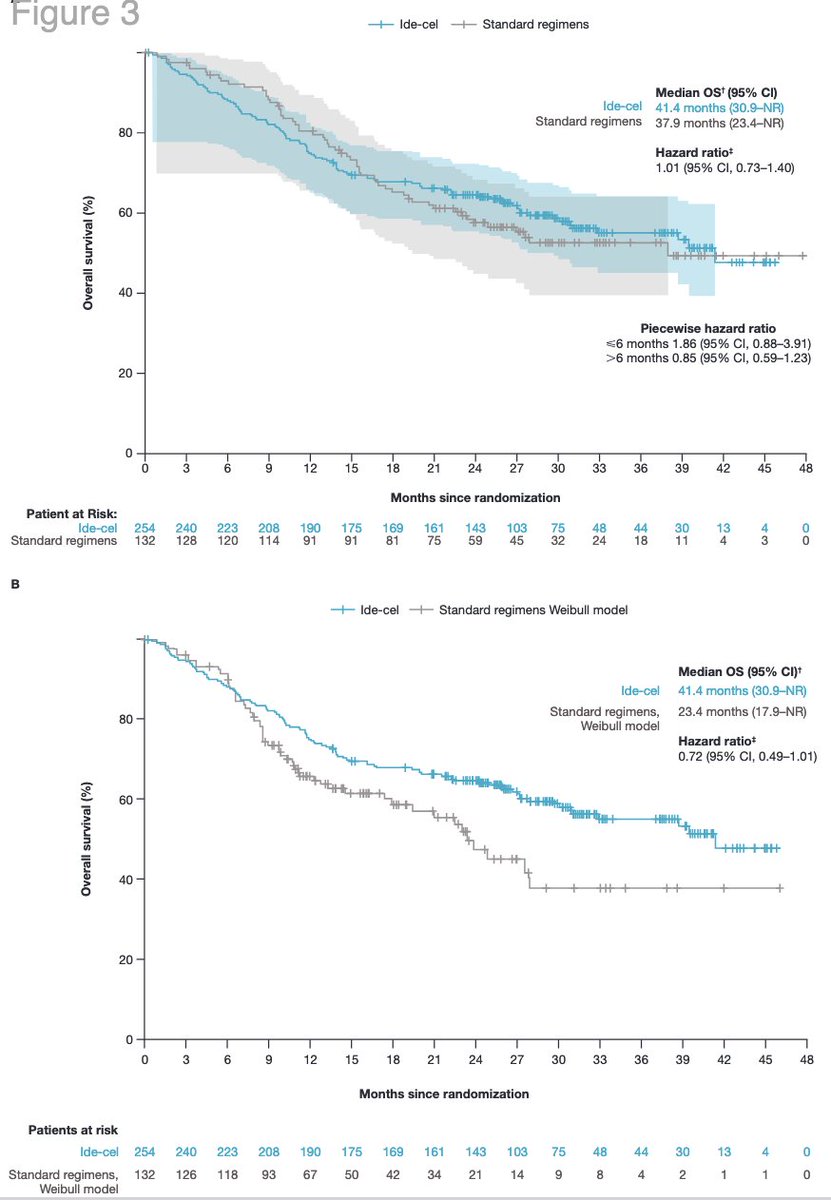
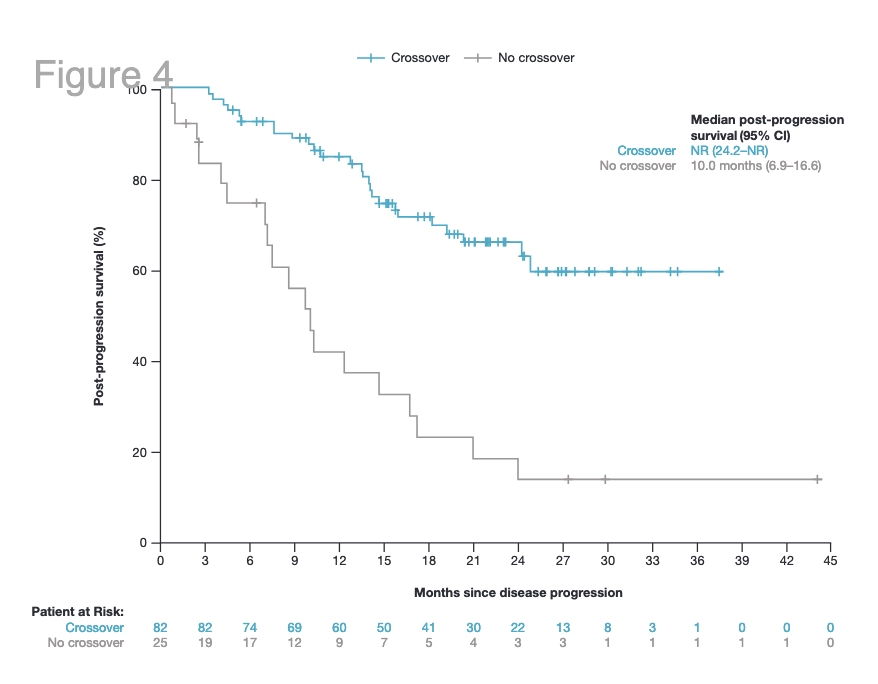
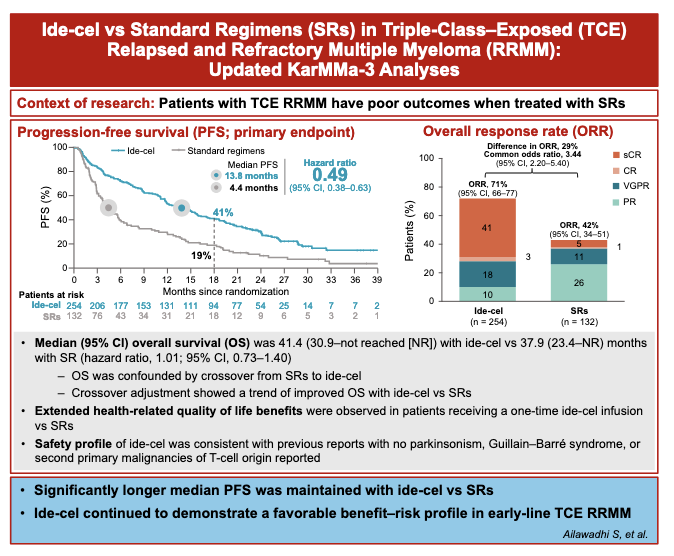
[Slide 1] Figure 2 Ide-cel Standard regimens 100 Median PFS* 18-month PFS rate Ide-cel 13.8 months 41% (SE, 3) Standard regimens 4.4 months 19% (SE, 4) 80 Hazard ratio 0.49 (95% CI, 0.38-0.63) Progression-free survival (%) 60 41% 40 20 19% #H 0 0 3 6 9 12 15 18 21 24 27 30 33 36 39 Months since randomization Patients at risk Ide-cel 254 206 177 153 131 111 94 77 54 25 14 7 7 2 Standard regimens 132 76 43 34 31 21 18 12 9 6 5 3 2 1 B 100 Median PFS* (95% CI) 2 prior lines 3 prior lines 4 prior lines Ide-cel 16.2 months (13.3-20.9) 13.6 months (10.2-17.7) 11.2 months (7.4-15.2) 80 Standard regimens 4.8 months (3.2-13.3) 3.4 months (2.3-5.7) 4.8 months (3.2-6.9) Progression-free survival (%) 60 40 20 0 0 3 6 9 12 15 18 21 24 27 30 33 36 39 42 45 Months since randomization Patients at risk Idel-cel (2 lines) 78 68 60 54 46 40 33 26 20 8 4 0 0 0 0 0 Standard regimens (2 lines) 39 25 15 13 12 10 9 7 6 4 3 2 1 1 0 0 Idel-cel (3 lines) 95 76 65 57 49 42 34 26 19 10 8 6 6 2 1 0 Standard regimens (3 lines) 49 25 14 12 12 6 4 1 1 1 1 1 1 0 0 0 Idel-cel (4 lines) 81 62 52 42 36 29 27 25 15 7 2 1 1 0 0 0 Standard regimens (4 lines) 44 26 14 9 7 5 5 4 2 1 1 0 0 0 0 0 --- [Slide 2] Figure 3 Ide-cel Standard regimens Median OS' (95% CI) Ide-cel 41.4 months (30.9-NR) Standard regimens 37.9 months (23.4-NR) 80 Hazard ratio 1.01 (95% CI, 0.73-1.40) 60 Overall survival (%) 40 Piecewise hazard ratio <6 months 1.86 (95% CI, 0.88-3.91) >6 months 0.85 (95% CI, 0.59-1.23) 20 0 0 3 6 9 12 15 18 21 24 27 30 33 36 39 42 45 48 Months since randomization Patient at Risk: Ide-cel 254 240 223 208 190 175 169 161 143 103 75 48 44 30 13 4 0 Standard regimens 132 128 120 114 91 91 81 75 59 45 32 24 18 11 4 3 0 B Ide-cel Standard regimens Weibull model Median os (95% CI)+ Ide-cel 41.4 months (30.9-NR) 80 Standard regimens, 23.4 months (17.9-NR) Weibull model Hazard ratio* 0.72 (95% CI, 0.49-1.01) 60 Overall survival (%) 40 20 0 0 3 6 9 12 15 18 21 24 27 30 33 36 39 42 45 48 Months since randomization Patients at risk Ide-cel 254 240 223 208 190 175 169 161 143 103 75 48 44 30 13 4 0 Standard regimens, 132 126 118 93 67 50 42 34 21 14 9 8 4 2 1 1 0 Weibull model --- [Slide 3] Crossover No crossover Figure 4 100 Median post-progression survival (95% CI) Crossover NR (24.2-NR) No crossover 10.0 months (6.9-16.6) 80 Post-progression survival (%) 60 40 20 0 0 3 6 9 12 15 18 21 24 27 30 33 36 39 42 45 Months since disease progression Patient at Risk: Crossover 82 82 74 69 60 50 41 30 22 13 8 3 1 0 0 0 No crossover 25 19 17 12 9 7 5 4 3 3 1 1 1 1 1 0 --- [Slide 4] Ide-cel vs Standard Regimens (SRs) in Triple-Class-Exposed (TCE) Relapsed and Refractory Multiple Myeloma (RRMM): Updated KarMMa-3 Analyses Context of research: Patients with TCE RRMM have poor outcomes when treated with SRs Progression-free survival (PFS; primary endpoint) Overall response rate (ORR) 100 Ide-cel Standard regimens Difference in ORR, 29% 100 Common odds ratio, 3.44 sCR Median PFS Hazard ratio (95% CI, 2.20-5.40) 80 13.8 months 0.49 CR 4.4 months (95% CI, 0.38-0.63) 80 ORR, 71% VGPR PFS (%) 60 (95% CI, 66-77) PR . 41% 40 Patients (%) 60 41 ORR, 42% (95% CI, 34-51) 20 40 5 1 19% 3 11 0 20 18 0 3 6 9 12 15 18 21 24 27 30 33 36 39 26 Patients at risk Months since randomization 10 Ide-cel 0 254 206 177 153 131 111 94 77 54 25 14 7 7 2 Ide-cel SRs SRs 132 76 43 34 31 21 18 12 9 6 5 3 2 1 (n = 254) (n - 132) Median (95% CI) overall survival (OS) was 41.4 (30.9-not reached [NR]) with ide-cel vs 37.9 (23.4-NR) months with SR (hazard ratio, 1.01; 95% CI, 0.73-1.40) - OS was confounded by crossover from SRs to ide-cel - Crossover adjustment showed a trend of improved OS with ide-cel vs SRs Extended health-related quality of life benefits were observed in patients receiving a one-time ide-cel infusion vs SRs Safety profile of ide-cel was consistent with previous reports with no parkinsonism, Guillain-Barre syndrome, or second primary malignancies of T-cell origin reported Significantly longer median PFS was maintained with ide-cel vs SRs Ide-cel continued to demonstrate a favorable benefit-risk profile in early-line TCE RRMM Ailawadhi S, et al.
Luciano J Costa
Luciano J Costa @End_myeloma
KarMMa-3 Data
737 impressions · 2 likes · Aug 25, 2023
View on X ↗
Rahul Banerjee, MD, FACP
Rahul Banerjee, MD, FACP @RahulBanerjeeMD
KarMMa-3 Data
702 impressions · 6 likes · Nov 14, 2024
View on X ↗
[Slide 1] 79 Previous HDM/ASCT Adversely Impacts PFS with BCMA-Directed CAR T-Cell Therapy in Multiple Myeloma Program: Oral and Poster Abstracts Type: Oral Session: 653. Multiple Myeloma: Clinical and Epidemiological: Decluttering Responses and Dynamic Risk: How Can We Improve Prognostication in Multiple Myeloma? Hematology Disease Topics & Pathways: Research, Clinical trials, Clinical Research, Plasma Cell Disorders, Diseases, Therapy sequence, Treatment Considerations, Lymphoid Malignancies Saturday, December 7, 2024: 9:30 AM Joshua Gustine, MD¹*, Diana Cirstea, MD²*, Andrew R. Branagan, MD³, Andrew J. Yee, MD¹, Marcela Maus, MD⁴, Matthew J. Frigault, MD1* and Noopur Raje, MD5 Massachusetts General Hospital, Boston, MA 2Center for Multiple Myeloma, Massachusetts General Hospital, Boston, MA ³Harvard Medical School, Massachusetts General Hospital Cancer Center, Boston, MA Massachusetts General Hospital, Harvard Medical School, Boston, MA ⁵Center for Multiple Myeloma, Massachusetts General Hospital, Harvard Medical School, Boston, MA
Rahul Banerjee, MD, FACP
Rahul Banerjee, MD, FACP @RahulBanerjeeMD
KarMMa-3 Data
445 impressions · 1 likes · Dec 12, 2024
View on X ↗
Multiple Myeloma RF
KarMMa-3 Data
318 impressions · 7 likes · Feb 21, 2025
View on X ↗
[Slide 1] NASHVILLE HEMATOLOGY CONFERENCE 2025 MULTIPLE MYELOMA: EARLY RELAPSE Joshua Richter, MD, FACP Associate Professor of Medicine Tisch Cancer Institute Icahn School of Medicine at Mount Sinai Director of Myeloma at The Blavatnik Family - Chelsea Medical Center at Mount Sinai Presented by Accredited by February 21, 2025 IDE Ology Postgraduate Institute Health PIM for Medicine @JoshuaRichterMD Professional is Medical Education All Rights Reserved. All names light brands, and mademarks - property of the respective - and mer - do - emply endorsement. --- [Slide 2] BOSTON study: prolonged PFS with SVd vs Vd SVd (n=195) Vd (n=207) Early PFS benefit observed with SVd VS Vd Median PFS, months (95% CI) 13.93 (11.73-NE) 9.46 (8.11-10.78) There was a 30% decrease in the risk of relapse with HR 0.70 (95% Cl: 0.53-0.93) P=0.0075 SVd vs Vd 1.00 + Selinexor, bortezomib, and dexamethasone Bortezomib and dexamethasone 0.75 Probability of progression-free survival 0.50 Selinexor, bortezomib, and dexamethasone: 0.25 median 13.93 months (95% CI 11-73-not evaluable) Bortezomib and dexamethasone: median 9-46 months (95% C18-11-10-78) Hazard ratio 0-70 (95% C10-53-0-93). p=0-0075 0 0 1 2 3 4 5 6 7 8 9 10 11 12 13 14 15 16 17 18 19 20 21 22 23 24 25 26 Time (months) Number at risk (number censored) Selinexor, bortezomib, 195 187 175 152 135 117 106 89 79 76 69 64 57 51 45 41 35 27 26 22 19 14 9 7 6 4 2 and dexamethasone (0) (5) (12) (21) (31) (37) (42) (50) (57) (59) (63) (66) (71) (73) (76) (80) (83) (89) (90) (94) (97) (102)(106)(08)(9)(11)(113 Bortezomib and dexamethasone 207 187 175 152 138 127 111 100 90 81 66 59 56 53 49 42 35 26 20 16 10 8 5 4 3 3 2 (0) (8) (10) (15) (20) (22) (29) (32) (37) (37) (41) (43) (44) (45) (47) (52) (55) (60) (65) (69) (73) (75) (78) (79) (80) (80) (81) CI, confidence interval; HR, hazard ratio; NE, not evaluable; PFS, progression-free survival; NASHVILLE Grosicki S, et al. Lancet. 2020;396(10262)1563-1573. SVd, selinexor/bortezomib/dexamethasone; Vd, bortezomib/dexamethasone. HEMATOLOGY Speaker: Joshua Richter, MD, FACP; Icahn School of Medicine at Mount Sinai @NashvilleHeme #NashvilleHeme25 All Rights Reserved. All names, logos, brands, and trademarks are property of their respective owners and their use(s) do not imply endorsement. --- [Slide 3] Ph 3 KarMMa-3: ide-cel vs SoC in TCE RRMM (2-4 prior lines) Final PFS analysis and OS data (mFUP 31 m) Key elegibility: 2-4 PL. Triple-class exposed. Refractory to last line. Baseline characteristics were comparable between 2 arms: mDOR ide-cel (16.6m [12.0-18.6] VS SoC 9.7 [5.4-16.3] m) Median n° of PL: 3 mTTR: 2.9 (0.5-13.0) VS 2.1 (0.9-9.4) months Median time from diagnosis to study entry 4 years. MRDneg CR: ide-cel 35% (57) VS SoC 2% (1) 65% of patients in both arms were triple-class refractory mPFS2 23.5 m VS 16.7 m [HR 0.79 (95% Cl, 0.6-1.04)] Median TTP in last regimen: 7 months Final PFS analysis 100 Difference in ORR, 29% OR, 3.36ᵃ 100 de-cel Standard regimens (95% Cl, 2.17-5.22) sCR Median PFS Hazard ratio 18-month PFS rate 80 80 13.8 months ORR, 71% CR HR 0.49 41% 19% (95% CI, 66-77) 4.4 months (95% CI, 0.38-0.63) VGPR 60 60 Patients (%) PR PFS (%) 41% 41 ORR, 42%c 40 (95% CI, 34-51) 40 5 1 11 20 19% 20 18 0 26 0 3 6 9 12 15 18 21 24 27 30 33 36 39 Months since randomization 10 Patients at risk 0 Ide-cel 254 206 177 153 131 111 94 77 54 25 14 7 7 2 Ide-cel Standard regimens Standard regimens 132 76 43 34 31 21 18 12 9 6 5 3 2 1 (n 254) (n 132) NASHVILLE Rodriguez-Otero P et al. oral presentation. ASH 2023. Abstract 1028 Speaker: Joshua Richter, MD, FACP; Icahn School of Medicine at Mount Sinai NashvilleHeme #NashvilleHeme25 HEMATOLOGY All Rights Reserved. All names, logos, brands, and trademarks are property of their respective owners and their use(s) do not imply endorsement. --- [Slide 4] Key Takeaways for the Community: 1. Most patients in the US only get 3 or 4 lines of therapy so make each one count! Incorporate a "new" MOA in each line of therapy to optimize depth and durability of response. 2. Triple class refractoriness can occur early in the relapse setting. Go beyond the 3 core classes: IMId, PI, Mab SINE, BCL-2 inhibitor, BCMA, etc. 3. Amazing data with T-cell redirection in early relapse with CAR-T; data with bisabs is around the corner. If experiencing sub-optimal responses to novel agents consider early incorporation of T-cell based therapy. SHVILI HEMATOLOGY Speaker: Joshua Richter, MD, FACP; Icahn School of Medicine at Mount Sinai @NashvilleHeme #NashvilleHeme25 Desenved All-names legos brands, and demarks - property of theirrernective and their use(s) do not moly endorsement
Victor H Jimenez-Zepeda
KarMMa-3 Data
20 impressions · 0 likes · Dec 05, 2025
View on X ↗
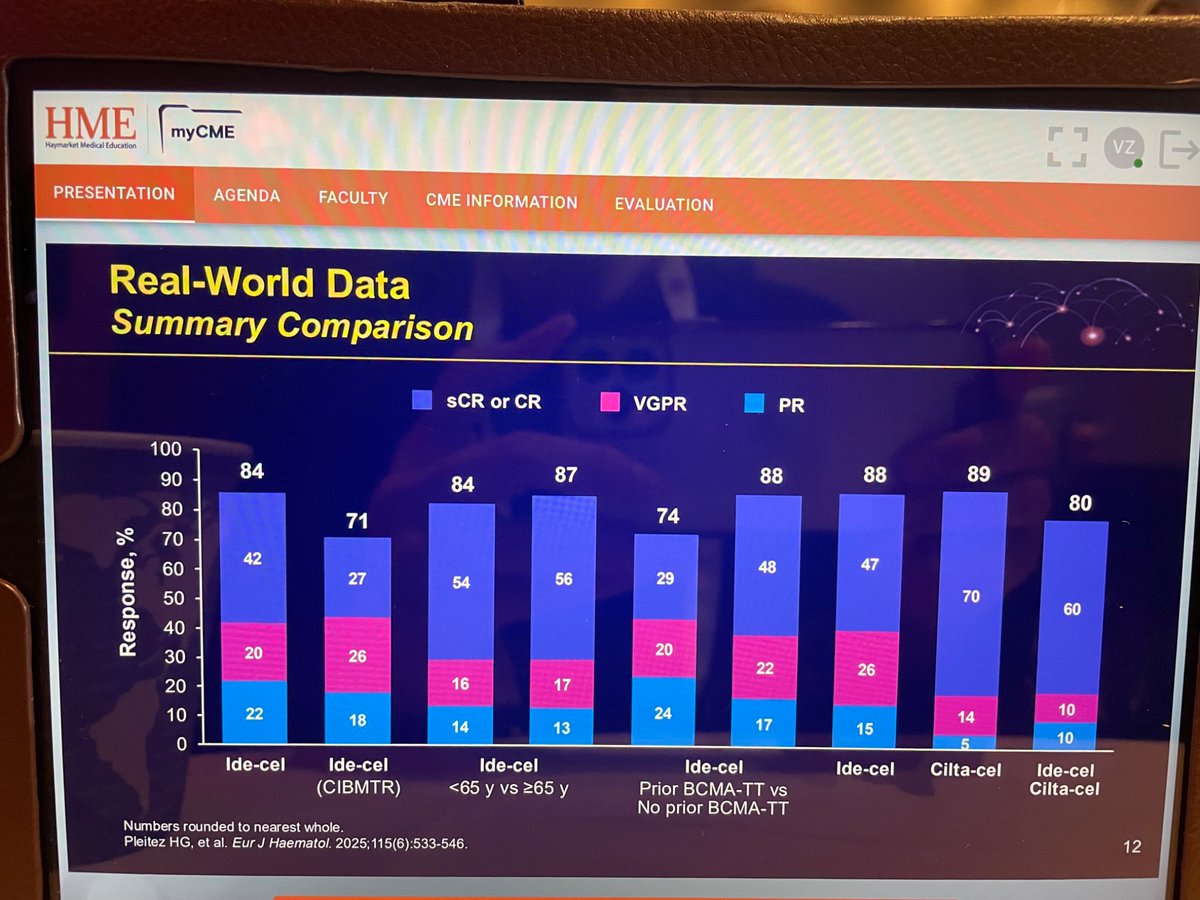
[Slide 1] VZ ESENTATION AGENDA FACULTY CME INFORMATION EVALUATION Pivotal Clinical Trial Data Summary Comparison sCR or CR VGPR PR 100 97 90 84 80 73 71 70 60 67 Response, % 33 50 39 73 40 30 20 20 22 26 10 22 11 8 0 4 3 KarMMaᵃ KarMMa-3b CARTITUDE-1ª CARTITUDE-4b ᵃAs-treated population; Pintent-to-treat population. Pleitez HG, et al. Eur J Haematol. 2025;115(6):533-546. 11 ? ASK QUESTION i TAKE NOTE is DRAW NOTE SAVE SLIDE --- [Slide 2] HME myCME Haymarket Medical Education HOP PRESENTATION AGENDA FACULTY CME INFORMATION EVALUATION Real-World Data Summary Comparison sCR or CR VGPR PR 100 90 84 87 88 88 89 84 80 80 71 74 70 Response, % 42 60 48 47 27 54 56 29 70 50 60 40 20 20 30 26 22 26 20 16 17 10 22 24 10 14 18 14 13 17 15 0 5 10 Ide-cel Ide-cel Ide-cel Ide-cel Ide-cel Cilta-cel Ide-cel (CIBMTR) <65 y vs ≥65 y Prior BCMA-TT vs Cilta-cel No prior BCMA-TT Numbers rounded to nearest whole. Pleitez HG, et al. Eur J Haematol. 2025;115(6):533-546. 12
Victor H Jimenez-Zepeda
KarMMa-3 Data
18 impressions · 0 likes · Dec 05, 2025
View on X ↗

KarMMa-3 Top Tweets

Top 10 by impressions - click to view on X

Luciano J Costa
Luciano J Costa@End_myeloma

We had the privilege to contribute to both Cartitude-4 and KarMMa-3. Crucial differences between these important studies often overlooked #myeloma 1/X

👁 5.7K ♡ 52 ↻ 12 Aug 25, 2023
Beth Faiman PhD
Beth Faiman PhD@Bethfaiman

More good news for patients. We used to dream about all these options!! #abecma #bcma #rrmm #mmsm will you offer...

👁 4.7K ♡ 22 ↻ 6 Apr 05, 2024
Robert Z. Orlowski
Robert Z. Orlowski@Myeloma_Doc

#Myeloma Paper of the Day: Updated KarMMa-3 analyses shows Ide-cel improved median PFS vs. standard regimens (13.8 vs. 4.4 months; HR 0.49; 95% CI 0.38-0.63) and ORR (71% vs. 42%;...

👁 4.5K ♡ 49 ↻ 15 Aug 31, 2024
Manni Mohyuddin
Manni Mohyuddin@ManniMD1

We are all tempted to compare to cilta-cel. The CARTITUDE-4 trial is positive on a press-release, but please remember, the patient population in that trial will be less heavily pre-treated (1-3...

👁 2.4K ♡ 8 ↻ 0 Feb 10, 2023
Elias K. Mai MD
Elias K. Mai MD@EliasKarlMai

It is sad that a very efficient drug, ide-cel, is likely being removed from the German market. What factored into this decision is the lack of a clear OS benefit. KarMMa-3 allowed cross-over after...

👁 2.2K ♡ 9 ↻ 2 Oct 31, 2024
Raj Chakraborty
Raj Chakraborty@rajshekharucms

Reflects all the issues with PRO data in most RCTs. We wouldn&#x27;t tolerate this with PFS or OS data, hence, PRO should be held to similar standard as well IMO. I highlighted some...

👁 1.4K ♡ 6 ↻ 1 Mar 15, 2024
Murali Janakiram
Murali Janakiram@JanakiramMurali

@ManniMD1 Manni we have to be precise in comparing apples to apples here. There are significant differences in trial designs , post protocol therapy, bridging to name a few that I suspect...

👁 1.1K ♡ 6 ↻ 1 Mar 15, 2024
Amar Kelkar, MD, MPH, FACP
Amar Kelkar, MD, MPH, FACP@amarkelkar

@JanakiramMurali I agree that Ide-cel should be available (it is already) and has utility for myeloma, but the point of crossover in an RCT is to show whether sequencing matters, so if the...

👁 1.0K ♡ 4 ↻ 0 Mar 15, 2024
Rahul Banerjee, MD, FACP
Rahul Banerjee, MD, FACP@RahulBanerjeeMD

Looking forward to this #ASH24 #MMsm oral by @KarenSweiss @EagleMyeloma @HealthTree! I will say that this is one of the key benefits of...

👁 911 ♡ 8 ↻ 1 Dec 06, 2024
Louis Williams
Louis Williams@LouisWilliamsMD

@Bethfaiman @khouri_jack @FaizAnwerMD1 Earlier CAR-T will be a part of the future undoubtedly. Sponsors for #idecel to be congratulated for allowing...

👁 897 ♡ 12 ↻ 1 Apr 05, 2024

About the KarMMa-3 Trial

KarMMa-3 is an international, randomized, open-label Phase III trial that evaluated idecabtagene vicleucel (ide-cel, Abecma) versus standard regimens in adults with relapsed and refractory multiple myeloma who had received 2 to 4 prior lines of therapy including an immunomodulatory agent, a proteasome inhibitor, and daratumumab. The trial randomized 386 patients 2:1 to ide-cel or investigator's choice of five standard regimens. KarMMa-3 is the first Phase III trial to demonstrate superiority of a CAR-T cell therapy over standard of care in earlier-line RRMM, leading to the first FDA approval of CAR-T in this setting.

FDA Approval

FDA APPROVED Abecma (idecabtagene vicleucel, ide-cel) — Adults with relapsed or refractory multiple myeloma after two or more prior lines of therapy, including an immunomodulatory agent, a proteasome inhibitor, and an anti-CD38 monoclonal antibody

On April 4, 2024, the FDA approved ide-cel (Abecma) for adults with RRMM after 2+ prior lines including an IMiD, PI, and anti-CD38 mAb, based on KarMMa-3. This expanded the original 2021 accelerated approval (which required 4+ prior lines) to an earlier treatment setting. The ODAC voted 8-3 favorable despite early OS detriment concerns. This is the first FDA approval of a CAR-T cell therapy for this earlier-line RRMM indication.

Source: FDA Press Release

Trial Methodology & Results

Study Design

Phase III, international, open-label, 2:1 randomized trial comparing a single infusion of ide-cel (150-450 x 10^6 CAR+ T cells) to investigator's choice of five standard regimens (DPd, DVd, IRd, Kd, or EPd). Patients in the ide-cel arm underwent leukapheresis, optional bridging therapy (1 cycle), lymphodepleting chemotherapy (fludarabine + cyclophosphamide x 3 days), then a single ide-cel infusion. Crossover from standard regimens to ide-cel was permitted upon confirmed progressive disease.

Population

Adults with RRMM who had received 2 to 4 prior regimens including an IMiD, a proteasome inhibitor, and daratumumab, and who were refractory to their last regimen. 66% had triple-class-refractory disease and 95% had daratumumab-refractory disease. ECOG PS 0-1 required. Stratified by age (<65 vs >=65), prior regimens (2 vs 3-4), and cytogenetics (high-risk vs absence/unknown).

Interventions

Ide-cel arm: single infusion of ide-cel at target dose 150-450 x 10^6 CAR+ T cells after lymphodepleting chemotherapy. Standard regimen arm: continuous therapy with investigator's choice of DPd, DVd, IRd, Kd, or EPd until progression or unacceptable toxicity.

Primary Endpoints

Primary endpoint: progression-free survival (PFS) assessed by blinded independent review committee (IRC) per IMWG criteria. Key secondary endpoints: overall response rate (ORR, partial response or better) and overall survival (OS). Additional secondary endpoints: complete response rate (CRR), duration of response (DOR), MRD negativity, time to response, PFS2, health-related quality of life, and safety.

Progression-Free Survival (PFS)

At median follow-up of 18.6 months (primary analysis), median PFS was 13.3 months with ide-cel vs 4.4 months with standard regimens (HR 0.49; 95% CI 0.38-0.65; P<0.001). At the final PFS analysis (median follow-up 30.9 months), the benefit was maintained with median PFS of 13.8 vs 4.4 months (HR 0.49; 95% CI 0.38-0.63). PFS rate at 18 months was 41% with ide-cel vs 19% with standard regimens.

PFS HR 0.49 — 51% risk reduction

Source: NEJM - Rodriguez-Otero et al. 2023

Overall Survival (OS)

Overall survival data were immature at primary analysis. The first and second interim OS analyses demonstrated an OS detriment in the ide-cel arm for approximately the first 15 months after randomization, attributed to manufacturing delays and early treatment-related deaths. However, crossover-adjusted analyses trended toward ide-cel benefit. The FDA ODAC voted 8-3 that the benefit-risk profile was favorable despite early mortality concerns.


Source: FDA Clinical Review

Safety & Tolerability

Grade 3/4 adverse events occurred in 93% of ide-cel patients vs 75% with standard regimens. Among 225 ide-cel-treated patients: CRS occurred in 88-91% (Grade >=3 in 4-5%), investigator-identified neurotoxicity in 15% (Grade >=3 in 3%), and broader FDA-defined neurotoxicity in 46% (Grade >=3 in 5-11%). Grade 3/4 cytopenias were frequent: neutropenia 76-79%, anemia 45-51%, thrombocytopenia 42%. Prolonged Grade 3/4 cytopenias beyond Day 30: neutropenia 39%, thrombocytopenia 37%. Infections occurred in 56-58% (Grade 3/4 in 20-24%). Treatment-related Grade 5 events occurred in 3% of ide-cel patients (most commonly sepsis).

CRS 88-91%, manageable Grade >=3 5%

Source: FDA Approval Summary

Clinical Implications

KarMMa-3 established ide-cel as the first FDA-approved CAR-T cell therapy for triple-class exposed RRMM after 2+ prior lines of therapy. The approval shifted CAR-T from a last-resort option to an earlier treatment choice in the RRMM journey. Key clinical debates include the early OS detriment driven by manufacturing delays and CAR-T toxicity, competition with Carvykti (cilta-cel, CARTITUDE-4) approved for an overlapping indication, optimal patient selection and timing of CAR-T versus bispecific antibodies, and strategies to reduce manufacturing turnaround time.

KarMMa-3 in the News

Key KOL Sentiments - KarMMa-3

DoctorSentimentComment
Luciano J Costa
@End_myeloma
● POSITIVE We had the privilege to contribute to both Cartitude-4 and KarMMa-3. Crucial differences between these important studies often overlooked #myeloma 1/X https://t.co/KD5Rc32K5B
Beth Faiman PhD
@Bethfaiman
● POSITIVE More good news for patients. We used to dream about all these options!! #abecma #bcma #rrmm #mmsm will you offer #CART earlier to patients?? @LouisWilliamsMD @khouri_jack @FaizAnwerMD1 https://t.co/MWwVOVCbCP
Rahul Banerjee, MD, FACP
@RahulBanerjeeMD
● POSITIVE Looking forward to this #ASH24 #MMsm oral by @KarenSweiss @EagleMyeloma @HealthTree! I will say that this is one of the key benefits of CAR-T in KarMMa-3 and CARTITUDE-4... Yes PFS benefit ±OS benefit, but pain improved MUCH more quickly &amp; drama
Louis Williams
@LouisWilliamsMD
● POSITIVE @Bethfaiman @khouri_jack @FaizAnwerMD1 Earlier CAR-T will be a part of the future undoubtedly. Sponsors for #idecel to be congratulated for allowing crossover and a lens into the sequencing of therapies. The obvious ask across producits is longer te
Robert Z. Orlowski
@Myeloma_Doc
● NEUTRAL #Myeloma Paper of the Day: Updated KarMMa-3 analyses shows Ide-cel improved median PFS vs. standard regimens (13.8 vs. 4.4 months; HR 0.49; 95% CI 0.38-0.63) and ORR (71% vs. 42%; complete response, 44% vs. 5%) w/ no new safety signals: https://t.co
Elias K. Mai MD
@EliasKarlMai
● NEUTRAL It is sad that a very efficient drug, ide-cel, is likely being removed from the German market. What factored into this decision is the lack of a clear OS benefit. KarMMa-3 allowed cross-over after progression! Ethically correct! OS is not a bar t
Raj Chakraborty
@rajshekharucms
● NEUTRAL Reflects all the issues with PRO data in most RCTs. We wouldn't tolerate this with PFS or OS data, hence, PRO should be held to similar standard as well IMO. I highlighted some of these concerns with KarMMa-3 PRO data in this @TheLancetHaem piece: ht
Murali Janakiram
@JanakiramMurali
● NEUTRAL @ManniMD1 Manni we have to be precise in comparing apples to apples here. There are significant differences in trial designs , post protocol therapy, bridging to name a few that I suspect if you take like for like population the delta would be muc
● NEUTRAL @JanakiramMurali I agree that Ide-cel should be available (it is already) and has utility for myeloma, but the point of crossover in an RCT is to show whether sequencing matters, so if the curves converge it shows that it doesn't make a difference wh
● NEUTRAL @CoachBon Yes you are correct. KARMMA-3 is an earlier line therapy trial. Despite the OS being great, it is not different than the control arm (no OS with earlier use) Patient population are more similar between KARMMA-1 and MAGNETISM-3. Earlier lin
● NEUTRAL @JoshuaRichterMD offers important insights for early relapsing #myeloma patients based off several key clinical trials — incorporate diverse treatments in each new line of therapy. #NashvilleHeme25 https://t.co/VB2KGaROG4
● NEUTRAL Real world data for CART! Access always key.. #ASH25 https://t.co/jMQrot9AJX
Manni Mohyuddin
@ManniMD1
● NEGATIVE We are all tempted to compare to cilta-cel. The CARTITUDE-4 trial is positive on a press-release, but please remember, the patient population in that trial will be less heavily pre-treated (1-3 lines is enrollment criteria)- so not fair to compare