On September 24, 2026 the FDA approved belzutifan (Welireg, Merck) + lenvatinib (Lenvima, Eisai) for adults with advanced renal cell carcinoma with a clear cell component following a PD-1 or PD-L1 inhibitor. In LITESPARK-011 (n=747) the combination improved median PFS to 14.6 vs 10.6 months versus cabozantinib (HR 0.74; p=0.00095) and ORR to 53% vs 40%; final overall survival was not statistically significant.
Discover KOL Sentiment on LITESPARK-011 →Verbatim posts from physicians on the day of approval — click to view on X

New @FDA approval in advanced kidney cancer: belzutifan + lenvatinib after prior PD-1/PD-L1 therapy. Another meaningful option after IO.

FDA approves belzutifan + lenvatinib for advanced clear-cell kidney cancer (RCC) after prior immunotherapy. Compared with cabozantinib, the combination: -Delayed cancer progression (progression-free survival): 14.6 vs 10.6 months -Shrunk tumors more often (objective response rate): 53% vs 40%
JUST IN: @FDA approves the combo of Lenvatinib+HIF2 inhibitor Belzutifan in advanced clear cell renal cell carcinoma following PD1/L1 inhibitor. Results based on Litespark-011 trial led by @motzermd @DrDanielHeng @SchmidigerManu1

Today 9/24/26 new approval in 2L clear cell mRCC with some caveats #LITESPARK011 💢 4mo PFS gain, higher ORR (53% vs 40%) & DOR (23 v 12mo) 💢 OS is not yet significant 💢 how does it perform post 1L IO/IO vs IO/TKI, weight of extra toxicity & optimal sequencing still unclear
Design — Phase 3, open-label; belzutifan (Welireg) + lenvatinib vs cabozantinib, advanced ccRCC after PD-1/PD-L1 therapy (NCT04586231). (pivotal presentation)
PFS (primary) — Median 14.6 vs 10.6 months; HR 0.74 (95% CI 0.61-0.89); one-sided p=0.00095 — statistically significant. (FDA label, final analysis)
ORR — 53% (95% CI 47-58) vs 40% (95% CI 35-45); one-sided p=0.0002. (FDA label, final analysis)
Overall survival — Median 33.7 vs 28.6 months; HR 0.85 (95% CI 0.70-1.03) — the final OS analysis was NOT statistically significant; no OS benefit has been demonstrated. (FDA label, final analysis)
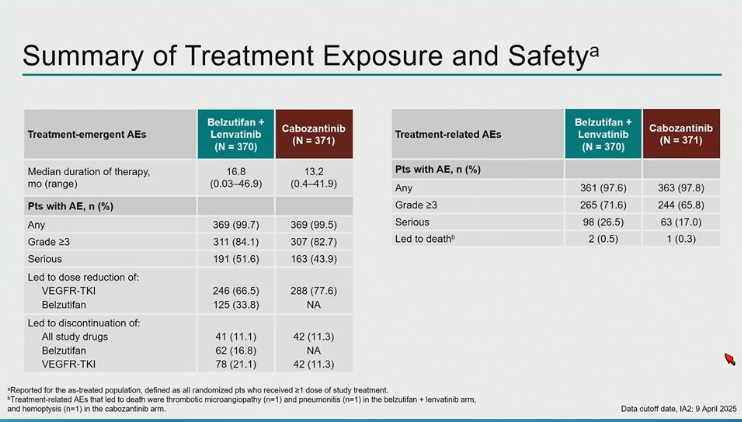
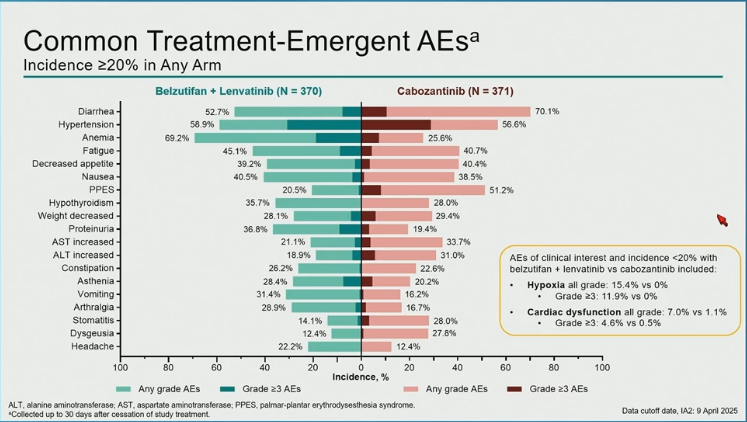
Safety — Belzutifan label carries a boxed warning for embryo-fetal toxicity plus warnings for anemia and hypoxia; the combination adds cardiac dysfunction. Lenvatinib adds hypertension, hepatotoxicity, proteinuria, GI perforation/fistula and others. (FDA approval notice)
Regulatory — ✅ FDA APPROVED September 24, 2026 — belzutifan (Welireg) + lenvatinib (Lenvima) for adults with advanced RCC with a clear cell component following a PD-1 or PD-L1 inhibitor. Dosage: lenvatinib 20 mg + belzutifan 120 mg once daily. (FDA approval notice)
Sponsor / Drug — Merck (with Eisai); belzutifan (HIF-2-alpha inhibitor) + lenvatinib (multikinase VEGFR TKI). (sponsor)
Compiled and reviewed by the KOL Pulse research team, led by Brian Shields, Founder, KOL Pulse. Last updated September 24, 2026.





Top tweets by impressions — click to view on X

⚡️LITESPARK-011 published in @TheLancet: belzutifan + lenvatinib vs cabozantinib in advanced ccRCC after anti-PD-(L)1 therapy (n=747). Median PFS: 14.8 vs 10.7 months (HR 0.70). OS not significantly different at interim (HR 0.85). #KidneyCancer https://t.co/XI7In9Fu5v

🟪 LITESPARK-011: Belzutifan Plus Lenvatinib in Advanced RCC The phase 3 LITESPARK-011 trial evaluated belzutifan plus lenvatinib versus cabozantinib in patients with advanced clear-cell renal cell carcinoma progressing after anti-PD-1/PD-L1 therapy. The trial randomized 747 patients to belzutifan 120 mg plus lenvatinib 20 mg once daily or cabozantinib 60 mg once daily. 👉 Median PFS was 14.8 vs 10.7 months (HR 0.70; 95% CI 0.59–0.84; one-sided p<0.0001). 👉 ORR was 53% vs 40%, with median duration of response of 23.0 vs 12.3 months. 👉 Median OS was 34.9 vs 27.6 months (HR 0.85; 95% CI 0.68–1.05; one-sided p=0.061) and was not statistically significantly different at the current analysis. The investigators concluded that belzutifan plus lenvatinib might represent a potential new standard of care in this post-immunotherapy setting. @motzermd @BurottoMauricio @DrIacovelli @raymanneh @AzadOncology @UgoDeGiorgi @AndreaNecchi @FabioSchutz78 @DrDanielHeng @schmidingerRCC https://t.co/JY30LvLO5d #OncoDaily #OncoDailyGU

Just published! Litespark-011 mPFS 14.8m Lenva Belzutifan vs 10.7m Cabozantinib HR 0.7 New options for our patients💪🏻proud to be part!! @sohecsas
Phase 3 LITESPARK-011: Belzutifan + Lenvatinib vs Cabozantinib in pretreated metastatic clear cell renal cancer #GU25 shows +ve PFS HR 0.75 , OS HR 0.85 (non-significant), ⬆️ RR 53% vs 40%, G3+…
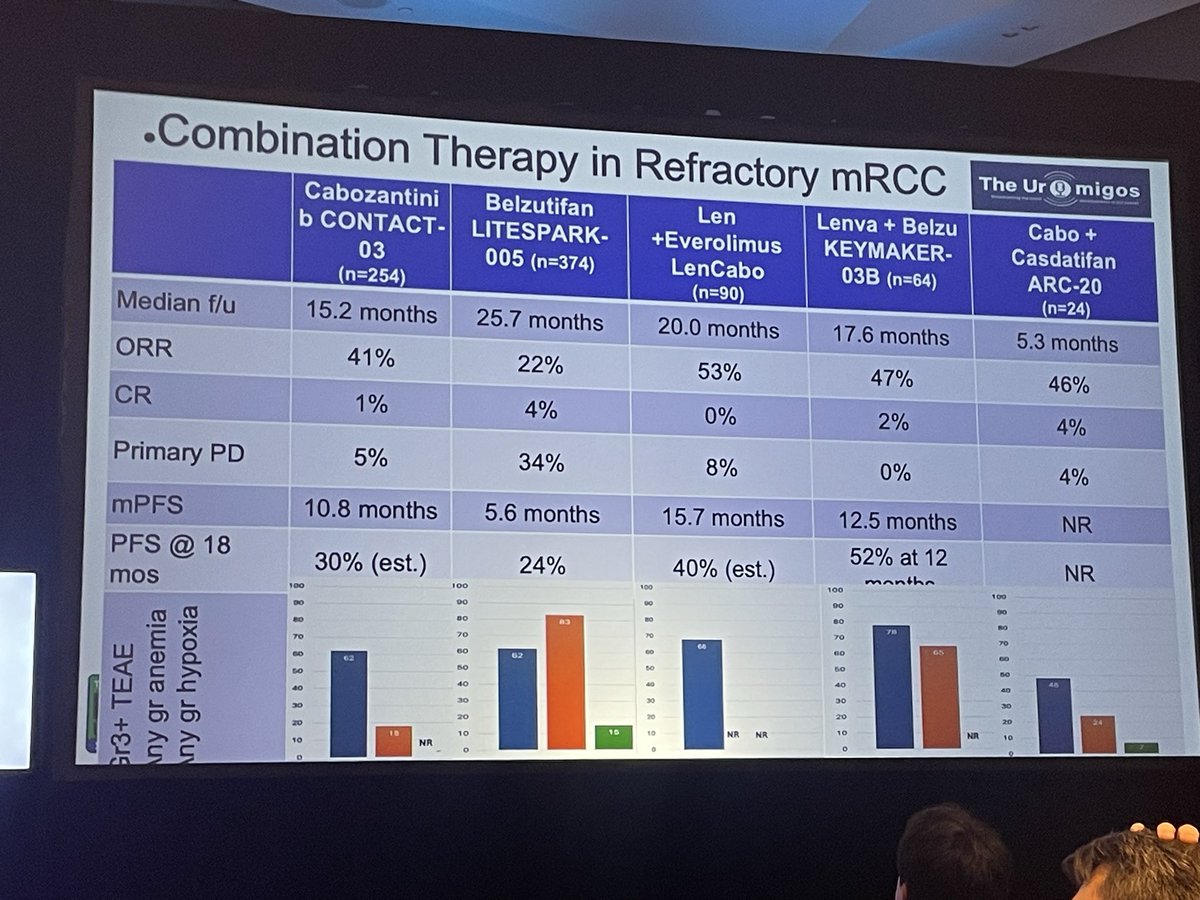
Combination therapy is emerging as a standard in refractory RCC. Combos increase tumor shrinkage endpoints. TKI provides early disease control. CRs are possible but is cure? Toxicity consideration is…
Summary of combination therapy in advanced RCC. Hard to compare phase II trials but clearly multiple options are emerging. #uromigoslive @Uromigos https://t.co/KspHdha2SJ
LITESPARK-011 | Phase III | #ASCOGU26 #GU26
Belzutifan + Lenvatinib vs Cabozantinib in advanced clear-cell RCC post anti–PD-(L)1
A pivotal study redefining the post-IO VEGFR-TKI landscape.
@motzermd …
More from #ASCODailyNews: Phase 3 LITESPARK-011 results support belzutifan + lenvatinib as alt to cabozantinib for pts with aRCC after disease progression on anti–PD-L1/anti–PD-1 therapy. Read the…
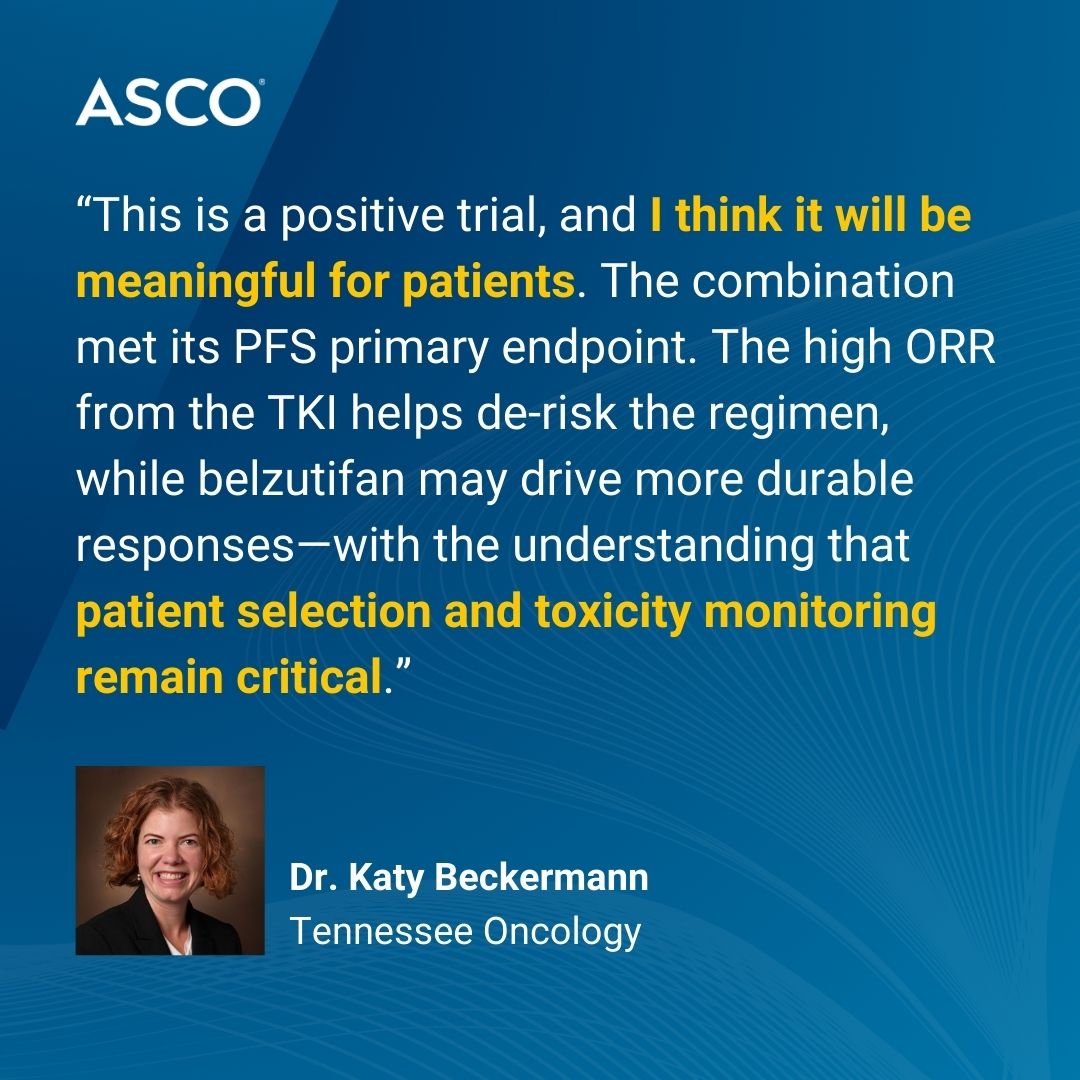
Thoughtful discussion by Dr. Katy Beckermann @katy_beckermann on the rationale for HIF-2α inhibitor–based combinations in LITESPARK-011 and -022, and the need to balance efficacy with quality of…

GU @ASCO highlights from #GU26 with @PGrivasMDPhD
✅ CREST/POTOMAC (update)
✅ EV304/KeynoteB15 (new SoC)
✅ LITESPARK-011 & 022
✅ CAPItello-281
Full 🗣️:
⭐️ On OncBrothers & @OncUpdates…
Big morning for Belzutifan🎉#ASCOGU26
#LITESPARK011 combo w/ Lenva vs Cabo in 2L+ s/p IO in mRCC (55% prior TKI)
➕ PFS, ORR, immature OS, 20 pts w/ CR
⚠️15% hypoxia, 2/3 DR TKI, 1/3 DR…

Kidney cancer trial breakdown 🎧
Brian, Tom, and @motzermd analyze the phase 3 LITESPARK-011 trial comparing belzutifan + lenvatinib vs cabozantinib—covering efficacy, safety, and implications for…
Nice slide to show take home message for Monday morning clinic after new RCC data 🙂 @ASCO #GU26 @OncoAlert https://t.co/R4hzBSrbuH
Positions belzutifan + lenvatinib as a potential new standard in advanced ccRCC after PD-1/PD-L1 inhibitor therapy — directly challenging single-agent cabozantinib (current SOC in this setting). Expands role of HIF-2α inhibition beyond VEGF-TKI-refractory monotherapy.
In the analysis supporting the FDA approval, median PFS by blinded independent central review (RECIST v1.1) was 14.6 months (95% CI 11.1-16.6) with belzutifan + lenvatinib vs 10.6 months (95% CI 9.2-11.1) with cabozantinib; HR 0.74 (95% CI 0.61-0.89), one-sided p=0.00095 — a statistically significant improvement. (FDA label, final analysis)
Objective response rate was 53% (95% CI 47-58) vs 40% (95% CI 35-45); one-sided p=0.0002. (FDA label, final analysis)
Earlier data cut, for reference: the ASCO GU 2026 LBA417 / Lancet presentation reported median PFS 14.8 vs 10.7 months (HR 0.70; 95% CI 0.59-0.84; p=0.00007) at 29.0 months median follow-up. (ASCO GU 2026 LBA417 / Lancet) These come from different analyses — do not mix the two.
The final analysis of overall survival was not statistically significant. Median OS was 33.7 months (95% CI 29.0-46.9) with belzutifan + lenvatinib vs 28.6 months (95% CI 24.1-31.4) with cabozantinib; HR 0.85 (95% CI 0.70-1.03). (FDA label, final analysis) No overall survival benefit has been demonstrated — the approval rests on PFS and ORR. An earlier interim cut reported HR 0.85 (95% CI 0.68-1.05; p=0.06075). (ASCO GU 2026 LBA417 / Lancet)
The belzutifan prescribing information carries a boxed warning for embryo-fetal toxicity and warnings for anemia and hypoxia; for the belzutifan + lenvatinib combination, warnings and precautions also include cardiac dysfunction. The lenvatinib prescribing information carries warnings for hypertension, cardiac dysfunction, arterial thromboembolic events, hepatotoxicity, renal failure or impairment, proteinuria, diarrhea, fistula formation and gastrointestinal perforation, QT prolongation, hypocalcemia, reversible posterior leukoencephalopathy syndrome, hemorrhagic events, thyroid dysfunction, impaired wound healing, osteonecrosis of the jaw, and embryo-fetal toxicity. (FDA approval notice; full prescribing information at Drugs@FDA)
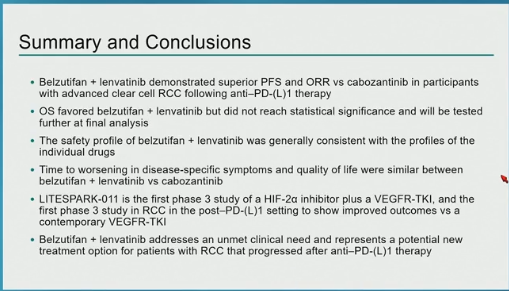
✅ FDA approved September 24, 2026 — a new option in post-IO advanced RCC with a clear cell component. Belzutifan + lenvatinib is now an approved regimen after a PD-1 or PD-L1 inhibitor, positioned directly against single-agent cabozantinib. It is the first positive Phase 3 to combine a multi-targeted TKI with a HIF-2α inhibitor in RCC, and the first to improve PFS versus a modern TKI comparator in this post-PD-(L)1 setting. Note that the survival benefit was not established: the final overall survival analysis was not statistically significant (HR 0.85; 95% CI 0.70-1.03), so the approval rests on progression-free survival and objective response rate.
LITESPARK-011 is a Phase 3, open-label, randomized, active-controlled trial (NCT04586231) of belzutifan (Welireg) plus lenvatinib versus cabozantinib in 747 patients with advanced renal cell carcinoma with a clear cell component whose disease progressed on or after a PD-1 or PD-L1 inhibitor, or within six months of completing adjuvant PD-1 therapy.
Yes. On September 24, 2026 the FDA approved belzutifan (Welireg, Merck & Co., Inc.) in combination with lenvatinib (Lenvima, Eisai Inc.) for adults with advanced renal cell carcinoma with a clear cell component (ccRCC) following a PD-1 or PD-L1 inhibitor. The approval came ahead of the October 4, 2026 PDUFA date and is based on LITESPARK-011.
In the FDA's final analysis, median progression-free survival by blinded independent central review (RECIST v1.1) was 14.6 months (95% CI 11.1-16.6) with belzutifan plus lenvatinib versus 10.6 months (95% CI 9.2-11.1) with cabozantinib (HR 0.74; 95% CI 0.61-0.89; one-sided p=0.00095) - a statistically significant improvement. The earlier ASCO GU 2026 LBA417 / Lancet presentation of an earlier data cut reported 14.8 versus 10.7 months (HR 0.70; 95% CI 0.59-0.84; p=0.00007) at 29.0 months median follow-up. The two figures come from different analyses and should not be mixed.
No. The final analysis of overall survival was not statistically significant. Median overall survival was 33.7 months (95% CI 29.0-46.9) with belzutifan plus lenvatinib versus 28.6 months (95% CI 24.1-31.4) with cabozantinib (HR 0.85; 95% CI 0.70-1.03). The FDA approval rests on the progression-free survival and objective response rate results, not on an overall survival benefit.
The recommended dosage is 20 mg of lenvatinib in combination with 120 mg of belzutifan once daily until disease progression or unacceptable toxicity. The belzutifan prescribing information includes a boxed warning for embryo-fetal toxicity and warnings for anemia and hypoxia; for the combination, warnings also include cardiac dysfunction.
Belzutifan (Welireg), a HIF-2-alpha inhibitor, is developed by Merck & Co., Inc. Lenvatinib (Lenvima), a multikinase VEGFR inhibitor, is developed by Eisai Inc. Merck Sharp & Dohme is the LITESPARK-011 trial sponsor and Eisai Inc. is a listed collaborator on ClinicalTrials.gov.

