KOL Pulse — Trial Profile

NorthStar Trial

EGFR-mutant locally advanced or metastatic NSCLC, non-progressing after osimertinib induction — MD Anderson Cancer Center (academic investigator-initiated)

EGFR-mutant locally advanced or metastatic NSCLC, non-progressing after osimertinib inductionTagrisso + LCTESMO 2025 LBA72 / ELCC 2026 secondary analysis
Visit Interactive Trial Page →

Top KOLs Discussing NorthStar

Stephen V Liu, MD
Stephen V Liu, MD
@StephenVLiu
11.6K impressions
Oncology Brothers
Oncology Brothers
@OncBrothers
9.5K impressions
Drew Moghanaki
Drew Moghanaki
@DrewMoghanaki
7.3K impressions
Hidehito HORINOUCHI
Hidehito HORINOUCHI
@HHorinouchi
7.3K impressions
Dr Rishabh Jain
Dr Rishabh Jain
@DrRishabhOnco
6.5K impressions
Eric K. Singhi, MD
Eric K. Singhi, MD
@lungoncdoc
3K impressions

NorthStar Key Slides & Visuals

Official trial slides and relevant visuals shared by KOLs at ESMO 2025 LBA72 / ELCC 2026 secondary analysis. Click any image to expand.

Stephen V Liu, MD
Stephen V Liu, MD @StephenVLiu
NorthStar Data
11.6K impressions · 88 likes · Oct 17, 2025
View on X ↗
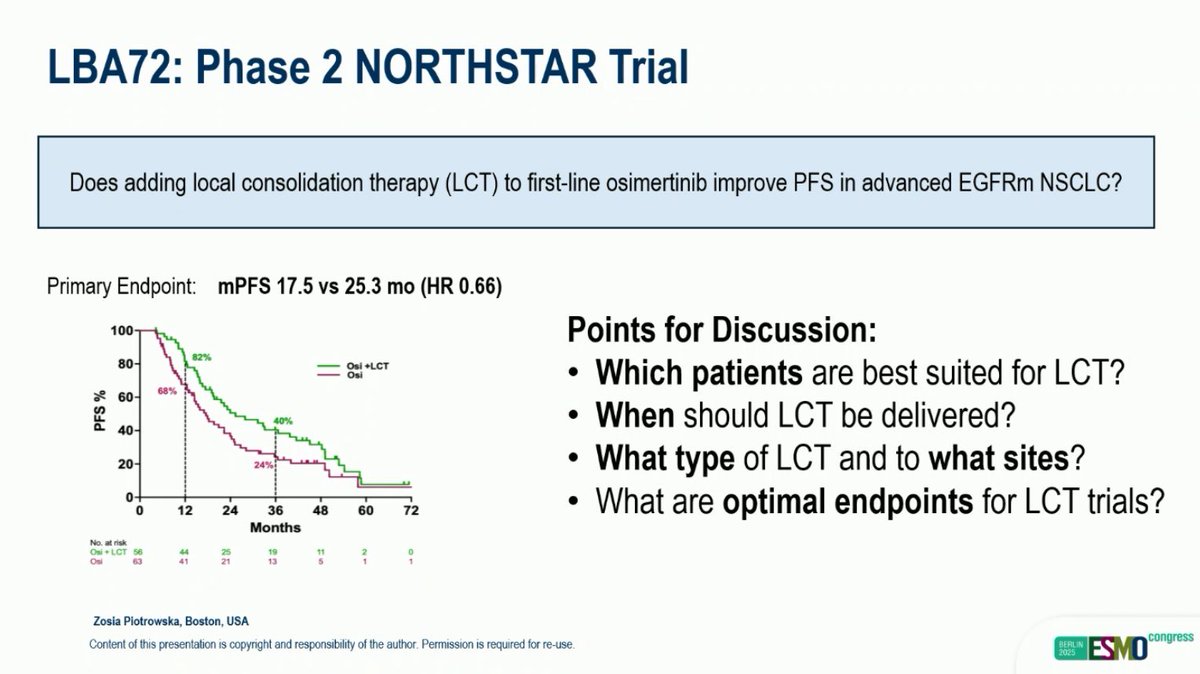
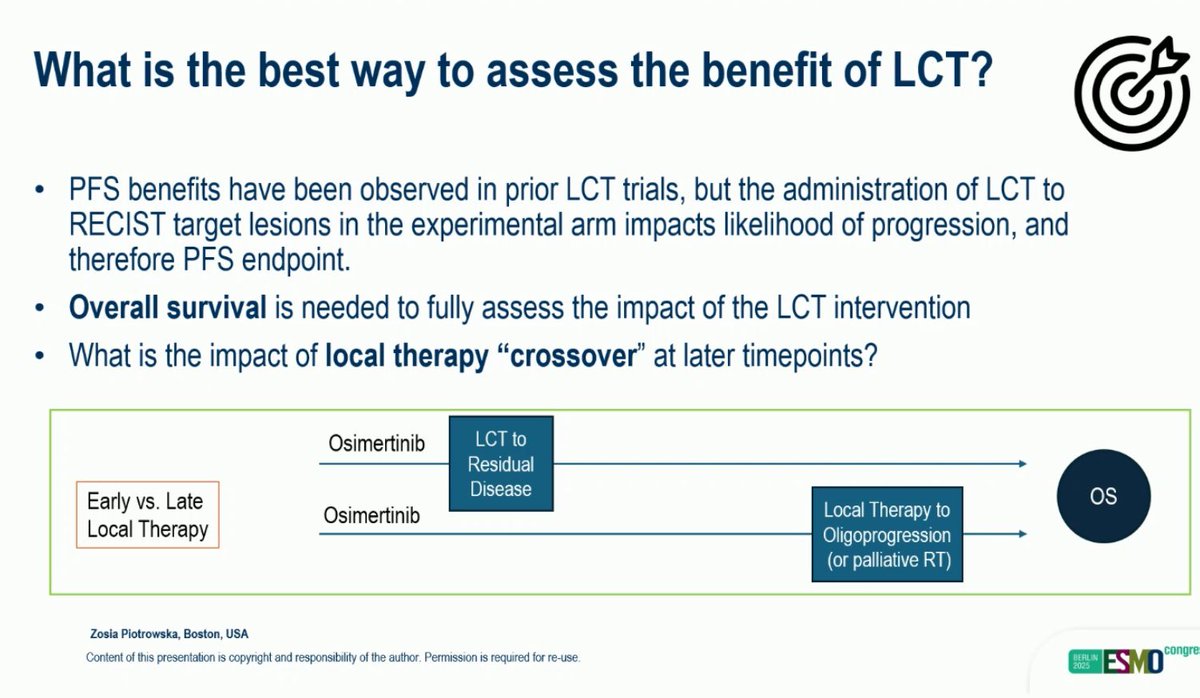
[Slide 1] LBA72: Phase 2 NORTHSTAR Trial Does adding local consolidation therapy (LCT) to first-line osimertinib improve PFS in advanced EGFRm NSCLC? Primary Endpoint: mPFS 17.5 vs 25.3 mo (HR 0.66) 100 Points for Discussion: 82% 80 Osi +LCT Osi Which patients are best suited for LCT? 68% PFS % 60 40% When should LCT be delivered? 40 20 24% What type of LCT and to what sites? 0 0 12 24 36 48 60 72 What are optimal endpoints for LCT trials? Months No. at risk Osi LCT 56 44 25 19 11 2 0 Osi 63 41 21 13 5 1 1 Zosia Piotrowska, Boston, USA Content of this presentation is copyright and responsibility of the author. Permission is required for re-use 2025 ESMO congress BERLIN --- [Slide 2] NORTHSTAR Patient population is heterogenous "Baseline" These subgroups reflect key differences in "Baseline" Oligometastatic Polymetastatic disease biology: Metastatic potential TKI sensitivity Tumor heterogeneity A "one size fits all" LCT approach will likely be inadequate Clearer definitions and better biomarkers are "Induced" needed to identify patients most likely to Oligometastatic benefit from LCT Zosia Piotrowska, Boston, USA Content of this presentation is copyright and responsibility of the author. Permission is required for re-use congress BERLIN 2025 ESMO --- [Slide 3] LCT Target Selection: What does "residual disease" really mean? Baseline Disease Residual Disease NORTHSTAR LCT Requirements: Induction Therapy Oligometastatic disease: LCT to all sites Polymetastatic disease: LCT to as many 6-12 weeks TKI sites as feasible and safe CT or PET-CT, RECIST 1.1 1. What is the optimal duration of TKI treatment prior to LCT? Likely not the same for all patients. Need for dynamic biomarkers (MRD) 2. How can we accurately identify sites of disease that should be treated? Metabolic response by PET Radiomics Zosia Piotrowska, Boston, USA Content of this presentation is copyright and responsibility of the author. Permission is required for re-use congress BERLIN 2025 ESMO --- [Slide 4] What is the best way to assess the benefit of LCT? PFS benefits have been observed in prior LCT trials, but the administration of LCT to RECIST target lesions in the experimental arm impacts likelihood of progression, and therefore PFS endpoint. Overall survival is needed to fully assess the impact of the LCT intervention What is the impact of local therapy "crossover" at later timepoints? Osimertinib LCT to Residual Disease Early VS. Late OS Osimertinib Local Therapy to Local Therapy Oligoprogression (or palliative RT) Zosia Piotrowska, Boston, USA Content of this presentation is copyright and responsibility of the author. Permission is required for re-use BERLIN 2025 ESMO congre
Oncology Brothers
Oncology Brothers @OncBrothers
NorthStar Data
9.5K impressions · 23 likes · Oct 17, 2025
View on X ↗
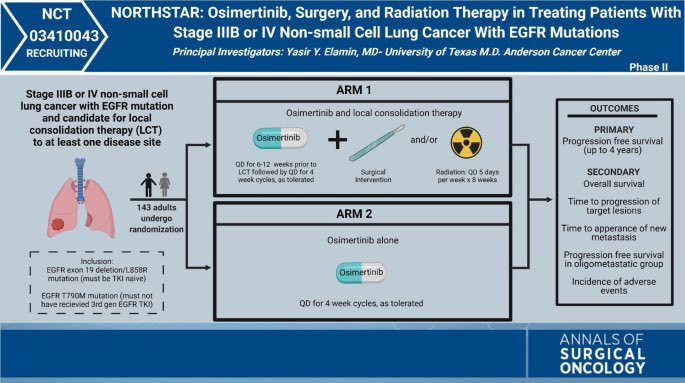
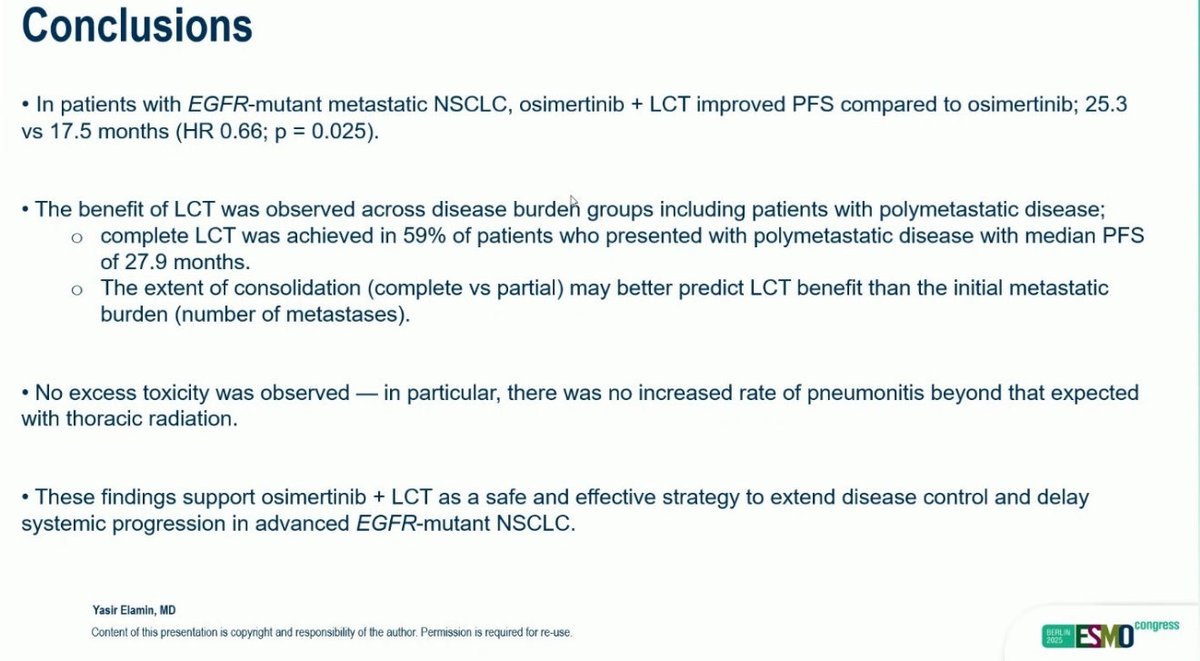
[Slide 1] NCT NORTHSTAR: Osimertinib, Surgery, and Radiation Therapy in Treating Patients With 03410043 Stage IIIB or IV Non-small Cell Lung Cancer With EGFR Mutations RECRUITING Principal Investigators: Yasir Y. Elamin, MD- University of Texas M.D. Anderson Cancer Center Phase II Stage IIIB or IV non-small cell ARM 1 lung cancer with EGFR mutation Osimertinib and local consolidation therapy OUTCOMES and candidate for local consolidation therapy (LCT) PRIMARY to at least one disease site Osimertinib + and/or Progression free survival (up to 4 years) OD for 6-12 weeks prior to LCT followed by QD for 4 Surgical Rediation 00 5 days SECONDARY week cycles, as tolerated Intervention per week ( 8 weeks Overall survival Time to progression of 143 adults undergo ARM 2 target lesions randomization Time to apperance of new Osimertinib alone metastasis Progression free survival Inclusion: in oligometastatic group EGFR exon 19 deletion/L858R Osimertinib mutation (must be TKI naive) Incidence of adverse events EGFR T790M mutation (must not have receivied 3rd gen EGFR TKI) I QD for 4 week cycles, as tolerated ANNALS OF SURGICAL ONCOLOGY --- [Slide 2] LBA72: Phase 2 NORTHSTAR Trial Does adding local consolidation therapy (LCT) to first-line osimertinib improve PFS in advanced EGFRm NSCLC? Primary Endpoint: mPFS 17.5 vs 25.3 mo (HR 0.66) 100 Points for Discussion: 82% 80 Osi +LCT Osi Which patients are best suited for LCT? 68% PFS % 60 40% When should LCT be delivered? 40 20 24% What type of LCT and to what sites? 0 0 12 24 36 48 60 72 What are optimal endpoints for LCT trials? Months No. at risk Osi . LCT 56 44 25 19 11 2 0 Osi 63 41 21 13 5 1 1 Zosia Piotrowska, Boston, USA Content of this presentation is copyright and responsibility of the author. Permission is required for re-use 2025 ESMO congress BERLIN --- [Slide 3] What is the best way to assess the benefit of LCT? PFS benefits have been observed in prior LCT trials, but the administration of LCT to RECIST target lesions in the experimental arm impacts likelihood of progression, and therefore PFS endpoint. Overall survival is needed to fully assess the impact of the LCT intervention What is the impact of local therapy "crossover" at later timepoints? Osimertinib LCT to Residual Disease Early VS. Late OS Osimertinib Local Therapy to Local Therapy Oligoprogression (or palliative RT) Zosia Piotrowska, Boston, USA Content of this presentation is copyright and responsibility of the author. Permission is required for re-use BERLIN 2025 ESMO congre --- [Slide 4] Conclusions In patients with EGFR-mutant metastatic NSCLC, osimertinib + LCT improved PFS compared to osimertinib; 25.3 vs 17.5 months (HR 0.66; p = 0.025). The benefit of LCT was observed across disease burden groups including patients with polymetastatic disease; complete LCT was achieved in 59% of patients who presented with polymetastatic disease with median PFS of 27.9 months. The extent of consolidation (complete VS partial) may better predict LCT benefit than the initial metastatic burden (number of metastases). No excess toxicity was observed — in particular, there was no increased rate of pneumonitis beyond that expected with thoracic radiation. These findings support osimertinib + LCT as a safe and effective strategy to extend disease control and delay systemic progression in advanced EGFR-mutant NSCLC. Yasir Elamin, MD Content of this presentation is copyright and responsibility of the author. Permission is required for re-use BERLIN 2025 ESMO congress
Hidehito HORINOUCHI
Hidehito HORINOUCHI @HHorinouchi
NorthStar Data
5.1K impressions · 9 likes · Mar 26, 2026
View on X ↗
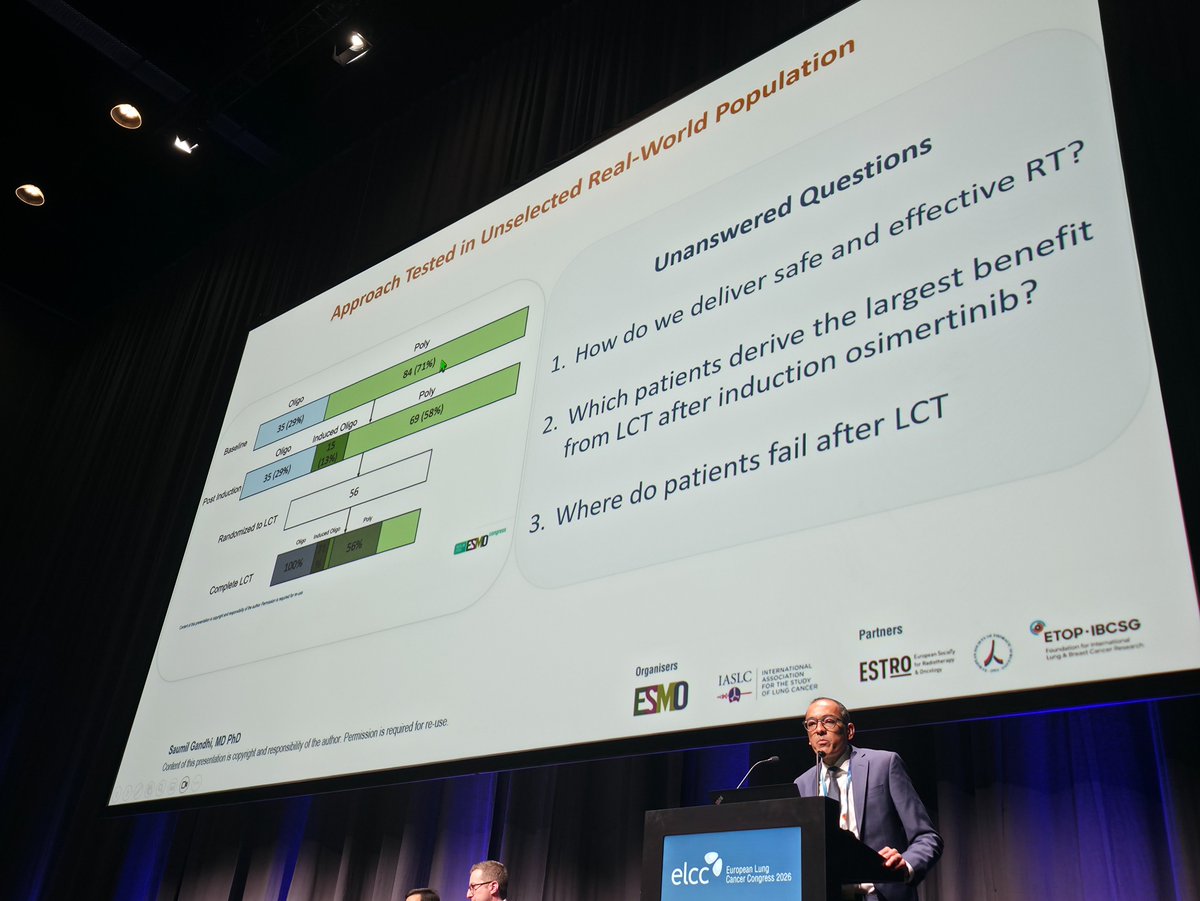
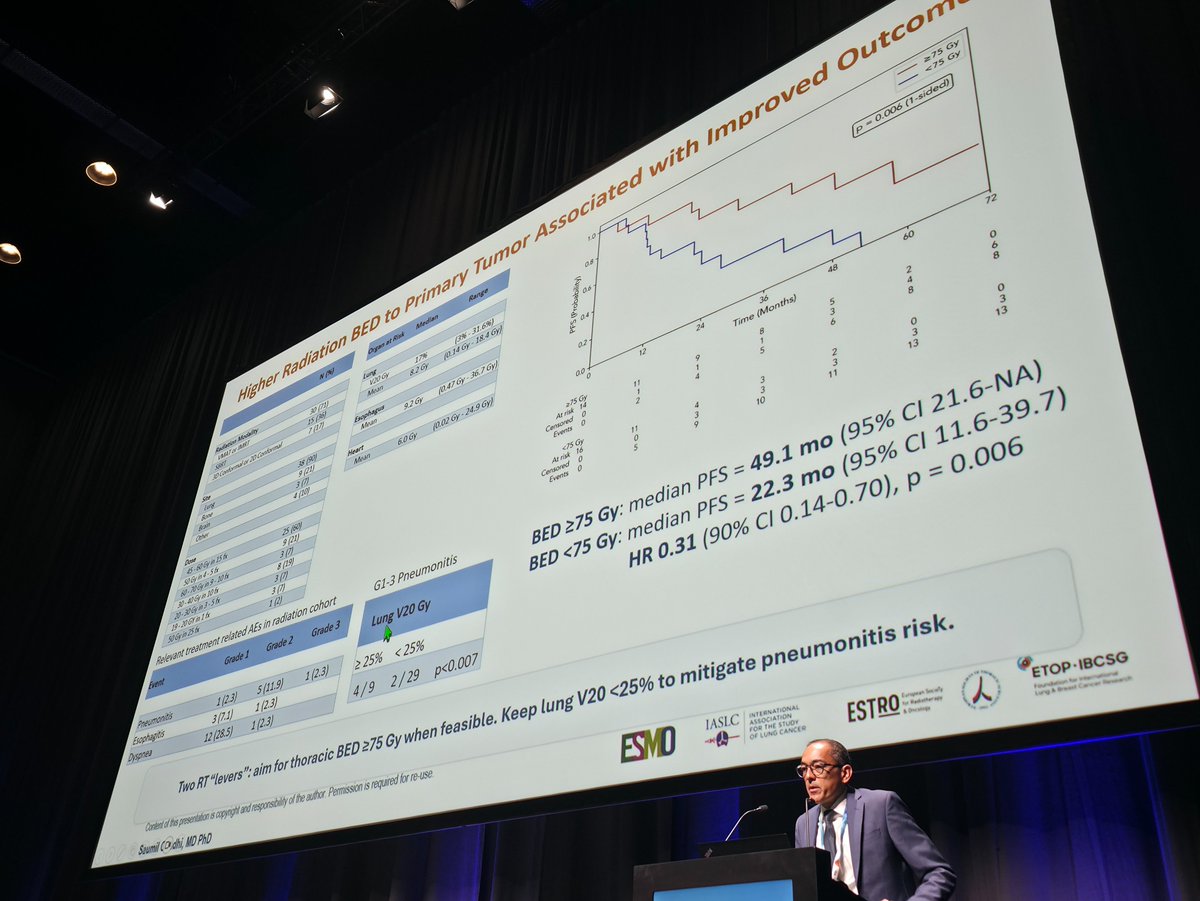
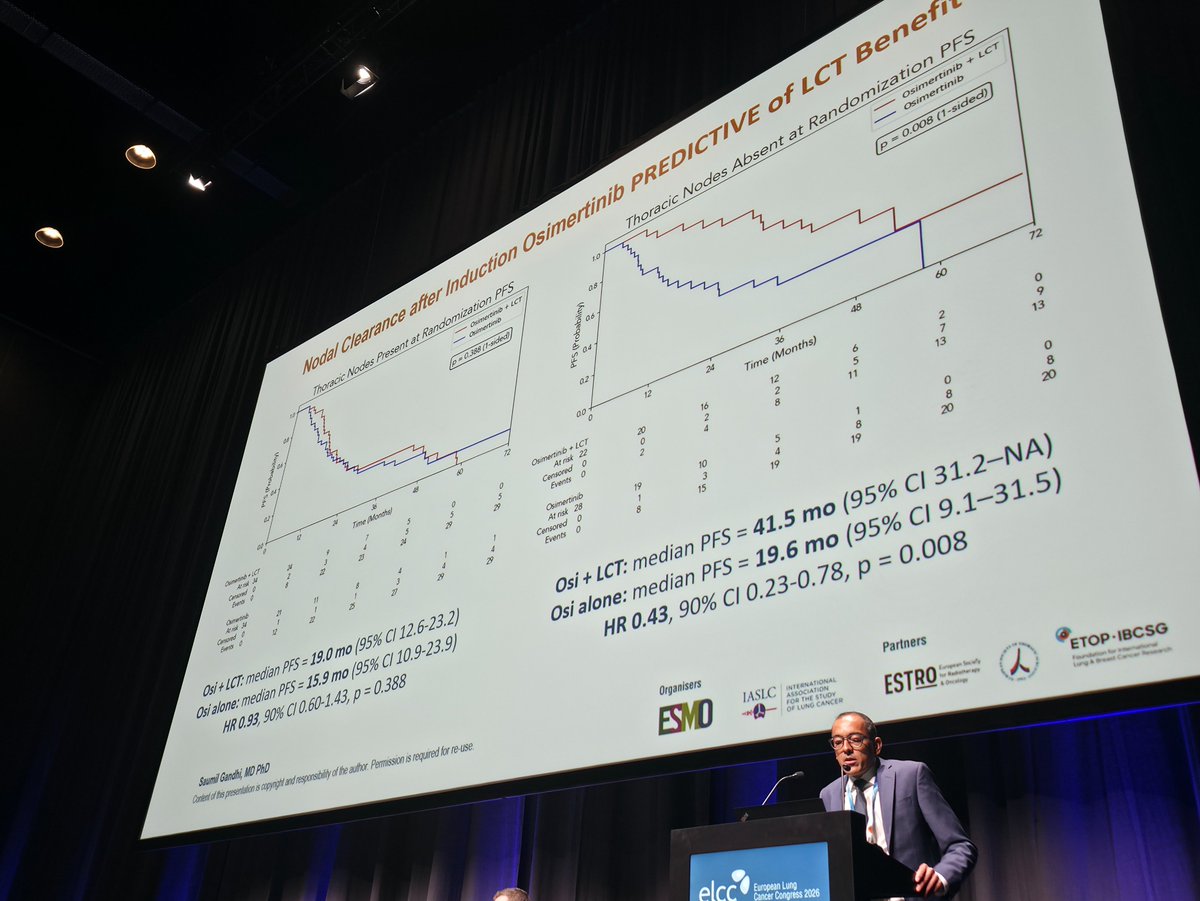
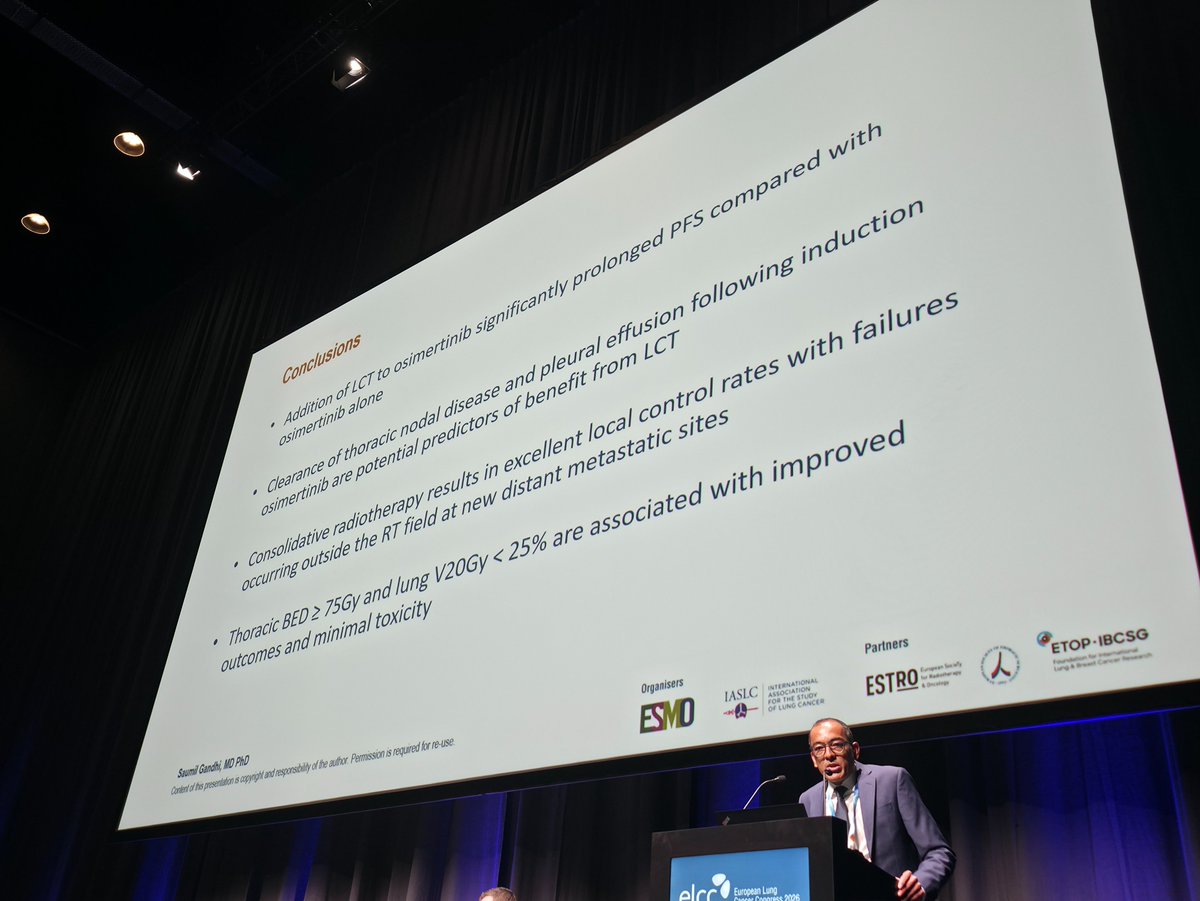
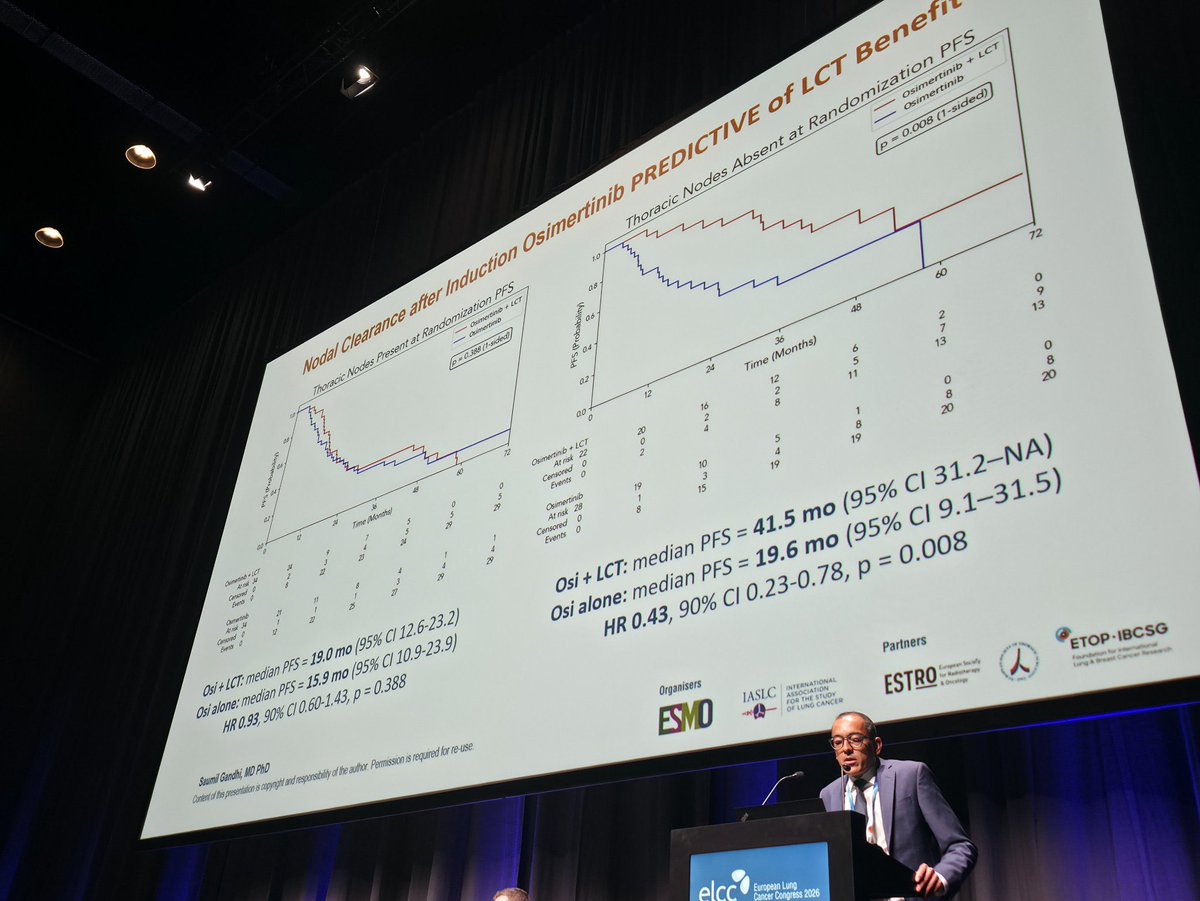
[Slide 1] Higher Radiation BED to Primary Tumor Associated with Improved Outcom >75 <75 Gy Gy 10 Organ at Risk Median Range N (%) P 0.006 (1-sided) 0.8 Lung Rediation Modality V20Gy 17% (3%-31.6%) UMATO MRT 30 30 (71) 15 (36) Mean 8.2 Gy (0.14 Gy - 18.4 Gy) S887 30 Conformal or 0 Conformal 7 (17) PFS (Probability) 0.6 Esophagus 0.4 Mean 9.2 Gy (0.47 Gy - 36.7 Gy) Site Lung 38 (90) 0.2 Bone 9(21) Heart Brain 3 (7) Mean 6.0 Gy (0.02 Gy - 24.9 Gy) Gy 0.0 4 (10) 36 48 60 72 Other 0 12 24 Time (Months) a75 Gy Dose At risk 14 11 9 8 5 2 0 25 (60) Censored 0 1 1 1 3 4 6 4 5 5 8 8 50Gyin4-56x 9(21) Events 0 2 60-70Gyin9-20fx 3 (7) <75 Gy 30-40 Gy in 10 fx 8 (29) At risk 16 11 4 3 2 0 0 Censored 0 0 3 (7) 3 3 3 3 3 Events 0 $ 9 10 11 13 13 19-20Gra1b 3 (7) 50Gyin 25 6x 1 (2) Relevant treatment related AEs in radiation cohort G1-3 Pneumonitis Event Grade 1 Grade 2 BED ≥75 Gy: median PFS = 49.1 mo (95% CI 21.6-NA) Grade 3 Lung V20 Gy BED <75 Gy: median PFS = 22.3 mo (95% CI 11.6-39.7) Pneumonitis 1 (2.3) 5(11.9) 1 (2.3) > 25% < 25% HR 0.31 (90% CI 0.14-0.70), p = 0.006 Esophagitis 3(7.1) 1 (2.3) Dyspnea 12 (28.5) 1 (2.3) 4/9 2/29 p<0.007 Saumil (Dudhi, MD PhD Content of this copyright responsibility of the author Permission is required for re-use Two presentation RT "levers": is and aim for thoracic BED ≥75 Gy when feasible. Keep lung V20 <25% to mitigate pneumonitis risk. ESMO ASLC ASSOCIATION INTERNATIONAL FOR THE STUDY or LUNG CANCER ESTRO Increase I 2 ETOP-IBCSG lings - 1 --- [Slide 2] Conclusions Addition of LCT to osimertinib significantly prolonged PFS compared with osimertinib alone Clearance of thoracic nodal disease and pleural effusion following induction osimertinib are potential predictors of benefit from LCT Consolidative radiotherapy results in excellent local control rates with failures occurring outside the RT field at new distant metastatic sites outcomes Thoracic BED and ≥ 75Gy and lung V20Gy < 25% are associated with improved minimal toxicity Saumil Gandhi, MD PhD Content of his presentation IS copyright and responsibility of the author Permission is required for re-use Organisers ESMO IASLC Partners INTERNATIONAL FOR THE STUDY OF LING CANCER ESTRO I 1 I i ETOP-IBCSG --- [Slide 3] Approach Tested in Unselected Real-World Population Oligo Poly Baseline 84 (71%) Unanswered Questions 35 (29%) Oligo Induced Oligo Poly 15 Post Induction 35 (29%) (13%) 69 (58%) 1. How do we deliver safe and effective RT? Randomized to LCT 56 2. Which patients derive the largest benefit Cige induced Cligo Poly Complete LCT 100% from LCT after induction osimertinib? 56% - ESMD 3. Where do patients fail after LCT Saumil Gandhi, MD PhD Content of a this presentation is copyright and responsibility of the author Permission is required for re-use Organisers ESMO IASLC Partners ASSOCIATIONAL OF LUNG CANCER ESTRO Empensions 1 L ETOP-IBCSG ling / --- [Slide 4] Higher Radiation BED to Primary Tumor Associated with Improved Outcom >75 <75 Gy Gy 10 Organ at Risk Median Range N (%) P 0.006 (1-sided) 0.8 Lung Rediation Modality V20Gy 17% (3%-31.6%) UMAT MRT 30 (71) 15 (36) Mean 8.2 Gy (0.14 Gy - 18.4 Gy) S887 30 Conformal or 0 Conformal 7 (17) PFS (Probability) 0.6 Esophagus 0.4 Mean 9.2 Gy (0.47 Gy - 36.7 Gy) Site Lung 38 (90) 0.2 Bone 9(21) Heart Brain 3 (7) Mean 6.0 Gy 0.02 Gy 24.9 Gy) 0.0 Other 0 12 36 48 60 72 4 (10) 24 Time (Months) a75 Gy Dose At risk 14 11 9 8 5 2 0 25 (60) Censored 0 1 1 1 3 4 6 5 8 8 50Gyin4-56x 9(21) Events 0 2 4 5 60-70Gyin9-20fx 3 (7) <75 Gy 30-40 Gy in 10 fx 8 (29) At risk 16 11 4 3 2 0 0 Censored 0 0 3(7) 3 3 3 3 3 Events 0 $ 9 10 11 13 13 19-20Gra1b 3 (7) 50Gyin 25 6x 1 (2) Relevant treatment related AEs in radiation cohort G1-3 Pneumonitis Event Grade 1 Grade 2 BED ≥75 Gy: median PFS = 49.1 mo (95% CI 21.6-NA) Grade 3 Lung V20 Gy BED <75 Gy: median PFS = 22.3 mo (95% CI 11.6-39.7) Pneumonitis 1 (2.3) 5(11.9) 1 (2.3) Esophagitis > 25% < 25% HR 0.31 (90% CI 0.14-0.70), p = 0.006 3(7.1) 1 (2.3) Dyspnea 12 (28.5) 1 (2.3) 4/9 2/29 p<0.007 Content of this copyright responsibility of the author Permission is required for re-use Two presentation RT "levers": is and aim for thoracic BED ≥75 Gy when feasible. Keep lung V20 <25% to mitigate pneumonitis risk. Saumil (Dudhi, MD PhD ESMO ASLC ASSOCIATION INTERNATIONAL FOR THE STUDY or LUNG CANCER ESTRO Increase 2 ETOP-IBCSG lings - 1 --- [Slide 5] Nodal Clearance after Induction Osimertinib PREDICTIVE of LCT Benefit Thoracic Nodes Absent at Randomization PFS Thoracic Nodes Present at Randomization PFS Osimertinib + LCT 1.0 13 Osimertinib LCT Osimertinib Oximertinib 08 0.8 P - 0.008 (1-sided) p . 0.388 (1-sided) È / 04 04 PFS (Probability) 0.6 0.4 02 0.2 & 0 2 24 38 & 0.0 60 72 Time (Months) 0 12 24 LCT 36 48 60 72 At mk 34 34 * Censored 0 7 $ Osimertinb LCT Time (Months) 2 3 0 4 0 Events 0 $ $ At nisk 22 5 20 22 23 5 Censored 0 16 12 24 0 6 29 Demerting 29 Events 0 2 2 2 0 2 5 At nok 34 4 7 8 9 Censored 0 12 21 1 11 11 8 Osimertinib 13 4 13 Eventy 0 1 1 1 22 3 At risk 28 25 4 27 4 19 Censored 0 10 29 5 29 1 3 1 Events 0 4 0 8 8 0 15 19 8 Osi Osi + LCT: median PFS = 19.0 mo (95% CI 12.6-23.2) 19 8 20 20 alone: HR median PFS = 15.9 mo (95% CI 10.9-23.9) 0.93, 90% CI 0.60-1.43, p = 0.388 Osi Osi alone: + LCT: median PFS = 41.5 mo (95% CI Saumil Gandhi, MD PhD HR median PFS = 19.6 mo (95% CI 31.2-NA) 9.1-31.5) 0.43, 90% CI 0.23-0.78, p = 0.008 Content of this presentation is copyright and responsibility of the author Permission is required for re-use Organisers ESMO ASLC Partners INTERNATIONAL STUDY OF LUNG CANCER ESTRO --- [Slide 6] Conclusions Addition of LCT to osimertinib significantly prolonged PFS compared with osimertinib alone Clearance of thoracic nodal disease and pleural effusion following induction osimertinib are potential predictors of benefit from LCT Consolidative radiotherapy results in excellent local control rates with failures occurring outside the RT field at new distant metastatic sites outcomes Thoracic BED and ≥ 75Gy and lung V20Gy < 25% are associated with improved minimal toxicity Saumil Gandhi, MD PhD Content of his presentation S copyright and responsibility of the author Permission is required for re-use Organisers ESMO IASLC Partners INTERNATIONAL FOR THE STUDY OF LUNG CANCER ESTRO I I i ETOP-IBCSG
Eric K. Singhi, MD
Eric K. Singhi, MD @lungoncdoc
NorthStar Data
3K impressions · 24 likes · Mar 27, 2026
View on X ↗
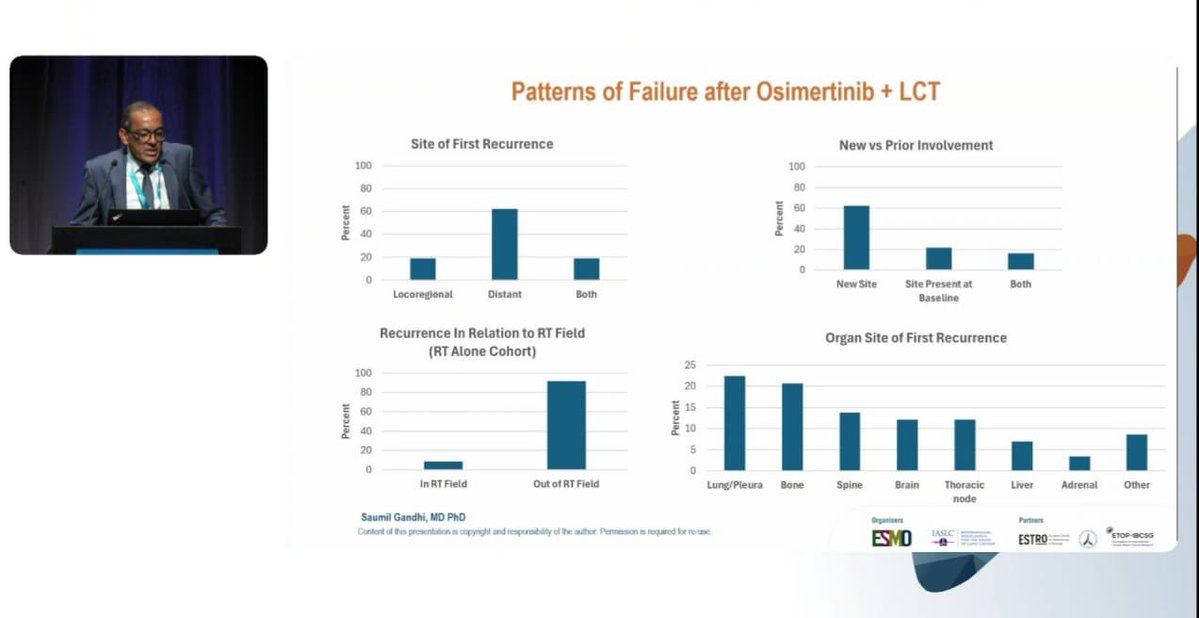
[Slide 1] Patterns of Failure after Osimertinib + LCT Site of First Recurrence New VS Prior Involvement 100 100 80 80 Percent 60 Percent 60 40 40 20 20 0 0 New Site Site Present at Both Locoregional Distant Both Baseline Recurrence In Relation to RT Field Organ Site of First Recurrence (RT Alone Cohort) 25 100 20 80 Percent 60 Percent 15 40 10 20 5 0 0 In RT Field Out of RT Field Lung/Pleura Bone Spine Brain Thoracic Liver Adrenal Other node Saumil Gandhi, MD PhD Organizers Partners Content of this presentation n copyright and responsibility of the author Permission is required for re-une ESMO IASLC ESTRO L ETOP-IBCSG --- [Slide 2] Nodal Clearance after Induction Osimertinib PREDICTIVE of LCT Benefit Thoracic Nodes Present at Randomization PFS Thoracic Nodes Absent at Randomization PFS Osimertinib + LCT 1.0 12 Osimertinib LCT Osimertinib Osimertinib as 0.8 p 0.388 (1-sided) P - 0.008 (1-sided) F / 04 04 PFS (Probability) 0.6 0.4 a 0.2 00 0 2 24 36 & 0.0 60 72 Time (Months) 0 12 Chined CT 24 36 48 60 At nat 34 72 34 * Censored 0 7 5 Osimertinb LCT Time (Months) 2 3 0 Events 0 4 0 $ At risk 22 8 5 20 22 23 5 Censored 0 16 24 12 29 0 6 Ownerting 29 2 2 Events 0 2 0 2 5 At nok 34 4 7 27 8 Cansored 0 11 9 11 1 8 4 Osimertinib 13 Eventy 0 1 1 1 13 1 2 22 3 25 I At nisk 28 27 4 19 Censored 0 10 29 29 1 5 Events 0 3 1 4 0 8 8 0 15 19 8 Osi Osi + LCT: median PFS = 19.0 mo (95% CI 12.6-23.2) 19 8 20 20 alone: HR median PFS = 15.9 mo (95% CI 10.9-23.9) 0.93, 90% CI 0.60-1.43, p = 0.388 Osi Osi alone: + LCT: median PFS = 41.5 mo (95% CI Saumil Gandhi, MD PhD HR median PFS = 19.6 mo (95% CI 31.2-NA) 9.1-31.5) 0.43, 90% CI 0.23-0.78, p = 0.008 Content of this presentation is copyright and responsibility of the author Permission is required for re-use Organisers ESMO ASLC Partners INTERNATIONAL FOR STUDY OF LUNG CANCER ESTRO ETOP
Hidehito HORINOUCHI
Hidehito HORINOUCHI @HHorinouchi
NorthStar Data
2.3K impressions · 5 likes · Mar 26, 2026
View on X ↗
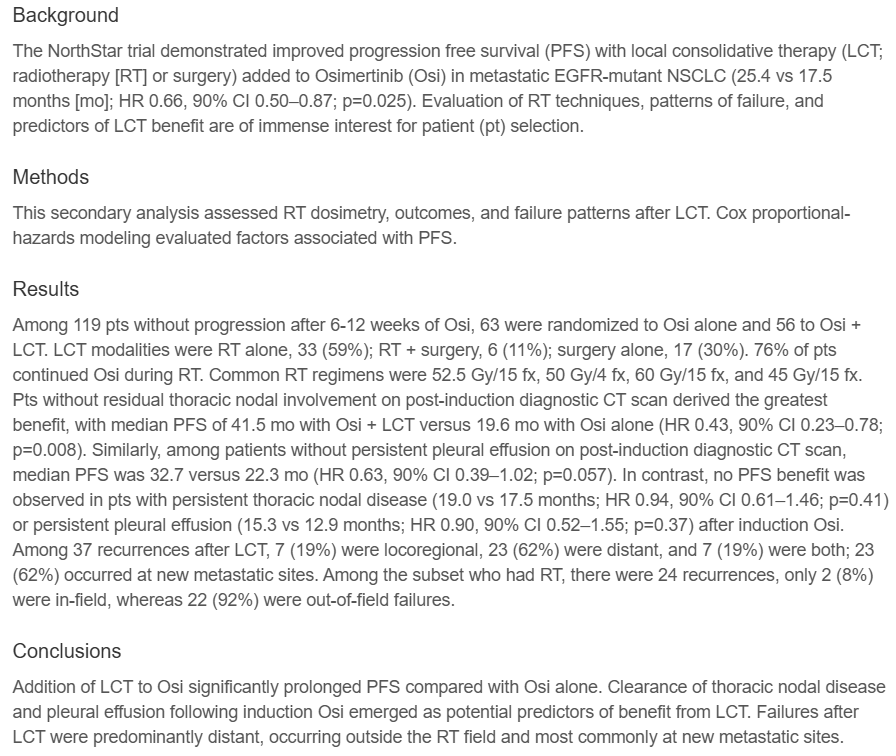
[Slide 1] Background The NorthStar trial demonstrated improved progression free survival (PFS) with local consolidative therapy (LCT; radiotherapy [RT] or surgery) added to Osimertinib (Osi) in metastatic EGFR-mutant NSCLC (25.4 VS 17.5 months [mo]; HR 0.66, 90% CI 0.50-0.87; p=0.025). Evaluation of RT techniques, patterns of failure, and predictors of LCT benefit are of immense interest for patient (pt) selection. Methods This secondary analysis assessed RT dosimetry, outcomes, and failure patterns after LCT. Cox proportional- hazards modeling evaluated factors associated with PFS. Results Among 119 pts without progression after 6-12 weeks of Osi, 63 were randomized to Osi alone and 56 to Osi + LCT. LCT modalities were RT alone, 33 (59%); RT + surgery, 6 (11%); surgery alone, 17 (30%). 76% of pts continued Osi during RT. Common RT regimens were 52.5 Gy/15 fx, 50 Gy/4 fx, 60 Gy/15 fx, and 45 Gy/15 fx. Pts without residual thoracic nodal involvement on post-induction diagnostic CT scan derived the greatest benefit, with median PFS of 41.5 mo with Osi + LCT versus 19.6 mo with Osi alone (HR 0.43, 90% CI 0.23-0.78; p=0.008). Similarly, among patients without persistent pleural effusion on post-induction diagnostic CT scan, median PFS was 32.7 versus 22.3 mo (HR 0.63, 90% CI 0.39-1.02; p=0.057). In contrast, no PFS benefit was observed in pts with persistent thoracic nodal disease (19.0 VS 17.5 months; HR 0.94, 90% CI 0.61-1.46; p=0.41) or persistent pleural effusion (15.3 VS 12.9 months; HR 0.90, 90% CI 0.52-1.55; p=0.37) after induction Osi. Among 37 recurrences after LCT, 7 (19%) were locoregional, 23 (62%) were distant, and 7 (19%) were both; 23 (62%) occurred at new metastatic sites. Among the subset who had RT, there were 24 recurrences, only 2 (8%) were in-field, whereas 22 (92%) were out-of-field failures. Conclusions Addition of LCT to Osi significantly prolonged PFS compared with Osi alone. Clearance of thoracic nodal disease and pleural effusion following induction Osi emerged as potential predictors of benefit from LCT. Failures after LCT were predominantly distant, occurring outside the RT field and most commonly at new metastatic sites.

NorthStar Top Tweets

Top tweets by impressions — click to view on X

Stephen V Liu, MD
Stephen V Liu, MD@StephenVLiu

Dr. @ZPiotrowskaMD discusses NORTHSTAR #ESMO25 - impressive PFS benefit in #EGFR NSCLC when local consolidation therapy added, but notable heterogeneity. Pt selection important, need uniform…

👁 11.6K ♡ 88 ↻ 21 Oct 17, 2025
Oncology Brothers
Oncology Brothers@OncBrothers

4. #NorthStar: PhII, Osimertinib +/- local consolidative therapy (LCT)for mNSCLC EGFR+:

- ⬆️ PFS w/ LCT (25.3mos vs 17.5mos, HR: 0.66)
- Benefit even with polymetastatic disease
- No new AEs or…

👁 9.5K ♡ 23 ↻ 7 Oct 17, 2025
Drew Moghanaki
Drew Moghanaki@DrewMoghanaki

The long-awaited results of NORTHSTAR are finally reported at #ESMO25. @fifimcdrmh https://t.co/GJfCUwnGCO

👁 7.3K ♡ 51 ↻ 17 Oct 18, 2025
Hidehito HORINOUCHI
Hidehito HORINOUCHI@HHorinouchi

🆙 #ELCC26 @myESMO @IASLC 🇩🇰
🔥Mini Oral session 1
☑️NorthStar
🎯PFS Osi +/- LCT 41.5m vs. 19.6m (HR 0.43, 90%CI 0.23–0.78)
🎙️Dr. Saumil Ghandi
🎙️Chair: @DocSacher Dr. Andreas…

👁 5.1K ♡ 9 ↻ 4 Mar 26, 2026
Dr Rishabh Jain
Dr Rishabh Jain@DrRishabhOnco

🔥 Not all EGFRm metastatic NSCLC patients benefit from LCT
#ELCC26

NorthStar (LBA3) secondary analysis finally tells us who truly benefits from adding local consolidative therapy (LCT) to…

👁 4.6K ♡ 29 ↻ 7 Mar 26, 2026
Eric K. Singhi, MD
Eric K. Singhi, MD@lungoncdoc

#NORTHSTAR update #ELCC26

1️⃣Post-osi CT @ 6-12 wks
•Nodes cleared: 41.5 v 19.6 mo
•Persistent: no benefit
•Effusion gone: 32.7 v 22.3 mo
•Persistent: no benefit

2️⃣RT w/ strong local control
•8%…

👁 3K ♡ 24 ↻ 12 Mar 27, 2026
high5md
high5md@high5md

“Very few negatives — only positives here.”

Dr. @StephenVLiu wraps up #ESMO2025 in Berlin with his expert insights on HARMONi-6, OptiTROP-Lung04 &amp; a surprise from NorthStar.
🎥 Watch the reports…

👁 2.3K ♡ 20 ↻ 7 Oct 21, 2025
Hidehito HORINOUCHI
Hidehito HORINOUCHI@HHorinouchi

🆙 #ELCC26 @myESMO 🇩🇰
🔥Mini Oral session 1
☑️NorthStar
🎯PFS Osi +/- LCT 41.5m vs. 19.6m (HR 0.43, 90%CI 0.23–0.78)
🎙️Dr. Saumil Ghandi
🎙️Chair: @DocSacher Dr. Andreas Rimner
📍NCT04479306
@OncoAlert

👁 2.3K ♡ 5 ↻ 3 Mar 26, 2026
Dr Rishabh Jain
Dr Rishabh Jain@DrRishabhOnco

Not all EGFRm NSCLC pts should get LCT

#ELCC26

NorthStar (LBA3) deep dive clarifies who truly benefits from osimertinib + LCT

🧪 After 6–12 weeks induction osimertinib (no progression):

🟢 Best…

👁 1.9K ♡ 14 ↻ 5 Mar 26, 2026
Dr Amol Akhade
Dr Amol Akhade@SuyogCancer

Addition of local RT to Osimertinib improves PFS in metastatic NSCLC ( egfr mutated ) Northstar Trial update . @myESMO #elcc26 @DrewMoghanaki @Alfdoc2 @RManochakian https://t.co/pKR0y1G5Sq

👁 1.5K ♡ 21 ↻ 8 Mar 26, 2026

About the NorthStar Trial

NorthStar is the first randomized Phase 2 to show that adding local consolidative therapy (surgery and/or radiotherapy) to osimertinib induction improves PFS in EGFR-mutant metastatic NSCLC (HR 0.66, P=0.025). Best responders are those achieving thoracic nodal clearance after induction, where mPFS reached 41.5 months with LCT vs. 19.6 months without. Small sample size and heterogeneous population are caveats. Applicability in the context of emerging 1L combinations (MARIPOSA [ami + lazertinib], FLAURA2 [osi + chemo]) awaits further study.

Trial Methodology & Results

Progression-Free Survival (PFS) — Primary Endpoint

Median: 25.3 months (osimertinib + LCT) vs. 17.5 months (osimertinib alone). HR 0.66, P=0.025 PFS in EGFR ex19del subgroup rate: 39.8% (osi+LCT) vs. 22.8% (osi alone). PFS in EGFR L858R subgroup rate: 19.1% (osi+LCT) vs. 11.0% (osi alone). PFS comprehensive LCT vs partial LCT rate: 33.1% (comprehensive) vs. 15.1% (partial). Phase II randomized trial (N=119 non-progressors after 6-12 weeks of osimertinib induction). Median PFS 25.3 months with osimertinib + LCT vs. 17.5 months with osimertinib alone; HR 0.66 (P=0.025) — 34% reduction in progression risk. Subgroups: EGFR ex19del (mPFS 39.8 vs. 22.8 mo, HR 0.58); L858R (19.1 vs. 11.0 mo, HR 0.60); >3 metastases (20.7 vs. 15.9 mo, HR 0.73); comprehensive LCT (33.1 mo) vs. partial LCT (15.1 mo), HR 0.42 (95% CI 0.19-0.90). LCT arm (n=56): surgery 17, radiotherapy 33, both 6. Control (n=63): osimertinib alone.

✓ mPFS 25.3 vs. 17.5 mo (HR 0.66, P=0.025); comprehensive LCT 33.1 mo

📄 Source: KOL commentary on X →

Overall Survival (OS)

ELCC 2026 secondary analysis: clearance of thoracic nodal disease after induction identifies strongest LCT responders (mPFS 41.5 vs. 19.6 mo). Absence of persistent pleural effusion also predictive. Residual thoracic nodal disease or persistent pleural effusion do NOT derive benefit. 92% of recurrences after LCT were distant (out-of-field); only 8% in-field — systemic progression remains dominant challenge. Maintaining lung V20 <25% reduces toxicity. Higher radiation dose (BED ≥75 Gy) improves outcomes. Median OS data not yet reported.


📄 Source →

Safety & Tolerability

Key AEs: LCT-specific pneumonitis (1 case, Grade 3), arterial injury (1 case, Grade 3), empyema (1 case, Grade 3). LCT-specific Grade 3 AEs: 3 total cases in LCT arm — pneumonitis, arterial injury, empyema (1 each). Treatment was overall well tolerated. Long-term toxicity assessment needed per investigator commentary.

✓ 3 LCT-specific Grade 3 events; treatment well tolerated

📄 Source →

Clinical Implications

🔄 Investigational Phase 2: consolidative LCT improves PFS by 7.8 mo (25.3 vs. 17.5) on top of osimertinib in oligometastatic EGFR NSCLC. NorthStar is the first randomized Phase 2 to show that adding local consolidative therapy (surgery and/or radiotherapy) to osimertinib induction improves PFS in EGFR-mutant metastatic NSCLC (HR 0.66, P=0.025). Best responders are those achieving thoracic nodal clearance after induction, where mPFS reached 41.5 months with LCT vs. 19.6 months without. Small sample size and heterogeneous population are caveats. Applicability in the context of emerging 1L combinations (MARIPOSA [ami + lazertinib], FLAURA2 [osi + chemo]) awaits further study.

NorthStar in the News

Key KOL Sentiments — NorthStar

DoctorSentimentComment
Stephen V Liu, MD ● POSITIVE Dr. @ZPiotrowskaMD discusses NORTHSTAR #ESMO25 - impressive PFS benefit in #EGFR NSCLC when local consolidation therapy added, but notable heterogeneity. Pt selection important, need uniform definitions, biomarkers (radiomics?). Encouraging results here. #ESMOAmbassadors https://t.co/xAzInUZy2t
Oncology Brothers ● POSITIVE 4. #NorthStar: PhII, Osimertinib +/- local consolidative therapy (LCT)for mNSCLC EGFR+: - ⬆️ PFS w/ LCT (25.3mos vs 17.5mos, HR: 0.66) - Benefit even with polymetastatic disease - No new AEs or increased risk of pneumonitis - LCT should be considered for the right pt! 6/12 https://t.co/89A3SBaMnb https://t.co/BVvEEH5sE7
high5md ● POSITIVE “Very few negatives — only positives here.” Dr. @StephenVLiu wraps up #ESMO2025 in Berlin with his expert insights on HARMONi-6, OptiTROP-Lung04 &amp; a surprise from NorthStar. 🎥 Watch the reports now via high5oncologyTV #LungCancer #Oncology #high5oncologyTV @OncoAlert https://t.co/yor8QOMpoi
Dr Riyaz Shah ● POSITIVE NORTHSTAR; induction osi prior to randomisation; largely Tx naive; lots of mets; induced oligo is a real phenomenon. PFS advantage. Fascinating study. Knowing if there’s an OS benefit for this approach is key #ESMO25 https://t.co/zglKh9ogas
Devika Das, MD, MSHQS, FASCO ● POSITIVE Moving target with how this plays out with the use of Chemo/ Osi upfront but good to see more data in this space. A lot of clinicians have successfully been using this strategy with single agent Osimertinib and oligoprogressions . Congratulations to the study team! #lcsm #ESMO25 https://t.co/oeyNhl3BoY
Alfredo Addeo MD ● POSITIVE @DrewMoghanaki @fifimcdrmh It is not a phase III though…. Strong rational to use osi and add SBRT on mts rather than chemo or ami and getting rather similar PFS! I know , I know .. No OS yet … still intriguing IMHO
Drew Moghanaki ● NEUTRAL The long-awaited results of NORTHSTAR are finally reported at #ESMO25. @fifimcdrmh https://t.co/GJfCUwnGCO
Hidehito HORINOUCHI ● NEUTRAL 🆙 #ELCC26 @myESMO @IASLC 🇩🇰 🔥Mini Oral session 1 ☑️NorthStar 🎯PFS Osi +/- LCT 41.5m vs. 19.6m (HR 0.43, 90%CI 0.23–0.78) 🎙️Dr. Saumil Ghandi 🎙️Chair: @DocSacher Dr. Andreas Rimner 📍NCT04479306 @OncoAlert @Larvol #LCSM https://t.co/MNJvRFIns7 https://t.co/ClskePLN7v
Dr Rishabh Jain ● NEUTRAL 🔥 Not all EGFRm metastatic NSCLC patients benefit from LCT #ELCC26 NorthStar (LBA3) secondary analysis finally tells us who truly benefits from adding local consolidative therapy (LCT) to osimertinib 🧪 Study design Pts without progression after 6–12 weeks osimertinib ➡️ Osi https://t.co/guhTD5osOw https://t.co/7oZRjR5Hqn
Hidehito HORINOUCHI ● NEUTRAL 🆙 #ELCC26 @myESMO 🇩🇰 🔥Mini Oral session 1 ☑️NorthStar 🎯PFS Osi +/- LCT 41.5m vs. 19.6m (HR 0.43, 90%CI 0.23–0.78) 🎙️Dr. Saumil Ghandi 🎙️Chair: @DocSacher Dr. Andreas Rimner 📍NCT04479306 @OncoAlert @Larvol #LCSM https://t.co/JM6icFxp9N https://t.co/TBMJOlr07F
Dr Rishabh Jain ● NEUTRAL Not all EGFRm NSCLC pts should get LCT #ELCC26 NorthStar (LBA3) deep dive clarifies who truly benefits from osimertinib + LCT 🧪 After 6–12 weeks induction osimertinib (no progression): 🟢 Best responders = nodal clearance ➡️ PFS ~49 vs 22 mo ➡️ HR 0.34–0.43 🟡 No pleural https://t.co/OjFPNOwsy1 https://t.co/WKsNgC4fMB
Dr Amol Akhade ● NEUTRAL Addition of local RT to Osimertinib improves PFS in metastatic NSCLC ( egfr mutated ) Northstar Trial update . @myESMO #elcc26 @DrewMoghanaki @Alfdoc2 @RManochakian https://t.co/pKR0y1G5Sq
Bhaarath PG ● NEUTRAL Top Trials to Follow on Day 2 @myESMO #ELCC26 KANDLELIT-001 | ADEPPT | NORTHSTAR | ASTEROID | BeamionLung-1 | BECOME #ELCC #ELCC2026 #Cancer #Oncology #LungCancer #NSCLC #SCLC #lcsm #pembrolizumab #adagrasib #durvalumab #zongertinib #becotarug #osimertinib #EGFR #KRAS #ERBB2 https://t.co/YorVHdKNyu
OncLive.com ● NEUTRAL Adding local consolidative therapy to osimertinib improved outcomes in EGFR-mutated #NSCLC. 🫁 In a secondary analysis of the phase 2 NorthStar trial presented during #ELCC26 LCT + osimertinib significantly prolonged PFS vs osimertinib alone, with recurrences largely occurring
Dr Riyaz Shah ● NEUTRAL https://t.co/M4TcfYf3OD
Bhaarath PG ● NEUTRAL @myESMO #ELCC26: Top Trials from Day 2 ADEPPT | BeamionLung-1 | ASTEROID | NORTHSTAR | BECOME | KANDLELIT-001 | NCT02941458 #ELCC #ELCC2026 #Cancer #Oncology #LungCancer #NSCLC #SCLC #lcsm #ClinicalTrials #OncologyEvents #CancerResearch #OncTwitter #MedTwitter #MedX #LARVOL https://t.co/kXpp9llxGO
Henning Willers, MD, FASTRO ● NEUTRAL @blally_md @DrewMoghanaki @fifimcdrmh LCT was after 6-12 weeks which feels early because we still typically see ongoing regression from TKI during that time period. We favor LCT at around 6 months when max regression is achieved and before actual resistance develops.
Dr Riyaz Shah ● NEUTRAL https://t.co/mzv1Dn7dPY
Oncology Learning Network ● NEUTRAL Updates from #ELCC26: Results from the phase 2 #NorthStar trial demonstrate that adding local consolidative therapy to #osimertinib significantly improves outcomes in metastatic #EGFR-mutated #NSCLC. Learn more: https://t.co/la7yFqoOda #medtwitter #onctwitter https://t.co/VTXc8R5pia
Jianjiao Ni ● NEUTRAL with the OS benefit of FLAURA2 and MARIPOSA. The clinical value of LCT in EGFR-mutant metastatic NSCLC needs to be re-evaluated https://t.co/dI0Lq6rEVz
Alessio Cortellini ● NEUTRAL @Alfdoc2 @DrewMoghanaki @fifimcdrmh and it maintains safety and quality of life 😇, seems a thrid way to me! We know, we know... not a phase 3, let's be cautious 😅
Henning Willers, MD, FASTRO ● NEUTRAL @Alfdoc2 @DrewMoghanaki @fifimcdrmh Exactly!
Eric K. Singhi, MD ● NEGATIVE #NORTHSTAR update #ELCC26 1️⃣Post-osi CT @ 6-12 wks •Nodes cleared: 41.5 v 19.6 mo •Persistent: no benefit •Effusion gone: 32.7 v 22.3 mo •Persistent: no benefit 2️⃣RT w/ strong local control •8% in v 92% out-of-field 3️⃣RT technique •BED≥75:⬆️outcomes •V20&lt;25%:⬇️toxicity https://t.co/3ma5s4PVQm https://t.co/nB786Cb3a4