LIVE ASCO 2026 Live — KOL insights, hot abstracts & $TICKER finance buzz View Live Updates →
KOL Pulse — Trial Profile

PERSEVERA Trial

Giredestrant (oral SERD) + palbociclib vs letrozole + palbociclib in 1L ER+/HER2- advanced breast cancer — Roche/Genentech

1L ER+/HER2- locally advanced or metastatic breast cancer Giredestrant + palbociclib Phase 3 · N=992 · ASCO 2026 LBA1006 ✗ Primary PFS NOT MET · HR 0.89 (p=0.16)
Read Roche Press Update →

Top KOLs Discussing PERSEVERA

Oncology Brothers
Oncology Brothers
@oncbrothers
12.9K impressions
Yakup Ergün
Yakup Ergün
@dr_yakupergun
2.8K impressions
Dra. María Natalia Gandur Quiroga
@nataliagandur
2.8K impressions
Dr Rishabh Jain
Dr Rishabh Jain
@DrRishabhOnco
2.6K impressions
Michel Doepke
Michel Doepke
@doepke_michel
1.8K impressions
MV Chandrakanth
MV Chandrakanth
@ChandrakanthMv
1.3K impressions

PERSEVERA Key Slides & Visuals

KOL-authored visual breakdowns of the PERSEVERA readout. Click any image to expand.

@dr_yakupergun
Yakup Ergün@dr_yakupergun
PERSEVERA Data
1.2K impressions · 5 likes · 2026-06-02
View on X →
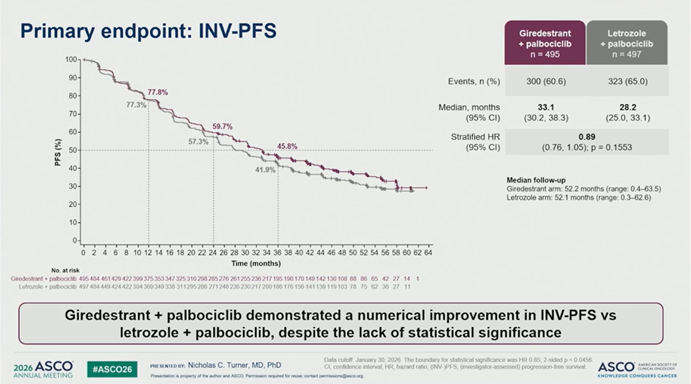
[Slide 1 — persevERA BC Study Design (ASCO 2026 · LBA1006 · presented by Nicholas C. Turner, MD, PhD)] Phase III, randomized, double-blind, placebo-controlled, multicenter trial in 1L LA/mBC. Key eligibility: 1L ER+/HER2- locally advanced or metastatic breast cancer; no prior treatment for advanced disease; no prior SERD; de novo mBC capped at 20%. Randomization (R 1:1), N = 992: • Giredestrant 30 mg PO QD + Palbociclib 125 mg PO QD (Days 1–21 of each 28-day cycle) • Letrozole 2.5 mg PO QD + Palbociclib 125 mg PO QD (Days 1–21 of each 28-day cycle) Treatment until PD or unacceptable toxicity → survival follow-up. Stratification: site of disease (visceral vs non-visceral); menopausal status; region (North America vs Western Europe vs Asia-Pacific vs other); TFI since prior (neo)adjuvant therapy. Primary endpoint: Investigator-assessed PFS (INV-PFS) per RECIST v1.1. Secondary endpoints: OS, ORR, CBR, DoR, safety, PROs (TTD of pain, physical/role functioning, GHS/QoL). Enrollment Oct 9, 2020 – Mar 27, 2023. ClinicalTrials.gov NCT04546009. [Slide 2 — Patient demographics & baseline characteristics] Balanced between arms (Giredestrant+palbo n=495; Letrozole+palbo n=497). Median age 63.0 years both arms; ~99% female. ER positive (>10% of cells) 98.4% vs 97.6%; PgR positive 83.2% vs 78.5%. Visceral disease 60.8% vs 60.0%. Post-menopausal 79.4% vs 80.9%. Region: Asia-Pacific 27.7%/27.2%, Western Europe 24.4%/24.9%, North America 13.1%/13.3%. No prior (neo)adjuvant therapy 20.8% vs 19.7%. Data cutoff January 30, 2026. [Slide 3 — Primary endpoint: INV-PFS] Giredestrant+palbociclib (n=495): events 300 (60.6%), median PFS 33.1 months (95% CI 30.2–38.3). Letrozole+palbociclib (n=497): events 323 (65.0%), median PFS 28.2 months (95% CI 25.0–33.1). Stratified HR 0.89 (95% CI 0.76–1.05); p = 0.1553. Pre-specified significance boundary was HR 0.85 (2-sided p < 0.0456) — NOT crossed. Median follow-up: Giredestrant arm 52.2 mo, Letrozole arm 52.1 mo. Conclusion: numerical improvement in INV-PFS but did not reach statistical significance. [Slide 4 — INV-PFS in key subgroups (forest plot)] Results generally consistent with the overall population (all-patients HR 0.89, 95% CI 0.76–1.04). Site: visceral HR 0.94 (0.77–1.15); non-visceral HR 0.80 (0.62–1.04). Menopausal: post-menopausal HR 0.87 (0.73–1.03); pre-/peri-menopausal HR 0.96 (0.67–1.38). Region: Asia-Pacific HR 0.70 (0.52–0.95); North America HR 0.74 (0.47–1.15); Western Europe HR 1.26 (0.90–1.76); other HR 0.90 (0.70–1.17). TFI: ≤12 months HR 1.04 (0.67–1.61); >12 months HR 0.86 (0.71–1.05). No prior therapy HR 0.93 (0.66–1.31). Data cutoff January 30, 2026.
@ElisaAgostinett
Elisa Agostinetto@ElisaAgostinett
PERSEVERA Data
893 impressions · 16 likes · 2026-06-02
View on X →
[Slide 1 — persevERA BC Study Design (ASCO 2026 · LBA1006 · Nicholas C. Turner, MD, PhD)] Phase III, randomized, double-blind, placebo-controlled, multicenter trial in 1L LA/mBC. N = 992. Giredestrant 30 mg PO QD + Palbociclib 125 mg vs Letrozole 2.5 mg PO QD + Palbociclib 125 mg (Days 1–21 q28), randomized 1:1. 1L ER+/HER2- LA/mBC; no prior treatment for advanced disease; no prior SERD; de novo mBC capped at 20%. Primary endpoint: INV-PFS per RECIST v1.1. Secondary: OS, ORR, CBR, DoR, safety, PROs. NCT04546009. Enrollment Oct 9, 2020 – Mar 27, 2023. [Slide 2 — Primary endpoint: INV-PFS] Giredestrant+palbociclib (n=495): events 300 (60.6%), median 33.1 mo (95% CI 30.2–38.3). Letrozole+palbociclib (n=497): events 323 (65.0%), median 28.2 mo (95% CI 25.0–33.1). Stratified HR 0.89 (95% CI 0.76–1.05); p = 0.1553. Significance boundary HR 0.85 — not crossed. Median follow-up ~52 months both arms. Numerical improvement without statistical significance. Data cutoff January 30, 2026. [Slide 3 — Secondary endpoint: Overall Survival (OS)] Giredestrant+palbociclib (n=495): events 172 (34.7%), median OS NE (95% CI NE, NE). Letrozole+palbociclib (n=497): events 166 (33.4%), median OS NE (95% CI 61.3, NE). Stratified HR 1.03 (95% CI 0.83–1.28); p = 0.7767. No difference in OS observed between arms. Data cutoff January 30, 2026.
@to_be_elizabeth
PERSEVERA Data
489 impressions · 9 likes · 2026-06-02
View on X →
[Slide 1 — Primary endpoint: INV-PFS (ASCO 2026 · LBA1006 · Nicholas C. Turner, MD, PhD)] Giredestrant+palbociclib (n=495): events 300 (60.6%), median 33.1 mo (95% CI 30.2–38.3). Letrozole+palbociclib (n=497): events 323 (65.0%), median 28.2 mo (95% CI 25.0–33.1). Stratified HR 0.89 (95% CI 0.76–1.05); p = 0.1553. Significance boundary HR 0.85 (2-sided p<0.0456) — not crossed. Median follow-up ~52 months. Numerical improvement, not statistically significant. Data cutoff January 30, 2026. [Slide 2 — INV-PFS in key subgroups] All patients HR 0.89 (95% CI 0.76–1.04). Generally consistent across subgroups. Non-visceral HR 0.80 (0.62–1.04); visceral HR 0.94 (0.77–1.15). Asia-Pacific HR 0.70 (0.52–0.95); Western Europe HR 1.26 (0.90–1.76). TFI ≤12 months HR 1.04 (0.67–1.61); >12 months HR 0.86 (0.71–1.05). [Slide 3 — Secondary endpoint: OS] Giredestrant+palbociclib events 172 (34.7%); Letrozole+palbociclib events 166 (33.4%). Median OS NE vs NE. Stratified HR 1.03 (95% CI 0.83–1.28); p = 0.7767. No difference in OS. Data cutoff January 30, 2026. [Slide 4 — Key takeaways / conclusions] ① 1L giredestrant + palbociclib resulted in a numerical improvement in INV-PFS vs letrozole + palbociclib in ER+/HER2- LA/mBC, though it did NOT meet pre-defined statistical significance. ② Giredestrant + palbociclib was well tolerated, with a manageable safety profile and no unexpected findings. ③ Further exploration is needed to assess which patients may benefit from giredestrant in the 1L setting.
@GaiaGriguolo
Gaia Griguolo@GaiaGriguolo
PERSEVERA Data
330 impressions · 6 likes · 2026-06-02
View on X →
@OmarOnco
PERSEVERA Data
125 impressions · 2 likes · 2026-06-02
View on X →
KOL-Made Infographics
Self-authored visual summaries of the PERSEVERA readout · click to enlarge
@DrRishabhOnco PERSEVERA infographic
View full size
@DrRishabhOnco
@ChandrakanthMv PERSEVERA infographic
View full size
@ChandrakanthMv

Top Tweets — PERSEVERA

About the PERSEVERA Trial

PERSEVERA (persevERA) is a randomized, double-blind, placebo-controlled Phase 3 trial evaluating giredestrant (oral SERD) + palbociclib vs letrozole + palbociclib in patients with 1L ER+/HER2-negative locally advanced or metastatic breast cancer. ~992 patients were randomized. The trial tested whether an oral selective estrogen receptor degrader (SERD) could replace aromatase inhibitors as the endocrine backbone alongside CDK4/6 inhibition in the front-line setting. Companion programs in the giredestrant development program — lidERA (early breast cancer), evERA (advanced post-endocrine resistance), and pionERA (post-CDK4/6 resistant) — remain ongoing.

Phase 3 Negative Readout — March 9, 2026

PRIMARY ENDPOINT NOT MET Giredestrant + Palbociclib vs Letrozole + Palbociclib

Roche announced on March 9, 2026 that the Phase 3 PERSEVERA study did not meet its primary objective of a statistically significant improvement in progression-free survival (PFS) with giredestrant + palbociclib vs letrozole + palbociclib in patients with ER+/HER2-negative locally advanced or metastatic breast cancer who had not received prior systemic therapy for advanced disease. Full data were presented at ASCO 2026 (Abstract LBA1006): median PFS 33.1 vs 28.2 months, HR 0.89 (p=0.16) — a numerical but not statistically significant benefit.

Safety: Profile was consistent with the known safety profiles of giredestrant and palbociclib. No new safety signals identified.

Status: ⚠️ Investigational — no FDA filing for this indication. The broader giredestrant program continues with lidERA (adjuvant), evERA (advanced post-endocrine resistance), and pionERA (CDK4/6-resistant disease) ongoing.

📄 Source: Roche Press Release (2026-03-09) →

Trial Methodology & Results

Population & Randomization

ER+/HER2-negative locally advanced or metastatic breast cancer; no prior systemic therapy for advanced disease (frontline setting). Approximately 992 patients randomized 1:1.

1L ER+/HER2- mBC · ~992 patients · frontline endocrine + CDK4/6 backbone

📄 Source: OncLive →

Treatment Arms

Experimental: Giredestrant 30 mg PO once daily + Palbociclib 125 mg PO (Days 1–21 of a 28-day cycle).
Control: Letrozole 2.5 mg PO once daily + Palbociclib 125 mg PO (Days 1–21 of a 28-day cycle).

Oral SERD vs aromatase inhibitor — both on the same CDK4/6 backbone (palbociclib)

Progression-Free Survival (PFS) — Primary Endpoint · NOT MET

The primary investigator-assessed PFS (INV-PFS) endpoint was not met. Full data presented at ASCO 2026 (Abstract LBA1006, Nicholas C. Turner) showed median PFS of 33.1 months (95% CI 30.2–38.3) with giredestrant + palbociclib vs 28.2 months (95% CI 25.0–33.1) with letrozole + palbociclib — stratified HR 0.89 (95% CI 0.76–1.05), p = 0.1553. The pre-specified significance boundary (HR 0.85, 2-sided p < 0.0456) was not crossed: a numerical benefit only, with no demonstrated superiority over the letrozole + palbociclib standard. Median follow-up ~52 months; data cutoff January 30, 2026.

✗ Primary INV-PFS NOT MET · 33.1 vs 28.2 mo · HR 0.89 (0.76–1.05), p=0.1553 (NS)

📄 Source: ASCO 2026 Abstract LBA1006 → · also Roche Press Release (2026-03-09 topline)

Overall Survival (OS) — Secondary Endpoint

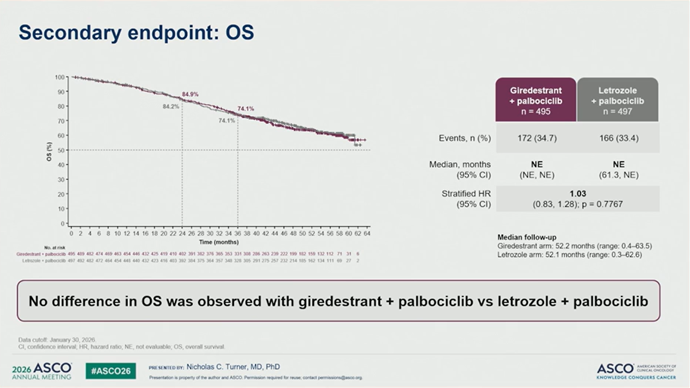
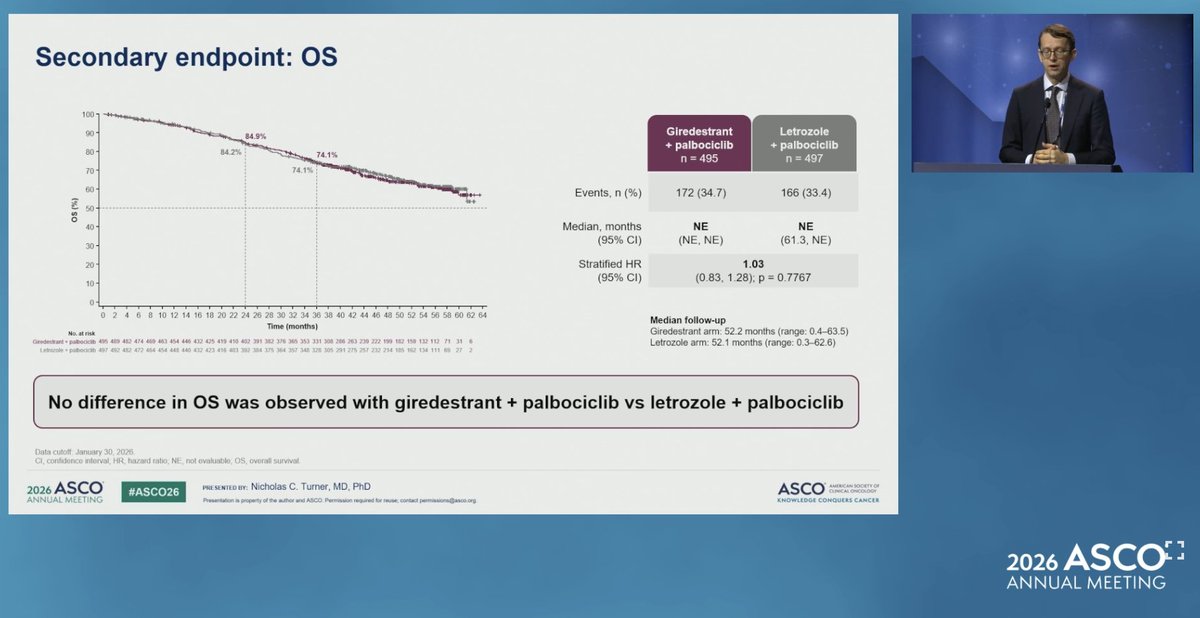
OS, a key secondary endpoint, showed no difference between arms at the January 30, 2026 data cutoff. Events: 172/495 (34.7%) with giredestrant + palbociclib vs 166/497 (33.4%) with letrozole + palbociclib. Median OS was not estimable (NE) in both arms (control 95% CI 61.3–NE). Stratified HR 1.03 (95% CI 0.83–1.28), p = 0.7767.

OS: HR 1.03 (0.83–1.28), p=0.7767 · median NE both arms · no difference

📄 Source: ASCO 2026 Abstract LBA1006 →

Response & Duration — Secondary Endpoints

Tumor response was similar between arms: objective response rate (ORR) 60.2% with giredestrant + palbociclib vs 59.9% with letrozole + palbociclib; clinical benefit rate (CBR) 82.6% vs 82.1%. Duration of response (DoR) was numerically longer with giredestrant — median 38.5 months (95% CI 30.4–48.7) vs 30.4 months (95% CI 25.3–36.1) — but without statistical significance, consistent with the deeper ER suppression the oral SERD provides without translating into a PFS win.

ORR 60.2% vs 59.9% · CBR 82.6% vs 82.1% · DoR 38.5 vs 30.4 mo (numerical, NS)

📄 Source: CancerNetwork / ASCO 2026 LBA1006 →

Safety & Tolerability

Safety was consistent with the known profiles of giredestrant and palbociclib individually, with no unexpected findings. Any-grade adverse events occurred in 99.8% (giredestrant arm) vs 98.0% (letrozole arm); grade 3/4 AEs in 85.5% vs 80.8%; AEs leading to treatment discontinuation were low and similar (9.5% vs 8.3%). Neutropenia was the dominant AE in both arms (CDK4/6 class effect). The one distinctive signal was bradycardia, more frequent with giredestrant (11.7% vs 1.8%) — but the vast majority were grade 1 and asymptomatic, with no grade 3/4 events in either arm.

✓ Consistent with known agents · bradycardia 11.7% vs 1.8% (Gr1/asymptomatic, no Gr3/4)

📄 Source: CancerNetwork / ASCO 2026 LBA1006 →

Why Was PERSEVERA Negative? — KOL Synthesis

KOLs have proposed four mechanistic explanations for the negative readout, drawn from @ChandrakanthMv's published breakdown:

Frontline disease is highly endocrine-sensitive. Aromatase inhibition + CDK4/6 already achieves strong ER pathway suppression in untreated mBC. Replacing the AI with an oral SERD offers limited incremental benefit in this setting.
ESR1 mutations are uncommon upfront. ESR1 mutations — where oral SERDs typically show their advantage — emerge after AI exposure. Frontline populations therefore derive limited SERD-specific benefit.
CDK4/6 already blocks downstream signaling. Palbociclib suppresses ER-driven cell-cycle progression. Additional ER degradation may not significantly enhance disease control beyond what CDK4/6 inhibition already provides.
Strong comparator arm. Letrozole + palbociclib is a highly effective standard. Superiority against this backbone is difficult to demonstrate.


📄 Source: @ChandrakanthMv breakdown →

Discussant Perspective — The CDK4/6 "Blunting" Hypothesis

ASCO discussant Matthew P. Goetz, MD (Mayo Clinic) framed the central interpretation: in the frontline setting, palbociclib suppresses ER-driven cell-cycle progression so effectively that swapping the aromatase inhibitor for an oral SERD adds little incremental benefit — the CDK4/6 inhibitor "blunts" any advantage the SERD might otherwise show. He also raised an alternative hypothesis: that mechanisms driving CDK4/6 resistance are not addressed simply by exchanging a SERD for an AI. His proposed path forward is strategic deployment of oral SERDs — potentially as 1L monotherapy with timing matched to a patient's risk profile — rather than a blanket AI-for-SERD substitution on the CDK4/6 backbone.

Goetz: CDK4/6 "blunts" SERD benefit upfront · favors strategic 1L SERD use, not AI swap

📄 Source: OBR Oncology / ASCO 2026 discussant →

Clinical Implications

⚠️ AI + CDK4/6 remains the standard first-line therapy in ER+/HER2- metastatic breast cancer. PERSEVERA suggests oral SERDs do not displace aromatase inhibitors in the 1L setting. The likely value proposition for oral SERDs remains after endocrine resistance or in ESR1-mutant disease — settings being tested in evERA (advanced post-endocrine resistance) and pionERA (post-CDK4/6 resistant). The adjuvant question — does an oral SERD reduce recurrence vs AI in early disease — is being tested in lidERA. Contrast against EMBER-3 (imlunestrant) and SERENA-6 (camizestrant), where SERDs have shown benefit in selected resistant/ESR1-mutant populations.

PERSEVERA in the News

Key KOL Sentiments — PERSEVERA