KOLs Discussing PROTEUS
PROTEUS Key Slides & Visuals
Slides shared by KOLs at the ASCO 2026 Plenary (presented by Mary-Ellen Taplin, MD — Dana-Farber). Click any image to expand; expand “View OCR Text” for the full slide text.
PROTEUS primary results presented May 31, 2026. Perioperative apalutamide + ADT met both dual primary endpoints — pCR/MRD 8.9% vs 1.0% (OR 10.17, p<0.0001) and MFS HR 0.80 (95% CI 0.67–0.96, p=0.02). Overall survival, an exploratory endpoint, showed no benefit (HR 1.08). The KOL slide decks below capture the schema, dual-primary, EFS/distant-metastasis, safety, and conclusions slides.



Top PROTEUS Tweets

#ASCO26 The PROTEUS trial results are now online...buckle up as we wait to see the full presentation. This is going to be a trial that is likely highly controversial until the full results are published. Some may call this a homerun, others may call this the largest negative

Finalizing my PROTEUS Discussant talk for #ASCO26 Plenary. Biggest trial of surgery for prostate cancer, so much data, so many fascinating angles to consider. Will be big moment for Rx of high-risk prostate cancer. Look forward to Dr Taplin reading it out @DanaFarber_GU @gu_onc https://t.co/CM7wZGTeVD

Our very own Prof. Mary-Ellen Taplin from @DanaFarber_GU opens up the plenary session at #ASCO26 with practice-changing results from the phase 3 PROTEUS trial. Perioperative apalutamide + ADT significantly improved pathologic response rates (8.9% vs 1.0%) and metastasis-free https://t.co/SOf8A6MEo6
As #ASCO26 is approaching, here are my top 10 GU abstracts to be presented (based on the titles). 1-Abstract LBA1: PROTEUS In high-risk localized prostate cancer, intensifying perioperative therapy may improve long-term outcomes, #DrMaryEllenTaplin from @DanaFarber_GU will https://t.co/5NjVPXJ50L

PROTEUS and STAMPEDE both support ARPI intensification in high-risk M0 prostate cancer, but across different designs and local treatments. The real advance is not “which wins?” It is “which patient, which path?” #ASCO26 @DrChoueiri @TiansterZhang @CathyEngMD @montypal https://t.co/7a0feCyAbL

Breaking news #ASCO26 👉Ph3 PROTEUS trial👉Periop ADT + apalutamide in high-risk localized/locally advanced #prostatecancer undergoing radical prostatectomy👉↑ pathologic response (8.9% vs 1.0%) & 5-yr metastasis-free survival (78.2% vs 73.5%; HR 0.80) @urotoday @OncoAlert https://t.co/PNCDH286DZ

Day 3 #ASCO26 5 plenary highlights: 1. #PROTEUS: PeriOp/PostOp Apa in Prostate Ca 2. #SARC041: Adj Abema in dediff liposarcoma 3. #LIBRETTO432 : Adj Selpercatinib in NSCLC 4. #HARMONi6: 1L Ivonescimab in Sq mNSCLC 5. #RASolute302: 2L Daraxonrasib in Panc Ca @ASCO 1/6 https://t.co/8I3qtOtzSP

Finally #PROTEUS (#MyBaby) presents results. Significantly improved outcomes reported by Mary-Ellen Taplin for #neoadjuvant/perioperative treatment with #Apalutamide prior to #RadicalProstatectomy PCR/MFS (+based on #PSMAPET), Time to subsequent treatment, to distant mets https://t.co/hWNymvz7XX

⭐ PROTEUS: perioperative intensification reaches the #ASCO26 Plenary and NEJM ⭐ A major moment for high-risk localized / locally advanced #ProstateCancer. 🚨 PROTEUS tests a clinically important question: Can intensifying systemic therapy around radical prostatectomy improve https://t.co/N0a9AamWUh
Overview
PROTEUS (NCT03767244) is a Johnson & Johnson / Janssen-sponsored Phase 3 randomized, double-blind, placebo-controlled study of the androgen receptor pathway inhibitor apalutamide (Erleada) plus ADT versus placebo plus ADT, administered before and after radical prostatectomy (perioperative) in patients with newly diagnosed high-risk localized or locally advanced prostate cancer. The rationale: combining intensified systemic androgen-pathway blockade with surgery — an approach already standard in other aggressive solid tumors — to deepen pathologic response and delay metastasis. The trial enrolled 2,109 patients across more than 200 sites in 18 countries. Principal investigator: Mary-Ellen Taplin, MD, FASCO (Dana-Farber Cancer Institute / Harvard); co-led with Adam Kibel, MD (Brigham). Presented at the ASCO 2026 Plenary Session on May 31, 2026, with simultaneous publication in the New England Journal of Medicine.
Study Design
Phase 3 randomized double-blind placebo-controlled multicenter study (200+ sites, 18 countries). Dual primary endpoints assessed by blinded independent central review. Both endpoints met. Median follow-up 61.7 months.
Population
Newly diagnosed high-risk localized or locally advanced prostate cancer, candidates for radical prostatectomy. n=2109. All participants underwent protocol-defined radical prostatectomy.
Intervention
Experimental: Apalutamide 240 mg orally once daily + ADT, perioperatively (6 cycles neoadjuvant + adjuvant). Control: Placebo + ADT. Both arms underwent radical prostatectomy.
Endpoints
Dual primary: pathologic complete response/minimal residual disease (pCR/MRD, defined ypT0 or ypT2 with ≤5 mm residual) and metastasis-free survival (MFS, by conventional or PSMA-PET imaging, histopathology, or death). Exploratory: overall survival, safety. (MFS captured both conventional and PSMA-PET imaging, reflecting staging-technology evolution over the trial's long enrollment window.)
PROTEUS Plenary Results
Pathologic Complete Response / MRD (Co-Primary Endpoint)
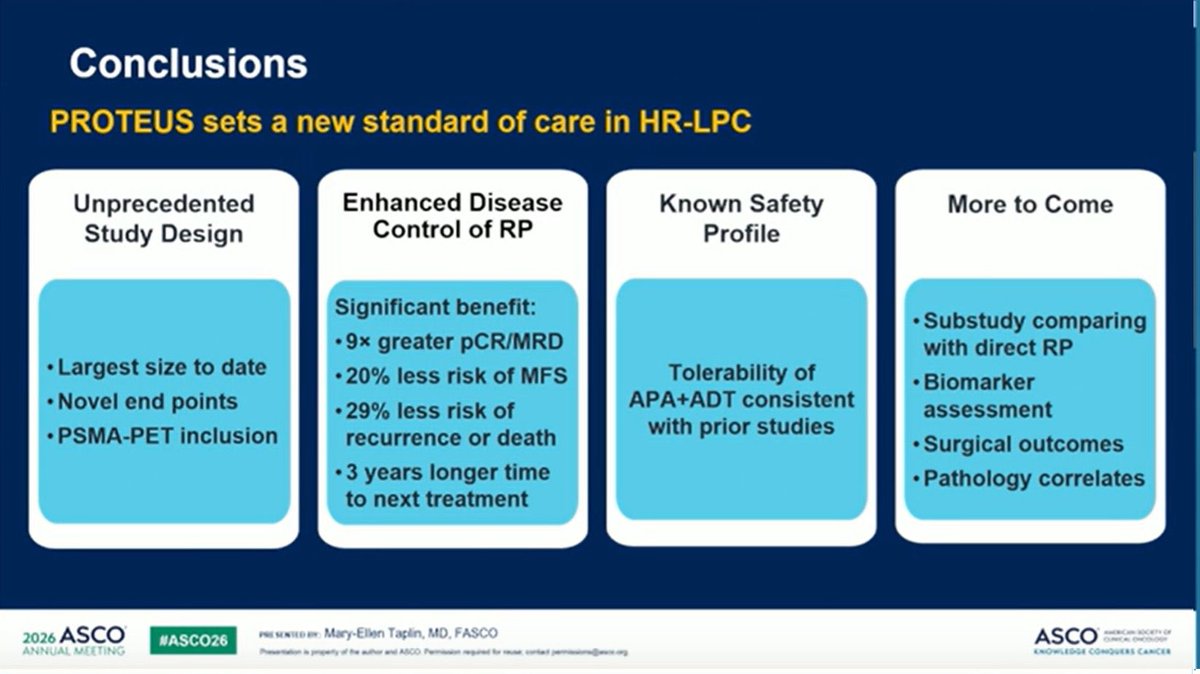
PROTEUS met the pCR/MRD co-primary endpoint. The pCR/MRD rate was 8.9% with apalutamide + ADT versus 1.0% with placebo + ADT — odds ratio 10.17 (95% CI 5.27–19.64), p<0.0001, a roughly nine-fold improvement after six cycles of neoadjuvant therapy. The stricter ypT0 (no residual tumor) rate was 5.1% vs 0.4%. Positive surgical margins at prostatectomy were present in 20.9% vs 42.7%, and an exploratory residual cancer burden response was reported in 30.6% vs 11.7% (OR 3.36, 95% CI 2.67–4.23, p<0.0001).
pCR/MRD 8.9% vs 1.0% · OR 10.17 (95% CI 5.27–19.64) · p<0.0001 (J&J Press / ASCO Slide)Sources: PROTEUS Plenary pCR/MRD slide (OCR-verified) · OncoDaily ASCO 2026 detailed results · ASCO Post (surgical margins) · J&J press releaseMetastasis-Free Survival (Co-Primary Endpoint)
PROTEUS also met the MFS co-primary endpoint. By blinded independent central review, apalutamide + ADT produced a statistically significant 20% reduction in the risk of metastasis or death — HR 0.80 (95% CI 0.67–0.96), p=0.02, with five-year MFS rates of 78.2% vs 73.5%. Investigator-assessed MFS was directionally stronger (HR 0.74, 95% CI 0.62–0.87, p=0.0004). MFS was defined by conventional or PSMA-PET imaging. By conventional imaging alone, the difference was not statistically significant (HR 0.84, 95% CI 0.67–1.07); the significant primary result was driven substantially by PSMA-PET detection of distant metastases.
MFS (BICR) HR 0.80 (95% CI 0.67–0.96) · p=0.02 · 5-yr 78.2% vs 73.5% (NEJM / J&J Press)Sources: PROTEUS Plenary MFS slide (OCR-verified) · J&J press release · NEJM 2026 · SurvivorNet (conventional-imaging MFS) · NEJM 2026 (NEJMoa2603878)Distant Metastasis & Recurrence (Secondary)
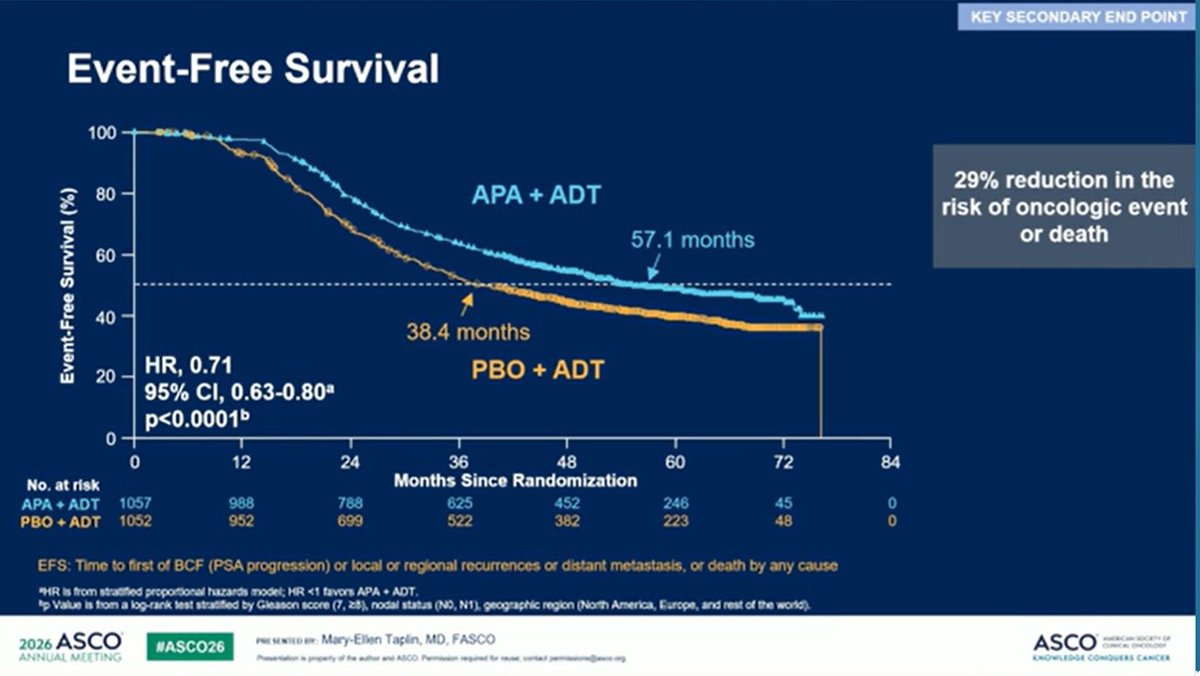
Time to distant metastasis (by conventional or PSMA-PET) favored apalutamide: HR 0.68 (95% CI 0.55–0.83), p=0.0002, with five-year distant-metastasis-free rates of 82.8% vs 76.2%. Investigators also reported a 29% reduction in prostate cancer recurrence (event-free survival HR 0.71, 95% CI 0.63–0.80, p<0.0001; median EFS 57.1 vs 38.4 months). Median time to first subsequent therapy was 74.2 vs 41.5 months (HR 0.65, 95% CI 0.57–0.73, p<0.0001). Fewer apalutamide patients required subsequent therapy of any kind (42.4% vs 56.7%), including less subsequent systemic therapy (26.7% vs 36.4%) and less postoperative radiotherapy (13.0% vs 18.4%).
Distant mets HR 0.68 (95% CI 0.55–0.83) · p=0.0002 · 5-yr 82.8% vs 76.2% · EFS 57.1 vs 38.4 mo (ASCO Slide / J&J Press)Sources: PROTEUS Plenary secondary-endpoint slides (OCR-verified) · OncoDaily ASCO 2026 results · J&J press release (EFS, time to subsequent therapy)Overall Survival (Exploratory — No Benefit)
Overall survival was an exploratory measure and the trial was not powered to detect it. At a median follow-up of five years with overall mortality of 8.5%, the hazard ratio for death was 1.08 — numerically unfavorable, though below the prespecified threshold for unacceptable detriment, and not a demonstration of survival benefit. The accompanying NEJM editorial stated that a confirmed OS benefit with longer follow-up has not been shown.
OS exploratory · HR 1.08 · mortality 8.5% · no benefit, not powered (NEJM Editorial)Sources: PROTEUS Plenary OS slide (OCR-verified) · SurvivorNet ASCO 2026 analysis · NEJM 2026 editorialSafety & Tolerability
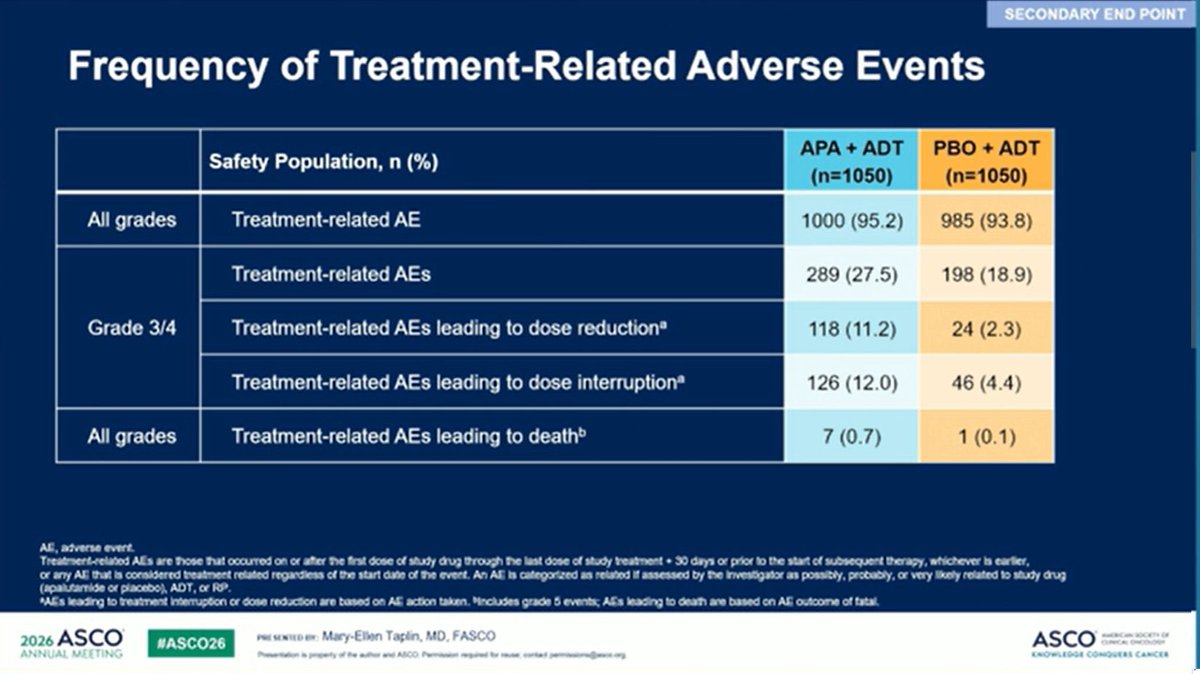
Grade 3 or 4 adverse events occurred in 39.6% of the apalutamide arm versus 31.0% of the placebo arm, with the difference driven primarily by rash (21.2% vs 10.0%) — a well-characterized apalutamide class effect. The overall profile was consistent with prior apalutamide experience (SPARTAN, TITAN), and no new safety signals were reported in the perioperative setting.
Grade 3/4 AEs 39.6% vs 31.0% · rash 21.2% vs 10.0% (NEJM / ASCO Slide)Sources: PROTEUS Plenary safety slide (OCR-verified) · SurvivorNet ASCO 2026 analysis · NEJM 2026Regulatory & Clinical Implications
Apalutamide (Erleada) is currently FDA-approved in non-metastatic castration-resistant prostate cancer (nmCRPC) and metastatic castration-sensitive prostate cancer (mCSPC). PROTEUS provides the first Phase 3 evidence for perioperative apalutamide in localized/locally advanced disease — an investigational use. Johnson & Johnson has positioned the dual-primary win as supporting a paradigm shift toward systemic-plus-surgery intensification. The trial met both co-primary endpoints (pCR/MRD and MFS); overall survival was exploratory with HR 1.08 and is not yet a demonstration of benefit.
Investigational in perioperative localized disease · potential new indication pending regulatory reviewSources: J&J press release · CancerNetwork ASCO 2026 coverage · UroToday ASCO 2026 (McKay)Key KOL Sentiments — PROTEUS


Media Coverage & Primary Sources
Primary publication and verified coverage of the PROTEUS ASCO 2026 Plenary readout. Sources reconciled against the trial’s clinical-intelligence notebook.
Perioperative Apalutamide in High-Risk Localized Prostate Cancer — the full PROTEUS Phase 3 report (NEJMoa2603878), published simultaneously with the ASCO Plenary.
Sponsor announcement: ERLEADA (apalutamide) before and after surgery significantly reduces the risk of metastasis or death in high-risk localized prostate cancer.
PROTEUS trial suggests perioperative apalutamide may improve outcomes in high-risk localized prostate cancer — detailed endpoint and surgical-margin coverage.
ASCO 2026 detailed results: pCR/MRD, MFS, distant metastasis, and safety breakdowns for the PROTEUS plenary presentation.
Perioperative apalutamide shifts the standard in localized, high-risk prostate cancer — clinical framing of the dual-primary win.
PROTEUS final analysis at ASCO 2026 — perioperative apalutamide delivers, with the NEJM editorial’s caution on exploratory overall survival.
Trials in prostate and kidney cancer featured at ASCO 2026 — Rana McKay, MD, on where PROTEUS fits the GU landscape.