TALAPRO-2 is a Phase 3 trial of the PARP inhibitor talazoparib (Talzenna) plus enzalutamide (Xtandi) versus placebo plus enzalutamide as first-line therapy for metastatic castration-resistant prostate cancer (mCRPC). The combination improved radiographic progression-free survival (33.1 vs 19.5 months; HR 0.667) and final overall survival (45.8 vs 37.0 months; HR 0.796). The FDA approval (June 2023) is restricted to HRR gene-mutated mCRPC. Sponsor: Pfizer.
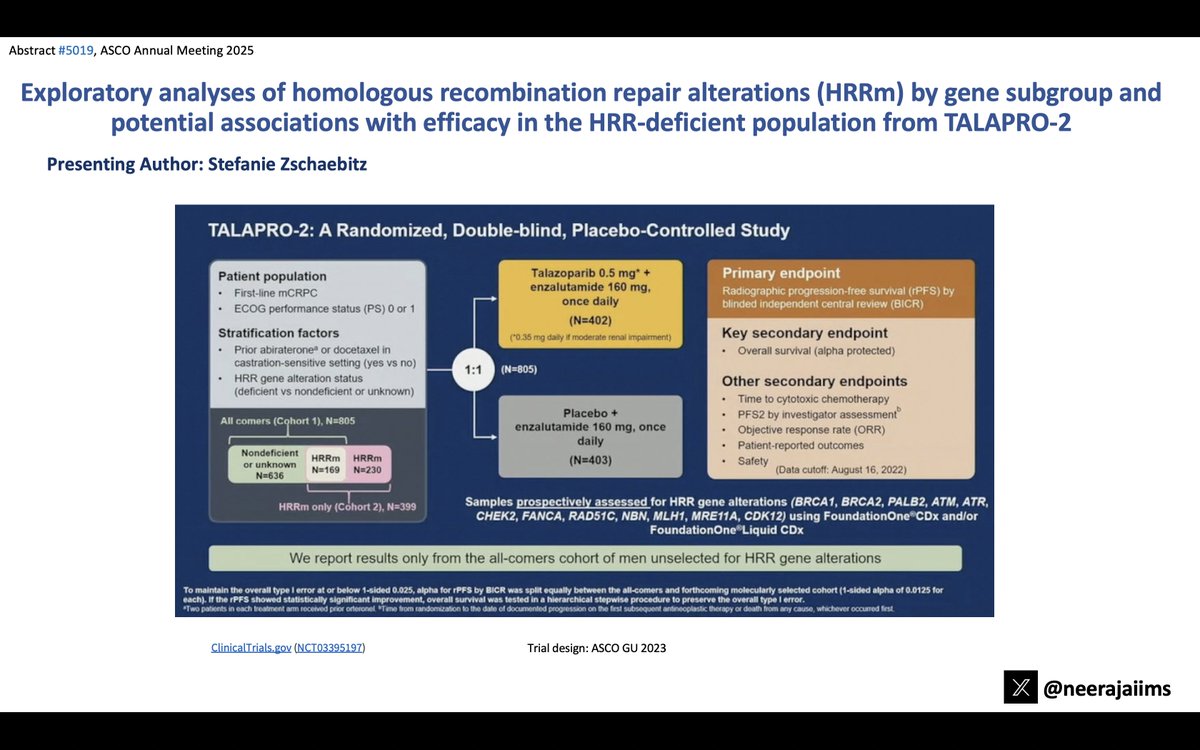
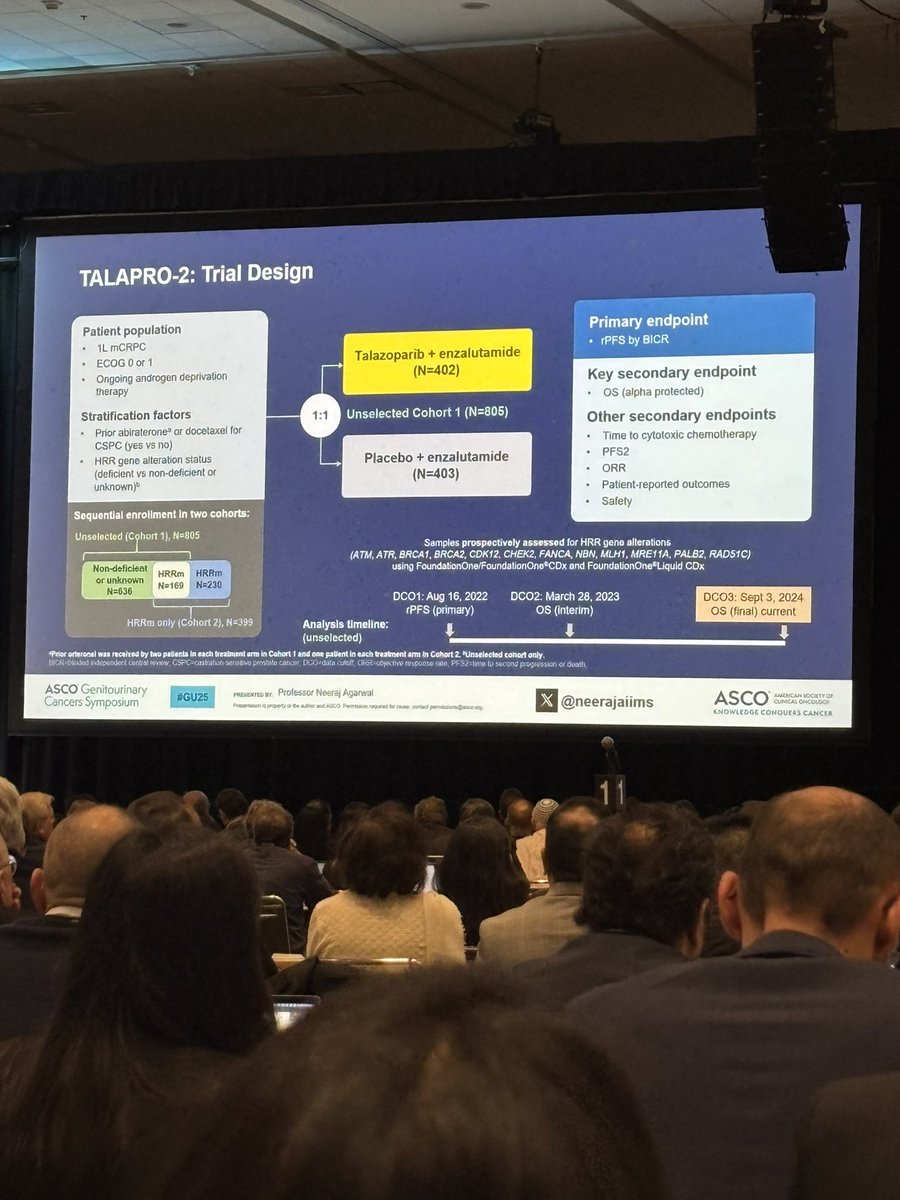
Discover KOL Sentiment on TALAPRO-2 →Design — Phase 3, randomized, double-blind; talazoparib (Talzenna) + enzalutamide (Xtandi) vs placebo + enzalutamide, 1L mCRPC (all-comers + HRR-mutated cohorts), NCT03395197. (NEJM/Lancet; ASCO GU 2025 final OS)
rPFS (primary) — Median 33.1 vs 19.5 months in all-comers (HR 0.667; 95% CI 0.551-0.807); HRR-mutated HR ~0.45; BRCA-mutated HR ~0.20. (primary analysis)
Overall survival — Final OS (ASCO GU 2025; cutoff 3-Sep-2024; ~53-mo follow-up) 45.8 vs 37.0 months in all-comers (HR 0.796; 95% CI 0.661-0.958; p=0.0155) — met. (ASCO GU 2025)
Safety — Added cytopenias from PARP inhibition: Grade 3/4 anemia 49% vs 4.5%, neutropenia 19.3% vs 1.5%; AE discontinuation 21.6% vs 13.0%. (label / primary)
Regulatory (scope-critical) — FDA approved June 2023 ONLY for HRR gene-mutated mCRPC (companion diagnostic required); the approval does NOT cover HRR-non-mutated/all-comers patients despite the broader trial benefit. (FDA label)
Sponsor / Drug — Pfizer; talazoparib (Talzenna, PARP inhibitor) + enzalutamide (Xtandi, androgen receptor inhibitor). (FDA label)
Compiled and reviewed by the KOL Pulse research team, led by Brian Shields, Founder, KOL Pulse. Last updated July 21, 2026.










Top tweets by impressions — click to view on X
We report in @TheLancet : Primary efficacy data from TALAPRO-2 Phase 3 trial in mCRPC #prostatecancer : Talazoparib + Enza improves outcomes in all subgroups vs Enza. Prospective tissue testing in…
Breaking news👉@US_FDA approves Talazoparib + Enzalutamide for mCRPC #prostatecancer with HRR mutations. Weblink👉 https://t.co/adGntAZAnb Efficacy data, HRR mutations👇@PCFnews @OncoAlert @urotoday…
Just in @NatureMedicine👉Results from Ph3 TALAPRO-2 trial in 399 pts w/ HRR-deficient mCRPC #prostatecancer👉enza + tala vs. enza, rPFS HR 0.44, OS trending strongly HR 0.69, efficacy in multiple HRR…
From @neerajaiims’ podium presentation at @ASCO #GU23 to his paper in the @TheLancet to this most recent publication in @NatureMedicine, it has been wonderful to see the #TALAPRO2 study unfold.…
🎤 Reporting from #GU23:
Dr. @neerajaiims & ASCO Expert Dr. @montypal discuss the results of the #TALAPRO2 study and what it means for patients with #mCRPC. #pcsm #prostatecancer…
Woke up to this incredible news from the #TALAPRO2 study. Hugely proud of @neerajaiims @huntsmancancer for leading the 1st study to show an OS benefit with ARPI + PARP in mCRPC. Note PR cites OS…
Wonderful to see this approval arrive not long after @neerajaiims @huntsmancancer's stellar presentation at @ASCO #GU23 & follow-up paper in @TheLancet! #TALAPRO2 offers a new std of care…
GU abstracts for #ASCO25!
Schedule & looking forward to:
🔵PARPI in mCSPC #AMPLITUDE
-HRRm analysis #TALAPRO2
-prognosis of PSA>0.2 at 6-12mo in mCSPC
🟠analysis of responders in…
Ab#5019 @ASCO #ASCO25 by #StefanieZschaebitz 👉https://t.co/2Le7iVZ3cF👉Exploratory analysis of ph3 TALAPRO-2 trial in pts w/ mCRPC #prostatecancer👉Benefit w/ talazoparib + enzalutamide across multiple…

TALAPRO2
@PBarataMD 🇺🇸and our #OncoAlertAF colleague @bavilima 🇧🇷 at #GU25 discuss the different aspects of the trials and the results presented by our OncoAlert🚨Faculty @neerajaiims…
TALAPRO-2 final OS (ASCO GU 2025) is one of the longest OS readouts ever in Phase 3 mCRPC (~45 months) with ~9-month median OS improvement across populations. FDA approval (June 2023) is restricted to HRR-mutant mCRPC, but the OS benefit in all-comers (HR 0.796) raises debate about expanding use. Benefit is strongest in BRCA-mutant disease (rPFS HR 0.20). Applicability to patients who received intensified therapy for mHSPC (not represented in TALAPRO-2) remains an open clinical question. Competes with PROpel (olaparib + abiraterone) and MAGNITUDE (niraparib + abiraterone, BRCA-restricted).
Median: 33.1 months (talazoparib + enzalutamide) vs. 19.5 months (placebo + enzalutamide). HR 0.667 (95% CI 0.551-0.807), P<0.0001 All-comers cohort (N=805): median rPFS 33.1 vs. 19.5 months, HR 0.667 (95% CI 0.551-0.807, P<0.0001). HRR-mutant cohort (N=399): median rPFS not reached vs. 13.8 months, HR 0.45 (95% CI 0.33-0.61, P<0.0001). BRCA-mutant subgroup (N=155): HR 0.20 (95% CI 0.11-0.36) — strongest benefit. Non-BRCA HRR: HR 0.72 (95% CI 0.49-1.07).
Median: 45.8 months (talazoparib + enzalutamide) vs. 37.0 months (placebo + enzalutamide). HR 0.796 (95% CI 0.661-0.958), P=0.0155 Final OS analysis (ASCO GU 2025; data cutoff September 3, 2024; median follow-up ~53 months). All-comers: median OS 45.8 vs. 37.0 months, HR 0.796 (95% CI 0.661-0.958, P=0.0155) — met prespecified ≤0.022 significance boundary. ~9-month median OS improvement. HRR-deficient subgroup: HR 0.542 (95% CI 0.361-0.814). Non-BRCA detected: HR 0.749 (95% CI 0.582-0.963). No detectable HRR deficiency: HR 0.782 (95% CI 0.582-1.050). One of the longest median OS durations (~45+ months) ever reported in Phase 3 mCRPC.
Discontinuation due to AEs: 21.6% (tala_enz) vs. 13.0% (plac_enz). Key AEs: anemia (Grade 3/4: 49% tala+enza vs. 4.5% plac+enza), neutropenia (Grade 3/4: 19.3% vs. 1.5%), thrombocytopenia (Grade ≥3: 8%), hemoglobin decrease all-grade: 79% vs. 34%, fatigue (49% vs. 40%). Marked increase in cytopenias with PARP addition. Grade 3/4 anemia in 49% of tala+enz patients (median time to onset 3.3 months); 42.2% required RBC transfusion. Talazoparib dose interruption 65.3%, dose reduction 54.5%, discontinuation 21.6% (vs. 24.7% / 7.2% / 13.0% in placebo arm). Fatal AEs 1.5% (pneumonia, COVID, sepsis). No new safety signals with extended follow-up.
✅ FDA-approved (June 2023) for HRR-mutant mCRPC; final OS confirms all-comers benefit. TALAPRO-2 final OS (ASCO GU 2025) is one of the longest OS readouts ever in Phase 3 mCRPC (~45 months) with ~9-month median OS improvement across populations. FDA approval (June 2023) is restricted to HRR-mutant mCRPC, but the OS benefit in all-comers (HR 0.796) raises debate about expanding use. Benefit is strongest in BRCA-mutant disease (rPFS HR 0.20). Applicability to patients who received intensified therapy for mHSPC (not represented in TALAPRO-2) remains an open clinical question. Competes with PROpel (olaparib + abiraterone) and MAGNITUDE (niraparib + abiraterone, BRCA-restricted).
TALAPRO-2 (NCT03395197) is a Phase 3, randomized, double-blind trial of the PARP inhibitor talazoparib (Talzenna) plus enzalutamide (Xtandi) versus placebo plus enzalutamide as first-line therapy for metastatic castration-resistant prostate cancer. It enrolled both an all-comers cohort and a homologous-recombination-repair (HRR) gene-mutated cohort, and was sponsored by Pfizer.
The combination improved radiographic progression-free survival to a median of 33.1 versus 19.5 months in all-comers (HR 0.667), with deeper benefit in HRR-mutated (HR ~0.45) and BRCA-mutated (HR ~0.20) subgroups. Final overall survival (ASCO GU 2025) was 45.8 versus 37.0 months (HR 0.796; p=0.0155), one of the longest OS readouts reported in Phase 3 mCRPC.
Yes, but with a restricted scope. Talazoparib (Talzenna) plus enzalutamide (Xtandi) was FDA approved in June 2023 only for HRR (homologous recombination repair) gene-mutated metastatic castration-resistant prostate cancer, as identified by an FDA-approved companion diagnostic. The approval does not cover HRR-non-mutated or all-comers patients, even though TALAPRO-2 showed benefit in the broader population.
Although TALAPRO-2 demonstrated radiographic progression-free survival and overall-survival benefit in the all-comers population, the benefit was substantially deeper in HRR-mutated and especially BRCA-mutated disease. The FDA restricted the approval to HRR gene-mutated mCRPC, where the benefit-risk profile — balanced against the added cytopenia toxicity of PARP inhibition — is most favorable.
Adding the PARP inhibitor talazoparib markedly increased cytopenias: Grade 3/4 anemia occurred in about 49% versus 4.5%, and Grade 3/4 neutropenia in 19.3% versus 1.5%. Treatment discontinuation due to adverse events was 21.6% versus 13.0%. Anemia frequently required dose modification or transfusion.