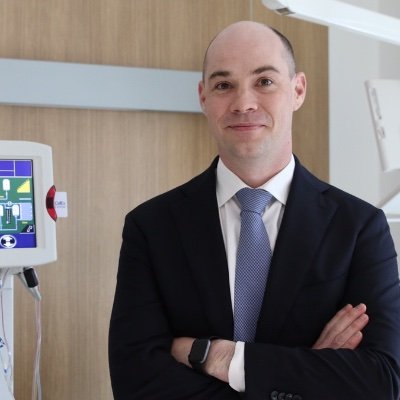
 Chadi Nabhan, MD, MBA, FACP · @chadinabhan
“These are very important results, while we wait on more data regarding efficacy and safety. The EPCORE-DLBCL-2 trial is positive. Another regimen tops R-CHOP after the POLARIX study. Lots to discuss in the weeks to come.”
View post ↗Full Leukemia & Lymphoma coverage in today's digest →The DeLLphi-305 trial of investigational tarlatamab plus durvalumab as first-line maintenance in extensive-stage small cell lung cancer (ES-SCLC) has shown positive results for overall response rate, progression-free survival, and overall survival via press release, with full data anticipated at an ESMO 2026 Presidential Session. Additionally, discord among specialists on patient selection for neoadjuvant chemoimmunotherapy in stage III NSCLC is a key topic, alongside updates on investigational agents from trials like HARMONi-6, WU-KONG28, and OptiTROP-Lung05 in advanced NSCLC.

“Countdown to #ESMO26 DeLLphi-305: ES-SCLC ⏰ Saturday Presidential Session 1 💉 1L maintenance Tarlatamab + Durvalumab 🚨 We know from Press Release that this is positive for ORR, PFS & OS 🤔 Likely to be (one) of the standards of care where funded”
— @tnewsomdavis · DeLLphi-305 trial in SCLC · View post ↗📌 Amplified by @KolPulseAI

“It is my opinion that the discord among specialists taking care of stage III NSCLC has reached unprecedented levels in the history of lung cancer care. This is simply not acceptable, and our patients expect more of us while we keep touting that we provide "MDT care".”
— @DrewMoghanaki · Stage III NSCLC management · View post ↗📌 Amplified by @KolPulseAI

“Dr. @jennifermarksmd presents updates in adv NSCLC at Yellowstone 2026 Best of @ASCO including HARMONi-6, WU-KONG28 and OptiTROP-Lung05. Will be impt to see how these agents perform in global studies and in case of sunvo, would just like ACCESS to drug! Hopefully coming soon!!”
— @Joshua_Reuss · Investigational agents in NSCLC · View post ↗📌 Amplified by @KolPulseAI

“@StephenVLiu speaking at #EOS2026. Are we seeing rise of SCLC in non smokers. Interesting slide . With newer Drugs ,especially ADCs, our treatment algorithms are changing . Can ADC come in first line ?”
— @SuyogCancer · SCLC in non-smokers and ADCs · View post ↗📌 Amplified by @KolPulseAI
An AI tool called Clairity Breast has FDA De Novo authorization (granted May 2025) to forecast a woman's 5-year risk of developing breast cancer from a standard screening mammogram in women with no current diagnosis; per @EricTopol, it made the New York Times front page this week as it becomes more widely available. For patient quality of life, a JCO review finds low-dose vaginal estrogen is safe after breast cancer, with observational data showing no increased recurrence or mortality, including in ER+ patients on tamoxifen. Additionally, the AFT-70 NAVIGATE trial design is exploring a risk-adapted strategy in ER+ early breast cancer, using serial MRD monitoring to guide the addition of a CDK4/6 inhibitor to the investigational SERD giredestrant.

“A "normal" mammogram interpreted by AI can accurately forecast high-risk of breast cancer in the next 5 years. Approved by FDA, now becoming available.”
— @EricTopol · AI in mammography · View post ↗
“New JCO OP review: low-dose vaginal estrogen keeps serum estradiol in the postmenopausal range. Observational data show no ↑ recurrence or mortality, incl. ER+ & tamoxifen.”
— @JAMouabbi · Vaginal estrogen safety · View post ↗
“Can we spare CDK4/6i in ER+ early breast cancer and escalate only when needed? #AFT70 NAVIGATE: giredestrant + serial MRD monitoring, with CDK4/6i added only if MRD turns +ve.”
— @jhaveri_komal · AFT-70 NAVIGATE trial · View post ↗
“Key words: ADCs, CDK4, IO, and impactful updates of practice-changing phase 3 trials.”
— @PTarantinoMD · ESMO26 preview · View post ↗📌 Amplified by @KolPulseAI
A study of 10,937 patients with advanced biliary tract cancer found ctDNA NGS was feasible in 90% of cases versus 50% for tissue, with a faster turnaround time (8 vs 27 days). For advanced HCC, the AI-driven CAPTYN model, validated in the phase III IMbrave150 cohort, uses routine blood tests to predict benefit from atezolizumab/bevacizumab. The GI oncology community is also discussing early insights into resistance mechanisms for the investigational agent daraxonrasib in pancreatic cancer.

“ctDNA can expand access, accelerate precision medicine”
— @ArndtVogel · ctDNA in Biliary Tract Cancer · View post ↗
“Can routine blood tests & AI predict benefit from Ate/Bev in advanced HCC?”
— @hongjaechon · AI Model in HCC · View post ↗
“Clues to Why a Breakthrough Pancreatic Cancer Drug Eventually Stops Working”
— @DrHBurstein · Daraxonrasib Resistance · View post ↗📌 Amplified by @KolPulseAI

“Is perioperative immunotherapy finally changing the standard of care in resectable gastric cancer?”
— @DraMartinezLago · Perioperative Gastric Cancer Therapy · View post ↗Track oncology’s top KOLs in your specialty
Create a free account, pick the tumor types you cover, and go beyond the tweet — the intelligence pharma teams use to map influence and prepare for engagement:
- ✓Enhanced KOL profiles
- ✓Pharma influence & potential advisory-board patterns
- ✓2025 Open Payments financial analysis
- ✓Social-media sentiment & trend signals
A study in Nature Medicine on urine cell-free RNA profiling (uRARE-seq) for bladder cancer detection showed 95% sensitivity at 90% specificity, outperforming cytology. New analysis from the PROpel trial in mCRPC found that olaparib plus abiraterone improved rPFS versus abiraterone alone in patients without BRCA mutations. Commentary from Dr. Tanya Dorff on a presentation by Dr. Scott Tagawa noted that for PSMA-targeted radionuclide therapy, dose matters and clonal hematopoiesis may help predict toxicity.

“95% sensitivity at 90% specificity for localized BLCA — outperforming cytology and urine tumor DNA. Also predicts response to BCG vs intravesical chemotherapy (AUC 0.93).”
— @drenriquegrande · uRARE-seq in Bladder Cancer · View post ↗
“New #PROpel insights in #mCRPC: #olaparib + #abiraterone improved rPFS vs abiraterone alone in patients without #BRCA mutations, with no new safety signals, supporting further refinement of biomarker-driven treatment selection.”
— @g_procopio_ · PROpel Trial in mCRPC · View post ↗
“Learning from master @DrScottTagawa giving grand rounds at @cityofhope - for targeted radionuclide therapy dose matters and clonal hematopoiesis may help predict toxicity. Future dosing schedules and combinations will optimize benefits of PSMA targeted RT”
— @TDorffOnc · PSMA Radionuclide Therapy · View post ↗Updated Phase I TRILogy-1 findings for investigational ramantamig in triple-class exposed relapsed/refractory multiple myeloma showed a 93.6% overall response rate and an estimated 24-month PFS of 81.3%. A separate CoMMit publication found that standard-risk, newly diagnosed patients with 12-month sustained MRD negativity who stopped therapy have an approximate 2.5% annual risk of progression. Additionally, a study in Nature Medicine characterized cilta-cel-associated enterocolitis, noting that upadacitinib showed benefit in two patients.

“Among 47 BCMA/GPRC5D-naïve patients treated at the recommended phase II dose: 🔹 93.6% overall response rate 🔹 78.7% achieved complete response or better 🔹 MRD negativity: 95% at 10⁻⁵ (19/20) and 93.3% at 10⁻⁶ (14/15) among evaluable patients 🔹 Estimated 24-month PFS: 81.3%, with median follow-up of 21.8 months”
— @Abdallah81MD · Ramantamig TRILogy-1 data · View post ↗📌 Amplified by @KolPulseAI

“Patients with standard risk NDMM and 12-month sustained MRD negativity and NO further therapy have ~2.5% year risk of progression!!”
— @CoMMitTrials · MRD-guided therapy cessation · View post ↗
“Cilta-cel enterocolitis, Nature Medicine: biopsies from 10 affected pts vs 7 CAR-T controls show mucosal B/plasma cell loss, cytotoxic CAR-T expansion, JAK/STAT signaling. Upadacitinib helped 2 pts.”
— @AtrashShebli · Cilta-cel enterocolitis · View post ↗A topline announcement indicates the phase III EPCORE-DLBCL-2 trial of investigational epcoritamab in first-line diffuse large B-cell lymphoma (DLBCL) was positive. In Hodgkin lymphoma, updated 4-year survival rates from the phase III S1826 study in untreated advanced-stage disease were presented at ISHL14. The hematology community is also debating the role of allogeneic transplant for patients with TP53-mutated myelodysplastic syndromes (MDS), with Dr. Talha Badar arguing for selective use.
“wow wow #lymsm - very exciting top line announcement on #epcoritamab for 1L DLBCL #lymphoma #lymsm #bispecifcs - can't wait to see more - could herald a total paradigm change in DLBCL.”
— @mike_dickinson1 · Epcoritamab in 1L DLBCL · View post ↗“These are very important results, while we wait on more data regarding efficacy and safety. The EPCORE-DLBCL-2 trial is positive. Another regimen tops R-CHOP after the POLARIX study.”
— @chadinabhan · Epcoritamab in 1L DLBCL · View post ↗📌 Amplified by @KolPulseAI

“🚨🚨🚨 Updated 4-year survival rates for the Ph 3 study #S1826 in untreated advanced-stage #HodgkinLymphoma presented by @cityofhope Dr Alex Herrera at #ISHL14.”
— @DrAEvens · S1826 in Hodgkin Lymphoma · View post ↗
“Should we transplant patients with #TP53-mutated MDS? A weekend tutorial on alloHCT in TP53-mutated MDS, adapted from my debate at #iwmds_mpn26 @VJHemOnc My position: selective alloHCT, not molecular nihilism.”
— @TalhaBadarMD · Transplant in TP53-mutated MDS · View post ↗- What's Hot in Oncology — October 6, 2026
- What's Hot in Oncology — September 29, 2026
- What's Hot in Oncology — September 25, 2026
- What's Hot in Oncology — September 23, 2026
- What's Hot in Oncology — September 16, 2026
- What's Hot in Oncology — September 9, 2026
- What's Hot in Oncology — September 8, 2026
- What's Hot in Oncology — September 6, 2026
- What's Hot in Oncology — September 2, 2026
- What's Hot in Oncology — August 31, 2026