Perioperative muscle-invasive bladder cancer (cisplatin-eligible MIBC) — AstraZeneca
Discover KOL Sentiment on NIAGARA →Design - Phase III, randomized, open-label: neoadjuvant durvalumab + gemcitabine/cisplatin, then radical cystectomy, then adjuvant single-agent durvalumab, vs neoadjuvant chemotherapy alone in 1,063 cisplatin-eligible MIBC patients (ESMO 2024).
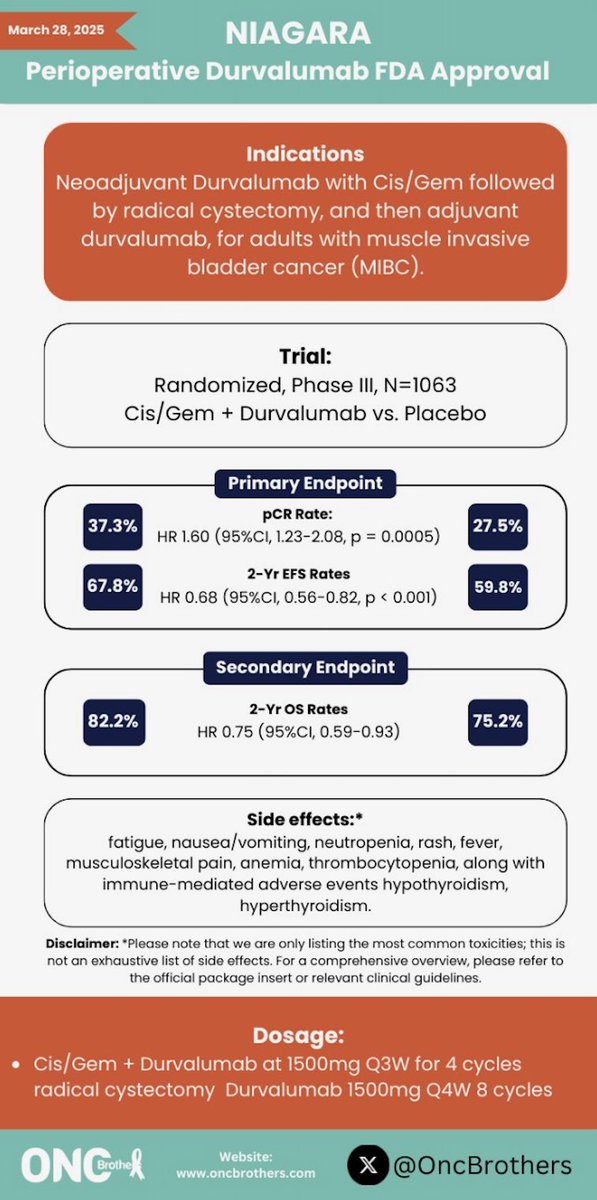
Event-free survival - 2-year EFS 67.8% with durvalumab + GC vs 59.8% with chemotherapy alone (HR 0.68, 95% CI 0.56-0.82). Pathologic complete response 37.3% vs 27.5%.
Overall survival - OS HR 0.75 (95% CI 0.59-0.93, P=0.0106) favoring perioperative durvalumab - the first trial to demonstrate an OS benefit with perioperative immunotherapy in MIBC.
Safety - Immune-related adverse events consistent with the durvalumab monotherapy profile; no new safety signals. Radical cystectomy completion rates were comparable between arms.
Regulatory / sponsor - FDA approved March 28, 2025: durvalumab (Imfinzi) + gemcitabine/cisplatin neoadjuvant, then adjuvant durvalumab, in adult MIBC. Sponsor: AstraZeneca.
Compiled and reviewed by the KOL Pulse research team, led by Brian Shields, Founder, KOL Pulse. Last updated August 19, 2026.






Top tweets by impressions — click to view on X
Neoadjuvant chemotherapy plus durvalumab, followed by adjuvant durvalumab after cystectomy, led to event-free survival superior to that with neoadjuvant chemotherapy followed by cystectomy alone.…
< 2 wks to #ASCO25, here is a📝 of 🔑abstracts for general onc that could guide our SoC!
- #ATOMIC
- #MATTERHORN
- #SERENA6
- #ASCENT04
- #DestinyBreast09
- #IMforte & #Dellphi304
- Updates:…
NIAGRA presented #ESMO24 and published today @NEJM – huge accomplishment 1000+ patients enrolled. Exciting results!
Some thoughts on applying them to practice... https://t.co/6vXd50lC83
Post-#ESMO24 #ESMO2024 Edition !
With @VPrasadMDMPH , we review 6 trials:
-NIAGARA (periop durva bladder)
-AMBASSADOR (adj pembro bladder)
-LEAP-012
-SOLARIS (vitD CRC)
-CONTACT-02
- and SPLASH in…

⭐️ Mind blowing results of immunotherapy across different tumor types presented #ESMO24 now at @NEJM
- Melanoma (CM 067) 10 years FU Nivo, Nivo-Ipi.
- TNBC (KEYNOTE-522): 5y OS perioperative…
One page takeaway from #NIAGARA study that resulted in #durvalumab’s @FDAOncology approval on March 28, 2025 for resectable muscle invasive #BladderCancer
#OncTwitter #MedTwitter #gusm @OncoAlert…
Breaking news (practice changing) from @myESMO #ESMO24 👉@tompowles1 presents the 1st results of the ph3 Niagara trial of cisplatin + gemcitabine +|- durvalumab in MIBC #bladdercancer 👉Significant…
NIAGRA: neoadjuvant gem/cis +/- perioperative durvalumab shows significant OS and EFS. #GU25 @MattGalsky now shows the prognostic relevance of pCR. It also showed the durvalumab outperforms the…
Listen to the NEJM editors discuss the significance of the NIAGARA trial in a podcast: https://t.co/15pOYwjRvg #ESMO24
Ab#659 @ASCO #GU25 by @MattGalsky 👉https://t.co/hlZ7AC2Oz6 👉Ph3 NIAGARA trial of perioperative durvalumab + neo-adj gem-cis vs. neo-adj gem-cis in MIBC #bladdercancer👉Durva improved EFS & OS in…
First trial to demonstrate OS benefit with perioperative immunotherapy in cisplatin-eligible MIBC. Immediately practice-changing. Debate centers on optimal sequencing vs. adjuvant nivolumab (CheckMate-274) and patient selection across the perioperative/adjuvant/observation options.
2-year EFS was 67.8% in the durvalumab+GC arm vs. 59.8% with chemotherapy alone (HR 0.68, 95% CI 0.56-0.82, P<0.0001). pCR rate: 37.3% vs. 27.5% (OR 1.6, P=0.0005).
Overall survival HR was 0.75 (95% CI 0.59-0.93, P=0.0106) favoring perioperative durvalumab. First trial demonstrating OS benefit with perioperative immunotherapy in MIBC.
Immune-related adverse events consistent with durvalumab monotherapy profile. No new safety signals. Radical cystectomy completion rates comparable between arms — perioperative durvalumab did not compromise surgical outcomes.
✅ First OS-positive perioperative immunotherapy in cisplatin-eligible MIBC. First trial to demonstrate OS benefit with perioperative immunotherapy in cisplatin-eligible MIBC. Immediately practice-changing. Debate centers on optimal sequencing vs. adjuvant nivolumab (CheckMate-274) and patient selection across the perioperative/adjuvant/observation options.
NIAGARA (NCT03732677) is a Phase III, randomized, open-label AstraZeneca trial in 1,063 cisplatin-eligible patients with muscle-invasive bladder cancer. It compared neoadjuvant durvalumab plus gemcitabine/cisplatin followed by radical cystectomy and adjuvant durvalumab against neoadjuvant chemotherapy alone. Results were presented at ESMO 2024.
NIAGARA met its event-free survival co-primary endpoint: 2-year EFS was 67.8% with perioperative durvalumab vs 59.8% with chemotherapy alone (HR 0.68, 95% CI 0.56-0.82), with pathologic complete response rates of 37.3% vs 27.5%. Overall survival also favored durvalumab (HR 0.75, 95% CI 0.59-0.93, P=0.0106), making it the first trial to show an OS benefit with perioperative immunotherapy in MIBC.
Yes. On March 28, 2025 the FDA approved durvalumab (Imfinzi) with gemcitabine and cisplatin as neoadjuvant treatment, followed by single-agent durvalumab as adjuvant treatment after radical cystectomy, for adult patients with muscle-invasive bladder cancer, based on the NIAGARA trial.
Immune-related adverse events were consistent with the known durvalumab monotherapy profile and no new safety signals emerged. Importantly, radical cystectomy completion rates were comparable between arms, indicating that adding perioperative durvalumab did not compromise surgical outcomes.
NIAGARA is the first trial to demonstrate an overall survival benefit with perioperative immunotherapy in cisplatin-eligible MIBC and was viewed as immediately practice-changing. Ongoing debate centers on optimal sequencing versus adjuvant nivolumab (CheckMate-274) and on patient selection across perioperative, adjuvant, and observation options.