KOL Pulse — Trial Profile

TROPiCS-04 Trial

Pretreated locally advanced or metastatic urothelial cancer (post-platinum, post-checkpoint inhibitor) — Gilead Sciences

Pretreated locally advanced or metastatic urothelial cancer (post-platinum, post-checkpoint inhibitor)TrodelvyESMO 2024
Visit Interactive Trial Page →

Top KOLs Discussing TROPiCS-04

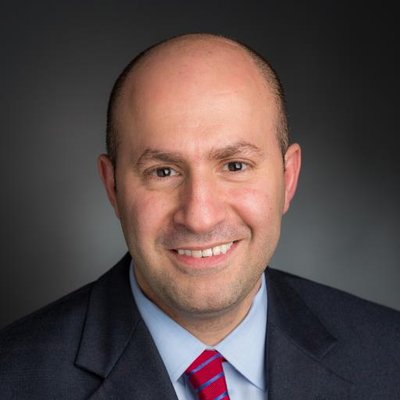
Neeraj Agarwal, MD, FASCO
@neerajaiims
7.1K impressions
Petros Grivas
Petros Grivas
@PGrivasMDPhD
4.3K impressions
Sumanta K. Pal, MD, FASCO
@montypal
3.3K impressions
Tom Powles
Tom Powles
@tompowles1
2K impressions
Toni Choueiri, MD
Toni Choueiri, MD
@DrChoueiri
787 impressions
Paolo Tarantino
Paolo Tarantino
@PTarantinoMD
729 impressions

TROPiCS-04 Key Slides & Visuals

Official trial slides and relevant visuals shared by KOLs at ESMO 2024. Click any image to expand.

Neeraj Agarwal, MD, FASCO
TROPiCS-04 Data
7.1K impressions · 45 likes · Feb 20, 2025
View on X ↗
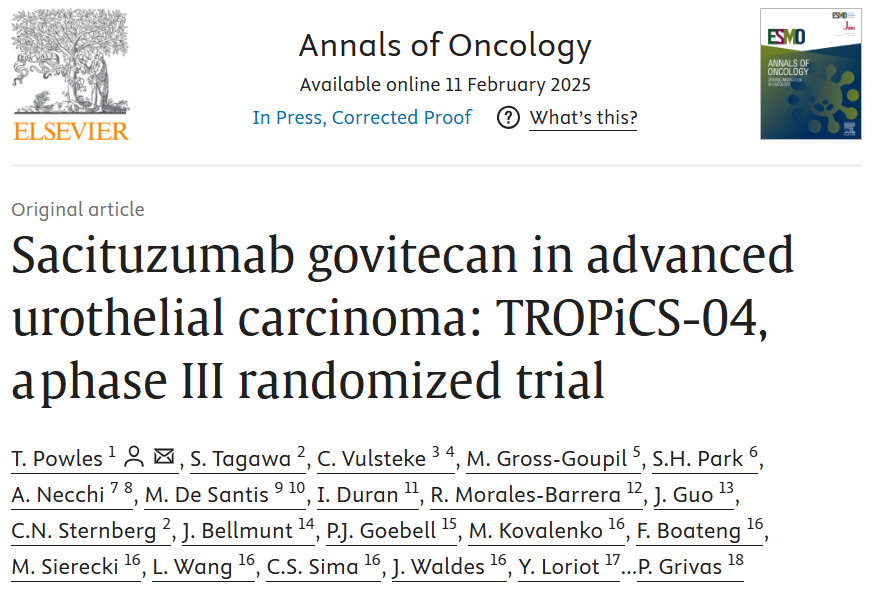
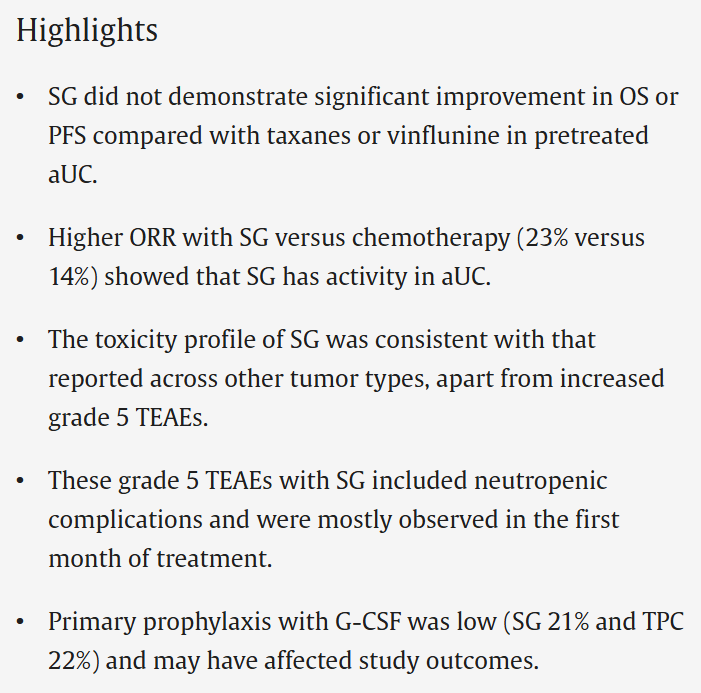
[Slide 1] Highlights SG did not demonstrate significant improvement in os or PFS compared with taxanes or vinflunine in pretreated aUC. Higher ORR with SG versus chemotherapy (23% versus 14%) showed that SG has activity in aUC. The toxicity profile of SG was consistent with that reported across other tumor types, apart from increased grade 5 TEAEs. These grade 5 TEAEs with SG included neutropenic complications and were mostly observed in the first month of treatment. Primary prophylaxis with G-CSF was low (SG 21% and TPC 22%) and may have affected study outcomes. --- [Slide 2] SG (n = 355) TPC (n = 356) 100 Number of participants with events 258 226 90 Median PFS, months (95% CI) 4.2 (3.8-4.5) 3.6 (2.9-4.2) Stratified HR (95% CI) 0.86 (0.72-1.03) 80 12-month PFS rate, % (95% CI) 14.5 (10-19) 9 (5-14) 70 60 50 40 30 20 10 + SG (n=355) TPC (n = 356) 0 T 10 12 14 16 18 20 22 24 26 0 2 4 6 8 Time (months) Number at risk (events) SG 355 (0) 221 (100) 160 (148) 82 (205) 64 (218) 39 (238) 28 (247) 19 (252) 14 (256) 10 (257) 4 (258) 1 (258) 1 (258) 0 (258) TPC 356 (0) 196 (90) 116 (151) 52 (194) 29 (211) 14 (222) 10 (224) 8 (225) 6 (225) 5 (225) 0 (226) Figure 2. Kaplan-Meier plot of progression-free survival by blinded independent central review. CI, confidence interval; HR, hazard ratio; PFS, progression-free survival; SG, sacituzumab govitecan; TPC, treatment of physician's choice. --- [Slide 3] ESMI Annals of Oncology ESMO ANNALS OF ONCOLOGY Available online 11 February 2025 In Press, Corrected Proof ? What's this? ELSEVIER Original article Sacituzumab govitecan in advanced urothelial carcinoma: TROPiCS-04, aphase III randomized trial T. Powles 1 of O X , S. Tagawa 2 C. Vulsteke 34 , M. Gross-Goupil 5, S.H. Park 6, 6 A. Necchi 78, M. De Santis 9 10, I. Duran 11 , R. Morales-Barrera ¹², ) J. Guo¹³, C.N. Sternberg 2 , J. Bellmunt 14, P.J. Goebell 15 , M. Kovalenko 16, F. Boateng 16 , M. Sierecki 16 L. Wang 16 C.S. Sima 16, J. Waldes 16, Y. Loriot 17...P. Grivas 18 --- [Slide 4] Highlights SG did not demonstrate significant improvement in OS or PFS compared with taxanes or vinflunine in pretreated aUC. Higher ORR with SG versus chemotherapy (23% versus 14%) showed that SG has activity in aUC. The toxicity profile of SG was consistent with that reported across other tumor types, apart from increased grade 5 TEAEs. These grade 5 TEAEs with SG included neutropenic complications and were mostly observed in the first month of treatment. Primary prophylaxis with G-CSF was low (SG 21% and TPC 22%) and may have affected study outcomes. --- [Slide 5] A 100 SG (n = 355) TPC (n = 356) Number of participants with events 272 279 90 Median OS, months (95% CI) 10.3 (9.1-11.8) 9.0 (7.5-9.7) 80 Stratified HR (95% CI) 0.86 (0.73-1.02) Stratified log-rank P value P = 0.087 70 12-month OS rate, % (95% CI) 44 (39-49) 37 (32-42) os probability (%) 60 50 40 30 20 10 0 SG (n = 355) TPC (n = 356) 0 2 4 6 8 10 12 14 16 18 20 22 24 26 28 30 32 34 Time (months) Number at risk (events) SG 355 (0) 320 (33) 282 (71) 241 (112) 209 (143) 179 (172) 155 (196) 132 (218) 112 (235) 78 (252) 49 (262) 26 (266) 12 (271) 4 (272) 1 (272) 1 (272) 0 (272) TPC 356 (0) 323 (22) 269 (76) 224 (121) 184 (160) 148 (195) 125 (218) 106 (236) 84 (255) 59 (265) 41 (271) 26 (274) 16 (276) 7 (278) 4 (279) 2 (279) 1 (279) 0 (279) Figure 1. Overall survival. (A) Kaplan-Meier plot of overall survival intent-to-treat analysis set. (B) Forest plot of overall survival across prespecified subgroups. CI, confidence interval; HR, hazard ratio; OS, overall survival; SG, sacituzumab govitecan; TPC, treatment of physician's choice. --- [Slide 6] 100 SG (n = 355) TPC (n = 356) Number of participants with events 258 226 90 Median PFS, months (95% CI) 4.2 (3.8-4.5) 3.6 (2.9-4.2) 80 Stratified HR (95% CI) 0.86 (0.72-1.03) 12-month PFS rate, % (95% CI) 14.5 (10-19) 9 (5-14) 70 PFS probability (%) 60 50 40 30 20 10 0 SG (n = 355) TPC (n = 356) 0 2 4 6 8 10 12 14 16 18 20 22 24 26 Time (months) Number at risk (events) SG 355 (0) 221 (100) 160 (148) 82 (205) 64 (218) 39 (238) 28 (247) 19 (252) 14 (256) 10 (257) 4 (258) 1 (258) 1 (258) 0 (258) TPC 356 (0) 196 (90) 116 (151) 52 (194) 29 (211) 14 (222) 10 (224) 8 (225) 6 (225) 5 (225) 0 (226) Figure 2. Kaplan-Meier plot of progression-free survival by blinded independent central review. CI, confidence interval; HR, hazard ratio; PFS, progression-free survival; SG, sacituzumab govitecan; TPC, treatment of physician's choice.
Tom Powles
Tom Powles @tompowles1
TROPiCS-04 Data
2K impressions · 32 likes · Feb 11, 2025
View on X ↗
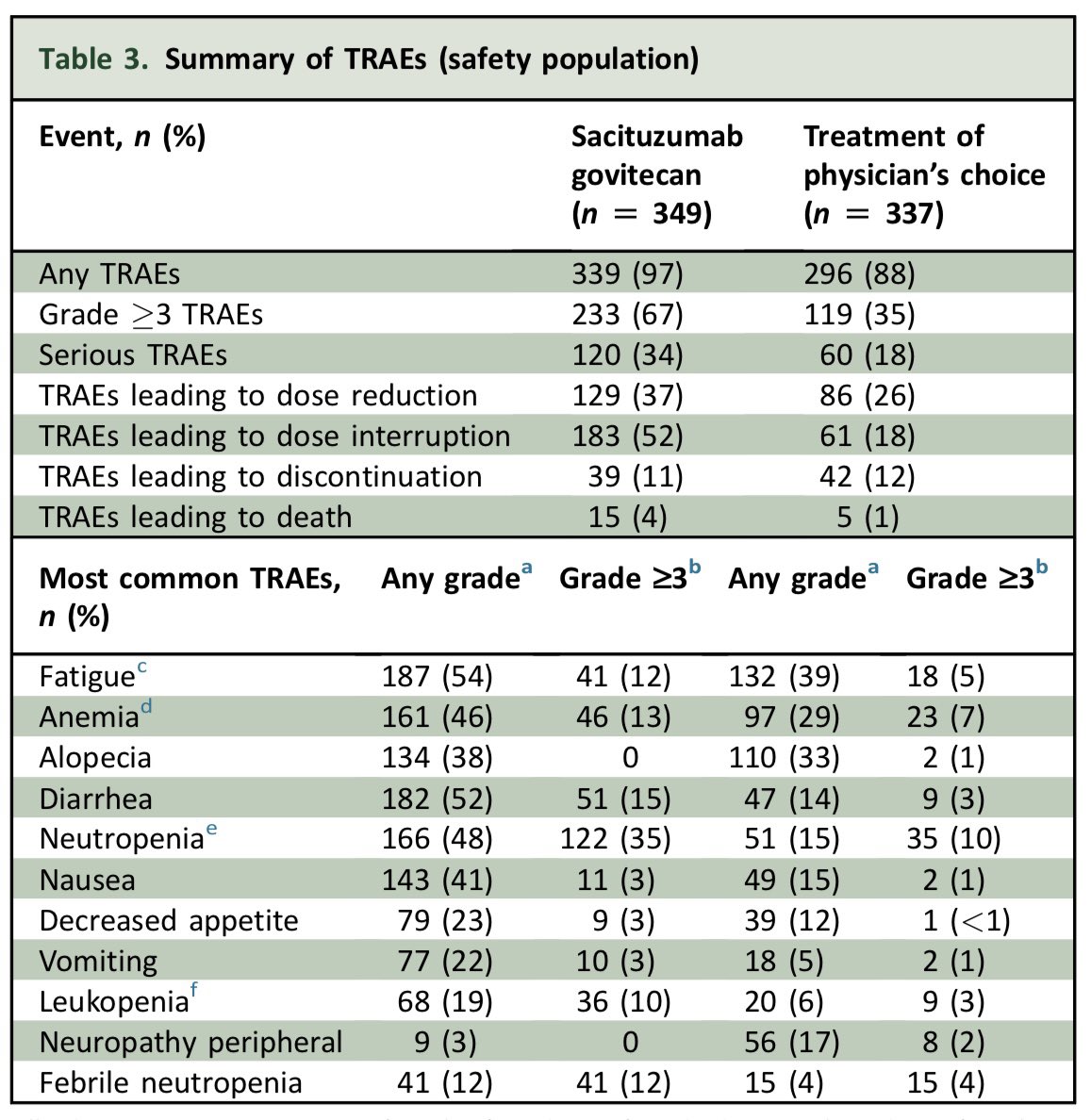
[Slide 1] Table 3. Summary of TRAEs (safety population) Event, n (%) Sacituzumab Treatment of govitecan physician's choice (n = 349) (n = 337) Any TRAEs 339 (97) 296 (88) Grade >3 TRAEs 233 (67) 119 (35) Serious TRAEs 120 (34) 60 (18) TRAEs leading to dose reduction 129 (37) 86 (26) TRAEs leading to dose interruption 183 (52) 61 (18) TRAEs leading to discontinuation 39 (11) 42 (12) TRAEs leading to death 15 (4) 5 (1) Most common TRAEs, Any grade Grade >3b Any grade a Grade >3b n (%) Fatigue C 187 (54) 41 (12) 132 (39) 18 (5) Anemia d 161 (46) 46 (13) 97 (29) 23 (7) Alopecia 134 (38) 0 110 (33) 2 (1) Diarrhea 182 (52) 51 (15) 47 (14) 9 (3) Neutropenia® 166 (48) 122 (35) 51 (15) 35 (10) Nausea 143 (41) 11 (3) 49 (15) 2 (1) Decreased appetite 79 (23) 9 (3) 39 (12) 1 (<1) Vomiting 77 (22) 10 (3) 18 (5) 2 (1) Leukopenia f 68 (19) 36 (10) 20 (6) 9 (3) Neuropathy peripheral 9 (3) 0 56 (17) 8 (2) Febrile neutropenia 41 (12) 41 (12) 15 (4) 15 (4) --- [Slide 2] 100 SG (n = 355) TPC (n = 356) Number of participants with events 258 226 90 Median PFS, months (95% CI) 4.2 (3.8-4.5) 3.6 (2.9-4.2) 80 Stratified HR (95% CI) 0.86 (0.72-1.03) 12-month PFS rate, % (95% CI) 14.5 (10-19) 9 (5-14) 70 PFS probability (%) 60 50 40 30 20 10 0 SG (n = 355) TPC (n = 356) 0 2 4 6 8 10 12 14 16 18 20 22 24 26 Time (months) Number at risk (events) SG 355 (0) 221 (100) 160 (148) 82 (205) 64 (218) 39 (238) 28 (247) 19 (252) 14 (256) 10 (257) 4 (258) 1 (258) 1 (258) 0 (258) TPC 356 (0) 196 (90) 116 (151) 52 (194) 29 (211) 14 (222) 10 (224) 8 (225) 6 (225) 5 (225) 0 (226) Figure 2. Kaplan-Meier plot of progression-free survival by blinded independent central review. CI, confidence interval; HR, hazard ratio; PFS, progression-free survival; SG, sacituzumab govitecan; TPC, treatment of physician's choice. --- [Slide 3] A 100 SG (n = 355) TPC (n = 356) Number of participants with events 272 279 90 Median OS, months (95% CI) 10.3 (9.1-11.8) 9.0 (7.5-9.7) 80 Stratified HR (95% CI) 0.86 (0.73-1.02) Stratified log-rank P value P = 0.087 70 12-month OS rate, % (95% CI) 44 (39-49) 37 (32-42) OS probability (%) 60 50 40 30 20 10 0 SG (n = 355) TPC (n = 356) 0 2 4 6 8 10 12 14 16 18 20 22 24 26 28 30 32 34 Time (months) Number at risk (events) SG 355 (0) 320 (33) 282 (71) 241 (112) 209 (143) 179 (172) 155 (196) 132 (218) 112 (235) 78 (252) 49 (262) 26 (266) 12 (271) 4 (272) 1 (272) 1 (272) 0 (272) TPC 356 (0) 323 (22) 269 (76) 224 (121) 184 (160) 148 (195) 125 (218) 106 (236) 84 (255) 59 (265) 41 (271) 26 (274) 16 (276) 7 (278) 4 (279) 2 (279) 1 (279) 0 (279) Figure 1. Overall survival. (A) Kaplan-Meier plot of overall survival intent-to-treat analysis set. (B) Forest plot of overall survival across prespecified subgroups. CI, confidence interval; HR, hazard ratio; OS, overall survival; SG, sacituzumab govitecan; TPC, treatment of physician's choice. --- [Slide 4] Table 3. Summary of TRAEs (safety population) Event, n (%) Sacituzumab Treatment of govitecan physician's choice (n = 349) (n = 337) Any TRAEs 339 (97) 296 (88) Grade >3 TRAEs 233 (67) 119 (35) Serious TRAEs 120 (34) 60 (18) TRAEs leading to dose reduction 129 (37) 86 (26) TRAEs leading to dose interruption 183 (52) 61 (18) TRAEs leading to discontinuation 39 (11) 42 (12) TRAEs leading to death 15 (4) 5 (1) Most common TRAEs, Any gradeᵃ Grade ≥3b Any gradeᵃ Grade ≥3ᵇ n (%) Fatigueᶜ 187 (54) 41 (12) 132 (39) 18 (5) Anemia 161 (46) 46 (13) 97 (29) 23 (7) Alopecia 134 (38) 0 110 (33) 2 (1) Diarrhea 182 (52) 51 (15) 47 (14) 9 (3) Neutropenia® 166 (48) 122 (35) 51 (15) 35 (10) Nausea 143 (41) 11 (3) 49 (15) 2 (1) Decreased appetite 79 (23) 9 (3) 39 (12) 1 (<1) Vomiting 77 (22) 10 (3) 18 (5) 2 (1) Leukopenia 68 (19) 36 (10) 20 (6) 9 (3) Neuropathy peripheral 9 (3) 0 56 (17) 8 (2) Febrile neutropenia 41 (12) 41 (12) 15 (4) 15 (4) --- [Slide 5] Background: Sacituzumab govitecan (SG), a Trop-2-directed antibody-drug conjugate, demonstrated efficacy and manageable toxicity in the phase II TROPHY-U-01 study in pretreated advanced urothelial carcinoma (aUC). We report the results from final analysis of the global open-label randomized phase III TROPiCS-04 study (NCT04527991) in pretreated aUC. Patients and methods: Patients with aUC whose disease had progressed on prior platinum-based chemotherapy and checkpoint inhibitor therapy were randomized 1: 1 to receive SG or treatment of physician's choice (TPC; paclitaxel, docetaxel, or vinflunine). The primary endpoint was overall survival (OS). Secondary endpoints included progression- free survival (PFS) and objective response rate (ORR) by investigator and blinded independent committee review, as well as safety. Results: Overall, 711 patients were randomized. After a median follow-up of 9.2 months, the primary endpoint was not met [median os for SG versus TPC: 10.3 months versus 9.0 months, hazard ratio (HR) 0.86, 95% confidence interval (CI) 0.73-1.02, P = 0.087]. Median PFS with SG and TPC was 4.2 months and 3.6 months, respectively (HR 0.86, 95% CI 0.72-1.03); ORR (95% CI) was 23% (18% to 27%) and 14% (10% to 18%). The most common grade >3 treatment-related adverse event (TRAE) with SG was neutropenia (35%, including 12% with febrile neutropenia). Incidence of grade >3 TRAEs (67% versus 35%) and grade 5 treatment-emergent adverse events (TEAEs; 7% versus 2%) was higher with SG versus TPC. In the SG group, 16/25 grade 5 TEAEs were infections with neutropenia mostly occurring early in the treatment course of patients with multiple risk factors for febrile neutropenia. Primary prophylactic granulocyte colony-stimulating factor (G-CSF) usage with SG and TPC was 21% and 22%, respectively. Conclusions: SG did not result in a significant improvement in OS or PFS compared with TPC in pretreated aUC, although SG activity was demonstrated by a higher ORR. Early toxicity-related complications with SG may have impacted efficacy outcomes. Key words: antibody-drug conjugate, bladder cancer, metastatic urothelial carcinoma, sacituzumab govitecan, SN-38, topoisomerase I inhibitor
Anita Turk
Anita Turk @anita_turk
TROPiCS-04 Data
159 impressions · 4 likes · Jul 12, 2025
View on X ↗
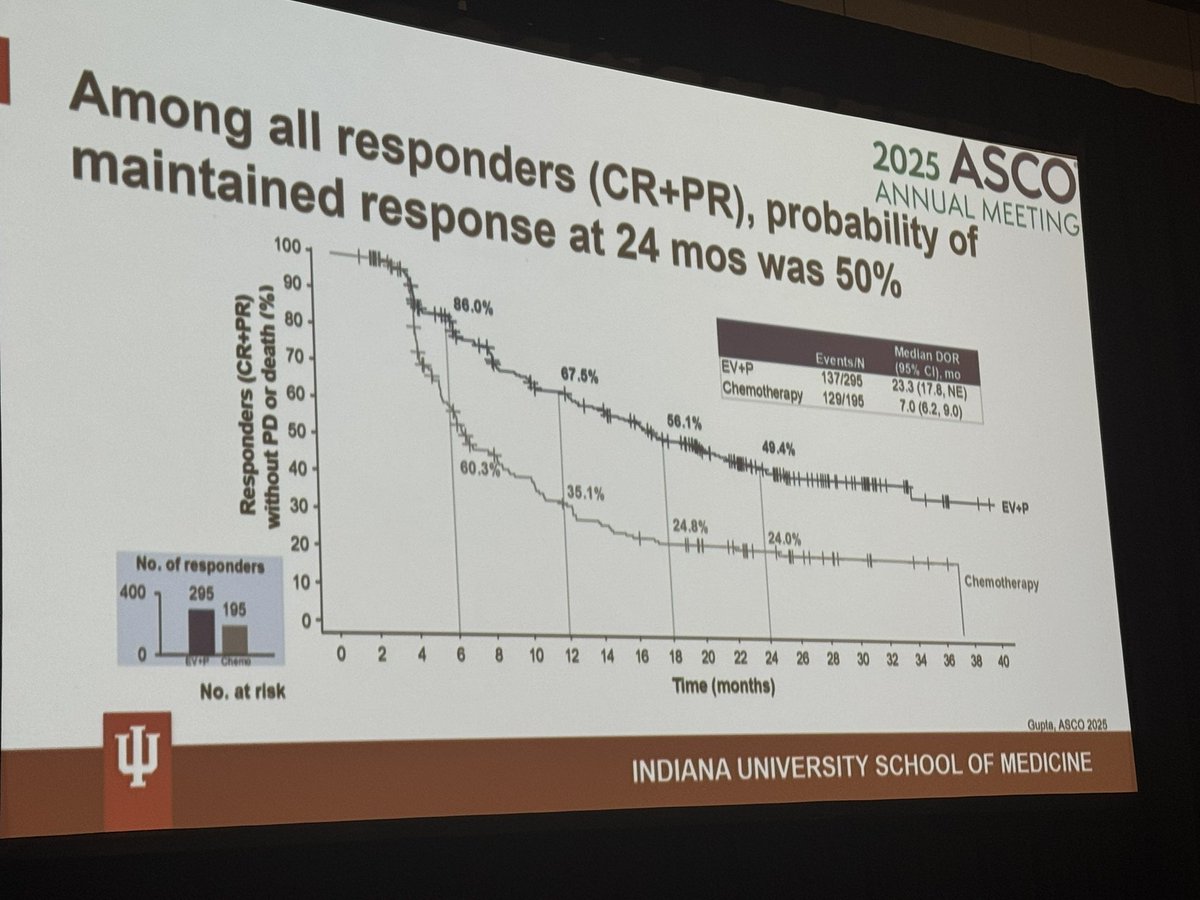
[Slide 1] Improved EFS with perioperative durvalumab regardless of pCR pCR Derralumab Comparator 1.0 pCR 92.1% N-199 N-146 No events, 0(N) 23(12) 29(20) Median EFS NR NR 0.8 ### (W% CO. norths (NR-NR) (NR-NR) non-pCR 85.8% EFS HR 0.58 Probability of event-free survival (95% CI) (0.332-0.999) 0.6 non-pCR Durvalumab Comparator 0.4 N*334 N-344 53.3% No events, (%) 164(49) 217(57) 49.5% Median EFS 347 22.8 0.2 (95% CI) norths (205-NR) (155-306) Durvalumab arm EFS HR 0.77 Comparator arm (95% CI) (0.631-0.948) 0 6 8 10 12 14 16 18 20 22 24 26 28 30 32 34 36 38 40 42 44 46 48 50 52 54 56 58 60 62 0 2 4 ITT Time from randomization (months) No of patients of risk (A of 40 39 14 1 $ I EFS HR 0.68 176 174 173 172 170 170 164 145 142 134 9) 70 PCR 140 139 136 131 120 126 124 121 119 116 115 n " 7) 50 57 M 30 17 1 6 $ 0 (95%C) (054-082) 146 71 71 54 46 42 If 11 11 pCR 173 165 100 160 137 133 99 00 320 266 239 221 210 Carm 362 203 276 242 222 209 197 174 172 147 162 123 и 93 as 74 72 (6 29 26 15 12 10 2 150 Galsky, GU ASCO 2025 Ф INDIANA UNIVERSITY SCHOOL OF MEDICINE --- [Slide 2] Improved EFS with perioperative durvalumab regardless of ctDNA status EFS (combined arms) EFS (per arm) 10 10 08 08 ctDNA- ctDNA- ctDNA- Probability of EFS 06 Protein EFS B 06 ctDNA+ ctDNA+ 04 04 ctDNA+ 02 02 D+NAC NAC 0 0 0 ) 6 9 12 21 24 27 30 42 is 51 M 57 0 9 12 15 18 21 24 II 30 * 42 45 48 11 M Time from randomization (months) Time from randomization (months) No of patients al risk No of patients M risk ENA 11 # **** ecea **** ctDNA- vs ctDNA+ HR, 0.42 (95% CI, 0.30-0.60) ctDNA-: D+NAC vs NAC HR, 0.45 (95% CI, 0.24-0.84) ctDNA+: D+NAC vs NAC HR, 0.73 (95% CI, 0.51-1.05) Durvalumab arm # D+NAC; Comparator am # NAC BEP baseline ctDNA+ = 57% Powles, ASCO 2025 W INDIANA UNIVERSITY SCHOOL OF MEDICINE --- [Slide 3] 2025 ASCO Among all responders (CR+PR), probability ANNUAL of MEETING maintained response at 24 mos was 50% 100 90 86.0% Median DOR Events/N 80 (95% CI), mo EV+P 137/295 23.3 (17.8, NE) Responders (CR+PR) without PD or death (%) 70 67.5% Chemotherapy 129/195 7.0 (6.2, 9.0) 60 56.1% 49.4% 50 60.3% EV+P 40 35.1% 30 24.8% 24.0% 20 Chemotherapy No. of responders 10 400 295 195 0 0 2 4 6 8 10 12 14 16 18 20 22 24 26 28 30 32 34 36 38 40 0 EV+P Cheme Time (months) No. at risk Gupta, ASCO 2025 Ф INDIANA UNIVERSITY SCHOOL OF MEDICINE --- [Slide 4] No difference in OS A 100 90 SG (n 355) TPC (n 356) Number of participants with events 272 279 80 Median os, months (95% CI) 10.3 (9.1-11.8) 9.0(7.5-9.7) Stratified HR (95% CI) 0.86 (0.73-1.02) In Oct 70 Stratified log-rank P value P 0.087 12-month os rate, % (95% CI) 44 (39-49) 37 (32-42) 2024, FDA os probability (%) 60 indication 50 for SG in 40 metastatic 30 bladder 20 cancer was 10 withdrawn 0 SG (n 355) TPC (n 356) 0 2 4 6 8 10 12 14 16 18 20 22 24 26 28 30 32 34 Time (months) Number at risk (events) 355(0) 320 (33) 282 (71) 241 (112) 209 (143) 179 (172) 155 (196) 132 (218) 112 (235) 78 (252) 49 (262) 26 (266) 12 (271) 4 (272) 1 (272) 1 (272) 0 (272) SG TPC 356 (0) 323 (22) 269 (76) 224 (121) 184 (160) 148 (195) 125 (218) 106 (236) 84 (255) 59 (265) 41 (271) 26 (274) 16 (276) 7 (278) 4 (279) 2 (279) 1 (279) 0 (279) Powles, Annals of Oncology 2025 Ф INDIANA UNIVERSITY SCHOOL OF MEDICINE
Paolo Tarantino
Paolo Tarantino @PTarantinoMD
TROPiCS-04 Data
729 impressions · 11 likes · Feb 11, 2025
View on X ↗
OCR text not available for this slide. View the original post on X for context.

TROPiCS-04 Top Tweets

Top tweets by impressions — click to view on X

Neeraj Agarwal, MD, FASCO
Neeraj Agarwal, MD, FASCO@neerajaiims

Just in @Annals_Oncology by @tompowles1 @PGrivasMDPhD &amp; team👉Ph3 TROPiCS-04 trial result👉Sacituzumab govitecan (SG) vs physician’s choice chemoRx in pretreated mUC #bladdercancer👉No OS or PFS…

👁 7.1K ♡ 45 ↻ 31 Feb 20, 2025
Petros Grivas
Petros Grivas@PGrivasMDPhD

We just published TROPiCS04 P3 trial data @Annals_Oncology with @tompowles1 @y_loriot @DrScottTagawa et al.
Primary OS endpoint was not met, higher ORR with SG (23%) vs taxane/vinflunine (14%), G-CSF…

👁 4.3K ♡ 54 ↻ 21 Feb 11, 2025
Sumanta K. Pal, MD, FASCO
Sumanta K. Pal, MD, FASCO@montypal

So important that this dataset from @tompowles1 @Uromigos @BartsECMC, @PGrivasMDPhD @fredhutch @UW, et al is out there for our detailed evaluation. The role of #sacituzumab in #BladderCancer appears…

👁 3.3K ♡ 31 ↻ 13 Feb 20, 2025
Tom Powles
Tom Powles@tompowles1

TROPICS4 sacituzimab govitecan vs chemo in pretreated UC @Annals_Oncology OS &amp; PFS HRs=0.86. RR 23 vs 14, but G3+ TRAE 67 vs 35% with ⬆️ G5 TRD. While there is activity the ⬆️ tox &amp; lower RR…

👁 2K ♡ 32 ↻ 17 Feb 11, 2025
Toni Choueiri, MD
Toni Choueiri, MD@DrChoueiri

Phase 3 TROPiCS-04 in Metastatic Bladder Cancer: single agent ADC (SG) was not superior to trt choice chemo in terms of OS

⁦⁦@BladderCancerUS⁩ ⁦@DanaFarber_GU⁩ ⁦@OncoAlert⁩ ⁦@OncoBellmunt⁩…

👁 787 ♡ 12 ↻ 3 May 30, 2024
Paolo Tarantino
Paolo Tarantino@PTarantinoMD

TROPiCS-04 trial out on @Annals_Oncology: no statistical improvement in OS with the Trop2 ADC #SG vs TPC in met urothelial cancer, with higher rate of G5 AEs with SG. Led to the withdrawal of SG…

👁 729 ♡ 11 ↻ 1 Feb 11, 2025
Shilpa Gupta
Shilpa Gupta@shilpaonc

Congrats @tompowles1 @PGrivasMDPhD @y_loriot @AndreaNecchi &amp; entire TROPICS-04 team on getting the data out in @Annals_Oncology
It is crucial to learn from negative trials &amp; important…

👁 268 ♡ 3 ↻ 1 Feb 11, 2025
Andrea Apolo, M.D.
Andrea Apolo, M.D.@apolo_andrea

Phase 3 TROPiCS-04 Study in metastatic #BladderCancer (post platinum &amp; CPI) of sacituzimab govitecan #SG vs 2L chemo did not meet OS endpoint. However, drug is active &amp; well tolerated. Will…

👁 217 ♡ 6 ↻ 2 May 30, 2024
Anita Turk
Anita Turk@anita_turk

Dr Jennifer King with bladder cancer updates: NIAGARA shows perioperative durvalumab improves EFS regardless of pCR/ctDNA status. EV-302 demonstrates 50% maintained response at 24 months among…

👁 159 ♡ 4 ↻ 0 Jul 12, 2025

About the TROPiCS-04 Trial

TROPiCS-04 is the archetype of an accelerated-approval confirmation trial failure leading to voluntary withdrawal. The prior accelerated approval (April 2021) was based on TROPHY-U-01 ORR data. When TROPiCS-04 missed OS (and showed higher early mortality from neutropenic complications), Gilead withdrew the indication. Sacituzumab govitecan remains approved for metastatic TNBC and HR+/HER2- breast cancer. The mUC treatment landscape has since shifted decisively toward EV-302 (enfortumab vedotin + pembrolizumab) as 1L SOC.

Trial Methodology & Results

Overall Survival — Primary Endpoint (ITT Population)

TROPiCS-04 did NOT meet its primary endpoint of overall survival in the ITT population. A numerical OS improvement favoring sacituzumab govitecan was observed, along with trends in secondary endpoints (PFS, ORR) and prespecified subgroups, but these were not alpha-controlled for formal statistical testing. Exact OS medians, HR, and CI not disclosed in topline release. 711 patients randomized 1:1 to sacituzumab govitecan 10 mg/kg on days 1 and 8 of 21-day cycle vs. physician's choice chemotherapy (paclitaxel, docetaxel, or vinflunine).

❌ Did NOT meet OS primary endpoint

📄 Source: KOL commentary on X →

Overall Survival (OS)

Primary endpoint was OS (see above). No statistically significant OS benefit.


📄 Source →

Safety & Tolerability

Higher number of deaths due to adverse events with sacituzumab govitecan vs. chemotherapy — primarily early in treatment and related to neutropenic complications including infection. No new safety signals beyond known Trodelvy profile (severe/life-threatening neutropenia per Boxed Warning; diarrhea). Gilead emphasized G-CSF use for prevention of neutropenic complications.

⚠ Higher early AE mortality vs. chemo (neutropenic complications)

📄 Source →

Clinical Implications

Negative Phase 3; accelerated approval voluntarily withdrawn. No longer available for urothelial cancer. TROPiCS-04 is the archetype of an accelerated-approval confirmation trial failure leading to voluntary withdrawal. The prior accelerated approval (April 2021) was based on TROPHY-U-01 ORR data. When TROPiCS-04 missed OS (and showed higher early mortality from neutropenic complications), Gilead withdrew the indication. Sacituzumab govitecan remains approved for metastatic TNBC and HR+/HER2- breast cancer. The mUC treatment landscape has since shifted decisively toward EV-302 (enfortumab vedotin + pembrolizumab) as 1L SOC.

TROPiCS-04 in the News

Key KOL Sentiments — TROPiCS-04

DoctorSentimentComment
Shilpa Gupta ● POSITIVE Congrats @tompowles1 @PGrivasMDPhD @y_loriot @AndreaNecchi &amp; entire TROPICS-04 team on getting the data out in @Annals_Oncology It is crucial to learn from negative trials &amp; important lessons were learned from this. @montypal @neerajaiims @DrScottTagawa @Uromigos… https://t.co/7aXySIDIeC https://t.co/Mvr92qrAcN
Neeraj Agarwal, MD, FASCO ● NEUTRAL Just in @Annals_Oncology by @tompowles1 @PGrivasMDPhD &amp; team👉Ph3 TROPiCS-04 trial result👉Sacituzumab govitecan (SG) vs physician’s choice chemoRx in pretreated mUC #bladdercancer👉No OS or PFS benefit with SG👇https://t.co/lDaoCR0q9s @urotoday @OncoAlert @BladderCancerUS https://t.co/G7gliafPhV
Petros Grivas ● NEUTRAL We just published TROPiCS04 P3 trial data @Annals_Oncology with @tompowles1 @y_loriot @DrScottTagawa et al. Primary OS endpoint was not met, higher ORR with SG (23%) vs taxane/vinflunine (14%), G-CSF primary prophy only ~20% -&gt;G5 neutropenic events on SG: https://t.co/Uil5hsZATU
Sumanta K. Pal, MD, FASCO ● NEUTRAL So important that this dataset from @tompowles1 @Uromigos @BartsECMC, @PGrivasMDPhD @fredhutch @UW, et al is out there for our detailed evaluation. The role of #sacituzumab in #BladderCancer appears to still be hotly debated, as discussion from our recent #AUC3 meeting… https://t.co/OXsWiRbahs https://t.co/tKdNXP3HEM
Tom Powles ● NEUTRAL TROPICS4 sacituzimab govitecan vs chemo in pretreated UC @Annals_Oncology OS &amp; PFS HRs=0.86. RR 23 vs 14, but G3+ TRAE 67 vs 35% with ⬆️ G5 TRD. While there is activity the ⬆️ tox &amp; lower RR compared to EV/erda was problematic. Phase 2 Data on 2 other TROP2/TOPO1 ADCs #ASCOGU25 https://t.co/qqX07q4HtH
Toni Choueiri, MD ● NEUTRAL Phase 3 TROPiCS-04 in Metastatic Bladder Cancer: single agent ADC (SG) was not superior to trt choice chemo in terms of OS ⁦⁦@BladderCancerUS⁩ ⁦@DanaFarber_GU⁩ ⁦@OncoAlert⁩ ⁦@OncoBellmunt⁩ ⁦@bergsa83⁩ ⁦@BradMcG04⁩ https://t.co/WpslbUVhgf
Paolo Tarantino ● NEUTRAL TROPiCS-04 trial out on @Annals_Oncology: no statistical improvement in OS with the Trop2 ADC #SG vs TPC in met urothelial cancer, with higher rate of G5 AEs with SG. Led to the withdrawal of SG approval for mUC. No association bw Trop2 exp &amp; SG activity. https://t.co/Vx6SKnLgKI https://t.co/NZoTHMo2Bk
Andrea Apolo, M.D. ● NEUTRAL Phase 3 TROPiCS-04 Study in metastatic #BladderCancer (post platinum &amp; CPI) of sacituzimab govitecan #SG vs 2L chemo did not meet OS endpoint. However, drug is active &amp; well tolerated. Will await data ⁦@OncoAlert⁩ ⁦⁦⁦@OncBrothers⁩ https://t.co/r0xpMdwyis
Anita Turk ● NEUTRAL Dr Jennifer King with bladder cancer updates: NIAGARA shows perioperative durvalumab improves EFS regardless of pCR/ctDNA status. EV-302 demonstrates 50% maintained response at 24 months among responders. TROPiCS-04 confirms no OS difference. @IUCancerCenter https://t.co/ailvA4Gbey