LIVE ASCO 2026 Live — KOL insights, hot abstracts & $TICKER finance buzz View Live Updates →
KOL Pulse — Trial Profile

evERA Breast Cancer

Giredestrant (oral SERD) + everolimus vs physician's choice endocrine therapy + everolimus in ER+/HER2- advanced breast cancer after CDK4/6 inhibition — Roche/Genentech

ER+/HER2- advanced breast cancer · post-CDK4/6i Giredestrant + everolimus Phase 3 · NCT05306340 · ESMO 2025 / ASCO 2026 ✓ Co-primary PFS MET · HR 0.56 ITT / 0.38 ESR1-mut ⚠ Investigational
Read Roche Press Release →

Top KOLs Discussing evERA

Erica L. Mayer, MD, MPH
@elmayermd
ESMO 2025 Presenter · Dana-Farber
Komal Jhaveri, MD
Komal Jhaveri, MD
@jhaveri_komal
ASCO 2026 Presenter · MSK
Yakup Ergün
Yakup Ergün
@dr_yakupergun
12.2K impressions
Hope Rugo
Hope Rugo
@hoperugo
12.2K impressions
Erika Hamilton, MD, FASCO
@ErikaHamilton9
9.7K impressions
VIRGINIA KAKLAMANI
VIRGINIA KAKLAMANI
@VKaklamani
5.3K impressions
Dr Sarah Sammons
Dr Sarah Sammons
@drsarahsam
2.9K impressions
Paolo Tarantino
Paolo Tarantino
@PTarantinoMD
2.3K impressions

evERA Key Slides & Visuals

Conference presentation slides and KOL-authored visual breakdowns of the evERA readout. Click any image to expand.

@PTarantinoMD
Paolo Tarantino@PTarantinoMD
evERA Data
2026-05-31
View on X →
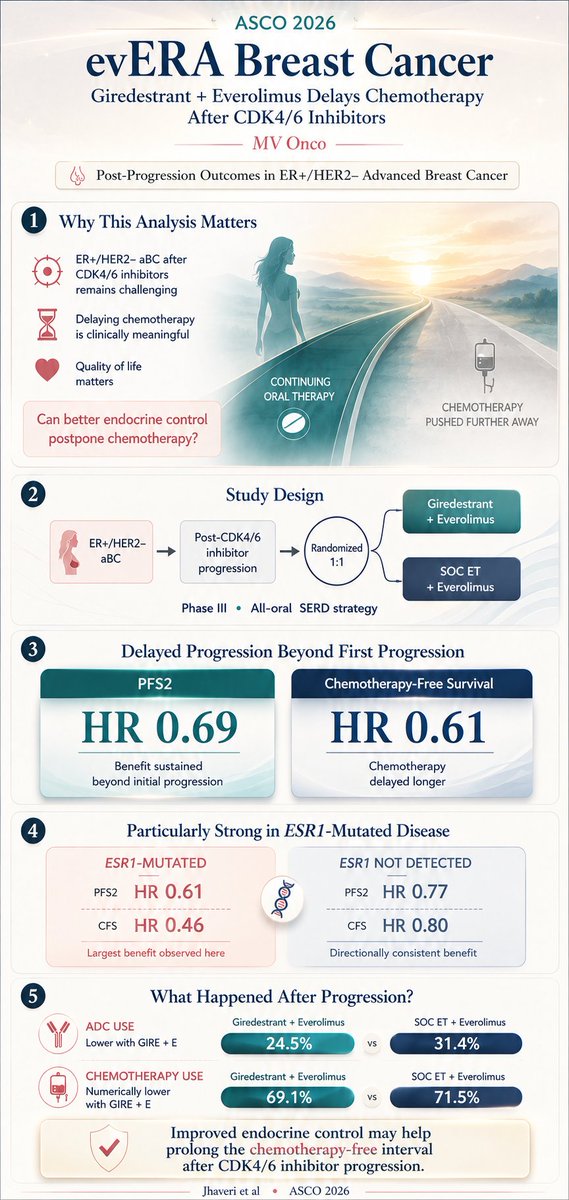
[Slide 1 — evERA post-progression analyses (ASCO 2026 · presented by Komal Jhaveri, MD)] Giredestrant + everolimus vs SoC ET + everolimus, ER+/HER2- aBC after CDK4/6i. PFS2 (time to second progression) longer with giredestrant + everolimus: ITT HR 0.69; ESR1-mutated HR 0.61; ESR1m-not-detected HR 0.77. Chemotherapy-free survival (CFS) longer with giredestrant + everolimus: ITT HR 0.61; ESR1-mutated HR 0.46; ESR1m-not-detected HR 0.80. Exploratory analyses; medians favored giredestrant + everolimus across subgroups. J Clin Oncol 44, 2026 (suppl 16; abstr 1016).
@ErikaHamilton9
evERA Data
2025-10-18
View on X →
@drsarahsam
Dr Sarah Sammons@drsarahsam
evERA Data
2025-10-18
View on X →
[Slide 1 — evERA (Phase III) topline] Giredestrant + everolimus doubled PFS vs SOC ET + everolimus post-CDK4/6 in HR+/HER2- MBC, ESR1-mutated population: 10 months vs 5.4 months. [Slide 2 — subgroups] Benefit greatest in ESR1-mutated tumors. No major benefit in the ESR1-wildtype sub-analysis. [Slide 3 — interpretation] Positive co-primary readout; ESR1-mutation status sharpens the magnitude of giredestrant benefit.
KOL-Made Infographics
Self-authored visual summaries of the evERA readout · click to enlarge
@DrRishabhOnco evERA infographic
View full size
@DrRishabhOnco
@chandrakanthmv evERA infographic
View full size
@chandrakanthmv

Top Tweets — evERA

About the evERA Breast Cancer Trial

evERA Breast Cancer is a randomized, open-label Phase 3 trial from Roche/Genentech evaluating giredestrant (oral SERD) + everolimus vs physician's choice endocrine therapy + everolimus in patients with ER+/HER2-negative locally advanced or metastatic breast cancer that has progressed after a CDK4/6 inhibitor. The study was enriched for ESR1-mutated patients and built ESR1-mutation status into its co-primary analysis. At ESMO 2025 the trial met its co-primary PFS endpoints in both the ITT and ESR1-mutated populations; updated subgroup data followed at SABCS 2025, post-progression (PFS2/OS) analyses at ASCO 2026, and patient-reported outcomes at ESMO Breast 2026. evERA sits within the broader giredestrant program alongside lidERA (early breast cancer), pionERA (CDK4/6-resistant), and persevERA (1L — which did not meet its primary PFS endpoint).

Positive Co-Primary Readout — ESMO 2025

CO-PRIMARY ENDPOINTS MET Giredestrant + Everolimus vs SOC ET + Everolimus

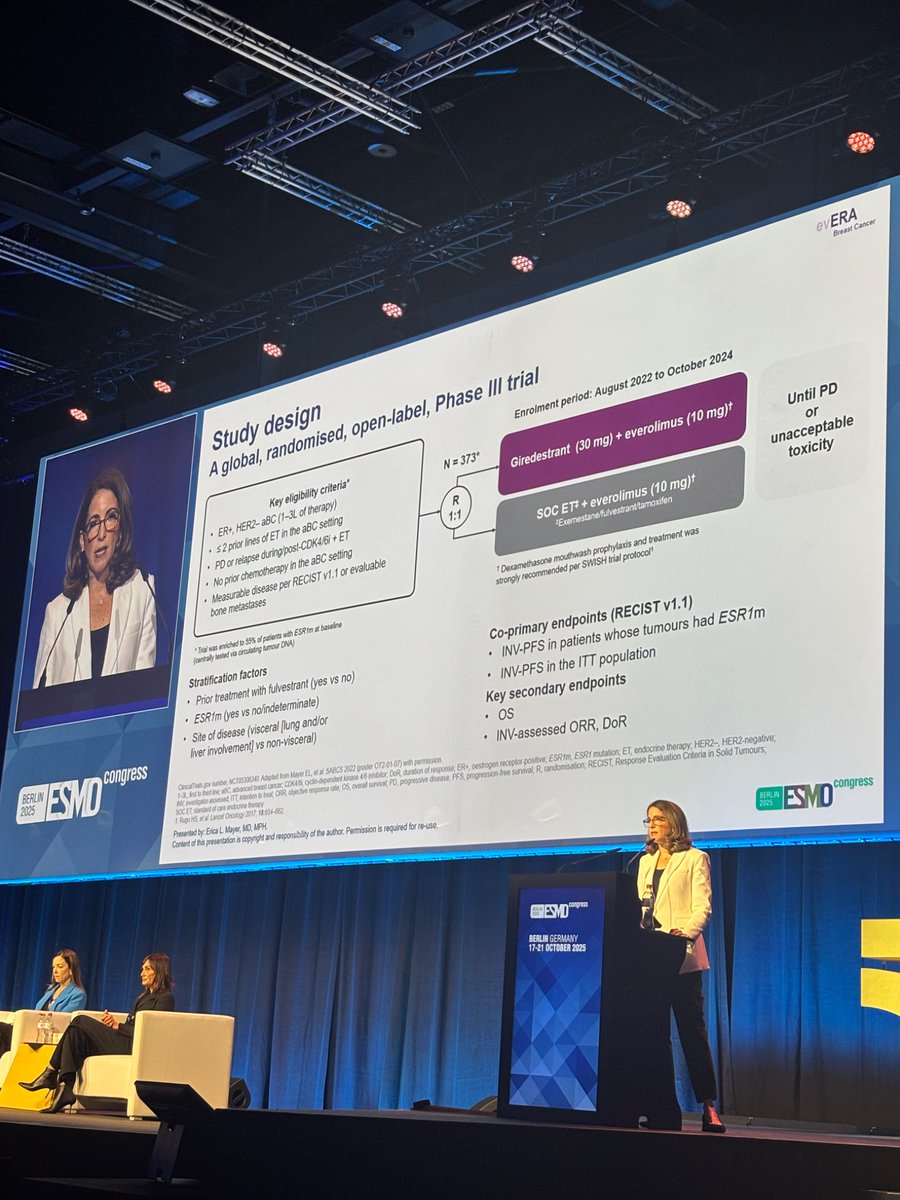
Roche reported that the Phase 3 evERA Breast Cancer study met its co-primary endpoints, demonstrating a statistically significant and clinically meaningful improvement in progression-free survival (PFS) with giredestrant + everolimus vs physician's choice endocrine therapy + everolimus in both the ITT and the ESR1-mutated populations of ER+/HER2-negative advanced breast cancer after a CDK4/6 inhibitor. Data were first presented at ESMO 2025 by Erica L. Mayer, MD, MPH: median PFS 8.77 vs 5.49 months, HR 0.56 (95% CI 0.44–0.71; p<0.0001) in the ITT population and 9.99 vs 5.45 months, HR 0.38 (95% CI 0.27–0.54; p<0.0001) in ESR1-mutated patients.

Safety: Giredestrant + everolimus was well tolerated with no new safety signals and — notably — no photopsia (a class effect seen with some other oral SERDs). The stomatitis profile reflects the everolimus backbone; the ESMO Breast 2026 PRO update emphasized prophylactic dexamethasone mouth rinse as practical mitigation.

Regulatory status: ⚠ Investigational — not yet FDA-approved. On 20 Feb 2026 the FDA accepted the New Drug Application for giredestrant + everolimus in ESR1-mutated, ER-positive, HER2-negative locally advanced or metastatic breast cancer following progression on prior endocrine therapy, with a PDUFA target date of 18 Dec 2026 — potentially the first oral SERD combination in the post-CDK4/6i setting. (Separately, giredestrant's early-stage adjuvant program from lidERA holds its own FDA review; pionERA in CDK4/6-resistant disease is ongoing.)

📄 Source: Roche Press Release (2025-10-18) →   📄 FDA NDA acceptance — Roche (2026-02-20) →

Trial Methodology & Results

Population & Randomization

Adults with ER+/HER2-negative locally advanced or metastatic breast cancer previously treated with a CDK4/6 inhibitor plus endocrine therapy. The trial was enriched for ESR1-mutated patients, with ESR1-mutation status built into the co-primary analysis. Randomized open-label, stratified by ESR1-mutation status, visceral disease, and prior endocrine-therapy duration.

ER+/HER2- ABC · post-CDK4/6i · ESR1-mutation-enriched co-primary design

📄 Source: ClinicalTrials.gov NCT05306340 →

Treatment Arms

Experimental: Giredestrant (oral SERD) + everolimus 10 mg daily.
Control: Physician's choice endocrine therapy + everolimus 10 mg daily.
Patients continued until disease progression or unacceptable toxicity.

All-oral regimen — oral SERD vs physician's-choice ET, both on the same everolimus backbone

Progression-Free Survival (PFS) — Co-Primary Endpoint · MET

The co-primary investigator-assessed PFS endpoints were met in both populations. In the ITT population, median PFS was 8.77 vs 5.49 monthsHR 0.56 (95% CI 0.44–0.71); p<0.0001. In the ESR1-mutated population, median PFS was 9.99 vs 5.45 monthsHR 0.38 (95% CI 0.27–0.54); p<0.0001. The benefit was largest in ESR1-mutated tumors; the ESR1-wildtype subgroup showed a more modest PFS difference (with ORR still improved).

✓ Co-primary PFS MET · ITT 8.77 vs 5.49 mo HR 0.56 (p<0.0001) · ESR1-mut 9.99 vs 5.45 mo HR 0.38 (p<0.0001)

📄 Source: Roche Press Release / ESMO 2025 (Mayer) →

Post-Progression Outcomes — PFS2 & Chemo-Free Survival (ASCO 2026)

Exploratory post-progression analyses presented at ASCO 2026 by Komal L. Jhaveri, MD (MSK / Weill Cornell) showed longer PFS2 (time to second progression) and longer chemotherapy-free survival (CFS) with giredestrant + everolimus vs SoC ET + everolimus, with the greatest benefit in the ESR1-mutated population. PFS2 HR 0.69 (ITT) and 0.61 (ESR1-mut); CFS HR 0.61 (ITT) and 0.46 (ESR1-mut). These data support durability of benefit beyond the first progression.

✓ PFS2 HR 0.69 ITT / 0.61 ESR1-mut · CFS HR 0.61 ITT / 0.46 ESR1-mut · ASCO 2026

📄 Source: ASCO 2026 · J Clin Oncol 44, 2026 (suppl 16; abstr 1016) →
📄 Source: ASCO 2026 (Jhaveri, post-progression analyses) →

Overall Survival (OS) — Secondary Endpoint

OS data remain immature but show a clear positive trend in both populations: ITT HR 0.69 (95% CI 0.47–1.00, p=0.0473) and ESR1-mutated HR 0.62 (95% CI 0.38–1.02, p=0.0566) at the primary analysis. Follow-up for OS continues to the next analysis.

OS immature · positive trend (ITT HR 0.69, 95% CI 0.47–1.00; ESR1-mut HR 0.62, 95% CI 0.38–1.02)

📄 Source: Roche Press Release / ESMO 2025 →

Response & Subgroups

Objective response rate (ORR) was improved with giredestrant + everolimus in both ESR1-mutated and ESR1-wildtype subgroups. SABCS 2025 subgroup analyses (presented by Hope Rugo) showed a consistent PFS benefit across genomic and clinical subgroups — including PI3K-pathway alterations (PIK3CA, AKT1, PTEN), visceral vs non-visceral disease, and prior endocrine-therapy duration — with the magnitude greatest in ESR1-mutated tumors.

✓ ORR improved in ESR1-mut AND ESR1-WT · PFS benefit consistent across PI3K-pathway subgroups

📄 Source: SABCS 2025 subgroup analyses (Rugo) →

Safety, Tolerability & PROs

Giredestrant + everolimus was well tolerated with no new safety signals and no added toxicity beyond the everolimus backbone — adverse events were consistent with the known profiles of the individual medicines. Notably there was no photopsia — a class effect seen with some other oral SERDs. Pneumonitis events were low-grade and reversible, at incidence rates consistent with prior everolimus studies. The dominant tolerability issue is stomatitis from everolimus; the ESMO Breast Cancer 2026 safety/PRO update (Miguel Martin) showed that prophylactic dexamethasone mouth rinse (used by 62.5% of patients) reduced clinically significant stomatitis — grade 2: 14.4% with prophylaxis vs 21.1% without; grade 3: 1.8% vs 4.2%; no grade 4/5 — and delayed onset. AE-related discontinuation was low (5.3% giredestrant vs 8.2% control).

✓ Well tolerated · no photopsia · dexamethasone mouth rinse mitigates everolimus stomatitis

📄 Source: evERA safety/PRO update · ESMO Breast Cancer 2026 (Martin) →

KOL Synthesis — The ESR1-Wildtype Debate

The central interpretive tension is biomarker selection. Erika Hamilton flagged it directly: "No benefit among those patients WITHOUT ESR1m. Although ITT was significant with high % of pts with ESR1m, benefit is NOT in all-comers." Hope Rugo — on the discussant side of the ESMO 2025 presentation by Erica Mayer — described "very nice data from EVERA combining giredestrant/everolimus vs SOC ET/everolimus with marked improvement in PFS and ORR in mESR1 and ITT," adding at SABCS 2025: "Note PFS in non-ESR1m subgroup similar. ORR better." Sarah Sammons summarized the topline: giredestrant + everolimus "doubled PFS vs SOC ET + everolimus … 10 mo vs 5.4 mo in ESR1-mut tumors." Virginia Kaklamani placed evERA next to EMBER-3: "Combo benefit similar to evera trial although here benefit regardless of esr1m. Would love to see the combo approved." Luca Recco noted the SABCS 2025 subgroup picture (consistent benefit, particularly in PI3K-pathway alterations), and Abi Siva flagged the practical PRO detail — dexamethasone mouth rinse for all patients.


📄 Source: @ErikaHamilton9 / @hoperugo / @drsarahsam / @VKaklamani →

Clinical Implications

⚠ evERA positions giredestrant + everolimus as an all-oral post-CDK4/6i option in ER+/HER2- advanced breast cancer, with the largest benefit in ESR1-mutated disease — sharpening the case for ESR1 testing at progression to guide sequencing. The contrast with persevERA (negative in the 1L AI-replacement setting) reinforces that the value of oral SERDs lies after endocrine resistance rather than as a frontline AI substitute. Comparisons against EMBER-3 (imlunestrant), SERENA-6 (camizestrant, ctDNA-guided), INAVO120 (inavolisib), and CAPItello-291 (capivasertib) frame how SERD- and PI3K/AKT-pathway strategies will be sequenced in this space.

evERA in the News

Key KOL Sentiments — evERA

DoctorSentimentComment
Gaia Griguolo
@GaiaGriguolo
● POSITIVESubgroup analysis of evERA trial presented by @hoperugo at #sabcs25 Benefit of giredestrant+everolimus Vs ET+everolimus Is observed regardless of: -PIK3CA/AKT1/PTEN alterations -Duration of prior CDK4/6 @OncoAlert https://t.co/xCx8COIJGh
Yara Abdou, MD, MSCR
@YAbdouMD
● POSITIVEevERA: Giredestrant + everolimus showed favorable interim OS trends, prolonged PFS2, and extended chemotherapy-free survival — particularly in the ESR1m population. Another step toward delaying chemotherapy while improving outcomes. @jhaveri_komal 👏🏼 #ASCO26 #bcsm @OncoAlert https://t.co/Dj2ojjzqMG
Luca Arecco, MD
@Lucarecco
● POSITIVEGS3-09 – #SABCS25 Giredestrant + eve confirm consistent PFS benefit across genomic and clinical subgroups in evERA, particularly: - PI3K-pathway alterations (PIK3CA, AKT1, PTEN) and in pts with multiple co-alterations - Duration of prior CDK4/6i therapy - Type of prior CDK4/6i https://t.co/sXDSsRmq2F
Aya Mohamed | MSc, MD
@Dr_Oncologista
● POSITIVEevERA Phase III: Establishing Giredestrant + Everolimus as a highly tolerable, all oral post-CDK4/6i strategy in ER+/HER2− advanced #BreastCancer — preserving QoL while optimizing endocrine precision through proactive stomatitis management. #ESMOBreast26 @OncoAlert @myESMO #bcsm https://t.co/0ligr8pPM7
Dr Michelle Li
@michelle_li
● POSITIVEHappy to see PROs taking centre stage for two recent practice-changing trials, evERA + TROPION-Breast02 Key points: - Prophylactic steroid MW helped reduce incidence and delay onset of stomatitis with everolimus - Meaningful improvement in QoL with Dato-DXd > ICC #ESMOBreast26
tatsunori_shimoi 下井辰徳
@shimoi_oncology
● NEUTRAL#ASCO26 evERA試験 二次内分泌療法以降での、ギレデストラント+エベロリムスvsFULまたはEXE+エベロリムス PFS2も特にESR1変異ありが引っ張って、よいトレンド OSも良いトレンド https://t.co/UedWRTeMQq
Icro Meattini
@Icro_Meattini
● NEUTRALPost-progression treatment analyses of evERA #BreastCancer - A phase III trial of giredestrant + everolimus in patients with ER+, HER2– aBC previously treated with a CDK4/6 inhibitor Komal L. Jhaveri #ASCO26 @OncoAlert #OncoAlert https://t.co/CDI4NA3kcz
Andres Meraz-Brenez
@iandresmeraz
● NEUTRALevERA BC at #ASCO26, presented by @jhaveri_komal, adds to a key question in ER+/HER2-negative advanced breast cancer: how should ESR1 testing guide sequencing when oral SERD combinations may benefit patients beyond ESR1-mutant disease? 🧬 Giredestrant + everolimus prolonged PFS2 https://t.co/wjeUfP1WLu
Abi Siva MD
@AbiSivaMD
● NEUTRALEVERA PRO’s were presented today at #ESMOBreast26 Dex mouth rinse was recommended to all patients. Somatic rates below: W and WO prophylaxis. https://t.co/66Q57Z3D8m