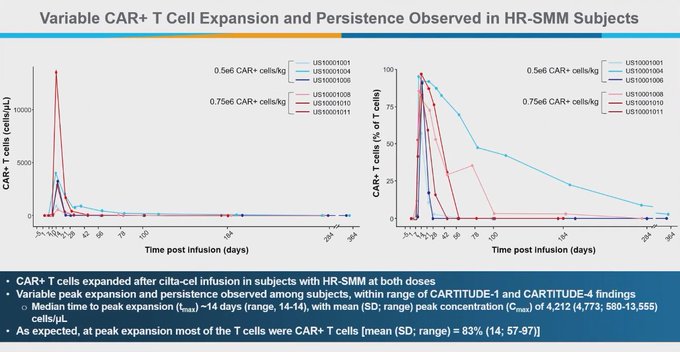
The CAR-PRISM study explored the use of Ciltacabtagene Autoleucel (cilta-cel)—a BCMA-targeting CAR-T therapy—for patients with high-risk smoldering multiple myeloma (HR-SMM), marking a bold shift in CAR-T use toward earlier disease stages. In this early-phase study, six participants were treated, excluding those with >40% plasma cells and without a control group. Results presented at ASH 2024 demonstrated 100% complete response (CR) and MRD negativity at 10⁻⁶, with no dose-limiting toxicities or high-grade cytokine release syndrome (CRS). Despite these impressive efficacy signals, several key opinion leaders, including Dr. Vinay Prasad and Dr. Aaron Goodman, raised ethical concerns about the study’s design—particularly the absence of a control arm and potential risks in treating otherwise asymptomatic patients. While the therapy appears safe and effective in this small cohort, the lack of long-term data and questions about overtreatment in HR-SMM warrant further scrutiny before broader application.
Myeloma Cancer
CAR-PRISM
About the CAR-PRISM Trial
Table of Contents
Major Presentations and Milestones
CAR-PRISM Trial design, results, and conclusions
CAR-PRISM Sentiments and Criticisms
CAR-PRISM Temporal Sentiment Arc
Professional Resources : Interactive Tweet History, Influence Diagram, Sentiment Table, AI Chatbot
CAR-PRISM Trial: Major Presentations and Milestones
Primary speakers driving the story
ASH 2024 abstract release (Nov 2024): Early attention to CAR-PRISM as a CAR-T strategy in high-risk smoldering myeloma.
Source: https://x.com/Abdallah81MD/status/1860570028015280226
ASH 2024 oral presentation cycle (Dec 2024): Broader discussion of eligibility definition, safety signals, and depth of response in a very small cohort.
Source: https://x.com/MM_Hub/status/1866961368001515582
CAR-PRISM Trial Design, Results, and Conclusions
Trial Design (as described in tweet text):
- Study: CAR-PRISM study using ciltacabtagene autoleucel (cilta-cel) in high-risk smoldering multiple myeloma (precursor myeloma).
- Enrollment (as stated by Abdallah): “6 pts were enrolled/Cilta-Cel to treat High risk smoldering myeloma…”
- Eligibility nuance (as stated by Al-Hadidi): “Pts with PC>40% were excluded” and he notes missing baseline disease burden details in the presentation (“No data on M protein levels, FLC or PC% provided”).
Sources:
- https://x.com/Abdallah81MD/status/1860570028015280226
- https://x.com/HadidiSamer/status/1866284015638196596
Key Results (as stated in tweet text):
- Safety (Al-Hadidi): “Safety data presented were limited: 2 G2 CRS (one-third of patients), 1 pt with facial palsy (17%) …”
- Early efficacy/depth (MM_Hub summary): “There were no DLTs observed, no GR≥3 CRS, ≥CR 100%, MRD x10^-6 100%. Longer FU is required to determine durability…”
Source: https://x.com/MM_Hub/status/1866961368001515582
Safety detail and eligibility critique (KOL thread):
Source: https://x.com/HadidiSamer/status/1866284015638196596
Key Conclusions:
- CAR-PRISM is being discussed as demonstrating very deep responses in an extremely small high-risk smoldering cohort treated with cilta-cel, with early safety signals including grade 2 CRS and cranial neuropathy/facial palsy reported in the meeting discussion.
- Multiple commentators emphasize the need for longer follow-up and careful patient selection/definition of “high risk” given the toxicity and cost profile of CAR-T in a precursor condition.
CAR-PRISM Sentiments and Criticisms (Themes)
Theme 1 — Ethical concerns and risk-benefit balance in precursor disease
- Goodman: “You can you be completely healthy, get a lab test checked you never needed, and end up receiving a toxic million dollar therapy with risks of secondary cancers and long term neurologic side effects.”
Source: https://x.com/AaronGoodman33/status/1844470329714106595
Source: https://x.com/AaronGoodman33/status/1844470329714106595
Theme 2 — Trial design criticism (control arm / ethics framing)
- Prasad: “A reminder that this trial ongoing at @DanaFarber is unethical… More than half these pts won't progress in 3 yrs & researchers are giving a product with 3% risk of parkinsons… Worst: no control arm… This is reckless experimentation”
Source: https://x.com/VPrasadMDMPH/status/1860119611431432418
Source: https://x.com/VPrasadMDMPH/status/1860119611431432418
Theme 3 — Risk definition and reporting transparency
- Al-Hadidi: “No data on M protein levels, FLC or PC% provided” and “Safety data presented were limited…” (in the context of defining high-risk SMM and interpreting a 6-patient cohort).
Source: https://x.com/HadidiSamer/status/1866284015638196596
CAR-PRISM Temporal Sentiment Arc
Oct 2024: early public skepticism about overtreatment risk
Nov 2024 (ASH abstract release): awareness + early framing
- https://x.com/Abdallah81MD/status/1860570028015280226
- https://x.com/VPrasadMDMPH/status/1860119611431432418
Dec 2024 (ASH24 oral): early results dissemination and “need longer follow-up” emphasis
- https://x.com/HadidiSamer/status/1866284015638196596
- https://x.com/MM_Hub/status/1866961368001515582
CAR-PRISM Professional Resources
CAR-PRISM at a Glance
Design - Phase II single-arm study (Dana-Farber Cancer Institute) of ciltacabtagene autoleucel, a BCMA-targeting CAR T-cell therapy, in high-risk smoldering multiple myeloma. Six participants were treated in the cohort reported at ASH 2024; patients with >40% plasma cells were excluded and there was no control group.
Response - 100% complete response rate among the six treated patients (ASH 2024).
MRD - All responders achieved MRD negativity at the 10^-6 threshold (ASH 2024).
Safety - No dose-limiting toxicities and no high-grade cytokine release syndrome (CRS) were reported in the six-patient cohort (ASH 2024). Long-term safety data in this asymptomatic precursor population are not yet available.
Regulatory / sponsor - Investigational in smoldering myeloma. Cilta-cel (Carvykti, Janssen/Legend Biotech) is FDA-approved only for relapsed/refractory multiple myeloma (Feb 2022, >=4 prior lines; expanded Apr 2024 to >=1 prior line, lenalidomide-refractory). KOLs including Dr. Vinay Prasad and Dr. Aaron Goodman raised ethical concerns about the uncontrolled design in asymptomatic patients.
Compiled and reviewed by the KOL Pulse research team, led by Brian Shields, Founder, KOL Pulse. Last updated August 19, 2026.
CAR-PRISM Frequently Asked Questions
What is the CAR-PRISM trial?
CAR-PRISM (PRecision Intervention Smoldering Myeloma, NCT05767359) is a Phase II study sponsored by Dana-Farber Cancer Institute testing ciltacabtagene autoleucel (cilta-cel), a BCMA-directed CAR T-cell therapy, in high-risk smoldering multiple myeloma. It marks a shift in CAR-T use toward earlier, precursor stages of myeloma, before symptomatic disease develops.
What did CAR-PRISM show at ASH 2024?
In the cohort presented at ASH 2024, all six treated patients with high-risk smoldering myeloma achieved a complete response with MRD negativity at 10^-6. No dose-limiting toxicities and no high-grade cytokine release syndrome were reported. Patients with more than 40% plasma cells were excluded, and the study has no control arm.
Is cilta-cel (Carvykti) FDA approved for smoldering myeloma?
No. Cilta-cel's use in smoldering multiple myeloma is investigational. Carvykti is FDA-approved for relapsed or refractory multiple myeloma - first in February 2022 for patients after four or more prior lines of therapy (CARTITUDE-1), then expanded in April 2024 to patients after at least one prior line who are lenalidomide-refractory (CARTITUDE-4). It is not approved for any precursor condition such as high-risk smoldering myeloma.
What is the safety profile of cilta-cel in CAR-PRISM?
In the six-patient cohort reported at ASH 2024, there were no dose-limiting toxicities and no high-grade cytokine release syndrome. However, the cohort is very small, follow-up is short, and long-term safety in otherwise asymptomatic smoldering myeloma patients has not been established.
Why is the CAR-PRISM trial controversial?
Despite the 100% complete response rate, prominent KOLs including Dr. Vinay Prasad and Dr. Aaron Goodman raised ethical concerns about the study's design - particularly the absence of a control arm and the risks of giving CAR-T therapy to asymptomatic patients who may never have progressed. The debate centers on possible overtreatment in high-risk smoldering myeloma before long-term data mature.