PREVIEW #ESMO26 — pre-conference KOL intelligence for the ESMO Congress 2026 in Madrid, Oct 23–27 See the Preview →
Multiple Myeloma · FDA Approved (Mar 5, 2026) · ASH 2025 / NEJM

MajesTEC-3 Trial

MajesTEC-3 is a randomized phase 3 trial of teclistamab + daratumumab SC (Tec-Dara) versus daratumumab-based standard care (DPd/DVd) in relapsed/refractory myeloma. KOLs called it "unprecedented": median PFS was not reached vs 18.1 months (HR 0.17), and 36-month overall survival was 83% vs 65% (HR 0.46). The FDA approved Tec-Dara (Tecvayli + Darzalex Faspro, Johnson & Johnson) on March 5, 2026 for relapsed/refractory myeloma after at least one prior line.

Phase 3 · NCT05083169Teclistamab + DaratumumabRelapsed/Refractory MMPFS HR 0.17 · OS HR 0.46FDA Approved · Mar 5 2026
Discover KOL Sentiment on MajesTEC-3 →

FDA APPROVEDTec-Dara approved March 5, 2026

On March 5, 2026 the FDA approved teclistamab (Tecvayli) in combination with daratumumab and hyaluronidase-fihj (Darzalex Faspro) for adults with relapsed or refractory multiple myeloma who have received at least one prior line of therapy, including a proteasome inhibitor and an immunomodulatory agent — based on the MajesTEC-3 trial.

Source: FDA approval notice (March 5, 2026)

MajesTEC-3 — the TL;DR

Design: Randomized phase 3, Tec-Dara (SC teclistamab + SC daratumumab) vs DPd/DVd, relapsed/refractory MM after 1–3 prior lines (ASH 2025 LBA-6; NEJM).
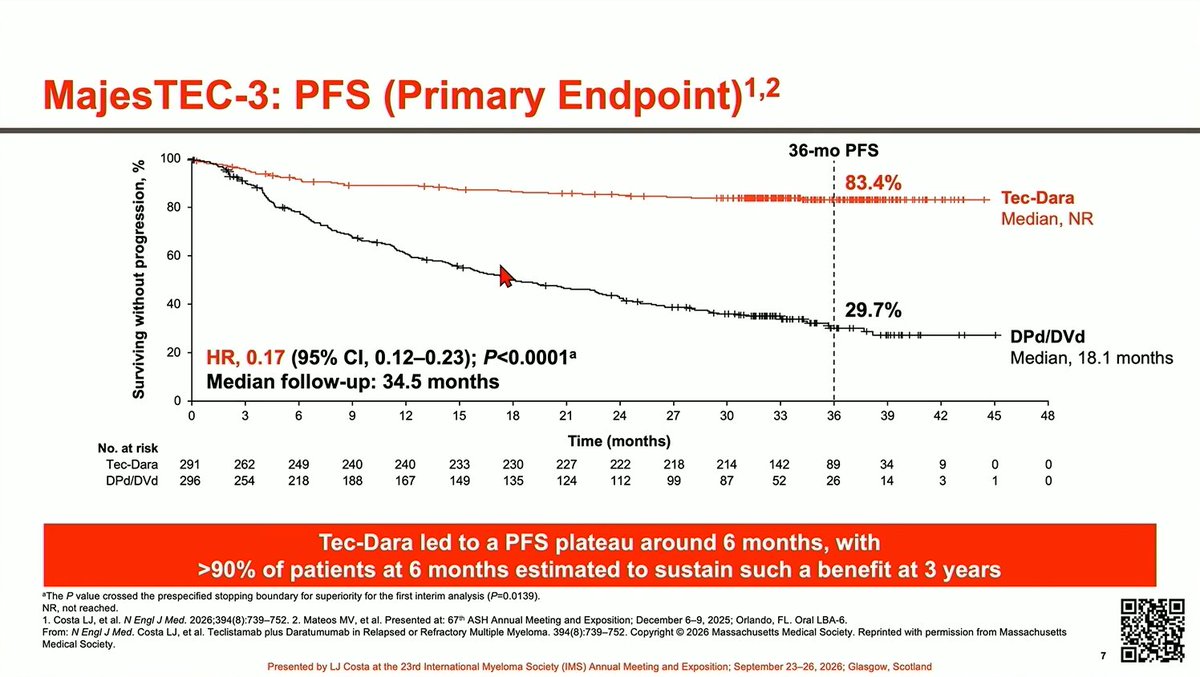
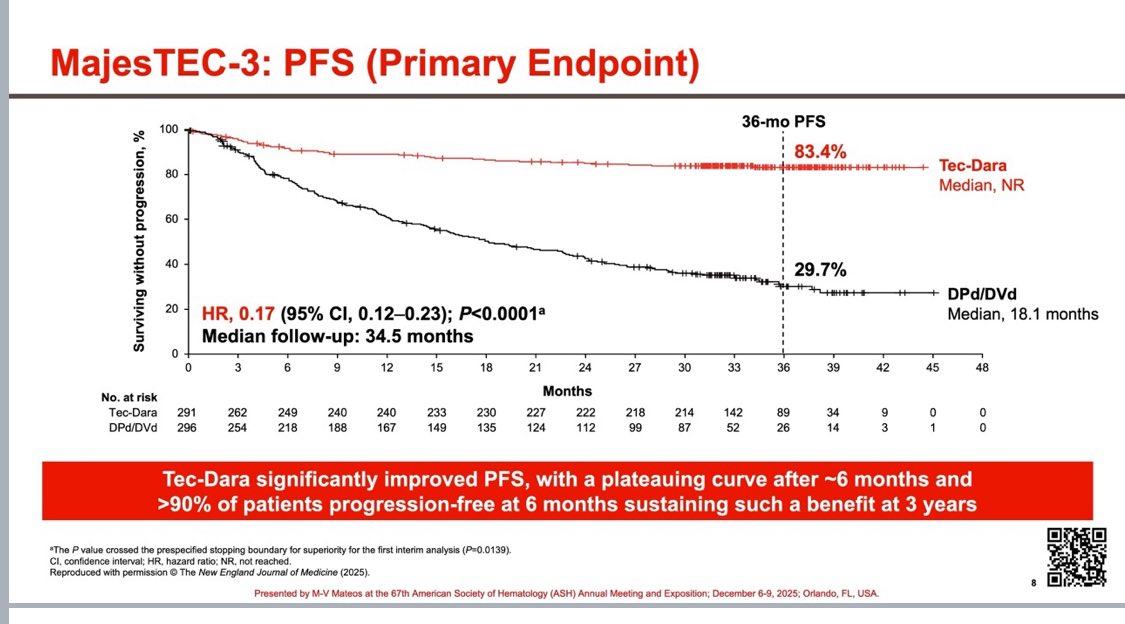
PFS: Median not reached vs 18.1 mo — HR 0.17 (95% CI 0.12–0.23, P<0.0001). KOLs: "unprecedented."
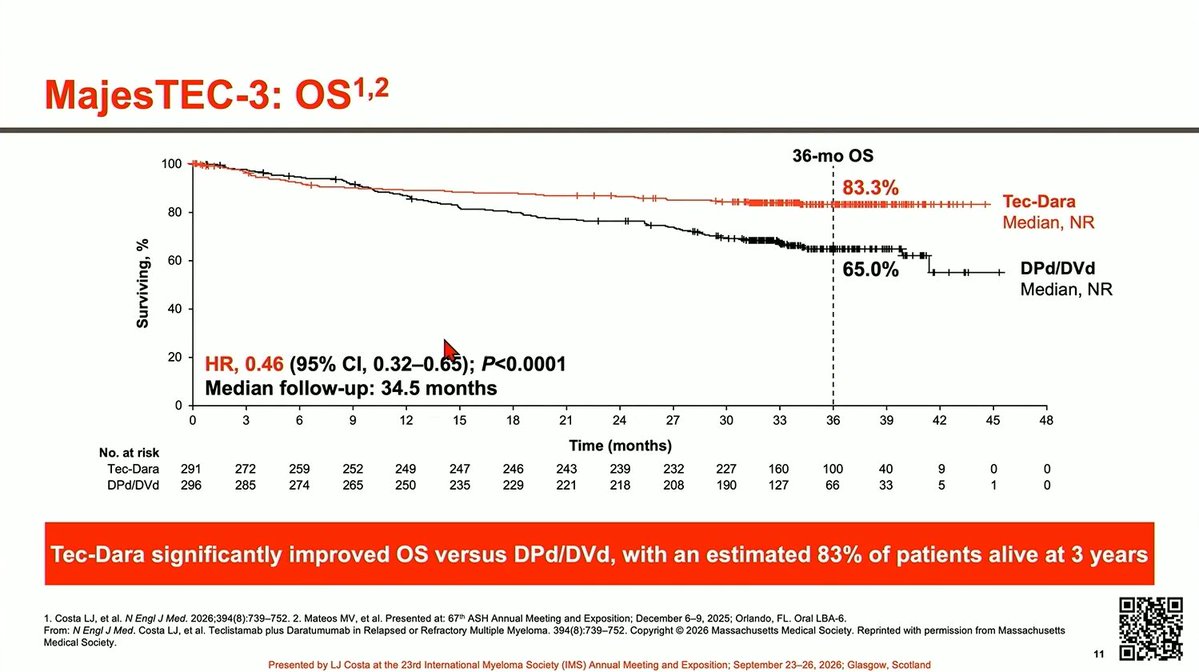
OS: 36-month 83.3% vs 65.0% — HR 0.46 (95% CI 0.32–0.65, P<0.0001).
By risk (36-mo PFS): ~87% (std) / ~78% (high) with Tec-Dara vs ~37% / ~12% (ASH 2025 slide); benefit consistent across HRCA subgroups (HR 0.15–0.22).
Safety: infection risk is the key issue — routine monthly IVIG and infection prevention emphasized.
Regulatory: FDA approved March 5, 2026 for relapsed/refractory myeloma after ≥1 prior line (incl. a proteasome inhibitor and an immunomodulatory agent) — Tecvayli + Darzalex Faspro (Johnson & Johnson).
Sponsor / drugs: Johnson & Johnson — teclistamab (Tecvayli) + daratumumab (Darzalex Faspro).

Source: ClinicalTrials.gov NCT05083169 · ASH 2025 LBA-6 · NEJM (Dec 9 2025)

New at IMS 2026: Competing-Risk and Cure-Model Analyses

Two oral presentations at the 23rd International Myeloma Society Annual Meeting (Glasgow, September 23–26, 2026) re-analysed the MajesTEC-3 dataset: OA-49, a competing-risk analysis presented by Luciano J. Costa (@End_myeloma), and OA-58, a mixture cure model presented by Niels W.C.J. van de Donk. Neither reports new trial follow-up — both re-examine the existing 34.5-month data cut.

How to read this section

The Tec-Dara regimen itself is FDA approved (March 5, 2026) — see the FDA section above. The IMS 2026 analyses below are exploratory, post-hoc and model-based analyses of the same ~34.5-month data cut already reported at ASH 2025 and in the NEJM. They were not pre-specified endpoints, they carry no regulatory status, and they do not extend or alter the approved indication.

In particular, “statistical cure fraction” and “functional cure” are statistical modelling constructs — a model’s estimate of the proportion of patients whose long-term mortality would match a matched general population — not an observed clinical outcome, and not a claim that any individual patient has been cured. The projected median survival figures are extrapolations far beyond the observed follow-up and will change as the trial matures.

OA-49 · Competing-risk analysis — what is actually driving the survival benefit (L.J. Costa et al.)

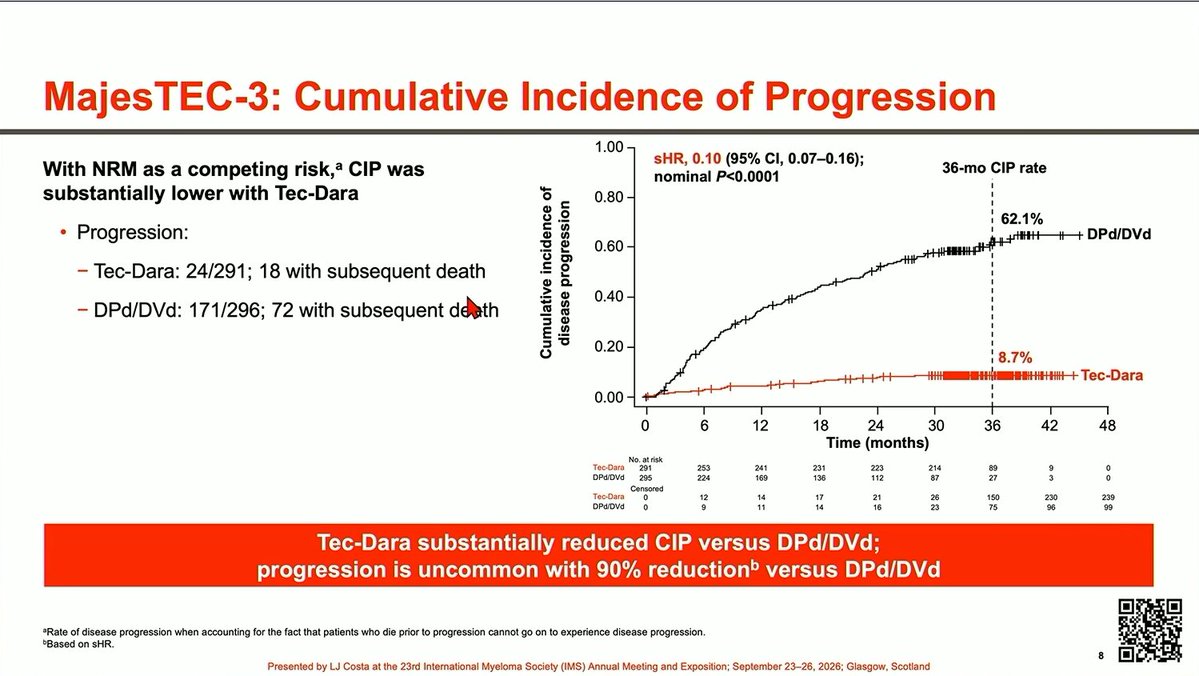
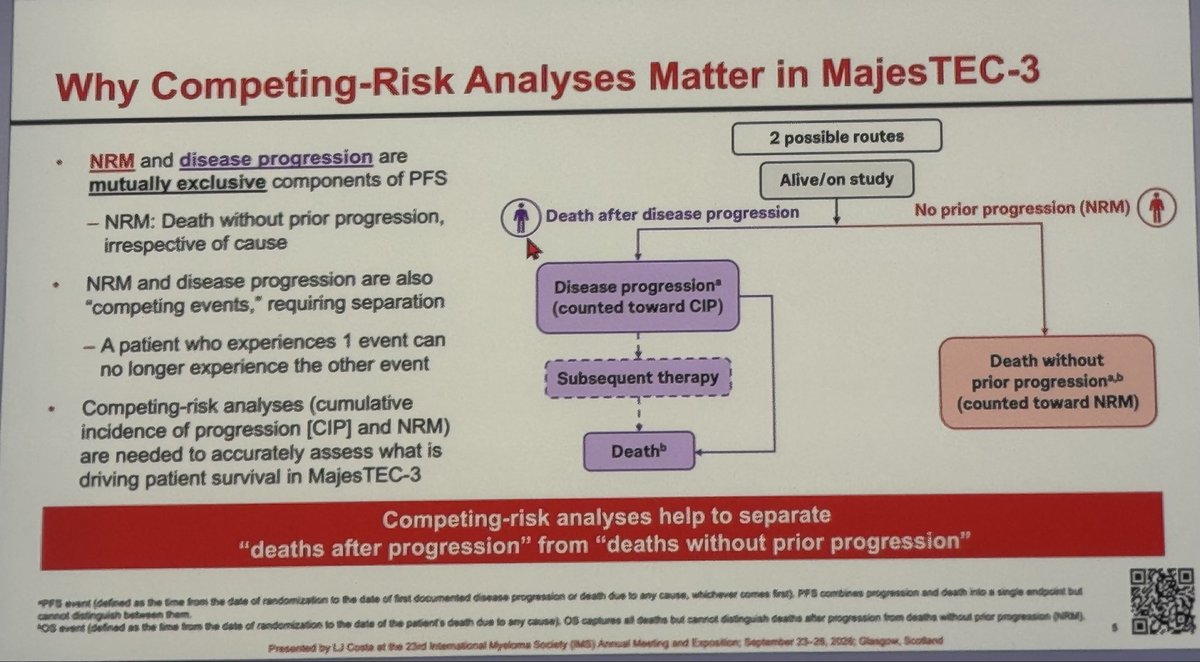
Progression-free survival bundles two mutually exclusive events — disease progression and non-relapse mortality (NRM, death without prior progression) — so it cannot show which of them is driving outcomes. This analysis separated them using cumulative incidence of progression (CIP) and NRM as competing risks, plus a time-stratified Cox model of overall survival.

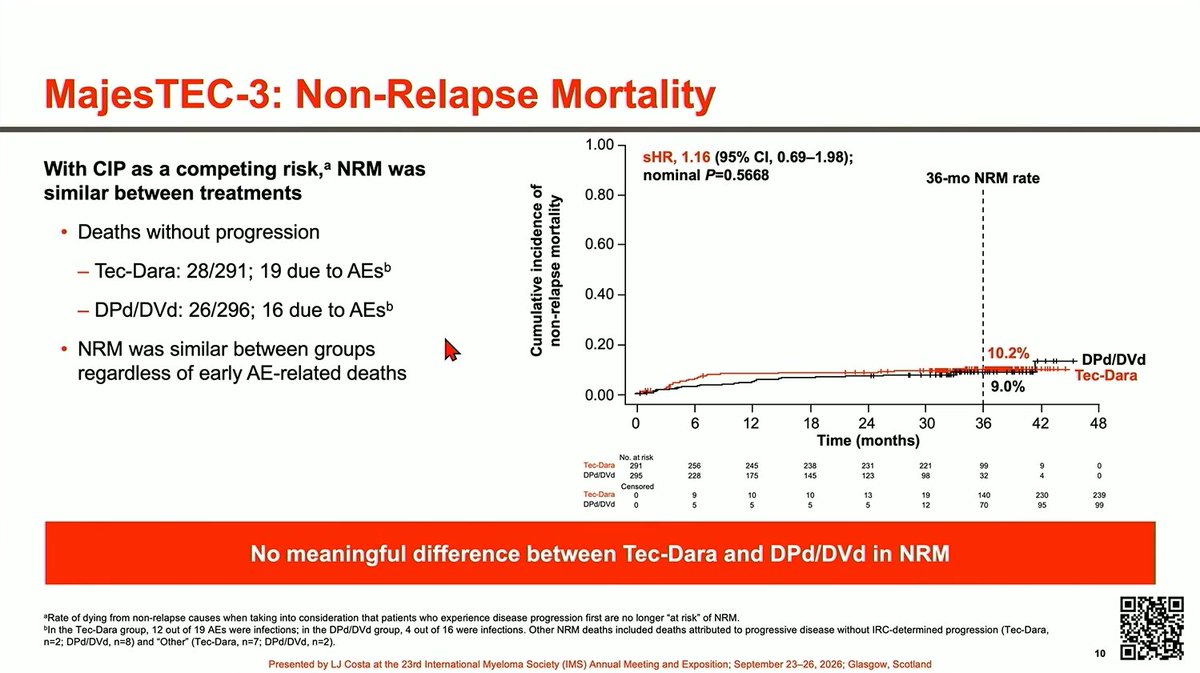
Tec-Dara produced a 90% reduction in the cumulative incidence of disease progression (sHR 0.10; 95% CI 0.07–0.16; P<0.0001), with progressions becoming uncommon after roughly 6 months. NRM was not meaningfully different between the arms (36-month NRM 10.2% vs 9.0%; sHR 1.16; 95% CI 0.69–1.98; P=0.5668). Deaths in the first 10 months were comparable (29 vs 29), after which the survival curves separated sharply. (IMS 2026 OA-49 slides; J&J press release, Sept 23 2026; 34.5-month median follow-up — same data cut as ASH 2025 LBA-6 / NEJM.)

OS benefit driven by suppression of progression, not by lower NRMSource: Johnson & Johnson press release, September 23, 2026 (IMS 2026 abstracts OA-49 / OA-58) · presentation slides posted by @AuclairDan and @hhashmi87

Time-stratified Cox analysis of overall survival (OA-49)

PeriodOS hazard ratio, Tec-Dara vs DPd/DVd (95% CI)Reading
Overall (intent-to-treat)0.46 (0.32–0.65), P<0.000154% lower risk of death overall
First 10 months1.08 (0.64–1.81)No difference; 29 deaths in each arm
After 10 months0.22 (0.13–0.38)78% lower risk of death

Causes of death within the first 10 months (curve cross), per the OA-49 slide: Tec-Dara — adverse events n=18, progressive disease n=5, “other” n=6; DPd/DVd — adverse events n=8, progressive disease n=20, “other” n=1. Rendered as a table rather than as raw curve OCR (RULE 23); the source slide image is shown below.

Competing-risk endpoints at 36 months (OA-49)

EndpointTec-DaraDPd/DVdsHR (95% CI)
Cumulative incidence of disease progression90% relative reduction with Tec-Dara0.10 (0.07–0.16), P<0.0001
Non-relapse mortality, 36 mo10.2%9.0%1.16 (0.69–1.98), P=0.5668
Non-relapse mortality events, n2826—
  — adverse-event related1916—
  — infections and infestations12 (11 within 6 mo)4 (2 within 6 mo)—

OA-58 · Mixture cure model — projecting a “functional cure” fraction (N.W.C.J. van de Donk et al.)

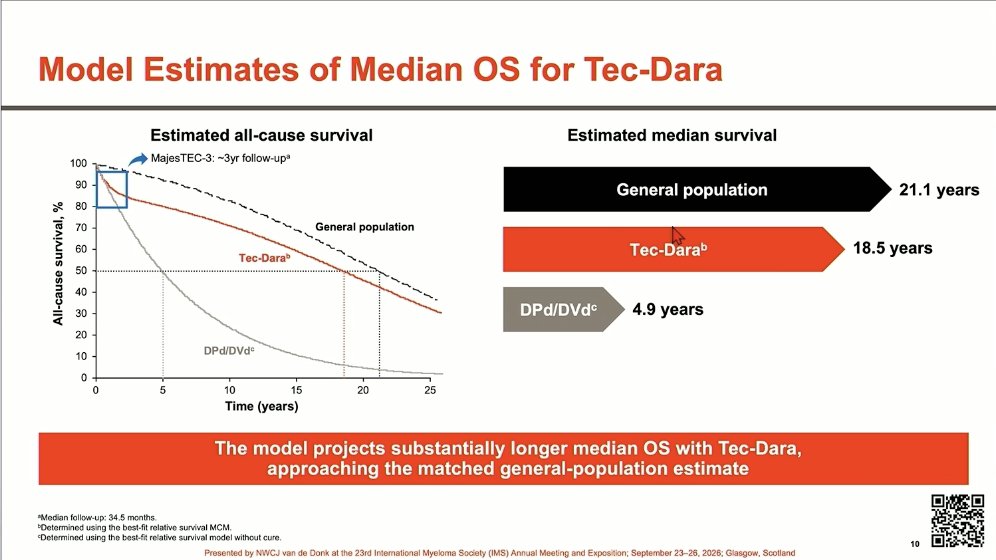
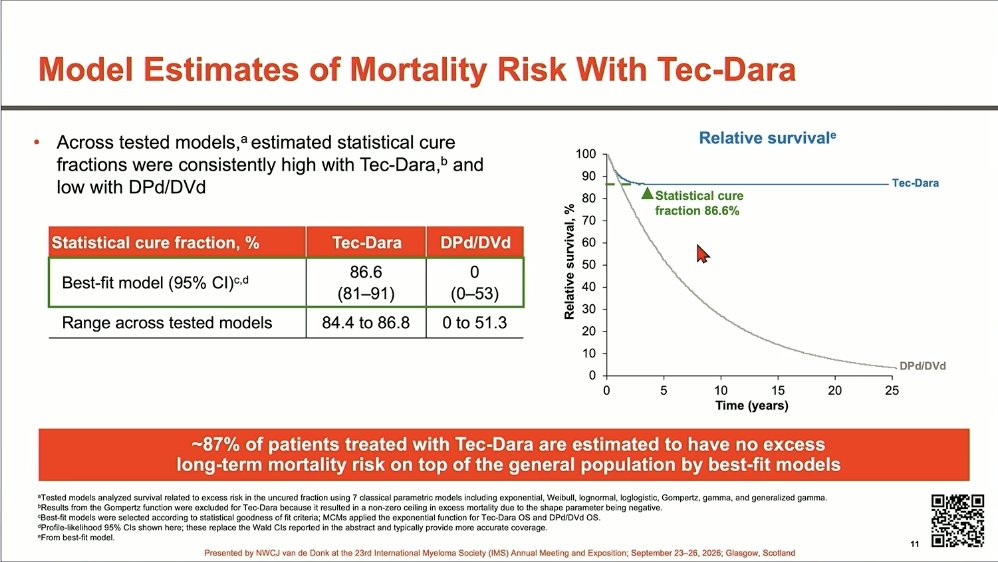
A mixture cure model was fitted to the MajesTEC-3 survival data to estimate a statistical cure fraction — the modelled proportion of patients with no excess long-term mortality relative to a matched general population. Under the best-fit model the estimate was 86.6% (95% CI 81–91) for Tec-Dara versus 0% (95% CI 0–53) for DPd/DVd; across the seven parametric models tested the range was 84.4–86.8% versus 0–51.3%. The model projects a median overall survival of 18.5 years with Tec-Dara versus 4.9 years with DPd/DVd, against a matched general-population estimate of 21.1 years. (IMS 2026 OA-58 slides; J&J press release, Sept 23 2026; modelled from the 34.5-month data cut.)

This is a projection, not an observed result: median survival of 18.5 years is extrapolated from under three years of follow-up, the wide confidence interval on the comparator arm (0–53%) reflects real uncertainty, and no patient in MajesTEC-3 has been followed anywhere near long enough to confirm cure.

Modelled statistical cure fraction 86.6% (95% CI 81–91) — exploratorySource: Johnson & Johnson press release, September 23, 2026 · presentation slides posted by @HadidiSamer and @RahulBanerjeeMD · reported by @Myeloma_Society

Mixture cure model estimates (OA-58) — modelled, not observed

Model outputTec-DaraDPd/DVd
Statistical cure fraction, best-fit model (95% CI)86.6% (81–91)0% (0–53)
Statistical cure fraction, range across 7 tested models84.4–86.8%0–51.3%
Projected median overall survival18.5 years4.9 years
Matched general-population reference21.1 years

IMS 2026 presentation slides

Slide photographs posted publicly by attending KOLs. Both decks carry the presenter attribution footer “23rd International Myeloma Society (IMS) Annual Meeting and Exposition; September 23–26, 2026; Glasgow, Scotland”.

Multiple Myeloma Hub@MM_Hub · Sep 25
MajesTEC-3 OA post hoc survival analysis (L.J. Costa) · #IMS26 — official presentation slides
View tweet
[Slide 1 - MajesTEC-3: PFS (Primary Endpoint)] 36-mo PFS: Tec-Dara 83.4% (median NR) vs DPd/DVd 29.7% (median 18.1 months) HR 0.17 (95% CI 0.12–0.23); P<0.0001. Median follow-up: 34.5 months Tec-Dara led to a PFS plateau around 6 months, with >90% of patients at 6 months estimated to sustain such a benefit at 3 years Costa LJ, et al. N Engl J Med. 2026;394(8):739–752. Presented by LJ Costa at the 23rd International Myeloma Society (IMS) Annual Meeting; September 23–26, 2026; Glasgow, Scotland --- [Slide 2 - MajesTEC-3: Cumulative Incidence of Progression] With NRM as a competing risk, CIP was substantially lower with Tec-Dara. Progression: Tec-Dara 24/291 (18 with subsequent death) vs DPd/DVd 171/296 (72 with subsequent death) 36-mo CIP rate: Tec-Dara 8.7% vs DPd/DVd 62.1%. sHR 0.10 (95% CI 0.07–0.16); nominal P<0.0001 Tec-Dara substantially reduced CIP versus DPd/DVd; progression is uncommon with 90% reduction versus DPd/DVd --- [Slide 3 - MajesTEC-3: Non-Relapse Mortality] With CIP as a competing risk, NRM was similar between treatments. Deaths without progression: Tec-Dara 28/291 (19 due to AEs) vs DPd/DVd 26/296 (16 due to AEs) 36-mo NRM rate: Tec-Dara 9.0% vs DPd/DVd 10.2%. sHR 1.16 (95% CI 0.69–1.98); nominal P=0.5668 No meaningful difference between Tec-Dara and DPd/DVd in NRM --- [Slide 4 - MajesTEC-3: OS] 36-mo OS: Tec-Dara 83.3% (median NR) vs DPd/DVd 65.0% (median NR) HR 0.46 (95% CI 0.32–0.65); P<0.0001. Median follow-up: 34.5 months Tec-Dara significantly improved OS versus DPd/DVd, with an estimated 83% of patients alive at 3 years Costa LJ, et al. N Engl J Med. 2026;394(8):739–752. Presented by LJ Costa at the 23rd International Myeloma Society (IMS) Annual Meeting; September 23–26, 2026; Glasgow, Scotland
Multiple Myeloma Hub@MM_Hub · Sep 25
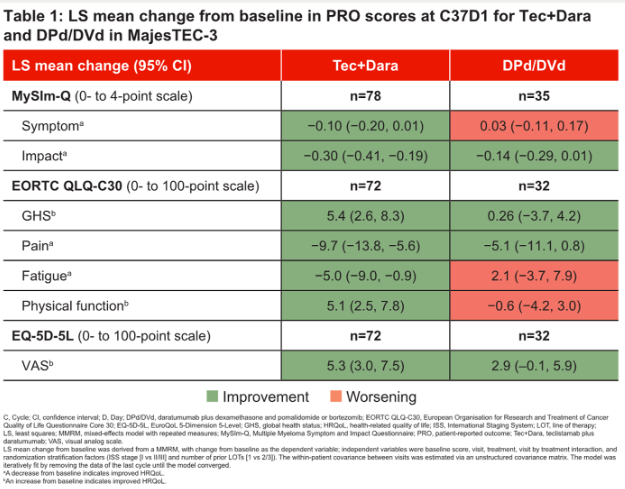
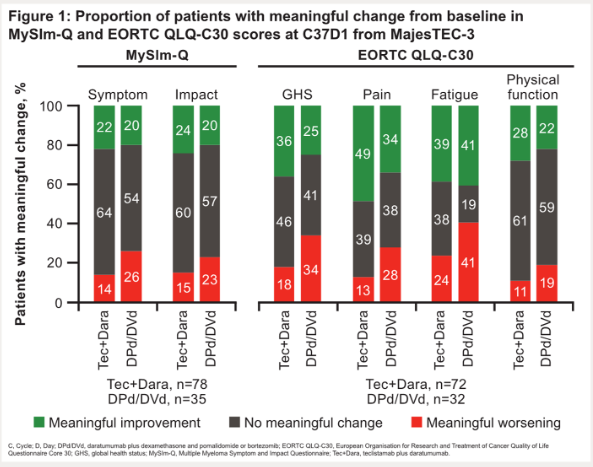
MajesTEC-3 expanded PRO poster (K. Weisel) · #IMS26 — official poster slides
View tweet
[Slide 1 - MajesTEC-3: Table 1 — LS Mean Change From Baseline in PRO Scores at C37D1] Tec+Dara (n=78) vs DPd/DVd (n=35): MySIm-Q Symptom −0.10 (−0.20, 0.01) vs 0.03 (−0.11, 0.17); Impact −0.30 (−0.41, −0.19) vs −0.14 (−0.29, 0.01) EORTC QLQ-C30 (n=72 vs n=32): GHS 5.4 (2.6, 8.3) vs 0.26 (−3.7, 4.2); Pain −9.7 (−13.8, −5.6) vs −5.1 (−11.1, 0.8); Fatigue −5.0 (−9.0, −0.9) vs 2.1 (−3.7, 7.9); Physical function 5.1 (2.5, 7.8) vs −0.6 (−4.2, 3.0) EQ-5D-5L VAS: 5.3 (3.0, 7.5) vs 2.9 (−0.1, 5.9) --- [Slide 2 - MajesTEC-3: Figure 1 — Proportion of Patients With Meaningful Change From Baseline at C37D1] MySIm-Q and EORTC QLQ-C30, Tec+Dara (n=78) vs DPd/DVd (n=35), % meaningful improvement/no change/worsening: Symptom: 22/64/14 vs 20/54/26. Impact: 24/60/15 vs 20/57/23 GHS: 36/46/18 vs 25/41/34. Pain: 49/39/13 vs 34/28/28. Fatigue: 39/38/24 vs 41/19/41. Physical function: 28/61/11 vs 22/59/19
Daniel Auclair@AuclairDan · 2026-09-24
MajesTEC-3 OA-49 (L.J. Costa) · #IMS26
View tweet
[Slide 1 - OA-49, slide 5] Why Competing-Risk Analyses Matter in MajesTEC-3 - NRM and disease progression are mutually exclusive components of PFS - NRM: Death without prior progression, irrespective of cause - NRM and disease progression are also "competing events," requiring separation - A patient who experiences 1 event can no longer experience the other event - Competing-risk analyses (cumulative incidence of progression [CIP] and NRM) are needed to accurately assess what is driving patient survival in MajesTEC-3 Flow: Alive/on study -> 2 possible routes: Disease progression (counted toward CIP) -> Subsequent therapy -> Death | OR Death without prior progression (counted toward NRM) Banner: Competing-risk analyses help to separate "deaths after progression" from "deaths without prior progression" --- [Slide 2 - OA-49, slide 9] MajesTEC-3: Causes of Non-Relapse Mortality NRM was primarily due to AEs in both treatment groups - AEs were primarily infections and infestations, occurring most commonly within 6 months of treatment initiation - Tec-Dara: 12; 11 <=6 months - DPd/DVd: 4; 2 <=6 months - Infection prophylaxis was recommended per protocol, with IgRT and antimicrobial use reinforced as experience and guidelines evolved - Supportive RWE and IMWG guidelines recommend IgRT prophylaxis for the reduction of high-grade infections with BCMA-targeting BsAbs [Table: NRM, n | Tec-Dara (n=28) | DPd/DVd (n=26)] AE-related | 19 | 16 Infections and infestations | 12 | 4 General disorders and administration-site conditions | 2 | 4 Respiratory, thoracic, and mediastinal disorders | 2 | 3 Nervous system disorders | 1 | 2 Hepatobiliary disorders | 1 | 1 Cardiac disorders | 1 | 0 Immune system disorders | 1 | 0 Neoplasms benign, malignant, and unspecified (including cysts and polyps) | 0 | 1 Gastrointestinal disorders | 0 | 1 PD without IRC-determined progression | 2 | 8 Other | 7 | 2 Banner: Infection-related NRM may be reduced through diligent use of established IgRT and antimicrobial prophylaxis protocols --- [Slide 3 - OA-49, slide 13] MajesTEC-3: Time-Stratified Cox Analysis of OS >10 months: HR, 0.22 (95% CI, 0.13-0.38) <=10 months: HR, 1.08 (95% CI, 0.64-1.81) Overall: HR, 0.46 (95% CI, 0.32-0.65); P<0.0001 Deaths within first 10 months were comparable: 29 Tec-Dara vs 29 DPd/DVd Cause of death within first 10 months (curve cross): - Tec-Dara: AEs (n=18), PD (n=5), "Other" (n=6) - DPd/DVd: AEs (n=8), PD (n=20), "Other" (n=1) Footnote: Of 18 AE deaths, 12 were infections. Banner: Tec-Dara substantially reduced the risk of death by 78% versus DPd/DVd after 10 months [Kaplan-Meier curve axis tick labels not transcribed - see the numbers table above (RULE 23)] --- [Slide 4 - OA-49, slide 14] Conclusions - Tec-Dara significantly improved PFS (HR, 0.17) and OS (HR, 0.46) over DPd/DVd in patients with RRMM and 1-3 prior LOTs, with a sustained plateau in survival curves - With Tec-Dara, progressions became uncommon after 6 months, with an unparalleled reduction in disease progression (sHR, 0.10), which is the leading cause of mortality in RRMM - There was no meaningful difference in NRM between treatments over time; infection-related NRM occurred with both treatments - Infections can be better managed now with guideline-based IgRT and antimicrobial prophylaxis - OS benefit with Tec-Dara versus DPd/DVd was driven by durable disease control without an increase in NRM - Superior OS with Tec-Dara was supported by RMST and time-stratified Cox analysis (>10 months) Banner: Tec-Dara's OS benefit is driven by profound suppression of disease progression, while NRM remains comparable over time References: 1. Costa LJ, et al. N Engl J Med. 2026;394(8):739-752. 2. Mateos MV, et al. Presented at: 67th ASH Annual Meeting and Exposition; December 6-9, 2025; Orlando, FL. Oral LBA-6. 3. Tan CR, et al. Blood Adv. 4. Rodriguez-Otero P, et al. Lancet Oncol. 2024;25(5):e205-e216.
Samer Al Hadidi, MD,MS,FACP@HadidiSamer · 2026-09-23
MajesTEC-3 OA-58 (N.W.C.J. van de Donk) · #IMS26
View tweet
[Slide 1 - OA-58, slide 10] Model Estimates of Median OS for Tec-Dara Estimated all-cause survival (MajesTEC-3: ~3yr follow-up) - curves for General population, Tec-Dara, DPd/DVd [Estimated median survival] General population | 21.1 years Tec-Dara | 18.5 years DPd/DVd | 4.9 years Banner: The model projects substantially longer median OS with Tec-Dara, approaching the matched general-population estimate Footnotes: Median follow-up: 34.5 months. Determined using the best-fit relative survival MCM. Determined using the best-fit survival model without cure. --- [Slide 2 - OA-58, slide 11] Model Estimates of Mortality Risk With Tec-Dara - Across tested models, estimated statistical cure fractions were consistently high with Tec-Dara, and low with DPd/DVd [Table: Statistical cure fraction, % | Tec-Dara | DPd/DVd] Best-fit model (95% CI) | 86.6 (81-91) | 0 (0-53) Range across tested models | 84.4 to 86.8 | 0 to 51.3 Relative survival chart: Statistical cure fraction 86.6% (Tec-Dara plateau); DPd/DVd curve declines toward 0 Banner: ~87% of patients treated with Tec-Dara are estimated to have no excess long-term mortality risk on top of the general population by best-fit models Footnotes: Tested models analyzed survival related to excess risk in the uncured fraction using 7 classical parametric models including exponential, Weibull, lognormal, loglogistic, Gompertz, gamma, and generalized gamma. Results from the Gompertz function were excluded for Tec-Dara because it resulted in a non-zero ceiling in excess mortality due to the shape parameter being negative. Best-fit models were selected according to statistical goodness of fit criteria; MCMs applied the exponential function for Tec-Dara OS and DPd/DVd OS. Profile-likelihood 95% CIs shown here; these replace the Wald CIs reported in the abstract and typically provide more accurate coverage.

IMS 2026 coverage on X

All 11 posts captured for MajesTEC-3 from IMS 2026, verbatim. @Myeloma_Society is the conference society account; all other posts are from attending clinicians and researchers.

Meral Beksac@mbeksac56
#IMS2026 How to approach first relapse by @DrRakeshPopat https://t.co/3uXrSIgjY7
422 impressions9 likes2026-09-23
Saurabh Zanwar@ZanwarSaurabh
Never a good time to be a myeloma patient but this is the best it has ever been! Remarkable results in early relapse setting! @mvmateos #IMS26 https://t.co/rNUviKkXc5
359 impressions8 likes2026-09-23
Rahul Banerjee, MD, FACP@RahulBanerjeeMD
#IMS26 Worth highlighting since pts with MM often aged 70+. We don't need OS plateau if myeloma remains in remission & no excess long-term mortality versus general population. Excellent 'functional cure' MajesTEC-3 data for tec-dara - I hope time-limited BsAb can replicate!
320 impressions9 likes2026-09-24
Rahul Banerjee, MD, FACP@RahulBanerjeeMD
#IMS26 Elegant (post hoc) MajesTEC-3 analysis by @End_myeloma Unlike other myeloma drugs, I bet real-world tec-dara OS will look *better* than MajesTEC-3 did. Why? Because we now know PPx toci, PPx IVIG, etc - early BsAb deaths can be prevented, vs fatal PD with Dara-Pd can't.
281 impressions4 likes2026-09-24
Samer Al Hadidi, MD,MS,FACP@HadidiSamer
#IMS26 #mmsm Oral- % of functional cure with the use of Tec-Dara @Myeloma_Society Estimated functional cure of 87% with Tec-Dara showing excellent promise of such therapy. ➡️Future will need time limited therapy (Stop and see what will happen) ➡️Assess cumulative toxicity with longer use of this therapy (infections most imp)- Non relapse mortality will be imp Future is bright in myeloma
204 impressions2 likes2026-09-23
Myeloma Society@Myeloma_Society
Niels van de Donk, MD, PhD, spoke abt a mixed cure model to estimate statistical cure fraction - % of pts w/o excess mortality & long-term disease control. In MajesTEC-3, statistical cure fraction w/ Tec-Dara was 86.6% vs 0% w/ DVd or DPd. #IMS26 https://t.co/83OcpeAl2d
199 impressions1 likes2026-09-23
Samer Al Hadidi, MD,MS,FACP@HadidiSamer
#IMS26 #mmsm Oral MajesTEC-3 post hoc analysis @End_myeloma ➡️ In Tec-Dara, progressions became uncommon after 6 months, with an reduction in disease progression (sHR, 0.10), which is the leading cause of mortality in RRMM https://t.co/jctyzj62b3
109 impressions0 likes2026-09-24
Samer Al Hadidi, MD,MS,FACP@HadidiSamer
#IMS26 #mmsm Oral MajesTEC-3 post hoc analysis @End_myeloma ➡️Tec-Dara reduced the risk of death by 78% versus DPd/DVd after 10 months with similar early deaths Better AEs management will help further mitigate higher risk of infection early on Moving forward this should change to time limited therapy given excellent results and depth of response
69 impressions0 likes2026-09-24
Daniel Auclair@AuclairDan
Very interesting Competing-Risk analysis of MajesTEC-3 presented by @End_myeloma at #IMS26 . Tec-Dara OS benefit driven by suppression of disease progression while NRM remains comparable over time. https://t.co/nxIZ0GDYk6
122 impressions2 likes2026-09-24
Hamza Hashmi@hhashmi87
@End_myeloma on MajesTEC-3 competing-risk analysis at #IMS26: Tec-Dara vs DPd/DVd in RRMM, 1–3 prior LOTs • Progression sHR 0.10 • NRM similar (28 vs 26) • OS HR 0.22 after 10 mo Early infection deaths → IgRT + antimicrobial prophylaxis is a must. #mmsm @Myeloma_Society https://t.co/J9QwgmmdCZ
93 impressions2 likes2026-09-24
Breno Moreno de Gusmão@morenodegusmao
A question I get asked constantly: can we actually cure myeloma now? MajesTEC-3 remodeled with a mixture cure model shows Tec-Dara's survival curves plateauing (PFS HR 0.17, OS HR 0.46 vs DPd/DVd) — a real signal of a functional cure fraction in RRMM. #RRMM #mmsm #IMS2026
38 impressions0 likes2026-09-23

KOL Leaders Discussing MajesTEC-3

Prof. María-Victoria MateosProf. María-Victoria Mateos
@mvmateos
Trial presenter · ASH 2025 LBA-6
Vincent RajkumarVincent Rajkumar
@vincentrk
219,006 impressions
Samer Al Hadidi, MD,MS,FACPSamer Al Hadidi, MD,MS,FACP
@HadidiSamer
50,537 impressions
Rahul Banerjee, MD, FACPRahul Banerjee, MD, FACP
@rahulbanerjeemd
36,234 impressions
Luciano J CostaLuciano J Costa
@End_myeloma
27,836 impressions
Raj ChakrabortyRaj Chakraborty
@rajshekharucms
22,877 impressions
Hamza HashmiHamza Hashmi
@hhashmi87
7,388 impressions
Meral BeksacMeral Beksac
@mbeksac56
422 impressions
Saurabh ZanwarSaurabh Zanwar
@ZanwarSaurabh
359 impressions
Breno Moreno de GusmãoBreno Moreno de Gusmão
@morenodegusmao
38 impressions

Presented by Prof. María-Victoria Mateos (@mvmateos), ASH 2025 LBA-6. Other voices ranked by total impressions among physicians discussing the trial.

Key Slides & Data

Presentation slides shared by KOLs at ASH 2025, with full OCR text available per slide.

Samer Al Hadidi, MD,MS,FACP@HadidiSamer · 2026-06-13
MajesTEC-3 · #ASH25
View tweet
[Slide 1] MajesTEC-3: PFS by Number of Expandedᵃ HRCAs 0 HRCAs 1 HRCA ≥2 HRCAs Estimated Estimated Estimated 36-mo PFS rate 36-mo PFS rate 36-mo PFS rate 100 100 100 90.1% Tec-Dara, 0 HRCAs 82.0% 80 80 Tec-Dara, 80 76.4% 1 HRCA Tec-Dara, % surviving without progression >2 HRCAs 60 60 60 40 31.9% 40 40 30.7% DPd/DVd, 0 HRCAs DPd/DVd, 20 Tec-Dara, n=52 20 Tec-Dara, n=105 1 HRCA 20 Tec-Dara, n=64 13.7% DPd/DVd, n=55 DPd/DVd. n=111 DPd/DVd, n=69 DPd/DVd, HR, 0.12 (95% CI, 0.04-0.30) HR, 0.19 (95% CI, 0.11-0.32) HR, 0.16 (95% CI, 0.08-0.29) >2 HRCAs 0 0 0 0 3 6 9 12 15 18 21 24 27 30 33 36 39 42 45 0 3 6 9 12 15 18 21 24 27 30 33 36 39 42 45 48 0 3 6 9 12 15 18 21 24 27 30 33 36 39 42 45 Months Months Months No. at risk No. at risk No. at risk Tec-Dara 52 50 46 45 45 45 44 44 44 43 42 28 15 8 3 0 Tec-Dara 105 93 87 84 84 82 81 79 79 78 78 54 34 13 3 0 0 Tec-Dara 64 54 52 49 49 47 46 45 44 43 41 26 19 6 3 0 DPd/DVd 55 51 46 39 34 32 32 29 26 22 19 12 8 3 0 0 DPd/DVd 111 97 82 71 61 55 49 47 44 41 34 20 10 7 2 1 0 DPd/DVd 69 56 47 39 34 29 22 17 13 11 11 7 1 1 1 0 Tec-Dara consistently improved PFS vs DPd/DVd, including in patients with ultra high-risk RRMM PHRCA number is defined as the number of abnormalities present from the following: del(17p). t(4;14), t(14;16), amp(1q21). or gain(1q21). 11 Presented by R Banerjee at the 31st European Hematology Association (EHA) Annual Meeting: June 11-14, 2026; Stockholm, Sweden --- [Slide 2] MajesTEC-3: PFS by Functional High-Risk Statusᵃ Estimated 100 36-mo PFS rate 89.9% Tec-Dara, not FHR after 1 prior LOT % surviving without progression 80 77.3% Tec-Dara, FHR after 1 prior LOT 60 40 35.9% & DPd/DVd, not FHR Not FHR after 1 prior LOT: Tec-Dara, n=82; DPd/DVd, n=94 after 1 prior LOT 20 HR, 0.11 (95% CI, 0.05-0.23) 0% FHR after 1 prior LOT: Tec-Dara, n=26; DPd/DVd, n=20 DPd/DVd, FHR after 1 prior LOT HR, 0.22 (95% CI, 0.08-0.62) 0 0 3 6 9 12 15 18 21 24 27 30 33 36 39 42 45 48 Months No. at risk Tec-Dara, not FHR after 1PL 82 78 78 77 77 74 74 72 71 70 69 46 30 15 3 0 0 DPd/DVd, not FHR after 1PL 94 86 73 65 59 53 47 45 39 38 36 24 13 7 2 1 0 Tec-Dara, FHR after 1PL 26 20 18 18 18 17 17 17 17 16 16 8 6 2 1 0 0 DPd/DVd, FHR after 1 PL 20 16 14 12 12 11 10 9 8 5 4 1 0 0 0 0 0 Tec-Dara substantially prolonged PFS vs DPd/DVd in patients with FHR MM, surpassing inferior outcomes historically seen with traditional therapies¹ 1PL, 1 prior LOT; MM, multiple myeloma. *Functional high-risk status defined as patients with 1 prior LOT and progressive disease within 18 months of ASCT or start of initial therapy. 1. Banerjee R, et al. Frontiers Oncol. 2023;13:1240966. 13 Presented by R Banerjee at the 31st European Hematology Association (EHA) Annual Meeting: June 11-14, 2026; Stockholm, Sweden --- [Slide 3] MajesTEC-3: PFS By Risk Status (ITT) Tec-Dara DPd/DVd Events Median Events Median n/N n/N HR (95% CI) PFS (mo) PFS (mo) Functional high risk 5/26 NE 14/20 23.2 0.22 (0.08-0.62) Non-functional high risk 8/82 NE 57/94 20.8 0.11 (0.05-0.23) Prespecified std. risk 15/126 NE 84/145 24.7 0.16 (0.09-0.27) Prespecified high risk 20/104 NE 78/104 14.4 0.15 (0.09-0.25) Expanded std. riskᵇ 5/52 NE 34/55 24.2 0.12 (0.04-0.30) Expanded high riskb 30/169 NE 122/180 15.8 0.18 (0.12-0.26) 1 HRCA 17/105 NE 69/111 17.9 0.19 (0.11-0.32) ≥2 HRCAs 13/64 NE 53/69 14.4 0.16 (0.08-0.29) 0.01 0.1 1 10 Tec-Dara better DPd/DVd better Tec-Dara consistently improved PFS vs DPd/DVd regardless of disease biology CI, confidence interval; HR hazard ratio; ITT, intent-to-treat; NE, not estimable; Std., standard Prespecified standard risk: none of del(17p), t(4;14), or t(14;16). Prespecified high risk: >1 of del(17p), t(4;14), or t(14;16). Expanded standard risk: none of del(17p), t(4;14), t(14;16), amp(1q21), or gain(1q21). Expanded high risk: >1 of del(17p), t(4;14), t(14;16), amp(1q21), or gain(1q21). 6 Presented by R Banerjee at the 31st European Hematology Association (EHA) Annual Meeting; June 11-14, 2026; Stockholm, Sweden --- [Slide 4] MajesTEC-3: PFS by Number of Expandedᵃ HRCAs 0 HRCAs 1 HRCA ≥2 HRCAs Estimated Estimated Estimated 36-mo PFS rate 36-mo PFS rate 36-mo PFS rate 100 100 100 90.1% Tec-Dara, 0 HRCAs 82.0% 80 80 Tec-Dara, 80 76.4% 1 HRCA Tec-Dara, % surviving without progression >2 HRCAs 60 60 60 40 31.9% 40 40 30.7% DPd/DVd, 0 HRCAs DPd/DVd, 20 Tec-Dara, n=52 20 Tec-Dara, n=105 1 HRCA 20 Tec-Dara, n=64 13.7% DPd/DVd, n=55 DPd/DVd. n=111 DPd/DVd, n=69 DPd/DVd, HR, 0.12 (95% CI, 0.04-0.30) HR, 0.19 (95% CI, 0.11-0.32) HR, 0.16 (95% CI, 0.08-0.29) >2 HRCAs 0 0 0 0 3 6 9 12 15 18 21 24 27 30 33 36 39 42 45 0 3 6 9 12 15 18 21 24 27 30 33 36 39 42 45 48 0 3 6 9 12 15 18 21 24 27 30 33 36 39 42 45 Months Months Months No. at risk No. at risk No. at risk Tec-Dara 52 50 46 45 45 45 44 44 44 43 42 28 15 8 3 0 Tec-Dara 105 93 87 84 84 82 81 79 79 78 78 54 34 13 3 0 0 Tec-Dara 64 54 52 49 49 47 46 45 44 43 41 26 19 6 3 0 DPd/DVd 55 51 46 39 34 32 32 29 26 22 19 12 8 3 0 0 DPd/DVd 111 97 82 71 61 55 49 47 44 41 34 20 10 7 2 1 0 DPd/DVd 69 56 47 39 34 29 22 17 13 11 11 7 1 1 1 0 Tec-Dara consistently improved PFS vs DPd/DVd, including in patients with ultra high-risk RRMM PHRCA number is defined as the number of abnormalities present from the following: del(17p). t(4;14), t(14;16), amp(1q21). or gain(1q21). 11 Presented by R Banerjee at the 31st European Hematology Association (EHA) Annual Meeting: June 11-14, 2026; Stockholm, Sweden --- [Slide 5] MajesTEC-3: PFS by Functional High-Risk Statusᵃ Estimated 100 36-mo PFS rate 89.9% Tec-Dara, not FHR after 1 prior LOT % surviving without progression 80 77.3% Tec-Dara, FHR after 1 prior LOT 60 40 35.9% & DPd/DVd, not FHR Not FHR after 1 prior LOT: Tec-Dara, n=82; DPd/DVd, n=94 after 1 prior LOT 20 HR, 0.11 (95% CI, 0.05-0.23) 0% FHR after 1 prior LOT: Tec-Dara, n=26; DPd/DVd, n=20 DPd/DVd, FHR after 1 prior LOT HR, 0.22 (95% CI, 0.08-0.62) 0 0 3 6 9 12 15 18 21 24 27 30 33 36 39 42 45 48 Months No. at risk Tec-Dara, not FHR after 1PL 82 78 78 77 77 74 74 72 71 70 69 46 30 15 3 0 0 DPd/DVd, not FHR after 1PL 94 86 73 65 59 53 47 45 39 38 36 24 13 7 2 1 0 Tec-Dara, FHR after 1PL 26 20 18 18 18 17 17 17 17 16 16 8 6 2 1 0 0 DPd/DVd, FHR after 1 PL 20 16 14 12 12 11 10 9 8 5 4 1 0 0 0 0 0 Tec-Dara substantially prolonged PFS vs DPd/DVd in patients with FHR MM, surpassing inferior outcomes historically seen with traditional therapies¹ 1PL, 1 prior LOT; MM, multiple myeloma. *Functional high-risk status defined as patients with 1 prior LOT and progressive disease within 18 months of ASCT or start of initial therapy. 1. Banerjee R, et al. Frontiers Oncol. 2023;13:1240966. 13 Presented by R Banerjee at the 31st European Hematology Association (EHA) Annual Meeting: June 11-14, 2026; Stockholm, Sweden --- [Slide 6] MajesTEC-3: PFS By Risk Status (ITT) Tec-Dara DPd/DVd Events Median Events Median n/N n/N HR (95% CI) PFS (mo) PFS (mo) Functional high risk 5/26 NE 14/20 23.2 0.22 (0.08-0.62) Non-functional high risk 8/82 NE 57/94 20.8 0.11 (0.05-0.23) Prespecified std. risk 15/126 NE 84/145 24.7 0.16 (0.09-0.27) Prespecified high risk 20/104 NE 78/104 14.4 0.15 (0.09-0.25) Expanded std. riskᵇ 5/52 NE 34/55 24.2 0.12 (0.04-0.30) Expanded high riskb 30/169 NE 122/180 15.8 0.18 (0.12-0.26) 1 HRCA 17/105 NE 69/111 17.9 0.19 (0.11-0.32) ≥2 HRCAs 13/64 NE 53/69 14.4 0.16 (0.08-0.29) 0.01 0.1 1 10 Tec-Dara better DPd/DVd better Tec-Dara consistently improved PFS vs DPd/DVd regardless of disease biology CI, confidence interval; HR hazard ratio; ITT, intent-to-treat; NE, not estimable; Std., standard Prespecified standard risk: none of del(17p), t(4;14), or t(14;16). Prespecified high risk: >1 of del(17p), t(4;14), or t(14;16). Expanded standard risk: none of del(17p), t(4;14), t(14;16), amp(1q21), or gain(1q21). Expanded high risk: >1 of del(17p), t(4;14), t(14;16), amp(1q21), or gain(1q21). 6 Presented by R Banerjee at the 31st European Hematology Association (EHA) Annual Meeting; June 11-14, 2026; Stockholm, Sweden
Multiple Myeloma Hub@MM_Hub · 2026-06-13
MajesTEC-3 · #ASH25
View tweet
[Slide 1] MajesTEC-3: PFS By Risk Status (ITT) Tec-Dara DPd/DVd Events Median Events Median n/N PFS (mo) n/N HR (95% CI) PFS (mo) Functional high risk 5/26 NE 14/20 23.2 0.22 (0.08-0.62) Non-functional high risk 8/82 NE 57/94 20.8 0.11 (0.05-0.23) Prespecified std. risk 15/126 NE 84/145 24.7 0.16 (0.09-0.27) Prespecified high risk 20/104 NE 78/104 14.4 0.15 (0.09-0.25) Expanded std. riskᵇ 5/52 NE 34/55 24.2 0.12 (0.04-0.30) Expanded high riskᵇ 30/169 NE 122/180 15.8 0.18 (0.12-0.26) 1 HRCA 17/105 NE 69/111 17.9 0.19 (0.11-0.32) ≥2 HRCAs 13/64 NE 53/69 14.4 0.16 (0.08-0.29) 0.01 0.1 1 10 Tec-Dara better DPd/DVd better Tec-Dara consistently improved PFS vs DPd/DVd regardless of disease biology CI, confidence interval; HR hazard ratio; ITT. intent-to-treat; NE, not estimable; Std., standard "Prespecified standard risk: none of del(17p). 1(4;14), or 1(14;16). Prespecified high risk: >1 of del(17p). t(4;14). or t(14;16). Expanded standard risk: none of del(17p). t(4;14). t(14;16), amp(1q21). or gain(1q21). Expanded high risk: >1 of del(17p). t(4;14). t(14;16). amp(1q21). or gain(1q21). 6 Presented by R Banenee at the 31st European Hematology Association (EHA) Annual Meeting: June 11-14. 2026: Stockholm. Sweden --- [Slide 2] MajesTEC-3: PFS by Prespecifieda Cytogenetic Risk Estimated 100 36-mo PFS rate 87.4% Tec-Dara, std. risk % surviving without progression 80 Tec-Dara, high risk 77.7% 60 40 37.1% DPd/DVd, std. risk Std. risk: Tec-Dara, n=126; DPd/DVd, n=145 20 HR, 0.16 (95% CI, 0.09-0.27) High risk: Tec-Dara, n=104; DPd/DVd, n=104 11.5% DPd/DVd, high risk HR, 0.15 (95% CI, 0.09-0.25) 0 4 0 3 6 9 12 15 18 21 24 27 30 33 36 39 42 45 48 Months No. at risk Tec-Dara, std. risk 126 116 108 105 105 104 103 102 101 99 97 64 36 17 6 0 0 DPd/DVd, std. risk 145 131 115 99 87 82 78 73 69 62 53 34 20 10 2 1 0 Tec-Dara, high risk 104 89 86 82 82 79 77 75 74 73 71 47 31 10 3 0 0 DPd/DVd. high risk 104 85 71 61 53 45 35 30 24 20 18 10 2 2 1 0 0 Tec-Dara demonstrated superior PFS vs DPd/DVd regardless of cytogenetic risk and mirroring the overall study effect (HR 0.17)¹ "Prespecified standard risk: none of del(17p). t(4;14). or t(14;16). Prespecified high risk: 21 of del(17p). t(4;14). or t(14;16). 1. Costa LJ, et al. N Engl J Med. 2026,394(8):739-752. 7 Presented by R Banerjee at the 31st European Hematology Association (EHA) Annual Meeting: June 11-14, 2026; Stockholm, Sweden --- [Slide 3] MajesTEC-3: MRD-Negative ≥CR by Prespecified Cytogenetic Risk MRD-negative ≥CRᵃ (10⁻⁵) MRD-negative ≥CRᵃ (10⁻⁶) Tec-Dara 100 100 DPd/DVd 90 OR, 5.08 90 (95% CI, 2.90-8.88) OR, 12.83 OR, 8.29 80 80 (95% CI, 4.46-15.42) OR, 21.28 (95% CI, 5.77-28.53) (95% CI, 7.93-57.14) MRD-negative ≥CR rate, % 70 62.6 70 57.9 58.9 60 60 54.7 50 50 40 40 30 24.8 30 20 20 14.7 9.7 10 10 5.4 0 0 n=107 n=129 n=95 n=93 n=107 n=129 n=95 n=93 Prespecified std. riskb Prespecified high riskc Prespecified std. riskb Prespecified high riskc Tec-Dara substantially increased MRD-negative ≥CR rates, with an MRD-negative ≥CR (10⁻⁶) rate that was 10-fold that of DPd/DVd OR, odds ratio. "MRD-negative >CR refers to MRD negativity achieved within 3 months prior to achieving CR/sCR or at any time after CR/sCR and before progression or subsequent therapy. Assessed in the MRD NGS primary analysis set, defined as all randomized patients except those recruited in China (due to China instead utilizing NGF for MRD assessment). Prespecified standard risk: none of del(17p). 1(4;14), or 1(14;16). Prespecified high risk: 21 of del(17p), 1(4;14), or t(14;16). 8 Presented by R Banerjee at the 31st European Hematology Association (EHA) Annual Meeting: June 11-14, 2026; Stockholm, Sweden --- [Slide 4] MajesTEC-3: MRD-Negative ≥CR by Functional High-Risk Statusᵃ MRD-negative ≥CRb (10⁻⁵) MRD-negative ≥CRb (10⁻⁶) Tec-Dara DPd/DVd 100 100 90 OR, 4.47 90 OR, 5.95 80 (95% CI, 2.32-8.60) OR, 12.75 80 (95% CI, 2.98-11.88) (95% CI, 1.42-114.40) MRD-negative ≥CR rate, % 70 70 61.3 58.8 OR, NE 60 60 (95% CI, NE-NE) 50 42.9 50 38.1 40 40 30 26.1 30 19.3 20 20 10 5.6 10 0 0 0 n=80 n=88 n=21 n=18 n=80 n=88 n=21 n=18 Not FHR after 1 prior LOT FHR after 1 prior LOT Not FHR after 1 prior LOT FHR after 1 prior LOT Tec-Dara consistently increased MRD-negative >CR rates vs DPd/DVd at both 10⁻⁵ and the more stringent 10⁻⁶ threshold in patients with FHR MM Functional high-risk status defined as patients with 1 prior LOT and progressive disease within 18 months of ASCT or start of initial therapy. MRD-negative >CR refers to MRD negativity achieved within 3 months prior to achieving CR/sCR or at any time after CR/sCR and before progression or subsequent therapy. Assessed in the MRD NGS primary analysis set, defined as all randomized patients except those recruited in China (due to China instead utilizing NGF for MRD assessment). 14 Presented by R Banerjee at the 31st European Hematology Association (EHA) Annual Meeting: June 11-14, 2026; Stockholm, Sweden
Mark Wildgust (he/him)@MAWildgust · 2026-06-13
MajesTEC-3 · #ASH25
View tweet
[Slide 1] Teclistamab (RRMM): (Pts) With Relapsed Ratumumab and Rahul on Cytogenetic - Raphael Jin Lu," Banerjee, Charlotte 12 Niels WCJ Hamza Carson, " van de Hashmi, Agata Meletios . Donk? Caeiro, Weill Tyczynska, Roberto to Sun, Larry A 12 Dimopoulos, Alain 4: D Mina,' Kentos, Anderson 2 Markus Maria 19,20 Vania Hansson, Jr, Elena Victoria Hungria, Zamagni, a Mateos, Mark % na Anna Grey, Nizar Satosh K Surbhi Bahlis, Yoshihara, Charlotte Aurone # Kihyun Toftmann Perrot! Kim, Ajay Hansen, K Nooka, Institute, Consejo Fred Hulchinson Superior Emoy University Cancer de Conter, Adanta Vieyra, Sextle GA " USA Lijuan University Kang, of Hongmel Kristen Xu, Lantz, Ricardo " Anne Claudio Attar, Seifert, . Cerchione. Deborah * Salomon Briseno- Sidana, Manier Toomey, Paula * Jesis Rodriguez Paul Geerts, a Service Cirical Athers, SA, Medizinsche Cárdiba, Research d'Hematologie, School Argentina Kink of Center ACT for Hematologic Oncopole Certificate). Johnan Disease, Principal Toubute CBERONG Being France Ching Salamance Beigun Emay Washington, The Salamance Royal Spain Seate Ane Writing M de Cancer inestigición American Cance Haria University Christopher Medical " Chiu, Caigary Luciano Costa's Lina Otaro, . Case i I I / / 1 Göleborg Mediche Titala Cancer Scan Center Chirurgiche, Sweden Clinica Zeole Medicine The University The Athers, Nethertands, Bologra, Greece: to *2. *You Bologra, talk Car Bladipod styoge "Chica Kore, Neueger, Certano, The Natinomya, that Dresdien, Demany PRIN Copentages, Carata Terrary RCCS, Cancer Medicale, Center, New Spain True, * taly, NY, Badges law Center, Johnson Presented & Johnson, by TN R Ratan Banerjee "Johnson Lie, & France, PA "Cancer Dine Certer University Katara de CIMA, in Into at the 31st European Hematology Association (EHA) Annual Meeting: June No. 11-14, 2028; - Stockhaim, Sweden --- [Slide 2] Rahul Banerjee EHA2026 Congress eha
Benlazar S M A@smbenlazar · 2026-05-12
MajesTEC-3 · #ASH25
View tweet
[Slide 1] Estimated 36-mo PFS rate 100 87.4% Tec-Dara, std. risk 80 77.7% % surviving without progression Tec-Dara, high risk 60 40 37.1% DPd/DVd, std. risk 20 11.5% DPd/DVd, high risk 0 0 3 6 9 12 15 18 21 24 27 30 33 36 39 42 45 48 Months
Vincent Rajkumar@VincentRK · 2025-12-09
MajesTEC-3 · #ASH25
View tweet
No OCR text captured for this slide.
Vincent Rajkumar@VincentRK · 2025-12-09
MajesTEC-3 · #ASH25
View tweet
No OCR text captured for this slide.

Top Tweets

Vincent Rajkumar@VincentRK
Unprecedented. #ASH25 Tec-Dara in relapsed myeloma. @mvmateos https://t.co/hjxKrGsmH9
62.6K impressions230 likes2025-12-09
Vincent Rajkumar@VincentRK
This is the one of the most incredible outcome difference I have seen in myeloma: Results of the randomized Majestec-3 trial in myeloma. @mvmateos HR 0.17 !! Late breaker at #ASH25 @ASH_hematology https://t.co/GRCGkQgBjZ
60.1K impressions236 likes2025-11-24
Vincent Rajkumar@VincentRK
OK here it is. Finally. My #ASH25 algorithm for Relapsed Myeloma: First Relapse. Discussed with @YiLinMDPhD @myelomaMD Give comments. I’m willing to adjust it based on your insights. https://t.co/uP8RFXIKYU
20.7K impressions99 likes2025-12-09
Vincent Rajkumar@VincentRK
Just out in @NEJM Majestec-3 trial. Tec-Dara in relapsed myeloma. #ASH25 @End_myeloma @mvmateos Link: https://t.co/DnTeuBMsLU More in thread https://t.co/GrYwRuLUIL
16.1K impressions54 likes2025-12-09
Samer Al Hadidi, MD,MS,FACP@HadidiSamer
#ASH25 #mmsm @ASH_hematology Treatment Refinement in Multiple Myeloma @SLentzsch Reasons why CAR-T should be positioned before BsAbs https://t.co/cYiU44RR7f
16.0K impressions41 likes2025-12-07
Samer Al Hadidi, MD,MS,FACP@HadidiSamer
Given the emerging data of MajesTEC-3, here is a table of early BCMA based therapies (combination BCMA (Tec-Dara, Belnrep triplet) and Cilta Cel #ASH25 #mmsm @ASH_hematology Efficacy summary https://t.co/Rxas7bubCm
15.6K impressions111 likes2025-11-24
Al-Ola A Abdallah MD (USMIRC)@Abdallah81MD
Finally I found the 10th abstract for #ASH25 🔥🔥🔥 Phase 3 randomized study of teclistamab plus daratumumab versus investigator’s choice of DPd/DVd in Pts with RRMM: majestec-3 1/ 🔥 Practice-changing data in RRMM! MajesTEC-3 is the first phase 3 trial of a BCMA×CD3 bispecific https://t.co/FLt9haCc28
14.7K impressions27 likes2025-11-24
Luciano J Costa@End_myeloma
Implications are many: Off-the-shelf, highly active, outpatient-based, community-accessible, T-cell redirecting therapy. Steroid free with a convenient schedule. It will force us to reappraise options in 1-3 LOT. https://t.co/gnVq6bOcxN
13.8K impressions54 likes2025-11-24
Murali Janakiram@JanakiramMurali
Wow its happening.... Cure / long term remission in early relapse MM Dara-Tec vs DPD/DVD -PFS @ 36 mo (HR, 0.17; 95% CI, 0.12-0.23)-83.4% vs 29.7% -OS (HR, 0.46; 95% CI, 0.32-0.65)-83.3% and 65.0% Any grade infections- 96.5% and 84.1% of Tec-Dara and DPd/DVd pts, respectively;
11.5K impressions49 likes2025-11-24
Vincent Rajkumar@VincentRK
Efficacy in terms of PFS #ASH25 https://t.co/S3noKkLe5y
11.5K impressions11 likes2025-12-09

Results — What the Data Show

Progression-Free Survival

Median PFS was not reached with Tec-Dara versus 18.1 months with daratumumab-based standard care — a hazard ratio of 0.17 (95% CI 0.12–0.23, P<0.0001), an 83% reduction in the risk of progression or death at nearly three years of follow-up (3-year PFS 83.4% vs 29.7%). Depth of response strongly favored Tec-Dara (≥CR 81.8% vs ~32%; higher MRD-negativity) in this 587-patient randomized trial.

Median PFS NR vs 18.1 mo · HR 0.17
Source: ASH 2025 LBA-6 · NEJM · NCT05083169

Overall Survival

At 36 months, overall survival was 83.3% with Tec-Dara versus 65.0% with standard care — HR 0.46 (95% CI 0.32–0.65, P<0.0001), a 54% reduction in the risk of death.

36-mo OS 83% vs 65% · HR 0.46
Source: ASH 2025 / ASCO Post

High-Risk Cytogenetics

The PFS benefit was consistent across cytogenetic risk: HR 0.16 with ≥2 high-risk cytogenetic abnormalities (HRCAs), 0.19 with 1 HRCA, and 0.15 in the prespecified high-risk group. Estimated 36-month PFS reached ~87% (standard risk) and ~78% (high risk) with Tec-Dara.

Source: ASH 2025 subgroup slides

Safety & Administration

As a BCMA-directed bispecific combination, infection risk is the central safety consideration. KOLs emphasize close monitoring, routine monthly IVIG, and infection-prevention measures. MajesTEC-3 used a less-frequent, daratumumab-like teclistamab dosing schedule with subcutaneous administration. Cytokine release syndrome occurred in ~60% of patients but was limited to grades 1–2 and resolved.

Source: ASH 2025 · KOL commentary

Physician Sentiment

KOLCommentSentiment
Samer Al Hadidi, MD,MS,FACP
@HadidiSamer
#IMS26 #mmsm Oral- % of functional cure with the use of Tec-Dara @Myeloma_Society Estimated functional cure of 87% with Tec-Dara showing excellent promise of such therapy. ➡️Future will need time limited therapy (Stop and see what will happen) ➡️Assess cumulative toxicity with longer use of this therapy (infections most imp)- Non relapse mortality will be imp Future is bright in myelomaPositive
Samer Al Hadidi, MD,MS,FACP
@HadidiSamer
#IMS26 #mmsm Oral MajesTEC-3 post hoc analysis @End_myeloma ➡️Tec-Dara reduced the risk of death by 78% versus DPd/DVd after 10 months with similar early deaths Better AEs management will help further mitigate higher risk of infection early on Moving forward this should change to time limited therapy given excellent results and depth of responsePositive
Rahul Banerjee, MD, FACP
@RahulBanerjeeMD
#IMS26 Worth highlighting since pts with MM often aged 70+. We don't need OS plateau if myeloma remains in remission & no excess long-term mortality versus general population. Excellent 'functional cure' MajesTEC-3 data for tec-dara - I hope time-limited BsAb can replicate!Positive
Rahul Banerjee, MD, FACP
@RahulBanerjeeMD
#IMS26 Elegant (post hoc) MajesTEC-3 analysis by @End_myeloma Unlike other myeloma drugs, I bet real-world tec-dara OS will look *better* than MajesTEC-3 did. Why? Because we now know PPx toci, PPx IVIG, etc - early BsAb deaths can be prevented, vs fatal PD with Dara-Pd can't.Positive
Saurabh Zanwar
@ZanwarSaurabh
Never a good time to be a myeloma patient but this is the best it has ever been! Remarkable results in early relapse setting! @mvmateos #IMS26 https://t.co/rNUviKkXc5Positive
Breno Moreno de Gusmão
@morenodegusmao
A question I get asked constantly: can we actually cure myeloma now? MajesTEC-3 remodeled with a mixture cure model shows Tec-Dara's survival curves plateauing (PFS HR 0.17, OS HR 0.46 vs DPd/DVd) — a real signal of a functional cure fraction in RRMM. #RRMM #mmsm #IMS2026Positive
Vincent Rajkumar
@VincentRK
OK here it is. Finally. My #ASH25 algorithm for Relapsed Myeloma: First Relapse. Discussed with @YiLinMDPhD @myelomaMD Give comments. I’m willing to adjust it based on your insights. https://t.co/uP8RFXIKYUPositive
Al-Ola A Abdallah MD (USMIRC)
@Abdallah81MD
Finally I found the 10th abstract for #ASH25 🔥🔥🔥 Phase 3 randomized study of teclistamab plus daratumumab versus investigator’s choice of DPd/DVd in Pts with RRMM: majestec-3 1/ 🔥 Practice-changing data in RRMM! MajesTEC-3 is the first phase 3 trial of a BCMA×CD3 bispecific https://t.co/FLt9haCc28Positive
Raj Chakraborty
@rajshekharucms
Game-Changer! The plateau is hard to beat. With universal IVIG prophylaxis, these results could be event better by averting the early infection-related deaths, which would have potentially pushed the 3-year PFS beyond 90%! Now awaiting MajesTEC-9 to see how much single-agent Tec https://t.co/blUwQCwtWyPositive
Taxiarchis Kourelis
@Taxkourel
Vincent this would be a great Monday meeting discussion. Here are my points of confusion 1) Ciltacel 2nd line in Dara naive makes me pause. here is the OS curve for 2nd line patients with Ciltacel (source https://t.co/WiL1IPdtAH). Tec-Dara would obviously be way safer but... 1/ https://t.co/9A8eLMmw9e https://t.co/XDMpqsJQqDPositive
Vincent Rajkumar
@VincentRK
Congrats Marivi, Luciano, and all the investigators, and the J&J team. @mvmateos @End_myelomaPositive
Murali Janakiram
@JanakiramMurali
This will be the next question to answer in the field . Dara- Tec shd have a good uptake in the community. The way I see it currently is that - Ciltacel in later lines has data with a 33% chance of remission at 5 yrs - Hence it opens up good choices for patients . Some of my https://t.co/L3N9XVtiqxPositive
Hamza Hashmi
@hhashmi87
MajesTEC-3 was one of the first trials I enrolled #RRMM patients on as a junior investigator and saw some truly profound and deep responses in high-risk patients. Approval of Dara/Tec will be a big win for #myeloma patients. https://t.co/p6FlyAAb0qPositive
Vincent Rajkumar
@VincentRK
The major change was all due to the unprecedented results of Majestec-3 trial #ASH25 I cannot emphasize enough that to do Tec-Dara safely you absolutely need good preventive measures: close monitoring, routine monthly IVIG, and other infection prevention measures as in the https://t.co/GMgLMUhZK2Positive
Rafael Fonseca MD 🦔🇺🇸🏜🇲🇽
@Rfonsi1
What an honor to be part of the MM community as these changes happen. It is "not the end of the beginning, but the beginning of the end for myeloma." Rarely do you see such HR in MM. Congratulations to all investigators, J&J, @End_myeloma and @mvmateos for this study. #ASH25RF https://t.co/IPRVplUwgDPositive
Al-Ola A Abdallah MD (USMIRC)
@Abdallah81MD
🧵 MajesTEC-3 Trial — Teclistamab + Daratumumab in RRMM A breakthrough Phase 3 trial reshaping post-lenalidomide treatment! 🔥 #ASH25 Wow and wow see the thread 🧵 and my critiques in tweet 6 1️⃣ Study Overview • RRMM pts with 1–3 prior LOT, all previously exposed to PI + LEN • https://t.co/hgAcGqcrdcPositive
Raj Chakraborty
@rajshekharucms
Wow! These curves in 1 and 2+ HRCA are amazing! In patients who are CD38 naive or exposed (not refractory), based on these data, I would recommend Tec-Dara over Cilta-cel in both standard-risk and high-risk! For patients who are CD38-refractory, both Cilta-cel and Tec https://t.co/A8QX2XjpsWPositive
Andrew M. Evens, DO, MBA, MSc
@DrAEvens
👏👏 Super kudos to Dr @mvmateos & Dr @End_myeloma and all co-authors on this pivotal study and these outstanding results (via @ASH_hematology)! #ASH25 #ASH2025 #ASHKudos https://t.co/K36ekLnysBPositive
Vincent Rajkumar
@VincentRK
@End_myeloma @mvmateos @ASH_hematology Yes. It could well be. And in terms of generalizability, I don’t think it will be affected by prior dara exposure even; dara refractoriness maybe not exposure per se. This result considering control arm has dara is amazing. And I’m sure we can tweak the schedule but, yes. QuitePositive
Luciano J Costa
@End_myeloma
@VincentRK @YiLinMDPhD @myelomaMD @mvmateos @RahulBanerjeeMD @SurbhiSidanaMD @TomBmt133 @SagarLonialMD @szusmani @Myeloma_Doc @NikhilMunshiMD @NoopurRajeMD Vincent, love it. My question is we are taking a leap of faith with anti-CD38 mAB-triplets on anti-CD38 MAb refractory disease. Why not with Tec-Dara when apples to apples data is better?Positive
Al Garfall
@AlGarfall
@End_myeloma @VincentRK @YiLinMDPhD @myelomaMD @mvmateos @RahulBanerjeeMD @SurbhiSidanaMD @TomBmt133 @SagarLonialMD @szusmani @Myeloma_Doc @NikhilMunshiMD @NoopurRajeMD Ongoing studies will directly address early-line Tec in dara-ref pts. Until then, we can accept the big-picture finding that second-line bispecifics offer an exceptionally effective option for those who don’t want cilta-cel risks or otherwise cannot access CAR T cells.Positive
Jim Omel
@IMFjimMYELOMA
I knew while working with @End_myeloma that the MajesTEC LBA would be a game changer for MM patients. Thanks @MAWildgust and @JNJInnovMed for all your progress in fighting, and curing (though we can’t define it yet) #myeloma. Wear your tie with pride sir!! https://t.co/rsugA34shLPositive
Jim Omel
@IMFjimMYELOMA
Good reasoning, but Late Breaking Abstract #ASH25 will show amazing results with Tec/Dara. Community based. Available immediately. Very Effective. https://t.co/Ytquwm0FrSPositive
Rahul Banerjee, MD, FACP
@RahulBanerjeeMD
#ASH25 MajesTEC-3 will transform #MMsm care even more than CAR-T for many 🌏 pts in near future. But to shout (again) from rooftop: to do tec-dara safely, use primary IVIG/SCIG prophylaxis! Excellent suppl fig in @NEJM illustrating why OS curves crossed and how they fixed it. https://t.co/m2hKfHCf1m https://t.co/4ajqSlrbJpPositive
Mehdi Hamadani, MD
@MediHumdani
@End_myeloma @Rizwanhemat @JNJNews Congrats Luciano, with community adoption start of the end of CAR for all in second line?Positive
Luciano J Costa
@End_myeloma
@MediHumdani @Rizwanhemat @JNJNews Complex. Uptake of CAR-T is much lower than we perceive from our academic centers. There are nuances of patient populations and evidently patient preference and perception of risk/benefit that will steer adoption.Positive
Luciano J Costa
@End_myeloma
@VincentRK @mvmateos Thanks Vincent. A truly global effort with a robust and diverse participation from US. It takes all of us to move the field forward.Positive
Samer Al Hadidi, MD,MS,FACP
@HadidiSamer
9️⃣ MajesTEC-3 #ASH25 #mmsm Teclistamab-Dara vs DPd/DVd Great results Median follow-up: 34.5 months ✅ 83% PFS at 3yrs (HR 0.17, p<0.0001) ✅ 82% ≥CR rate vs 32% ✅ 83% OS at 3yrs (HR 0.46, p<0.0001) ✅ 58% MRD-negative vs 17% ⚠️ Safety: G3/4 infections 54% vs 43% ➡️Positive
Hira Mian
@HiraSMian
@HadidiSamer @ASH_hematology super helpful..i would say although we don't have 36 months PFS, we have 30 month PFS for CART4 and that is 59.4% so inferior to 36 month PFS for Majestic 3Positive
Samer Al Hadidi, MD,MS,FACP
@HadidiSamer
#ASH25 #mmsm @ASH_hematology MajesTEC-3 thoughts We need to have paradigm shift to time limited therapy in myeloma, we are already curing a subset of patients and with this data we will increase the fraction https://t.co/Du9YnTELtQ End 🧵Positive
Raj Chakraborty
@rajshekharucms
@HiraSMian @HadidiSamer @ASH_hematology Have to look at the manuscript for details, but this will potentially eat up >50% of my share of patients on whom I use cilta-cel for early relapse (1-3 prior lines). Maybe even more of the PFS is indeed much better than Cilta-celPositive
Rahul Banerjee, MD, FACP
@RahulBanerjeeMD
#ASH25 Others have eloquently tweeted about MajesTEC-3 efficacy 👇🏼... Once tec-dara in mainstream, D-Pd / Isa-Kd etc will be retired. We don't have raw PFS, but also fascinating: tec-dara comp efficacy unchanged by HRCAs or BMPC% - forest plot all sig! https://t.co/W8HJvgkvFz https://t.co/7BeyG9kIsMPositive
Jose Sandoval S, MD FACP 🇨🇴🇨🇴
@HemSandoval
@End_myeloma Very interesting and powerful results. Question: Why was dara/carfilzomib/dex not included as part of the control options? How can I chose between DKd and this option?Positive
Irene Ghobrial
@IrenemGhobrial
@VincentRK @End_myeloma @JNJNews Congrats! Keep improving until we have a cure.Positive
Raj Chakraborty
@rajshekharucms
@HiraSMian @HadidiSamer @ASH_hematology Agree. A 20% absolute difference in PFS at 3-ish years would be a big deal (of course, need to examine the patient population etc. critically once the paper is out). Exciting times!Positive
Al Garfall
@AlGarfall
@End_myeloma @MediHumdani @Rizwanhemat @JNJNews It will be interesting to see how the control arm outcomes in Tec-3 compare to CAR-4. If similar, Tec may be superior. The risks with CAR, at least cilta-cel, are not just perception and hard to justify in 2nd line with an option like Tec available.Positive
Samer Al Hadidi, MD,MS,FACP
@HadidiSamer
#IMS26 #mmsm Oral MajesTEC-3 post hoc analysis @End_myeloma ➡️ In Tec-Dara, progressions became uncommon after 6 months, with an reduction in disease progression (sHR, 0.10), which is the leading cause of mortality in RRMM https://t.co/jctyzj62b3Neutral
Hamza Hashmi
@hhashmi87
@End_myeloma on MajesTEC-3 competing-risk analysis at #IMS26: Tec-Dara vs DPd/DVd in RRMM, 1–3 prior LOTs • Progression sHR 0.10 • NRM similar (28 vs 26) • OS HR 0.22 after 10 mo Early infection deaths → IgRT + antimicrobial prophylaxis is a must. #mmsm @Myeloma_Society https://t.co/J9QwgmmdCZNeutral
Meral Beksac
@mbeksac56
#IMS2026 How to approach first relapse by @DrRakeshPopat https://t.co/3uXrSIgjY7Neutral

Media Coverage

Frequently Asked Questions

What is the MajesTEC-3 trial?

A randomized phase 3 trial of teclistamab + daratumumab SC (Tec-Dara) vs daratumumab-based standard care (DPd or DVd) in relapsed/refractory myeloma after 1–3 prior lines, presented at ASH 2025 (LBA-6) and published in the NEJM.

What were the results?

Median PFS not reached vs 18.1 mo (HR 0.17, 95% CI 0.12–0.23, P<0.0001); 36-month OS 83.3% vs 65.0% (HR 0.46).

Is Tec-Dara FDA approved?

Yes. On March 5, 2026 the FDA approved teclistamab + daratumumab hyaluronidase-fihj (Tecvayli + Darzalex Faspro) for relapsed/refractory multiple myeloma after at least one prior line of therapy, based on MajesTEC-3.

What is the main safety concern?

Infection risk; KOLs emphasize close monitoring, routine monthly IVIG, and infection prevention.

Why does it matter?

KOLs called the benefit "unprecedented" and noted it could shift first-relapse standard of care from monotherapy to a bispecific-based combination as early as second line.

Does MajesTEC-3 mean myeloma can now be cured?

No. At IMS 2026 a mixture cure model (abstract OA-58) estimated a statistical cure fraction of 86.6% (95% CI 81-91) with Tec-Dara versus 0% (95% CI 0-53) with DPd/DVd, and a companion competing-risk analysis (OA-49) showed a 90% reduction in disease progression (sHR 0.10) with no meaningful difference in non-relapse mortality. These are exploratory, post-hoc statistical models of the existing 34.5-month data cut, not observed cures: "statistical cure fraction" means the modelled proportion of patients with no excess mortality versus a matched general population. Longer follow-up is required, and no regulatory claim of cure exists.

Compiled and reviewed by the KOL Pulse research team, led by Brian Shields, Founder, KOL Pulse. KOL quotes verbatim from public posts; impressions/sentiment from the KOL Pulse database. Efficacy figures verified against ASH 2025 LBA-6, NEJM, and the J&J press release. Last updated September 24, 2026 (IMS 2026 competing-risk and cure-model analyses added).