KOL Pulse — Trial Profile

VERITAC-2 Trial

ER+/HER2- advanced breast cancer, 2L+ after CDK4/6 inhibitor, ESR1-mutant — Arvinas + Pfizer

ER+/HER2- advanced breast cancer, 2L+ after CDK4/6 inhibitor, ESR1-mutantASCO 2025 / NEJM 2025
Visit Interactive Trial Page →
Top KOLs Discussing VERITAC-2

Erika Hamilton, MD
Erika Hamilton, MD
@ErikaHamilton9
27.8K impressions
Madeleine Armstrong
Madeleine Armstrong
@ByMadeleineA
18.3K impressions
Dr Amol Akhade
Dr Amol Akhade
@SuyogCancer
13.3K impressions
Harold J. Burstein, MD, PhD, FASCO
@DrHBurstein
13.2K impressions
Sara Tolaney
Sara Tolaney
@stolaney1
12.5K impressions
Sally Church
Sally Church
@MaverickNY
6.4K impressions

VERITAC-2 Key Slides & Visuals

Official trial slides and relevant visuals shared by KOLs at ASCO 2025 / NEJM 2025. Click any image to expand.

Dr Amol Akhade
Dr Amol Akhade @SuyogCancer
VERITAC-2 Data
8K impressions · 74 likes · May 31, 2025
View on X ↗
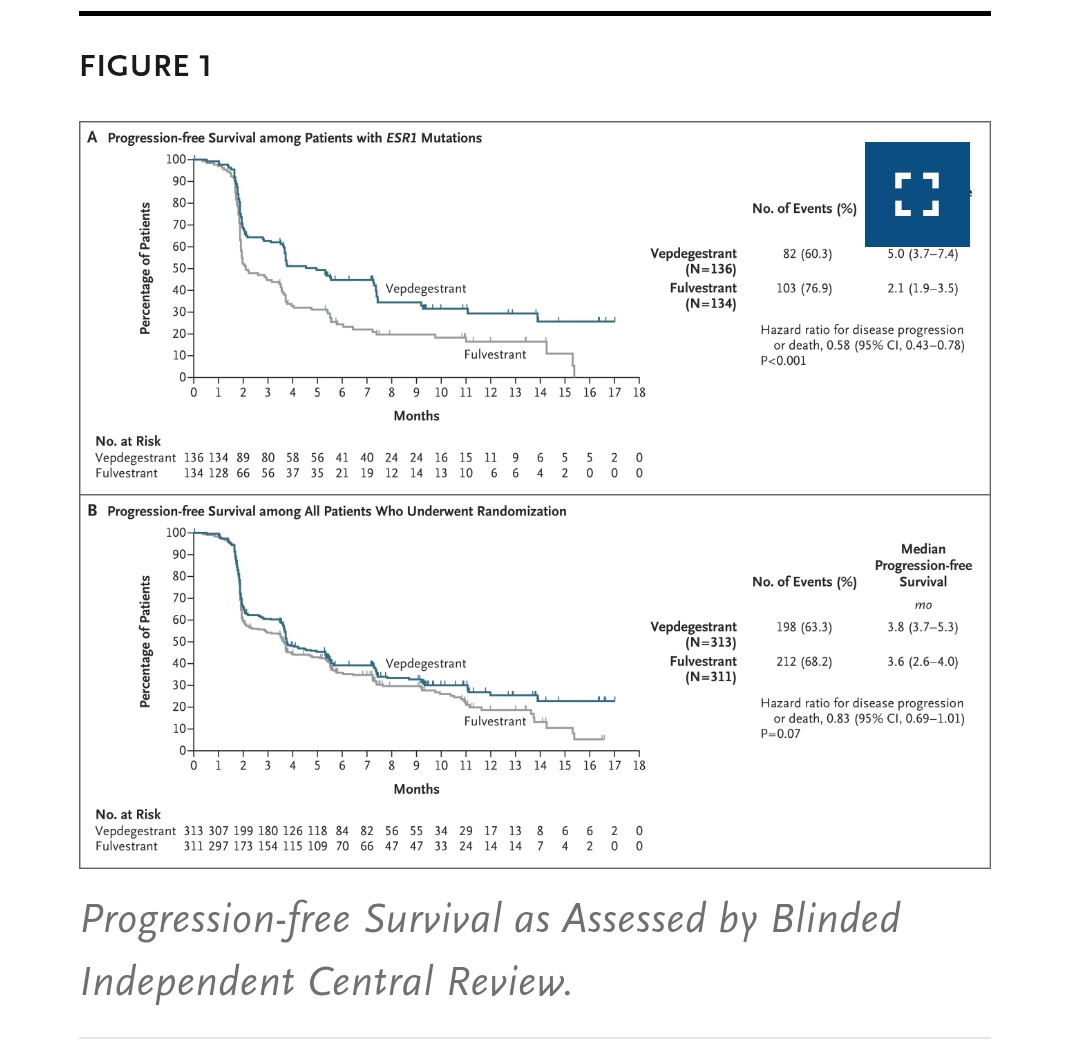
[Slide 1] ORIGINAL ARTICLE f X in x Vepdegestrant, a PROTAC Estrogen Receptor Degrader, in Advanced Breast Cancer Authors: Mario Campone, M.D., Ph.D., Michelino De Laurentiis, M.D., Ph.D., Komal Jhaveri, M.D., Xichun Hu, M.D., Ph.D., Sylvain Ladoire, M.D., Ph.D., Anne Patsouris, M.D., Ph.D., Claudio Zamagni, M.D., +20 , for the VERITAC-2 Study Group* Author Info & Affiliations Published May 31, 2025 I Copyright © 2025 --- [Slide 2] FIGURE 2 Hazard Ratio for Disease Prog Subgroup Vepdegestrant Fulvestrant or Death (95% CI) no. of events/no. of patients Patients with ESR1 mutations 79/136 95/134 ( Age <65 yr 50/86 66/88 0.51 (0.35-0.74) >65 yr 29/50 29/46 0.75 (0.45-1.26) Menopausal status Premenopausal or perimenopausal 14/28 20/28 0.48 (0.24-0.95) Postmenopausal 65/108 75/106 0.60 (0.43-0.85) Pooled geographic region Asia 32/56 38/50 0.43 (0.26-0.70) Europe 25/41 39/56 0.65 (0.40-1.08) North America 13/20 10/16 0.73 (0.32-1.69) Other 9/19 8/12 0.71 (0.27-1.89) ECOG performance-status score 0 46/78 49/76 0.69 (0.46-1.04) 1 33/58 46/58 0.46 (0.29-0.73) Visceral disease Yes 59/92 69/91 0.54 (0.38-0.77) No 20/44 26/43 0.65 (0.36-1.18) Liver disease Yes 45/63 49/59 0.50 (0.33-0.75) No 34/73 46/75 0.60 (0.38-0.94) Bone-only disease Yes 8/25 15/24 0.47 (0.20-1.13) No 71/111 80/110 0.58 (0.42-0.80) Lines of previous therapy 1 65/112 76/107 0.54 (0.39-0.75) 2 14/24 19/27 0.86 (0.43-1.72) 0.1 1.0 10.0 Vepdegestrant Better Fulvestrant Better Subgroup Analysis of Progression-free Survival as Assessed by Blinded Independent Central Review among Patients with ESR1 Mutations. --- [Slide 3] FIGURE 1 A Progression-free Survival among Patients with ESR1 Mutations 100 90 80 No. of Events (%) 70 Percentage of Patients 60 Vepdegestrant 82 (60.3) 5.0 (3.7-7.4) 50 (N=136) 40 Vepdegestrant Fulvestrant 103 (76.9) 2.1 (1.9-3.5) 30 (N=134) 20 Hazard ratio for disease progression or death, 0.58 (95% CI, 0.43-0.78) 10 Fulvestrant P<0.001 0 0 1 2 3 4 5 6 7 8 9 10 11 12 13 14 15 16 17 18 Months No. at Risk Vepdegestrant 136 134 89 80 58 56 41 40 24 24 16 15 11 9 6 5 5 2 0 Fulvestrant 134 128 66 56 37 35 21 19 12 14 13 10 6 6 4 2 0 0 0 B Progression-free Survival among All Patients Who Underwent Randomization 100 90 Median Progression-free 80 No. of Events (%) Survival 70 Percentage of Patients mo 60 Vepdegestrant 198 (63.3) 3.8 (3.7-5.3) 50 (N=313) 40 Vepdegestrant Fulvestrant 212 (68.2) 3.6 (2.6-4.0) 30 (N=311) 20 Hazard ratio for disease progression Fulvestrant or death, 0.83 (95% CI, 0.69-1.01) 10 P=0.07 0 0 1 2 3 4 5 6 7 8 9 10 11 12 13 14 15 16 17 18 Months No. at Risk Vepdegestrant 313 307 199 180 126 118 84 82 56 55 34 29 17 13 8 6 6 2 0 Fulvestrant 311 297 173 154 115 109 70 66 47 47 33 24 14 14 7 4 2 0 0 Progression-free Survival as Assessed by Blinded Independent Central Review.
Dr Amol Akhade
Dr Amol Akhade @SuyogCancer
VERITAC-2 Data
5.3K impressions · 65 likes · Apr 25, 2025
View on X ↗
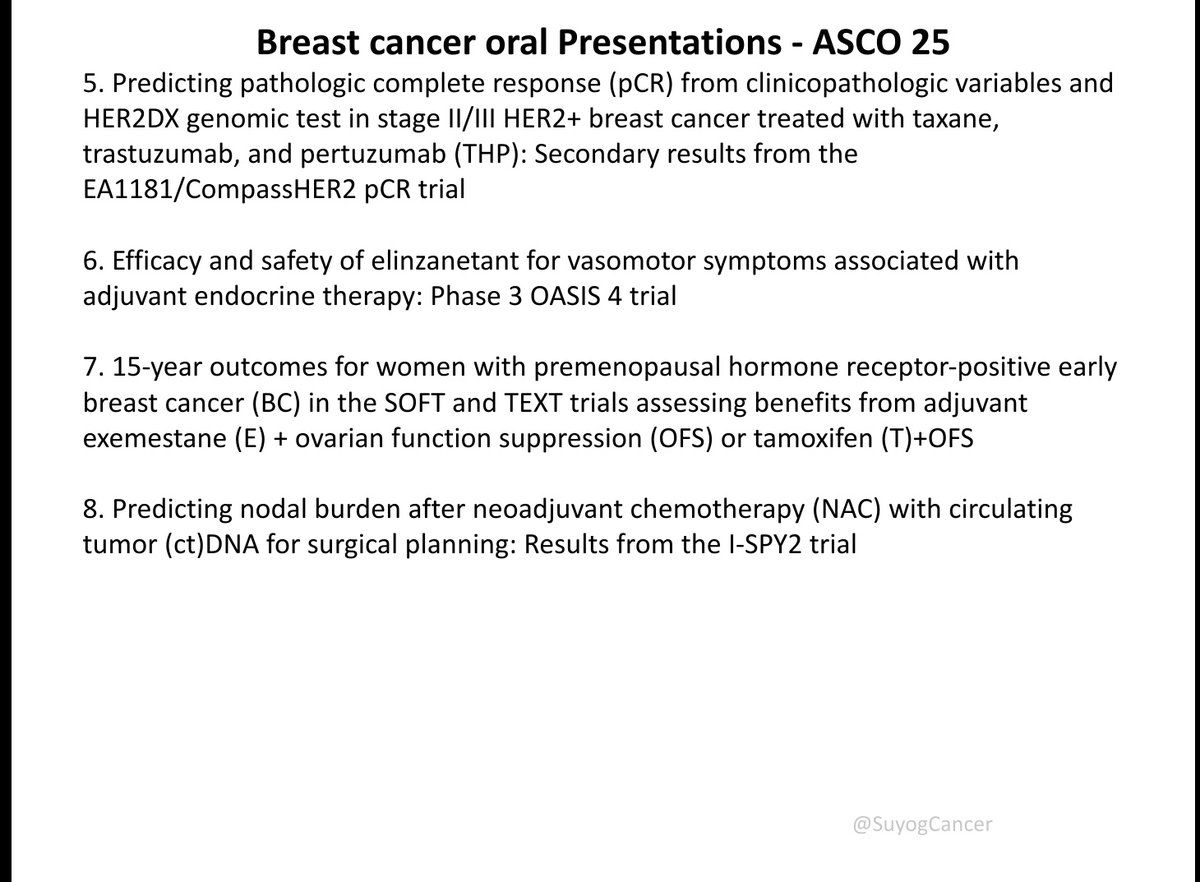
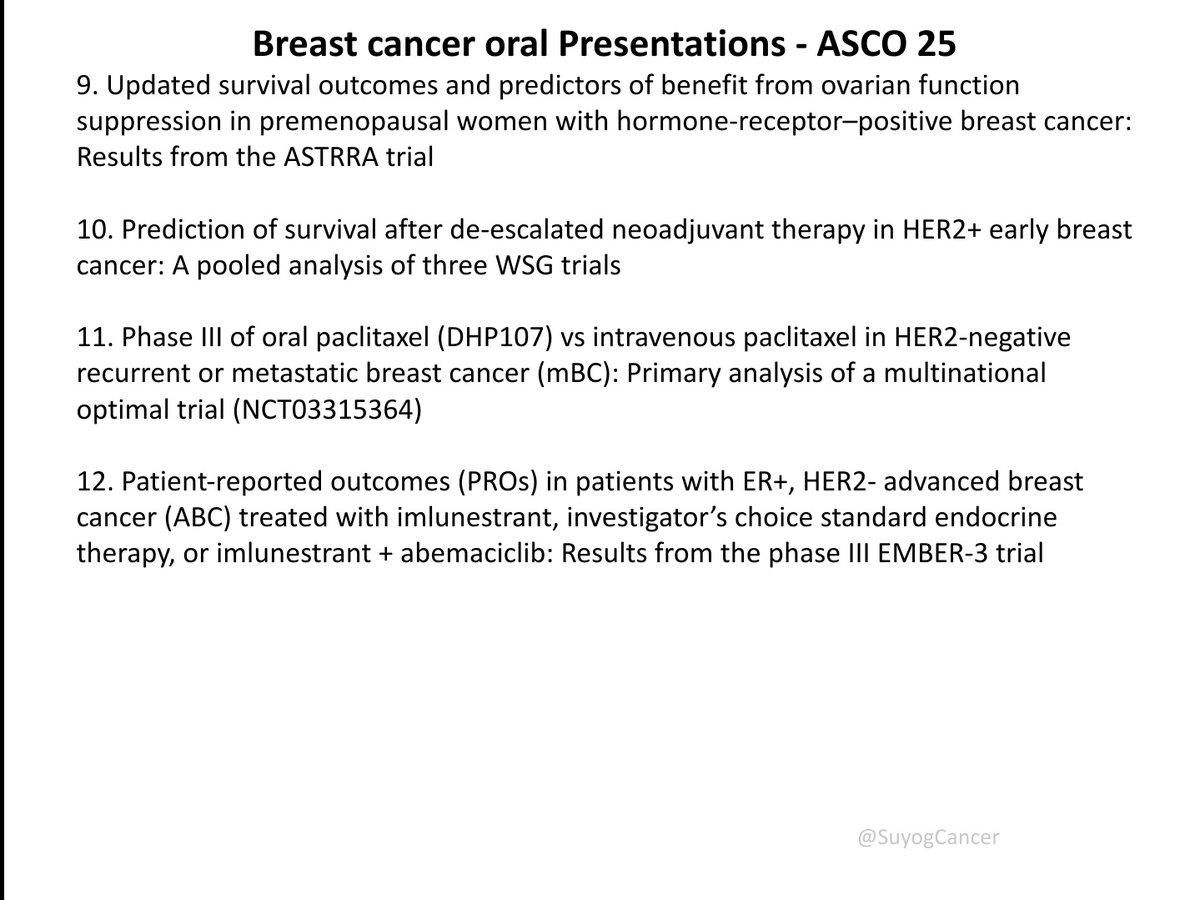
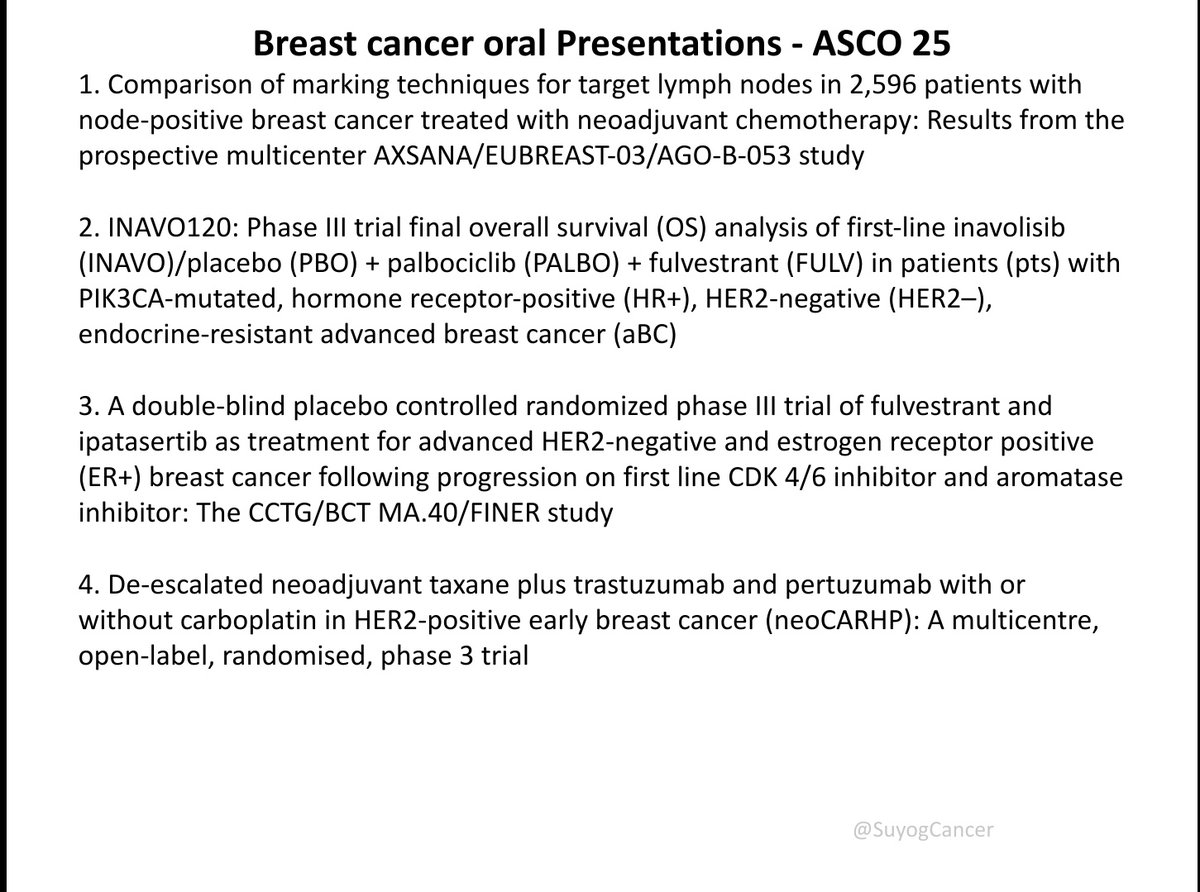
[Slide 1] Breast cancer oral Presentations - ASCO 25 1. Comparison of marking techniques for target lymph nodes in 2,596 patients with node-positive breast cancer treated with neoadjuvant chemotherapy: Results from the prospective multicenter AXSANA/EUBREAST-03/AGO-B-053 study 2. INAVO120: Phase III trial final overall survival (OS) analysis of first-line inavolisib (INAVO)/placebo (PBO) + palbociclib (PALBO) + fulvestrant (FULV) in patients (pts) with PIK3CA-mutated, hormone receptor-positive (HR+), HER2-negative (HER2-), endocrine-resistant advanced breast cancer (aBC) 3. A double-blind placebo controlled randomized phase III trial of fulvestrant and ipatasertib as treatment for advanced HER2-negative and estrogen receptor positive (ER+) breast cancer following progression on first line CDK 4/6 inhibitor and aromatase inhibitor: The CCTG/BCT MA.40/FINER study 4. De-escalated neoadjuvant taxane plus trastuzumab and pertuzumab with or without carboplatin in HER2-positive early breast cancer (neoCARHP): A multicentre, open-label, randomised, phase 3 trial @SuyogCancer --- [Slide 2] Breast cancer oral Presentations - ASCO 25 5. Predicting pathologic complete response (pCR) from clinicopathologic variables and HER2DX genomic test in stage II/III HER2+ breast cancer treated with taxane, trastuzumab, and pertuzumab (THP): Secondary results from the EA1181/CompassHER2 pCR trial 6. Efficacy and safety of elinzanetant for vasomotor symptoms associated with adjuvant endocrine therapy: Phase 3 OASIS 4 trial 7. 15-year outcomes for women with premenopausal hormone receptor-positive early breast cancer (BC) in the SOFT and TEXT trials assessing benefits from adjuvant exemestane (E) + ovarian function suppression (OFS) or tamoxifen (T)+OFS 8. Predicting nodal burden after neoadjuvant chemotherapy (NAC) with circulating tumor (ct)DNA for surgical planning: Results from the I-SPY2 trial @SuyogCancer --- [Slide 3] Breast cancer oral Presentations - ASCO 25 9. Updated survival outcomes and predictors of benefit from ovarian function suppression in premenopausal women with hormone-receptor-positive breast cancer: Results from the ASTRRA trial 10. Prediction of survival after de-escalated neoadjuvant therapy in HER2+ early breast cancer: A pooled analysis of three WSG trials 11. Phase III of oral paclitaxel (DHP107) vs intravenous paclitaxel in HER2-negative recurrent or metastatic breast cancer (mBC): Primary analysis of a multinational optimal trial (NCT03315364) 12. Patient-reported outcomes (PROs) in patients with ER+, HER2- advanced breast cancer (ABC) treated with imlunestrant, investigator's choice standard endocrine therapy, or imlunestrant + abemaciclib: Results from the phase III EMBER-3 trial @SuyogCancer --- [Slide 4] Breast cancer oral Presentations - ASCO 25 13. Phase l/lb study of inavolisib (INAVO) alone and in combination with endocrine therapy ± palbociclib (PALBO) in patients (pts) with PIK3CA-mutated, hormone receptor-positive, HER2-negative locally advanced/metastatic breast cancer (HR+, HER2- LA/mBC) 14. Analysis of hyperglycemia (HG) in prediabetic/obese pts. 15. The impact of ovarian function suppression with adjuvant endocrine therapy on survival outcomes in young germline BRCA mutation carriers with breast cancer: Secondary analysis of an international cohort study 16. Vepdegestrant, a PROTAC estrogen receptor (ER) degrader, vs fulvestrant in ER- positive/human epidermal growth factor receptor 2 (HER2)-negative advanced breast cancer: Results of the global, randomized, phase 3 VERITAC-2 study @SuyogCancer
Stephanie Graff, MD, FACP, FASCO
VERITAC-2 Data
3.2K impressions · 39 likes · May 31, 2025
View on X ↗
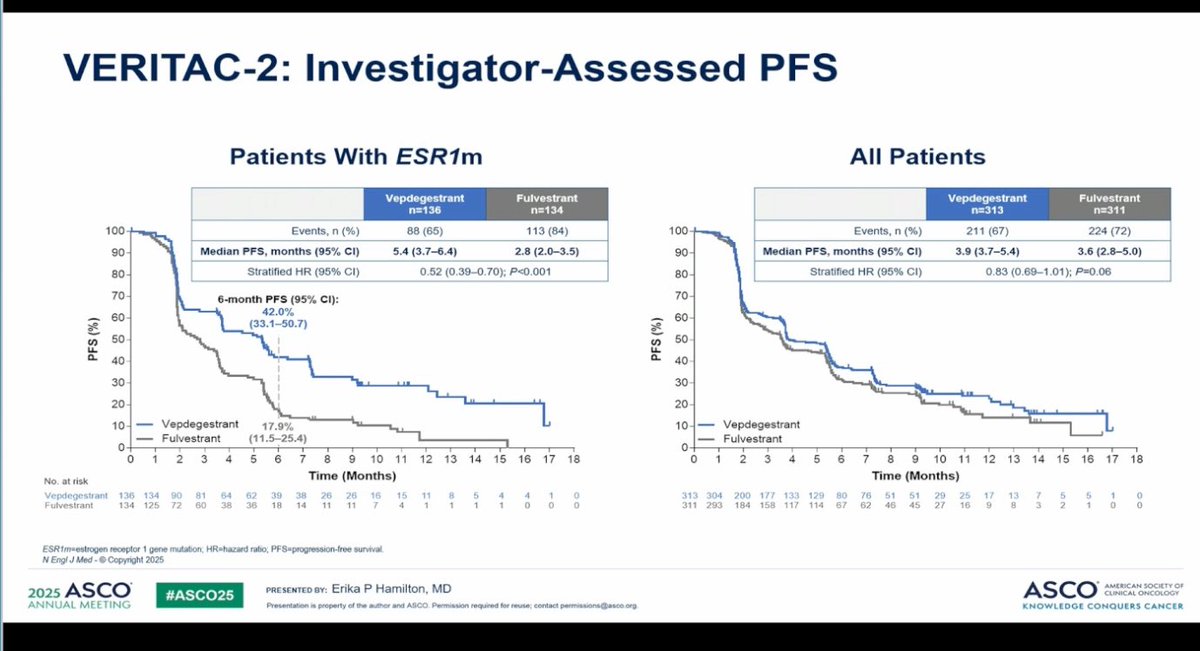
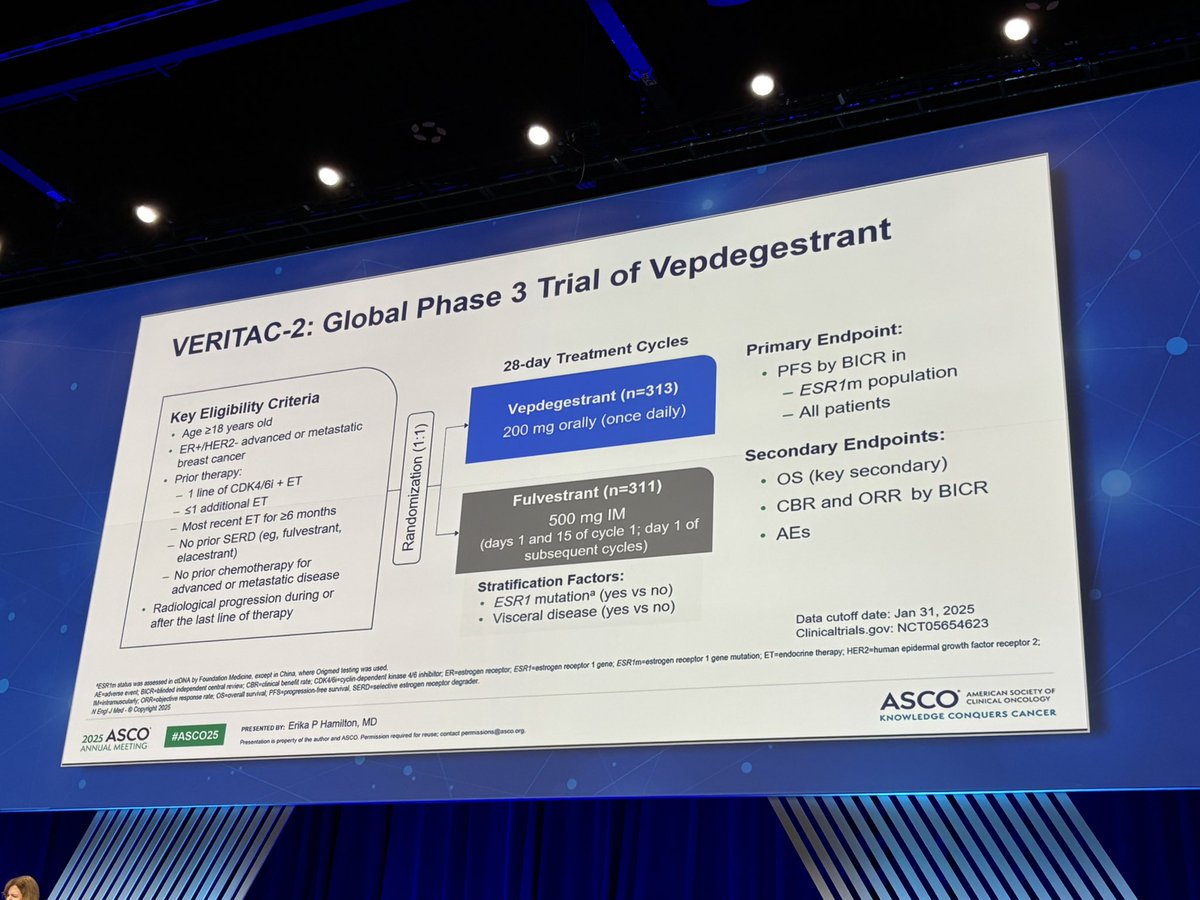
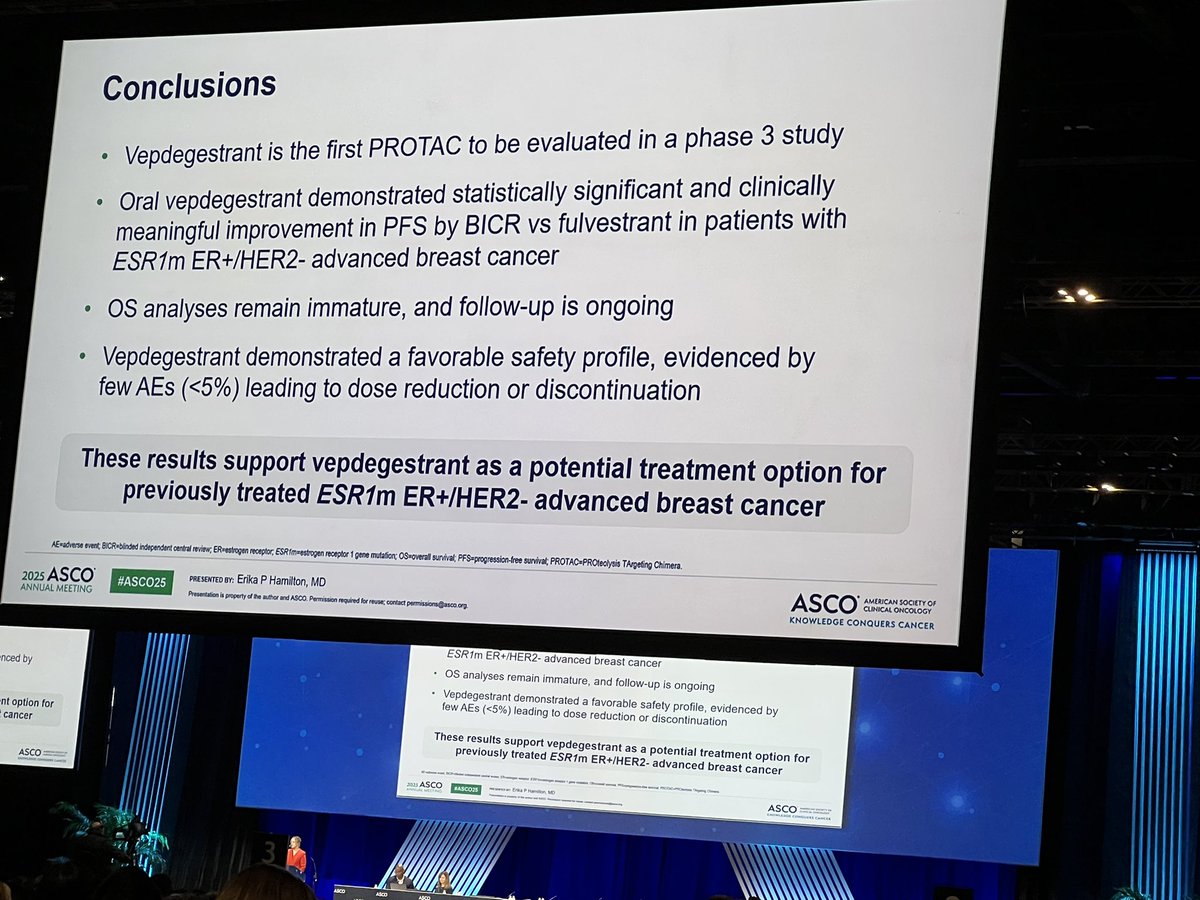
[Slide 1] VERITAC-2: Global Phase 3 Trial of Vepdegestrant Key Eligibility Criteria 28-day Treatment Cycles Age >18 years old Primary Endpoint: ER+/HER2- advanced or metastatic Vepdegestrant (n=313) PFS by BICR in breast cancer Prior therapy: 200 mg orally (once daily) - ESR1m population - 1 line of CDK4/6i + ET - ≤1 additional ET Randomization (1:1) - All patients Secondary Endpoints: - Most recent ET for ≥6 months - No prior SERD (eg, fulvestrant, Fulvestrant (n=311) OS (key secondary) elacestrant) 500 mg IM CBR and ORR by BICR - No prior chemotherapy for (days 1 and 15 of cycle 1; day 1 of advanced or metastatic disease subsequent cycles) AEs Radiological progression during or Stratification Factors: after the last line of therapy ESR1 mutationa (yes VS no) Visceral disease (yes VS no) Data cutoff date: Jan 31, 2025 Clinicaltrials.gov: NCT05654623 'ESRfm status was assessed in cIDNA by Foundation Medicine, except in China, where Origmed testing was used. AE=adverse event; BICR=blinded independent central review, CBR=clinical benefit rate; CDK4/6i=cyclin-dependent kinase 4/6 inhibitor, ER=estrogen receptor; ESRf=estrogen receptor 1 gene; ESR1m=estrogen receptor gene mutation; ET=endocrine therapy: HER2+human epidermal growth factor receptor 2, M=intramuscularly, ORR=objective response rate; OS=overall survival; PFS=progression-free survival, SERD=selective estrogen receptor degrader. N Engl Med ® Copyright 2025 2025 ASCO PRESENTED BY: Erika P Hamilton, MD #ASCO25 ASCO AMERICAN SOCIETY OF CLINICAL ONCOLOGY ANNUAL MEETING Presentation is property of the author and ASCO. Permission required for reuse; contact permissions@asco.org. KNOWLEDGE CONQUERS CANCER --- [Slide 2] VERITAC-2 Primary Endpoint: PFS by BICR in Patients With ESR1m 100 Vepdegestrant Fulvestrant — Vepdegestrant n=136 n=134 90 — Fulvestrant Median follow-up, months 7.4 6.0 80 Events, n (%) 79 (58) 95 (71) 70 Median PFS, months 5.0 2.1 6-month PFS (95% CI): (95% CI) (3.7-7.4) (1.9-3.5) 60 45.2% PFS (%) Stratified HR (95% CI) 0.57 (0.42-0.77) (36.1-53.9) 50 2-sided P<0.001 40 30 20 22.7% LLIB 10 (15.1-31.2) 0 0 1 2 3 4 5 6 7 8 9 10 11 12 13 14 15 16 17 18 No. at risk Time (Months) Vepdegestrant 136 134 87 78 55 53 38 37 22 22 15 14 10 8 4 3 3 2 0 Fulvestrant 134 125 62 52 30 29 15 12 8 8 7 2 1 1 1 1 0 0 0 BICR=blinded independent central review, ESR Im-estrogen receptor 1 gene mutation; HR=hazard ratio, PFS=progression-free survival N Engl J Med © Copyright 2025 2025 ASCO #ASCO25 PRESENTED BY: Erika P Hamilton, MD ASCO AMERICAN SOCIETY OF CLINICAL ONCOLOGY ANNUAL MEETING Presentation is property of the author and ASCO Permission required for reuse; contact permissions@asco.org KNOWLEDGE CONQUERS CANCER --- [Slide 3] VERITAC-2: Investigator-Assessed PFS Patients With ESR1m All Patients Vepdegestrant Fulvestrant Vepdegestrant Fulvestrant n=136 n=134 n=313 n=311 100 Events, n (%) 88 (65) 113 (84) 100 Events, n (%) 211 (67) 224 (72) 90 Median PFS, months (95% CI) 5.4 (3.7-6.4) 2.8 (2.0-3.5) 90 Median PFS, months (95% CI) 3.9 (3.7-5.4) 3.6 (2.8-5.0) 80 Stratified HR (95% CI) 0.52 (0.39-0.70): P<0.001 80 Stratified HR (95% CI) 0.83 (0.69-1.01); P=0.06 70 6-month PFS (95% CI): 70 60 42.0% 60 PFS (%) (33.1-50.7) 50 PFS (%) 50 40 40 30 30 20 20 10 Vepdegestrant 17.9% 10 Vepdegestrant Fulvestrant (11.5-25.4) Fulvestrant 0 0 0 1 2 3 4 5 6 7 8 9 10 11 12 13 14 15 16 17 18 0 1 2 3 4 5 6 7 8 9 10 11 12 13 14 15 16 17 18 No. at risk Time (Months) Time (Months) Vepdegestrant 136 134 90 81 64 62 39 38 26 26 16 15 11 8 5 4 4 1 0 313 304 200 177 133 129 80 76 51 51 29 25 17 13 / 5 5 1 0 Fulvestrant 134 125 72 60 38 36 18 14 11 11 7 4 1 1 1 1 0 0 0 311 293 184 158 117 114 67 62 46 45 27 16 9 8 3 2 1 0 0 ESR Im=estrogen receptor 1 gene mutation HR=hazard ratio, PF S=progression-free survival N Engl J Med - . Copyright 2025 2025 ASCO #ASCO25 PRESENTED BY: Erika P Hamilton, MD ASCO AMERICAN SOCIETY OF CLINICAL ONCOLOGY ANNUAL MEETING Presentation is property of the author and ASCO Permission required for reuse, contact permissions@asco.org KNOWLEDGE CONQUERS CANCER --- [Slide 4] VERITAC-2: Safety and Tolerability (All Treated Patients) Overview TEAEs in >10% of Patients in Either Group Vepdegestrant Fulvestrant Vepdegestrant Fulvestrant TEAEs, % (n=312) (n=307) (n = 312) (n = 307) Any grade 87 81 TEAE, % Any Grade Grade 3/4 Any Grade Grade 3/4 Grade ≥3 23 18 Fatigue 27 1 16 1 Serious 10 9 ALT increasedᵇ 14 1 10 1 Leading to treatment discontinuation 3 1 AST increasedb 14 1 10 3 Leading to dose reduction 2 NA TRAEs, % Nausea 13 0 9 1 Any grade 57 40 Anemiab.c 12 2 8 3 Grade ≥3 8 3 Neutropenia 12 2ᵉ 5 1° QT prolongation Back pain 11 1 7 <1 TEAEs: vepdegestrant, 10%; fulvestrant, 1% A QT interval sub-study (n=88) confirmed a mild increase (11.1 ms) from Arthralgia 11 1 11 0 baseline in mean QTcF. with upper 90% CI (13.7 ms) <20 ms,¹ indicating no large QT-prolonging effect Decreased appetite 11 <1 5 0 AL T=alanine aminotransferase; AST -aspartate aminotransferase; Glegastrointestinal; QTcF=corrected QT interval using Fridericia's method TEAE=treatment emergent adverse event; TRAE=treatment related adverse event "includes tatigue and asthenia No between-group differences were observed for ALT/AST increases or anemia based on laboratory values Includes anemia, hemoglobin decreased and iron deficiency anemia includes neutropenia and neutrophil count decreased No events led to dose reductions or treatment discontinuation in either treatment group There were no events of febrile neutropenia in the vepdegestrant group and event of grade 2 febrile neutropenia in the fulvestrant group "1 patient with grade 4 event Based on a concentration QTc population modeling analysis 2025 ASCO #ASCO25 PRESENTED BY: Erika P Hamilton, MD ASCO AMERICAN SOCIETY OF CLINICAL ONCOLOGY ANNUAL MEETING Presentation is property of the author and ASCO Permission required for reuse; contact permissions@asco.org KNOWLEDGE CONQUERS CANCER
Matteo Lambertini, MD PhD
VERITAC-2 Data
3.1K impressions · 35 likes · May 31, 2025
View on X ↗
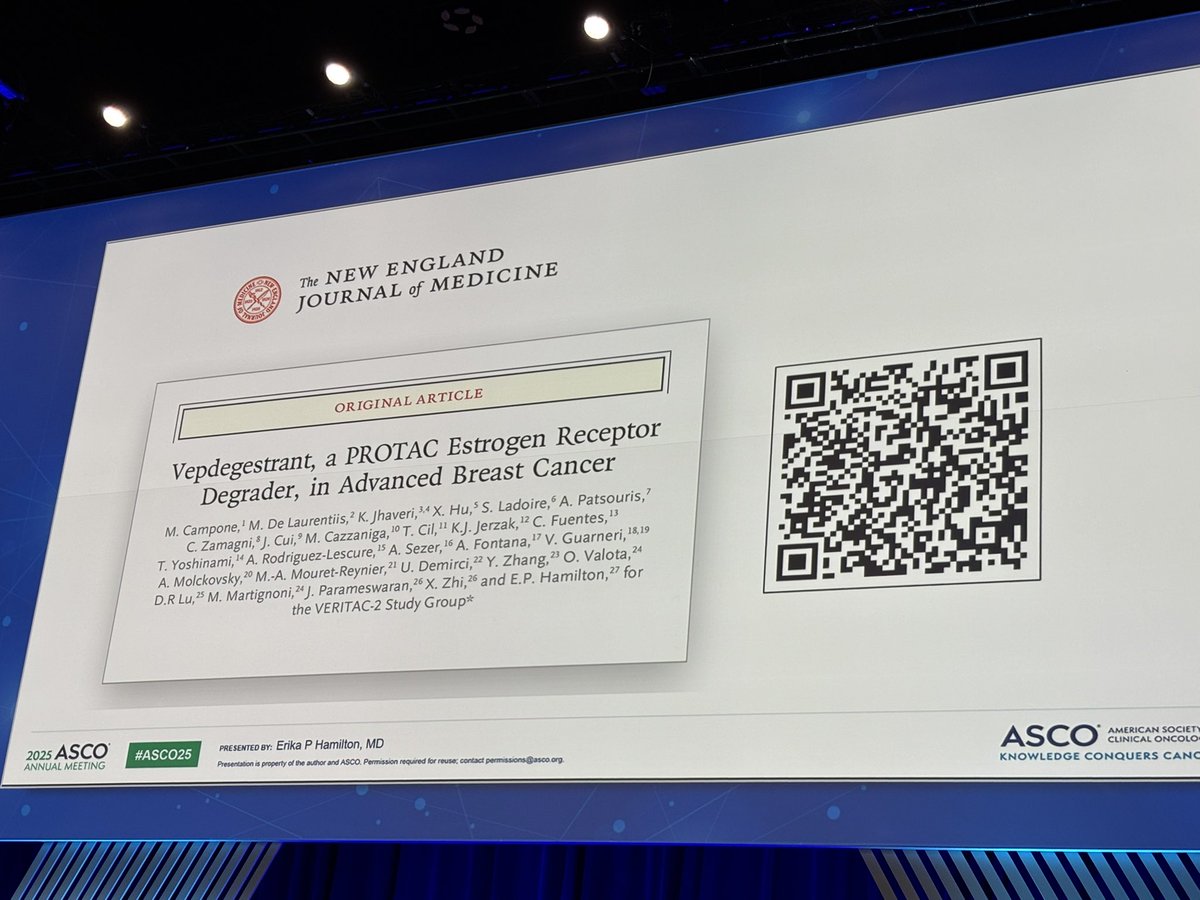
[Slide 1] VERITAC-2: Global Phase 3 Trial of Vepdegestrant Key Eligibility Criteria 28-day Treatment Cycles Age >18 years old Primary Endpoint: ER+/HER2- advanced or metastatic Vepdegestrant (n=313) PFS by BICR in breast cancer 200 mg orally (once daily) - ESR1m population Prior therapy: Randomization (1:1) - All patients - 1 line of CDK4/6i + ET - S1 additional ET Secondary Endpoints: - Most recent ET for >6 months Fulvestrant (n=311) - No prior SERD (eg, fulvestrant, OS (key secondary) elacestrant) 500 mg IM CBR and ORR by BICR - No prior chemotherapy for (days 1 and 15 of cycle 1; day 1 of advanced or metastatic disease subsequent cycles) AEs Radiological progression during or Stratification Factors: after the last line of therapy ESR1 mutation (yes VS no) Visceral disease (yes VS no) Data cutoff date: Jan 31, 2025 Clinicaltrials.gov: NCT05654623 ESRim status was assessed in BIDNA by Foundation Medicine, except in China, where Origmed testing was used. AExadveme event BICR-blinded independent central review; CBR+clinical benefit rate; CDK4/Gi=cyclin-dependent kinase 4/6 inhibitor, ER=estrogen receptor, ESRi=estrogen receptor gene; ESRim-estrogen receptor gene mutation; ET=endocrine therapy, HER2=human epidermal growth factor receptor 2; ORR=objective response rate: OS-overall survival PFS+progression-free survival, SERD=selective estrogen receptor degrader. N Engl Med 0 Copyright 2025 2025 ASCO PRESENTED BY: Erika P Hamilton, MD ASCO AMERICAN SOCIETY OF CLINICAL ONCOLOGY #ASCO25 ANNUAL MEETING Presentation is property of the author and ASCO Permission required for reuse, contact permissions@asco.org KNOWLEDGE CONQUERS CANCER --- [Slide 2] VERITAC-2 Primary Endpoint: PFS by BICR in Patients With ESR1m 100 Vepdegestrant Fulvestrant - Vepdegestrant n=136 n=134 90 - Fulvestrant Median follow-up, months 7.4 6.0 80 Events, n (%) 79 (58) 95 (71) Median PFS, months 5.0 2.1 70 6-month PFS (95% CI): (95% CI) (3.7-7.4) (1.9-3.5) 60 45.2% Stratified HR (95% CI) 0.57 (0.42-0.77) PFS (%) (36.1-53.9) 50 2-sided P<0.001 40 30 20 LIL 22.7% 10 (15.1-31.2) 0 0 1 2 3 4 5 6 7 8 9 10 11 12 13 14 15 16 17 18 Time (Months) No. at risk Vepdegestrant 136 134 87 78 55 53 38 37 22 22 15 14 10 8 4 3 3 2 0 Fulvestrant 134 125 62 52 30 29 15 12 8 8 7 2 1 1 1 1 0 0 0 BICR=blinded independent central review, ESRimestrogen receptor gene mutation; HR=hazard ratio; PFS=progression-l free survival N Engl Med 0 Copyright 2025 ASCO AMERICAN SOCIETY OF 2025 ASCO PRESENTED BY: Erika P Hamilton, MD CLINICAL ONCOLOGY #ASCO25 Presentation is property of the author and ASCO. Permission required for reuse, contact permissions@asco org. KNOWLEDGE CONQUERS CANCER ANNUAL MEETING --- [Slide 3] VERITAC-2: Investigator-Assessed PFS Patients With ESR1m All Patients Vepdegestrant Vepdegestrant Fulvestrant Fulvestrant n=136 n=134 n=313 n=311 100 Events, (%) 88 (65) 113 (84) 100 Events, n (%) 211 (67) 224 (72) 90 Median PFS, months (95% CI) 5.4 (3.7-6.4) 2.8 (2.0-3.5) 90 Median PFS, months (95% CI) 3.9 (3.7-5.4) 3.6 (2.8-5.0) 80 Stratified HR (95% CI) 0.52 (0.39-0.70): P<0.001 80 Stratified HR (95% CI) 0.83 (0.69-1.01); P=0.06 70 70 6-month PFS (95% CI): 42.0% 60 60 (33.1-50.7) PFS (%) 50 PFS (%) 50 40 40 30 30 20 20 10 Vepdegestrant 17.9% 10 Vepdegestrant Fulvestrant (11.5-25.4) Fulvestrant 0 0 0 1 2 3 4 5 6 7 8 9 10 11 12 13 14 15 16 17 18 0 1 2 3 4 5 6 7 8 9 10 11 12 13 14 15 16 17 18 Time (Months) No. at risk Time (Months) Vepdegestrant 136 134 90 81 64 62 39 38 26 26 16 15 11 8 5 4 4 1 0 313 304 200 177 133 129 80 76 51 51 29 25 17 13 7 5 5 1 0 Fulvestrant 134 125 72 60 38 36 18 14 11 11 / 4 1 1 1 1 0 0 0 311 293 184 158 117 114 67 62 46 45 27 16 9 8 3 2 1 0 0 ESRimestrogen receptor gene mutation; HR=bazard ratio: PFS-progression-tree survival N Engl Med-6 Copyright 2025 2025 ASCO #ASCO25 PRESENTED BY: Erika P Hamilton, MD ASCO AMERICAN SOCIETY OF CLINICAL ONCOLOGY ANNUAL MEETING Presentation 6 property of the author and ASCO. Permission required for resse, contact penmissions@asco KNOWLEDGE CONQUERS CANCER --- [Slide 4] The NEW ENGLAND ITEMS JOURNAL of MEDICINE ORIGINAL ARTICLE Vepdegestrant, a PROTAC Estrogen Receptor Degrader, in Advanced Breast Cancer M. Campone,¹ M. De Laurentiis,² K. Jhaveri,3,4 X. Hu,5 S. Ladoire,6 A. Patsouris,⁷ C. Zamagni,$J. Cui,9 M. Cazzaniga, 10 T. Cil,11 K.J. Jerzak, 12 C. Fuentes,13 T. Yoshinami,¹⁴ A. Rodriguez-Lescure,¹⁵ A. Sezer, 16 A. Fontana,¹⁷ V. Guarneri,¹⁸,¹⁹ A. Molckovsky,20 M.-A. Mouret-Reynier,21 U. Demirci,22 Y. Zhang,23 O. Valota,24 D.R Lu,25 M. Martignoni,24 J. Parameswaran,²⁶ X. Zhi,26 and E.P. Hamilton,²⁷ for the VERITAC-2 Study Group*
Janice Cowden
Janice Cowden @JaniceTNBCmets
VERITAC-2 Data
1.2K impressions · 16 likes · May 31, 2025
View on X ↗
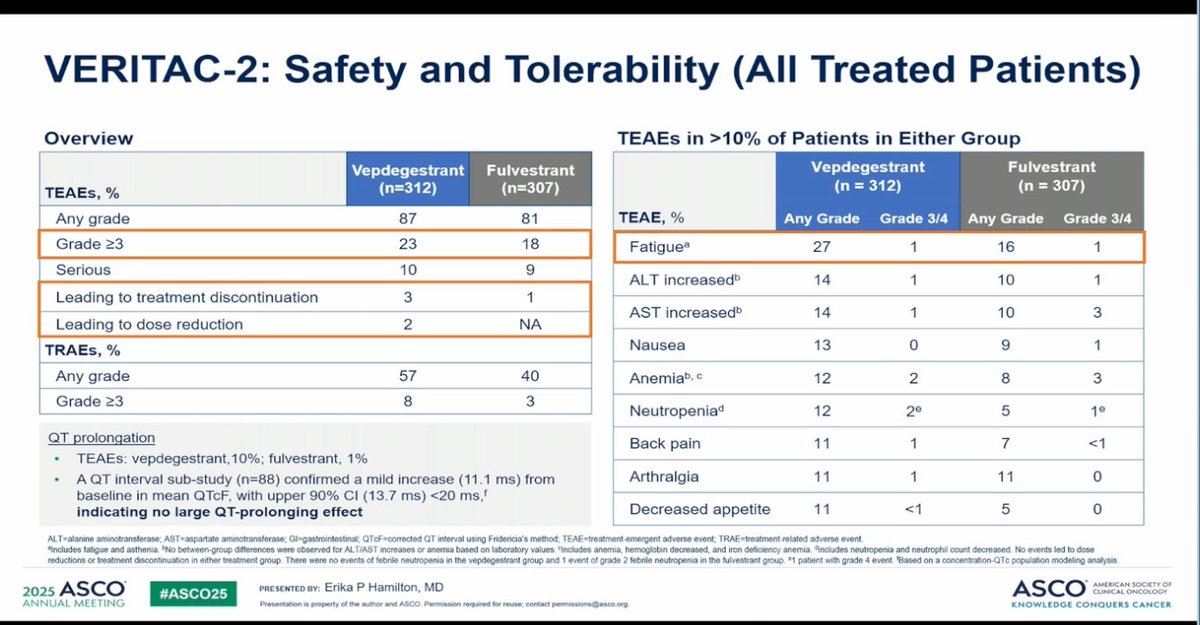
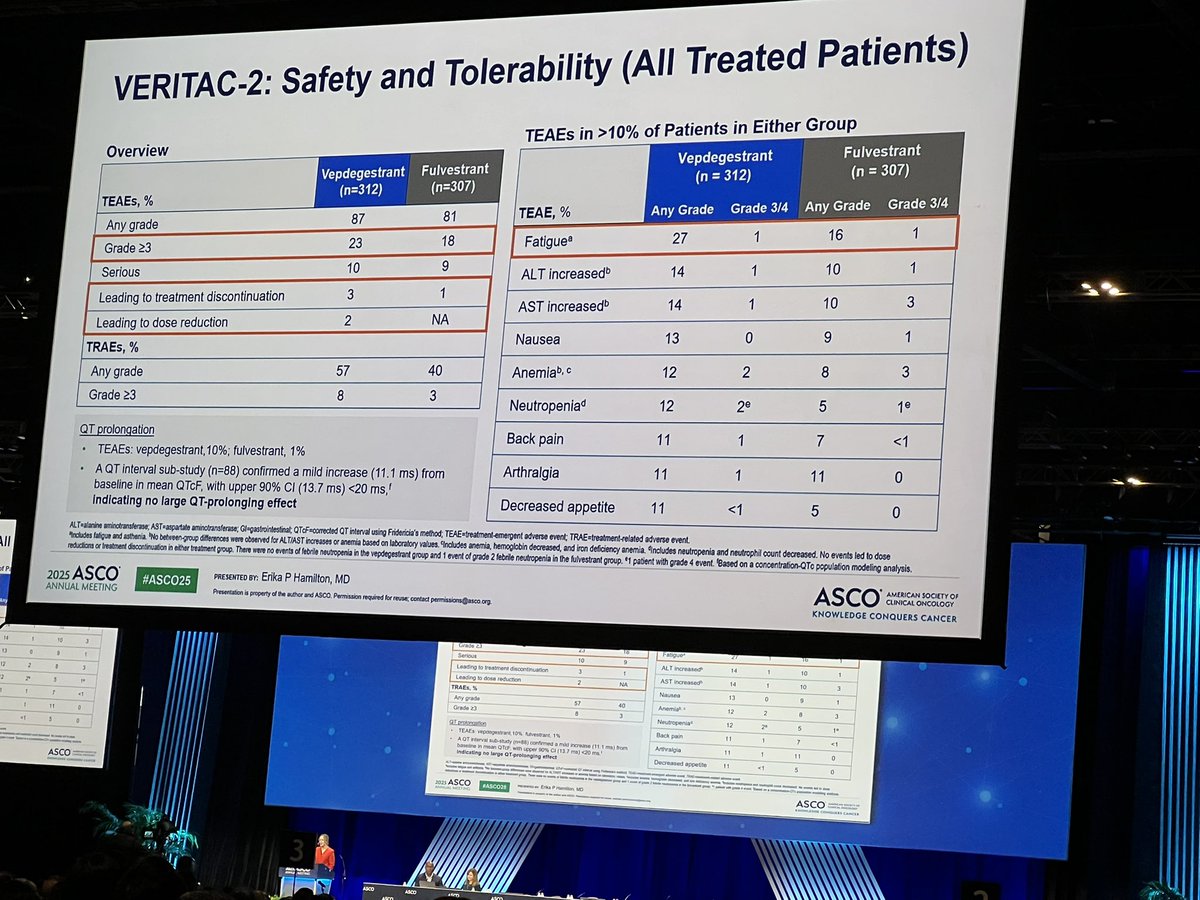
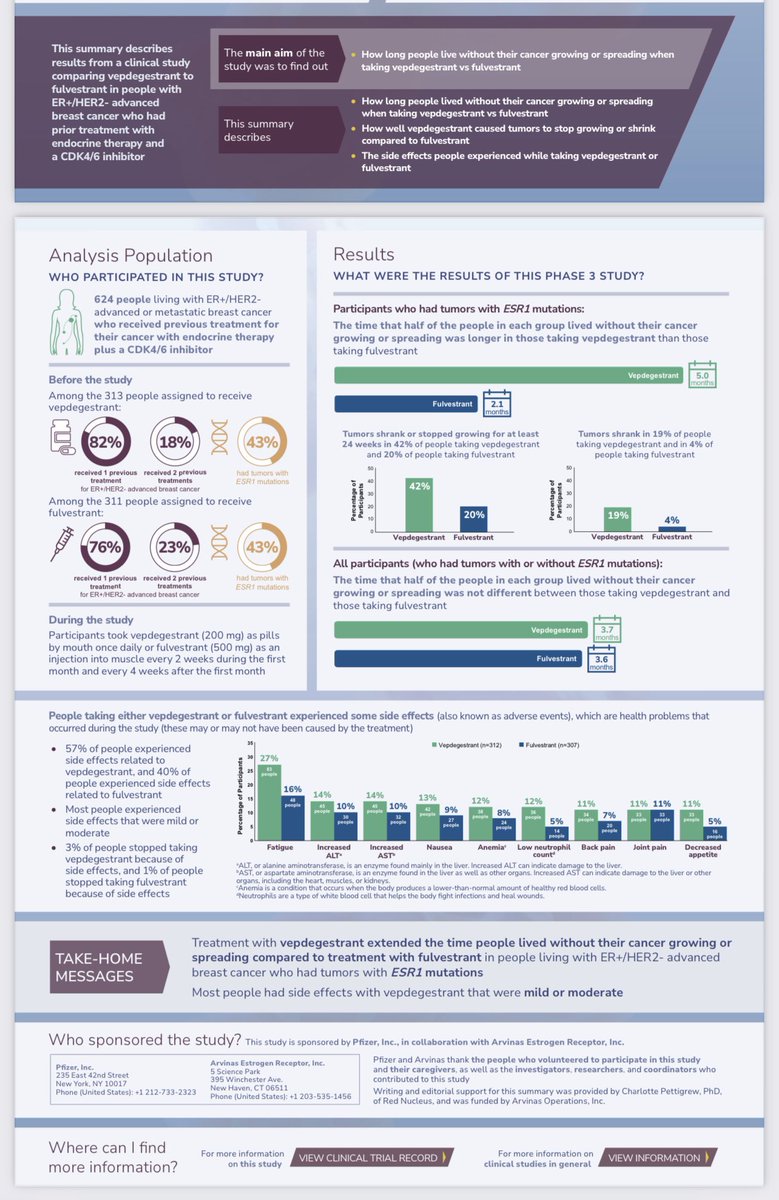
[Slide 1] VERITAC-2: Safety and Tolerability (All Treated Patients) Overview TEAEs in >10% of Patients in Either Group Vepdegestrant Fulvestrant Vepdegestrant Fulvestrant TEAEs, % (n=312) (n=307) (n = 312) (n = 307) Any grade 87 81 TEAE, % Any Grade Grade 3/4 Any Grade Grade 3/4 Grade >3 23 18 Fatigue® 27 1 16 1 Serious 10 9 ALT increasedᵇ 14 1 10 1 Leading to treatment discontinuation 3 1 AST increasedᵇ 14 1 10 3 Leading to dose reduction 2 NA TRAEs, % Nausea 13 0 9 1 Any grade 57 40 Anemia 12 2 8 3 Grade ≥3 8 3 Neutropenia 12 2e 5 1e QT prolongation Back pain 11 1 7 <1 TEAEs: vepdegestrant, 10%; fulvestrant, 1% A QT interval sub-study (n=88) confirmed a mild increase (11.1 ms) from Arthralgia 11 1 11 0 baseline in mean QTcF, with upper 90% CI (13.7 ms) <20 ms,¹ indicating no large QT-prolonging effect Decreased appetite 11 <1 5 0 ALTealanine aminotransferase; ST*aspartate aminotransferase; Glegastrointestinal; QTcF=corrected QT interval using Fridericia's method; TEAE=treatment-emergent adverse event, TRAE=treatment related adverse event. includes fatigue and asthenia No between-group differences were observed for ALT/AST increases or anemia based on laboratory values, includes anemia, hemoglobin decreased, and iron deficiency anemia. includes neutropenia and neutrophil count decreased. No events led to dose reductions or treatment discontinuation in either treatment group. There were no events of febrile neutropenia in the repdegestrant group and event of grade febrile neutropenia in the fulvestrant group. 1 patient with grade 4 event. Based on a concentration-QT population modeling analysis. 2025 ASCO #ASCO25 PRESENTED BY: Enka P Hamilton, MD ASCO AMERICAN SOCIETY OF CLINICAL ONCOLOGY ANNUAL MEETING Presentation is property of the author and ASCO. Permission required for revise, contact permissions@asco org. KNOWLEDGE CONQUERS CANCER Grade 0 asquer - 10 1 Serious 10 9 ALT increased 14 1 10 1 0 I 1 Leading to treatment discontinuation 3 1 AST increased 14 1 10 3 Leading dose reduction 2 NA 7 - 3 TRAES, % Nausea 13 0 ) 1 r 1 - Any grade 57 40 Anemia 12 2 8 3 1 7 11 Grade 23 1 3 Neutropenia* 12 % 5 - - 11 I instruction Back pain 11 1 7 TEACH reporterement 10% 1% 0 " 1 # A.OT interval NO staty (n+84) confirmed med noses (11. - form Anthraigia 11 1 11 0 before - OTIP with upper 90% ma) <20 - - indicating no large OT prolonging effect Decreased appetite 11 " , 0 I | I - | - I ASCO - 2023 ASCO RASCO28 - the - MO ASCO - CANCELLA --- [Slide 2] Conclusions Vepdegestrant is the first PROTAC to be evaluated in a phase 3 study Oral vepdegestrant demonstrated statistically significant and clinically meaningful improvement in PFS by BICR VS fulvestrant in patients with ESR1m ER+/HER2- advanced breast cancer OS analyses remain immature, and follow-up is ongoing Vepdegestrant demonstrated a favorable safety profile, evidenced by few AEs (<5%) leading to dose reduction or discontinuation These results support vepdegestrant as a potential treatment option for previously treated ESR1m ER+/HER2- advanced breast cancer AE=adverse event, BICR=blinded independent central review, ERvestrogen receptor; ESRfm=estrogen receptor 1 gene mutation; OS*overall survival; PFS=progression-fre survival; PROTAC=PROteclysis TArgeting Chimera. 2025 ASCO #ASCO25 PRESENTED BY: Erika P Hamilton, MD ANNUAL MEETING ASCO AMERICAN SOCIETY OF Presentation a property of the author and ASCO Permission required for reuse, contact permissions@asco. CLINICAL ONCOLOGY KNOWLEDGE CONQUERS CANCER ESR1m ER+/HER2- advanced breast cancer nced by OS analyses remain immature, and follow-up is ongoing Vepdegestrant demonstrated a favorable safety profile, evidenced by few AEs (<5%) leading to dose reduction or discontinuation nt option for cancer These results support vepdegestrant as a potential treatment option for previously treated ESR1m ER+/HER2- advanced breast cancer ASCO 2523 ASCO RASCO25 ---- - MD ASCO --- [Slide 3] MAY 2025 Vepdegestrant (vep-DEG-eh-strent). a PROTAC ER degrader, VS fulvestrant in people living with ER+/HER2- advanced breast cancer This summary contains information from the scientific presentation: CLICK HERE TO VIEW THE Vepdegestrant, a PROTAC ER Degrader, vs Fulvestrant PRESENTATION SLIDES in ER+/HER2- Advanced Breast Cancer: Results of the Copies of this presentation obtained through this link are for personal use only and may Global, Randomized, Phase 3 VERITAC-2 Study not be reproduced without written permission from ASCO or the authors of this presentation What is ER+/HER2- HER2 What are some common treatments for advanced breast cancer? + ER ER+/HER2- advanced breast cancer? ER+/HER2- breast cancer is a specific type of breast cancer Doctors often use hormone therapy (also called endocrine therapy). Certain types of breast cancer grow in response to which works by either blocking the body's ability to produce estrogen, a hormone in the body. This is called estrogen estrogen or blocking the activity of estrogen in cancer cells. This receptor-positive (ER+) breast cancer may slow or stop cancer growth Some types of breast cancer have high levels of a Aromatase inhibitors, such as letrozole, anastrozole, or exemestane, protein called human epidermal growth factor are endocrine therapies that reduce the production of estrogen receptor 2 (HER2) and are called HER2-positive Fulvestrant is an endocrine therapy that attaches to estrogen receptors (HER2+). Other breast cancer types have low levels and blocks their activity, which reduces estrogen's effects on tumors or no HER2 and are called CDK4/6 inhibitors are another type of treatment and work by blocking HER2-negative (HER2-) certain proteins that cause cancer cells to grow Advanced breast cancer is cancer that Some people have tumors that develop mutations, or changes in the has spread from the breast to nearby tumor's DNA, in a gene called the estrogen receptor 1 gene (ESR1). These tissue (locally advanced cancer) or mutations can make certain endocrine therapies not work as well from the breast to more distant parts Some new medicines specifically aim to treat people with ER+/HER2- of the body (metastatic cancer) advanced breast cancer whose tumors have developed ESR1 mutations What is vepdegestrant? Why is vepdegestrant being Vepdegestrant, also called ARV-471, is an investigational compared to fulvestrant in drug taken by mouth as a pill that researchers are testing for the treatment of ER+/HER2- breast cancer. It is a this study? PROteolysis TArgeting Chimera (PROTAC) estrogen receptor degrader Fulvestrant is an endocrine therapy given to people with PROTACs are designed to attach to specific proteins in cells that ER+/HER2- breast cancer whose tumors grow or spread after can cause disease, which causes those proteins to be marked for treatment with a different endocrine therapy elimination by a natural protein disposal system in the body In laboratory research studies, vepdegestrant eliminated more Vepdegestrant works by causing estrogen receptors to be estrogen receptors and had stronger effects at preventing eliminated, which blocks the activity of estrogen and may stop tumor growth than fulvestrant ER+ breast cancer tumors from growing or cause the tumors to shrink This summary describes The main aim of the How long people live without their cancer growing or spreading when results from a clinical study study was to find out taking vepdegestrant vs fulvestrant comparing vepdegestrant to fulvestrant in people with ER+/HER2- advanced How long people lived without their cancer growing or spreading breast cancer who had when taking vepdegestrant vs fulvestrant prior treatment with This summary How well vepdegestrant caused tumors to stop growing or shrink describes endocrine therapy and compared to fulvestrant a CDK4/6 inhibitor The side effects people experienced while taking vepdegestrant or fulvestrant --- [Slide 4] This summary describes The main aim of the How long people live without their cancer growing or spreading when results from a clinical study study was to find out taking vepdegestrant vs fulvestrant comparing vepdegestrant to fulvestrant in people with ER+/HER2- advanced How long people lived without their cancer growing or spreading breast cancer who had when taking vepdegestrant vs fulvestrant prior treatment with This summary How well vepdegestrant caused tumors to stop growing or shrink describes endocrine therapy and compared to fulvestrant a CDK4/6 inhibitor The side effects people experienced while taking vepdegestrant or fulvestrant Analysis Population Results WHO PARTICIPATED IN THIS STUDY? WHAT WERE THE RESULTS OF THIS PHASE 3 STUDY? 624 people living with ER+/HER2- advanced or metastatic breast cancer Participants who had tumors with ESR1 mutations: who received previous treatment for The time that half of the people in each group lived without their cancer their cancer with endocrine therapy growing or spreading was longer in those taking vepdegestrant than those plus a CDK4/6 inhibitor taking fulvestrant Before the study Vepdegestrant 5.0 Among the 313 people assigned to receive vepdegestrant: Fulvestrant 2.1 months Tumors shrank or stopped growing for at least Tumors shrank in 19% of people 82% 18% 43%, 24 weeks in 42% of people taking vepdegestrant taking vepdegestrant and in 4% of and 20% of people taking fulvestrant people taking fulvestrant received previous received previous had sumors with treatment treatments ESR1 mutations for ER+/HER2- advanced breast cancer 42% Participants 30 Percentage - Among the 311 people assigned to receive 20 20 fulvestrant: 20% 19% 4% Vepdegestrant Fulvestrant Vepdegestrant Fulvestrant 76% 23% 43% All participants (who had tumors with or without ESR1 mutations): received previous received previous had tumors with The time that half of the people in each group lived without their cancer treatment treatments ESR1 mutations for ER+/HER2- advanced breast cancer growing or spreading was not different between those taking vepdegestrant and those taking fulvestrant During the study Participants took vepdegestrant (200 mg) as pills Vepdegestrant 3.7 by mouth once daily or fulvestrant (500 mg) as an injection into muscle every 2 weeks during the first Fulvestrant 3.6 month and every 4 weeks after the first month People taking either vepdegestrant or fulvestrant experienced some side effects (also known as adverse events), which are health problems that occurred during the study (these may or may not have been caused by the treatment) - 57% of people experienced Vepdegestrant (n=312) Fulvestrant (n=307) side effects related to * 27% vepdegestrant. and 40% of as people experienced side effects I Parcentage I - 16% related to fulvestrant 14% 14% 15 13% 12% 12% Most people experienced people 10% 10% 11% 11% 11% 11% - 9% 8% side effects that were mild or - people 7% people people 5% - people 5% people - moderate perpor I I 3% of people stopped taking Fatigue Increased Increased Nausea Anemia' Low neutrophil Back pain Joint pain Decreased vepdegestrant because of ALT* AST count" appetite ALT. or alanine aminotransferase, is an enzyme found mainly in the liver. increased ALT can indicate damage to the liver. side effects, and 1% of people AST, or aspartate aminotransferase. is an enzyme found in the liver as well as other organs increased AST can indicate damage to the Over or other stopped taking fulvestrant organs, including the heart, muscles, or kidneys. Anemia condition that occurs when the body produces lower than-normal amount of healthy red blood cells. because of side effects Neutrophis are type of white blood cell that helps the body fight infections and heal wounds Treatment with vepdegestrant extended the time people lived without their cancer growing or TAKE-HOME spreading compared to treatment with fulvestrant in people living with ER+/HER2- advanced MESSAGES breast cancer who had tumors with ESR1 mutations Most people had side effects with vepdegestrant that were mild or moderate Who sponsored the study? This study is sponsored by Pfizer, Inc., in collaboration with Arvinas Estrogen Receptor, Inc. Arvinas Estrogen Receptor, Inc. Pfizer and Arvinas thank the people who volunteered to participate in this study Pfizer, Inc. Science Park and their caregivers. as well as the investigators researchers and coordinators who 235 East 42nd Street 395 Winchester Ave. New York, NY 10017 contributed to this study New Haven, CT 06511 Phone (United States): 212-733-2323 Writing and editorial support for this summary was provided by Charlotte Pettigrew, PhD, Phone (United States): +1 203-535-1456 of Red Nucleus, and was funded by Arvinas Operations, Inc. Where can I find For more information For more information on VIEW CLINICAL TRIAL RECORD VIEW INFORMATION more information? on this study clinical studies in general

VERITAC-2 Top Tweets

Top tweets by impressions — click to view on X

Sara Tolaney
Sara Tolaney@stolaney1

Vepdegestrant demonstrates significant improvement in PFS in 2L in pts with ESR1m HR+ mBC (hazard ratio better than 0.60 targeted in the study). No significant benefit seen in ITT.

First PROTAC…

👁 12.5K ♡ 61 ↻ 22 Mar 11, 2025
Erika Hamilton, MD
Erika Hamilton, MD@ErikaHamilton9

Love @ASCO&#x27;s patient summaries!

Patients are who we are here for. Communicating findings in lay person wording so everyone can learn is so important!

#VERITAC2 #PROTAC #bcsm #vepdegestrant

👁 12K ♡ 34 ↻ 8 May 31, 2025
Madeleine Armstrong
Madeleine Armstrong@ByMadeleineA

$ARVN &amp; $PFE&#x27;s vepdegestrant disappoints, and Arvinas shares plunge 40%. My take, via @ApexOnco https://t.co/YanBaOK4pG https://t.co/vXZVjjnDrY

👁 11.2K ♡ 37 ↻ 4 Mar 11, 2025
Dr Amol Akhade
Dr Amol Akhade@SuyogCancer

🧬 VERITAC-2 Trial (NEJM May 2025)
📌 Oral PROTAC ER degrader vepdegestrant vs. fulvestrant in ER+/HER2– MBC post-CDK4/6i
🎯 Primary PFS Results: — ESR1-mut+ ⬆️ PFS:
 5.0 vs 2.1 mo
 HR 0.58 | p &lt;…

👁 8K ♡ 74 ↻ 25 May 31, 2025
Erika Hamilton, MD
Erika Hamilton, MD@ErikaHamilton9

Today at #ASCO25, I’ll be presenting findings from the VERITAC-2 study on vepdegestrant in ER+/HER2- metastatic #breastcancer, the most common subtype, demonstrating a 43% risk reduction in…

👁 7.2K ♡ 126 ↻ 22 May 31, 2025
Madeleine Armstrong
Madeleine Armstrong@ByMadeleineA

Not really surprised to see that vepdegestrant worked in ESR1 mutants, but not in the overall Veritac-2 population $ARVN $PFE https://t.co/L4pzFImdlO

👁 7K ♡ 24 ↻ 2 Mar 11, 2025
Sally Church
Sally Church@MaverickNY

Seeing the Arvinas VERITAC-2 data today reminds me BSB readers recently got the heads up it was unlikely to succeed in allcomers, might have a shot in ESR1 mutant disease… https://t.co/LZS3J4jIRr

👁 5.7K ♡ 3 ↻ 2 Mar 11, 2025
Harold J. Burstein, MD, PhD, FASCO
Harold J. Burstein, MD, PhD, FASCO@DrHBurstein

Arvinas and Pfizer Announce Positive Topline Results from Phase 3 VERITAC-2 Clinical Trial https://t.co/gpwT1Y6XCS

👁 5.5K ♡ 23 ↻ 7 Mar 11, 2025
Erika Hamilton, MD
Erika Hamilton, MD@ErikaHamilton9

Join us in Hall B1 this afternoon to hear the details.

What am I particularly excited about?

Of course 5.0 vs. 2.1 months for ESR1m

But...it&#x27;s the tolerability! Discontinuations and reductions…

👁 5.4K ♡ 31 ↻ 8 May 31, 2025
Dr Amol Akhade
Dr Amol Akhade@SuyogCancer

key oral abstracts in breast cancer from #ASCO25
Covering neoadjuvant, adjuvant &amp; metastatic settings: INAVO120, EMBER-3, VERITAC-2, DESTINY-Breast06, AXSANA, I-SPY2 &amp; more! @ASCO @OncoAlert

👁 5.3K ♡ 65 ↻ 13 Apr 25, 2025

About the VERITAC-2 Trial

VERITAC-2 is the first positive Phase 3 trial of a PROTAC degrader in any cancer. PFS benefit robust in ESR1-mutant subgroup (HR 0.57) but ITT miss (HR 0.83, P=0.07) will shape the approved label. Competes with elacestrant (EMERALD/EMBER-3) for ESR1-mutant 2L ER+ mBC. Oral once-daily with favorable tolerability. OS data maturing.


Trial Methodology & Results

Progression-Free Survival (ESR1-mutant population) — Dual Primary Endpoint (BICR-assessed)

Median: 5.0 months (vepdegestrant, 95% CI 3.7-7.4) vs. 2.1 months (fulvestrant, 95% CI 1.9-3.5). HR 0.57 (95% CI 0.42-0.77), P<0.001 6-month PFS rate: 45.2% (vepdegestrant) vs. 22.7% (fulvestrant). In ESR1-mutant population (n=270, 43% of enrolled), median PFS 5.0 months (95% CI 3.7-7.4) with vepdegestrant vs. 2.1 months (95% CI 1.9-3.5) with fulvestrant; HR 0.57 (95% CI 0.42-0.77, P<0.001) — 43% reduction in risk of progression or death. ORR 18.6% vs. 4.0% (OR 5.45, P=0.001). CBR 42.1% vs. 20.2%. In ITT population, median PFS 3.7 vs. 3.6 months (HR 0.83, 95% CI 0.68-1.02, P=0.07) — did NOT reach statistical significance.

✓ ESR1m mPFS 5.0 vs. 2.1 mo (HR 0.57); ITT miss (HR 0.83)

📄 Source: KOL commentary on X →

Overall Survival (OS)

Overall survival (key secondary endpoint) immature at time of primary analysis — less than a quarter of required events had occurred. No treatment-related deaths in either arm.


📄 Source →

Safety & Tolerability

Grade ≥3 adverse events: 8% (vepde) vs. 3% (fulv). Discontinuation due to AEs: 2.9% (vepde) vs. 0.7% (fulv). Key AEs: fatigue (26.6%), ALT/AST increase (14% each), nausea (13%), anemia (12%). Oral PROTAC degrader generally well tolerated. Grade ≥3 TRAE 8% vs. 3%. Most common TEAEs fatigue, AST/ALT elevation, nausea. GI toxicity rates low (nausea 13.5%, vomiting 6.4%, diarrhea 6.4%). No treatment-related deaths in either arm.

Well-tolerated oral PROTAC; low GI toxicity

📄 Source →

Clinical Implications

🔄 First PROTAC degrader with Phase 3 positivity; NDA under review (PDUFA June 5, 2026). VERITAC-2 is the first positive Phase 3 trial of a PROTAC degrader in any cancer. PFS benefit robust in ESR1-mutant subgroup (HR 0.57) but ITT miss (HR 0.83, P=0.07) will shape the approved label. Competes with elacestrant (EMERALD/EMBER-3) for ESR1-mutant 2L ER+ mBC. Oral once-daily with favorable tolerability. OS data maturing.

VERITAC-2 in the News

Key KOL Sentiments — VERITAC-2

DoctorSentimentComment
Sara Tolaney ● POSITIVE Vepdegestrant demonstrates significant improvement in PFS in 2L in pts with ESR1m HR+ mBC (hazard ratio better than 0.60 targeted in the study). No significant benefit seen in ITT. First PROTAC with positive phase 3 data in breast cancer! https://t.co/5UGYNeaxBD
Erika Hamilton, MD ● POSITIVE Today at #ASCO25, I’ll be presenting findings from the VERITAC-2 study on vepdegestrant in ER+/HER2- metastatic #breastcancer, the most common subtype, demonstrating a 43% risk reduction in progression/death for ESR1-mutant patients. @NEJM https://t.co/GHvyyWVebZ
Erika Hamilton, MD ● POSITIVE Join us in Hall B1 this afternoon to hear the details. What am I particularly excited about? Of course 5.0 vs. 2.1 months for ESR1m But...it's the tolerability! Discontinuations and reductions &lt;5%! #VERITAC2 #vepdegestrant #PROTAC #ASCO25 @SarahCannonDocs https://t.co/evvoXzvVeA
Toni Choueiri, MD ● POSITIVE First Positive Phase III trial with a PROTAC/ER Degrader via ⁦@BCNewsWire⁩ https://t.co/Dwzchyb1zM
Erika Hamilton, MD ● POSITIVE Happy to get the word out about the ongoing #VERITAC2 trial with #vepdegestrant. We need better endocrine therapies post CDK4&amp;6! VERITAC-2: a Phase III study of vepdegestrant, a PROTAC ER degrader, versus fulvestrant in ER /HER2- advanced breast cancer https://t.co/U7j45dMv15
Janice Cowden ● POSITIVE Grateful to @ErikaHamilton9 for highlighting the imp of real-world impact—assessing drug tolerability by discontinuation rates &amp; dose reductions rather than just TEAEs. Data matters, but so does patients #QoL. We appreciate you, Dr. Hamilton. #bcsm #ASCO25 https://t.co/rfm2hFe7sk https://t.co/vhPDyMOgw1
Anis Toumeh, MD ● POSITIVE @ErikaHamilton9 @NEJM Congratulations on the study and the publication! Vepdeg seems quite well tolerated which makes it a combo partner for trials.
Erika Hamilton, MD ● NEUTRAL Love @ASCO's patient summaries! Patients are who we are here for. Communicating findings in lay person wording so everyone can learn is so important! #VERITAC2 #PROTAC #bcsm #vepdegestrant #ASCO25 @SarahCannonDocs https://t.co/bwS8lzKvW4
Dr Amol Akhade ● NEUTRAL 🧬 VERITAC-2 Trial (NEJM May 2025) 📌 Oral PROTAC ER degrader vepdegestrant vs. fulvestrant in ER+/HER2– MBC post-CDK4/6i 🎯 Primary PFS Results: — ESR1-mut+ ⬆️ PFS:  5.0 vs 2.1 mo  HR 0.58 | p &lt; 0.001 — ITT:  3.8 vs 3.6 mo  HR 0.83 | NS (p = 0.07) 📈 ORR (ESR1-mut):  18.6% vs https://t.co/y9btDmOHnv
Madeleine Armstrong ● NEUTRAL Not really surprised to see that vepdegestrant worked in ESR1 mutants, but not in the overall Veritac-2 population $ARVN $PFE https://t.co/L4pzFImdlO
Sally Church ● NEUTRAL Seeing the Arvinas VERITAC-2 data today reminds me BSB readers recently got the heads up it was unlikely to succeed in allcomers, might have a shot in ESR1 mutant disease… https://t.co/LZS3J4jIRr
Harold J. Burstein, MD, PhD, FASCO ● NEUTRAL Arvinas and Pfizer Announce Positive Topline Results from Phase 3 VERITAC-2 Clinical Trial https://t.co/gpwT1Y6XCS
Dr Amol Akhade ● NEUTRAL key oral abstracts in breast cancer from #ASCO25 Covering neoadjuvant, adjuvant &amp; metastatic settings: INAVO120, EMBER-3, VERITAC-2, DESTINY-Breast06, AXSANA, I-SPY2 &amp; more! @ASCO @OncoAlert @OncBrothers @ErikaHamilton9 @drsarahsam 🧬📊🩺🎯 https://t.co/v2FEKhyDfe
Vivek Subbiah, MD ● NEUTRAL 8/ Vepdegestrant, a PROTAC Estrogen Receptor Degrader, in Advanced Breast Cancer @ErikaHamilton9 @NEJM #ASCO25 @ASCO https://t.co/3oPPghlT30
Harold J. Burstein, MD, PhD, FASCO ● NEUTRAL VERITAC-2 published in @NEJM Vepdegestrant ⬆️ mPFS from 2 to 5m but only in ESR1mut. No benefit at all in ESR1 wt https://t.co/imW5MahKDk https://t.co/MEVJtniSQa
dough ● NEUTRAL $ARVN $PFE #ASCO25 Ph3 VERITAC-2 data of vepdegestrant (ER PROTAC) in breast cancer will be presented as a late-breaking abstract (LBA). $AZN's Ph3 SERENA-6 trial (1L switch) of camizestrant (oral SERD) in 1L breast cancer will be presented at a plenary session on Sunday (6/1).
Guilherme Nader Marta ● NEUTRAL Just out in @NEJM : VERITAC-2 trial of oral PROTAC ER degrader vepdegestrant vs. fulvestrant in ER+/HER2– advanced BC ESR1-mut pts: - PFS 5.0 vs 2.1 mo - HR 0.58 (0.4–0.8) P&lt;0.01 ITT: - PFS 3.8 vs 3.6 mo - HR 0.83 (0.69–1.0) P=0.07 G ≥3 AEs: 23.4% vs 17.6% @OncoAlert #bcsm https://t.co/swGw3Gkkkb
Stephanie Graff, MD, FACP, FASCO ● NEUTRAL VERITAC-2 shows vepdegestrant improves PFS after CDK4/6i among pts with HR+ mutESR1 MBc, from 2.1 months to 5.0 months. @ErikaHamilton9 @OncoAlert #ASCO25 https://t.co/GAuZn9eLaC
Harold J. Burstein, MD, PhD, FASCO ● NEUTRAL Cross trial comparisons are tricky. But an important point in VERITAC-2 is that its endpoint was BICR (blinded independent central review), which in many trials of ER+ mBC -&gt; longer median PFS than investigator-reported endpoints b/c investigators factor in other clinical data
Matteo Lambertini, MD PhD ● NEUTRAL First oral presentation at #ASCO25 and first @NEJM: super @ErikaHamilton9 presenting results of #VERITAC2 trial showing the first phase 3 efficacy data of #vepdegestrant in patients with #ESR1m advanced HR+/HER2- #BreastCancer @OncoAlert @ASCO https://t.co/8r2JsKCAgD
M. Bolton ● NEUTRAL VERITAC-2 ER+/HER2- advanced or metastatic breast cancer -&gt; previously received treatment with a CDK4/6 inhibitor plus endocrine therapy -&gt; ESR1m -&gt; fulvestrant vs vepdegestrant “Positive” top line result (PFS) https://t.co/BbYx2kuQZv
Sally Church ● NEUTRAL The big question is what’s the magnitude of PFS in ESR1 mt? Let’s not forget elacestrant in this population was only 3.8 months over 1.9 for fulvestrant control.
Santhosh Ambika ● NEUTRAL @stolaney1 Wish it does more in ESR1 WT, else it is like current SERD - looks like despite good Degrader effect the outcomes didn’t improve much ..
Timothée Olivier, MD ● NEUTRAL #ASCO25, breast cancer, two oral presentations scheduled later today are out in NEJM - INAVO120 - VERITAC-2 censoring patterns, unreported in the NEJM publications, are available : https://t.co/Nmg4fFsy7s
VIRGINIA KAKLAMANI ● NEUTRAL @DrHBurstein This is now a very crowded field and will get even more crowded.
Paolo Tarantino ● NEUTRAL @ErikaHamilton9 presents results from VERITAC-2. Vepdegestrant improved PFS vs fulvestrant (5 vs 2.1 mo) among pts with HR+/HER2- MBC and ESR1 mutations. No benefit in the absence of ESR1m. 10% had QTc prolongation w/ vepdeg. Concomitant @NEJM publication: https://t.co/3t1Ooh2uK5 https://t.co/XJACqWpB8I
Madeleine Armstrong ● NEGATIVE $ARVN &amp; $PFE's vepdegestrant disappoints, and Arvinas shares plunge 40%. My take, via @ApexOnco https://t.co/YanBaOK4pG https://t.co/vXZVjjnDrY
Santhosh Ambika ● NEGATIVE @ErikaHamilton9 @NEJM Unfortunately ends up being another ESR1 specific drug , Serena-6 may change practice making other options moot PROTACs so far has been rather disappointing.
Santhosh Ambika ● NEGATIVE @DrHBurstein Doesn’t look like PROTACs do much in ESR1 WT.. Failed in ITT population
Sally Church ● NEGATIVE @Banana_Oncology Saw some tweets where peeps were expecting 8 mos PFS – it might be a bit unrealistic, even in the ESR1 mt tumours. A shame they did allcomers really