4 min read
5 Reasons Every Oncology MSL Should Rely on KOL Pulse
The short version: Oncology MSLs need to know what experts are saying right now — and feed that intelligence straight into the AI tools they (and...
3 min read
Brian Shields
:
Jun 28, 2026 12:00:10 PM
The short version: “AI-native” means data and software built from the ground up so AI tools can read, reason over, and cite it — machine-readable, structured, open, and answer-engine-optimized. It’s the opposite of a legacy database with a chatbot bolted on. For oncology medical affairs, AI-native is what lets your intelligence flow into the tools your team and your physicians actually use, instead of staying trapped behind a login.
“AI-native” gets used loosely, so let’s be precise. It’s not “we added a chatbot.” It’s a design philosophy: the data and the pages are structured so that any AI system — ChatGPT, Claude, Perplexity, OpenEvidence, NotebookLM, or the next one — can consume them as reliable, grounded context and cite them in an answer.
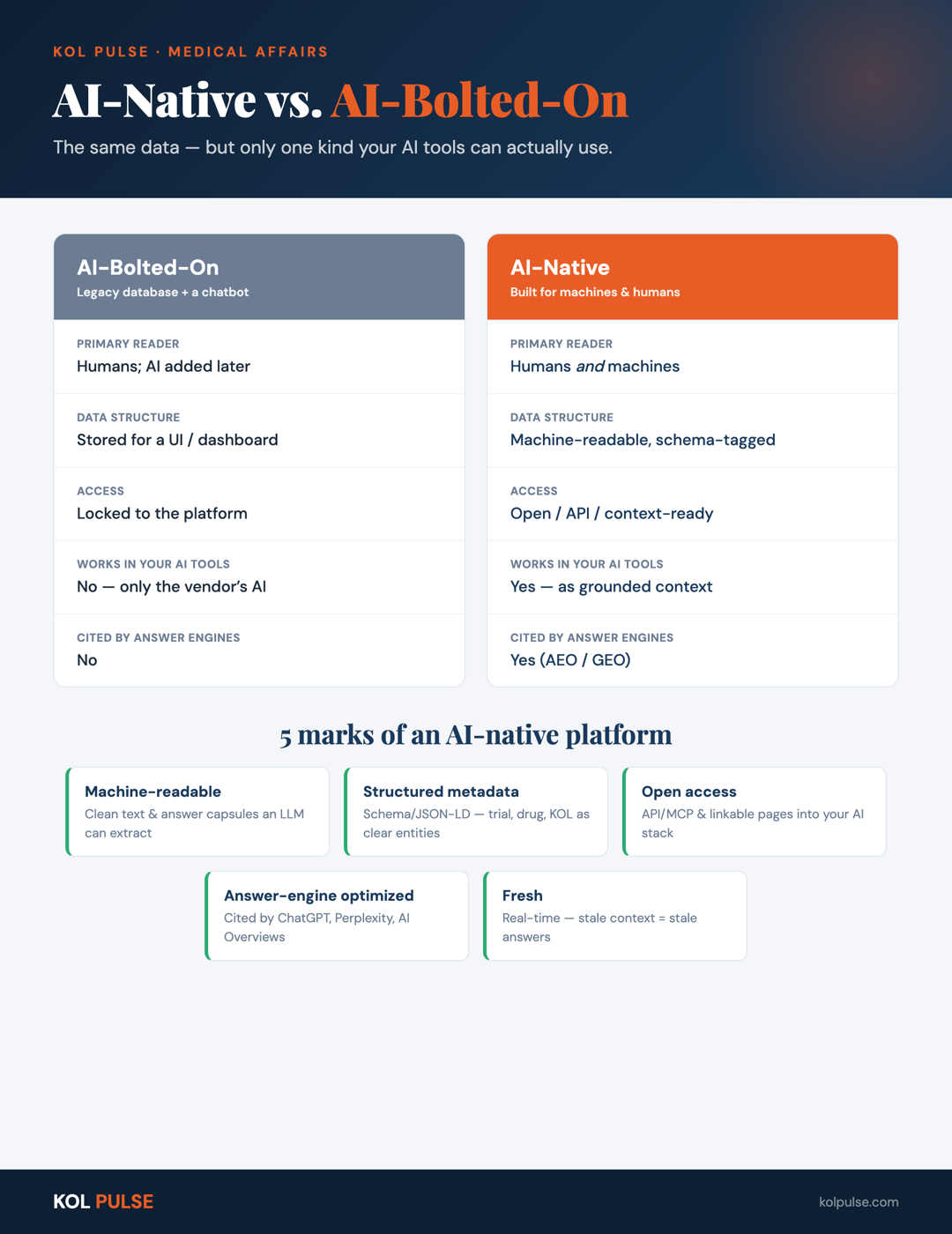
An AI-native product is built so machines, not just humans, are first-class readers. In practice that means: clean, extractable text; structured metadata (schema/JSON-LD) so entities like a trial, drug, or KOL are unambiguous; stable URLs that serve as dependable reference points; and programmatic access (API/MCP) treated as a primary interface, not an afterthought. The test: can an AI tool reach your data, understand it, and quote it correctly without a human copying and pasting? If yes, it’s AI-native.
Most “AI” in enterprise software today is a feature added to a system designed for a pre-AI world. The intelligence still lives inside a closed platform; the AI just sits on top of it. That’s useful, but it’s capped — the model can only help inside the vendor’s walls.
| Dimension | AI-native | AI-bolted-on (legacy + chatbot) |
|---|---|---|
| Primary reader | Humans and machines | Humans; AI added later |
| Data structure | Machine-readable, schema-tagged | Stored for a UI/database |
| Access | Open / API / context-ready | Locked to the platform |
| Works in your AI tools | Yes — as grounded context | No — only the vendor’s AI |
| Cited by answer engines (AEO/GEO) | Yes | No |
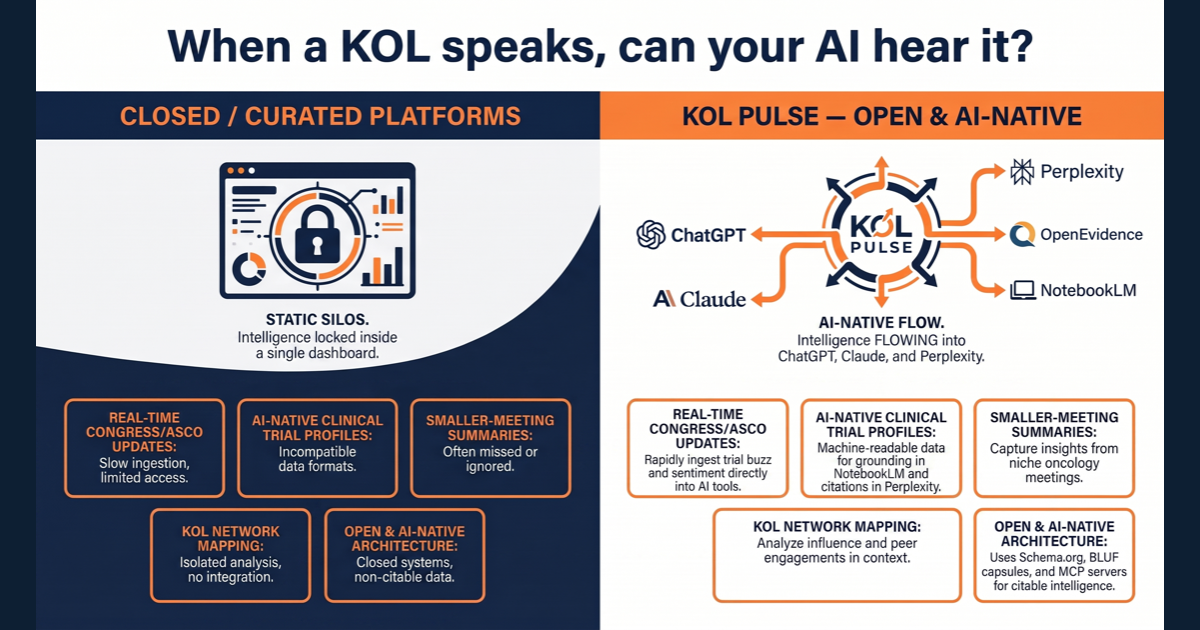
Because the workflow has already shifted. Physicians increasingly resolve clinical questions inside AI tools, and MSLs prep, synthesize, and follow up with them too. If your scientific intelligence is locked in a closed dashboard, those tools can’t use it as context and answer engines can’t surface it — so your evidence is effectively invisible at the moment of decision. AI-native data does the opposite: it travels into the workflow, grounds the model’s answer, and gets cited. The value compounds every time someone’s AI reaches for it.
Yes — by design. KOL Pulse trial profiles, conference intelligence, and KOL pages are machine-readable, schema-structured, answer-engine-optimized, and accessible programmatically. They’re built to be pasted, linked, or pulled into ChatGPT, Claude, Perplexity, OpenEvidence, and NotebookLM as grounding context — and to be cited when answer engines respond to oncology questions. That’s the difference between intelligence you can see and intelligence your AI can use. Want the practical steps? Read How to Use KOL Pulse in Your AI Workflows, and see why it matters for the oncology MSL.
Data and software designed from the start so AI tools can read, reason over, and cite it — machine-readable, structured, open, and answer-engine-optimized — rather than a legacy system with an AI feature added on top.
AI-enabled means a traditional platform added a chatbot or AI feature inside its walls. AI-native means the underlying data is structured and open so any AI tool — not just the vendor’s — can use it as grounded context.
Physicians and MSLs increasingly work through AI tools. If your intelligence is locked in a closed dashboard, those tools can’t reach it and answer engines can’t cite it. AI-native data flows into the workflow and compounds in value.
KOL Pulse pages are machine-readable, schema-structured, answer-engine-optimized, and accessible programmatically, so they work as grounding context inside ChatGPT, Claude, Perplexity, OpenEvidence, and NotebookLM.
See AI-native intelligence in action
Browse live trial profiles and conference intelligence — or book a demo.
Compiled and reviewed by the KOL Pulse research team, led by Brian Shields, Founder, KOL Pulse. Last updated June 2026.
4 min read
The short version: Oncology MSLs need to know what experts are saying right now — and feed that intelligence straight into the AI tools they (and...

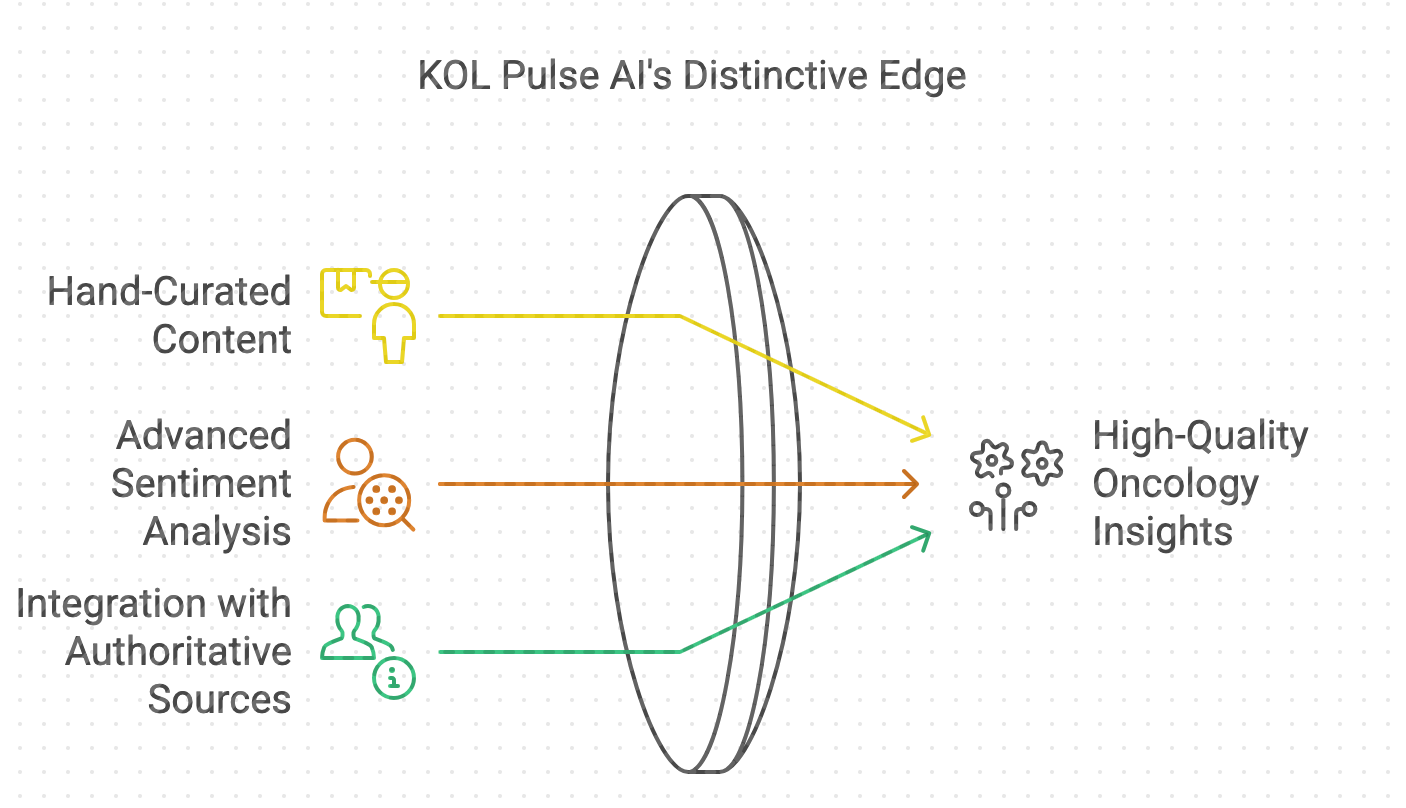
KOL Pulse AI is a specialized platform that leverages hand-curated Key Opinion Leader (KOL) conversations in oncology, enhanced by advanced AI...
1 min read
In the healthcare industry, influencers and opinion leaders play a crucial role in shaping the opinions of their peers and influencing the decisions...