4 min read
5 Reasons Every Oncology MSL Should Rely on KOL Pulse

“Your physicians are already asking AI about your competitors’ trials — can that AI even read your KOL intelligence?”
— The question every medical-affairs team should be asking in 2026
The problem: oncologists increasingly resolve clinical questions inside ChatGPT, Perplexity, and OpenEvidence. The catch: if your KOL and trial intelligence lives in a closed database, those tools can’t reach it and answer engines can’t cite it — so your science is invisible at the moment of decision. The fix: KOL Pulse is the open, AI-native layer that feeds the tools your team and your physicians actually use.
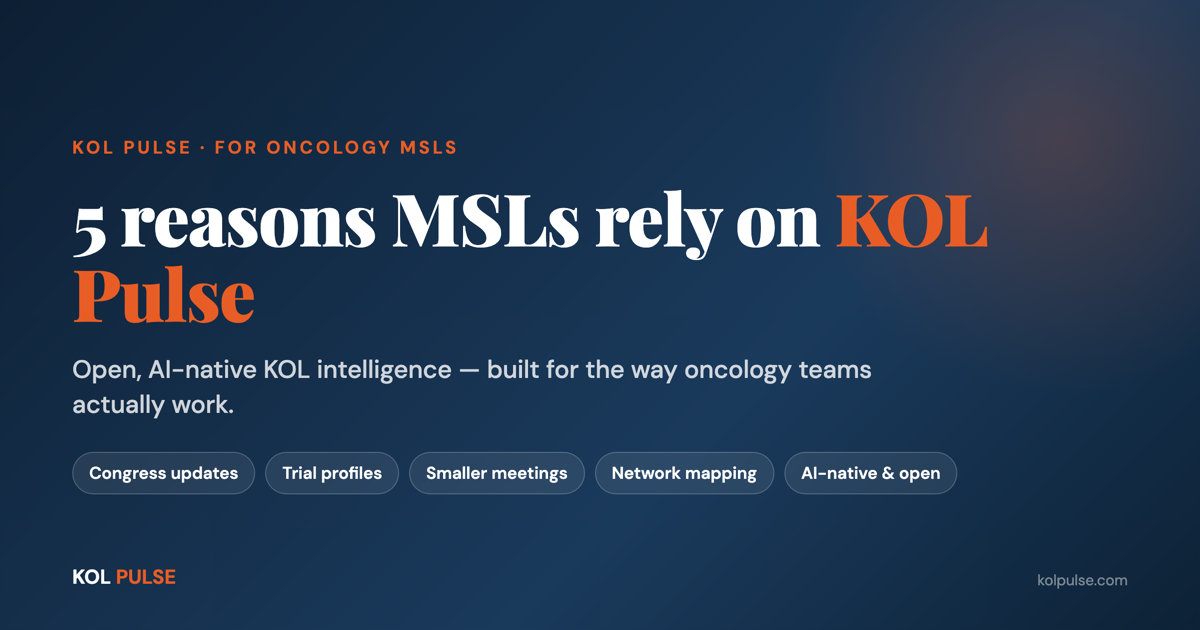
Veeva Link markets “real-time intelligence on key people,” and Larvol offers “real-time reactions from 5,000+ verified oncologists on X.” Both are good curated databases. But the deciding factor in 2026 is no longer who has the data — it’s whose data your AI workflow can reach and act on. Here are five reasons oncology MSLs rely on KOL Pulse.
1. Real-time ASCO (and every congress) updates — built for your AI workflow
When ASCO, ESMO, ASH, or SABCS is live, an insight’s half-life is hours. KOL Pulse captures the conference conversation as it happens — top voices, hot abstracts, trial buzz, and the debates forming on the floor — on a page your team and your AI tools can use immediately. Paste it into Claude for a Day-1 briefing or NotebookLM for a grounded prep notebook; the intelligence is structured to be consumed, not just read.
2. AI-native clinical trial profiles
Every major readout gets a trial profile: the data, the KOL sentiment, the slide text, the regulatory status, and the top voices — one page, structured with answer capsules and schema so it works as a clean “context object” for any AI tool. Drop the URL into ChatGPT and ask “summarize the KOL sentiment and name the top five voices,” and you get a grounded answer from the page, not a hallucination from training data.
3. Smaller-meeting summaries — the conversations the big platforms miss
The major congresses are covered by everyone. The edge is in the long tail: regional symposia, satellite sessions, tumor-board debates, X journal clubs, and KOL podcasts like Oncology Brothers and Uromigos. KOL Pulse summarizes these smaller, high-signal moments — often where practice-changing opinions form first, weeks before they reach a formal review.
4. Network mapping — when a KOL talks, who actually listens?
Influence isn’t a title or a profile score. KOL Pulse maps the amplification network: when a given oncologist posts, who reacts, quotes, and spreads it — which peers, institutions, and patient advocates. That tells an MSL who the real nodes are, who is rising, and how an idea will travel through the community — the difference between “who is influential” and “who is listening when they speak.”
5. Open and AI-native — why a closed system caps your AI
This reason ties the others together. Veeva delivers its intelligence via web app, API, and data file integrated with Veeva CRM; Larvol distills sources into curated reports. Both are, by design, licensed and closed. KOL Pulse is open and answer-engine-optimized — built to be consumed by ChatGPT, Claude, Perplexity, OpenEvidence, and NotebookLM, and to be cited when those engines answer oncology questions. When AI is doing the reasoning, the intelligence your model can reach and cite beats the intelligence locked in someone else’s dashboard.
KOL Pulse vs. Veeva Link vs. Larvol — for an oncology MSL
| What an MSL needs | KOL Pulse | Veeva Link | Larvol |
|---|---|---|---|
| Real-time congress coverage | AI-native page | In-platform alerts | Curated recap |
| Trial profiles with KOL sentiment | Trial-centric | People-centric | Drug / CI-centric |
| Smaller meetings & podcasts | Focus area | Formal record | Big-congress focus |
| KOL amplification network | Live network | Influence attribute | KOL monitoring |
| Feeds your AI tools (open) | Yes | API into Veeva | Reports / dashboard |
| Cited by answer engines (AEO) | Yes | No | No |
Comparison reflects design philosophy (open / AI-native vs. closed / curated). Sources: veeva.com, larvol.com.
What this means for the medical-affairs team
The throughline across all five: medical affairs is shifting from “who has the most data” to “whose data the AI can use.” An MSL armed with an open, AI-native intelligence layer engages physicians as a peer, surfaces the right voices faster, and stays visible at the exact moment a clinician (or their AI) is forming an opinion.
Frequently asked questions
How is KOL Pulse different from Veeva Link?
Veeva Link is a curated KOL database and insights suite inside the Veeva ecosystem and CRM. KOL Pulse adds an open, AI-native, trial-and-sentiment-centric layer that flows into the AI tools your team already uses and is visible to answer engines.
How is KOL Pulse different from Larvol?
Larvol excels at oncology competitive intelligence and conference recaps in curated reports. KOL Pulse focuses on MSL field engagement — live KOL sentiment, amplification networks, and smaller-meeting coverage — in an AI-native format.
Why does a closed system limit AI outcomes?
If intelligence lives only inside a licensed platform, your AI tools can’t reach it as grounded context and answer engines can’t cite it. The AI result is only as good as the data it can access.
Can KOL Pulse data be used in ChatGPT, Claude, or NotebookLM?
Yes — pages are AEO-structured and built to be pasted, linked, or pulled into AI tools as grounding context.
Featured trial profiles on KOL Pulse
Catch the live congress chatter
Compiled and reviewed by the KOL Pulse research team, led by Brian Shields, Founder, KOL Pulse. Last updated June 2026.