Brian Shields
“Combination therapy shows over ONE-YEAR mOS improvement compared to osimertinib alone. Key data to discuss with patients in clinic—but does this simplify first-line treatment decisions?”
— Eric K. Singhi, MD (@lungoncdoc) on MARIPOSA — 59,629 impressions
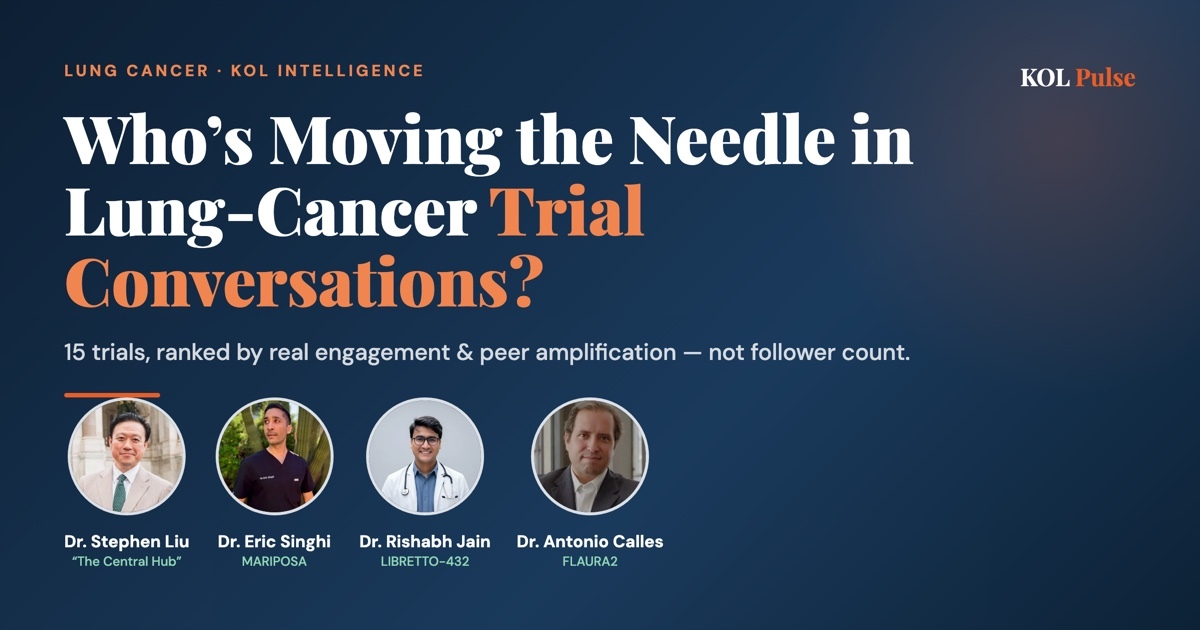
When Dr. Eric Singhi asks his followers whether MARIPOSA’s survival win simplifies first-line decisions, he isn’t just reporting data — he’s shaping how the field reads the trial. That’s how sentiment forms in lung cancer: in the takes practicing oncologists post, debate, and amplify. The problem: a name search on X tells you whether a doctor posts — not whose questions actually move the conversation. The miss: follower counts hide who genuinely shapes sentiment on a given trial, whose take travels through the community, and who pushes back. The lens: rank by real engagement and peer amplification, trial by trial. Here’s how the lung-cancer conversation is actually structured — aggregated across 15 major trials (MARIPOSA, FLAURA2, LAURA, CROWN, ADAURA, ADRIATIC, AEGEAN, CheckMate-77T, ALINA, HARMONi-6, LIBRETTO-432 and more), practicing physicians only, by the numbers.
The lung-cancer leaderboard (real engagement, physicians only)
These are practicing thoracic oncologists — media and pharma accounts removed — ranked by total impressions on clinical-trial discussion across the 15 trials we aggregated. The number that matters most next to each is peer amplification (retweets + quotes received): how far their take actually travels.
| KOL | Impressions | Amplification | Most active on |
|---|---|---|---|
| Stephen V. Liu @stephenvliu | 599,453 | 1,856 | MARIPOSA, LAURA, AEGEAN, HARMONi-6 |
| Eric K. Singhi @lungoncdoc | 544,090 | 648 | MARIPOSA |
| Rami Manochakian @rmanochakian | 223,975 | 546 | ADRIATIC, MARIPOSA, FLAURA2 |
| Amol Akhade @suyogcancer | 214,947 | 373 | MARIPOSA, LAURA, ALINA |
| Rishabh Jain @drrishabhonco | 199,539 | 370 | LIBRETTO-432 (curator) |
| Jarushka Naidoo @drjnaidoo | 173,394 | 410 | FLAURA2, ALINA |
| H. Jack West @jackwestmd | 162,383 | 96 | LAURA, ADAURA (skeptic) |
| Charu Aggarwal @charuaggarwalmd | 156,719 | 199 | ADAURA, CROWN |
| Hidehito Horinouchi @hhorinouchi | 135,302 | 376 | CROWN, AEGEAN |
| Antonio Calles @tony_calles | 134,348 | 489 | FLAURA2, FLAURA |
Impressions and amplification (retweets + quotes received) aggregated across 15 lung trials in the KOL Pulse database. Media, institutional, and pharma accounts excluded.
The micro-networks: who shapes the conversation on each trial?
Zoom in and the broad lung network resolves into trial-level micro-networks — tight clusters of physicians engaging around one study. Dr. Stephen Liu is the connecting hub, the most-engaged voice across many trials at once. But beneath the hub, each trial has its own anchor — the voice, besides Dr. Liu, who most shapes that specific conversation. Ranked by real engagement (likes + retweets + replies + quotes, not just views) — and on MARIPOSA, that anchor out-engages even the hub:
| Trial micro-network | Trial’s anchoring voice | Engagement | Impressions |
|---|---|---|---|
| MARIPOSA | @lungoncdoc — Eric Singhi | 1,457 | 217,015 |
| LIBRETTO-432 (RET+) | @drrishabhonco — Rishabh Jain | 877 | 164,728 |
| LAURA | @fordepatrick — Patrick Forde | 442 | 52,377 |
| ADAURA | @vprasadmdmph — Vinay Prasad | 291 | 221,874 |
| AEGEAN | @drewmoghanaki — Drew Moghanaki | 232 | 69,678 |
| ALINA | @dr_yakupergun — Yakup Ergün | 236 | 19,719 |
Engagement = likes + retweets + replies + quotes for that physician on that trial, from verified multi-post discussion (3+ posts, excluding one-off presenter announcements). The table excludes the cross-trial hub (Dr. Stephen Liu) to surface each trial’s own anchoring voice. Physicians only.
Don’t confuse the presenter with the voice shaping the digital conversations
One nuance the raw numbers hide: engagement attributed to an author can belong to a PI or presenter whose talk the field is discussing — not an actively engaged digital voice. On ADAURA, the most-engaged account is Dr. Roy Herbst, but his footprint is two presenter announcements (“Presenting the ADAURA data now @ASCO … DFS HR=0.17!” and the 2023 OS plenary). On ADRIATIC, the top author is reporting Dr. David Spigel’s plenary. These conversations orbit the presenter rather than being shaped by them on X. Both signals matter — Dr. Herbst and Dr. Spigel are the authoritative PIs behind the data — but presenter gravity is a different thing from a voice actively shaping social sentiment, and only a real engagement view (who authored what, how often) tells the two apart.
See the analytics in action
These aren’t cherry-picked screenshots — they’re the top authored posts from each trial’s most-engaged voice, with the real engagement KOL Pulse captures on every tweet. Notice the through-line: each is a substantive take on a specific trial — a question to the field, a read on the data, an opinion — which is how sentiment actually forms:


The archetypes moving the needle
1. The Central Hub — broad across the field
Dr. Stephen Liu is the EGFR/ALK conversation hub: nearly 600K impressions and the top voice on FLAURA2, LAURA, AEGEAN, CheckMate-77T and KRYSTAL-12, with the highest peer amplification in lung cancer(1,856 retweets + quotes). When he frames a question, the field answers.
2. The trial-focused voice — deep, not wide
Dr. Eric Singhi is the clearest example: 544K impressions, the overwhelming majority concentrated on MARIPOSA, making him the leading digital voice in the conversation on amivantamab + lazertinib in 1L EGFR NSCLC. His MARIPOSA micro-network draws 1,457 engagements — more than anyone else on the trial, the cross-trial hub included. A follower count alone would never tell you that — the trial-level engagement does.
3. The amplifier / curator — reach beyond their own data
Dr. Rishabh Jain shows a different kind of influence: high-reach curation. His “most important trials of #ASCO26” threads pull 50K–98K impressions and 60–160 retweets, putting trials like LIBRETTO-432 in front of the whole community. Amplifiers like this don’t generate the primary data — they decide what the field sees.
4. The international voices — the ones a US-name search misses
Easy to overlook from a US desk: international voices who shape a trial’s conversation in their region. Dr. Hidehito Horinouchi (Japan) on CROWN’s 7-year ALK+ update, Dr. Yakup Ergün on ALINA, and Dr. Noemi Reguart (Spain) on HARMONi-6 each carry real reach a US-name search never surfaces — and they shape how each readout lands across their regions.
5. The skeptics — and an open role
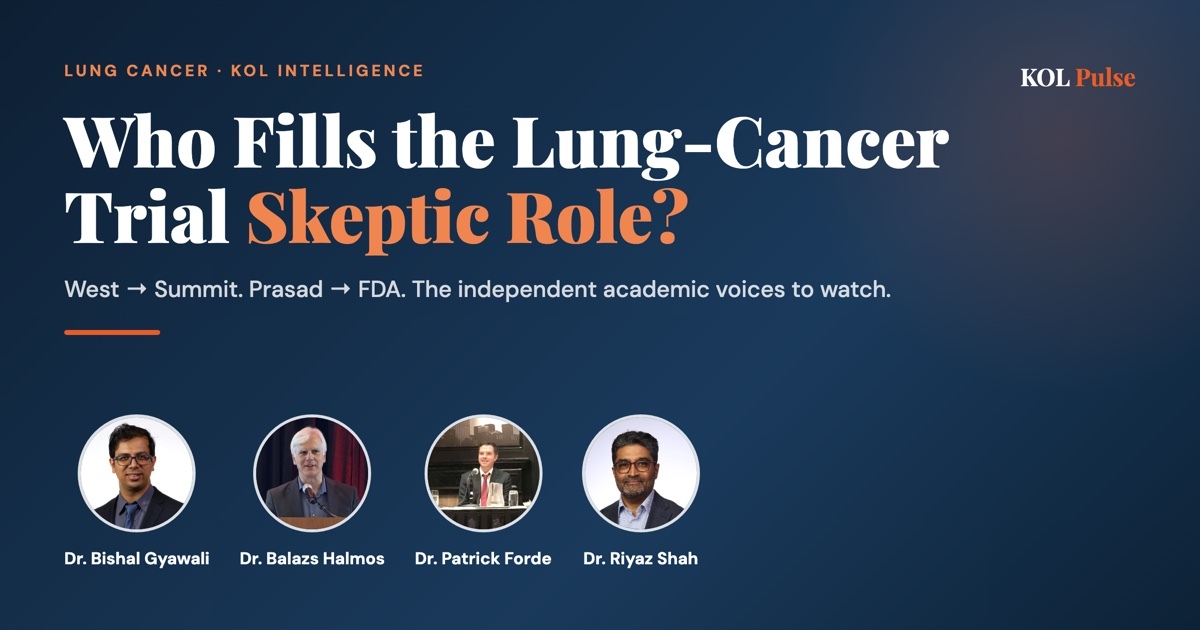
Skeptics shape the debate as much as boosters — pressing on endpoints, surrogate measures, and what a result actually means in clinic. But the field’s two most-networked skeptics have both stepped out of the independent-academic role. Dr. Jack West joined Summit Therapeutics as VP of Clinical Development — working on ivonescimab, the very PD-1/VEGF bispecific behind HARMONi-6 above — so that incisive voice now speaks from industry. And Dr. Vinay Prasad served as the FDA’s CBER Director and Chief Medical & Scientific Officer before returning to UCSF in 2026. That leaves a real question for the field: who fills the high-reach, independent-skeptic role now? Whoever does will quietly shape how the next wave of lung cancer clinical trial readouts is received — we name the independent academics already stepping in, with their data, in the companion piece: Who Fills the Lung-Cancer Trial Skeptic Role?
Why peer amplification beats follower count
Follower count is a vanity number; amplification is a behavior. When peers retweet and quote a KOL, they’re vouching — and that’s how an idea actually spreads through the lung community. Dr. Liu (1,856), Dr. Singhi (648), Dr. Manochakian (546), Dr. Calles (489) and Dr. Naidoo (410) lead on amplification, which is why their framing of a trial tends to become the field’s framing. Mapping amplification tells you not just who is loud, but who is listened to.
What the map reveals
Read together, the data shows influence in lung cancer isn’t a popularity ranking — it’s a structure. A connecting hub (Dr. Liu) links most trials; trial-focused voices like Dr. Singhi shape sentiment on a single study more than anyone else; amplifiers decide what the field actually sees; international voices carry how a readout lands in their regions; and the skeptic role that pressure-tests every result is, right now, in flux. For anyone who follows the field — the opinion leaders shaping it and the teams who engage them alike — that map is the difference between “who has a big following” and “whose voice actually moves opinion on this trial.”
Frequently asked questions
Who are the most influential lung-cancer KOLs on X?
By real engagement across 15 lung trials, the top physician voices include Dr. Stephen V. Liu (~599K impressions), Dr. Eric Singhi (~544K, MARIPOSA), Dr. Rami Manochakian, Dr. Jarushka Naidoo, Dr. Antonio Calles, and Dr. Hidehito Horinouchi.
What is peer amplification and why does it matter?
Amplification is how often a KOL’s posts are retweeted and quoted by peers — a vouching behavior that measures real influence and idea-spread far better than follower count.
What’s a ‘trial-focused voice’?
A KOL whose engagement concentrates on one study — like Dr. Eric Singhi on MARIPOSA — making them the voice that most shapes that trial’s conversation, regardless of overall follower count.
What is a trial micro-network?
A tight cluster of physicians who engage with each other around one specific trial. The broad lung network contains many such micro-networks, each with its own most-engaged voice — e.g. Eric Singhi’s MARIPOSA cluster. A network visualization, like the KOL Pulse ELCC 2026 graph, makes these clusters visible in a way a ranked list cannot.
Does high engagement always mean a KOL is shaping the conversation?
No. Engagement attributed to an account can reflect a PI or presenter whose talk the field is discussing — e.g. Dr. Roy Herbst on ADAURA, whose footprint is two presenter announcements. That’s meaningful (they’re the authoritative PI), but it’s distinct from a voice actively shaping sentiment. A real engagement view — who authored what, and how often — separates the two.
Who are the lung-cancer skeptic voices now?
The field’s two most-networked skeptics have stepped out of the independent-academic role: Dr. Jack West joined Summit Therapeutics (VP of Clinical Development, working on ivonescimab), and Dr. Vinay Prasad served as the FDA’s CBER Director and Chief Medical & Scientific Officer before returning to UCSF in 2026. That leaves an open, high-reach independent-skeptic role — one worth watching closely.
How can you see who shapes a trial’s reception?
Rank the voices on a trial by real engagement and peer amplification, not follower count. That surfaces who actually shapes sentiment on that study — the hub, the trial-focused voice, the amplifier, and the skeptic — turning a static name list into a live influence map of the conversation.
The lung-cancer trials behind this network
Catch the live congress chatter
Compiled and reviewed by the KOL Pulse research team, led by Brian Shields, Founder, KOL Pulse. Engagement, impressions, and verbatim quotes are real figures from the KOL Pulse database, aggregated across 15 lung-cancer trials. Last updated June 2026.