The Peters table — as presented
Shared from the floor by Dr. Stephen Liu during Prof. Solange Peters’ talk on immunotherapy for PD-L1+ early-stage NSCLC. Source table: Remon & Peters, Lancet Respiratory Medicine 2026 (the slide notes the AEGEAN study was supported by AstraZeneca).

The same table, machine-readable
Every value transcribed verbatim from the slide above (IO arm vs control). EFS = event-free survival; pCR = pathological complete response. Timeframes: 2-year EFS and 5-year OS for all trials except RATIONALE 315 (2-year EFS / 4-year OS). Green = the endpoint was formally met against its prespecified statistical boundary in a reported analysis; amber = not formally met at the analyses shown (CI crossing 1, boundary not crossed, or a secondary/interim/immature readout). CI levels vary by analysis — interim readouts use alpha-adjusted intervals (e.g. CheckMate 77T OS is a 97.63% CI). Color coding is ours, not the slide’s.
| Trial | Setting & regimen | pCR (IO vs ctrl) | 2y EFS % (IO vs ctrl) | EFS HR (CI as reported) | 5y OS % (IO vs ctrl) | OS HR (CI as reported) | Notes |
|---|---|---|---|---|---|---|---|
| CheckMate 816 | Neoadjuvant: CT + nivolumab → surgery, vs CT → surgery · 3 cycles | 24% vs 2.2% | 64 vs 45 | 0.65 (0.44–0.96)† | 65 vs 55 | 0.72 (0.52–0.99) | US: all PD-L1; EU: PD-L1 ≥1% |
| KEYNOTE-671 | Perioperative: CT + pembrolizumab → surgery → pembrolizumab, vs CT → surgery → placebo | 18% vs 4.0% | 61 vs 42 | 0.59 (0.46–0.72) | 65 vs 54 | 0.72 (0.56–0.93) | All PD-L1 (US & EU) |
| AEGEAN | Perioperative: CT + durvalumab → surgery → durvalumab, vs CT → surgery → placebo | 17.2% vs 4.3% | 63 vs 52 | 0.69 (0.55–0.88) | — | 0.89 (0.70–1.14) | US & EU: all PD-L1 (no PD-L1 threshold in either label; EMA label excludes EGFR/ALK-positive disease). Study supported by AstraZeneca (slide footnote) |
| CheckMate 77T | Perioperative: CT + nivolumab → surgery → nivolumab, vs CT → surgery → placebo | 25.3% vs 4.3% | 67 vs 44 | 0.61 (0.46–0.80) | — | 0.85 (0.58–1.25) | US: all PD-L1; EU: PD-L1 ≥1% |
| RATIONALE 315 | Perioperative: CT + tislelizumab → surgery → tislelizumab, vs CT → surgery → placebo | 41% vs 5.7% | 67 vs 52 | 0.58 (0.43–0.79) | 72 vs 62 (4y) | 0.65 (0.45–0.93) | All PD-L1; 2y EFS / 4y OS. Tislelizumab: EU-approved in this setting (Aug 2025); not FDA-approved in NSCLC (US label: esophageal & gastric/GEJ cancers only) |
| NEOTORCH | Perioperative: CT + toripalimab → surgery → CT + toripalimab (then toripalimab maintenance up to 13 cycles), vs CT → surgery → placebo | 24.8% vs 1.0% | 67 vs 46 | 0.40 (0.28–0.57) | — | 0.62 (0.38–1.00) | 2y EFS / 5y OS. OS secondary, interim (P=.05; CI touches 1). Tabulated data = stage III subset (404/501). Toripalimab: China NMPA only (stage IIIA–IIIB); not FDA/EMA-approved in this setting |
| Adebrelimab Ph3 (SHR-1316-III-303, NCT04316364) | Perioperative: CT + adebrelimab → surgery → adebrelimab, vs CT → surgery → placebo · 3 cycles | 31.1% vs 7.6% | 75 vs 56 | 0.52 (0.38–0.72) | — | 0.57 (0.36–0.88) | 2y EFS / 5y OS. OS secondary, immature; AACR 2026 abstract CT014, not yet peer-reviewed. Adebrelimab: China NMPA only; no FDA or EMA approval |
Transcribed verbatim from Remon & Peters, Lancet Respiratory Medicine 2026 (doi:10.1016/S2213-2600(26)00221-3), as presented at BTG Lung 2026. “—” = 5-year OS percentage not shown on the slide for that trial. These are seven different trials with different populations (CheckMate 816 is stage IB–IIIA by AJCC 7th ed.; NEOTORCH’s tabulated data are its stage III subset; RATIONALE 315, NEOTORCH and the adebrelimab trial enrolled in China only), geographies, PD-L1 distributions, induction backbones and follow-up maturity (median follow-up behind the EFS column ranges ~18 to 68 months, with no per-cell data-cut labels on the source slide) — the table informs positioning discussions, not treatment selection between agents.
Regulatory status (September 2026): CheckMate 816, KEYNOTE-671, AEGEAN and CheckMate 77T regimens are FDA-approved in resectable NSCLC. Tislelizumab (RATIONALE 315) is EU-approved in this setting but not FDA-approved in NSCLC. Toripalimab (NEOTORCH) and adebrelimab are approved only in China; neither has FDA or EMA approval in this setting.
Values are as presented on the slide. Where the primary publication differs, the primary value is given here: †CheckMate 816 — the slide’s “EFS HR 0.65 (0.44–0.96)” corresponds to the 5-year lung-cancer-specific survival HR (NEJM 2025); the published EFS HRs are 0.63 (97.38% CI 0.43–0.91; primary, NEJM 2022) and 0.68 (0.51–0.91; 5-year final). KEYNOTE-671 — published EFS HR at IA2 is 0.59 (0.48–0.72); the CI shown belongs to IA1’s HR 0.58; the 5-year OS HR is 0.74 (0.59–0.92), while the HR 0.72 shown is from IA2 (36.6-month follow-up). CheckMate 77T — published control-arm pCR is 4.7% (NEJM 2024); the OS interval shown is the 97.63% interim CI (95% CI 0.61–1.18). NEOTORCH — published investigator-assessed 2-year EFS is 64.7% vs 38.7% (JAMA 2024); the 67 vs 46 shown reflects IRC assessment. RATIONALE 315 — the published landmark is 36-month OS 79.3% vs 69.3% (Ann Oncol 2026; median follow-up 38.5 months); the 4-year values shown could not be verified in a peer-reviewed publication, and its 2-year EFS landmark (published 68.3% vs 51.8%) is from the interim cut while the HRs shown are from the final analysis. Published 2-year EFS landmarks also differ elsewhere: KEYNOTE-671 62.4% vs 40.6% (NEJM 2023); CheckMate 77T has no published 24-month EFS landmark (published: 18-month 70.2% vs 50.0%, NEJM 2024; 30-month 61% vs 43%, ASCO 2025).
The discussant frame: two curative paradigms, one evidence gap
From Dr. Kevin Chua (Duke-NUS / National Cancer Centre Singapore), photographed at the same meeting by Dr. Liu.
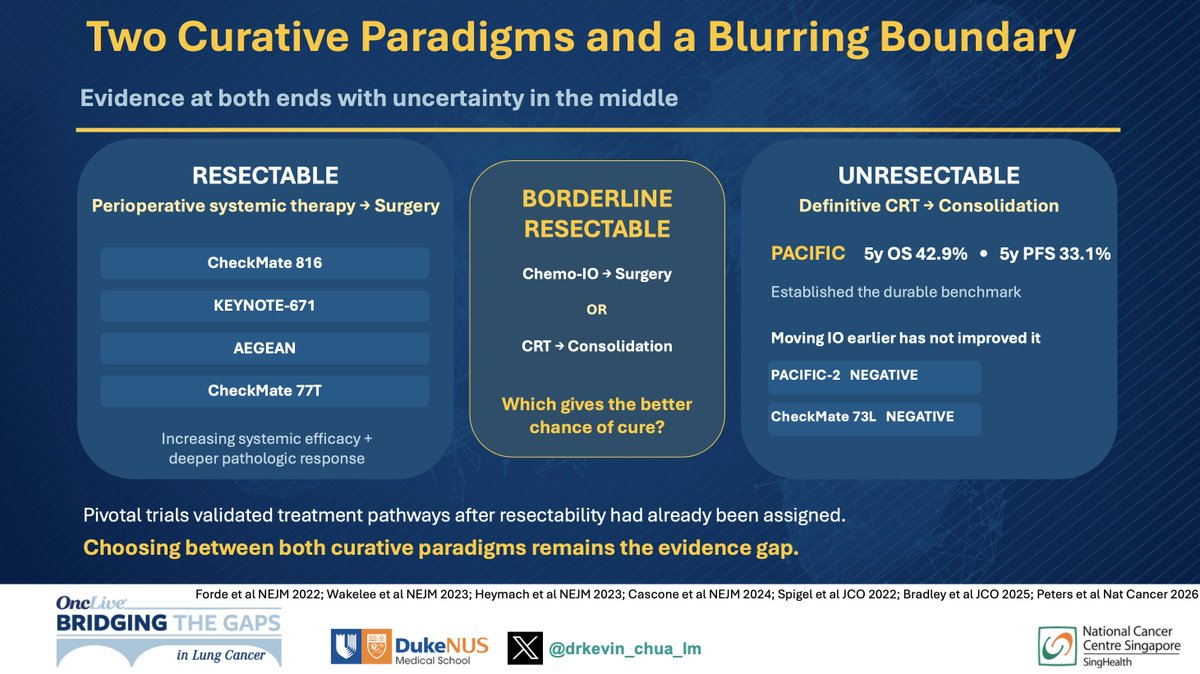
The perioperative table above answers “which IO regimen once resectability is assigned.” Chua’s frame asks the harder upstream question: pivotal trials validated pathways after resectability had been decided. The radiation-based paradigm holds a durable benchmark (PACIFIC: 5-year OS 42.9%, 5-year PFS 33.1%) that subsequent trials have not improved — PACIFIC-2 (durvalumab concurrent with CRT vs CRT alone) and CheckMate 73L (which tested moving IO earlier against a PACIFIC-style consolidation control) were both negative — and for borderline-resectable disease, chemo-IO → surgery versus CRT → consolidation remains, in his words on the slide, the evidence gap.
Explore the trials on KOL Pulse
Questions this page answers
Which perioperative immunotherapy trials in resectable NSCLC does this page compare?
Seven randomized trials: CheckMate 816 (neoadjuvant nivolumab) and the perioperative trials KEYNOTE-671 (pembrolizumab), AEGEAN (durvalumab), CheckMate 77T (nivolumab), RATIONALE 315 (tislelizumab), NEOTORCH (toripalimab) and the adebrelimab Phase 3 — pCR, 2-year EFS and OS side by side, per Remon & Peters (Lancet Resp Med 2026).
Which trial shows the strongest event-free survival effect?
These seven trials cannot be ranked against one another — populations, stages, regions and data cuts differ, so cross-trial comparisons are hypothesis-generating only. Within the table, NEOTORCH reports the lowest EFS hazard ratio (0.40, 95% CI 0.28–0.57), in a stage III-only tabulation; among the three trials that formally met an overall survival endpoint, RATIONALE 315 reports HR 0.65 and CheckMate 816 and KEYNOTE-671 both report HR 0.72.
Do all of these trials show an overall survival benefit?
No. Three trials have formally met an overall survival endpoint: CheckMate 816 (HR 0.72, final analysis), KEYNOTE-671 (OS a dual primary endpoint; HR 0.72) and RATIONALE 315 (HR 0.65, final analysis). AEGEAN (0.89) and CheckMate 77T (0.85) have confidence intervals crossing 1 at these analyses, NEOTORCH’s OS is a secondary, interim readout (0.62, CI 0.38–1.00, P=.05), and the adebrelimab trial’s OS is secondary and immature (abstract-only).
Which of these regimens are FDA-approved in resectable NSCLC?
As of September 2026: the CheckMate 816, KEYNOTE-671, AEGEAN and CheckMate 77T regimens are FDA-approved in resectable NSCLC. Tislelizumab (RATIONALE 315) is EU-approved in this setting but not FDA-approved in NSCLC; toripalimab (NEOTORCH) and adebrelimab are approved only in China, with no FDA or EMA approval in this setting.
How should this comparison be used?
As positioning context. Per the BTG Lung 2026 discussant framing, the pivotal trials validated pathways after resectability was assigned — choosing between the surgical and radiation-based curative paradigms, especially in borderline-resectable disease, remains the evidence gap. Paste this page URL into your AI assistant and ask it to compare any two rows — every figure above is in the machine-readable table.