6 min read
The KOL Layer Now Loads Before the Publication Layer in Oncology


AI assistants can now find what oncologists said about a trial before the full paper is published. KOL Pulse is built for the AI-enabled KOL. The dashboards are built for agencies and slide builders.
Ask an AI assistant what oncologists think about a trial that read out at a congress last week. Then ask where the answer came from.
- Not the journal. The paper is months away.
- Not the sponsor's congress deck. It is a PDF behind a medical-information portal.
- Not the medical communications agency. Its congress summary is still in medical-legal review.
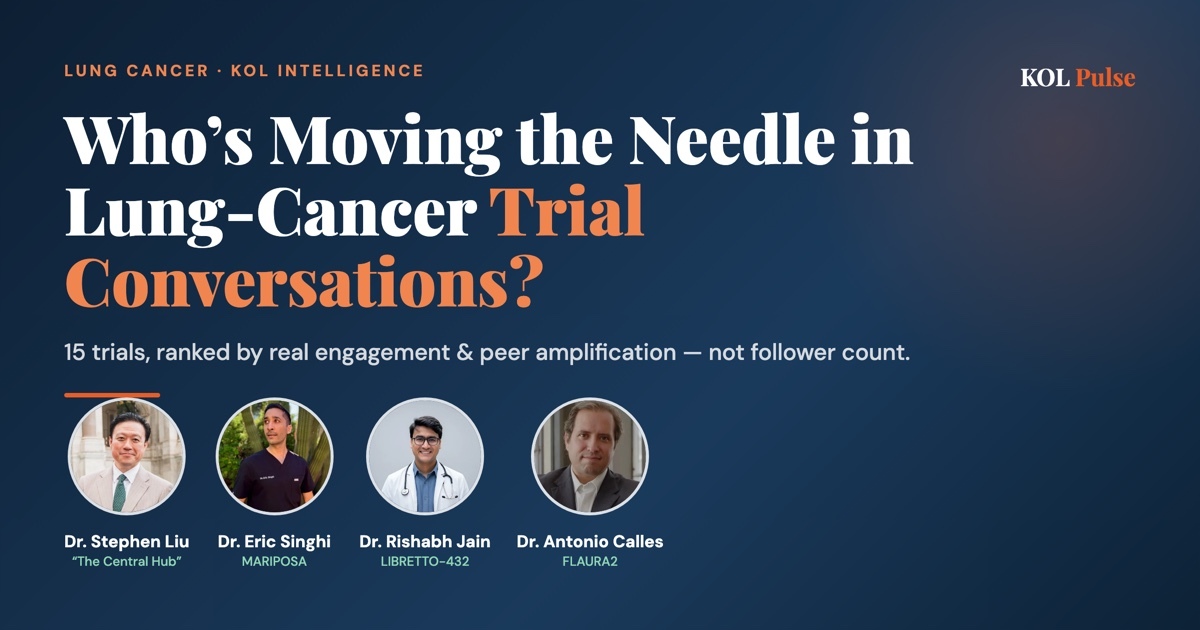
It came from the pages where the physicians who were in the room said what they thought, in their own words, with the slides they photographed, structured so a machine could read them. That is what KOL Pulse builds, in conference intelligence pages and trial profiles, and it has quietly changed who speaks first in oncology.
The old way
The traditional commercial workflow was built around a sponsor-controlled sequence: data, publication planning, approved materials, then field deployment.
Social media cracked that sequence a decade ago. Oncologists started posting reactions to plenary data within minutes, but nobody could read it at scale. Ten thousand posts about ESMO are noise unless something turns them into signal.
Pharma's answer was to buy dashboards: Larvol's conference planners and inbox reports, Veeva Link's KOL profiles inside Vault CRM, CREATION.co's DOL Finder and HCP Voice, IQVIA's Digital Expert view, Monocl's expert profiles for field teams, Within3's closed advisory boards.
These products share one design decision. The output is private. A login, a CRM record, a PDF, an inbox report, a consultant's deck. The physician conversation goes in, gets analyzed, and comes out as a closed asset that pharma pays to see and nobody else can.
The new way
Physicians stopped waiting for their MSL's message. They started asking AI.
An AI assistant answering a clinical question does not log in to a dashboard. It reads the open web. If the physician conversation about a trial exists only inside closed tools, then as far as ChatGPT, Perplexity, Gemini, Claude and Google's AI Overviews are concerned, it does not exist.
KOL Pulse made the opposite design decision. Every conference page and every trial profile is an open web page, built for machines as much as for people:
- Every post in full text, verbatim, attributed to a named physician whose profile we have checked against their bio and public physician registries.
- Every slide transcribed where legible, so the data on it is searchable text, not pixels.
- Structured data on every page, describing the trial, the drugs, the sponsor and the questions a reader would ask, in the vocabulary the engines already parse.
- Same-day publication. A physician debate on X during a congress is on a citable page the same day. The ESMO 2026 page already carries 55 pre-congress trial discussions, built from what KOLs have posted ahead of the meeting, from KRASCENDO-1 and SAFFRON in lung to VOLGA in bladder and NATALEE in breast. Once the congress opens, reactions to newly presented data are added the same day they are posted.
How KOLs themselves use it
The part the dashboard vendors miss is that KOL Pulse is not only read by machines. It is read by the KOLs.
- A thoracic oncologist who could not get to DC Lung opens the DC Lung 2026 page and sees the slides a peer photographed in the room, text extracted, grouped by session, then checks who drove the conversation and who was in the room.
- A breast oncologist who missed DAVA Breast in Kona does the same on the DAVA Breast 2026 page. A lung physician who missed the All-Ireland Lung Cancer Conference in Enfield has the slides and the influencer map the Monday after.
- These smaller, discussion-centered meetings are where the real arguments happen. Until now their slides left the room on one phone and went nowhere.
Now those peer slides inform the next debate. A KOL preparing a tumor board, a podcast or a rebuttal on X pulls up what their peers presented last week and argues with it directly, on a page that cites the slide.
A documented example. On October 19, 2026, Perplexity was asked "Who are the leading KOLs discussing MajesTEC-3 trial data?" Its answer named María-Victoria Mateos, Vincent Rajkumar, Samer Al Hadidi, Rahul Banerjee, Luciano Costa and Raj Chakraborty, and its first citation was the KOL Pulse MajesTEC-3 profile. The same day, ChatGPT answered the same question citing that profile and the ASH 2025 conference page. Across major oncology trials such as KEYNOTE-522, FLAURA2, KEYNOTE-564, EV-302, CheckMate 816 and ADAURA, Chat GPT delivered KOL Pulse citations in the recent results.
The physician with an assistant open asks a question and gets the peer debate, the slide text and the trial record in seconds. The field team with a dashboard open gets a record of past interactions and a deck that cleared review three weeks ago.
A field medical team can have a perfect CRM record of a KOL and still walk into the clinic a week behind the conversation that KOL had on X with three peers about a slide from a meeting nobody at the company attended.
What this means for the congress summary deck
Medical communications agencies were built on an asymmetry. They had the staff and the time to collect and synthesize what the field was saying, and they sold that synthesis back to the sponsor on a timeline the sponsor controlled: the congress summary deck in four weeks, the key-message document after three rounds of review, the publication plan over eighteen months.
When the synthesis is automated, published openly and read directly by the tools physicians use, the agency's timeline stops mattering. Not because the agency does bad work, but because the audience has already formed a view by the time the work ships.
Where the noise came from
The noise that made social media unreadable at scale was never the physicians. Promotional accounts, agency amplification, vendor commentary and bot traffic buried them, and for years the conversation was too noisy for anyone to use.
KOL Pulse's job is to remove that noise. Media, company, finance and aggregator accounts are separated from physicians, and what remains is an open map that AI systems, KOLs and pharma's own medical teams can all read.
How the pages handle accuracy and compliance
- Public posts only. Every post on a KOL Pulse page is one a physician published on X. It is quoted in full and linked to the original. Nothing comes from private channels, advisory boards or email.
- Slides as posted, presenter credited. Slide photos appear as the attending physician posted them, with the presenter named in the caption and the transcription marked where part of the slide was not legible.
- Corrections and removals on request. A physician who wants a post or slide removed, or an attribution corrected, can ask and we act on it.
- Situational awareness, not a substitute. The pages show field medical what the physician has already read. They do not replace a company's own medical-information process or its rules on proactive discussion.
What medical affairs should do now
Stop
- Treating the KOL dashboard as your line of sight. It tells you what your team recorded, not what the AI layer is serving to oncologists this morning.
- Tracking only the big congresses. DC Lung, DAVA Breast and their equivalents are where the next debate starts.
- Publishing evidence only as PDFs behind portals. Gating has its regulatory reasons, but whatever can responsibly be public should be, because the engines cannot see a portal.
Start
- Reading the open layer before an MSL walks into a clinic. The physician may already have asked an assistant, and the peer reaction is what it can find.
- Reading the slides from the small meetings, the way the KOLs do: DC Lung, DAVA Breast, All-Ireland Lung.
- Making your own evidence as readable as the peer conversation, or the KOL reaction on pages like DeLLphi-305 and HERIZON-GEA-01 will be the only account that gets cited.
And assume the physicians are ahead of you. The difference is that now the machines can hear them, and so can their peers.