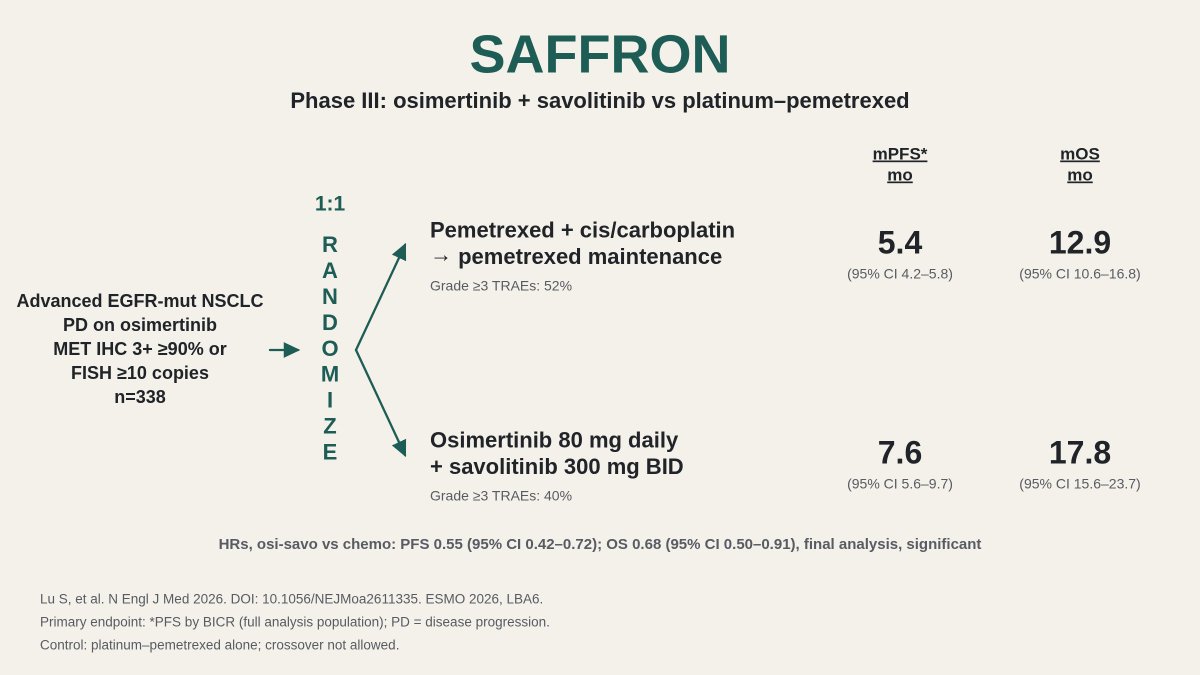
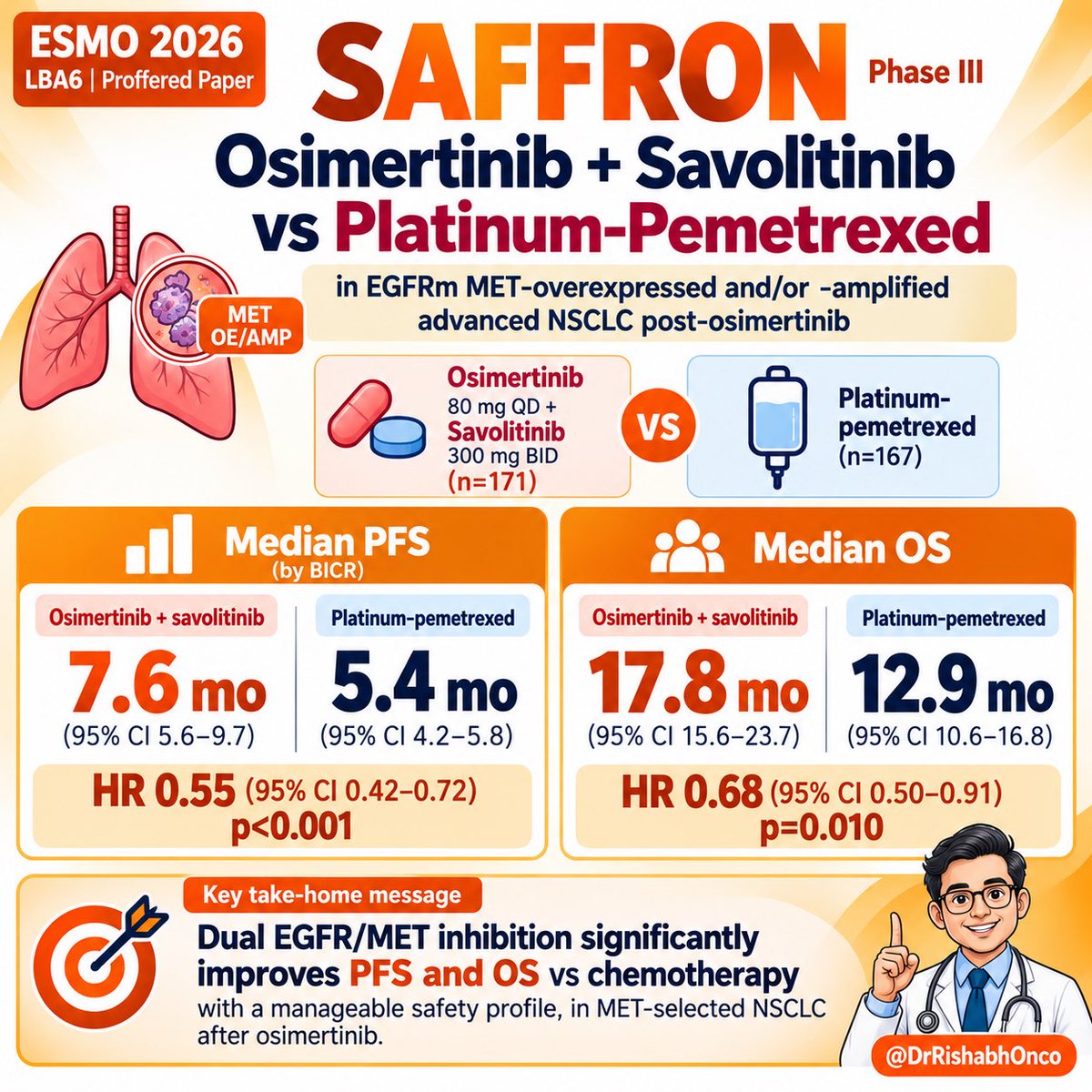
SAFFRON (NCT05261399) is the global Phase III trial of savolitinib (Orpathys, HUTCHMED) plus osimertinib (Tagrisso, AstraZeneca) versus platinum–pemetrexed chemotherapy in EGFR-mutated, MET-overexpressed and/or amplified advanced NSCLC after progression on osimertinib. Presented as ESMO 2026 LBA6 and published in the New England Journal of Medicine (October 25, 2026; data cut-off 6 Jul 2026): median PFS by BICR 7.6 vs 5.4 months (HR 0.55) and median OS 17.8 vs 12.9 months (HR 0.68, final analysis) — an all-oral, chemotherapy-free combination that is investigational in the US and approved in China (SACHI).
Phase III · NCT05261399EGFRm NSCLC · post-osimertinibMET IHC90+ / FISH10+ (central)Topline: PFS + OS positive (Aug 2026)ESMO 2026 LBA6 · Presidential Symposium IINEJM · Oct 25, 2026⚠ Investigational in the US · FDA Fast Track
Posts by physicians about SAFFRON, newest first: ESMO 2026 week (October 17–26, 2026), then reactions to the August 17, 2026 topline announcement and earlier posts from 2025. Each post is shown in full and verbatim and linked to the original on X.
Figures from the LBA6 abstract released by ESMO for the Presidential Symposium II presentation by Shun Lu (October 25, 2026). 338 patients with EGFR-mutated, MET-overexpressed (IHC 3+ in ≥90% of tumour cells) and/or MET-amplified (≥10 copies by FISH) advanced NSCLC after first- or second-line osimertinib were randomized to osimertinib + savolitinib (n=171) or platinum–pemetrexed (n=167). (ESMO 2026 LBA6 abstract, DCO 6 Jul 2026)
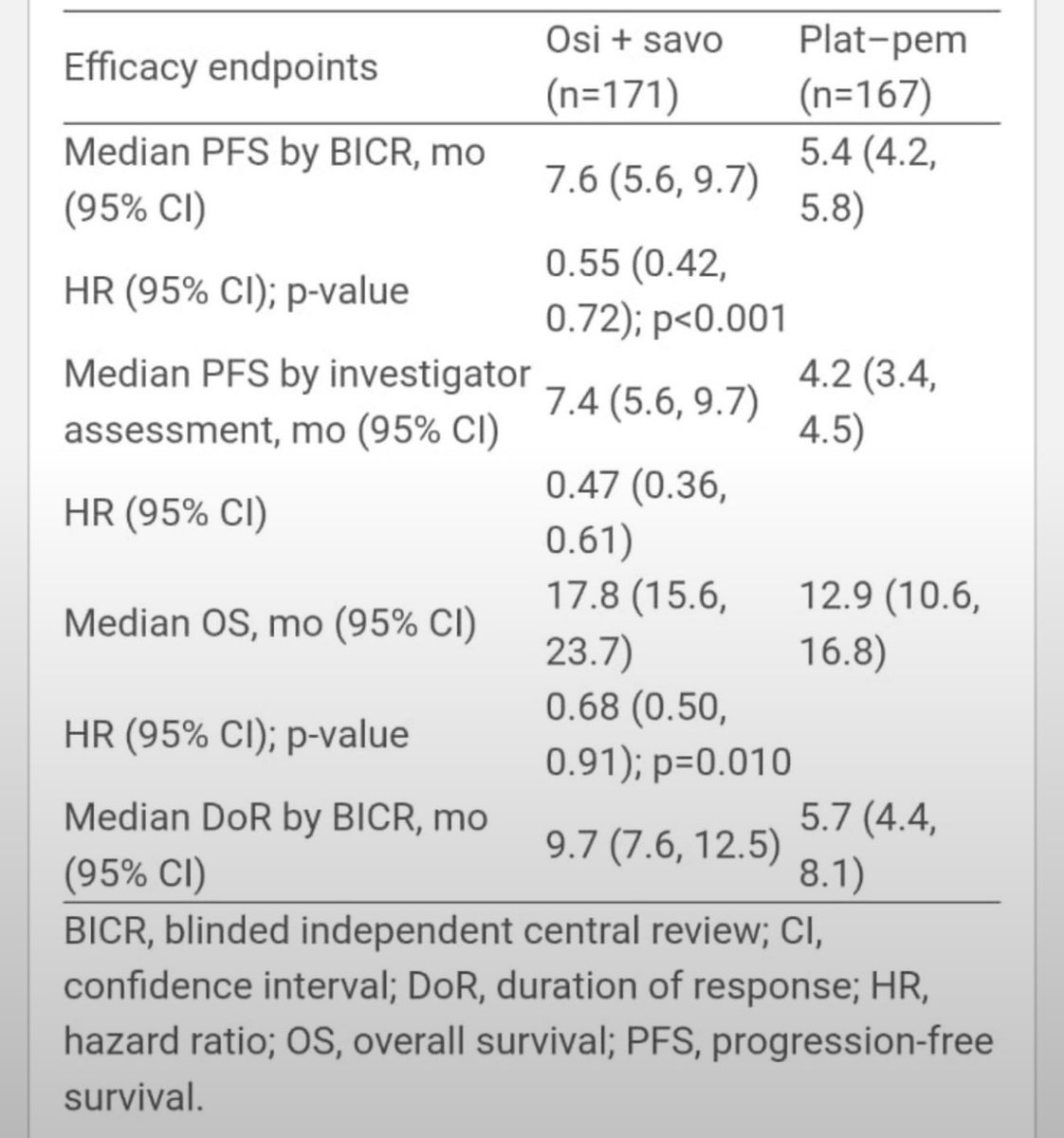
Progression-free survival by BICR (primary endpoint): median 7.6 months (95% CI 5.6–9.7) vs 5.4 months (95% CI 4.2–5.8); HR 0.55 (95% CI 0.42–0.72); p<0.001. Investigator-assessed PFS was 7.4 vs 4.2 months (HR 0.47, 95% CI 0.36–0.61). The PFS benefit was consistent in the MET-overexpressed and MET-amplified subgroups.
Overall survival (key secondary endpoint): median 17.8 months (95% CI 15.6–23.7) vs 12.9 months (95% CI 10.6–16.8); HR 0.68 (95% CI 0.50–0.91); p=0.010. Median duration of response by BICR was 9.7 vs 5.7 months.
Safety: grade ≥3 adverse events of any cause 64% vs 63%; grade ≥3 treatment-related adverse events 40% vs 52%; serious treatment-emergent adverse events (any cause) 41% vs 28%; treatment-emergent adverse events leading to discontinuation (any cause) 14% vs 8%.
Response (key secondary endpoint): confirmed objective response by BICR 51% (88/171) vs 27% (45/167); odds ratio 2.90. (LBA6 slide, DCO 6 Jul 2026)
NEJM (Lu et al., published October 25, 2026): 1,746 patients were screened and 338 randomized. The paper reports the same PFS (HR 0.55; 95% CI 0.42–0.72; P<0.001) and OS results (HR 0.68; 95% CI 0.50–0.91; P=0.01), describing the OS analysis as final; 12-month PFS was 36% vs 10% and 12-month OS 70% vs 53%. In the MET-overexpressed analysis population median PFS was 8.5 vs 5.6 months (HR 0.51; 95% CI 0.37–0.71) and in the MET-amplified population 7.6 vs 4.2 months (HR 0.48; 95% CI 0.35–0.66). The most frequent adverse events with the combination were peripheral edema (49%), anemia (26%) and diarrhea (26%); grade ≥3 adverse events occurred in 64% vs 63%. The trial was funded by AstraZeneca. (NEJM, doi:10.1056/NEJMoa2611335)
The combination remains investigational in the US. Abstract, slide and paper figures are labeled by source; serious adverse event and discontinuation rates above are from the LBA6 abstract.
Savolitinib + osimertinib delivered a statistically significant and clinically meaningful improvement in PFS (primary endpoint, BICR) and in OS versus platinum-based doublet chemotherapy. The announcement gave no numeric results; the first figures are from the ESMO 2026 LBA6 abstract (block above).
Per the topline announcement, the safety profile of osimertinib plus savolitinib was consistent with the known profiles of each medicine, with no new safety findings. Quantitative safety data from the ESMO 2026 LBA6 abstract are in the block above.
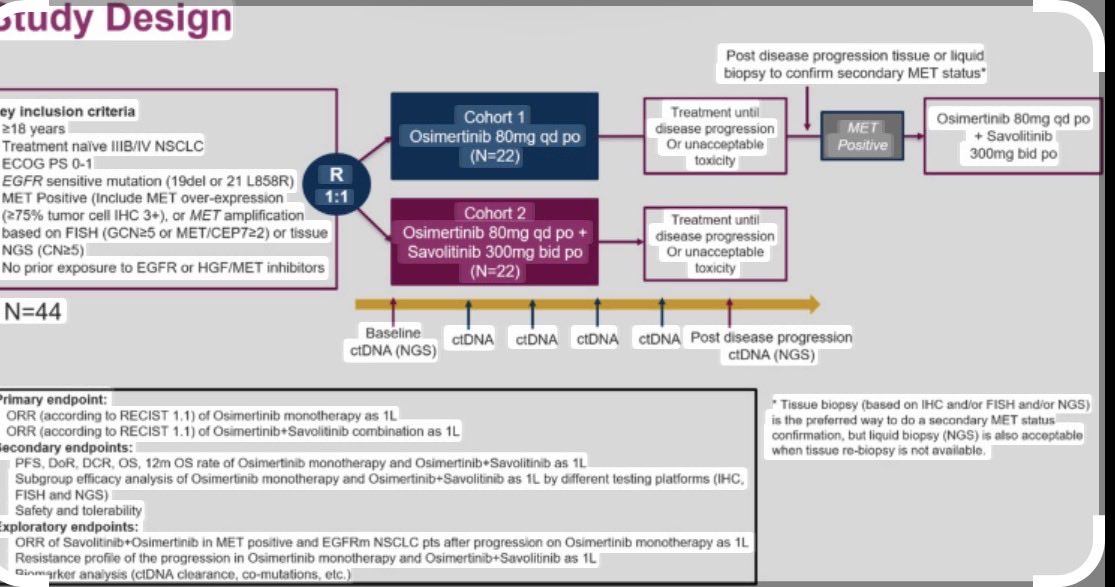
MET-driven resistance selected prospectively by central lab: IHC 3+ in ≥90% of tumor cells and/or FISH ≥10 copies — the high-MET cut-off from SAVANNAH. JTO design abstract · AstraZeneca PR
ESMO 2026 discussion — comparator, crossover and MET testing
Discussant view (Rebecca Heist, Proffered Paper session “NSCLC, metastatic”, October 26, 2026): Dr. Heist, invited discussant for abstracts LBA69 (SANOVO) and 2615O, placed SAFFRON beside the other phase III EGFR + MET trials in acquired resistance. Her comparison slide lists SACHI (China; PFS 8.2 vs 4.5 months, HR 0.34; OS HR 0.84, 95% CI 0.55–1.29; 35% prior third-generation EGFR TKI), SAFFRON (global; PFS 7.6 vs 5.4 months, HR 0.55; OS 17.8 vs 12.9 months, HR 0.68, p=0.010; 100% prior third-generation EGFR TKI) and dalmelitinib/aumolertinib (China; PFS 6.2 vs 4.4 months, HR 0.60). On that slide, 13% of SAFFRON’s chemotherapy arm received subsequent MET-directed therapy, versus 52% in SACHI. She asked whether platinum chemotherapy is the right comparator, citing MARIPOSA-2 (amivantamab–chemotherapy improved PFS over chemotherapy after osimertinib without MET selection), and posed open questions on the best definition of MET positivity, oral vs IV regimens and adverse-event profiles, and how to increase tumor biopsy at progression. (Heist discussion slides, photographed by Dr. Young Kwang Chae)
Physician concerns on X: Dr. Noah Lindenberg argued that patients in the chemotherapy arm should have been able to cross over to the combination once SACHI read out; Dr. Alfred So called it “an additional option rather than the new SOC”; several physicians flagged re-biopsy at progression as the practical limit. Their full posts are in Physician Reactions above. Cross-trial comparisons with MARIPOSA-2 are not head-to-head evidence: the trials differ in MET selection and comparator.
Regulatory status & clinical implications
⚠ Investigational in the US: savolitinib is not FDA approved and the combination has no FDA approval; the FDA granted the combination Fast Track Designation in this setting in 2023 (HUTCHMED, March 2025). ✅ Approved in China by the NMPA (June 2025) for locally advanced or metastatic EGFR-mutated non-squamous NSCLC with MET amplification after progression on EGFR-inhibitor therapy, based on the SACHI Phase III trial. Osimertinib monotherapy is FDA-approved in EGFRm NSCLC. Switzerland has granted the combination a temporary authorization in this high-MET setting based on SAVANNAH. If registered globally on SAFFRON, an all-oral targeted doublet would challenge platinum chemotherapy as the default after osimertinib failure in MET-driven disease — and would sharpen the case for routine MET testing (IHC/FISH/NGS) at progression. ClinicalTrials.gov lists AstraZeneca as the sole lead sponsor of SAFFRON, with no collaborators listed, and the NEJM paper states funding by AstraZeneca; savolitinib is jointly developed by HUTCHMED and AstraZeneca. ClinicalTrials.gov NCT05261399 · HUTCHMED, 20 Mar 2025 (Fast Track) · HUTCHMED: China approval (SACHI) · AstraZeneca PR
Free Access · KOL Pulse Intelligence
Track oncology’s top KOLs in your specialty
Create a free account, pick the tumor types you cover, and go beyond the tweet — the intelligence pharma teams use to map influence and prepare for engagement:
Choose the tumor types you follow. No cost, unsubscribe anytime.
Influence Leaders
Top KOLs Discussing SAFFRON
The physicians whose SAFFRON posts drew the most views. The presenter, Prof. Shun Lu, has no X profile we could verify; the presentation slides are in Key Slides. The invited discussant at the Presidential Symposium was Dr. Natasha B. Leighl.
Slides from ESMO 2026 (Madrid) as photographed and shared on X by physicians, newest first. Each post is shown verbatim; click any slide to enlarge, and open the OCR text under each post. All ESMO 2026 SAFFRON slides in the KOL Pulse slide library →
Great discussion by Dr. Rebecca Heist (@MassGeneralBrigham) at #ESMO2026 summarizing key Phase III trials targeting acquired resistance in EGFRm NSCLC! 🧬
Key takeaways on EGFR + MET TKI strategies:
▪️ SAFFRON (Osi + Savo vs Chemo): PFS 7.6 vs 5.4 mo (HR 0.55), OS 17.8 vs 12.9 mo (HR 0.68) post-3rd gen TKI.
▪️ SACHI (Osi + Savo): PFS 8.2 vs 4.5 mo (HR 0.34) | ORR 63% vs 36%.
▪️ MARIPOSA-2 Benchmarking: Ami-chemo gives PFS 8.3 vs 4.2 mo (HR 0.44), but without MET selection.
Dr. Heist highlighted critical open questions: defining optimal MET cutoffs, balancing oral vs IV regimens, and distinct AE profiles across combinations!
#LungCancer #OncoX #ESMO26 #NSCLC
[Slide 1 - Questions] (photographed from the room)
How do the EGFR + MET TKI combinations compare to amivantamab-chemotherapy (MARIPOSA-2) regimen? biomarker selected v non-selected; oral v IV regimens; AE profiles
Will there be differential ability of MET TKIs, Abs and Bispecific Abs, ADCs, to address MET acquired resistance and different cutoffs for activity?
What is the best definition of MET positivity?
How do we increase tumor biopsy at time of progression?
[Slide 2 - Phase III trials of EGFR + MET in acquired resistance]
| SACHI | SAFFRON | Dalmelitinib/Aumolertinib
EGFR + MET | Osimertinib + Savolitinib | Osimertinib + Savolitinib | Aumolertinib + Dalmelitinib
Enrollment | China | Global | China
Biomarker testing | Post-progression tissue biopsy (all three)
RR | 63% v 36% | 51% v 27% | 59.6% v 38.6%
PFS | 8.2 mo v 4.5 mo, HR 0.34 p < 0.0001 | 7.6 mo v 5.4 mo, HR 0.55 (0.42, 0.72) p < 0.001 | 6.2 mo v 4.4 mo, HR 0.60 (0.45, 0.81) p < 0.001
OS | 22.9 mo v 17.7 mo, HR 0.84 (0.55-1.29) | 17.8 mo v 12.9 mo, HR 0.68 (0.50, 0.91) p = 0.010 | NR v 19.6 mo, HR 0.84 (0.52, 1.35)
In chemo arm: received subsequent MET Rx | 52% | 13% | 51.9%
Prior exposure to 3rd gen EGFR TKI | 35% | 100% | 95%
MET definition | GCN >= 5 or MET:CEP7 >= 2; if prior 3rd gen EGFR TKI: GCN >= 10 | FISH >= 10 and/or MET IHC 3+ >= 90% | MET GCN >= 5 or MET:CEP7 >= 2
% with GCN >= 10 | 71% | 72% | 33%
Lu et al Lancet 2026; Lu et al ESMO 2026; Lu et al ESMO 2026
[Slide 3 - Is platinum chemotherapy the right comparator?] (MARIPOSA-2 PFS curves)
Median PFS, months (95% CI): amivantamab-chemotherapy 6.3 (5.6-8.4); amivantamab-lazertinib-chemotherapy 8.3 (6.8-9.1); chemotherapy 4.2 (4.0-4.4).
Amivantamab-chemotherapy versus chemotherapy: HR for disease progression or death 0.48 (95% CI 0.36-0.64), P<0.001. Amivantamab-lazertinib-chemotherapy versus chemotherapy: HR 0.44 (95% CI 0.35-0.56), P<0.001.
- Amivantamab-chemotherapy improved PFS over platinum chemotherapy after progression on osimertinib
- No selection by MET status. Passaro et al Annals Onc 2024
Dr. Heist was the invited discussant for abstracts LBA69 (SANOVO) and 2615O (Proffered Paper session “NSCLC, metastatic”, October 26); these slides place SAFFRON among the phase III EGFR + MET trials. Slide 3 is a Kaplan–Meier curve; the panel gives the numbers printed on the slide.
🚨 #ESMO26 | SAFFRON Phase III | NEJM
Osimertinib + savolitinib vs chemotherapy in MET-positive EGFRm NSCLC after osimertinib:
✅ PFS: 7.6 vs 5.4 mo (HR 0.55)
✅ OS: 17.8 vs 12.9 mo (HR 0.68)
✅ ORR: 51% vs 27%
🎯 A potential new standard of care!
#LungCancer #NSCLC https://t.co/5fE6rh1wV2
[Slide 1]
Is SAFFRON well-designed with valid results? [check] YES and [check] YES
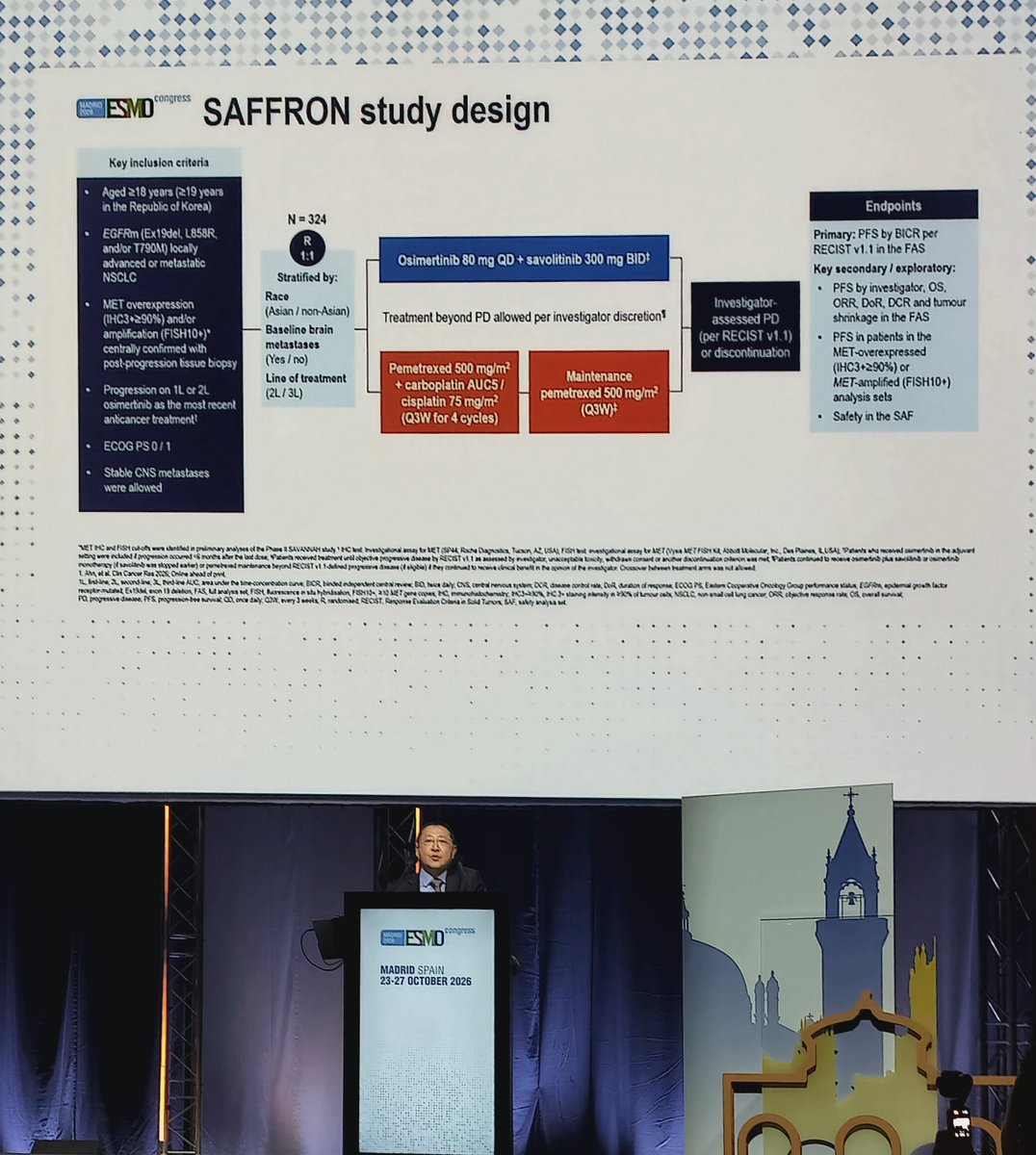
SAFFRON study design
[Embedded study-design schematic and CONSORT diagram - small print largely illegible in this photo. Legible fragments: Osimertinib 80 mg QD + savolitinib 300 mg BID; Pemetrexed 500 mg/m2 + carboplatin AUC5/cisplatin 75 mg/m2 (Q3W for 4 cycles); Maintenance pemetrexed 500 mg/m2 (Q3W); Endpoints - Primary: PFS by BICR per RECIST v1.1 in the FAS; Key secondary/exploratory: PFS by investigator, OS, ORR, DoR, DCR and tumour shrinkage in the FAS; PFS in patients in the MET-overexpressed [illegible] or MET-amplified [illegible] analysis sets; Safety in the SAF; Osimertinib + savolitinib, n = 171; Platinum-pemetrexed, n = 167; Patients screened, N = [illegible]; Patients randomised, N = [illegible]]
0 v 8% withdrew post randomization
99% v 87% started protocol therapy
Patient withdrawal 6% v 13%
Lost to follow up 0 v 1%
✓ Molecular selection, dual targeting strategy informed by prior studies1-4
✓ Is the control arm the current standard of care? (it was...)
✓ Randomized, power 90%, intent-to-treat-analysis, no crossover
✓ Unblinded but primary endpoint PFS by BICR
✓ PFS primary endpoint acceptable, (OS preferred)
✓ Patient characteristics balanced (1/3 male, 2/3 Asian, 31% CNS metastases, 16% post 2 TKIs)
✓ Disproportionate withdrawals in control arm
✓ Fixed sequence hierarchical testing appropriate for multiple testing (Type 1 error controlled) – IHC+ subgroup prioritized→ relevant for implementation
Lu S et al. ESMO Congress. 2026 LBA6
[Slide 2]
Is MET Overexpression Enough or Do We Need MET Addiction?
PFS for MET-overexpressed analysis set
Median PFS, months (95% CI)
Osimertinib + savolitinib | 8.5 (5.7, 11.1)
Platinum–pemetrexed | 5.6 (4.4, 6.7)
HR 0.51 (95% CI 0.37-0.71); p<0.001
Landmark labels at 12 months: 40% | 11%
No. at Risk
Osimertinib + savolitinib 124 106 92 64 55 40 29 22 17 15 10 6 4 1 1 1 1 1 1 0
Platinum-pemetrexed 118 77 63 33 23 13 7 6 3 2 1 0 0 0 0 0 0 0 0 0
PFS for MET-amplified analysis set*
Median PFS, months (95% CI)
Osimertinib + savolitinib | 7.6 (5.6, 9.7)
Platinum–pemetrexed | 4.2 (3.1, 5.5)
HR 0.48 (95% CI 0.35-0.66)
*No formal statistical testing was carried out for the MET-amplified analysis set
Landmark labels at 12 months: 33% | 8%
No. at Risk
Osimertinib + savolitinib 129 108 91 63 54 39 28 20 19 16 11 6 4 1 1 1 1 1 1 0
Platinum-pemetrexed 116 72 42 23 16 9 4 3 1 0 0 0 0 0 0 0 0 0 0 0
Lu S et al. ESMO Congress. 2026; Courtesy J. Pinchevsky, AstraZeneca (internal data)
Natasha B. Leighl
Survival table
Endpoint: PFS by MET analysis set
Arm | N | Median | Median CI
MET-overexpressed: osimertinib + savolitinib | 124 | 8.5 mo | 5.7, 11.1
MET-overexpressed: platinum-pemetrexed | 118 | 5.6 mo | 4.4, 6.7
MET-amplified: osimertinib + savolitinib | 129 | 7.6 mo | 5.6, 9.7
MET-amplified: platinum-pemetrexed | 116 | 4.2 mo | 3.1, 5.5
HR: MET-overexpressed 0.51; MET-amplified 0.48
HR CI: 0.37-0.71; 0.35-0.66
P: MET-overexpressed p<0.001; MET-amplified not formally tested
Landmark rates:
12 months (dotted line): MET-overexpressed: osimertinib + savolitinib 40% | MET-overexpressed: platinum-pemetrexed 11% | MET-amplified: osimertinib + savolitinib 33% | MET-amplified: platinum-pemetrexed 8%
A major new milestone post-osimertinib! Totally agree with Natasha: a new therapeutic standard, MET testing for all our #EGFRm pts with disease progression post-Osi, and access to Osi + Savolitinib (now the most difficult step for our patients upon our return post-#ESMO26)... https://t.co/bcMIUoBHPs
[Slide 1]
[Discussant slide — the embedded SAFFRON study-design and CONSORT flow diagrams are not legible in this photo and are not transcribed]
Is SAFFRON well-designed with valid results? YES and YES
SAFFRON study design
0 v 8% withdrew post randomization
99% v 87% started protocol therapy
Patient withdrawal 6% v 13%
Lost to follow up 0 v 1%
- Molecular selection, dual targeting strategy informed by prior studies
- Is the control arm the current standard of care? (it was...)
- Randomized, power 90%, intent-to-treat-analysis, no crossover
- Unblinded but primary endpoint PFS by BICR
- PFS primary endpoint acceptable, (OS preferred)
- Patient characteristics balanced (1/3 male, 2/3 Asian, 31% CNS metastases, 16% post 2 TKIs)
- Disproportionate withdrawals in control arm
- Fixed sequence hierarchical testing appropriate for multiple testing (Type 1 error controlled) – IHC+ subgroup prioritized -> relevant for implementation
Lu S et al. ESMO Congress. 2026 LBA6
[Slide 2]
Are the results from SAFFRON clinically meaningful? YES
Progression-free survival (BICR)
Median PFS, months (95% CI)
Osimertinib + savolitinib: 7.6 (5.6, 9.7)
Platinum-pemetrexed: 5.4 (4.2, 5.8)
HR 0.55 (95% CI 0.42-0.72); p<0.01
12-month: 36% vs 10%
No. at Risk (months 0-38, every 2 months)
Osimertinib + savolitinib: 171 144 120 82 70 54 39 29 24 21 14 8 5 1 1 1 1 1 1 0
Platinum pemetrexed: 167 109 77 43 30 17 8 7 4 3 1 0 0 0 0 0 0 0 0 0
Median follow-up PFS: osimertinib+savolitinib 5.6 months, platinum-pemetrexed 3.5 months. Overall maturity: 68%.
Overall survival
Median OS, months (95% CI)
Osimertinib + savolitinib: 17.8 (15.6, 23.7)
Platinum-pemetrexed: 12.9 (10.6, 16.8) [CI per ESMO 2026 LBA6 abstract; lower bound blurred in photo]
HR 0.68; 95% CI, 0.50-0.91; p=0.010*
12-month: 70% vs 53%
Subsequent therapy: Osi+Savo – 60%; 41% ChT; Chemo – 66%; 13% MET+EGFR TKI
No. at Risk (months 0-38, every 2 months)
Osimertinib + savolitinib: 171 166 157 144 133 119 98 89 63 51 43 31 22 14 13 7 5 3 1 0
Platinum pemetrexed: 167 150 137 128 113 86 62 48 36 27 21 20 18 16 11 7 4 2 1 0
Median follow-up (OS): osimertinib+savolitinib 14.2 months, platinum-pemetrexed 10.2 months. Overall maturity 53%.
*Boundary to declare statistical significance p=0.03047.
Objective response rate higher with osimertinib + savolitinib (51% v. 27%), odd ratio 2.9; Median duration of response 9.7 months v. 5.7 months
Lu S et al. ESMO Congress. 2026 LBA6; Passaro A et al. Ann Oncol 2023; Popat S et al. Ann Oncol 2024; Fang W et al NEJM 2026
Natasha B. Leighl
Survival table
Endpoint: PFS (BICR) and OS
Arm | N | Median | Median CI
Osimertinib + savolitinib (PFS) | 171 | 7.6 | 5.6, 9.7
Platinum-pemetrexed (PFS) | 167 | 5.4 | 4.2, 5.8
Osimertinib + savolitinib (OS) | 171 | 17.8 | 15.6, 23.7
Platinum-pemetrexed (OS) | 167 | 12.9 | 10.6, 16.8 (LBA6 abstract)
HR: PFS 0.55; OS 0.68
HR CI: PFS 0.42-0.72; OS 0.50-0.91
P: PFS p<0.01; OS p=0.010 (boundary p=0.03047)
Landmark rates:
12 months: Osimertinib + savolitinib (PFS) 36% | Platinum-pemetrexed (PFS) 10% | Osimertinib + savolitinib (OS) 70% | Platinum-pemetrexed (OS) 53%
[Slide 3]
Have we MET a new standard of care? YES!
- SAFFRON is the first study in osimertinib resistant EGFR mutated lung cancer to demonstrated improved PFS and OS (HR 0.55, 0.68) with an oral combination in a molecularly defined population (IHC3+>=90% or FISH10+)
- Tomorrow we must start to ensure that each patient with resistance has molecular testing (tissue preferred) and is matched to the best possible therapy or clinical trials
- Then we must ensure drug access, addressing issues of regulatory authorities and cost
- MET IHC, MET FISH -> from tier ESCAT 2B to tier ESCAT 1p (proven)
- SAFFRON MCBS score 3 -> to be incorporated into next guideline update
[ESMO-MCBS scorecard thumbnail, Final Score 3; other text illegible]
Natasha Leighl
SAFFRON Ph3 met its primary endpoint with osimertinib + savolitinib vs chemo in EGFRm MET overexpressed /amp post osimertinib in NSCLC 🫁
1746 patients screened, 338 randomised.
✅ mPFS 7.6 vs 5.4m HR 0.55
✅ mOS 17.8 vs 12.9m HR 0.68
✅ ORR 51% vs 27%
❌ Crossover not permitted
Peripheral oedema most common AE.
Remember Insight2 with Tepotinib ORR 50%, mPFS 5.6m, mOS 17.8m but Ph2.
Congrats to Shun Lu and co-investigators 👏🏼👏🏼👏🏼
#PresidentialDay2
#ESMO26
@myESMO
@OncoAlert
[Slide 1]
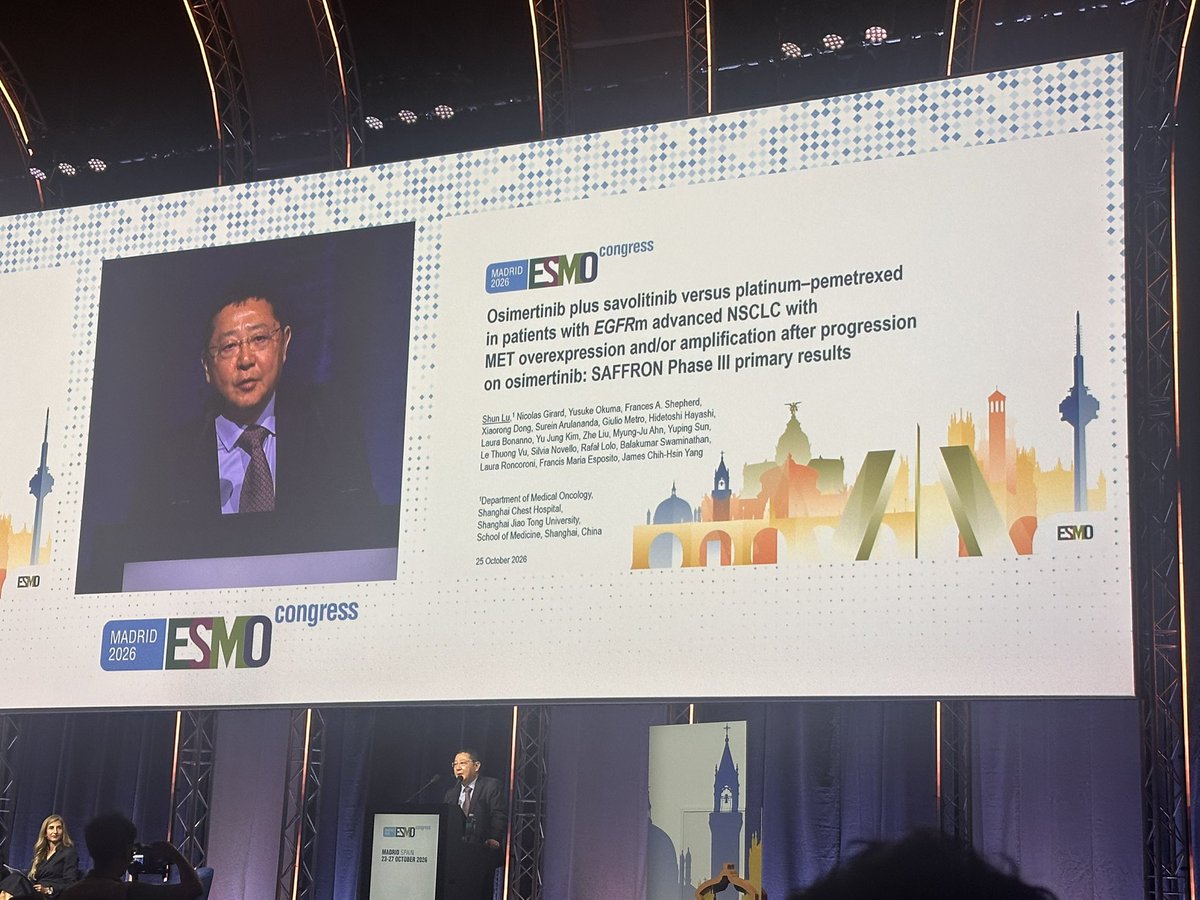
Osimertinib plus savolitinib versus platinum–pemetrexed in patients with EGFRm advanced NSCLC with MET overexpression and/or amplification after progression on osimertinib: SAFFRON Phase III primary results
Shun Lu,1 Nicolas Girard, Yusuke Okuma, Frances A. Shepherd, Xiaorong Dong, Surein Arulananda, Giulio Metro, Hidetoshi Hayashi, Laura Bonanno, Yu Jung Kim, Zhe Liu, Myung-Ju Ahn, Yuping Sun, Le Thuong Vu, Silvia Novello, Rafał Lolo, Balakumar Swaminathan, Laura Roncoroni, Francis Maria Esposito, James Chih-Hsin Yang
1Department of Medical Oncology, Shanghai Chest Hospital, Shanghai Jiao Tong University, School of Medicine, Shanghai, China
25 October 2026
MADRID SPAIN 23-27 OCTOBER 2026
[Slide 2]
Progression-free survival by BICR
Median PFS, months (95% CI): Osimertinib + savolitinib 7.6 (5.6, 9.7); Platinum–pemetrexed 5.4 (4.2, 5.8)
HR (95% CI); p-value 0.55 (0.42, 0.72); p<0.001
36% / 10% (at 12 months)
No. at risk
Osimertinib + savolitinib | 171 166 144 124 120 98 82 75 70 64 54 49 39 34 29 25 24 22 21 14 14 8 8 6 5 2 1 1 1 1 1 1 1 1 1 1 1 0 | 171 / 117
Platinum–pemetrexed | 167 139 109 87 77 61 43 34 30 22 17 12 8 7 7 4 4 3 3 1 1 1 0 0 0 0 0 0 0 0 0 0 0 0 0 0 0 0 | 167 / 113
Osimertinib plus savolitinib provided a statistically significant 45% reduction in the risk of disease progression or death compared with platinum–pemetrexed
Data cut-off: 06 July 2026. Median follow-up for PFS by BICR: osimertinib + savolitinib 5.6 months, platinum–pemetrexed 3.5 months. Overall maturity: 68%.
[Survival data captured as a table — no point estimates read from the curve]
Endpoint: PFS by BICR
Osimertinib + savolitinib | 171 | 7.6 | 5.6, 9.7
Platinum–pemetrexed | 167 | 5.4 | 4.2, 5.8
HR: 0.55
HR CI: 0.42, 0.72
P: <0.001
Landmark 12 months | Osimertinib + savolitinib | 36%
Landmark 12 months | Platinum–pemetrexed | 10%
Note: DCO 06 July 2026.
[Slide 3]
Overall survival
Median OS, months (95% CI): Osimertinib + savolitinib 17.8 (15.6, 23.7); Platinum–pemetrexed 12.9 (10.6, 16.8)
HR (95% CI); p-value 0.68 (0.50, 0.91); p = 0.010*
Overall maturity: 53%
70% / 53% (at 12 months)
No. at risk
Osimertinib + savolitinib | 171 170 166 162 157 152 144 138 133 130 119 114 98 93 89 74 63 59 51 46 43 39 31 27 22 17 14 14 13 9 7 6 5 5 3 2 1 1 0 | 171 / 87
Platinum–pemetrexed | 167 154 150 142 137 134 128 119 113 96 86 70 62 51 48 40 36 32 27 23 21 20 20 19 18 18 16 12 11 9 7 4 4 3 2 2 1 1 0 | 167 / 93
Osimertinib plus savolitinib provided a statistically significant 32% reduction in the risk of death, with a 4.9 month improvement in median OS, compared with platinum–pemetrexed
Data cut-off: 06 July 2026. Median follow-up for OS: osimertinib + savolitinib 14.2 months, platinum–pemetrexed 10.2 months.
*Boundary to declare statistical significance: p<0.03047.
[Survival data captured as a table — no point estimates read from the curve]
Endpoint: Overall survival
Osimertinib + savolitinib | 171 | 17.8 | 15.6, 23.7
Platinum–pemetrexed | 167 | 12.9 | 10.6, 16.8
HR: 0.68
HR CI: 0.50, 0.91
P: 0.010 (boundary p<0.03047)
Landmark 12 months | Osimertinib + savolitinib | 70%
Landmark 12 months | Platinum–pemetrexed | 53%
Note: DCO 06 July 2026; overall maturity 53%.
[Slide 4]
Tumour response by BICR
| Osimertinib + savolitinib (n = 171) | Platinum–pemetrexed (n = 167) | Odds ratio (95% CI)
Patients with a confirmed objective response, n (%) | 88 (51) | 45 (27) | 2.90 (1.85, 4.61)
Median DoR, months (95% CI) | 9.7 (7.6, 12.5) | 5.7 (4.4, 8.1)
Median best percentage change in target lesion size, % (min, max) | −44 (−100, 50) | −25 (−100, 35)
Patients with disease control,* n (%) | 145 (85) | 108 (65) | 3.18 (1.88, 5.50)
Waterfall plots: Osimertinib + savolitinib; Platinum–pemetrexed
Best overall response: Complete response | Partial response | Stable disease | Progressive disease | Not evaluable
Tumour response endpoints all favoured the osimertinib plus savolitinib arm
Data cut-off: 06 July 2026.
*Based on unconfirmed response; †Values imputed to 20%.
BICR, blinded independent central review; CI, confidence interval; DoR, duration of response.
Have we MET new SOC ? Nice discussion. SAFFRON trial has made this space spicy 🙂 @OncoAlert @myESMO #ESMO26 https://t.co/wcVyUOhfIc
[Slide 1]
16:30 - 18:15 Presidential Symposium II
CHAIRS: GIUSEPPE CURIGLIANO, YELENA JANJIGIAN
Is SAFFRON well-designed with valid results? ✅ YES and ✅ YES
SAFFRON study design [embedded schematic small; see clean copy 2114392179212951939_s3]
0 v 8% withdrew post randomization
99% v 87% started protocol therapy
Patient withdrawal 6% v 13%
Lost to follow up 0 v 1%
✓ Molecular selection, dual targeting strategy informed by prior studies1-4
✓ Is the control arm the current standard of care? (it was…)
✓ Randomized, power 90%, intent-to-treat-analysis, no crossover
✓ Unblinded but primary endpoint PFS by BICR
✓ PFS primary endpoint acceptable, (OS preferred)
✓ Patient characteristics balanced (1/3 male, 2/3 Asian, 31% CNS metastases, 16% post 2 TKIs)
✓ Disproportionate withdrawals in control arm
✓ Fixed sequence hierarchical testing appropriate for multiple testing (Type 1 error controlled) – IHC+ subgroup prioritized→ relevant for implementation
Lu S et al. ESMO Congress. 2026 LBA6
Natasha Leighl
Invited Discussant LBA6
ALICANTE AUDITORIUM - HALL 6
[Slide 2]
16:30 - 18:15 Presidential Symposium II
CHAIRS: GIUSEPPE CURIGLIANO, YELENA JANJIGIAN
Resistance post Combination Therapy → Different Biology?
(Not for cross trial comparison)
FLAURA2 - no new resistance mechanisms, reduction in emergent mutations, fusions (ctDNA)
Osimertinib + Chemo vs Osimertinib: Acq EGFR mt 4% vs 14%; MET amplification 12% vs 11%; Her2 amplification 4% vs 1%; PI3K 7% vs 6; RAS/RAF 4% vs 13%; Other RTK 4% vs 7%; Fusions 8% vs 15%; Cell Cycle 13% vs 10%; TP53/RB1 loss 3% vs 4%
MARIPOSA - no new resistance mechanisms, reduction in MET, EGFR driven resistance (ctDNA)
Osimertinib (n=198) vs Amivantamab+Lazertinib (n=148): MET amplification 13.1% vs 3.4% (P=0.002); Secondary EGFR resistance mutations (C797S, L718X, G724X) 7.6% vs 1.4% (P=0.01); HER2 amplification 4.5% vs 8.8%; PI3K 9.1% vs 8.1%; RAS/RAFa 11.6% vs 10.1%; Other RTK 4.5% vs 2.0%; Cell cycleb 9.6% vs 12.8%; TP53/RB1 loss 2.5% vs 1.4%
aIncludes BRAF, KRAS, NRAS, PTPN11, and RAF1. bIncludes CCNE1, CDK4, CDKN2A, CCND2, CDK6, and CCND1. Note: Differences between other pathways were not statistically significant.
Figure created from Yang JC et al WCLC 2024; Hayashi et al. J Thorac. Oncol. 2026:103894.
Natasha B. Leighl
Natasha Leighl
Invited Discussant LBA6
ALICANTE AUDITORIUM - HALL 6
Brilliant discussion of the SAFFRON trial by prof Leighl at #ESMO26!
As always, incredibly engaging, insightful and clinically focused!
Robust, clinically meaningful PFS and OS benefits with osimertinib + savolitinib.
Toxicity matters: edema, diarrhea and paronychia require careful management.
Key question: Is MET overexpression by IHC enough? IHC identifies eligible patients, but adding FISH can help avoid missing patients with MET amplification.
Precision oncology is not just about having the right drug, but also identifying the right patients! We have a clear new SOC here
#ESMOAmbassadors #ESMO26 #LungCancer #EGFR #MET
[Slide 1]
1L Options For EGFRm NSCLC
(Not for cross-comparison purposes)
FLAURA1,2 (Osimertinib): mPFS 18.9; mOS 38.6
FLAURA3-5 (Osimertinib+ChT): mPFS 25.5; mOS 47.5
MARIPOSA6,7 (Amivantamab +Lazertinib): mPFS 23.7; mOS Not Reached
mPFS (months) | mOS (months)
ESMO Guidelines8
Stage IV mNSCLC with EGFR-activating mutation [ESCAT I-A; ESCAT I-B for uncommon EGFR mutations]9
PS 0-2 [I, A]; PS 3-4 for all following options [III, A]
Osimertinib–pemetrexed–platinum-based doublet ChT [I, A; MCBS 3]
Lazertinib–amivantamab-vmjw [I, A; MCBS 4]
EGFR TKI monotherapy [I, A-B; MCBS 3-4]
Erlotinib–anti-VEGF(R) Ab [I, B; MCBS 1-2]
Gefitinib–carboplatin–pemetrexed [I, B]
Disease progression
Oligoprogression → Local treatment (surgery or RT) and continue targeted systemic treatment [IV, C]
Systemic progression
1. Soria JC et al New Engl J Med 2018;378:113-125; 2. Ramalingam S et al New Engl J Med 2020;382:41-50; 3. Janne PA et al. ESMO Congress. 2025; 4. Janne PA et al. WCLC. 2023; 5. Planchard D et al. WCLC. 2025; 6. Yang JCH et al. ELCC 2025; 7. Cho BC, et al., ESMO. 2023; 8. Hendriks L et al. Ann Oncol 2023 (ESMO Oncogene Addicted Metastatic NSCLC Living Guideline v1.3, Feb 2026); 9. Elamin YY et al. ESMO 2025 NCT03410043
Natasha B. Leighl
[Slide 2]
MET amplification - a common mechanism of resistance in oncogene addicted lung cancer
EGFR — EGF — EGFR-TKI → MET ← ALK — ALK-TKI
RAS → RAF → MEK → ERK; PI3K → AKT → mTOR
Targets involved in: · Survival · Proliferation · Cell-cycle progression
Donut chart: ~15%; METex14 3%; METamp; METamp-high 1%; EGFR 19%; ALK 3%; RET 1%; ROS1 1%; NTRK 0.2%; KRAS 34%; BRAF 3%; Others 35%; METamp; METamp; METamp
Coleman N, et al. ESMO Open 2021; Qin K, et al. Cancers 2023
[Slide 3]
How does MET amplification relate to protein expression?
FISH: MET/CEP7 ≥2 → Focal → MET amplification positive; MET/CEP7 <2 → MET CN/Tumor cell ≥5 → Polysomy; MET CN/Tumor cell <5 → Negative
NGS: KL ≥7 AND KL ≥7 → Focal → MET amplification positive; KL <7 OR KL <7 → GCN ≥5 → Polysomy; GCN <5 → Negative
H-score < 200 (negative); H-score ≥ 200 (positive)
Venn: NGS | FISH | IHC — 4, 14, 73, 22, 10, 21
FISH + / - | Concordance
NGS + | 87 | 5 | PPA: 66.9%
NGS - | 43 | 96 | NPA: 95.1%; OPA: 79.2%
IHC (c-MET) + | 94 | 14 | PPA: 72.9%
IHC (c-MET) - | 35 | 87 | NPA: 86.1%; OPA: 78.7%
MET alteration type | Description | Detection methods | Challenges
MET Amplification | Results from polysomy and local gene amplification | NGS, FISH, qRT-PCR | Definitive amplification thresholds challenging to establish
METex14 Skipping | Induced by mutations disrupting the regulatory juxtamembrane domain | Sanger Sequencing, RNA-based NGS, RT-PCR | /
MET Fusions | Arise from chromosomal rearrangements, often involving exon 15 and kinase domains | Hybridization-based technologies, AMP in RNA-NGS, FISH, qRT-PCR | DNA-NGS is less sensitive for detecting fusions
MET Overexpression | Associated with ligand-independent phosphorylation and aberrant signaling activation | IHC | Inconsistent truncation point settings for MET overexpression
Xiang et al Mod Path 2024; Cappuzzo et al J Clin Oncol 2009; Tsao et al 2025; Guo et al NRCO 2020
[Slide 4]
Is MET Overexpression Enough or Do We Need MET Addiction?
PFS for MET-overexpressed analysis set
Median PFS months (95% CI): Osimertinib + savolitinib 8.5 (5.7 [cut off]); Platinum–pemetrexed 5.6 (4.4 [cut off])
HR 0.51 (95% CI 0.37-0.71); p<0.[cut off]
40% / 11% (at 12 months)
Randomised patients N=338 (100%)
FAS IHC90+ n=242 (71.6%) | FAS FISH10+ n=245 (72.5%)
IHC90+ only n=91 (27%) | IHC90+ and FISH10+ n=151 (45%) | FISH10+ only n=94 (28%)
IHC90- and FISH10- n=2 (0.5%)
PFS for MET-amplified analysis set*
Median PFS, months (95% CI): Osimertinib + savolitinib 7.6 (5.6, 9.7); Platinum–pemetrexed 4.2 (3.1, 5.5)
HR 0.48 (95% CI 0.35-0.66)
*No formal statistical testing was carried out for the MET-amplified analysis set.
33% / 8% (at 12 months)
No. at Risk (MET-overexpressed): Osimertinib + savolitinib 124 106 92 64 55 40 29 22 17 16 10 6 4 1 1 1 1 1 1 0; Platinum–pemetrexed 118 77 63 33 23 13 7 6 3 2 1 0 0 0 0 0 0 0 0 0
No. at Risk (MET-amplified): [illegible]
Lu S et al. ESMO Congress. 2026; Courtesy J. Pinchevsky, AstraZeneca (internal data)
Natasha B. Leighl
Survival table
Endpoint: PFS (BICR) in MET-overexpressed and MET-amplified analysis sets
MET-OE set: Osimertinib + savolitinib | 124 | 8.5
MET-OE set: Platinum–pemetrexed | 118 | 5.6
MET-amp set: Osimertinib + savolitinib | 7.6 | 5.6, 9.7
MET-amp set: Platinum–pemetrexed | 4.2 | 3.1, 5.5
HR: MET-OE 0.51; MET-amp 0.48
HR CI: MET-OE 0.37-0.71; MET-amp 0.35-0.66
P: MET-OE p<0.[cut off by Venn overlay]; MET-amp no formal testing
Landmark rates:
12 months: MET-OE: Osimertinib + savolitinib 40% | MET-OE: Platinum–pemetrexed 11% | MET-amp: Osimertinib + savolitinib 33% | MET-amp: Platinum–pemetrexed 8%
🚨 Awaited SAFFRON #ESMO26 OSI + savolitinib vs ChT EGFRm/MET+ NSCLC after 1L OSI. First positive targeted strategy post-progression!👏👏
🔹 PFS: 7.6 vs 5.4 mo (HR 0.55)
🔹 OS: 17.8 vs 12.9 mo (HR 0.68)
@NEJM New roads, challenges: biomarker testing IHC/NGS Tx, Liquid in focus! https://t.co/vfW8thruns
[Slide 1]
Progression-free survival by BICR
Median PFS, months (95% CI)
Osimertinib + savolitinib 7.6 (5.6, 9.7)
Platinum–pemetrexed 5.4 (4.2, 5.8)
HR (95% CI); p-value 0.55 (0.42, 0.72); p<0.001
36% / 10% (at 12 months)
No. at risk
Osimertinib + savolitinib | 171 166 144 124 120 98 82 75 70 64 54 49 39 34 29 25 24 22 21 14 14 8 8 6 5 2 1 1 1 1 1 1 1 1 1 1 1 0 | 171 / 117
Platinum–pemetrexed | 167 139 109 87 77 61 43 34 30 22 17 12 8 7 7 4 4 3 3 1 1 1 0 0 0 0 0 0 0 0 0 0 0 0 0 0 0 0 | 167 / 113
Osimertinib plus savolitinib provided a statistically significant 45% reduction in the risk of disease progression or death compared with platinum–pemetrexed
Data cut-off: 06 July 2026. Median follow-up for PFS by BICR: osimertinib + savolitinib 5.6 months, platinum–pemetrexed 3.5 months. Overall maturity: 68%
Shun Lu
Osimertinib (osi) + savolitinib (savo) vs platinum–pemetrexed (plat–pem) in EGFRm MET-overexpressed (OE) and/or -amplified (AMP) advanced NSCLC post-osi: SAFFRON phase (Ph) 3 primary results
Survival table
Endpoint: PFS by BICR
Arm | N | Median | Median CI
Osimertinib + savolitinib | 171 | 7.6 | 5.6, 9.7
Platinum–pemetrexed | 167 | 5.4 | 4.2, 5.8
HR: 0.55
HR CI: 0.42, 0.72
P: <0.001
Landmark rates:
12 months: Osimertinib + savolitinib 36% | Platinum–pemetrexed 10%
[Slide 2]
Progression-free survival by BICR: MET subgroups
MET-overexpressed analysis set
Median PFS, months (95% CI): Osimertinib + savolitinib 8.5 (5.7, 11.1); Platinum–pemetrexed 5.6 (4.4, 6.7)
HR (95% CI); p-value 0.51 (0.37, 0.71); p<0.001
MET-amplified analysis set*
Median PFS, months (95% CI): Osimertinib + savolitinib 7.6 (5.6, 9.7); Platinum–pemetrexed 4.2 (3.1, 5.5)
HR (95% CI) 0.48 (0.35, 0.66)
[number-at-risk rows illegible]
PFS by BICR in the MET-overexpressed and MET-amplified analysis sets was generally consistent with the full analysis set
*No formal statistical testing was carried out for the MET-amplified analysis set.
Shun Lu
Osimertinib (osi) + savolitinib (savo) vs platinum–pemetrexed (plat–pem) in EGFRm MET-overexpressed (OE) and/or -amplified (AMP) advanced NSCLC post-osi: SAFFRON phase (Ph) 3 primary results
Survival table
Endpoint: PFS by BICR, MET subgroups
MET-OE set: Osimertinib + savolitinib | 8.5 | 5.7, 11.1
MET-OE set: Platinum–pemetrexed | 5.6 | 4.4, 6.7
MET-amp set: Osimertinib + savolitinib | 7.6 | 5.6, 9.7
MET-amp set: Platinum–pemetrexed | 4.2 | 3.1, 5.5
HR: MET-OE 0.51; MET-amp 0.48
HR CI: MET-OE 0.37, 0.71; MET-amp 0.35, 0.66
P: MET-OE <0.001; MET-amp not formally tested
Excellent discussion from Natasha Leighl contextualising Saffron study. MET amplification defined by previous Savannah study. Is IHC enough - yes!Control arm performs as expected, but note that MET is a poor prognostic marker
But less than a third have MET 3+.
#ESMO26 #LCSM https://t.co/NuBYbao35t
🆙#ESMO26 #LCSM Presidential Symposium II Discussion🌟
🔥 "SAFFRON: A New Spice in the Post-Osimertinib Landscape"
🎙️ Dr. Natasha Leighl
🔗 https://t.co/XAhF0PTCbx
@OncoAlert @Larvol @myESMO @IASLC @EGFRResisters https://t.co/KdYsp2qmTZ https://t.co/RNEGufGyat
[Slide 1]
Resistance Patterns After Osimertinib Treatment
On-target: EGFR Mut/amp — C797X, L792X, L718Q, G796X, G724S, Ex20ins,
Off-target (EGFR-independent): Amplification (MET, HER2, FGFR) | Mutation (MET, HER2, FGFR) | Upregulation | Fusions
MDM2 → TP53 → RB1 → Cyclin/CDK
Downstream signaling pathways: JAK → STAT3; RAS (Mut/gain) → RAF (Mut/fusion) → MEK → ERK (Amp); PI3K (Mut) → AKT ⊣ PTEN (Del) → mTOR
Cell proliferation + survival, apoptosis, angiogenesis, migration/invasion
Cell survival, cell proliferation, cell invasion, drug resistance, EMT, histological transformation (i.e. SCLC, NEC, SCC)
Pie chart: Small cell transformation 15%; 6–10%; 8–17%; 1–8%; 13–14%; 10%; 40–50%; C797X; L718Q; EGFRamp; G724S; S768I; METamp (7–15%) [boxed]; HER2amp (1–2%); SPTBN1-ALK; RET fusions; BRAF fusions; BRAFV600E (3%); PI3KCA (7%); KRAS (3–4%); HER2 (1%); CCND1amp; CCND2amp; CCNE1amp; CDK4amp; CDK6amp
ELIOS: Paired plasma + tissue NGS in 51 patients with EGFR TKI resistance
• 56% successful tissue NGS at PD
• More treatable alterations in tissue (31% v 13% plasma)
• Higher if both tissue, plasma used
| Tissue | Plasma
EGFR C797S | 13% | 28%
MET amplification | 31% | 13%
RB1 | 16% | 3%
TP53 | 81% | 84%
MTAP/CDKN2A loss | 22-25% | --
Mut, mutation; Amp, Amplification; Upreg, Upregulation; Overexp, Overexpression; Activ, Activation; Made in Biorender.com
Schmid S, Li JJN, Leighl N. Lung Cancer. 2020;147:123-129; Adapted from Ferro A et al. CROH. 2024 Leonetti et al Br J Cancer 2019; Piotrowska et al. Cancer Disc 2026
Natasha B. Leighl
[Slide 2]
Is SAFFRON well-designed with valid results? ✅ YES and ✅ YES
SAFFRON study design
Key inclusion criteria
• Aged ≥18 years (≥19 years in the Republic of Korea)
• EGFRm (Ex19del, L858R, and/or T790M) locally advanced or metastatic NSCLC
• MET overexpression (MET IHC3+≥90%) and/or amplification (FISH10+)* centrally confirmed with post-progression tissue biopsy
• Progression on 1L or 2L osimertinib as the most recent anti-cancer treatment†
• ECOG PS 0/1
• Stable CNS metastases were allowed
N=324 R 1:1; Stratified by: Race (Asian/non-Asian); Baseline brain metastases (Yes/no); Line of treatment (2L/3L)
Osimertinib 80 mg QD + savolitinib 300 mg BID‡
Treatment beyond PD allowed per investigator discretion¶
Pemetrexed 500 mg/m2 + carboplatin AUC5/ cisplatin 75 mg/m2 (Q3W for 4 cycles) → Maintenance pemetrexed 500 mg/m2 (Q3W)‡
Investigator-assessed PD (per RECIST v1.1) or discontinuation → 28-day safety follow-up visit** → Survival follow-up
Endpoints
Primary: PFS by BICR per RECIST v1.1 in the FAS
Key secondary/exploratory:
• PFS by investigator, OS, ORR, DoR, DCR and tumour shrinkage in the FAS
• PFS in patients in the MET-overexpressed (MET IHC3+≥90%) or MET-amplified (FISH10+) analysis sets
• Safety in the SAF
Patients screened, N = 1746*; Patients randomised, N = 338
Osimertinib + savolitinib, n = 171; Received treatment, n = 170 (99%); Ongoing any treatment at DCO, n = 45 (26%); Discontinued any treatment, n = 127 (75%)†
Platinum–pemetrexed, n = 167; Received treatment, n = 145 (87%); Ongoing any treatment at DCO, n = 3 (2%); Discontinued any treatment, n = 142 (98%)†
0 v 8% withdrew post randomization
99% v 87% started protocol therapy
Patient withdrawal 6% v 13%
Lost to follow up 0 v 1%
✓ Molecular selection, dual targeting strategy informed by prior studies1-4
✓ Is the control arm the current standard of care? (it was…)
✓ Randomized, power 90%, intent-to-treat-analysis, no crossover
✓ Unblinded but primary endpoint PFS by BICR
✓ PFS primary endpoint acceptable, (OS preferred)
✓ Patient characteristics balanced (1/3 male, 2/3 Asian, 31% CNS metastases, 16% post 2 TKIs)
✓ Disproportionate withdrawals in control arm
✓ Fixed sequence hierarchical testing appropriate for multiple testing (Type 1 error controlled) – IHC+ subgroup prioritized→ relevant for implementation
Lu S et al. ESMO Congress. 2026 LBA6
Saffron trial. Osimertinib plus savolitinib against chemo, post progression on osimertinib for advanced NSCLC with egfr mutation and met amplification /overexpression. @OncoAlert @myESMO #esmo26 https://t.co/7gw1KKowcT
[Slide 1]
16:30 - 18:15 Presidential Symposium II
CHAIRS: GIUSEPPE CURIGLIANO, YELENA JANJIGIAN
Conclusions
• SAFFRON is the first global phase 3 study showing statistically significant and clinically meaningful improvements in PFS and OS with osimertinib plus savolitinib versus platinum–pemetrexed, after progression on osimertinib, in EGFRm MET-overexpressed and/or -amplified advanced NSCLC
PFS HR 0.55; 95% CI 0.42, 0.72; p<0.001 | OS HR 0.68; 95% CI 0.50, 0.91; p = 0.010
• The PFS benefit with osimertinib plus savolitinib versus platinum–pemetrexed was consistent across prespecified subgroups
• The combination demonstrated a tolerable safety profile, which was consistent with the established profiles for each treatment1–5
• SAFFRON establishes the clinical value of an all-oral, biomarker-directed treatment approach targeting both EGFR and MET following progression on osimertinib, reinforcing osimertinib as a backbone treatment across lines of therapy
Osimertinib plus savolitinib establishes a new global standard of care for patients with EGFRm advanced NSCLC with MET overexpression and/or amplification after progression on osimertinib
[footnote references illegible]
Shun Lu
Osimertinib (osi) + savolitinib (savo) vs platinum–pemetrexed (plat–pem) in EGFRm MET-overexpressed (OE) and/or -amplified (AMP) advanced NSCLC post-osi: SAFFRON phase (Ph) 3 primary results
ALICANTE AUDITORIUM - HALL 6
[Slide 2]
16:30 - 18:15 Presidential Symposium II
CHAIRS: GIUSEPPE CURIGLIANO, YELENA JANJIGIAN
Patient disposition
35% of patients evaluable for MET testing had MET overexpression (IHC3+≥90%) and/or MET amplification (FISH10+)
Patients screened, N = 1746*
Patients randomised, N = 338
Osimertinib + savolitinib, n = 171 | Platinum–pemetrexed, n = 167
Received treatment, n = 170 (99%)† | Received treatment, n = 145 (87%)†
Ongoing any treatment at DCO, n = 45 (26%)‡ | Ongoing any treatment at DCO, n = 3 (2%)‡
Osimertinib + savolitinib, n = 43 (25%); Savolitinib, n = 43 (25%); Osimertinib, n = 45 (26%) | Pemetrexed, n = 3 (2%)
Discontinued any treatment, n = 127 (75%)‡¶ | Discontinued any treatment, n = 142 (98%)‡
Progressive disease, n = 89 (52%) | Progressive disease, n = 110 (76%)
Adverse event, n = 25 (15%) | Patient decision, n = 15 (10%)
Death, n = 9 (5%) | Adverse event, n = 13 (9%)
Patient decision, n = 7 (4%) | Consent withdrawal, n = 3 (2%)
Other, n = 4 (2%) | Death, n = 1 (1%)
Consent withdrawal, n = 2 (1%)
Data cut-off 06 July 2026. [remaining footnotes illegible]
Shun Lu
Osimertinib (osi) + savolitinib (savo) vs platinum–pemetrexed (plat–pem) in EGFRm MET-overexpressed (OE) and/or -amplified (AMP) advanced NSCLC post-osi: SAFFRON phase (Ph) 3 primary results
ALICANTE AUDITORIUM - HALL 6
[Slide 3]
16:30 - 18:15 Presidential Symposium II
CHAIRS: GIUSEPPE CURIGLIANO, YELENA JANJIGIAN
First subsequent treatment
Platinum-based chemotherapy was the most common FST in the osimertinib plus savolitinib arm
Non-platinum-based chemotherapy was the most common FST in the platinum–pemetrexed arm
Osimertinib + savolitinib (n = 126)*: No FST (n = 51); FST (n = 75); 60% patients received FST†
Received FST‡ bar: 33% | 5% | 15% | 5% | 41%
Platinum–pemetrexed (n = 164)*: No FST (n = 56); FST (n = 108); 66% patients received FST†
Received FST‡ bar: 23% | 19% | 14% | 33% | 10%
Legend: Platinum-based chemotherapy | Non-platinum-based chemotherapy | EGFR-TKI | MET-TKI | Other¶
Data cut-off: 06 July 2026. [remaining footnotes illegible]
Shun Lu
Osimertinib (osi) + savolitinib (savo) vs platinum–pemetrexed (plat–pem) in EGFRm MET-overexpressed (OE) and/or -amplified (AMP) advanced NSCLC post-osi: SAFFRON phase (Ph) 3 primary results
ALICANTE AUDITORIUM - HALL 6
💊 In the Osimertinib era, osi+savo in MET-OE or MET-amp EGFRmut NSCLC improved ORR, PFS, and OS compared to chemotherapy without better tolerability.
High attrition rate (1746 pts screened, 338 pts randomized), old treatment paradigm with FLAURA-2 or MARIPOSA
regimens available in 1L.
A needle 🪡 in a haystack #ESMO26 #LCSM
[Slide 1]
[Kaplan-Meier slide — raw curve OCR not published; values captured from legible slide text only]
Progression-free survival by BICR: MET subgroups
Analysis set | Arm | N | Events | Median PFS, months (95% CI) | 12-month PFS
MET-overexpressed | Osimertinib + savolitinib | 124 | 77 | 8.5 (5.7, 11.1) | 40%
MET-overexpressed | Platinum–pemetrexed | 118 | 80 | 5.6 (4.4, 6.7) | 11%
MET-amplified* | Osimertinib + savolitinib | 129 | 89 | 7.6 (5.6, 9.7) | 33%
MET-amplified* | Platinum–pemetrexed | 116 | 79 | 4.2 (3.1, 5.5) | 8%
MET-overexpressed: HR (95% CI) 0.51 (0.37, 0.71); p<0.001
MET-amplified: HR (95% CI) 0.48 (0.35, 0.66)
PFS by BICR in the MET-overexpressed and MET-amplified analysis sets was generally consistent with the full analysis set
Data cut-off: 06 July 2026.
*No formal statistical testing was carried out for the MET-amplified analysis set.
BICR, blinded independent central review; CI, confidence interval; HR, hazard ratio; PFS, progression-free survival.
In patients harbouring MET mutation mNSCLC progressing on Osimertinib, the addition of savolitinib improves PFS and OS compared to the SoC. #ESMO26 @myESMO @curijoey @StephenVLiu @OncoAlert @darioT_ https://t.co/BESAEO9PEb
[Slide 1]
SAFFRON study design
Key inclusion criteria
• Aged ≥18 years (≥19 years in the Republic of Korea)
• EGFRm (Ex19del, L858R, and/or T790M) locally advanced or metastatic NSCLC
• MET overexpression (IHC3+≥90%) and/or amplification (FISH10+)* centrally confirmed with post-progression tissue biopsy
• Progression on 1L or 2L osimertinib as the most recent anticancer treatment†
• ECOG PS 0 / 1
• Stable CNS metastases were allowed
N = 324
R 1:1
Stratified by: Race (Asian / non-Asian); Baseline brain metastases (Yes / no); Line of treatment (2L / 3L)
Osimertinib 80 mg QD + savolitinib 300 mg BID‡
Treatment beyond PD allowed per investigator discretion¶
Pemetrexed 500 mg/m2 + carboplatin AUC5 / cisplatin 75 mg/m2 (Q3W for 4 cycles) -> Maintenance pemetrexed 500 mg/m2 (Q3W)‡
Investigator-assessed PD (per RECIST v1.1) or discontinuation
Endpoints
Primary: PFS by BICR per RECIST v1.1 in the FAS
Key secondary / exploratory:
• PFS by investigator, OS, ORR, DoR, DCR and tumour shrinkage in the FAS
• PFS in patients in the MET-overexpressed (IHC3+≥90%) or MET-amplified (FISH10+) analysis sets
• Safety in the SAF
[Slide 2]
Progression-free survival by BICR
Median PFS, months (95% CI)
Osimertinib + savolitinib | 7.6 (5.6, 9.7)
Platinum–pemetrexed | 5.4 (4.2, 5.8)
HR (95% CI); p-value | 0.55 (0.42, 0.72); p<0.001
12-month labels on curve: 36% | 10%
Months since randomisation
No. at risk
Osimertinib + savolitinib: 171 166 144 124 120 98 82 75 70 64 54 49 39 34 29 25 24 22 21 14 14 8 8 6 5 2 1 1 1 1 1 1 1 1 1 1 1 1 0 | 171 / 117
Platinum–pemetrexed: 167 139 109 87 77 61 43 34 30 22 17 12 8 7 7 4 4 3 3 1 1 1 0 0 0 0 0 0 0 0 0 0 0 0 0 0 0 0 0 | 167 / 113
(Number of patients / number of events)
Osimertinib plus savolitinib provided a statistically significant 45% reduction in the risk of disease progression or death compared with platinum–pemetrexed
Data cut-off: 06 July 2026. Median follow-up for PFS by BICR: osimertinib + savolitinib 5.6 months, platinum–pemetrexed 3.5 months. Overall maturity: 68%.
BICR, blinded independent central review; CI, confidence interval; HR, hazard ratio; PFS, progression-free survival.
[Survival data captured as a table — no point estimates read from the curve]
Endpoint: PFS by BICR
Osimertinib + savolitinib | 171 | 7.6 | 5.6, 9.7
Platinum–pemetrexed | 167 | 5.4 | 4.2, 5.8
HR: 0.55
HR CI: 0.42, 0.72
P: p<0.001
Landmark 12 months | Osimertinib + savolitinib | 36%
Landmark 12 months | Platinum–pemetrexed | 10%
Note: Data cut-off 06 July 2026; 45% risk reduction stated on slide.
[Slide 3]
Conclusions
• SAFFRON is the first global phase 3 study showing statistically significant and clinically meaningful improvements in PFS and OS with osimertinib plus savolitinib versus platinum–pemetrexed, after progression on osimertinib, in EGFRm MET-overexpressed and/or -amplified advanced NSCLC
PFS HR 0.55; 95% CI 0.42, 0.72; p<0.001 | OS HR 0.68; 95% CI 0.50, 0.91; p = 0.010
• The PFS benefit with osimertinib plus savolitinib versus platinum–pemetrexed was consistent across prespecified subgroups
• The combination demonstrated a tolerable safety profile, which was consistent with the established profiles for each treatment1–5
• SAFFRON establishes the clinical value of an all-oral, biomarker-directed treatment approach targeting both EGFR and MET following progression on osimertinib, reinforcing osimertinib as a backbone treatment across lines of therapy
Osimertinib plus savolitinib establishes a new global standard of care for patients with EGFRm advanced NSCLC with MET overexpression and/or amplification after progression on osimertinib
1. Hartmaier et al. Cancer Discov 2023;13:98–113; 2. Le et al. J Thorac Oncol 2026;21:318–327; 3. Yang et al. Clin Lung Cancer 2026;27:38–46; 4. de Marinis et al. Ann Oncol 2025;36:920–933; 5. Lu et al. Lancet. 2026 24;407:375–38[illegible]
Another positive Ph.III in NSCLC! #DrShunLu presents SAFFRON: osimertinib + savolitinib vs platinum/pemetrexed after osimertinib in EGFRm/MET+ disease. PFS 7.6 vs 5.4 mo (HR 0.55; p<0.001). OS 17.8 vs 12.9 mo (HR 0.68; p=0.010).
#ESMO26 #LungCancer @myESMO @OncoAlert https://t.co/I80Mmftreu
[Slide 1]
16:30 - 18:15 Presidential Symposium II
CHAIRS: GIUSEPPE CURIGLIANO, YELENA JANJIGIAN
Shun Lu - Osimertinib (osi) + savolitinib (savo) vs platinum–pemetrexed (plat–pem) in EGFRm MET-overexpressed (OE) and/or -amplified (AMP) advanced NSCLC post-osi: SAFFRON phase (Ph) 3 primary results
ALICANTE AUDITORIUM - HALL 6
Progression-free survival by BICR
Median PFS, months (95% CI)
Osimertinib + savolitinib | 7.6 (5.6, 9.7)
Platinum–pemetrexed | 5.4 (4.2, 5.8)
HR (95% CI); p-value | 0.55 (0.42, 0.72); p<0.001
12-month labels on curve: 36% | 10%
Months since randomisation
No. at risk
Osimertinib + savolitinib: 171 166 144 124 120 98 82 75 70 64 54 49 39 34 29 25 24 22 21 14 14 8 8 6 5 2 1 1 1 1 1 1 1 1 1 1 1 1 0 | 171 / 117
Platinum–pemetrexed: 167 139 109 87 77 61 43 34 30 22 17 12 8 7 7 4 4 3 3 1 1 1 0 0 0 0 0 0 0 0 0 0 0 0 0 0 0 0 0 | 167 / 113
(Number of patients / number of events)
Osimertinib plus savolitinib provided a statistically significant 45% reduction in the risk of disease progression or death compared with platinum–pemetrexed
Data cut-off: 06 July 2026. Median follow-up for PFS by BICR: osimertinib + savolitinib 5.6 months, platinum–pemetrexed 3.5 months. Overall maturity: 68%.
BICR, blinded independent central review; CI, confidence interval; HR, hazard ratio; PFS, progression-free survival.
Survival table
Endpoint: PFS by BICR
Arm | N | Median | Median CI
Osimertinib + savolitinib | 171 | 7.6 | 5.6, 9.7
Platinum–pemetrexed | 167 | 5.4 | 4.2, 5.8
HR: 0.55
HR CI: 0.42, 0.72
P: p<0.001
Landmark rates:
12 months: Osimertinib + savolitinib 36% | Platinum–pemetrexed 10%
[Slide 2]
16:30 - 18:15 Presidential Symposium II
CHAIRS: GIUSEPPE CURIGLIANO, YELENA JANJIGIAN
Shun Lu - Osimertinib (osi) + savolitinib (savo) vs platinum–pemetrexed (plat–pem) in EGFRm MET-overexpressed (OE) and/or -amplified (AMP) advanced NSCLC post-osi: SAFFRON phase (Ph) 3 primary results
ALICANTE AUDITORIUM - HALL 6
Overall survival
Median OS, months (95% CI)
Osimertinib + savolitinib | 17.8 (15.6, 23.7)
Platinum–pemetrexed | 12.9 (10.6, 16.8)
HR (95% CI); p-value | 0.68 (0.50, 0.91); p = 0.010*
Overall maturity: 53%
12-month labels on curve: 70% | 53%
Months since randomisation
No. at risk
Osimertinib + savolitinib: 171 170 166 162 157 152 144 138 133 130 119 114 98 93 89 74 63 59 51 46 43 39 31 27 22 17 14 14 13 9 7 6 5 5 3 2 1 1 0 | 171 / 87
Platinum–pemetrexed: 167 154 150 142 137 134 128 119 113 96 86 70 62 51 48 40 36 32 27 23 21 20 20 19 18 18 16 12 11 9 7 4 4 3 2 2 1 1 0 | 167 / 93
(Number of patients / number of events)
Osimertinib plus savolitinib provided a statistically significant 32% reduction in the risk of death, with a 4.9 month improvement in median OS, compared with platinum–pemetrexed
Data cut-off: 06 July 2026. Median follow-up for OS: osimertinib + savolitinib 14.2 months, platinum–pemetrexed 10.2 months.
*Boundary to declare statistical significance: p<0.03047.
CI, confidence interval; HR, hazard ratio; OS, overall survival.
Survival table
Endpoint: Overall survival
Arm | N | Median | Median CI
Osimertinib + savolitinib | 171 | 17.8 | 15.6, 23.7
Platinum–pemetrexed | 167 | 12.9 | 10.6, 16.8
HR: 0.68
HR CI: 0.50, 0.91
P: p = 0.010 (boundary p<0.03047)
Landmark rates:
12 months: Osimertinib + savolitinib 70% | Platinum–pemetrexed 53%
[Slide 3]
16:30 - 18:15 Presidential Symposium II
CHAIRS: GIUSEPPE CURIGLIANO, YELENA JANJIGIAN
Shun Lu - Osimertinib (osi) + savolitinib (savo) vs platinum–pemetrexed (plat–pem) in EGFRm MET-overexpressed (OE) and/or -amplified (AMP) advanced NSCLC post-osi: SAFFRON phase (Ph) 3 primary results
ALICANTE AUDITORIUM - HALL 6
Safety summary
| Osimertinib + savolitinib (n = 170) | Platinum–pemetrexed (n = 145)
Median total duration of exposure, months (range) | 8.5 (0.7–37.9) | 3.5 (0–20.3)
TEAEs (all causality), n (%) | 169 (99) | 140 (97)
Grade ≥3 | 108 (64) | 91 (63)
Serious | 69 (41) | 40 (28)
Fatal | 12 (7)* | 0
Leading to discontinuation of any treatment | 23 (14) | 12 (8)
Leading to dose modification | 104 (61) | 64 (44)
TRAEs,† n (%) | 158 (93) | 134 (92)
Grade ≥3 | 68 (40) | 75 (52)
Serious | 24 (14) | 23 (16)
Fatal | 1 (1) | 0
Leading to discontinuation of any treatment | 21 (12) | 9 (6)
Leading to dose modification | 82 (48) | 55 (38)
[footnotes illegible]
🚨 Another important Phase III trial at #ESMO26!
#SAFFRON: Osimertinib + savolitinib vs chemotherapy in EGFR-mutant, MET-high NSCLC after osimertinib.
📊 PFS: 7.6 vs 5.4 months
📊 OS: 17.8 vs 12.9 months
Both PFS and OS significantly improved!
A promising new targeted treatment option, highlighting the importance of biomarker testing after progression.
#LungCancer
@OncoAlert @StephenVLiu @GlopesMd @ManuelDomine @weoncologists @OpenMedKate
[Slide 1]
Efficacy endpoints | Osi + savo (n=171) | Plat–pem (n=167)
Median PFS by BICR, mo (95% CI) | 7.6 (5.6, 9.7) | 5.4 (4.2, 5.8)
HR (95% CI); p-value | 0.55 (0.42, 0.72); p<0.001
Median PFS by investigator assessment, mo (95% CI) | 7.4 (5.6, 9.7) | 4.2 (3.4, 4.5)
HR (95% CI) | 0.47 (0.36, 0.61)
Median OS, mo (95% CI) | 17.8 (15.6, 23.7) | 12.9 (10.6, 16.8)
HR (95% CI); p-value | 0.68 (0.50, 0.91); p=0.010
Median DoR by BICR, mo (95% CI) | 9.7 (7.6, 12.5) | 5.7 (4.4, 8.1)
BICR, blinded independent central review; CI, confidence interval; DoR, duration of response; HR, hazard ratio; OS, overall survival; PFS, progression-free survival.
SAFFRON Phase III at #ESMO26!
Prof. Lu presents the results of osimertinib + savolitinib vs platinum–pemetrexed in pts with EGFR-mutant NSCLC with MET overexpression and/or amplification after osimertinib progression.
Primary endpoint – PFS:
7.6 vs 5.4 months
HR 0.55 (95% CI 0.42–0.72), p<0.001
Secondary endpoint – OS:
17.8 vs 12.9 months
HR 0.68 (95% CI 0.50–0.91), p=0.010
Important detail: MET overexpression was defined as IHC 3+ in ≥90% of tumour cells, a particularly stringent threshold! MET amplification was defined as FISH10+.
Personal take: A compelling PFS benefit accompanied by OS data is clearly enough. Patient selection is critical: solid not done yet, let’s get back a key message for our pathologist: test it test it test for MET amp and or over-expressed by IHC!!!
#ESMOAmbassadors #ESMO26 #EGFR #MET #NSCLC #LungCancer
[Slide 1]
Progression-free survival by BICR: MET subgroups
MET-overexpressed analysis set
Median PFS, months (95% CI)
Osimertinib + savolitinib | 8.5 (5.7, 11.1)
Platinum–pemetrexed | 5.6 (4.4, 6.7)
HR (95% CI); p-value | 0.51 (0.37, 0.71); p<0.001
12-month labels on curve: 40% | 11%
No. at risk / number of events: [illegible] ... 127 / 77; [illegible] ... 118 / 80
MET-amplified analysis set*
Median PFS, months (95% CI)
Osimertinib + savolitinib | 7.6 (5.6, 9.7)
Platinum–pemetrexed | 4.2 (3.1, 5.5)
HR (95% CI) | 0.48 (0.35, 0.66)
12-month labels on curve: 33% | [illegible]
No. at risk / number of events: [illegible] ... 129 / [illegible]; [illegible] ... 116 / 79
PFS by BICR in the MET-overexpressed and MET-amplified analysis sets was generally consistent with the full analysis set
Data cut-off: 06 July 2026.
*No formal statistical testing was carried out for the MET-amplified analysis set.
Survival table
Endpoint: PFS by BICR (MET-overexpressed analysis set; MET-amplified analysis set)
Osimertinib + savolitinib (MET-overexpressed) | 8.5 | 5.7, 11.1
Platinum–pemetrexed (MET-overexpressed) | 5.6 | 4.4, 6.7
Osimertinib + savolitinib (MET-amplified) | 7.6 | 5.6, 9.7
Platinum–pemetrexed (MET-amplified) | 4.2 | 3.1, 5.5
HR: MET-overexpressed 0.51; MET-amplified 0.48
HR CI: 0.37, 0.71; 0.35, 0.66
P: MET-overexpressed p<0.001; MET-amplified no formal testing
Landmark rates:
12 months: Osimertinib + savolitinib (MET-overexpressed) 40% | Platinum–pemetrexed (MET-overexpressed) 11% | Osimertinib + savolitinib (MET-amplified) 33%
🔥 SAFFRON: osimertinib + savolitinib vs plat-pem in #EGFRm #NSCLC with MET-OE/AMP after osimertinib (n=338), in @NEJM
➡️ mPFS 7.6 vs 5.4 mo | HR 0.55 ➡️ mOS 17.8 vs 12.9 mo | HR 0.68 ➡️ mDoR 9.7 vs 5.7 mo
🎯 An all-oral targeted option for post-osi MET-driven resistance, with an OS benefit (around 35%)
Personal note: one of the first trials I joined after finishing residency. I still remember our patients behind some of these Kaplan-Meier curves @EGFRResisters 🙏
@KolPulseAI @OncoAlert @_SEOM @myESMO @brunolarvol
#LCSM #ESMO26
[Slide 1]
Progression-free survival by BICR: MET subgroups
MET-overexpressed analysis set
Median PFS, months (95% CI): Osimertinib + savolitinib 8.5 (5.7, 11.1) | Platinum–pemetrexed 5.6 (4.4, 6.7)
HR (95% CI); p-value: 0.51 (0.37, 0.71); p<0.001
Curve labels at 12 months: [40%, low confidence]; 11%
No. at risk: [illegible]; Number of patients / no. of events: [127 / 77 and 118 / 85 — low confidence]
MET-amplified analysis set*
Median PFS, months (95% CI): Osimertinib + savolitinib 7.6 (5.6, 9.7) | Platinum–pemetrexed 4.2 (3.1, 5.5)
HR (95% CI): 0.48 (0.35, 0.66)
Curve labels at 12 months: 33%; 8%
No. at risk: Osimertinib + savolitinib 129 125 108 93 91 75 63 58 54 49 39 35 28 24 20 19 19 17 14 11 11 6 6 4 4 2 1 ... [partly illegible]; Platinum–pemetrexed 116 96 72 52 42 32 23 19 13 12 9 5 4 3 3 1 1 0 ... [partly illegible]; events [129 / 89, 116 / 79 — low confidence]
PFS by BICR in the MET-overexpressed and MET-amplified analysis sets was generally consistent with the full analysis set
Data cut-off: 06 July 2026.
*No formal statistical testing was carried out for the MET-amplified analysis set.
BICR, blinded independent central review; CI, confidence interval; HR, hazard ratio; PFS, progression-free survival
[Survival data captured as a table — no point estimates read from the curve]
Endpoint: PFS by BICR — MET subgroups (MET-overexpressed and MET-amplified analysis sets)
MET-overexpressed: Osimertinib + savolitinib | 8.5 | 5.7, 11.1
MET-overexpressed: Platinum–pemetrexed | 5.6 | 4.4, 6.7
MET-amplified: Osimertinib + savolitinib | 7.6 | 5.6, 9.7
MET-amplified: Platinum–pemetrexed | 4.2 | 3.1, 5.5
HR: 0.51 (MET-overexpressed)
HR CI: 0.37, 0.71
P: <0.001 (MET-overexpressed)
Landmark 12 months | MET-overexpressed: Platinum–pemetrexed | 11%
Landmark 12 months | MET-amplified: Osimertinib + savolitinib | 33%
Landmark 12 months | MET-amplified: Platinum–pemetrexed | 8%
Note: MET-amplified set HR 0.48 (0.35, 0.66), no formal statistical testing. MET-OE osi+savo 12-month label (~40%) too blurry to record. Subgroup n not legible with confidence.
[Slide 2]
Overall survival
Median OS, months (95% CI)
Osimertinib + savolitinib | 17.8 (15.6, 23.7)
Platinum–pemetrexed | 12.9 (10.6, 16.8)
HR (95% CI); p-value | 0.68 (0.50, 0.91); p = 0.010*
Overall maturity: 53%
Curve labels at 12 months: 70%; 53%
No. at risk (Months since randomisation 0–38)
Osimertinib + savolitinib | 171 170 166 162 157 152 144 138 133 130 119 114 98 93 89 74 63 59 51 46 43 39 31 27 22 17 14 14 13 9 7 6 5 5 3 2 1 1 0 | Number of patients / number of events 171 / 87
Platinum–pemetrexed | 167 154 150 142 137 134 128 119 113 96 86 70 62 51 48 40 36 32 27 23 21 20 20 19 18 18 16 12 11 9 7 4 4 3 2 2 1 1 0 | 167 / 93
Osimertinib plus savolitinib provided a statistically significant 32% reduction in the risk of death, with a 4.9 month improvement in median OS, compared with platinum–pemetrexed
[footnote blurred in this photo; legible version: DCO 06 July 2026; *Boundary to declare statistical significance p<0.03047]
CI, confidence interval; HR, hazard ratio; OS, overall survival.
[Survival data captured as a table — no point estimates read from the curve]
Endpoint: Overall survival
Osimertinib + savolitinib | 171 | 17.8 | 15.6, 23.7
Platinum–pemetrexed | 167 | 12.9 | 10.6, 16.8
HR: 0.68
HR CI: 0.50, 0.91
P: 0.010 (boundary p<0.03047)
Landmark 12 months | Osimertinib + savolitinib | 70%
Landmark 12 months | Platinum–pemetrexed | 53%
Note: DCO 06 July 2026; overall maturity 53%.
Lu: presenting Saffron study comparing chemo vs Osi+Sav in Met high pt. Note no Osi in control arm. Increased ORR, PFS and OS! Main issue is need to show IHC or FISH+. More oedema, diarrhoea in Osi arm. Equal subsequent treatments in both arms. New SoC!
#LCSM #ESMO26 https://t.co/vzzugUzjLL
[Slide 1]
Patient demographics and baseline characteristics
Characteristic | Osimertinib + savolitinib (n = 171) | Platinum–pemetrexed (n = 167)
Sex: male / female, % | 36 / 64 | 35 / 65
Median age (range), years | 64 (34–86) | 64 (37–86)
Race: Asian / non-Asian,* % | 63 / 36 | 66 / 28
ECOG PS: 0 / 1, % | 35 / 65 | 29 / 71
Extent of disease: locally advanced / metastatic, % | 5 / 95 | 5 / 95
Brain metastases at baseline, yes / no, % | 31 / 69 | 31 / 69
Prior line of therapy: 1 / ≥2, % | 84 / 16 | 84 / 16
MET status: IHC3+≥90% / FISH10+ / both, % | 73 / 75 / 49 | 71 / 69 / 41
EGFR mutation at randomisation:† Ex19del / L858R / other,‡ % | 65 / 35 / 1 | 69 / 30 / 1
Smoking status: never / current / former, % | 68 / 2 / 30 | 68 / 4 / 28
Data cut-off: 06 July 2026. Percentages may not total 100 due to rounding.
*Data missing or not reported for n = 3 (osimertinib + savolitinib) and n = 11 (platinum–pemetrexed); †Patients with both Ex19del and L858R mutations were included in the Ex19del group (osimertinib + savolitinib arm: n = 4; platinum–pemetrexed arm: n = 6); ‡Other EGFR mutations included T790M (osimertinib + savolitinib arm: n = 1; platinum–pemetrexed arm: n = 1).
SAFFRON: #ESMO26 MET amp (FISH) or over expression(3+IHC); n338 (screened 1746-19%); 1/3brain mets; PFS HR 0.55; OS HR 0.68 5m longer: mDOR 9.7m ORR 88%; wonder what activity of M2 Is in this group? https://t.co/6e384IkiyK
[Slide 1]
Progression-free survival by BICR across subgroups
Subgroup | n, events / patients: Osimertinib + savolitinib | Platinum–pemetrexed | PFS HR (95% CI)
All patients | 117 / 171 | 113 / 167 | 0.55 (0.42, 0.72)
Age <65 years | 63 / 89 | 56 / 91 | 0.65 (0.45, 0.94)
Age ≥65 years | 54 / 82 | 57 / 76 | 0.45 (0.31, 0.66)
Sex Male | 45 / 61 | 43 / 58 | 0.53 (0.35, 0.81)
Sex Female | 72 / 110 | 70 / 109 | 0.56 (0.40, 0.78)
ECOG PS 0 | 38 / 60 | 35 / 49 | 0.40 (0.25, 0.64)
ECOG PS 1 | 79 / 111 | 78 / 118 | 0.65 (0.47, 0.89)
Race Asian | 72 / 107 | 75 / 110 | 0.57 (0.41, 0.79)
Race Non-Asian | 45 / 64 | 38 / 57 | 0.50 (0.32, 0.78)
Line of therapy Second-line | 96 / 143 | 91 / 141 | 0.57 (0.42, 0.76)
Line of therapy Third-line | 21 / 28 | 22 / 25 | 0.45 (0.25, 0.84)
Baseline brain metastases Yes | 38 / 53 | 31 / 51 | 0.50 (0.31, 0.82)
Baseline brain metastases No | 79 / 118 | 82 / 116 | 0.56 (0.41, 0.77)
EGFR mutation status at study entry* Ex19del | 77 / 111 | 76 / 116 | 0.57 (0.41, 0.79)
EGFR mutation status at study entry* L858R | 39 / 59 | 37 / 50 | 0.47 (0.30, 0.74)
EGFR mutation status based on ctDNA at C1D1 Positive | 65 / 94 | 66 / 82 | 0.49 (0.35, 0.70)
EGFR mutation status based on ctDNA at C1D1 Negative | 12 / 23 | 18 / 25 | 0.55 (0.26, 1.14)
EGFR mutation status based on ctDNA at C1D1 Missing | 40 / 54 | 29 / 60 | 0.62 (0.38, 1.02)
MET FISH10+ Yes | 89 / 129 | 79 / 116 | 0.46 (0.33, 0.63)
MET FISH10+ No / Unknown | 28 / 42 | 34 / 51 | 0.73 (0.44, 1.21)
MET IHC3+≥90% Yes | 77 / 124 | 80 / 118 | 0.51 (0.37, 0.70)
MET IHC3+≥90% No / Unknown | 40 / 47 | 33 / 49 | 0.64 (0.40, 1.02)
MET IHC and FISH status by enrolment assay FISH10+ and IHC3+≥90%+ | 50 / 83 | 46 / 68 | 0.39 (0.26, 0.59)
MET IHC and FISH status by enrolment assay FISH10– and IHC3+≥90%+ | 24 / 38 | 32 / 46 | 0.69 (0.40, 1.17)
MET IHC and FISH status by enrolment assay FISH10+ and IHC3+≥90%– | 37 / 44 | 21 / 33 | 0.67 (0.39, 1.18)
Favours osimertinib + savolitinib <- -> Favours platinum–pemetrexed
PFS benefit was consistent across prespecified subgroups
#ESMO26 | SAFFRON
Targeting MET-driven resistance after osimertinib with an all-oral, chemo-free regimen delivers both PFS and OS benefits. A nearly 5-month improvement in median OS reinforces its clinical value.
Identifying the resistance mechanism at progression matters! However, where osimertinib + savolitinib fits relative to amivantamab + chemo remains an open question.
[Slide 1]
Progression-free survival by BICR across subgroups
Subgroup | Category | Osimertinib + savolitinib (events / patients) | Platinum–pemetrexed (events / patients) | PFS HR (95% CI)
All patients | | 117 / 171 | 113 / 167 | 0.55 (0.42, 0.72)
Age | <65 years | 63 / 89 | 56 / 91 | 0.65 (0.45, 0.94)
Age | ≥65 years | 54 / 82 | 57 / 76 | 0.45 (0.31, 0.66)
Sex | Male | 45 / 61 | 43 / 58 | 0.53 (0.35, 0.81)
Sex | Female | 72 / 110 | 70 / 109 | 0.56 (0.40, 0.78)
ECOG PS | 0 | 38 / 60 | 35 / 49 | 0.40 (0.25, 0.64)
ECOG PS | 1 | 79 / 111 | 78 / 118 | 0.65 (0.47, 0.89)
Race | Asian | 72 / 107 | 75 / 110 | 0.57 (0.41, 0.79)
Race | Non-Asian | 45 / 64 | 38 / 57 | 0.50 (0.32, 0.78)
Line of therapy | Second-line | 96 / 143 | 91 / 141 | 0.57 (0.42, 0.76)
Line of therapy | Third-line | 21 / 28 | 22 / 25 | 0.45 (0.25, 0.84)
Baseline brain metastases | Yes | 38 / 53 | 31 / 51 | 0.50 (0.31, 0.82)
Baseline brain metastases | No | 79 / 118 | 82 / 116 | 0.56 (0.41, 0.77)
EGFR mutation status at study entry* | Ex19del | 77 / 111 | 76 / 116 | 0.57 (0.41, 0.79)
EGFR mutation status at study entry* | L858R | 39 / 59 | 37 / 50 | 0.47 (0.30, 0.74)
EGFR mutation status based on ctDNA at C1D1 | Positive | 65 / 94 | 66 / 82 | 0.49 (0.35, 0.70)
EGFR mutation status based on ctDNA at C1D1 | Negative | 12 / 23 | 18 / 25 | 0.55 (0.26, 1.14)
EGFR mutation status based on ctDNA at C1D1 | Missing | 40 / 54 | 29 / 60 | 0.62 (0.38, 1.02)
MET FISH10+ | Yes | 89 / 129 | 79 / 116 | 0.46 (0.33, 0.63)
MET FISH10+ | No / Unknown | 28 / 42 | 34 / 51 | 0.73 (0.44, 1.21)
MET IHC3+≥90% | Yes | 77 / 124 | 80 / 118 | 0.51 (0.37, 0.70)
MET IHC3+≥90% | No / Unknown | 40 / 47 | 33 / 49 | 0.64 (0.40, 1.02)
MET IHC and FISH status by enrolment assay | FISH10+ and IHC3+≥90%+ | 50 / 83 | 46 / 68 | 0.39 (0.26, 0.59)
MET IHC and FISH status by enrolment assay | FISH10– and IHC3+≥90%+ | 24 / 38 | 32 / 46 | 0.69 (0.40, 1.17)
MET IHC and FISH status by enrolment assay | FISH10+ and IHC3+≥90%– | 37 / 44 | 21 / 33 | 0.67 (0.39, 1.18)
PFS benefit was consistent across prespecified subgroups
Data cut-off: 06 July 2026. The shaded area denotes the 95% confidence interval for the overall hazard ratio from the stratified log-rank analysis in the full analysis set. For subgroups with fewer than 20 events across the two groups, hazard ratios were not produced
*Based on historical data at study sites.
🆙#ESMO26 Presidential Symposium II: #LCSM
🔥SAFFRON: Osimertinib (Osi) + Savolitinib (Savo) vs Platinum–Pemetrexed (Plat–Pem) in EGFRm MET-Overexpressed (OE) and/or -Amplified (AMP) Advanced NSCLC Post-Osi: Phase (Ph) 3 Primary Results
🎙️Dr. Shun Lu
🔢LBA6
🎯Post-Progression Re-biopsy Mandated
🎯35% of Patients Evaluable for MET testing had MET overexpression (IHC3+ ≥90%) and/or MET amplification (FISH 10+)
🎯Significantly Improved BICR-PFS (7.6 vs 5.4mo, HR 0.55; n=338) and OS (17.8 vs 12.9mo, HR 0.68, p=0.010)
🎯Grade≥3 TEAEs 64% vs 63%; Discontinuation 14% vs 8%
☑️NCT05261399
🔗 https://t.co/bIUj6lFjno
@OncoAlert @Larvol @myESMO @IASLC @EGFRResisters
[Slide 1]
SAFFRON study design
Key inclusion criteria
• Aged ≥18 years (≥19 years in the Republic of Korea)
• EGFRm (Ex19del, L858R, and/or T790M) locally advanced or metastatic NSCLC
• MET overexpression (IHC3+≥90%) and/or amplification (FISH10+)* centrally confirmed with post-progression tissue biopsy
• Progression on 1L or 2L osimertinib as the most recent anticancer treatment†
• ECOG PS 0 / 1
• Stable CNS metastases were allowed
N = 324, R 1:1
Stratified by: Race (Asian / non-Asian); Baseline brain metastases (Yes / no); Line of treatment (2L / 3L)
Osimertinib 80 mg QD + savolitinib 300 mg BID‡
Treatment beyond PD allowed per investigator discretion¶
Pemetrexed 500 mg/m² + carboplatin AUC5 / cisplatin 75 mg/m² (Q3W for 4 cycles) → Maintenance pemetrexed 500 mg/m² (Q3W)‡
Investigator-assessed PD (per RECIST v1.1) or discontinuation
Endpoints — Primary: PFS by BICR per RECIST v1.1 in the FAS
Key secondary / exploratory: • PFS by investigator, OS, ORR, DoR, DCR and tumour shrinkage in the FAS • PFS in patients in the MET-overexpressed (IHC3+≥90%) or MET-amplified (FISH10+) analysis sets • Safety in the SAF
*MET IHC and FISH cut-offs were identified in preliminary analyses of the Phase II SAVANNAH study.¹ IHC test: Investigational assay for MET (SP44; Roche Diagnostics, Tucson, AZ, USA); FISH test: investigational assay for MET (Vysis MET FISH Kit; Abbott Molecular, Inc., Des Plaines, IL, USA); †Patients who received osimertinib in the adjuvant setting were included if progression occurred <6 months after the last dose; ‡Patients received treatment until objective progressive disease by RECIST v1.1 as assessed by investigator, unacceptable toxicity, withdrawn consent or another discontinuation criterion was met; ¶Patients continued to receive osimertinib plus savolitinib or osimertinib monotherapy (if savolitinib was stopped earlier) or pemetrexed maintenance beyond RECIST v1.1-defined progressive disease (if eligible) if they continued to receive clinical benefit in the opinion of the investigator. Crossover between treatment arms was not allowed.
1. Ahn, et al. Clin Cancer Res 2026; Online ahead of print.
[abbreviations: 1L, first-line; 2L, second-line; 3L, third-line; AUC; BICR; BID; CNS; DCR; DoR; ECOG PS; EGFRm; Ex19del; FAS, full analysis set; FISH10+, ≥10 MET gene copies; IHC3+≥90%, IHC 3+ staining intensity in ≥90% of tumour cells; ... SAF, safety analysis set]
🔥SAFFRON: Osimertinib + savolitinib vs platinum-pemetrexed in EGFR-mutated NSCLC with MET overexpression/amp post-osimertinib
🆙 @NEJM #ESMO26
☑Phase 3 RCT; N=338; 12-mo PFS 36 vs 10% (HR 0.55, p<0.001); 12-mo OS 70 vs 53% (HR 0.68, p=0.01)
🎙Dr. Shun Lu @nicogirardcurie
#LCSM @OncoAlert @Larvol @EGFRResisters @metcrusaders
https://t.co/wW4HIucJNK
[Slide 1]
Progression-free Survival in the Full Analysis Population
| No. of Events/No. of Patients | Median Progression-free Survival (95% CI), mo
Osimertinib–Savolitinib | 117/171 | 7.6 (5.6–9.7)
Platinum–Pemetrexed | 113/167 | 5.4 (4.2–5.8)
Hazard ratio for disease progression or death, 0.55 (95% CI, 0.42–0.72)
P<0.001
12-month landmark: 36 (osimertinib–savolitinib), 10 (platinum–pemetrexed)
ORIGINAL ARTICLE
MEETING OF THE EUROPEAN SOCIETY FOR MEDICAL ONCOLOGY
Osimertinib plus Savolitinib in Advanced NSCLC
S. Lu and Others
In patients with EGFR-mutated and MET-altered non–small-cell lung cancer that had progressed during osimertinib therapy, osimertinib plus savolitinib (a MET tyrosine kinase inhibitor) led to longer survival than platinum–pemetrexed.
Survival table
Endpoint: PFS, full analysis population
Arm | N | Median | Median CI
Osimertinib–savolitinib | 171 | 7.6 mo | 5.6–9.7
Platinum–pemetrexed | 167 | 5.4 mo | 4.2–5.8
HR: 0.55
HR CI: 0.42–0.72
P: <0.001
Landmark rates:
12 mo: Osimertinib–savolitinib 36% | Platinum–pemetrexed 10%
🚨 #ESMO26 Presidential 2 | SAFFRON Ph3
Osimertinib + savolitinib vs platinum–pemetrexed in EGFRm MET-OE and/or -AMP advanced #NSCLC post-osimertinib
✅ mPFS: 7.6 vs 5.4 mo
✅ mOS:17.8 vs 12.9 mo
✅ Median DoR: 9.7 vs 5.7 mo
⚠️Grade ≥3 TRAEs:40% vs 52%
#LCSM #EGFR #OncTwitter https://t.co/IXuIsMA3BC
[Slide 1]
Conclusions
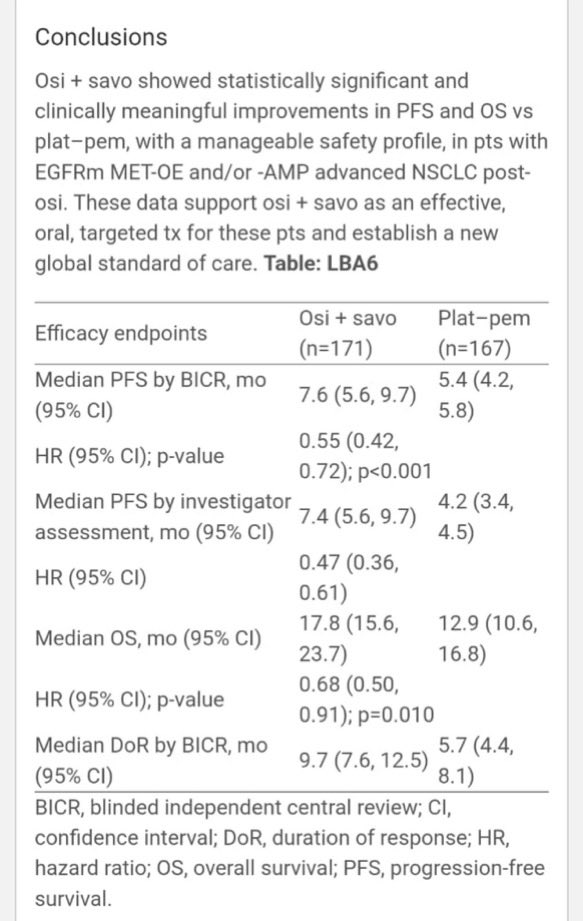
Osi + savo showed statistically significant and clinically meaningful improvements in PFS and OS vs plat–pem, with a manageable safety profile, in pts with EGFRm MET-OE and/or -AMP advanced NSCLC post-osi. These data support osi + savo as an effective, oral, targeted tx for these pts and establish a new global standard of care. Table: LBA6
Efficacy endpoints | Osi + savo (n=171) | Plat–pem (n=167)
Median PFS by BICR, mo (95% CI) | 7.6 (5.6, 9.7) | 5.4 (4.2, 5.8)
HR (95% CI); p-value | 0.55 (0.42, 0.72); p<0.001
Median PFS by investigator assessment, mo (95% CI) | 7.4 (5.6, 9.7) | 4.2 (3.4, 4.5)
HR (95% CI) | 0.47 (0.36, 0.61)
Median OS, mo (95% CI) | 17.8 (15.6, 23.7) | 12.9 (10.6, 16.8)
HR (95% CI); p-value | 0.68 (0.50, 0.91); p=0.010
Median DoR by BICR, mo (95% CI) | 9.7 (7.6, 12.5) | 5.7 (4.4, 8.1)
BICR, blinded independent central review; CI, confidence interval; DoR, duration of response; HR, hazard ratio; OS, overall survival; PFS, progression-free survival.
KOL-Made Infographics
Physician-authored summary graphics from ESMO 2026 · click to enlarge
Topline-day press captures (Aug 17, 2026) plus the SAVANNAH Phase II deck from ELCC25 that defined SAFFRON’s MET selection strategy. Full text via the OCR toggle on each card. SAVANNAH numbers are Phase II data (cut-off 23 Aug 2024) — SAFFRON Phase III numbers (ESMO 2026 LBA6) are in At a Glance.
Announcements & Press Releases, Oncology/Immunology | 17 Aug 2026
HUTCHMED Announces ORPATHYS(R) Plus TAGRISSO(R) Demonstrated Statistically Significant and Clinically Meaningful Improvements in Progression-Free and Overall Survival in MET-Driven EGFR-Mutated Lung Cancer After Progression on TAGRISSO(R)
- First global Phase III trial to show significant progression-free and overall survival benefits in this setting -
- SAFFRON trial results reinforce TAGRISSO as the backbone therapy across EGFRm lung cancer -
[AstraZeneca press release, 17 August 2026:] Tagrisso plus Orpathys demonstrated statistically significant and clinically meaningful improvements in progression-free and overall survival in MET-driven EGFR-mutated lung cancer after progression on Tagrisso. First global Phase III trial to show significant progression-free and overall survival benefits in this setting. SAFFRON trial results reinforce Tagrisso as the backbone therapy across EGFRm lung cancer.
[Second image — Study Design slide (NOTE: this is a 1L osimertinib +/- savolitinib cohort design, N=44, ORR primary endpoint — appears to be a separate Phase 2 study design, NOT the SAFFRON Phase 3 schema):] Key inclusion: >=18y, treatment-naive IIIB/IV NSCLC, ECOG 0-1, EGFR sensitive mutation (19del or L858R), MET positive (IHC3+ >=75% or FISH GCN>=5 or MET/CEP7>=2 or NGS CN>=5), no prior EGFR or HGF/MET inhibitors. Cohort 1: osimertinib 80mg qd (N=22); Cohort 2: osimertinib 80mg qd + savolitinib 300mg bid (N=22); serial ctDNA (NGS); post-progression MET-positive -> osimertinib + savolitinib 300mg bid. Primary: ORR (RECIST 1.1) of each cohort as 1L. Secondary: PFS, DoR, DCR, OS, 12m OS. Exploratory: ORR of savolitinib+osimertinib after progression on osimertinib monotherapy, resistance profile, biomarker analysis.
[AstraZeneca press-release pull quote:] Tagrisso plus Orpathys demonstrated statistically significant and clinically meaningful improvements in progression-free and overall survival in MET-driven EGFR-mutated lung cancer after progression on Tagrisso.
SAFFRON trial results reinforce Tagrisso as the backbone therapy across EGFRm lung cancer.
Positive high-level results from the SAFFRON Phase III trial showed Tagrisso (osimertinib) plus Orpathys (savolitinib) demonstrated a statistically significant and clinically meaningful improvement in both progression-free survival (PFS) and overall survival (OS) versus doublet platinum-based chemotherapy in patients with EGFR-mutated (EGFRm) non-small cell lung cancer (NSCLC). Patients in the trial had tumours with high levels of MET overexpression or amplification and had progressed on prior treatment with Tagrisso.
ELCC - European Lung Cancer Congress 2025. SAVANNAH: Savolitinib + osimertinib in patients with EGFRm advanced NSCLC and MET overexpression and/or amplification following progressive disease on osimertinib.
Myung-Ju Ahn, Tae Min Kim, Laura Bonanno, Susanna Cheng, Sang-We Kim, Marcello Tiseo, Quincy Chu, Claudia Proto, Adrian Sacher, Yung-Hung Luo, Christina Baik, Lyudmila Bazhenova, Jacques Cadranel, Tuan Bao Diep, Prasad Narayanan, James Chih-Hsin Yang, Alexander Gont, Matthew Haskins, Wanning Xu, Filippo de Marinis. Final publication number: 2O.
[Photos 2-3 are the same SAVANNAH design and tumour-response slides shown in Dr. Reguart's set below, photographed in-room; see that panel for the full transcription.]
Trial Design
SAFFRON Trial Design
MET overexpression and/or amplification is one of the most common mechanisms of acquired resistance to osimertinib in EGFR-mutated NSCLC. SAFFRON tests whether adding savolitinib — an oral, highly selective MET tyrosine kinase inhibitor jointly developed by HUTCHMED and AstraZeneca — to continued osimertinib can beat the platinum-doublet chemotherapy default in patients whose disease progressed on first- or second-line osimertinib as their most recent therapy.
Topline results (August 17, 2026) are in At a Glance. The program builds on TATTON and the SAVANNAH Phase II trial (which defined the IHC90+/FISH10+ selection), and on SACHI, the China Phase III that already supported the combination’s approval there. Physicians on this page immediately framed the readout around post-FLAURA2 sequencing and the value of routine MET testing at progression.
Study Design
Global, randomized (1:1), open-label, multicenter Phase III; 338 patients across 230 centers in 29 countries; last patient randomized October 31, 2025.
Population
Adults with locally advanced or metastatic EGFRm NSCLC (Ex19del/L858R ± T790M), MET-overexpressed (central IHC: 3+ in ≥90% of tumor cells) and/or amplified (FISH ≥10 copies / NGS), progressed on 1st- or 2nd-line osimertinib as most recent therapy.
Interventions
Savolitinib 300 mg BID + osimertinib 80 mg QD (all-oral) vs pemetrexed 500 mg/m² + cisplatin 75 mg/m² or carboplatin AUC5 q21d ×4, then pemetrexed maintenance.
Prospective central MET testing (IHC / FISH / NGS) using the SAVANNAH-derived high-MET cut-off (IHC90+ / FISH10+).
Sponsor
AstraZeneca (sole lead sponsor on ClinicalTrials.gov; NEJM: funded by AstraZeneca). Savolitinib is jointly developed by HUTCHMED and AstraZeneca and commercialized by AstraZeneca.
Published October 25, 2026 alongside ESMO 2026 LBA6, the NEJM paper (Lu et al.) reports that osimertinib plus savolitinib improved progression-free survival (HR 0.55; 95% CI 0.42-0.72; P<0.001) and overall survival (HR 0.68; 95% CI 0.50-0.91; P=0.01; final analysis) versus platinum-pemetrexed in 338 patients with EGFR-mutated NSCLC with MET overexpression and/or amplification after progression on osimertinib, with 12-month OS of 70% vs 53%. Peripheral edema (49%) was the most frequent adverse event with the combination. See At a Glance.
What concerns did physicians raise about SAFFRON at ESMO 2026?
Discussion focused on the comparator (platinum chemotherapy rather than amivantamab-chemotherapy, which improved PFS after osimertinib in MARIPOSA-2 without MET selection), the low rate of subsequent MET-directed therapy in the chemotherapy arm (13% on Dr. Rebecca Heist's discussion slide), whether crossover to the combination should have been allowed, how to define MET positivity, and the need for a tissue re-biopsy at progression to identify eligible patients. See the ESMO 2026 discussion.
What is the SAFFRON trial?
SAFFRON (NCT05261399) is a global, randomized, open-label Phase III trial of savolitinib (Orpathys) plus osimertinib (Tagrisso) versus platinum-pemetrexed chemotherapy in 338 patients with EGFR-mutated, MET-overexpressed and/or amplified advanced NSCLC that progressed on first- or second-line osimertinib. See Trial Design.
What did the SAFFRON topline results show?
Per AstraZeneca and HUTCHMED (August 17, 2026), savolitinib plus osimertinib significantly improved both progression-free survival (primary endpoint, BICR) and overall survival versus platinum-based chemotherapy. In the ESMO 2026 LBA6 abstract (data cut-off 6 Jul 2026), median PFS by BICR was 7.6 vs 5.4 months (HR 0.55, 95% CI 0.42-0.72) and median OS 17.8 vs 12.9 months (HR 0.68, 95% CI 0.50-0.91); see At a Glance.
Is the savolitinib plus osimertinib combination FDA approved?
No. The combination is investigational in the United States (FDA Fast Track). It is approved in China (June 2025) based on the SACHI Phase III trial, and osimertinib itself is FDA-approved in EGFR-mutated NSCLC. See At a Glance.
How were patients selected for MET status in SAFFRON?
A central laboratory selected patients prospectively by MET overexpression (IHC 3+ in at least 90% of tumor cells) and/or amplification (FISH 10 or more copies, or NGS), the cut-off defined in SAVANNAH. See Trial Design.
Why does SAFFRON matter for EGFR-mutant lung cancer?
MET aberration is one of the most common mechanisms of resistance to osimertinib, and SAFFRON is the first global Phase III to show significant PFS and OS benefits with an all-oral, chemotherapy-sparing combination in this setting. See At a Glance.



 𝕏
 𝕏
 𝕏
 𝕏
 𝕏
 𝕏
 𝕏
 𝕏