MARIPOSA is a Phase 3 trial of amivantamab (Rybrevant) plus lazertinib (Lazcluze) versus osimertinib in first-line EGFR exon 19 deletion or L858R advanced NSCLC. The combination improved median PFS to 23.7 vs 16.6 months (HR 0.70; p=0.0002) and later showed an overall survival benefit, supporting FDA approval on August 19, 2024. Sponsor: Janssen (Johnson & Johnson).
PFS (primary) — Median 23.7 vs 16.6 months; HR 0.70 (95% CI 0.58-0.85; p=0.0002). (NEJM, DCO1)
Overall survival — Statistically significant OS benefit at 42-mo follow-up; HR 0.75, >1 year median OS improvement. (ELCC 2025 update)
Safety — Higher AE burden than osimertinib; notable venous thromboembolism (VTE) signal requiring prophylactic anticoagulation for the first 4 months; EGFR/MET skin & nail toxicity. (NEJM)
Regulatory — FDA approved August 19, 2024 for 1L EGFR ex19del/L858R advanced NSCLC. (FDA.gov)
Compiled and reviewed by the KOL Pulse research team, led by Brian Shields, Founder, KOL Pulse. Last updated July 21, 2026.
Influence Leaders
Top KOLs Discussing MARIPOSA
Eric K. Singhi, MD
@lungoncdoc
212.7K impressions
Stephen V Liu, MD
@StephenVLiu
71.9K impressions
Dr Amol Akhade
@SuyogCancer
50.2K impressions
Benjamin Besse
@BenjaminBesseMD
43.3K impressions
Rami Manochakian MD, FASCO Cancer Education
@RManochakian
38.7K impressions
Bartomeu Massuti
@bmassutis
27.7K impressions
Free Access · KOL Pulse Intelligence
Track oncology’s top KOLs in your specialty
Create a free account, pick the tumor types you cover, and go beyond the tweet — the intelligence pharma teams use to map influence and prepare for engagement:
[Slide 1]
Available First Line Treatment Options for EGFRm NSCLC
FLAURA1.2
FLAURA23.4
FLAURA2
MARIPOSA5.6
MARIPOSA5
Osimertinib
Osimertinib
Osi + Chemotherapy
Osimertinib
Amivantamab + Lazertinib
(N=279)
(N=279)
(N=278)
(N=429)
(N=429)
ORR
80% (75-85)
76% (70-80)
83% (78-87)
85% (81-88)
86% (83-89)
18.9 mo
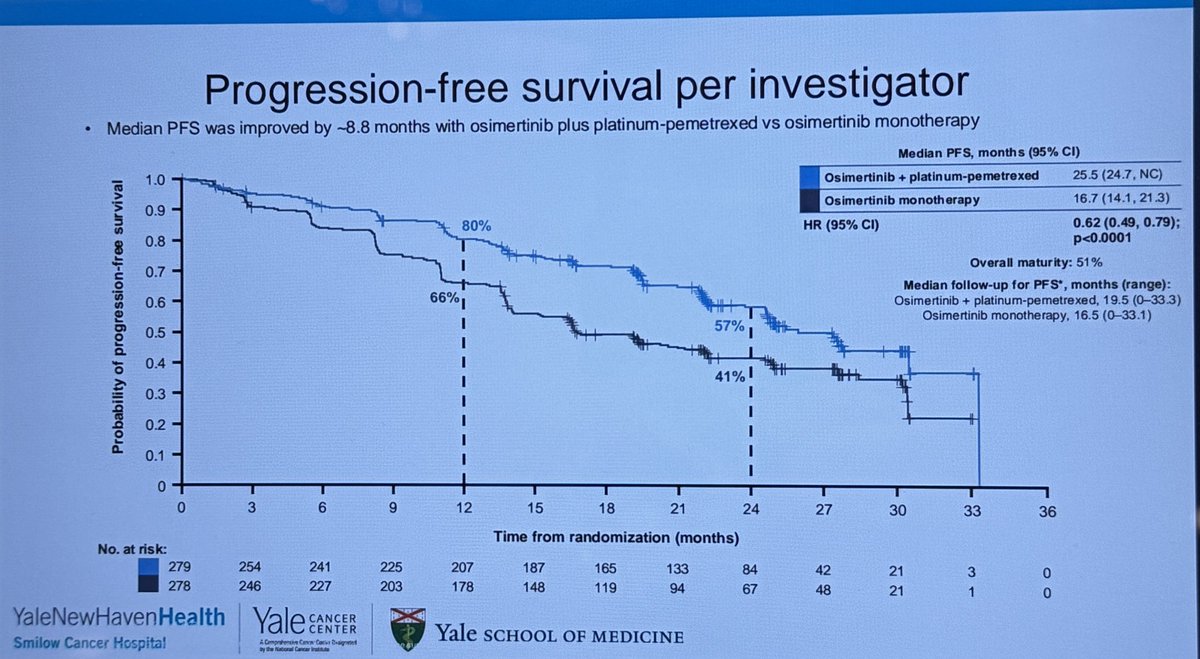
16.7 mo
25.5 mo
16.6 mo
23.7 mo
PFS, median
(15.2-21.4)
(14.1-21.3)
(24.7-NC)
(14.8-18.5)
(19.1-27.7)
PFS HR
0.62 (0.49-0.79)
0.70 (0.58-0.85)
38.6 months
36.7 month
Not Reached
OS, median
Not Reported
Not Reported
(34.5-41.8)
(33.4-41.0)
(37.8 mo follow up)
0.90 (0.65-1.24; P = 0.52)
0.75 (0.61-0.92; P < 0.005)
os HR
*27% data maturity
Final Analysis
Route of
PO
PO + IV (q3 weeks)
PO + IV (weekly, then q2 weeks)
Administration
Toxicity
Low grade diarrhea, rash
Fatigue, nausea, hematologic toxicities
Dermatologic toxicities, infusion reactions and VTE
Considerations
FLAURA2 Primary Endpoint- PFS (Investigator-Assessed)
1
Soria JC, et al N Engl J Med 2018.378.113.25.2 Ramalingam SS et al N Engli J Med 2020,382.41-50 3 Planchard D, et al N Engl
J
MARIPOSA: Primary Endpoint- PFS (BICR)
Med 2023,389 1935-1948 4 Valdiviezo N. FLCC 2024; 5 Cho BC et al N Engl J Med 2024 391 1486 1498 6 Yang JCH et al FLCC 2025
Zosia Piotrowska MD. MHS, Boston USA
Organisers
Partners
Content of this presentation is copyrightand responsibility of the author Permission is required for re-use
ESMD
IASLC
ESTRO
ETOP-IBCSG
[Slide 1]
Classic EGFR first-line therapy may no longer be one size fits all, to the benefit of patie
Osimertinib remains an option for standard, low-
risk classic EGFR mut and those with borderline
functional status
I will tel
what to
Addition of chemotherapy to osimertinib or
amivantamab to lazertinib may improve outcomes,
particularly in those with higher risk features (TP53,
ctDNA, brain/liver mets)
Subcutaneous amivantamab solves some
MARIPOSA issues, but not all
It's yet to be determined whether sub Q ami + laz
will take on FLAURA2 or find middle ground as a
chemo-free regimen
ctDNA continues to emerge as a biomarker -
clinical trials
[Slide 1]
Safety
MARIPOSA
Median duration of treatment
AEs by preferred term (220% of
Amivantamab +
Osimertinib
was 27.0 mo for amivantamab +
participants in either group)
lazertinib (n=421)
(n=428)
lazertinib and 22.4 mo for
Any grade
Grade >3
Any grade
Grade >3
Related to EGFR Inhibition
osimertinib
Paronychia
291 (69)
49 (12)
127 (30)
2 (<1)
Rash
Safety profile was consistent with
271 (64)
73 (17)
136 (32)
3 (<1)
Diarrhea
133 (32)
9 (2)
200 (47)
4 (<1)
the primary analysis
Dermatitis acneiform
127 (30)
37 (9)
55 (13)
0
AEs were mostly EGFR- and
Stomatitis
126 (30)
5 (1)
92 (21)
1 (<1)
MET-related and grades 1-21,2
Pruritus
107 (25)
2 (<1)
75 (18)
1 (<1)
Related to MET Inhibition
A minority of participants were
Hypoalbuminemia
216 (51)
26 (6)
29 (7)
0
Peripheral edema
prescribed antibiotics for rash (21%)
162 (38)
8 (2)
29 (7)
1 (<1)
Other
at study initiation2
Infusion-related reaction
275 (65)
27 (6)
0
0
ALT increased
170 (40)
28 (7)
Few were on anticoagulation (5%)
66 (15)
8 (2)
AST increased
139 (33)
15 (4)
68 (16)
at baseline², with VTE occurring in
6 (1)
Constipation
130 (31)
0
70 (16)
0
40% in the amivantamab +
COVID-19
125 (30)
8 (2)
112 (26)
9 (2)
lazertinib arm and 11% in the
Anemia
114 (27)
20 (5)
112 (26)
10 (2)
osimertinib arm
Decreased appetite
114 (27)
4 (1)
84 (20)
7 (2)
Nausea
99 (24)
5 (1)
65 (15)
1 (<1)
Hypocalcemia
96 (23)
11 (3)
37 (9)
0
Asthenia
84 (20)
13 (3)
54 (13)
7 (2)
Muscle spasms
84 (20)
3 (<1)
36 (8)
0
Thrombocytopenia
74 (18)
4 (1)
92 (21)
6 (1)
VVE is grouped term, which included pulmonary embolism deep vein thrombosis, limb venous thrombosa vencus thrombosis thombosis superficial vein thrombosis, thombophiebitis, embolism, venous ambolism, jugular von thombosis signoid sinus
elcc
thrombosis axilary ven thrombosis pulmonary infarction vena cava thrombosa central venous catheterization portal vent Ivorbosis post thrombobe syndrome pulmonary thrombosa superior sapital anus thombosis transverse sun thombosa pelve
venous thrombosis and superior venu cava syndrome 1 Cho BC. el al N Engl Med 2024,391(16) 1489-1498 2 Spira Al et al Presented at 2023 North America Conference on Lung Cancer (NACLC) December H 2023 Chicago, IL USA
European Lung Cancer Congress 2025
---
[Slide 2]
First Subsequent Therapy
MARIPOSA
Most common subsequent therapy class was chemotherapy-based regimens in both arms
5%
5%
28%
74% (129/175°) of
39%
TKI-based regimens
participants in
76% (195/258) of
Chemotherapy-based
the amivantamab +
regimens
participants in
lazertinib arm were
the osimertinib arm
Other
willing and able to
were willing and able
receive a subsequent
to receive a
therapy
subsequent therapy
56%
67%
MARIPOSA did not allow
treatment crossover
Amivantamab + lazertinib
Osimertinib
(n=129)
(n=195)
74% received 2L therapy, suggesting a long-term treatment plan after 1L amivantamab + lazertinib is feasible
Note: Percentages may not sum to 100 due to rounding
"Denominator is the number of participants who had disease progression and discontinued randomized treatment no based regiment include TIG chemotherapy (5% in both arms) Other therapy included VEGF alone antbody-drug
elcc
conjugates
ALK
tyrosine
after
participant
received
and
1
participant
monotherapy)
MARIPOSA
did
European Lung Cancer Congress 2025
[Slide 1]
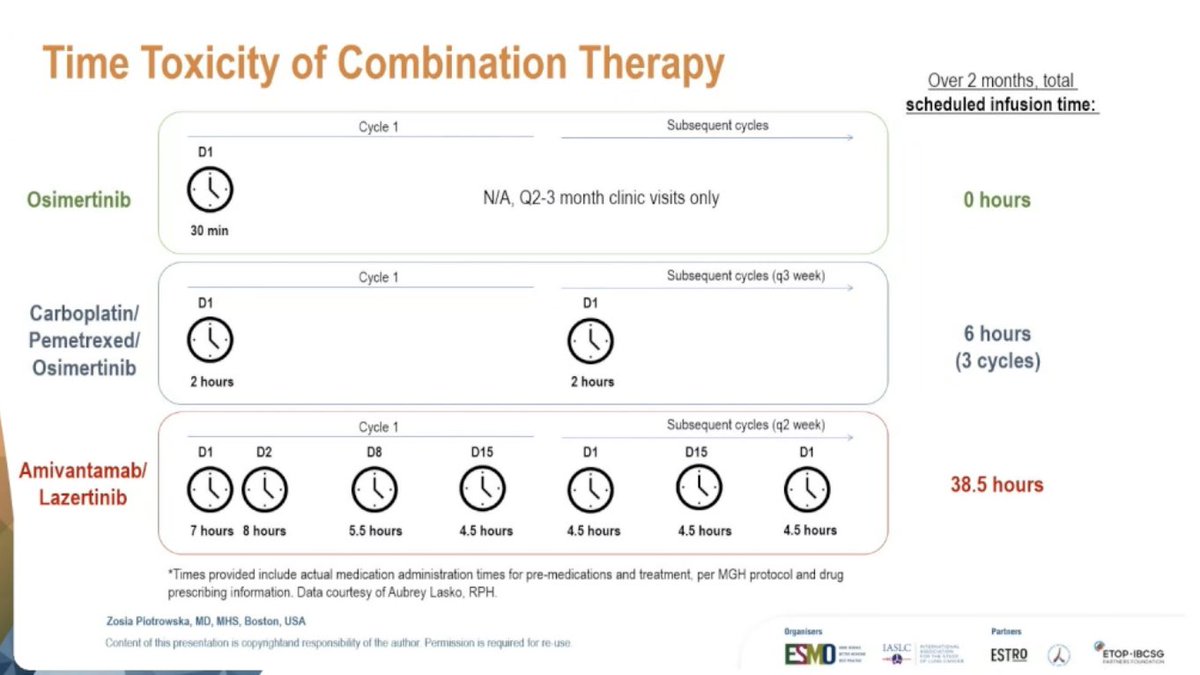
Time Toxicity of Combination Therapy
Over 2 months, total
scheduled infusion time:
Cycle 1
Subsequent cycles
D1
Osimertinib
I
N/A, Q2-3 month clinic visits only
0 hours
30 min
Cycle 1
Subsequent cycles (q3 week)
D1
D1
Carboplatin/
Pemetrexed/
(
6 hours
Osimertinib
(3 cycles)
2 hours
2 hours
Cycle 1
Subsequent cycles (q2 week)
D1
D2
D8
D15
D1
D15
D1
Amivantamab/
38.5 hours
Lazertinib
7 hours 8 hours
5.5 hours
4.5 hours
4.5 hours
4.5 hours
4.5 hours
*Times provided include actual medication administration times for pre-medications and treatment per MGH protocol and drug
prescribing information Data courtesy of Aubrey Lasko, RPH
Zosia Piotrowska MD. MHS Boston USA
Organisers
Partners
Content of this presentation is copyrightand responsibility of the author Permission is required for re-use
ESMD
--
IASLC
-
KINGDO
esmate
ESTRO
L
ETOP-IBCSG
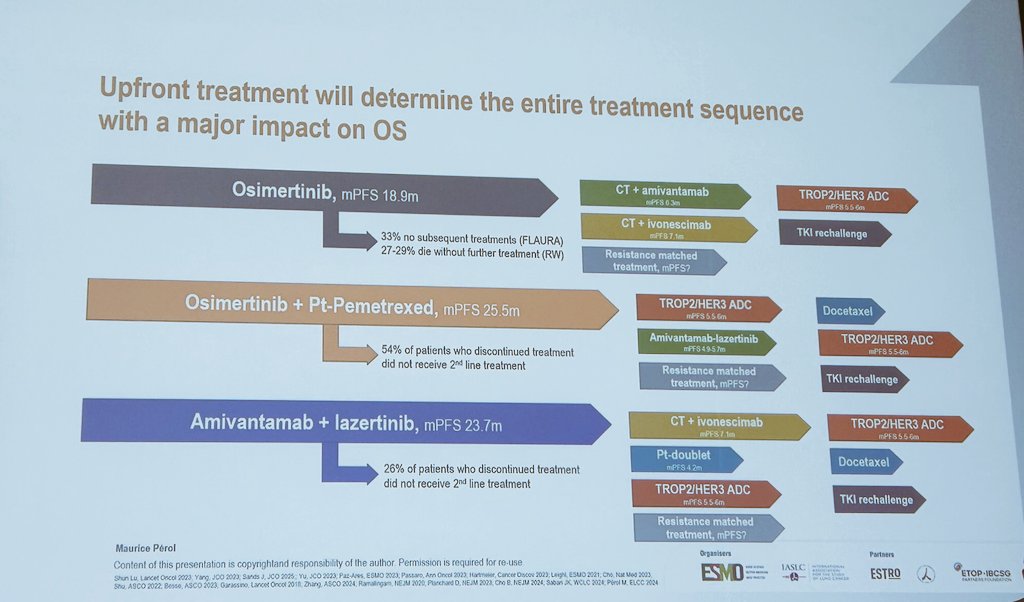
[Slide 1 — Treatment sequencing schematic, EGFRm NSCLC (Maurice Perol; ELCC 2025)]
"Upfront treatment will determine the entire treatment sequence with a major impact on OS"
First-line options and downstream sequence:
- Osimertinib monotherapy, mPFS 18.9m (FLAURA) — 33% no subsequent treatment (FLAURA); 27-29% die without further treatment (real-world)
- Osimertinib + Pt-Pemetrexed, mPFS 25.5m (FLAURA2) — 54% who discontinued did not receive 2nd-line treatment
- Amivantamab + lazertinib, mPFS 23.7m (MARIPOSA) — 26% who discontinued did not receive 2nd-line treatment
[mPFS verified vs NEJM: FLAURA osi mono 18.9 mo (Soria 2018); FLAURA2 osi+chemo 25.5 mo investigator-assessed (Planchard 2023); MARIPOSA ami+laz 23.7 mo BICR (Cho 2024). MARIPOSA is FDA-approved (Aug 19 2024) 1L EGFRm NSCLC.]
[Slide 1]
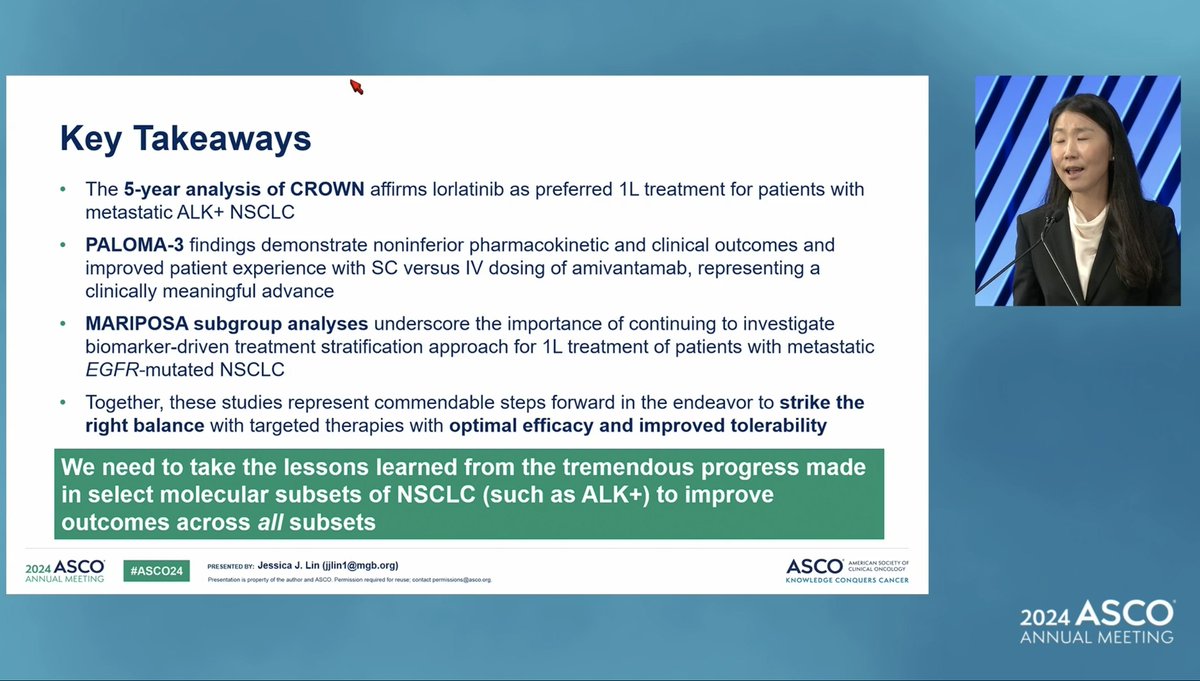
Key Takeaways
The 5-year analysis of CROWN affirms lorlatinib as preferred 1L treatment for patients with
metastatic ALK+ NSCLC
PALOMA-3 findings demonstrate noninferior pharmacokinetic and clinical outcomes and
improved patient experience with SC versus IV dosing of amivantamab, representing a
clinically meaningful advance
MARIPOSA subgroup analyses underscore the importance of continuing to investigate
biomarker-driven treatment stratification approach for 1L treatment of patients with metastatic
EGFR-mutated NSCLC
Together, these studies represent commendable steps forward in the endeavor to strike the
right balance with targeted therapies with optimal efficacy and improved tolerability
We need to take the lessons learned from the tremendous progress made
in select molecular subsets of NSCLC (such as ALK+) to improve
outcomes across all subsets
2024 ASCO
PRESENTED BY: Jessica J. Lin (jjin1@mgb.org)
ASCO
AMERICAN SOCIETY OF
#ASCO24
CUNICAL ONCOLOGY
ANNUAL MEETING
Presentation is property of the author and ASCO Permission required for reuse contact
KNOWLEDGE CONQUERS CANCER
2024
ASCO
ANNUAL MEETING
MARIPOSA is a phase 3, randomized, open-label trial (NCT04487080) evaluating amivantamab plus lazertinib versus osimertinib as first-line therapy in patients with EGFR-mutant advanced non-small cell lung cancer (NSCLC). The trial enrolled 1,074 patients with locally advanced or metastatic NSCLC harboring EGFR exon 19 deletions or exon 21 L858R substitution mutations. Results demonstrated a statistically significant improvement in both PFS and OS with the combination, leading to FDA approval in August 2024.
On August 19, 2024, the FDA approved lazertinib (Lazcluze) in combination with amivantamab-vmjw (Rybrevant) for the first-line treatment of locally advanced or metastatic NSCLC with EGFR exon 19 deletions or exon 21 L858R substitution mutations, as detected by an FDA-approved test. Approval was based on the MARIPOSA trial (NCT04487080) demonstrating statistically significant PFS improvement (HR 0.70; p=0.0002).
Phase 3, randomized (2:2:1), open-label, active-controlled, multicenter trial comparing amivantamab (EGFR-MET bispecific antibody) plus lazertinib (third-generation EGFR TKI) versus osimertinib monotherapy in treatment-naive EGFR-mutant advanced NSCLC.
Population
Adults with locally advanced or metastatic NSCLC with EGFR exon 19 deletions or exon 21 L858R substitution mutations, as detected by an FDA-approved test. No prior systemic therapy for advanced disease.
Interventions
Amivantamab-vmjw (Rybrevant) intravenous plus lazertinib (Lazcluze) oral daily versus osimertinib monotherapy. A third arm evaluated lazertinib monotherapy.
Primary Endpoints
Primary endpoint: progression-free survival (PFS) assessed by blinded independent central review. Key secondary endpoints included overall survival (OS), overall response rate (ORR), duration of response (DOR), and intracranial PFS.
Progression-Free Survival (PFS)
The combination of amivantamab plus lazertinib demonstrated a statistically significant improvement in PFS versus osimertinib (HR 0.70; 95% CI: 0.58-0.85; p=0.0002). Median PFS was 23.7 months (95% CI: 19.1-27.7) with the combination versus 16.6 months (95% CI: 14.8-18.5) with osimertinib. ORR was 86% with the combination versus 85% with osimertinib.
Updated OS data presented at ELCC 2025 showed a statistically significant OS improvement with amivantamab plus lazertinib versus osimertinib. At 42 months of follow-up, the OS HR was 0.75, with more than one year of median OS improvement. Three-year OS rates were 60% with the combination versus 51% with osimertinib.
The combination was associated with higher rates of adverse events compared to osimertinib monotherapy. A notable safety signal of venous thromboembolic events (VTE) was observed, requiring prophylactic anticoagulation for the first four months of therapy. Infusion-related reactions and skin toxicity were also more common with the combination. Time toxicity — the burden of treatment-related clinic visits and infusions — has been raised as a practical consideration by treating physicians.
MARIPOSA establishes amivantamab plus lazertinib as a new first-line standard for EGFR-mutant advanced NSCLC. The combination received FDA approval in August 2024 for patients with EGFR exon 19 deletions or L858R mutations. However, the increased toxicity and time burden compared to osimertinib monotherapy remain active topics of clinical debate, with some physicians reserving the combination for specific patient subgroups such as those with MET-positive tumors.
Conference Update · WCLC 2026 · Seoul
WCLC 2026: Live KOL Reaction
Physician posts about this trial captured live during the IASLC 2026 World Conference on Lung Cancer (Seoul, September 12–15). Quotes are verbatim; each card links to the original post. Last updated 2026-09-13.
MARIPOSA is a Phase 3, randomized, open-label trial (NCT04487080) evaluating amivantamab (Rybrevant) plus lazertinib (Lazcluze) versus osimertinib as first-line therapy in 1,074 patients with locally advanced or metastatic NSCLC harboring EGFR exon 19 deletions or exon 21 L858R mutations.
Is amivantamab + lazertinib FDA approved for first-line EGFR NSCLC?
Yes. On August 19, 2024 the FDA approved lazertinib (Lazcluze) in combination with amivantamab-vmjw (Rybrevant) for the first-line treatment of locally advanced or metastatic NSCLC with EGFR exon 19 deletions or exon 21 L858R substitution mutations, as detected by an FDA-approved test.
What were the MARIPOSA PFS results?
The combination of amivantamab plus lazertinib improved median progression-free survival to 23.7 months versus 16.6 months with osimertinib (HR 0.70; 95% CI 0.58-0.85; p=0.0002), a statistically significant improvement.
Did MARIPOSA show an overall survival benefit?
Yes. Updated data presented at ELCC 2025 (42-month follow-up) showed a statistically significant overall survival improvement with amivantamab plus lazertinib versus osimertinib (HR 0.75), with more than one year of median OS improvement.
What are the main safety concerns with the MARIPOSA regimen?
The combination has a higher adverse-event burden than osimertinib monotherapy, including EGFR- and MET-related skin and nail toxicity and a notable venous thromboembolic event (VTE) signal that requires prophylactic anticoagulation during the first four months of therapy.