DESTINY-Breast03 is a Phase 3 trial of trastuzumab deruxtecan (T-DXd, Enhertu) versus T-DM1 in HER2-positive metastatic breast cancer previously treated with trastuzumab and a taxane. T-DXd more than quadrupled median PFS (28.8 vs 6.8 months; HR 0.33) and improved overall survival (52.6 vs 42.7 months; HR 0.73), supporting FDA approval on May 4, 2022. Sponsor: Daiichi Sankyo / AstraZeneca.
Discover KOL Sentiment on DESTINY-Breast03 →Design — Phase 3, open-label; T-DXd (Enhertu) vs T-DM1 (Kadcyla), 2L HER2+ metastatic breast cancer post trastuzumab + taxane (NCT03529110). (Lancet/NEJM)
PFS (primary, BICR) — Median 28.8 vs 6.8 months; HR 0.33 (95% CI 0.26-0.43; p<0.0001); confirmed ORR 79.1%. (Lancet)
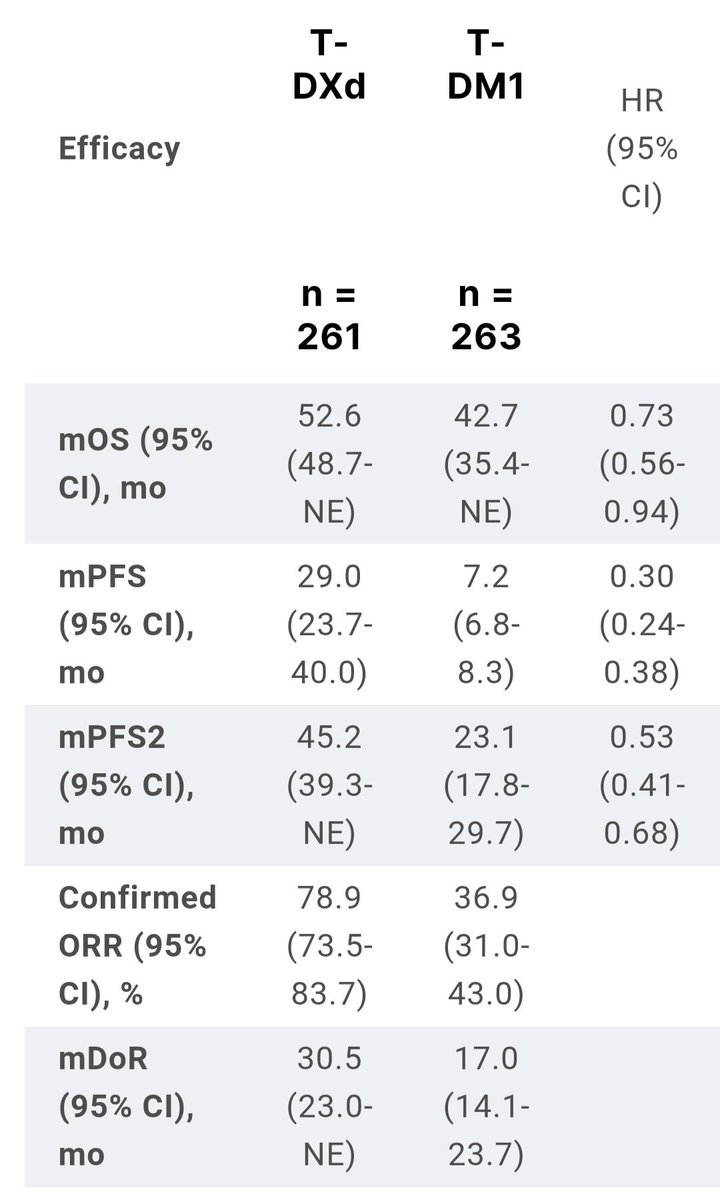
Overall survival — Median 52.6 vs 42.7 months; HR 0.73 (95% CI 0.56-0.94) — 27% reduction in risk of death. (updated OS)
Safety — ILD/pneumonitis (all-grade) 16.7% vs 3.4% — requires active monitoring per class labeling; no new Grade >=3 ILD in long-term follow-up. (Lancet)
Regulatory — FDA approved May 4, 2022 for HER2+ metastatic breast cancer after >=1 prior anti-HER2 regimen. (FDA.gov)
Sponsor / Drug — Daiichi Sankyo / AstraZeneca; T-DXd (Enhertu), a HER2-directed antibody-drug conjugate. (FDA label)
Compiled and reviewed by the KOL Pulse research team, led by Brian Shields, Founder, KOL Pulse. Last updated July 21, 2026.



Top tweets by impressions — click to view on X
#ASCO24
T-DXd vs T-DM in patients with HER2+ mBC: Updated survival results of DESTINY-Breast03
PFS➡️29.0 vs 7.2 mo
OS➡️52.6 vs 42.7 mo
ORR➡️79% vs 37%
ILD➡️16.7% vs 3.4% (all…
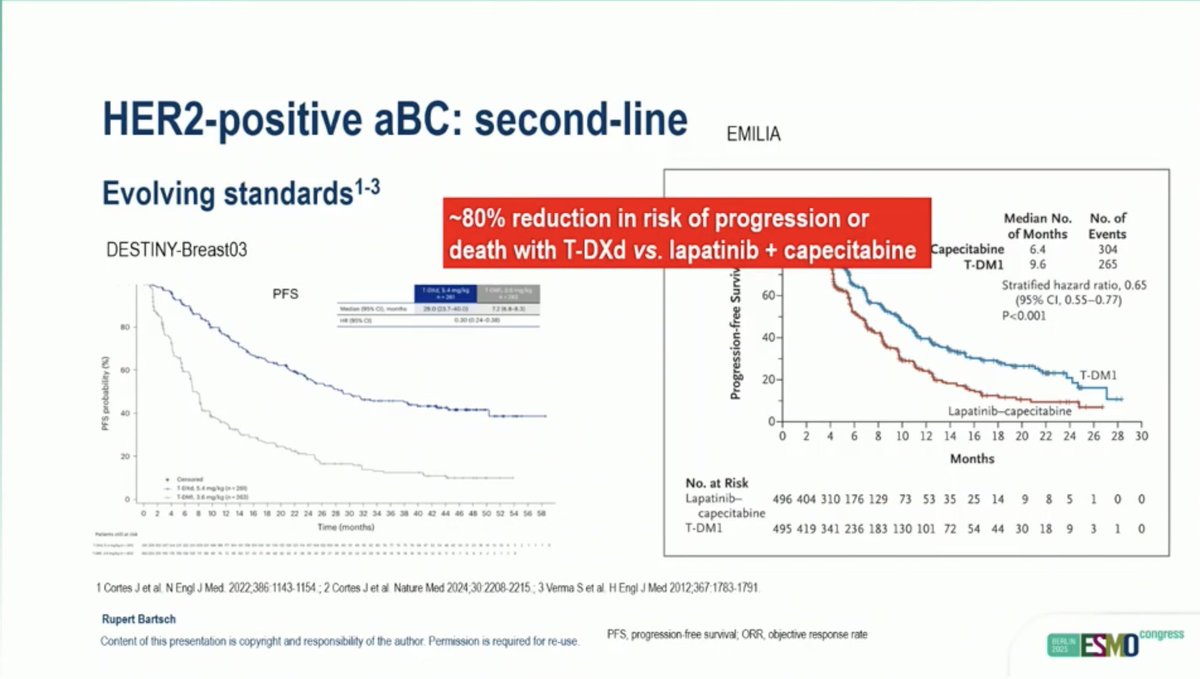
in 2L HER2+ metastatic breast cancer, in 10 years, from 2012 to 2022, we have reduced risk of progression and death by !!80%!!
- Lapatinib + cape 6.4 months
- TDM1 9.6 months
- TDXd 29.1 months
…
@giammi107 @ASCO Subsequent-line treatments (cross-over), adherence to subsequent-line treatments due to side effects, censored data, etc.
In clinical trials, OS is the gold standard endpoint, but in…
@dr_yakupergun @ASCO Maybe can you explain to a young doctor huge differences in pfs but not so much in os?
DESTINY-Breast03 established T-DXd as the 2L standard in HER2+ mBC by demonstrating unprecedented PFS and OS improvements over T-DM1. Long-term follow-up confirms durable benefit. T-DXd is now being studied in earlier lines (DESTINY-Breast09) and in HER2-low populations (DESTINY-Breast06).
Median: 28.8 months (T-DXd) vs. 6.8 months (T-DM1). HR 0.33 (95% CI 0.26-0.43), P<0.0001 T-DXd produced a >4-fold improvement in median PFS over T-DM1. Confirmed ORR 79.1% with T-DXd.
Median: 52.6 months (T-DXd, 95% CI 48.7-NE) vs. 42.7 months (T-DM1, 95% CI 35.4-NE). HR 0.73 (95% CI 0.56-0.94) Median OS 52.6 months (95% CI 48.7-NE) with T-DXd vs. 42.7 months (95% CI 35.4-NE) with T-DM1; HR 0.73 (95% CI 0.56-0.94) — 27% reduction in risk of death. Data cutoff Nov 20, 2023; median follow-up 41 months. ~10-month improvement in median OS — a significant survival benefit over T-DM1. Published Hamilton et al., Nature Medicine 2024.
ILD/pneumonitis (all-grade) 16.7% with T-DXd vs. 3.4% with T-DM1 — requires active monitoring per class labeling. No new Grade ≥3 ILD cases in long-term follow-up. Other TRAEs consistent with established T-DXd profile.
✅ 2L standard of care for HER2+ mBC. DESTINY-Breast03 established T-DXd as the 2L standard in HER2+ mBC by demonstrating unprecedented PFS and OS improvements over T-DM1. Long-term follow-up confirms durable benefit. T-DXd is now being studied in earlier lines (DESTINY-Breast09) and in HER2-low populations (DESTINY-Breast06).
DESTINY-Breast03 is a Phase 3, randomized, open-label trial (NCT03529110) comparing trastuzumab deruxtecan (T-DXd, Enhertu) with trastuzumab emtansine (T-DM1, Kadcyla) in patients with HER2-positive metastatic breast cancer previously treated with trastuzumab and a taxane.
Yes. On May 4, 2022 the FDA approved Enhertu (fam-trastuzumab deruxtecan-nxki) for adults with unresectable or metastatic HER2-positive breast cancer who have received one or more prior anti-HER2-based regimens, based on DESTINY-Breast03.
T-DXd produced a more than four-fold improvement in median progression-free survival versus T-DM1: 28.8 months versus 6.8 months (HR 0.33; 95% CI 0.26-0.43; p<0.0001), with a confirmed objective response rate of 79.1%.
Yes. Median overall survival was 52.6 months with T-DXd versus 42.7 months with T-DM1 (HR 0.73; 95% CI 0.56-0.94), a 27% reduction in the risk of death.
Interstitial lung disease (ILD)/pneumonitis is the key monitored risk: all-grade ILD occurred in 16.7% with T-DXd versus 3.4% with T-DM1. Active monitoring and prompt management are required per class labeling; no new Grade >=3 ILD cases were reported in long-term follow-up.