KOL Pulse - Trial Profile

ADRIATIC Trial

Limited-stage SCLC - AstraZeneca

Limited-stage SCLC Imfinzi (durvalumab) ASCO 2024 FDA Approved
Explore Trial Data

Top KOLs Discussing ADRIATIC

Rami Manochakian MD, FASCO CancerEducation
@RManochakian
30.9K impressions
Eric K. Singhi, MD
Eric K. Singhi, MD
@lungoncdoc
24.5K impressions
Shankar Siva
Shankar Siva
@_ShankarSiva
17.0K impressions
Dr. Antonio Calles
Dr. Antonio Calles
@Tony_Calles
13.7K impressions
Lecia Sequist, MD, MPH, FASCO
@LeciaSequist
12.3K impressions
Corinne Faivre-Finn
Corinne Faivre-Finn
@finn_corinne
10.6K impressions

ADRIATIC Key Slides & Visuals

Official trial slides and relevant visuals shared by KOLs at ASCO 2024. Click any image to expand.

Rami Manochakian MD, FASCO CancerEducation
ADRIATIC Data
28.7K impressions · 100 likes · Apr 05, 2024
View on X ↗
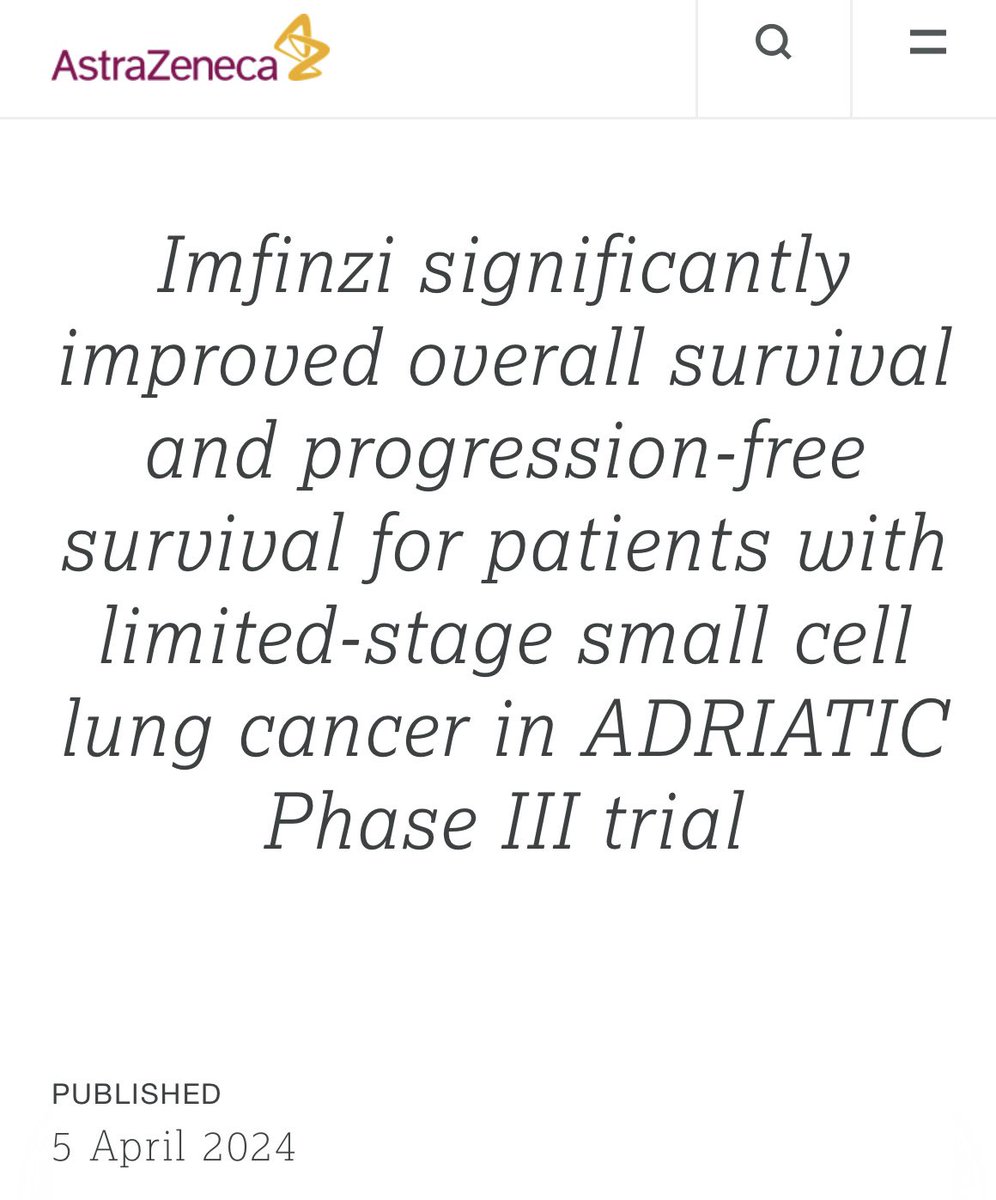
[Slide 1] Q = AstraZeneca Imfinzi significantly improved overall survival and progression-free survival for patients with limited-stage small cell lung cancer in ADRIATIC Phase III trial PUBLISHED 5 April 2024
Shankar Siva
Shankar Siva @_ShankarSiva
ADRIATIC Data
15.9K impressions · 136 likes · Jun 02, 2024
View on X ↗
[Slide 1] 2024ASCO ANNUAL MEETING --- [Slide 2] ADRIATIC study design Phase 3, randomized, double-blind, placebo-controlled, multicenter, international study (NCT03703297) Stage I-III LS SCLC Durvalumab (stage I/II inoperable) Dual primary endpoints: 1500 mg Q4W WHO PS 0 or 1 N=264 Durvalumab vs placebo - OS Had not progressed following cCRT* N=730 - PFS (by BICR, per RECIST v1.1) PCI* permitted before Placebo Key secondary endpoints: randomization R* Q4W Durvalumab + tremelimumab vs N=265 placebo cCRT components - OS Stratified by: Four cycles of platinum and Disease stage Durvalumab + tremelimumab - PFS (by BICR, per RECIST v1.1) eloposide (three permitted) (i/D V3 III) D 1500 mg Q4W + T 75 mg Q4W for 4 doses, RT: 60-66 Gy QD over 6 weeks PCI (yes vs no) followed by D 1500 mg Q4W Other secondary endpoints: or 45 Gy BID over 3 weeks N=200 OS/PFS landmarks RT must commence no later Safety than end of cycle 2 of CT Treatment until investigator-determined progression or intolerable toxicity, or for a maximum of 24 months "CRT and PCI treatment, if received per local standard of care, must have been completed within 1-42 days prior to randomization. TII disease control was achieved and no additional benefit was expected with an additional cycle of chemotherapy, in the opinion of the investigator. The first 600 patients were randomized in a 111 cato to the 3 treatment arms, subsequent patients were randomized 1:1 to either durvalumab or placebo. BOX (inded interested - aves BID - taly CT. chematherapy D and/or 2024 ASCO PRESENTED - Dr David R. Spigel PO prophyers - PS. performance KA every 8 weeks, #ASCO24 DD - day REDIST Regurst Education Otera . Sold Tunurs ASCO METCH SOCIETY OF DUNICAL ONCOLOGY ANNUAL MEETING - - of - - - - - - for - - 1 RT address T. terminumal WHO, World Health Organization KNOWLEDGE CONQUERS CANCER --- [Slide 3] Overall survival (dual primary endpoint) Median duration of follow up in censored patients: 37.2 months (range 0.1-60.9) 1.0 Durvalumab Placebo (n=264) (n=266) Events, n (%) 115(43.6) 146 (54.9) 0.8 mOS, months (95% CI) 55.9 (37.3-NE) 33.4 (25.5-39.9) 68.0% HR (95% CI) 0.73 (0.57-0.93) 56.5% p-value 0.0104 Probability of os 0.6 58.5% 0.4 47.6% 0.2 0 0 3 6 9 12 15 18 21 24 27 30 33 36 39 42 45 48 51 54 57 60 63 Time from randomization (months) No. at risk Durvalumab 264 261 248 236 223 207 189 183 172 162 141 110 90 68 51 39 27 19 11 5 1 0 Placebo 266 250 247 231 214 195 175 164 151 143 123 97 80 62 44 31 23 19 8 5 1 0 os was analyzed using a stratified bank test adjusted for receipt of PCI (yes vs no). The significance level for testing os at this interim analysis was 0.01679 (2-sided) at the overall 4.5% level, allowing for strong alpha control across interim and final analysis timepoints 2024 ASCO #ASCO24 ME STATED BY Dr David R. Spigel ASCO AMERICAN IDENTY OF CUNICAL ONCOLDER ANNUAL MEETING - . - of - who - - - - - - - 1 a confidence - m05, medium CS K - - KNOWLEDGE CONQUERS CANCER --- [Slide 4] Progression-free survival* (dual primary endpoint) Median duration of follow up in censored patients: 27.6 months (range 0.0-55.8) 1.0 Durvalumab Placebo (n=264) (n=266) Events, n (%) 139 (52.7) 169 (63.5) 0.8 mPFS, months (95% CI) 16.6 (10.2-28.2) 9.2 (7.4-12.9) HR (95% CI) 0.76 (0.61-0.95) Probability of PFS p-value 0.0161 0.6 48.8% 46.2% 0.4 36.1% 34.2% 0.2 0 0 3 6 9 12 15 18 21 24 27 30 33 36 39 42 45 48 51 54 57 60 63 No. at risk Time from randomization (months) Durvalumab 264 212 161 135 113 105 101 98 84 78 51 51 33 21 19 10 10 4 4 0 0 0 Placebo 266 208 146 122 100 88 79 76 71 69 47 47 34 23 22 15 14 5 5 0 0 0 "By BICR per RECIST v1.1. PFS - analyzed using a stratted by-ank test adjusted for dhease stage (1/8 vs (II) and receipt of PCI (yes vs no). The significance level for testing PFS - this interim analysis was 0.00184 (2-sided) at the 0.5% level, and ... (2-scled) . the overall 5% level. Statestical signature b PFS - achieved through the recycling multiple testing procedure framework and testing at the 5% (2-sided) alpha level (adjusted for an interim and final analysis). 2024 ASCO #ASCO24 MILIENTED - Dr David R. Spigal ASCO AMERICAN SOCIETY OF CLINICAL ONCOLGOY ANNUAL MEETING - a - - - - - - - - - - mPFS, median PFS KNOWLEDGE CONQUERS CANCER
Lecia Sequist, MD, MPH, FASCO
ADRIATIC Data
12.3K impressions · 160 likes · Jun 02, 2024
View on X ↗
Corinne Faivre-Finn
Corinne Faivre-Finn @finn_corinne
ADRIATIC Data
10.6K impressions · 36 likes · Sep 15, 2024
View on X ↗
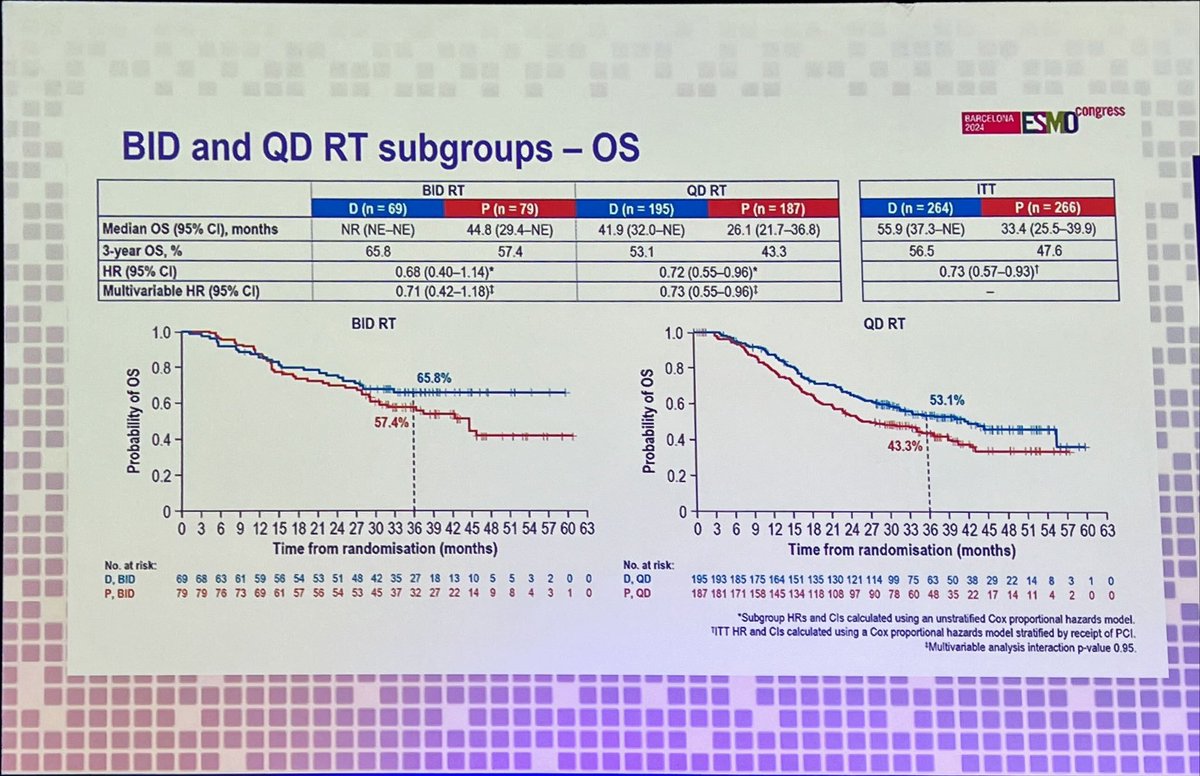
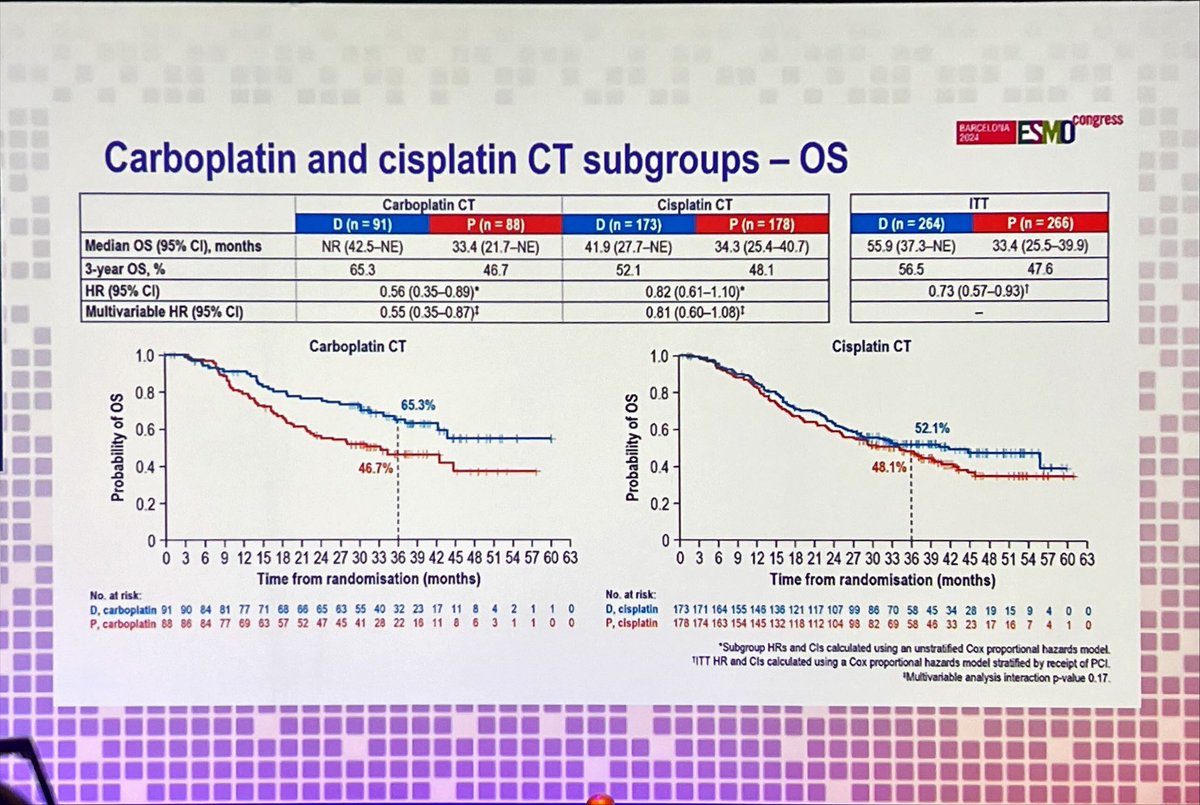
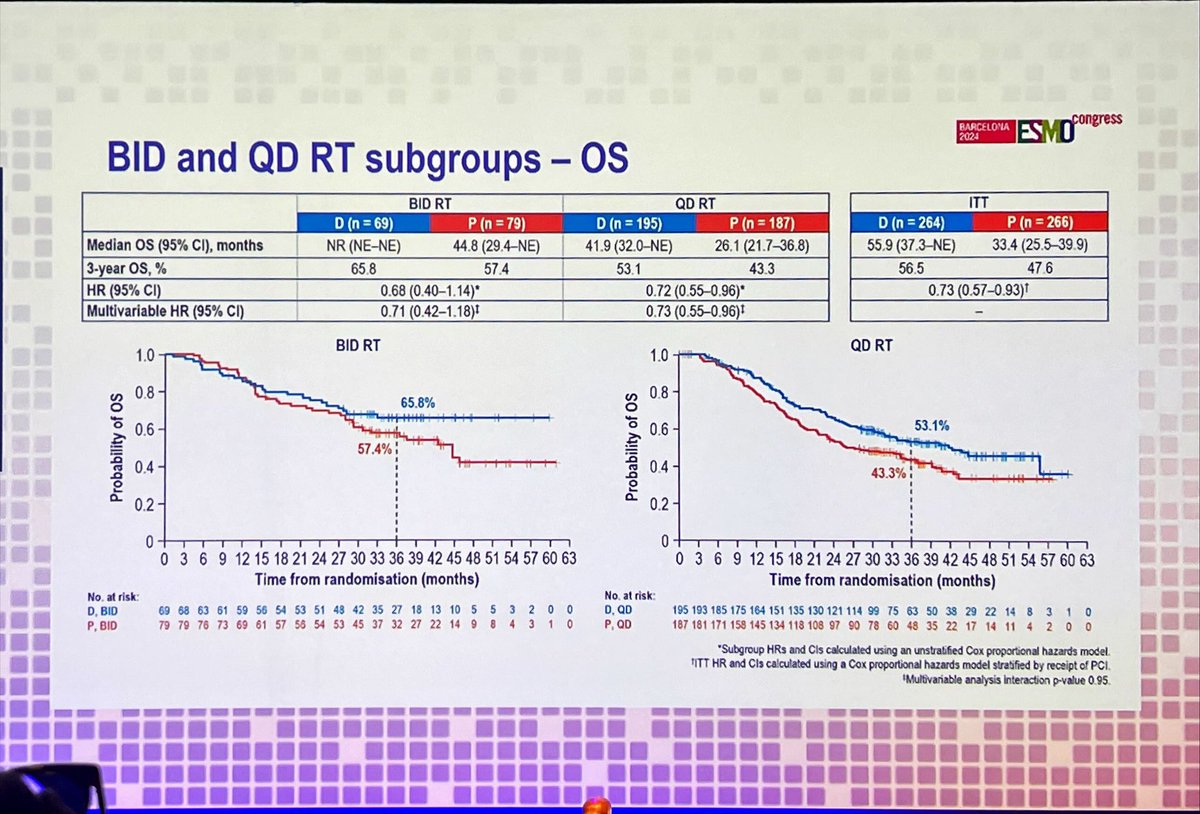
[Slide 1] BARCELONA congress 2024 ESMO BID and QD RT subgroups - OS BID RT QD RT ITT D (n = 69) P (n = 79) D (n = 195) P (n = 187) D (n = 264) P (п = 266) Median os (95% CI), months NR (NE-NE) 44.8 (29.4-NE) 41.9 (32.0-NE) 26.1 (21.7-36.8) 55.9 (37.3-NE) 33.4 (25.5-39.9) 3-year OS, % 65.8 57.4 53.1 43.3 56.5 47.6 HR (95% CI) 0.68 (0.40-1.14)* 0.72 (0.55-0.96)* 0.73 (0.57-0.93) Multivariable HR (95% CI) 0.71 (0.42-1.18)± 0.73 (0.55-0.96) - BID RT QD RT 1.0 1.0 0.8 0.8 65.8% Probability of os 0.6 57.4% 0.4 Probability of os 0.6 53.1% 0.4 43.3% 0.2 0.2 0 0 0 3 6 9 12 15 18 21 24 27 30 33 36 39 42 45 48 51 54 57 60 63 0 3 6 9 12 15 18 21 24 27 30 33 36 39 42 45 48 51 54 57 60 63 Time from randomisation (months) Time from randomisation (months) No. at risk: No. at risk: D, BID 69 68 63 61 59 56 54 53 51 48 42 35 27 18 13 10 5 5 3 2 0 0 D,QD 195 193 185 175 164 151 135 130 121 114 99 75 63 50 38 29 22 14 8 3 1 0 P, BID 79 79 76 73 69 61 57 56 54 53 45 37 32 27 22 14 9 8 4 3 1 0 P,QD 187 181 171 158 145 134 118 108 97 90 78 60 48 35 22 17 14 11 4 2 0 0 *Subgroup HRs and Cls calculated using an unstratified Cox proportional hazards model. ITT HR and Cls calculated using a Cox proportional hazards model stratified by receipt of PCI. Multivariable analysis interaction p-value 0.95.
Dr. Antonio Calles
Dr. Antonio Calles @Tony_Calles
ADRIATIC Data
10.2K impressions · 96 likes · Sep 13, 2024
View on X ↗
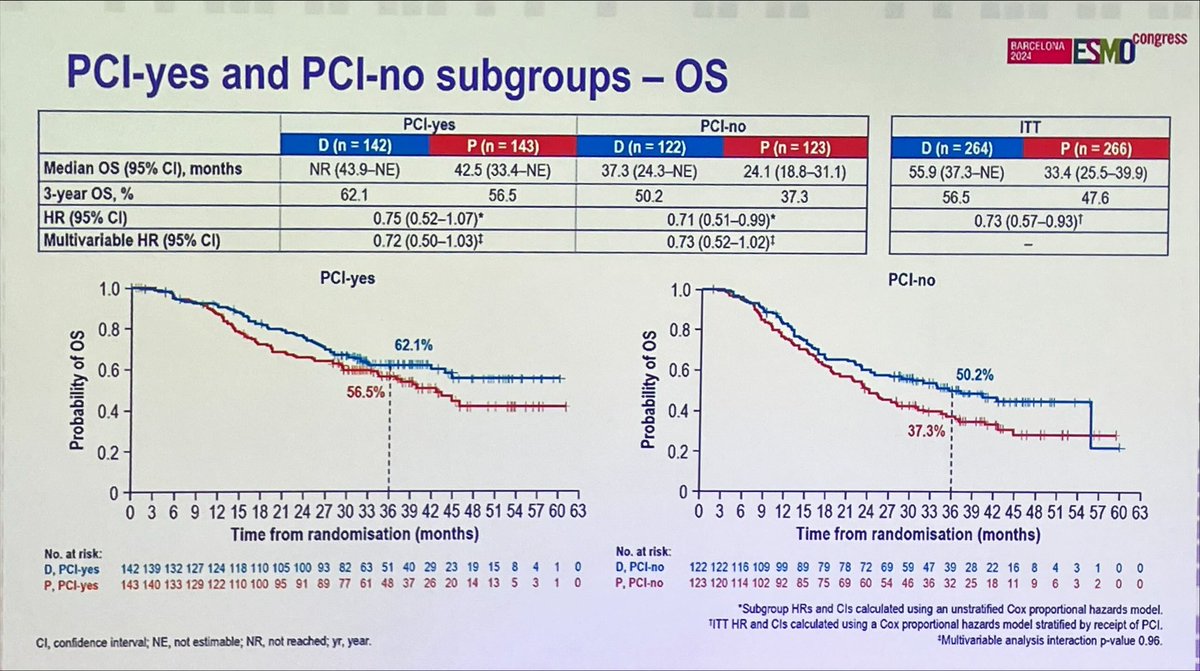
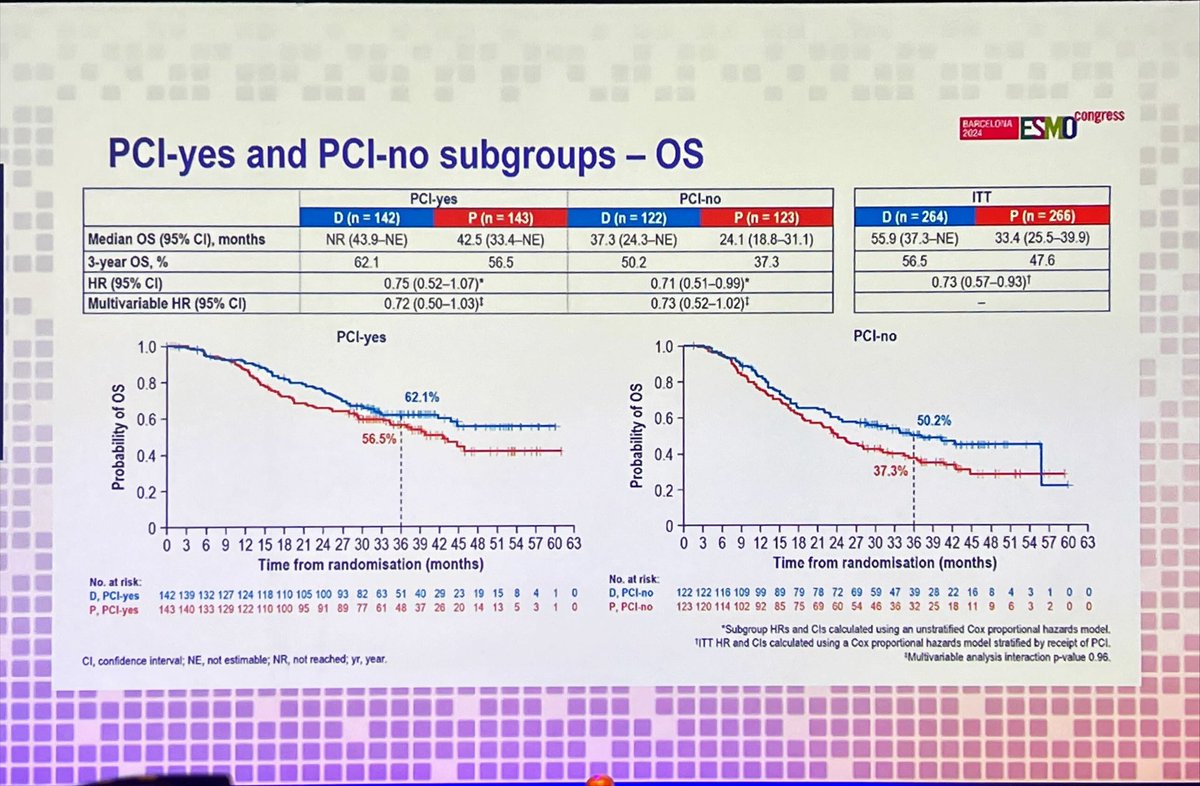
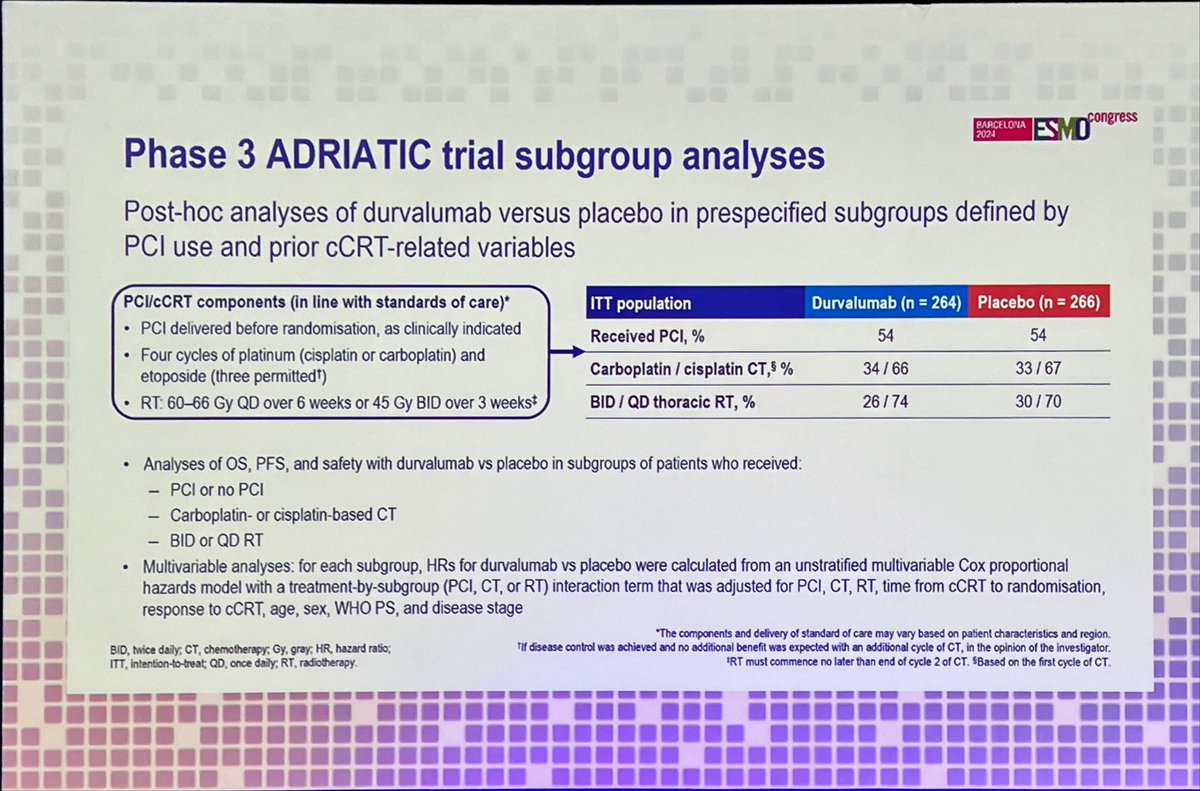
[Slide 1] BARCELONA ESMO congress 2024 Phase 3 ADRIATIC trial Ongoing, randomised, double-blind, placebo-controlled, multicentre, international study Durvalumab Dual primary endpoints: Stage I-III LS-SCLC N=264 D VS P N=730 (stage I/II inoperable) - PFS, OS WHO PS 0 or 1 Placebo R⁺ Key secondary endpoints: N=266 D+T VS P Had not progressed following cCRT* - PFS,+ OS Stratified by: PCI* permitted before randomisation Durvalumab + tremelimumab Disease stage Other secondary endpoints: (I/II VS III) N=200 PFS/OS landmarks, safety PCI (yes VS no) Treatment until investigator-determined PD or intolerable toxicity, or for a maximum of 24 months At the first interim analysis:¹ Consolidation durvalumab significantly improved the dual primary endpoints of OS and PFS versus placebo; generally consistent treatment benefit across predefined patient subgroups Treatment well tolerated; safety consistent with known safety profile of durvalumab in the post-cCRT setting Durvalumab + tremelimumab arm remained blinded BICR, blinded independent central review; cCRT, concurrent chemoradiotherapy; D, durvalumab; LS-SCLC, 1. Spigel D, et al. J Clin Oncol 2024;42(17 suppl):LBA5. limited-stage small-cell lung cancer, OS, overall survival; P, placebo; PCI, prophylactic cranial irradiation; 'cCRT and PCI treatment, if received per local standard of care, must have been completed within 1-42 days PD, progressive disease; PFS, progression-free survival; R, randomisation; RECIST, Response Evaluation prior to randomisation. The first 600 patients were randomised in a 1:1:1 ratio to the 3 arms; subsequent Criteria in Solid Tumors; T, tremelimumab; WHO PS, World Health Organization performance status. patients were randomised 1:1 to either durvalumab or placebo. PFS assessed by BICR, per RECIST v1.1. --- [Slide 2] BARCELONA congress 2024 ESMO PCI-yes and PCI-no subgroups - OS PCI-yes PCl-no ITT D (n = 142) P (n = 143) D (n = 122) P (n = 123) D (n = 264) P (n = 266) Median os (95% CI), months NR (43.9-NE) 42.5 (33.4-NE) 37.3 (24.3-NE) 24.1 (18.8-31.1) 55.9 (37.3-NE) 33.4 (25.5-39.9) 3-year OS, % 62.1 56.5 50.2 37.3 56.5 47.6 HR (95% CI) 0.75 (0.52-1.07)* 0.71 (0.51-0.99)* 0.73 (0.57-0.93) Multivariable HR (95% CI) 0.72 (0.50-1.03) 0.73 (0.52-1.02) - PCl-yes PCl-no 1.0 1.0 0.8 0.8 62.1% Probability of os 0.6 56.5% Probability of os 0.6 50.2% 0.4 0.4 37.3% 0.2 0.2 0 0 0 3 6 9 12 15 18 21 24 27 30 33 36 39 42 45 48 51 54 57 60 63 0 3 6 9 12 15 18 21 24 27 30 33 36 39 42 45 48 51 54 57 60 63 Time from randomisation (months) Time from randomisation (months) No. at risk: No. at risk: D, PCl-yes 142 139 132 127 124 118 110 105 100 93 82 63 51 40 29 23 19 15 8 4 1 0 D, PCI-no 122 122 116 109 99 89 79 78 72 69 59 47 39 28 22 16 8 4 3 1 0 0 P, PCI-yes 143 140 133 129 122 110 100 95 91 89 77 61 48 37 26 20 14 13 5 3 1 0 P, PCI-no 123 120 114 102 92 85 75 69 60 54 46 36 32 25 18 11 9 6 3 2 0 0 *Subgroup HRs and Cls calculated using an unstratified Cox proportional hazards model. TITT HR and Cls calculated using a Cox proportional hazards model stratified by receipt of PCI. CI, confidence interval; NE, not estimable; NR, not reached; yr, year. Multivariable analysis interaction p-value 0.96. --- [Slide 3] BARCELONA ESMO congress 2024 Carboplatin and cisplatin CT subgroups - OS Carboplatin CT Cisplatin CT ITT D (n = 91) P (n = 88) D (n = 173) P (n = 178) D (n = 264) P (n = 266) Median OS (95% CI), months NR (42.5-NE) 33.4 (21.7-NE) 41.9 (27.7-NE) 34.3 (25.4-40.7) 55.9 (37.3-NE) 33.4 (25.5-39.9) 3-year OS, % 65.3 46.7 52.1 48.1 56.5 47.6 HR (95% CI) 0.56 (0.35-0.89)* 0.82 (0.61-1.10)* 0.73 (0.57-0.93) Multivariable HR (95% CI) 0.55 (0.35-0.87)I 0.81 (0.60-1.08): - 1.0 Carboplatin CT 1.0 Cisplatin CT 0.8 0.8 65.3% Probability of os 0.6 Probability of os 0.6 52.1% 0.4 46.7% 0.4 48.1% 0.2 0.2 0 0 0 3 6 9 12 15 18 21 24 27 30 33 36 39 42 45 48 51 54 57 60 63 0 3 6 9 12 15 18 21 24 27 30 33 36 39 42 45 48 51 54 57 60 63 Time from randomisation (months) Time from randomisation (months) No. at risk: No. at risk: D, carboplatin 91 90 84 81 77 71 68 66 65 63 55 40 32 23 17 11 8 4 2 1 1 0 D, cisplatin 173 171 164 155 146 136 121 117 107 99 86 70 58 45 34 28 19 15 9 4 0 0 P, carboplatin 88 86 84 77 69 63 57 52 47 45 41 28 22 16 11 8 6 3 1 1 0 0 P, cisplatin 178 174 163 154 145 132 118 112 104 98 82 69 58 46 33 23 17 16 7 4 1 0 *Subgroup HRs and Cls calculated using an unstratified Cox proportional hazards model. TITT HR and Cls calculated using a Cox proportional hazards model stratified by receipt of PCI. Multivanable analysis interaction p-value 0.17. --- [Slide 4] BARCELONA congress 2024 ESMO BID and QD RT subgroups - OS BID RT QD RT ITT D (n = 69) P (n = 79) D (n = 195) P (n = 187) D (n = 264) P (n = 266) Median os (95% CI), months NR (NE-NE) 44.8 (29.4-NE) 41.9 (32.0-NE) 26.1 (21.7-36.8) 55.9 (37.3-NE) 33.4 (25.5-39.9) 3-year OS, % 65.8 57.4 53.1 43.3 56.5 47.6 HR (95% CI) 0.68 (0.40-1.14)* 0.72 (0.55-0.96)* 0.73 (0.57-0.93) Multivariable HR (95% CI) 0.71 (0.42-1.18) 0.73 (0.55-0.96): - BID RT QD RT 1.0 1.0 0.8 0.8 65.8% Probability of os 0.6 57.4% Probability of os 0.6 53.1% 0.4 0.4 43.3% 0.2 0.2 0 0 0 3 6 9 12 15 18 21 24 27 30 33 36 39 42 45 48 51 54 57 60 63 0 3 6 9 12 15 18 21 24 27 30 33 36 39 42 45 48 51 54 57 60 63 Time from randomisation (months) Time from randomisation (months) No. at risk: No. at risk: D, BID 69 68 63 61 59 56 54 53 51 48 42 35 27 18 13 10 5 5 3 2 0 0 D, QD 195 193 185 175 164 151 135 130 121 114 99 75 63 50 38 29 22 14 8 3 1 0 79 79 76 73 69 61 57 56 54 53 45 37 32 27 22 14 9 8 4 3 1 0 P, QD 187 181 171 158 145 134 118 108 97 90 78 60 48 35 22 17 14 11 4 2 0 0 P, BID *Subgroup HRs and Cls calculated using an unstratified Cox proportional hazards model. TITT HR and Cls calculated using a Cox proportional hazards model stratified by receipt of PCI. Multivariable analysis interaction p-value 0.95.
Tom Newsom-Davis
Tom Newsom-Davis @tnewsomdavis
ADRIATIC Data
9.5K impressions · 30 likes · Sep 13, 2024
View on X ↗
[Slide 1] congress BARCELONA 2024 ESMO PCI-yes and PCI-no subgroups - OS PCI-yes PCI-no ITT D (n = 142) P (n = 143) D (n = 122) P (n = 123) D (n = 264) P (n = 266) Median OS (95% CI), months NR (43.9-NE) 42.5 (33.4-NE) 37.3 (24.3-NE) 24.1 (18.8-31.1) 55.9 (37.3-NE) 33.4 (25.5-39.9) 3-year OS, % 62.1 56.5 50.2 37.3 56.5 47.6 HR (95% CI) 0.75 (0.52-1.07)* 0.71 (0.51-0.99)* 0.73 (0.57-0.93) Multivariable HR (95% CI) 0.72 (0.50-1.03) 0.73 (0.52-1.02) - PCl-yes PCl-no 1.0 1.0 0.8 0.8 62.1% Probability of os 0.6 56.5% Probability of os 0.6 50.2% 0.4 0.4 37.3% 0.2 0.2 0 0 0 3 6 9 12 15 18 21 24 27 30 33 36 39 42 45 48 51 54 57 60 63 0 3 6 9 12 15 18 21 24 27 30 33 36 39 42 45 48 51 54 57 60 63 Time from randomisation (months) Time from randomisation (months) No. at risk: No. at risk: D, PCl-yes 142 139 132 127 124 118 110 105 100 93 82 63 51 40 29 23 19 15 8 4 1 0 D, PCl-no 122 122 116 109 99 89 79 78 72 69 59 47 39 28 22 16 8 4 3 1 0 0 P. PCl-yes 143 140 133 129 122 110 100 95 91 89 77 61 48 37 26 20 14 13 5 3 1 0 P, PCI-no 123 120 114 102 92 85 75 69 60 54 46 36 32 25 18 11 9 6 3 2 0 0 "Subgroup HRs and Cls calculated using an unstratified Cox proportional hazards model. ITT HR and Cls calculated using a Cox proportional hazards model stratified by receipt of PCI. CI, confidence interval; NE, not estimable; NR, not reached; yr, year. Multivariable analysis interaction p-value 0.96. --- [Slide 2] congress BARCELONA 2024 ESMO Carboplatin and cisplatin CT subgroups - OS Carboplatin CT Cisplatin CT ITT D (n 91) P (n = 88) D (n = 173) P (n = 178) D (n = 264) P (n = 266) Median os (95% CI), months NR (42.5-NE) 33.4 (21.7-NE) 41.9 (27.7-NE) 34.3 (25.4-40.7) 55.9 (37.3-NE) 33.4 (25.5-39.9) 3-year OS, % 65.3 46.7 52.1 48.1 56.5 47.6 HR (95% CI) 0.56 (0.35-0.89)* 0.82 (0.61-1.10)* 0.73 (0.57-0.93)1 Multivariable HR (95% CI) 0.55 (0.35-0.87)1 0.81 (0.60-1.08)I - 1.0 Carboplatin CT 1.0 Cisplatin CT 0.8 0.8 65.3% Probability of os 0.6 Probability of os 0.6 52.1% 0.4 46.7% 0.4 48.1% 0.2 0.2 0 0 0 3 6 9 12 15 18 21 24 27 30 33 36 39 42 45 48 51 54 57 60 63 0 3 6 9 12 15 18 21 24 27 30 33 36 39 42 45 48 51 54 57 60 63 Time from randomisation (months) Time from randomisation (months) No. at risk: No. at risk: D. carboplatin 91 90 84 81 77 71 68 66 65 63 55 40 32 23 17 11 8 4 2 1 1 0 D. cisplatin 173 171 164 155 145 136 121 117 107 99 86 70 58 45 34 28 19 15 9 4 0 0 P, carboplatin 68 86 84 77 69 63 57 52 47 45 41 28 22 16 11 8 6 3 1 1 0 0 P, cisplatin 178 174 163 154 145 132 118 112 104 98 82 69 58 46 33 23 17 16 7 4 1 0 "Subgroup HRs and Cls calculated using an unstratified Cox proportional hazards model. ITT HR and Cls calculated using a Cox proportional hazards model stratified by receipt of PCI. Multivariable analysis interaction p-value 0.17. --- [Slide 3] BARCELONA congress 2024 ESMO BID and QD RT subgroups - OS BID RT QD RT ITT D (n = 69) P (n = 79) D (n = 195) P (n = 187) D (n = 264) P (n = 266) Median OS (95% CI), months NR (NE-NE) 44.8 (29.4-NE) 41.9 (32.0-NE) 26.1 (21.7-36.8) 55.9 (37.3-NE) 33.4 (25.5-39.9) 3-year OS, % 65.8 57.4 53.1 43.3 56.5 47.6 HR (95% CI) 0.68 (0.40-1.14)* 0.72 (0.55-0.96)* 0.73 (0.57-0.93) Multivariable HR (95% CI) 0.71 (0.42-1.18) 0.73 (0.55-0.96) - BID RT QD RT 1.0 1.0 0.8 0.8 65.8% Probability of os 0.6 57.4% Probability of os 0.6 53.1% 0.4 0.4 43.3% 0.2 0.2 0 0 0 3 6 9 12 15 18 21 24 27 30 33 36 39 42 45 48 51 54 57 60 63 0 3 6 9 12 15 18 21 24 27 30 33 36 39 42 45 48 51 54 57 60 63 Time from randomisation (months) Time from randomisation (months) No. at risk: No. at risk: D, BID 69 68 63 61 59 56 54 53 51 48 42 35 27 18 13 10 5 5 3 2 0 0 D,QD 195 193 185 175 164 151 135 130 121 114 99 75 63 50 38 29 22 14 8 3 1 0 P, BID 79 79 76 73 69 61 57 56 54 53 45 37 32 27 22 14 9 8 4 3 1 0 P,QD 187 181 171 158 145 134 118 108 97 90 78 60 48 35 22 17 14 11 4 2 0 0 "Subgroup HRs and Cls calculated using an unstratified Cox proportional hazards model. ITT HR and Cls calculated using a Cox proportional hazards model stratified by receipt of PCI. Multivariable analysis interaction p-value 0.95
Sanjay Popat
Sanjay Popat @DrSanjayPopat
ADRIATIC Data
6.6K impressions · 32 likes · Sep 13, 2024
View on X ↗
[Slide 1] BARCELONA congress 2024 ESMO Phase 3 ADRIATIC trial subgroup analyses Post-hoc analyses of durvalumab versus placebo in prespecified subgroups defined by PCI use and prior cCRT-related variables PCI/cCRT components (in line with standards of care)* ITT population Durvalumab (п = 264) Placebo (n = 266) PCI delivered before randomisation, as clinically indicated Received PCI, % 54 54 Four cycles of platinum (cisplatin or carboplatin) and etoposide (three permitted*) Carboplatin / cisplatin CT,$ % 34/66 33/67 RT: 60-66 Gy QD over 6 weeks or 45 Gy BID over 3 weeks BID / QD thoracic RT, % 26/74 30/70 Analyses of OS, PFS, and safety with durvalumab VS placebo in subgroups of patients who received: - PCI or no PCI — Carboplatin- or cisplatin-based CT - BID or QD RT Multivariable analyses: for each subgroup, HRs for durvalumab VS placebo were calculated from an unstratified multivariable Cox proportional hazards model with a treatment-by-subgroup (PCI, CT, or RT) interaction term that was adjusted for PCI, CT, RT, time from cCRT to randomisation, response to cCRT, age, sex, WHO PS, and disease stage *The components and delivery of standard of care may vary based on patient characteristics and region. BID, twice daily; CT, chemotherapy; Gy, gray; HR, hazard ratio; TIf disease control was achieved and no additional benefit was expected with an additional cycle of CT, in the opinion of the investigator. ITT, intention-to-treat; QD, once daily; RT, radiotherapy. RT must commence no later than end of cycle 2 of CT. $Based on the first cycle of CT. --- [Slide 2] BARCELONA congress 2024 ESMO PCI-yes and PCl-no subgroups - OS PCI-yes PCI-no ITT D (n = 142) P (n = 143) D (n = 122) P (n = 123) D (n = 264) P (n = 266) Median OS (95% CI), months NR (43.9-NE) 42.5 (33.4-NE) 37.3 (24.3-NE) 24.1 (18.8-31.1) 55.9 (37.3-NE) 33.4 (25.5-39.9) 3-year OS, % 62.1 56.5 50.2 37.3 56.5 47.6 HR (95% CI) 0.75 (0.52-1.07)* 0.71 (0.51-0.99)* 0.73 (0.57-0.93) Multivariable HR (95% CI) 0.72 (0.50-1.03)± 0.73 (0.52-1.02) - PCl-no 1.0 PCl-yes 1.0 0.8 0.8 62.1% Probability of os 0.6 56.5% Probability of os 0.6 50.2% 0.4 0.4 37.3% 0.2 0.2 0 0 0 3 6 9 12 15 18 21 24 27 30 33 36 39 42 45 48 51 54 57 60 63 0 3 6 9 12 15 18 21 24 27 30 33 36 39 42 45 48 51 54 57 60 63 Time from randomisation (months) Time from randomisation (months) No. at risk: No. at risk: D, PCI-yes 142 139 132 127 124 118 110 105 100 93 82 63 51 40 29 23 19 15 8 4 1 0 D, PCl-no 122 122 116 109 99 89 79 78 72 69 59 47 39 28 22 16 8 4 3 1 0 0 P, PCI-yes 143 140 133 129 122 110 100 95 91 89 77 61 48 37 26 20 14 13 5 3 1 0 P, PCI-no 123 120 114 102 92 85 75 69 60 54 46 36 32 25 18 11 9 6 3 2 0 0 "Subgroup HRs and Cls calculated using an unstratified Cox proportional hazards model. TITT HR and Cls calculated using a Cox proportional hazards model stratified by receipt of PCI. CI, confidence interval; NE, not estimable; NR, not reached; yr, year. Multivariable analysis interaction p-value 0.96. --- [Slide 3] BARCELONA congress 2024 ESMO Carboplatin and cisplatin CT subgroups - OS Carboplatin CT Cisplatin CT ITT D (n = 91) P (n = 88) D (n = 173) P (n = 178) D (n = 264) P (n = 266) Median OS (95% CI), months NR (42.5-NE) 33.4 (21.7-NE) 41.9 (27.7-NE) 34.3 (25.4-40.7) 55.9 (37.3-NE) 33.4 (25.5-39.9) 3-year OS, % 65.3 46.7 52.1 48.1 56.5 47.6 HR (95% CI) 0.56 (0.35-0.89)* 0.82 (0.61-1.10)* 0.73 (0.57-0.93) Multivariable HR (95% CI) 0.55 (0.35-0.87)± 0.81 (0.60-1.08) - Carboplatin CT Cisplatin CT 1.0 1.0 0.8 0.8 65.3% Probability of os 0.6 Probability of os 0.6 52.1% 0.4 46.7% 0.4 48.1% 0.2 0.2 0 0 0 3 6 9 12 15 18 21 24 27 30 33 36 39 42 45 48 51 54 57 60 63 0 3 6 9 12 15 18 21 24 27 30 33 36 39 42 45 48 51 54 57 60 63 Time from randomisation (months) Time from randomisation (months) No. at risk: No. at risk: D. carboplatin 91 90 84 81 77 71 68 65 65 63 55 40 32 23 17 11 8 4 2 1 1 0 D. cisplatin 173 171 164 155 146 136 121 117 107 99 86 70 58 45 34 28 19 15 9 4 0 0 P, carboplatin 68 $6 84 77 69 53 57 52 47 45 41 28 22 16 11 8 6 3 1 1 0 0 P, cisplatin 178 174 163 154 145 132 118 112 104 98 82 69 58 46 33 23 17 16 7 4 1 0 "Subgroup HRs and Cls calculated using an unstratified Cox proportional hazards model. TITT HR and Cls calculated using a Cox proportional hazards model stratified by receipt of PCI. Multivariable analysis interaction p-value 0.17. --- [Slide 4] BARCELONA congress 2024 ESMO BID and QD RT subgroups - OS BID RT QD RT ITT D (n = 69) P (n = 79) D (n = 195) P (n = 187) D (n = 264) P (n = 266) Median os (95% CI), months NR (NE-NE) 44.8 (29.4-NE) 41.9 (32.0-NE) 26.1 (21.7-36.8) 55.9 (37.3-NE) 33.4 (25.5-39.9) 3-year OS, % 65.8 57.4 53.1 43.3 56.5 47.6 HR (95% CI) 0.68 (0.40-1.14)* 0.72 (0.55-0.96)* 0.73 (0.57-0.93) Multivariable HR (95% CI) 0.71 (0.42-1.18)± 0.73 (0.55-0.96) - BID RT QD RT 1.0 1.0 0.8 0.8 65.8% Probability of os 0.6 57.4% 0.4 Probability of os 0.6 53.1% 0.4 43.3% 0.2 0.2 0 0 0 3 6 9 12 15 18 21 24 27 30 33 36 39 42 45 48 51 54 57 60 63 0 3 6 9 12 15 18 21 24 27 30 33 36 39 42 45 48 51 54 57 60 63 Time from randomisation (months) Time from randomisation (months) No. at risk: No. at risk: D, BID 69 68 63 61 59 56 54 53 51 48 42 35 27 18 13 10 5 5 3 2 0 0 D,QD 195 193 185 175 164 151 135 130 121 114 99 75 63 50 38 29 22 14 8 3 1 0 P, BID 79 79 76 73 69 61 57 56 54 53 45 37 32 27 22 14 9 8 4 3 1 0 P,QD 187 181 171 158 145 134 118 108 97 90 78 60 48 35 22 17 14 11 4 2 0 0 "Subgroup HRs and Cls calculated using an unstratified Cox proportional hazards model. ITT HR and Cls calculated using a Cox proportional hazards model stratified by receipt of PCI. Multivariable analysis interaction p-value 0.95.
Noemi Reguart
Noemi Reguart @NReguart
ADRIATIC Data
5.5K impressions · 91 likes · Jun 02, 2024
View on X ↗
[Slide 1] ADRIATIC study design Phase 3, randomized, double-blind, placebo-controlled, multicenter, international study (NCT03703297) Stage I-III LS-SCLC Durvalumab Dual primary endpoints: (stage I/II inoperable) 1500 mg Q4W WHO PS 0 or 1 Durvalumab VS placebo N=264 - OS Had not progressed following cCRT* N=730 - PFS (by BICR, per RECIST v1.1) PCI* permitted before Placebo Key secondary endpoints: randomization R+ Q4W Durvalumab + tremelimumab VS N=266 placebo cCRT components - OS Stratified by: Four cycles of platinum and Disease stage Durvalumab + tremelimumab - PFS (by BICR, per RECIST v1.1) etoposide (three permitted1) (1/11 VS III) D 1500 mg Q4W + T 75 mg Q4W for 4 doses, RT: 60-66 Gy QD over 6 weeks PCI (yes VS no) followed by D 1500 mg Q4W Other secondary endpoints: or 45 Gy BID over 3 weeks N=200 OS/PFS landmarks RT must commence no later Safety than end of cycle 2 of CT Treatment until investigator-determined progression or intolerable toxicity, or for a maximum of 24 months *cCRT and PCI treatment, if received per local standard of care, must have been completed within 1-42 days prior to randomization. TIf disease control was achieved and no additional benefit was expected with an additional cycle of chemotherapy, in the opinion of the investigator. The first 600 patients were randomized in a 1:1:1 ratio to the 3 treatment arms; subsequent patients were randomized 1:1 to either durvalumab or placebo. BICR, blinded independent central review, BID, twice daily; CT. chemotherapy, D, durvalumab; 2024 ASCO PRESENTED BY: Dr David R. Spigel PCI, prophylactic cranial irradiation; PS, performance status; Q4W, every 4 weeks; ASCO AMERICAN SOCIETY OF #ASCO24 QD, once daily; RECIST, Response Evaluation Criteria in Solid Tumors; CLINICAL ONCOLOGY ANNUAL MEETING Presentation is property of the author and ASCO Permission required for reuse, contact permissions@asco.org RT, radiotherapy; T. tremelimumab; WHO, World Health Organization KNOWLEDGE CONQUERS CANCER --- [Slide 2] Overall survival (dual primary endpoint) Median duration of follow up in censored patients: 37.2 months (range 0.1-60.9) 1.0 Durvalumab Placebo (n=264) (n=266) Events, n (%) 115 (43.6) 146 (54.9) 0.8 mOS, months (95% CI) 55.9 (37.3-NE) 33.4 (25.5-39.9) 68.0% HR (95% CI) 0.73 (0.57-0.93) 56.5% p-value 0.0104 Probability of OS 0.6 58.5% 0.4 47.6% 0.2 0 0 3 6 9 12 15 18 21 24 27 30 33 36 39 42 45 48 51 54 57 60 63 No. at risk Time from randomization (months) Durvalumab 264 261 248 236 223 207 189 183 172 162 141 110 90 68 51 39 27 19 11 5 1 0 Placebo 266 260 247 231 214 195 175 164 151 143 123 97 80 62 44 31 23 19 8 5 1 0 OS was analyzed using a stratified log-rank test adjusted for receipt of PCI (yes vs no). The significance level for testing OS at this interim analysis was 0.01679 (2-sided) at the overall 4.5% level, allowing for strong alpha control across interim and final analysis timepoints. 2024 ASCO #ASCO24 PRESENTED BY: Dr David R. Spigel ASCO AMERICAN SOCIETY OF CLINICAL ONCOLOGY ANNUAL MEETING Presentation is property of the author and ASCO Permission required for reuse, contact permissions@asco.org CI, confidence interval mos, median OS; NE, not estimable KNOWLEDGE CONQUERS CANCER --- [Slide 3] Pneumonitis/radiation pneumonitis Pneumonitis or radiation Durvalumab Placebo pneumonitis (grouped terms*), n (%) (n=262) (n=265) Any grade 100 (38.2) 80 (30.2) Maximum grade 3/4 8 (3.1) 7 (2.6) Leading to death 1 (0.4) 0 Leading to treatment discontinuation 23 (8.8) 8 (3.0) "Includes the preferred terms of immune-mediated lung disease, interstitial lung disease, pneumonitis, radiation fibrosis - lung, and radiation pneumonitis. Events are included irrespective of etiology and AE management 2024 ASCO #ASCO24 PRESENTED-BY: Dr David R. Spigel ASCO AMERICAN SOCIETY OF CLINICAL ONCOLOGY ANNUAL MEETING Presentation . property of THE author and ASCO Permission - for - contact permissions@ess.org KNOWLEDGE CONQUERS CANCER --- [Slide 4] Anti-PDL1 in Locally Advanced Lung Cancer (vs. ES-SCLC) Global approvals of Durvalumab PACIFIC — 71 independent regions CASPIAN - 69 independent regions* Limited Stage-SCLC PACIFIC (NSCLC) Extensive Stage-SCLC ~23 mo improvement in ~18 mo improvement in ~2 mo improvement in Overall Survival Overall Survival Overall Survival ADRIATIC (Interim) PACIFIC (5-year followup) CASPIAN IMpower133 (cCRT durvalumab vs Placebo) (cCRT -> durvalumab VS Placebo) (EP +/- Durva) (EP-Atezo vs. EP-Placebo) mOS -- 55.9 VS. 33.4 mOS -- 47.5 VS. 29.1 mOS - 13.0mo VS. 10.3mo mOS — 12.3mo vs 10.3mo (HR 0.73) (HR 0.72) (HR 0.73) (HR 0.77) Spigel et al, JCO 2022 Paz-Ares et al, Lancet 2019 Horn et al, NEJM 2018 Global map Rachel Davidowitz, Ph.D., MD. Anderson Cancer Center "CASPIAN approved in all 71 regions except Costa Rica and Cuba, EP (etoposide-platinum) 2024 ASCO #ASCO24 PRESENTED BY: Lauren Averett Byers, MD, MSc @LaurenByersMD ASCO AMERICAN SOCIETY OF CLINICAL ONCOLOGY ANNUAL MEETING Presentation is property of the author and ASCO Permission required for reuse, contact permissions@asco.org KNOWLEDGE CONQUERS CANCER

ADRIATIC Top Tweets

Top 10 by impressions - click to view on X

Rami Manochakian MD, FASCO CancerEducation
Rami Manochakian MD, FASCO CancerEducation@RManochakian

🔥🚨@OncoAlert Hot Off the Press BIG NEWS Press Release by @AstraZeneca #ADRIATIC phase 3 trial of #Durvalumab vs #Placebo after...

👁 28.7K ♡ 100 ↻ 45 Apr 05, 2024
Eric K. Singhi, MD
Eric K. Singhi, MD@lungoncdoc

Overheard at Best of #ASCO24 Albuquerque: “Wait. Are you that doctor that dances while giving updates on lung cancer?” Why yes, that’s me 😂

👁 24.5K ♡ 99 ↻ 9 Jun 23, 2024
Shankar Siva
Shankar Siva@_ShankarSiva

📢🚨#ASCO24 plenary @DavidRSpigel - pivotal ADRIATIC ph III trial; adjuvant durvalumab arm after chemoradiotherapy (cCRT) ± PCI in small cell #lungcancer; ⬆️...

👁 15.9K ♡ 136 ↻ 54 Jun 02, 2024
Lecia Sequist, MD, MPH, FASCO
Lecia Sequist, MD, MPH, FASCO@LeciaSequist

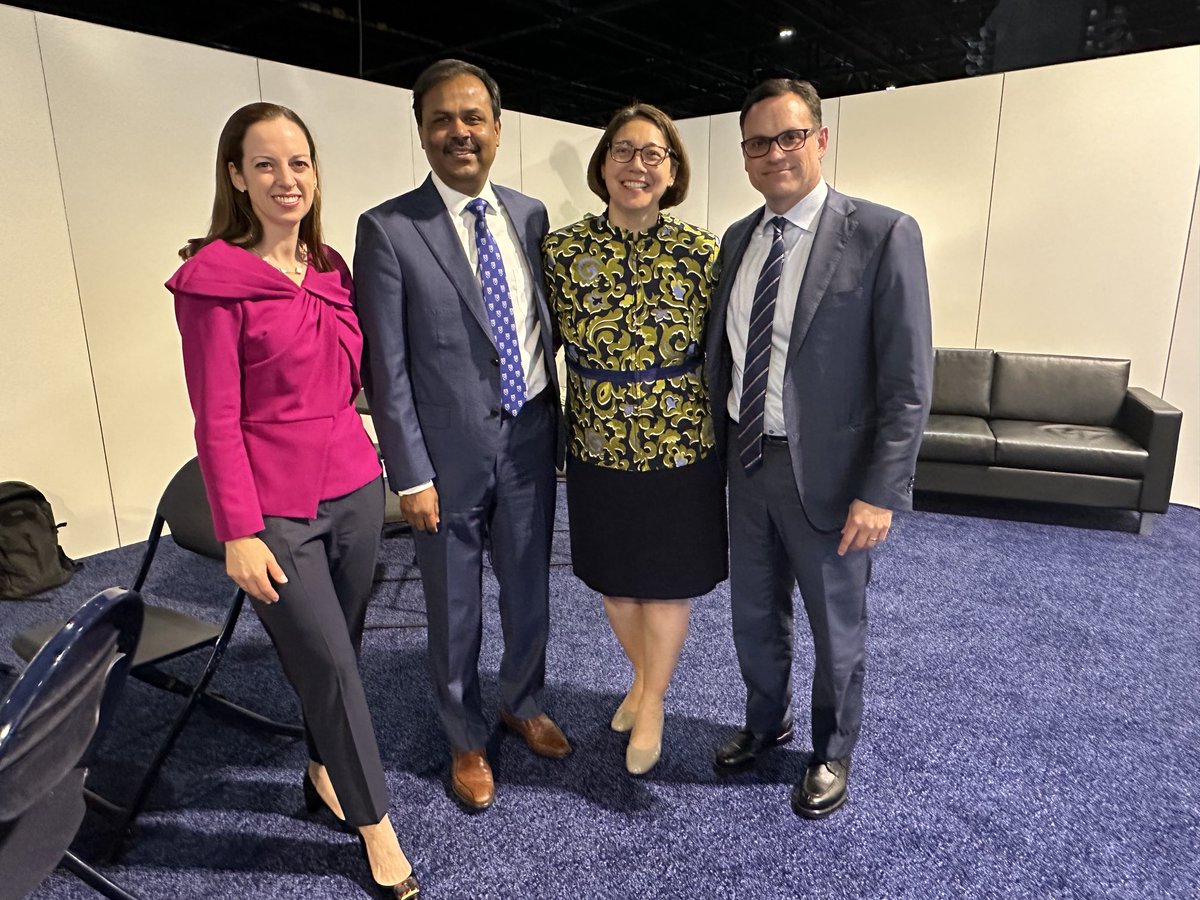
Ready backstage for LAURA and ADRIATIC!!! #ASCO24 plenary! ⁦@RamalingamMD⁩ ⁦@DavidRSpigel⁩ ⁦@LaurenByersMD

👁 12.3K ♡ 160 ↻ 19 Jun 02, 2024
Corinne Faivre-Finn
Corinne Faivre-Finn@finn_corinne

Key slide from the ADRIATIC presentation at #ESMO24 3-yr OS rates: ▶️ BD RT: 65.8% (durva) vs 57.4% (placebo) ▶️ OD RT: 53.1% (durva) vs 43.3% (placebo) ➡️ survival superior with BD...

👁 10.6K ♡ 36 ↻ 14 Sep 15, 2024
Dr. Antonio Calles
Dr. Antonio Calles@Tony_Calles

🧐 Subgroup analysis in ADRIATIC trial on consolidation durvalumab in LS-SCLC, specifically looking at the role of PCI, cis vs carbo, QD vs. BID radiation regimen. Additionally simultaneous...

👁 10.2K ♡ 96 ↻ 28 Sep 13, 2024
Tom Newsom-Davis
Tom Newsom-Davis@tnewsomdavis

ADRIATIC: relative Durva benefit in pre-specified subgroups 👉PCI: ⬆️ OS overall, but similar Durva benefit 👉Carbo v Cis: Non sig ⬆️ OS benefit 👉BD v OD RT: Comparable OS benefit 🤔 PCI in LS-SCLC...

👁 9.5K ♡ 30 ↻ 13 Sep 13, 2024
Sanjay Popat
Sanjay Popat@DrSanjayPopat

Dr Senan presents ADRIATIC post hoc prespecified subsets. PCI delivered before randomization. Similar durva benefits for PCI Y/N. Strong durva benefit for carbo but not cis. Strong durva benefit for...

👁 6.6K ♡ 32 ↻ 12 Sep 13, 2024
H. Jack West, MD, FASCO
H. Jack West, MD, FASCO@JackWestMD

Agree, practice-changing clear improvement in efficacy, and that doesn't happen often enough in SCLC!! Kudos!!👏🎉

👁 6.5K ♡ 56 ↻ 11 Jun 02, 2024
Noemi Reguart
Noemi Reguart@NReguart

Second practice changing trial of the day: ADRIATIC Durva consolidation vs plb after cCRT in LS-SCLC. Dual P. endpoints OS/PFS meet (3-y FUP): 24 mo OS gain (median 55.9 vs 33.4, HR 0.73) and 24%...

👁 5.5K ♡ 91 ↻ 39 Jun 02, 2024

About the ADRIATIC Trial

ADRIATIC is a Phase 3, randomized, double-blind, placebo-controlled trial evaluating durvalumab (Imfinzi) as consolidation therapy in patients with limited-stage small cell lung cancer (LS-SCLC) who had not progressed following concurrent platinum-based chemoradiotherapy (cCRT). The trial enrolled 730 patients across 164 centers in 19 countries, randomized 1:1:1 to durvalumab monotherapy, durvalumab plus tremelimumab, or placebo. Results demonstrated that consolidation durvalumab significantly improved both overall survival and progression-free survival compared to placebo, representing the first major therapeutic advance in LS-SCLC in over 30 years. NCCN guidelines now recommend durvalumab consolidation therapy for LS-SCLC patients without progression after cCRT.

FDA Approval

FDA APPROVED Imfinzi (durvalumab) — Adults with limited-stage small cell lung cancer (LS-SCLC) whose disease has not progressed following concurrent platinum-based chemotherapy and radiation therapy

FDA approved durvalumab on December 4, 2024 based on the ADRIATIC trial results, granted Priority Review and Breakthrough Therapy Designation under Project Orbis. The recommended dose is 1,500 mg IV every 4 weeks for up to 24 months.

Source: FDA Press Release

Trial Methodology & Results

Study Design

ADRIATIC is a Phase 3, randomized, double-blind, placebo-controlled, multicenter global trial (NCT03703297). Patients were randomized 1:1:1 to durvalumab 1,500 mg Q4W, durvalumab 1,500 mg + tremelimumab 75 mg Q4W (4 doses then durvalumab alone), or placebo Q4W for up to 24 months, stratified by disease stage (I/II vs III) and prior prophylactic cranial irradiation (PCI).

Population

The trial enrolled 730 adult patients with stage I-III LS-SCLC (including stage I/II inoperable disease) with WHO/ECOG PS 0-1 whose disease had not progressed following concurrent platinum-based chemoradiotherapy. Prior PCI was permitted before randomization.

Interventions

Durvalumab 1,500 mg IV every 4 weeks as consolidation monotherapy (n=264) versus placebo Q4W (n=266), administered until disease progression, unacceptable toxicity, or a maximum of 24 months. A third arm of durvalumab plus tremelimumab (n=200) remains blinded for future analysis.

Primary Endpoints

Dual primary endpoints were overall survival (OS) and progression-free survival (PFS) assessed by blinded independent central review (BICR) per RECIST v1.1 for durvalumab vs placebo. Secondary endpoints included objective response rate (ORR), duration of response (DoR), OS/PFS landmark rates, and safety.

Progression-Free Survival (PFS)

Durvalumab significantly improved PFS compared to placebo with an HR of 0.76 (95% CI: 0.61-0.95; p=0.0161). Median PFS was 16.6 months with durvalumab vs 9.2 months with placebo, a 7.4-month improvement. The 24-month PFS rate was 46.2% for durvalumab versus 34.2% for placebo (p=0.02).

PFS HR 0.76 - median 16.6 vs 9.2 months

Source: N Engl J Med 2024;391:1313-1327

Overall Survival (OS)

Durvalumab demonstrated a statistically significant OS improvement with an HR of 0.73 (95% CI: 0.57-0.93; p=0.0104), representing a 27% reduction in the risk of death. Median OS was 55.9 months with durvalumab vs 33.4 months with placebo, a 22.5-month improvement. The 3-year OS rate was 56.5% for durvalumab versus 47.6% for placebo (p=0.01).


Source: N Engl J Med 2024;391:1313-1327

Safety & Tolerability

The safety profile was manageable and consistent with known durvalumab toxicity. Overall Grade 3-4 AE rates were similar between arms (24.4% durvalumab vs 24.2% placebo). The most common adverse reactions were pneumonitis/radiation pneumonitis (22.9% vs 23.4%) and fatigue. Treatment discontinuation due to AEs occurred in 16.4% of durvalumab patients vs 10.6% placebo, with hypothyroidism notably higher in the durvalumab arm (16.0% vs 3.8%).

Grade 3-4 AEs balanced: 24.4% vs 24.2%

Source: FDA Approval Press Release

Clinical Implications

Durvalumab consolidation after cCRT is now the new standard of care for LS-SCLC, representing the first major therapeutic advance in this setting in over 30 years. The FDA approved Imfinzi (durvalumab) on December 4, 2024 for adults with LS-SCLC whose disease has not progressed following concurrent platinum-based chemotherapy and radiation therapy. KOLs including Dr. David Spigel and Dr. Stephen Liu have described the results as immediately practice-changing, with Dr. Liu noting that durvalumab makes the possibility of cure a reality for more patients with LS-SCLC.

ADRIATIC in the News

Key KOL Sentiments - ADRIATIC

DoctorSentimentComment
Shankar Siva
@_ShankarSiva
● POSITIVE 📢🚨#ASCO24 plenary @DavidRSpigel - pivotal ADRIATIC ph III trial; adjuvant durvalumab arm after chemoradiotherapy (cCRT) ± PCI in small cell #lungcancer; ⬆️ OS (HR 0.73), median OS 55.9 vs 33.4 for placebo. Grade 3/4 AEs in 24.3% vs 24.2%. 💥Practice
● POSITIVE Ready backstage for LAURA and ADRIATIC!!! #ASCO24 plenary! ⁦@RamalingamMD⁩ ⁦@DavidRSpigel⁩ ⁦@LaurenByersMD⁩ https://t.co/VzYXe6AgNH
● POSITIVE Agree, practice-changing clear improvement in efficacy, and that doesn't happen often enough in SCLC!! Kudos!!👏🎉 https://t.co/pOS9LOgkvW
Noemi Reguart
@NReguart
● POSITIVE Second practice changing trial of the day: ADRIATIC Durva consolidation vs plb after cCRT in LS-SCLC. Dual P. endpoints OS/PFS meet (3-y FUP): 24 mo OS gain (median 55.9 vs 33.4, HR 0.73) and 24% reduction in the risk of PFS/death (median 16.6 vs 9.2
Jarushka Naidoo
@DrJNaidoo
● POSITIVE #ASCO24 Plenary🔥 Ph III ADRIATIC trial of consolidation Durva +/-Treme post cCRT for LS SCLC: - benefit in mOS 55.9 v 33.4m (HR 0.73, p=0.01) & mPFS 16.6 v 9.2m - pneu 10.7% & RT pneu 22.4%* First advance in 30+yrs in LS SCLC @asco @myESMO
Dr. Antonio Calles
@Tony_Calles
● POSITIVE ☢️ Prof. Senan presents the patterns of progression in ADRIATIC trial of consolidation durvalumab after definite chemo-radiation LS-SCLC. 🩻 Less intra- and extra-thoracic progression, delayed for extrathoracic ones, and reduced CNS🧠 progression reg
● POSITIVE Standing ovations as KM curves revealed interrupt talks for both speakers for LAURA and ADRIATIC trials at #ASCO24 plenary. Totally worth it to be here in person to experience practice changing! https://t.co/iHuCPjczpg
Mariana Brandao
@MarianaBrandao0
● POSITIVE Interesting data from the ADRIATIC trial on the patterns of recurrence: 🔴 No difference in intrathoracic recurrence btw durva vs placebo arms 🔴 Impressive brain protection, in both PCI treated and untreated pts 🔴 PCI + durva: only 2.8% of brain Mets
Dr Amol Akhade
@SuyogCancer
● POSITIVE ADRIATIC trial . Durvalumab for 2 years consolidation for limited stage SCLC shows OS and PFS benifit. This should be standard of care . @ASCO @brunolarvol @Larvol https://t.co/OcMXjHhZuO
● POSITIVE 🔥🚨@OncoAlert Hot off the press. Just presented at #PLENARY session @ASCO #ASCO24. PRACTICE CHANGING results of: #ADRIATIC trial of consolidation #DURVALUMAB after concurrent chemoradiation for #LimitedStage #SmallCell #LungCancer. Median #OS 55
Salma Jabbour
@SalmaJabbour1
● POSITIVE ADRIATIC study is the new standard of care for limited stage small cell lung cancer followed by adjuvant durvalumab with improved mOS to 56 mo from 33 mo (placebo) and mPFS of 17 months with durvalumab vs 9 mo (placebo) #ASCO24 https://t.co/ZRqpQMhFL
Bishal Gyawali
@oncology_bg
● POSITIVE ADRIATIC trial is impressive with this margin of benefit. My only question here is what percentage of control arm patients had crossover. Otherwise, these are great results in SCLC. #ASCO24
Stephen V Liu, MD
@StephenVLiu
● POSITIVE Dr. @LaurenByersMD with a wonderful discussion of ADRIATIC at #ASCO24 - highlighting a much greater impact on OS with immunotherapy in the limited stage setting than seen in extensive stage. https://t.co/aQ5viZZYmR
Erika Hamilton, MD
@ErikaHamilton9
● POSITIVE So proud of @DavidRSpigel for an excellent presentation of transforming results with consolidation durvalumab in small cell #lcsm 🫁 Big win for patients! @SarahCannonDocs https://t.co/gD1HGRMMYp
A/Prof Tom John
@TommyJohn00
● POSITIVE Another practice changing study #ADRIATIC presented by @DavidRSpigel #ASCO24. Significant OS benefit for SCLC patients. Another standing ovation. 👏🏾 👏🏾. Pneumonitis not as bad as I would expect. https://t.co/juBcvjhIdW
Luis Lara-Meja
@LuisLara_M
● POSITIVE In ADRIATIC, durvalumab after cCRT in LE-SCLC delayed time to CNS progression and reduced brain mets — even without PCI. Insightful data shared by Dr. Suresh Senan at #ELCC25. A new horizon for limited-stage SCLC? #SCLC @myESMO https://t.co/Nr2v6ruK0
● POSITIVE #ADRIATIC - new standard of care in #SCLC, where we have not seen an advance in >2 decades. Truly historic data with use of immunotherapy consolidation #LungPlenary @DavidRSpigel @LaurenByersMD @ASCO #ASCO24 @OncoAlert https://t.co/nvmTD71uUl
Dr Riyaz Shah
@DrRiyazShah
● POSITIVE ADRIATIC. A brilliant presentation by @DavidRSpigel and discussion by @LaurenByersMD. I really reflected on the comment about despite similar HR’s, the absolute extensions are massive in LSvES. @BTOGORG #ASCO24 https://t.co/zWWN7iTdAb
Dipesh Uprety MD FACP
@DipeshUpretyMD
● POSITIVE #ASCO24 Plenary: ADRIATIC -Pts with limited-stage SCLC post chemo-RT randomized to Durvalumab versus Placebo - Improved PFS and OS with Durvalumab #lcsm @OncoAlert @BTFCancerNews https://t.co/oE3iQ9xPFX
● POSITIVE One more Standing Ovation 👏🏼 this time #ADRIATIC results Durvalumab as consolidation treatment for patients with limited-stage SCLC after cCRT. A new standard of care ✅ #ASCOLung #ASCO24 #EndCancer https://t.co/wTLBwaHWEX
● POSITIVE Final #ASCO24 plenary. ADRIATIC: consolidation with durvalumab after cCRT in limited stage #SCLC improves OS (55.9 vs 33.4 mo) & mPFS (16.6 vs 9.2 mo) vs pbo. Huge magnitude of benefit & new SOC. Big advance for a difficult disease. @DavidRS
Helena Linardou
@ElinardouHelena
● POSITIVE That unique amazing feeling of the Plenary when practice-changing results are presented… Great day for thoracic oncology! LAURA and ADRIATIC - two immediately practice-changing studies in areas of unmet need! #ASCO24 @myESMO https://t.co/EM0ULixuKj
Sandip Patel MD
@PatelOncology
● POSITIVE Great discussion of IO in SCLC by @LaurenByersMD @ASCO after presentation of ADRIATIC consolidation durvalumab after chemoXRT in LS-SCLC by @DavidRSpigel #MedIQASCO2024 https://t.co/jGpmaHq03w
Antonio Passaro
@APassaroMD
● POSITIVE The ADRIATIC study might finally highlight a new SoC in limited-stage SCLC after a long (too long) wait. We'll need to see the results to understand the magnitude of its clinical impact, but we're ready to move beyond chemo-only treatment here too...
Drew Moghanaki
@DrewMoghanaki
● POSITIVE @_ShankarSiva @DavidRSpigel @DrJNaidoo @n8pennell @JackWestMD @CharuAggarwalMD @gerryhanna @drdavidpalma @PatelOncology @DrYukselUrun @peters_solange Simply spectacular. I'm sure @XRT4U would agree; this is HUGE.
Alfredo Addeo MD
@Alfdoc2
● POSITIVE @FordePatrick @ASCO @thenasheffect @LeciaSequist @MMarmarelis @_ShankarSiva @MARIANOPROVENCI @jdoningtonmd This is IMHO the most impactful study presented at #ASCO24 given the magnitude of benefit, the type and the incidence of the SCLC
● POSITIVE @_ShankarSiva @DavidRSpigel @DrJNaidoo @n8pennell @JackWestMD @CharuAggarwalMD @gerryhanna @DrewMoghanaki @drdavidpalma @PatelOncology @DrYukselUrun @peters_solange Huge progress after many years of stagnation @DavidRSpigel any details about patients
Sarah Cannon Docs
@SarahCannonDocs
● POSITIVE @DavidRSpigel presented important updates from the ADRIATIC study for limited stage #smallcelllungcancer #ASCO24 An exciting day in #lungcancer with results from LAURA study as well as ADRIATIC study, proving again that Today’s Clinical Trials are T
Arianna Marinello, MD
@AriMarinel
● POSITIVE The time for a practice-changing trial in locally advanced SCLC has come! 🏆 In the ADRIATIC trial: significant OS benefit with durvalumab consolidation versus placebo after CTRT: - 55.9 versus 33.4 months OS at the first interim analysis #ASCO24 h
Alex Menter
@Alexmenter
● POSITIVE @JackWestMD Is that SOC arm doing better than we would expect historically? Not sure I have seen updated limited stage KM curves lately and I generally expect worse outcomes. It makes the durva win even more impressive.
Eric K. Singhi, MD
@lungoncdoc
● NEUTRAL Overheard at Best of #ASCO24 Albuquerque: “Wait. Are you that doctor that dances while giving updates on lung cancer?” Why yes, that’s me 😂 https://t.co/c6MxlPGTCo
Corinne Faivre-Finn
@finn_corinne
● NEUTRAL Key slide from the ADRIATIC presentation at #ESMO24 3-yr OS rates: ▶️ BD RT: 65.8% (durva) vs 57.4% (placebo) ▶️ OD RT: 53.1% (durva) vs 43.3% (placebo) ➡️ survival superior with BD RT 📝 CONVERT trial and @myESMO guidelines support adopting BD RT in
Tom Newsom-Davis
@tnewsomdavis
● NEUTRAL ADRIATIC: relative Durva benefit in pre-specified subgroups 👉PCI: ⬆️ OS overall, but similar Durva benefit 👉Carbo v Cis: Non sig ⬆️ OS benefit 👉BD v OD RT: Comparable OS benefit 🤔 PCI in LS-SCLC better studied in ongoing trials 🤔 Let’s stop using c
Sanjay Popat
@DrSanjayPopat
● NEUTRAL Dr Senan presents ADRIATIC post hoc prespecified subsets. PCI delivered before randomization. Similar durva benefits for PCI Y/N. Strong durva benefit for carbo but not cis. Strong durva benefit for BID vs OD RT. #ESMO24 @myESMO https://t.co/vH3MHqT
Hidehito HORINOUCHI
@HHorinouchi
● NEUTRAL 🔥#LBA5 ADRIATIC: Durva after CRT in LS-SCLC 🎯Discussant @LaurenByersMD 💯Exemplary way of discussing in plenary session ✅Concise summary of trial ✅Specialist viewpoint on efficacy ✅Future direction #ASCO24 #LCSM @OncoAlert @ASCO https://t.co/hxB36159o
ASCO
@ASCO
● NEUTRAL More news from the #ASCO24 Plenary Session: Interim ADRIATIC results show durvalumab improves survival in LS-#SCLC: mOS w/durvalumab was 55.9 vs 33.4 mos w/ placebo; mPFS 16.6 vs 9.2 mos, respectively: https://t.co/Ln5seIWf3K #LCSM #ASCODailyNews htt
Dr Rishabh Jain
@DrRishabhOnco
● NEUTRAL 🚨 ATR inhibition + IO fails to beat chemo in post-IO NSCLC #ELCC26 LATIFY trial: Ceralasertib + Durvalumab vs docetaxel 👇 🧬 Study population • LA/mNSCLC • Progressed after anti-PD-(L)1 ± platinum CT • No actionable mutations 💊 Arms • 🟣 Ceralaserti
Ben Slotman
@bslotman
● NEUTRAL Suresh Senan presenting exploratory analysis of #Adriatic study in #lungcancer at #ELCC25. Lowest risk of brainmets in #durva arm, esp when pci #radiotherapy is given as well. https://t.co/V9jlwxWKhK
Shreyas Kalantri, MD
@KalantriShreyas
● NEUTRAL ADRIATIC trial for L-SCLC @ASCO #ASCO24 Consolidation durvalumab - new standard of care for patients who have not progressed on cCRT @HemeOncUofl @HemOncFellows @OncoAlert https://t.co/cuZyo0ucRp
F Haroun, MD
@Cancer_talks
● NEUTRAL Durvalumab consolidation for pts with limited-stage small-cell lung ca Spigel #lcsm #asco24 The poor prognosis of SCLC even in limited stg disease translated to an OS benefit in the #ADRIATIC mirroring the CASPIAN results. Different SEA similar wave
● NEUTRAL @PTarantinoMD @LungCancerRx @RManochakian @JackWestMD @lungoncdoc @FawziAbuRous @DevikaDasMD @IyengarPuneeth @NRGonc @UTSW_RadOnc @MSKCancerCenter @DFCI_BreastOnc You will need #synergy, for this jab-cross combo I am about to put you through! Plenary
Jose G Montoya
@JosGilbertoMon1
● NEUTRAL @JackWestMD Time to study adding VGEF to PD-1 (or PDL-1) blockade?
Isabel Preeshagul
@ipreeshagul
● NEUTRAL #ADRIATIC the first approval in LS-SCLC setting in decades 👏🏽 ⁉️ are there unique characteristics for pts with LS disease? Subtypes? ⁉️should we consider concurrent Durva + CRT vs sequential ? ⁉️how can we better personalize this option? @SclcS
M. Bolton
@5_utr
● NEGATIVE No! Testing the treatment effect in a subgroup does not carry along with it the covariate adjustment needed, and subgrouping variable BID vs QD probably interacts with an ignored characteristic such as tumor size or nodal extent, and this is grossly