Muscle-Invasive Bladder Cancer (Cisplatin-Ineligible) — Perioperative Durvalumab + Neoadjuvant Enfortumab Vedotin ± Tremelimumab — AstraZeneca
Discover KOL Sentiment on VOLGA →Read AstraZeneca Topline →Design - Phase 3 perioperative durvalumab + neoadjuvant enfortumab vedotin +/- tremelimumab vs standard of care, cisplatin-ineligible muscle-invasive bladder cancer, 695 patients (NCT04960709); dual primary event-free survival.
EFS (dual primary) - Both experimental arms MET the EFS primary endpoint - statistically significant and clinically meaningful improvement versus standard of care (AstraZeneca topline, May 14, 2026).
OS (key secondary) - Doublet arm (durvalumab + enfortumab vedotin) met overall survival at interim; the triplet (adding tremelimumab) showed a favorable OS trend that did not reach statistical significance.
Safety - Consistent with the known profiles of the individual medicines; no new safety signals at this interim analysis (detailed data pending a future congress).
Regulatory - Investigational - not FDA approved. Positive Phase 3 topline reported May 14, 2026; FDA granted Priority Review to the durvalumab + enfortumab vedotin doublet on September 25, 2026 (PDUFA date Q4 2026).
Upcoming - Full VOLGA data will be presented at the ESMO 2026 Presidential Symposium, Saturday, October 24, 2026 (Madrid), by Prof. Thomas Powles.
Sponsor / drugs - AstraZeneca; durvalumab (Imfinzi) + enfortumab vedotin (Padcev) +/- tremelimumab (Imjudo).
Compiled and reviewed by the KOL Pulse research team, led by Brian Shields, Founder, KOL Pulse. Last updated October 5, 2026.




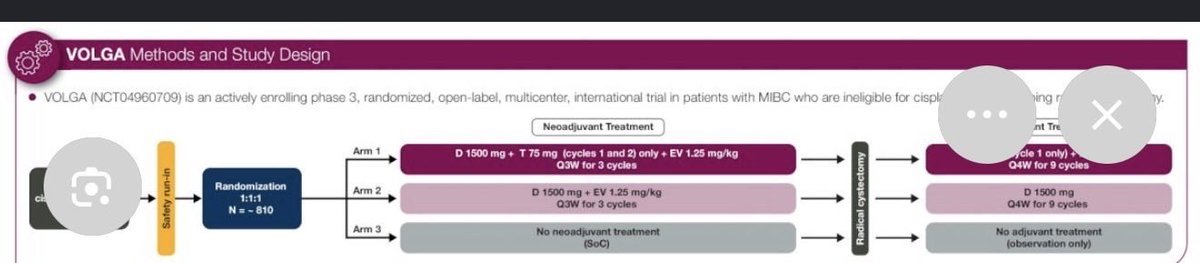
VOLGA (NCT04960709) is a Phase III, randomized, open-label, multi-centre global trial sponsored by AstraZeneca evaluating perioperative durvalumab (Imfinzi) with or without tremelimumab (Imjudo) in combination with neoadjuvant enfortumab vedotin (EV) versus radical cystectomy with or without approved adjuvant therapy in patients with muscle-invasive bladder cancer (MIBC) who are ineligible for or have declined cisplatin-based chemotherapy. The trial enrolled 695 patients across 182 centres in 25 countries and was designed with dual primary EFS endpoints for each experimental arm versus the standard-of-care comparator.
On 14 May 2026, AstraZeneca announced positive high-level results from a planned interim analysis: perioperative durvalumab + neoadjuvant EV (Arm 2) demonstrated statistically significant and clinically meaningful improvements in both event-free survival and overall survival versus standard of care. The triplet of durvalumab + tremelimumab + neoadjuvant EV (Arm 1) also met the EFS endpoint with statistical significance and showed a favourable trend for OS, though OS for the triplet was not statistically significant at this interim and will be reassessed at a subsequent analysis. Detailed data are expected at a forthcoming medical meeting.
Adults with muscle-invasive urothelial carcinoma of the bladder undergoing radical cystectomy who were ineligible for or had declined cisplatin-based chemotherapy.
Phase 3, randomised, open-label, multi-centre. 695 patients randomised 1:1:1 across 182 centres in 25 countries (Europe, North America, South America, Asia).
3 cycles Imfinzi + EV plus 2 cycles Imjudo (neoadjuvant) → radical cystectomy → 9 cycles Imfinzi + 1 cycle Imjudo (adjuvant).
3 cycles Imfinzi + EV (neoadjuvant) → radical cystectomy → 9 cycles Imfinzi adjuvant monotherapy.
Radical cystectomy with or without approved adjuvant therapy (standard of care).
Dual primary endpoints of EFS for Arm 1 vs Arm 3 and Arm 2 vs Arm 3.
Overall survival (Arm 1 vs 3, Arm 2 vs 3), pathologic complete response, disease-free survival, pathologic downstaging.
AstraZeneca. NCT04960709 / EudraCT 2020-005452-38 / D910PC00001.
Both experimental arms met the EFS primary endpoint. Perioperative Imfinzi + neoadjuvant EV (Arm 2) demonstrated a statistically significant and clinically meaningful improvement in EFS versus standard of care. Perioperative Imfinzi + Imjudo + neoadjuvant EV (Arm 1) also demonstrated a statistically significant and clinically meaningful improvement in EFS versus standard of care. Specific hazard ratios and median EFS values have not been disclosed in the topline announcement and are expected at the next medical meeting.
Both experimental arms met EFSPerioperative Imfinzi + neoadjuvant EV (Arm 2) demonstrated a statistically significant and clinically meaningful improvement in overall survival versus standard of care. The triplet arm (Arm 1: Imfinzi + Imjudo + EV) showed a favourable trend for OS but did not reach statistical significance at this planned interim analysis; OS for the triplet will be formally reassessed at a subsequent analysis. Numeric hazard ratios and median OS values are not yet disclosed.
Arm 2 (doublet) met OS at interimPer AstraZeneca, the safety and tolerability of Imfinzi with or without Imjudo plus EV was consistent with the known safety profiles of the individual medicines, with no new safety signals identified at this interim analysis. Detailed safety data will be presented at a forthcoming medical meeting.
No new safety signalsIf validated by detailed data and regulatory review, VOLGA would establish a chemo-free perioperative immunotherapy + ADC backbone for cisplatin-ineligible MIBC — a population historically with limited curative-intent options beyond cystectomy. Doublet durvalumab + EV (Arm 2) emerged as the cleaner regimen at interim, achieving both EFS and OS. The triplet's incremental contribution beyond doublet remains an open question pending mature OS and detailed subgroup data. ⚠️ All findings remain investigational; the regimen is not FDA-approved in this setting.
VOLGA is a Phase 3 randomized trial (NCT04960709; 695 patients) of perioperative durvalumab (Imfinzi) plus neoadjuvant enfortumab vedotin, with or without tremelimumab (Imjudo), versus standard of care in cisplatin-ineligible muscle-invasive bladder cancer. Event-free survival was the dual primary endpoint, with overall survival a key secondary endpoint.
In AstraZeneca's May 14, 2026 topline readout, both experimental arms met the event-free survival primary endpoint with a statistically significant and clinically meaningful improvement versus standard of care. The doublet arm (durvalumab plus enfortumab vedotin) also met overall survival at the interim analysis, while the triplet arm (adding tremelimumab) showed a favorable overall survival trend that did not reach statistical significance.
Not yet. The VOLGA perioperative regimen (durvalumab + enfortumab vedotin doublet) remains investigational, but on September 25, 2026 the FDA granted Priority Review to AstraZeneca's supplemental application, with a PDUFA date in Q4 2026. Full efficacy and safety data will be presented at the ESMO 2026 Presidential Symposium on Saturday, October 24, 2026, ahead of any approval decision.
VOLGA limits EV to 3 neoadjuvant cycles, with durvalumab (± tremelimumab) continuing alone in the adjuvant setting — no further EV after surgery. This is a deliberately lower EV exposure than the rival EV-303 regimen (perioperative EV + pembrolizumab, with EV continuing into the adjuvant phase), which several KOLs (Dr. Niklas Klümper, Dr. Kohji Takemura) have flagged as the key open question: because EV toxicity, particularly peripheral neuropathy, is cumulative and exposure-dependent, VOLGA's shorter EV course could mean a meaningfully better tolerability profile — if efficacy holds up once the full data are presented.
If validated by the detailed data and regulatory review, VOLGA would establish a chemotherapy-free perioperative immunotherapy-plus-antibody-drug-conjugate backbone for cisplatin-ineligible muscle-invasive bladder cancer - a population that historically has had limited curative-intent options beyond cystectomy. The doublet (durvalumab plus enfortumab vedotin) is the arm that met both event-free and overall survival.
Per AstraZeneca, the safety and tolerability of durvalumab, with or without tremelimumab, plus enfortumab vedotin were consistent with the known safety profiles of the individual medicines, with no new safety signals identified at the interim analysis. Detailed safety data will be presented at a forthcoming medical meeting.
FDA accepted and granted Priority Review to the sBLA for durvalumab + enfortumab vedotin (doublet arm only) in cisplatin-ineligible MIBC, based on the VOLGA interim EFS and OS results. PDUFA date in Q4 2026.
Topline results: Arm 2 (Imfinzi + EV) hit stat-sig EFS and OS. Arm 1 (Imfinzi + Imjudo + EV) hit EFS with a favourable but non-significant OS trend at this interim. No new safety signals.
Original AstraZeneca corporate announcement. Quotes from Thomas Powles (international coordinating investigator) and Susan Galbraith (EVP, Oncology R&D). Positions VOLGA alongside NIAGARA and POTOMAC.
Correction summary clarifying the three-arm design and the differential results for Arm 1 vs Arm 2. Useful side-by-side framing of which arm hit which endpoint.
Investor-oriented context on MIBC epidemiology: ~25% of bladder cancer patients have muscle-invasive disease, and up to 50% of those are cisplatin-ineligible. Frames the commercial setting around radical cystectomy.
UK regulatory news service version of the AstraZeneca announcement, including the planned regulatory submission language: "shared with global regulatory authorities."
Authoritative protocol record: 3-arm design, ~677 patient target, dual primary EFS endpoints, key secondary endpoints (OS, pCR, DFS, pathologic downstaging), and full inclusion/exclusion criteria.