Krascendo 1 (NCT06497556) is the Roche/Genentech phase III head-to-head study of investigational divarasib versus the approved KRAS G12C inhibitors sotorasib or adagrasib in previously treated advanced KRAS G12C+ NSCLC. In the ESMO 2026 LBA5 abstract (data cut-off 19 May 2026), divarasib improved median PFS to 9.8 vs 5.7 months (HR 0.58) and median OS to 17.7 vs 12.0 months (HR 0.56) in this phase III head-to-head comparison with the first-generation KRAS G12C inhibitors. Divarasib is investigational.
Phase III Head-to-Head · NCT06497556Sponsor: Hoffmann-La Roche / Genentech⚠️ Divarasib — Investigational, not FDA approvedTopline: PFS + OS met · Jul 1, 2026ESMO 2026 LBA5 · Presidential Symposium IIN=338 · Previously treated advanced NSCLC
Physician Reactions
Physician reactions to KRASCENDO-1
Posts by physicians about KRASCENDO-1, newest first: ESMO 2026 week (October 17–25, 2026), then reactions to the July 2026 topline announcement. Each post is shown in full and verbatim and linked to the original on X.
Figures from the LBA5 abstract released by ESMO for the Presidential Symposium II presentation by Ferdinandos Skoulidis (October 25, 2026). 338 patients were randomized to divarasib (n=167) or investigator’s choice of sotorasib (n=156) or adagrasib (n=15); median follow-up was 14.3 months. (ESMO 2026 LBA5 abstract, DCO 19 May 2026)
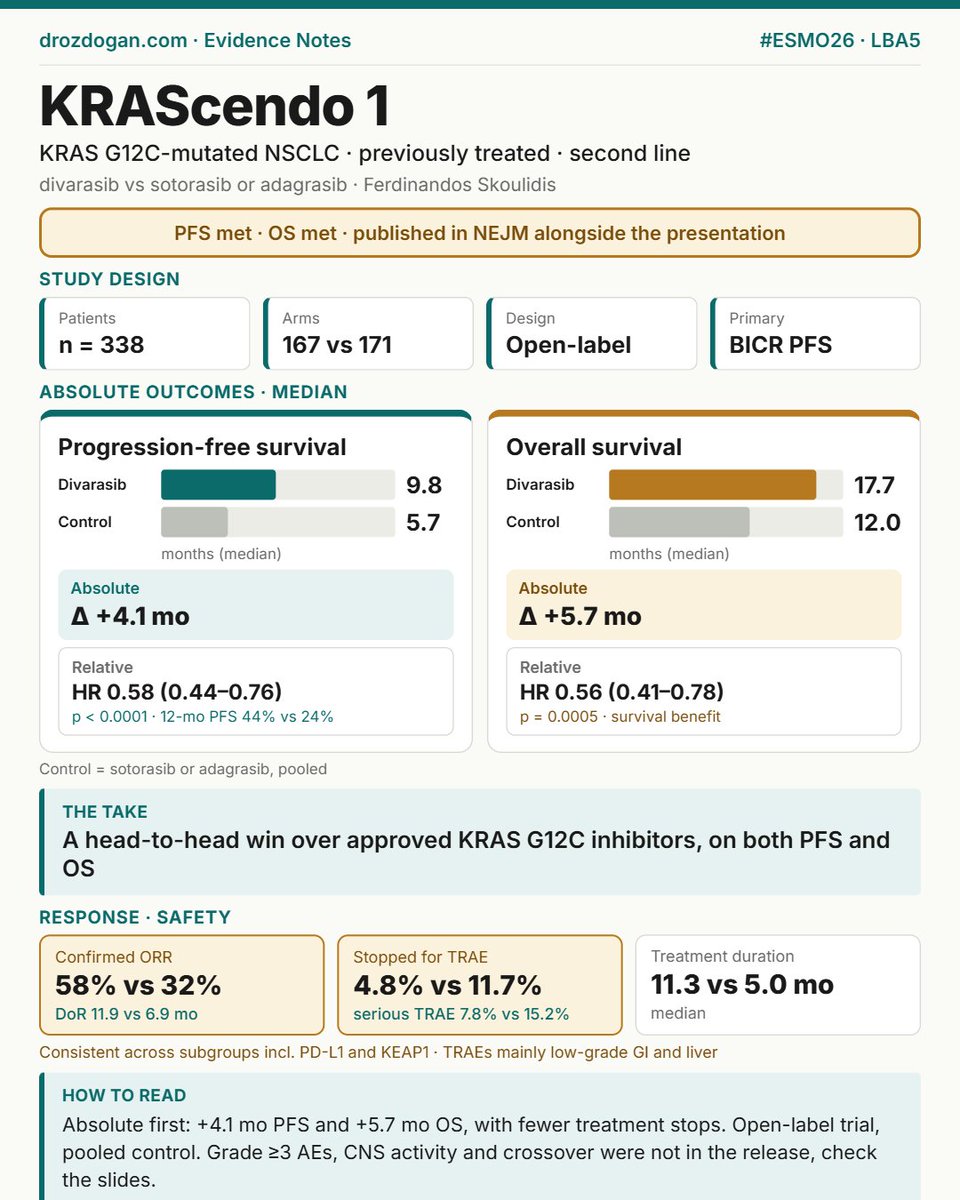
Progression-free survival by BICR (primary endpoint): median 9.8 months (95% CI 8.1–12.9) with divarasib vs 5.7 months (95% CI 4.2–6.8) with sotorasib/adagrasib; HR 0.58 (95% CI 0.44–0.76); p<0.0001.
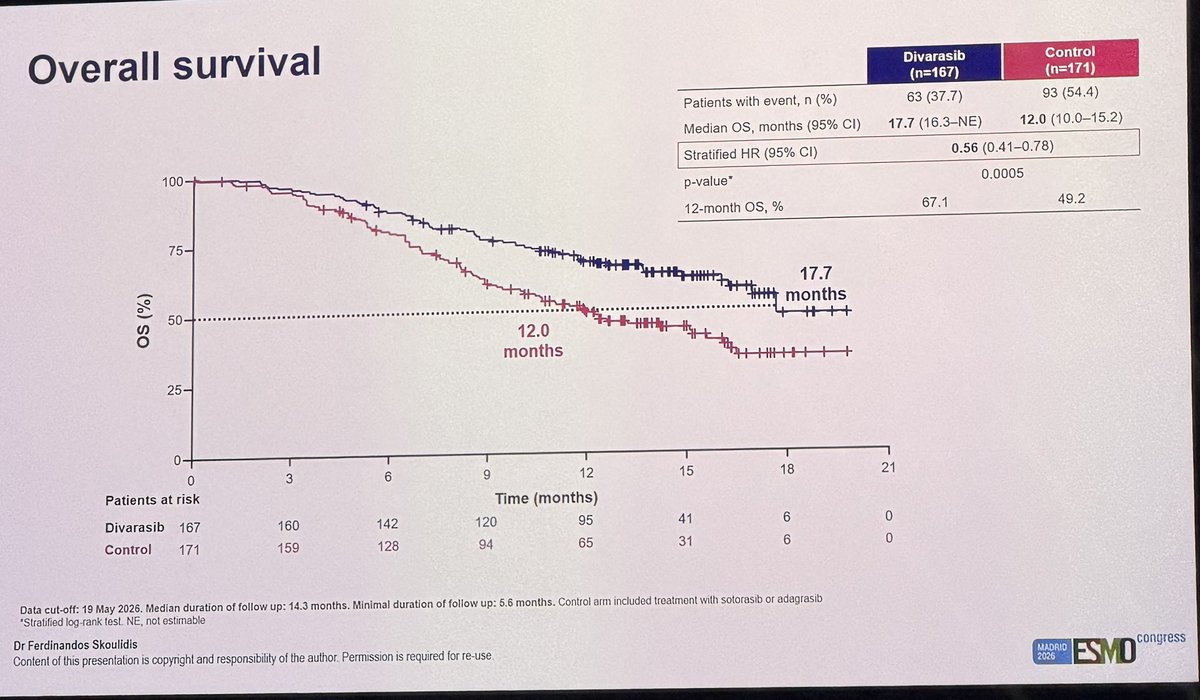
Overall survival (secondary endpoint): median 17.7 months (95% CI 16.3–not estimable) vs 12.0 months (95% CI 10.0–15.2); HR 0.56 (95% CI 0.41–0.78); p=0.0005.
Confirmed objective response rate by BICR: 58.4% (94/161) vs 32.3% (54/167).
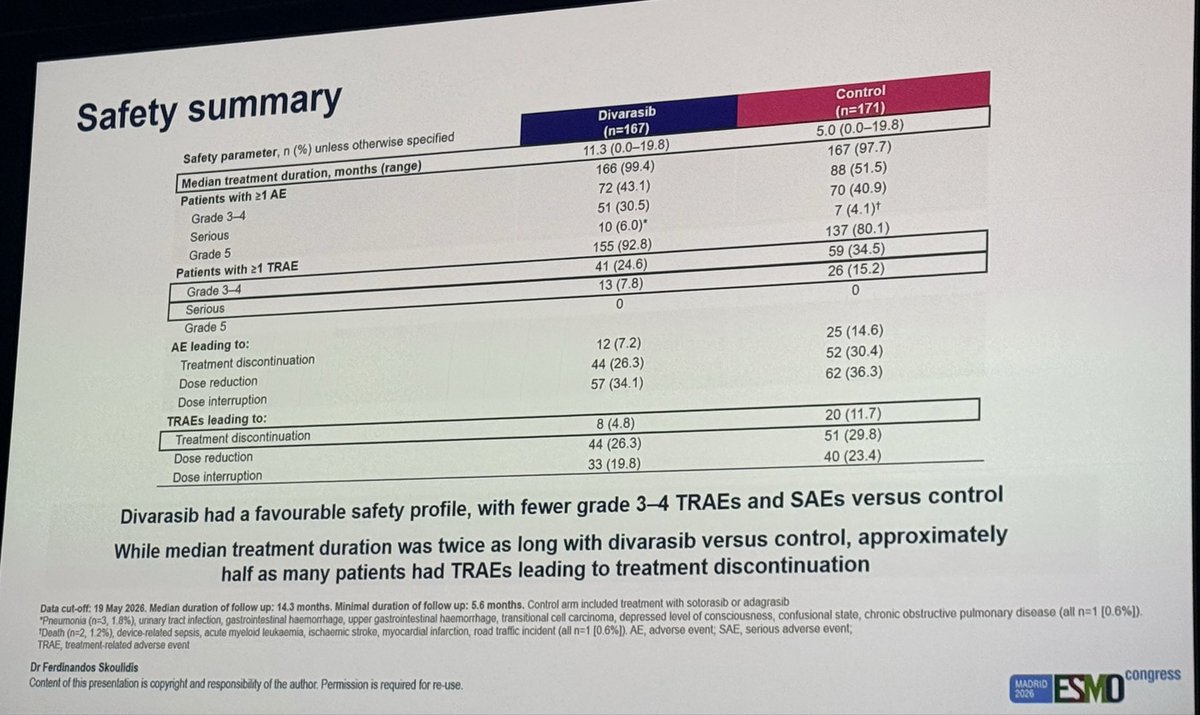
Safety: treatment-related adverse events of any grade 92.8% vs 80.1%; grade 3–4 treatment-related adverse events 24.6% vs 34.5% (grade 3–4 adverse events of any cause 43.1% vs 51.5%); serious treatment-related adverse events 7.8% vs 15.2%; treatment-related adverse events leading to discontinuation 4.8% vs 11.7%; no grade 5 treatment-related adverse events. Median treatment duration was 11.3 vs 5.0 months, so exposure was longer with divarasib.
Divarasib remains investigational. These are abstract figures; the slides presented at the session may add data.
Topline announcement (July 1, 2026) — PFS and OS both met
The study met its primary and key secondary endpoints: divarasib achieved clinically meaningful and statistically significant improvements in both progression-free survival and overall survival versus the first-generation KRAS G12C inhibitors sotorasib or adagrasib, with statistical significance for OS achieved at the interim analysis. The press release gave no numeric results; the first figures are from the ESMO 2026 LBA5 abstract (block above). (Genentech press release, 01-Jul-2026)
Per the press release, the safety profile for divarasib remained consistent with previous data, with no new findings detected; the most common treatment-related events were manageable and reversible. In earlier reported phase I experience at 400 mg daily, gastrointestinal toxicities (nausea, vomiting, diarrhea) predominated and were largely low grade. Per-arm phase III safety data from the ESMO 2026 LBA5 abstract are in the block above. (Genentech press release, 01-Jul-2026; phase I long-term follow-up, 400 mg cohort, Sacher et al., J Clin Oncol)
⚠️ Divarasib is investigational — not FDA approved in any setting; Genentech plans regulatory submissions based on these data. ✅ The comparators hold FDA ACCELERATED approvals for previously treated KRAS G12C+ NSCLC: sotorasib (Lumakras, Amgen; its full-approval application received a Complete Response Letter in December 2023) and adagrasib (Krazati, Bristol Myers Squibb). (Genentech press release; FDA)
KOL pulse
Patrick Forde called the result “An advance given all the negative or borderline trial results we have had after chemo & immunotherapy”; Stephen V Liu is “Eagerly awaiting data presentation”; Giannis Mountzios called it a “Significant press release” and a “@KRASKickers victory!”
Voices
KOLs Discussing KRASCENDO-1
Patrick Forde
@FordePatrick
7.9K impressions
Stephen V Liu, MD
@StephenVLiu
4.3K impressions
Biagio Ricciuti, MD, PhD
@BRicciutiMD
2K impressions
Giannis Mountzios
@g_mountzios
1.1K impressions
Trial Design
KRASCENDO-1 Trial Design
Krascendo 1 (NCT06497556) asks the question the KRAS G12C field has debated since sotorasib and adagrasib were approved: can a next-generation inhibitor beat the first generation head-to-head? Divarasib is an investigational, oral KRAS G12C inhibitor designed for greater potency and selectivity; in its long-term phase I follow-up it showed a confirmed ORR of 59.1% and median PFS of 15.3 months in the 400 mg daily cohort (n=44; Sacher et al., J Clin Oncol) — numerically higher than the first-generation agents reported in their own early-phase studies, but cross-trial comparisons are unreliable. Krascendo 1 removed that caveat by randomizing 338 previously treated patients directly between divarasib and sotorasib or adagrasib (locally approved first-generation KRAS G12C inhibitors).
“These results should establish divarasib as a new standard of care for previously-treated lung cancer patients with this genetically defined tumor subtype,” said Levi Garraway, MD, PhD, Genentech’s chief medical officer, in the July 1, 2026 topline press release (results in At a Glance). Note the naming: Krascendo 1 is distinct from NAUTIKA1, the separate phase II umbrella testing neoadjuvant divarasib in resectable NSCLC.
Study Design
Phase III, randomized, open-label, multicenter, global head-to-head. Divarasib monotherapy vs sotorasib or adagrasib (locally approved first-generation KRAS G12C inhibitors). (CTgov; Genentech PR)
Population
338 adults with KRAS G12C-mutant advanced or metastatic NSCLC and disease progression during or after 1–3 prior lines of systemic therapy. (Genentech PR; CTgov)
Interventions
Divarasib once daily vs sotorasib once daily or adagrasib twice daily (locally approved first-generation KRAS G12C inhibitors). (Genentech PR; CTgov)
Endpoints
Primary: PFS by blinded independent central review (RECIST v1.1). Key secondary: OS. Additional: confirmed objective response, duration of response, safety. (Genentech PR; CTgov)
Program Context
Krascendo 2 (NCT06793215): 1L non-squamous, divarasib + pembrolizumab vs pembrolizumab + pemetrexed-platinum. Krascendo 3 (NCT07541170): adjuvant divarasib vs immunotherapy or observation in resected stage II–IIIB disease, in patients without a pCR after neoadjuvant chemoimmunotherapy. Krascendo 170 (NCT05789082): Ph1b/2 first-line single-agent and combination cohorts. (Genentech PR; CTgov)
Described by Genentech as “the only global head-to-head study evaluating a KRAS G12C inhibitor in direct comparison with first generation KRAS G12C inhibitors.” (Genentech press release; ClinicalTrials.gov)
Two more #ESMO26 papers in @NEJM today:
In EGFR-mutated, MET-altered NSCLC progressing on osimertinib, adding savolitinib improved PFS (HR 0.55) and OS (HR 0.68) vs platinum-pemetrexed. 12-month OS was 70% vs 53%.
In previously treated KRAS G12C-mutated NSCLC, divarasib improved median PFS (9.8 vs 5.7 months; HR 0.58) and OS (17.7 vs 12.0 months; HR 0.56) vs sotorasib or adagrasib.
[Slide 1]
[KM curve] Percentage of Patients without an Event
Divarasib | Control
6 months: Divarasib 65.7; Control 47.8
12 months: Divarasib 43.9; Control 24.0
Months
ORIGINAL ARTICLE
MEETING OF THE EUROPEAN SOCIETY FOR MEDICAL ONCOLOGY
Divarasib for KRAS G12C–Mutated NSCLC
F. Skoulidis and Others
Survival table
Endpoint: Progression-free survival (confirmed by the NEJM figure caption: median PFS 9.8 vs 5.7 months)
Divarasib
Control
Landmark rates:
6 months: Divarasib 65.7% | Control 47.8%
12 months: Divarasib 43.9% | Control 24.0%
The last dance for KRAS inhibitors. Divarasib . Nice discussion. Systemic cross over should be reconsiderd when PFS is the primar end point. It will be intr to see future data for this drug against chemo plus IO . @OncoAlert @myESMO #esmo26 https://t.co/xOGzuBin5C
[Slide 1]
[Discussant slide photographed from the stage screen — raw curve and forest-plot OCR not published; only large legible labels captured. The summary tables and subgroup forest plots on this slide are not legible in the photo.]
KRASCENDO-1 - benefit
Benjamin Besse, Invited Discussant LBA5 — Presidential Symposium II
Arm | Median PFS by BICR | 12-mo PFS | Median OS | 12-mo OS
Divarasib | 9.8 months | 43.9% | 17.7 months | 67.1%
Control | 5.7 months | 24.0% | 12.0 months | 49.2%
Discussant annotation: CODEBREAK Sotorasib: 10.6 months => Likely selected population
Skoulidis ESMO 2026
Brilliant discussion from Dr. @BenjaminBesseMD at #ESMO26 on the Krascendo 1 study of divarasib vs sotorasib/adagrasib. Rightly points out lack of crossover in a study with a PFS endpoint as unjust. Excellent points all around. #ESMOAmbassadors https://t.co/AZp29NMYLI
[Slide 1]
KRASCENDO-1 - population
Key eligibility criteria
• KRAS G12C inhibitor naive
• ECOG PS 0–1
• Advanced KRAS G12C-mutated NSCLC
• ≥1 but ≤3 lines of prior systemic therapy, including platinum-based chemo and a PD-(L)1 inhibitor*
• Measurable disease per RECIST v1.1
• Patients with active, untreated CNS metastases were excluded
R 1:1, N=338
Divarasib (400 mg QD)
Treatment crossover not permitted
Sotorasib (960 mg QD) OR adagrasib (600 mg BID)†
Treatment until disease progression, unacceptable toxicity, death, withdrawal of consent, or study termination
Stratification factors: • History of CNS metastases • Intended choice of control arm KRAS G12C inhibitor† • KEAP1 mutation status‡
Primary endpoint: • PFS per BICR
Key secondary endpoints: • OS • Confirmed ORR per BICR • TTCD
Other secondary endpoints: • DoR per BICR • Safety • Other PROs
Prior therapy: Chemo-IO 69%; Chemo-IO → Docetaxel / IO → Chemo 30%; 9%; IO → Chemo → Docetaxel 1%
KRAS G12C INHIBITOR: 91% SOTORASIB | ADAGRASIB 9%
KEAP1 MUTATION STATUS: 22% PRESENT | 78% NOT DETECTED / UNKNOWN
HISTORY OF BRAIN METASTASES: 30% YES (History present)
rwPFS | sotorasib vs. adagrasib | rwOS [embedded real-world KM and forest plots; small text illegible]
Skoulidis ESMO 2026, Barsouk ASCO 2026
All baseline-characteristic graphics are confined to the lower half of the slide.
ORR: objective response rate, PFS: progression free survival, OS: overall survival, IO: immunotherapy, rw: real world
🚨 Exciting results from #ESMO26!
Phase III KRAScendo-1: Divarasib outperformed sotorasib/adagrasib in KRAS G12C-mutated NSCLC.
🔹 PFS: 9.8 vs 5.7 months
🔹 OS: 17.7 vs 12.0 months
🔹 ORR: 58% vs 32%
Better efficacy with fewer grade ≥3 treatment-related adverse events!
Could divarasib become the new standard of care? 👀
@OncoAlert @weoncologists @StephenVLiu @GlopesMd @OpenMedKate @ManuelDomine
[Slide 1]
Krascendo 1: efficacy and safety of divarasib versus sotorasib or adagrasib in previously treated locally advanced or metastatic KRAS G12C-mutated NSCLC
Ferdinandos Skoulidis,¹ Myung-Ju Ahn,² Shirish Gadgeel,³ Sanjay Popat,⁴ Niels Reinmuth,⁵ Bianca van Veggel,⁶ Farastuk Bozorgmehr,⁷ Victoria J Bray,⁸ Michael Duruisseaux,⁹ Wade T Iams,¹⁰ Julien Mazieres,¹¹ Laura Bonanno,¹² Lore Decoster,¹³ Bo Wang,¹⁴ Youyou Hu,¹⁵ Sarah M Shagan,¹⁶ Verena Lam,¹⁶ Uyi Osaghae,¹⁶ Tien Hoang,¹⁶ Benjamin J Solomon¹⁷
¹UT MD Anderson, Houston, TX, USA; ²Samsung Medical Center, Seoul, Republic of Korea; ³Emory University, Atlanta, GA, USA; ⁴Royal Marsden Hospital & Institute of Cancer Research, London, UK; ⁵German Centre for Lung Research, Munich-Gauting, Germany; ⁶Jeroen Bosch Hospital, Hertogenbosch, Netherlands; ⁷Heidelberg University and National Center for Tumor Diseases (NCT), NCT Heidelberg, a partnership between DKFZ and Heidelberg University Hospital, Heidelberg, Germany and Translational Lung Research Centre Heidelberg, LRC-H, German Center for Lung Research (DZL), Heidelberg, Germany; ⁸Liverpool Hospital, Liverpool, NSW, Australia; ⁹Louis Pradel Hospital, Hospices Civils de Lyon Cancer Institute, Bron, France; TheraLung Lab, Cancer Research Center of Lyon, UMR INSERM 1052, CNRS 5286, Lyon, France and Université Claude Bernard Lyon 1, Université de Lyon, Lyon, France; ¹⁰Greco-Hainsworth Centres for Research, Tennessee Oncology, Nashville, TN, USA; ¹¹Centre Hospitalier Universitaire de Toulouse, Université de Toulouse, Toulouse, France; ¹²Oncology and Gastroenterology, University of Padova, Padova, Italy; Medical Oncology 2, Istituto Oncologico Veneto IOV IRCCS, Padova, Italy; ¹³Universitair Ziekenhuis Brussel, Vrije Universiteit Brussel, Jette, Belgium; ¹⁴Willamette Valley Cancer Institute and Research Center, Eugene, OR, USA; ¹⁵F. Hoffmann-La Roche Ltd, Basel, Switzerland; ¹⁶Genentech Inc., South San Francisco, CA, USA; ¹⁷Peter MacCallum Cancer Centre, Melbourne, VIC, Australia
[Slide 2]
Progression-free survival by BICR
| Divarasib (n=167) | Control (n=171)
Patients with event, n (%) | 101 (60.5) | 128 (74.9)
Median PFS, months (95% CI) | 9.8 (8.1–12.9) | 5.7 (4.2–6.8)
Stratified HR (95% CI) | 0.58 (0.44–0.76)
p-value* | <0.0001
12-month PFS, % | 43.9 | 24.0
Curve labels: 9.8 months; 5.7 months; 43.9%; 24.0%
Patients at risk (Time, months 0/3/6/9/12/15/18/21)
Divarasib | 167 | 142 | 108 | 80 | 53 | 27 | 3 | 0
Control | 171 | 116 | 73 | 54 | 26 | 14 | 0 | 0
Data cut-off: 19 May 2026. Median duration of follow up: 14.3 months. Minimal duration of follow up: 5.6 months. Control arm included treatment with sotorasib or adagrasib
*Stratified log-rank test. CI, confidence interval
Dr Ferdinandos Skoulidis
[Survival data captured as a table — no point estimates read from the curve]
Endpoint: PFS by BICR
Divarasib | 167 | 9.8 | 8.1–12.9
Control (sotorasib or adagrasib) | 171 | 5.7 | 4.2–6.8
HR: 0.58 (stratified)
HR CI: 0.44–0.76
P: <0.0001
Landmark 12 months | Divarasib | 43.9%
Landmark 12 months | Control | 24.0%
Note: Data cut-off 19 May 2026; median follow-up 14.3 months.
[Slide 3]
Overall survival
| Divarasib (n=167) | Control (n=171)
Patients with event, n (%) | 63 (37.7) | 93 (54.4)
Median OS, months (95% CI) | 17.7 (16.3–NE) | 12.0 (10.0–15.2)
Stratified HR (95% CI) | 0.56 (0.41–0.78)
p-value* | 0.0005
12-month OS, % | 67.1 | 49.2
Curve labels: 17.7 months; 12.0 months
Patients at risk (Time, months 0/3/6/9/12/15/18/21)
Divarasib | 167 | 160 | 142 | 120 | 95 | 41 | 6 | 0
Control | 171 | 159 | 128 | 94 | 65 | 31 | 6 | 0
Data cut-off: 19 May 2026. Median duration of follow up: 14.3 months. Minimal duration of follow up: 5.6 months. Control arm included treatment with sotorasib or adagrasib
*Stratified log-rank test. NE, not estimable
Dr Ferdinandos Skoulidis
[Survival data captured as a table — no point estimates read from the curve]
Endpoint: Overall survival
Divarasib | 167 | 17.7 | 16.3–NE
Control (sotorasib or adagrasib) | 171 | 12.0 | 10.0–15.2
HR: 0.56 (stratified)
HR CI: 0.41–0.78
P: 0.0005
Landmark 12 months | Divarasib | 67.1%
Landmark 12 months | Control | 49.2%
Note: Data cut-off 19 May 2026; median follow-up 14.3 months.
🔥 KRASCENDO-1 at #ESMO26: @BenjaminBesseMD takes the stage!
As usual, a provocative, funny, and absolutely captivating discussion
Following the impressive PFS and OS results with divarasib, Benjamin challenged us to think beyond the numbers.
🎯 Key messages:
🔹 Divarasib demonstrates clear superiority over sotorasib/adagrasib, including a meaningful OS benefit.
🔹 Is this the farewell tour for first-generation KRAS G12C inhibitors? 🎸
🔹 The next frontier: moving KRAS G12C inhibition into first-line combinations with immunotherapy ± chemotherapy.
🔹 Clinical trials must evolve: reconsider crossover, better capture chronic toxicity, and broaden eligibility to reflect real-world patients.
My take: Great science deserves great discussions. @BenjaminBesseMD once again managed to combine sharp scientific criticism, humour, and a clear message ! 👏
#ESMOAmbassadors #ESMO26 #KRASG12C #Divarasib #NSCLC #LungCancer
[Slide 1]
KRAS (OFF) G12Ci in Lung cancer
Phase III study in 2nd line, after chemo-immunotherapy, vs docetaxel
CODEBREAK Sotorasib vs docetaxel [embedded KM plots, small text illegible] 5.6 mo; 10.6 mo
KRYSTAL Adagrasib vs docetaxel [embedded KM plot, small text illegible] 5.5 mo
Phase I/II data | ORR (%) | PFS (mo) | OS (mo)
DIVARASIB. N=44 (400 mg) | 59 | 15.3 |
ADAGRASIB. N=116 | 43 | 6.9 | 14.1
SOTORASIB. N=126 | 41 | 6.3 | 12.5
De Langen Lancet 2023, Barlesi Lancet 2025, Sacher NEJM 2023, Remon Cancer Treat Rev 2026
ORR: objective response rate, PFS: progression free survival, OS: overall survival
Benjamin BESSE
[Slide 2]
Conclusion
• KRASCENDO-1 demonstrates robust superiority of divarasib over sotorasib/adagrasib for the primary endpoint, PFS
• A meaningful overall survival benefit is reported
• The next frontier will be first-line development in combination with immunotherapy ± chemotherapy
• Clinical trial paradigms must evolve to keep pace with therapeutic progress
• Systematic cross-over should be reconsidered when PFS is the primary endpoint
• Toxicity assessment should capture chronic treatment burden, not only acute adverse events
• Eligibility criteria should be broadened to better reflect real-world populations, rather than a highly selected minority
🫁 #ESMO26 Krascendo 1 (ph III): divarasib beats soto/ada head-to-head in 2L+ KRAS G12C NSCLC
PFS 9.8 vs 5.7 mo (HR 0.58)
OS 17.7 vs 12.0 mo (HR 0.56)
ORR 58% vs 32%
Likely new 2L SoC. Caveats: control 91% sotorasib, immature OS, GI tox (diarrhea ~60% in ph I). https://t.co/s0i4iosvF0
[Slide 1]
Krascendo 1: a phase III, global, randomised, open-label trial in previously treated KRAS G12C-mutated advanced or metastatic NSCLC
Key eligibility criteria
• KRAS G12C inhibitor naive
• ECOG PS 0–1
• Advanced KRAS G12C-mutated NSCLC
• ≥1 but ≤3 lines of prior systemic therapy, including platinum-based chemo and a PD-(L)1 inhibitor*
• Measurable disease per RECIST v1.1
• Patients with active, untreated CNS metastases were excluded
R 1:1, N=338
Divarasib (400 mg QD)
Treatment crossover not permitted
Sotorasib (960 mg QD) OR adagrasib (600 mg BID)†
Treatment until disease progression, unacceptable toxicity, death, withdrawal of consent, or study termination
Treatment beyond progression was permitted
Stratification factors: • History of CNS metastases • Intended choice of control arm KRAS G12C inhibitor† • KEAP1 mutation status‡
Primary endpoint: • PFS per BICR
Key secondary endpoints: • OS • Confirmed ORR per BICR • TTCD
Other secondary endpoints: • DoR per BICR • Safety • Other PROs
NCT06497556
[footnotes small, partially illegible] PD-L1 all-comers population. *In the advanced or metastatic setting. †The control arm drug depended on local approvals and availability; if both drugs were locally approved and available, investigators designated their intended control drug for each patient prior to randomisation and patients received the same drug for the duration of the study. ‡Detected versus not detected/unknown.
Dr Ferdinandos Skoulidis
Dr Ferdinandos Skoulidis
[Slide 2]
Patient demographics and baseline characteristics
Characteristic, n (%), unless otherwise specified | Divarasib (n=167) | Control (n=171)
Median age, years (range) | 66.0 (42–87) | 66.0 (39–89)
Sex: Female | 72 (43) | 75 (44)
Sex: Male | 95 (57) | 96 (56)
ECOG PS: 0 | 65 (39) | 68 (40)
ECOG PS: 1 | 102 (61) | 103 (60)
Smoking status: Never smoked | 4 (2) | 6 (4)
Smoking status: Current/former smoker | 163 (98) | 165 (96)
Race: White | 127 (76) | 135 (79)
Race: Asian | 17 (10) | 23 (13)
Race: Black or African American | 5 (3) | 1 (1)
Race: Other | 18 (11) | 12 (7)
Geographic region: Europe | 106 (63) | 103 (60)
Geographic region: North America | 28 (17) | 27 (16)
Geographic region: Rest of World | 33 (20) | 41 (24)
Prior lines of therapy: 1 | 121 (72) | 118 (69)
Prior lines of therapy: 2 | 41 (25) | 51 (30)
Prior lines of therapy: 3 | 5 (3) | 2 (1)
Histology: Adenocarcinoma | 158 (95) | 164 (96)
Histology: Squamous | 2 (1) | 4 (2)
Histology: Other | 7 (4) | 3 (2)
KEAP1 mutation status*: Detected | 35 (21) | 37 (22)
KEAP1 mutation status*: Not detected or unknown† | 132 (79) | 134 (78)
PD-L1 status‡: <1% | 57 (34) | 70 (41)
PD-L1 status‡: 1–<50% | 62 (37) | 65 (38)
PD-L1 status‡: ≥50% | 43 (26) | 32 (19)
History of CNS metastases*§: Yes | 48 (29) | 51 (30)
History of CNS metastases*§: No | 119 (71) | 120 (70)
Intended KRAS G12C inhibitor in control arm*: Sotorasib | 153 (92) | 156 (91)
Intended KRAS G12C inhibitor in control arm*: Adagrasib | 14 (8) | 15 (9)
Prior CPI status: Prior CPI¶ | 165 (99) | 171 (100)
Prior CPI status: No prior CPI | 2 (1) | 0
Data cut-off: 19 May 2026. Median duration of follow up: 14.3 months. Minimal duration of follow up: 5.6 months. Control arm included treatment with sotorasib or adagrasib
*Per IxRS. †Three patients had unknown KEAP1 status (all control arm). ‡PD-L1 testing was conducted locally. PD-L1 TC/TPS negative: <1%, PD-L1 TC/TPS low: 1–<50%, PD-L1 TC/TPS high: ≥50%
§History of CNS metastases per eCRF: yes: n=48 for divarasib and n=54 for control; no: n=119 for divarasib and n=117 for control. ¶The timing of prior CPI for 1 patient is unknown
CPI, checkpoint inhibitor; eCRF, electronic case report form; IxRS, interactive voice/web response system; TC, tumour cell; TPS, tumour proportion score
Dr Ferdinandos Skoulidis
[Slide 3]
Progression-free survival by BICR subgroup analysis
Baseline risk factors | | Total n | Divarasib n | Divarasib Median (months) | Control n | Control Median (months) | HR (95% CI)
All Patients | | 338 | 167 | 9.8 | 171 | 5.7 | 0.57 (0.44–0.74)
Sex | Female | 147 | 72 | 11.1 | 75 | 5.7 | 0.50 (0.33–0.77)
Sex | Male | 191 | 95 | 8.3 | 96 | 5.4 | 0.61 (0.43–0.85)
Race | Asian | 43 | 20 | 10.7 | 23 | 6.7 | 0.58 (0.28–1.21)
Race | Non-Asian | 295 | 147 | 9.8 | 148 | 5.4 | 0.57 (0.43–0.75)
Age | <65 | 142 | 70 | 8.4 | 72 | 5.5 | 0.50 (0.33–0.75)
Age | ≥65 | 196 | 97 | 10.3 | 99 | 5.7 | 0.63 (0.45–0.89)
Geographic region | Europe | 209 | 106 | 8.3 | 103 | 4.3 | 0.54 (0.39–0.75)
Geographic region | North America | 55 | 28 | 10.9 | 27 | 5.7 | 0.79 (0.38–1.64)
Geographic region | Rest of World | 74 | 33 | 13.2 | 41 | 6.9 | 0.52 (0.29–0.92)
KEAP1 mutation status* | Detected | 72 | 35 | 4.6 | 37 | 2.8 | 0.56 (0.33–0.92)
KEAP1 mutation status* | Not detected/unknown† | 266 | 132 | 12.9 | 134 | 6.7 | 0.55 (0.40–0.75)
History of CNS metastases* | Yes | 99 | 48 | 6.8 | 51 | 5.7 | 0.74 (0.47–1.17)
History of CNS metastases* | No | 239 | 119 | 11.2 | 120 | 5.4 | 0.52 (0.37–0.71)
ECOG PS at baseline | 0 | 133 | 65 | 13.4 | 68 | 8.5 | 0.58 (0.37–0.92)
ECOG PS at baseline | 1 | 205 | 102 | 8.2 | 103 | 4.4 | 0.54 (0.39–0.74)
Line of therapy | Second line | 239 | 121 | 10.9 | 118 | 5.4 | 0.56 (0.40–0.76)
Line of therapy | Third/fourth line | 99 | 46 | 8.3 | 53 | 6.5 | 0.62 (0.39–1.01)
PD-L1 status (local testing)‡§ | TC/TPS <1% | 127 | 57 | 9.8 | 70 | 6.9 | 0.71 (0.46–1.09)
PD-L1 status (local testing)‡§ | TC/TPS 1–<50% | 127 | 62 | 13.2 | 65 | 4.4 | 0.41 (0.26–0.65)
PD-L1 status (local testing)‡§ | TC/TPS ≥50% | 75 | 43 | 8.1 | 32 | 4.4 | 0.61 (0.35–1.06)
Liver lesion at baseline¶ | Yes | 36 | 17 | 5.5 | 19 | 3.0 | 0.39 (0.18–0.83)
Liver lesion at baseline¶ | No | 302 | 150 | 10.9 | 152 | 6.5 | 0.57 (0.43–0.76)
Divarasib better | Control better
PFS benefit with divarasib was generally consistent across subgroups
Data cut-off: 19 May 2026. Median duration of follow up: 14.3 months. Minimal duration of follow up: 5.6 months. Control arm included treatment with sotorasib or adagrasib
All analyses shown in the forest plot are unstratified. *Per IxRS. †Three patients had unknown KEAP1 status (all control arm). ‡PD-L1 testing was conducted locally. PD-L1 TC/TPS negative: <1%, PD-L1 TC/TPS low: 1–<50%, PD-L1 TC/TPS high: ≥50%. §Data missing for 9 patients. ¶Per BICR
Dr Ferdinandos Skoulidis
#ESMO26
From Dr. Benjamin Besse’s excellent discussion of KRASCENDO-1 👏👏👏 https://t.co/v7cdYOjSN7
[Slide 1]
16:30 - 18:15 Presidential Symposium II
CHAIRS: GIUSEPPE CURIGLIANO, YELENA JANJIGIAN
Drug access
[World map]
Sotorasib only: Japan • Germany • Spain • Canada • Netherlands • Norway • Austria • Israel • Sweden • Czech Republic • Slovenia • South Korea • Finland
Sotorasib + adagrasib: United States • Italy • Poland
Chinese KRAS G12C inhibitors: China — Fulzerasib • Garsorasib • Glecirasib • Sosimerasib
• Excluding China, 87% of the global population has no access to KRASi
• Will these countries accept sotorasib / adagrasib as a control arm ?
• What will be the impact of new regulations ?
Image generated with copilot
Benjamin BESSE
Speaker panel: Benjamin Besse — Invited Discussant LBA5
ALICANTE AUDITORIUM - HALL 6
Followed by Benjamin Besse's great discussion, flagging the lack of crossover, probably there to protect OS; another point we usually miss #ESMO26 https://t.co/oTEuJbSDZa https://t.co/cGrZAGREbr
📣 Second Presidential Symposium
#ESMO26
KRASCENDO-1: Divarasib vs Sotorasib/Adagrasib in 1-3L #KRASG12C #NSCLC
📌 PFS 9.8 vs 5.7m HR 0.58
📌 OS 17.7 vs 12m HR 0.56
☣️ Diarrhea (66%), N/V (53/39%)
@OncoAlert @myESMO @ASCO @_SEOM @UTMDAnderson @NEJM @brunolarvol
👇🏽👇🏽 https://t.co/M21g3ISLPv
[Slide 1]
Confirmed ORR and DoR by BICR
[Waterfall plots: Divarasib; Control - Best change from baseline (%); Best overall response: PD, SD, PR, CR]
n (%), unless otherwise specified | Divarasib (n=161) | Control (n=167)
Confirmed ORR* | 94 (58) | 54 (32)
95% CI† | 50.4–66.1 | 25.3–40.0
Difference,‡ % (95% CI) | 25.8 (15.6–36.0)
CR | 7 (4) | 6 (4)
PR | 87 (54) | 48 (29)
SD | 56 (35) | 80 (48)
PD | 7 (4) | 19 (11)
Missing | 4 (2) | 14 (8)
DoR | n=94 | n=54
Median, months (95% CI) | 11.9 (9.7–NE) | 6.9 (5.3–8.3)
Median time to confirmed response, days | n=94 43.0 | n=54 44.0
Median best change from baseline,§ % | n=157 -47.9 | n=152 -27.1
Divarasib induced a statistically significant 25.8 percentage point increase in ORR versus control (58% vs 32%, respectively)
Data cut-off: 19 May 2026. Median duration of follow up: 14.3 months. Minimal duration of follow up: 5.6 months. Control arm included treatment with sotorasib or adagrasib. ORR was considered statistically significant if the 95% CI difference excluded zero. *BICR-assessed in the response-evaluable per BICR population (n=328; ten patients [divarasib arm, n=6; control arm, n=4] did not have measurable disease per BICR at baseline and were excluded from the response-evaluable set). †Calculated using the Clopper-Pearson method. ‡Covariate adjusted difference, adjusted for the stratification factors included in randomisation. §All patients with baseline and a post-baseline tumour assessment prior to study drug discontinuation and prior to subsequent anti-cancer therapy. CR, complete response; PD, progressive disease; PR, partial response; SD, stable disease
Dr Ferdinandos Skoulidis
Divarasib. New KRAS G12C inhibitor. New Diva in town ? Let's wait for trial against docetaxel 🤐🙂 @OncoAlert @myESMO #esmo26 https://t.co/YTahgCUoYN
[Slide 1]
16:30 - 18:15 Presidential Symposium II
CHAIRS: GIUSEPPE CURIGLIANO, YELENA JANJIGIAN
Summary
• Krascendo 1 is the first and only global trial evaluating a next-generation KRAS G12C inhibitor versus first-generation inhibitors
• The Krascendo 1 trial met its primary endpoint BICR-assessed PFS and key secondary endpoints OS and ORR, demonstrating a statistically significant and clinically meaningful improvement with divarasib versus control KRAS G12C inhibitor (sotorasib or adagrasib)
– Median PFS: 9.8 vs 5.7 months with divarasib versus control (HR: 0.58; 95% CI: 0.44–0.76)
o Investigator-assessed PFS was consistent with BICR-assessed PFS
– Median OS: 17.7 vs 12.0 months for divarasib versus control (HR: 0.56; 95% CI: 0.41–0.78)
– Confirmed ORR: 58% vs 32% for divarasib versus control (difference: 25.8%; 95% CI: 15.6–36.0)
• Divarasib exhibited a manageable safety profile consistent with previous reports, with no emergent new safety signals
Divarasib represents a new standard of care for patients with previously treated advanced/metastatic KRAS G12C-mutated NSCLC
Dr Ferdinandos Skoulidis
ALICANTE AUDITORIUM - HALL 6
Krascendo 1 met its endpoint of divarasib vs sotorasib/adagrasib in previously treated KRAS G12C NSCLC 🫁
✅ mPFS 9.8 vs 5.7m HR 0.58
✅ mOS 17.7 vs 12.0m HR 0.56
✅ ORR 58% vs 32%
🌟Well tolerated with mostly G1/2 diarrhoea, N+V
❌ Crossover not allowed 😢
Await 1L studies in with Krascendo 170 & 2
Congrats to @FSkoulidis and co investigators 👏🏼👏🏼👏🏼 @Roche
Great discussant @BenjaminBesseMD and well said 💪🏼
🙏🏼 Access is key now - we need it for our patients.
#PresidentialDay2
#ESMO26
@myESMO
[Slide 1]
Krascendo 1: efficacy and safety of divarasib versus sotorasib or adagrasib in previously treated locally advanced or metastatic KRAS G12C-mutated NSCLC
Ferdinandos Skoulidis,¹ Myung-Ju Ahn,² Shirish Gadgeel,³ Sanjay Popat,⁴ Niels Reinmuth,⁵ Bianca van Veggel,⁶ Farastuk Bozorgmehr,⁷ Victoria J Bray,⁸ Michael Duruisseaux,⁹ Wade T Iams,¹⁰ Julien Mazieres,¹¹ Laura Bonanno,¹² Lore Decoster,¹³ Bo Wang,¹⁴ Youyou Hu,¹⁵ Sarah M Shagan,¹⁶ Verena Lam,¹⁶ Uyi Osaghae,¹⁶ Tien Hoang,¹⁶ Benjamin J Solomon¹⁷
[affiliations small, partially illegible] ¹UT MD Anderson, Houston, TX, USA; ²Samsung Medical Center, Seoul, Republic of Korea; ³Emory University, Atlanta, GA, USA; ⁴Royal Marsden Hospital & Institute of Cancer Research, London, UK; ... ¹⁵F. Hoffmann-La Roche Ltd, Basel, Switzerland; ¹⁶Genentech Inc., South San Francisco, CA, USA; ¹⁷Peter MacCallum Cancer Centre, Melbourne, VIC, Australia
✨ PRACTICE CHANGING ✨ data from #ESMO26
Divarasib becomes the NEW Standard of Care for 2L KRAS G12C #LungCancer
@FSkoulidis presents results from Krascendo 1
Divarasib significantly prolongs PFS and OS with a more tolerable safety profile https://t.co/JAcDUqlyDi
[Slide 1]
Safety summary
Safety parameter, n (%) unless otherwise specified | Divarasib (n=167) | Control (n=171)
Median treatment duration, months (range) | 11.3 (0.0–19.8) | 5.0 (0.0–19.8)
Patients with ≥1 AE | 166 (99.4) | 167 (97.7)
Grade 3–4 | 72 (43.1) | 88 (51.5)
Serious | 51 (30.5) | 70 (40.9)
Grade 5 | 10 (6.0)* | 7 (4.1)†
Patients with ≥1 TRAE | 155 (92.8) | 137 (80.1)
Grade 3–4 | 41 (24.6) | 59 (34.5)
Serious | 13 (7.8) | 26 (15.2)
Grade 5 | 0 | 0
AE leading to:
Treatment discontinuation | 12 (7.2) | 25 (14.6)
Dose reduction | 44 (26.3) | 52 (30.4)
Dose interruption | 57 (34.1) | 62 (36.3)
TRAEs leading to:
Treatment discontinuation | 8 (4.8) | 20 (11.7)
Dose reduction | 44 (26.3) | 51 (29.8)
Dose interruption | 33 (19.8) | 40 (23.4)
Divarasib had a favourable safety profile, with fewer grade 3–4 TRAEs and SAEs versus control
While median treatment duration was twice as long with divarasib versus control, approximately half as many patients had TRAEs leading to treatment discontinuation
Data cut-off: 19 May 2026. Median duration of follow up: 14.3 months. Minimal duration of follow up: 5.6 months. Control arm included treatment with sotorasib or adagrasib
*Pneumonia (n=3, 1.8%), urinary tract infection, gastrointestinal haemorrhage, upper gastrointestinal haemorrhage, transitional cell carcinoma, depressed level of consciousness, confusional state, chronic obstructive pulmonary disease (all n=1 [0.6%]).
†Death (n=2, 1.2%), device-related sepsis, acute myeloid leukaemia, ischaemic stroke, myocardial infarction, road traffic incident (all n=1 [0.6%]). AE, adverse event; SAE, serious adverse event; TRAE, treatment-related adverse event
Dr Ferdinandos Skoulidis
Certainly we are hearing a crescendo in the activity of K-Ras G12C targeting agents based on great presentation by Dr. Skoulidis!
The new diva of our K-Ras field, divarasib clealy is superior as to efficacy as compared to adagrasib/sotorasib based on Krascendo-01. PFS HR of 0.58/4 month abs difference plus OS HR of 0.56/6 m median OS delta.
And in addition, surprisingly for a diva it actually needs less maintenance than ada/soto (only 5% treatment discontinuation rate) so a true win-win!
No prokrastination needed- a new SOC targeted agent and hopefully one that could move up to frontline/ periop and other avenues as well!
[Slide 1]
[Kaplan-Meier slide photographed from the stage screen (moiré) — raw curve OCR not published; values captured from legible slide text only. Patients-at-risk row and footnotes not reliably legible in this photo. Slide 2 (overall survival on the stage screen) is illegible and has no transcription.]
Progression-free survival by BICR
Arm | Patients with event, n (%) | Median PFS, months (95% CI) | 12-month PFS
Divarasib (n=167) | 101 (60.5) | 9.8 (8.1–12.9) | 43.9%
Control (n=171) | 128 (74.9) | 5.7 (4.2–6.8) | 24.0%
Stratified HR (95% CI): 0.58 (0.44–0.76); p-value <0.0001
Dr Ferdinandos Skoulidis
Practice-changing KRAS G12C data! @Fskoulidis presents Krascendo 1 Ph.III: divarasib vs sotorasib/adagrasib in pretreated NSCLC. PFS 9.8 vs 5.7 mo (HR 0.58; p<0.0001). OS 17.7 vs 12.0 mo (HR 0.56; p=0.0005). ORR 58% vs 32%.
#ESMO26 #LungCancer @myESMO @OncoAlert https://t.co/eAk2Th9t3a
[Slide 1]
16:30 - 18:15 Presidential Symposium II
CHAIRS: GIUSEPPE CURIGLIANO, YELENA JANJIGIAN
Ferdinandos Skoulidis — Krascendo 1: Efficacy and safety of divarasib (diva) vs sotorasib (soto) or adagrasib (ada) in previously treated locally advanced or metastatic KRAS G12C-mutated NSCLC
ALICANTE AUDITORIUM - HALL 6
Progression-free survival by BICR
| Divarasib (n=167) | Control (n=171)
Patients with event, n (%) | 101 (60.5) | 128 (74.9)
Median PFS, months (95% CI) | 9.8 (8.1–12.9) | 5.7 (4.2–6.8)
Stratified HR (95% CI) | 0.58 (0.44–0.76)
p-value* | <0.0001
12-month PFS, % | 43.9 | 24.0
9.8 months
5.7 months
43.9%
24.0%
Patients at risk
Time (months) 0 | 3 | 6 | 9 | 12 | 15 | 18 | 21
Divarasib 167 | 142 | 108 | 80 | 53 | 27 | 3 | 0
Control 171 | 116 | 73 | 54 | 26 | 14 | 0 | 0
Data cut-off: 19 May 2026. Median duration of follow up: 14.3 months. Minimal duration of follow up: 5.6 months. Control arm included treatment with sotorasib or adagrasib
*Stratified log-rank test. CI, confidence interval
Dr Ferdinandos Skoulidis
Survival table
Endpoint: Progression-free survival by BICR (primary endpoint)
Arm | N | Median | Median CI
Divarasib | 167 | 9.8 | 8.1–12.9
Control (sotorasib or adagrasib) | 171 | 5.7 | 4.2–6.8
HR: 0.58
HR CI: 0.44–0.76
P: <0.0001
Landmark rates:
12 months: Divarasib 43.9% | Control 24.0%
[Slide 2]
16:30 - 18:15 Presidential Symposium II
CHAIRS: GIUSEPPE CURIGLIANO, YELENA JANJIGIAN
Ferdinandos Skoulidis — Krascendo 1: Efficacy and safety of divarasib (diva) vs sotorasib (soto) or adagrasib (ada) in previously treated locally advanced or metastatic KRAS G12C-mutated NSCLC
ALICANTE AUDITORIUM - HALL 6
Safety summary
Safety parameter, n (%) unless otherwise specified | Divarasib (n=167) | Control (n=171)
Median treatment duration, months (range) | 11.3 (0.0–19.8) | 5.0 (0.0–19.8)
Patients with ≥1 AE | 166 (99.4) | 167 (97.7)
Grade 3–4 | 72 (43.1) | 88 (51.5)
Serious | 51 (30.5) | 70 (40.9)
Grade 5 | 10 (6.0)* | 7 (4.1)†
Patients with ≥1 TRAE | 155 (92.8) | 137 (80.1)
Grade 3–4 | 41 (24.6) | 59 (34.5)
Serious | 13 (7.8) | 26 (15.2)
Grade 5 | 0 | 0
AE leading to:
Treatment discontinuation | 12 (7.2) | 25 (14.6)
Dose reduction | 44 (26.3) | 52 (30.4)
Dose interruption | 57 (34.1) | 62 (36.3)
TRAEs leading to:
Treatment discontinuation | 8 (4.8) | 20 (11.7)
Dose reduction | 44 (26.3) | 51 (29.8)
Dose interruption | 33 (19.8) | 40 (23.4)
Divarasib had a favourable safety profile, with fewer grade 3–4 TRAEs and SAEs versus control
While median treatment duration was twice as long with divarasib versus control, approximately half as many patients had TRAEs leading to treatment discontinuation
Data cut-off: 19 May 2026. Median duration of follow up: 14.3 months. Minimal duration of follow up: 5.6 months. Control arm included treatment with sotorasib or adagrasib
[footnotes * and † listing grade 5 event causes — too small to transcribe reliably]
Dr Ferdinandos Skoulidis
Divarasib is improving the existing data in PFS , OS and ORR in KRAS G12C NSCLC in the Krascendo 1 trial. A really good news for our patients!
Congrats @FSkoulidis & team! Simultaneous publication in @NEJM
Excellent discussion @BenjaminBesseMD
@KRASKickers
@myESMO
#ESMO26 https://t.co/trgiiEnUeQ
Presidential Session:
Krascendo 1: Next-generation KRAS G12C inhibition delivers.
Divarasib vs sotorasib/adagrasib in previously treated advanced NSCLC:
• PFS: 9.8 vs 5.7 mo (HR 0.58)
• OS: 17.7 vs 12.0 mo (HR 0.56)
• ORR: 58% vs 32%
Compelling head-to-head evidence! #LCSM @myESMO #ESMO26 @Larvol @OncoAlert
[Slide 1]
[Kaplan-Meier slide — raw curve OCR not published; values captured from legible slide text only]
Progression-free survival by investigator*
Arm | Patients with event, n (%) | Median PFS, months (95% CI) | 12-month PFS
Divarasib (n=167) | 98 (58.7) | 11.1 (8.8–14.1) | 47.9%
Control (n=171) | 126 (73.7) | 5.6 (4.4–7.0) | 27.4%
Stratified HR (95% CI): 0.57 (0.43–0.75)
Patients at risk (months 0/3/6/9/12/15/18/21)
Divarasib: 167 | 144 | 105 | 90 | 58 | 29 | 3 | 0
Control: 171 | 118 | 74 | 55 | 34 | 17 | 0 | 0
Investigator-assessed PFS was consistent with BICR-assessed PFS
Data cut-off: 19 May 2026. Median duration of follow up: 14.3 months. Minimal duration of follow up: 5.6 months. Control arm included treatment with sotorasib or adagrasib
*A sensitivity analysis was performed for PFS as determined by the investigator
Dr Ferdinandos Skoulidis
@FSkoulidis presenting Krasecendo trial. Significant PFS and OS benefit. Higher ORR with Diva and DoR of 11.9mo. Better tox profile. Diva is clearly the Diva!
#ESMO26 #LCSM https://t.co/4tABF3Zax6
[Slide 1]
Safety summary
Safety parameter, n (%) unless otherwise specified | Divarasib (n=167) | Control (n=171)
Median treatment duration, months (range) | 11.3 (0.0–19.8) | 5.0 (0.0–19.8)
Patients with ≥1 AE | 166 (99.4) | 167 (97.7)
Grade 3–4 | 72 (43.1) | 88 (51.5)
Serious | 51 (30.5) | 70 (40.9)
Grade 5 | 10 (6.0)* | 7 (4.1)†
Patients with ≥1 TRAE | 155 (92.8) | 137 (80.1)
Grade 3–4 | 41 (24.6) | 59 (34.5)
Serious | 13 (7.8) | 26 (15.2)
Grade 5 | 0 | 0
AE leading to:
Treatment discontinuation | 12 (7.2) | 25 (14.6)
Dose reduction | 44 (26.3) | 52 (30.4)
Dose interruption | 57 (34.1) | 62 (36.3)
TRAEs leading to:
Treatment discontinuation | 8 (4.8) | 20 (11.7)
Dose reduction | 44 (26.3) | 51 (29.8)
Dose interruption | 33 (19.8) | 40 (23.4)
Divarasib had a favourable safety profile, with fewer grade 3–4 TRAEs and SAEs versus control
While median treatment duration was twice as long with divarasib versus control, approximately half as many patients had TRAEs leading to treatment discontinuation
Data cut-off: 19 May 2026. Median duration of follow up: 14.3 months. Minimal duration of follow up: 5.6 months. Control arm included treatment with sotorasib or adagrasib
*Pneumonia (n=3, 1.8%), urinary tract infection, gastrointestinal haemorrhage, upper gastrointestinal haemorrhage, transitional cell carcinoma, depressed level of consciousness, confusional state, chronic obstructive pulmonary disease (all n=1 [0.6%]).
†Death (n=2, 1.2%), device-related sepsis, acute myeloid leukaemia, ischaemic stroke, myocardial infarction, road traffic incident (all n=1 [0.6%]). AE, adverse event; SAE, serious adverse event; TRAE, treatment-related adverse event
Dr Ferdinandos Skoulidis
Let’s start the 2nd Plenary @myESMO at #ESMO26 with KRASCENDO-1: divarasib raises the bar in KRAS G12C-mutated NSCLC! @FSkoulidis presents the phase III KRASCENDO-1 trial (N=338), comparing divarasib vs sotorasib or adagrasib in previously treated KRAS G12C-mutated NSCLC.
Primary endpoint – PFS:
• 9.8 vs 5.7 months
• HR 0.58 (95% CI 0.44–0.76), p<0.0001
• 12-month PFS: 43.9% vs 24.0%
Key secondary endpoint – OS:
• 17.7 vs 12.0 months
• HR 0.56 (95% CI 0.41–0.78), p=0.0005
• 12-month OS: 67.1% vs 49.2%
My take: Impressive results! Not just improved PFS, but a substantial OS benefit against active KRAS G12C inhibitors. New SOC in this setting
#ESMOAmbassadors #ESMO26 #KRASG12C #NSCLC #LungCancer #PrecisionOncology
[Slide 1]
Krascendo 1: efficacy and safety of divarasib versus sotorasib or adagrasib in previously treated locally advanced or metastatic KRAS G12C-mutated NSCLC
Ferdinandos Skoulidis,1 Myung-Ju Ahn,2 Shirish Gadgeel,3 Sanjay Popat,4 Niels Reinmuth,5 Bianca van Veggel,6 Farastuk Bozorgmehr,7 Victoria J Bray,8 Michael Duruisseaux,9 Wade T Iams,10 Julien Mazieres,11 Laura Bonanno,12 Lore Decoster,13 Bo Wang,14 Youyou Hu,15 Sarah M Shagan,16 Verena Lam,16 Uyi Osaghae,16 Tien Hoang,16 Benjamin J Solomon17
#ESMO26 | KRASCENDO-1
Divarasib delivering both PFS and OS benefits over existing KRAS G12C inhibitors is impressive. OS HR: 0.56!
A practice-changing trial.
One question: can divarasib work after sotorasib/adagrasib? https://t.co/2C9rRMxLMD https://t.co/MwdHPYPmsq
[Slide 1]
Progression-free survival by BICR subgroup analysis
Baseline risk factor | Subgroup | Total n | Divarasib n | Divarasib median (months) | Control n | Control median (months) | HR (95% CI)
All Patients | | 338 | 167 | 9.8 | 171 | 5.7 | 0.57 (0.44–0.74)
Sex | Female | 147 | 72 | 11.1 | 75 | 5.7 | 0.50 (0.33–0.77)
Sex | Male | 191 | 95 | 8.3 | 96 | 5.4 | 0.61 (0.43–0.85)
Race | Asian | 43 | 20 | 10.7 | 23 | 6.7 | 0.58 (0.28–1.21)
Race | Non-Asian | 295 | 147 | 9.8 | 148 | 5.4 | 0.57 (0.43–0.75)
Age | <65 | 142 | 70 | 8.4 | 72 | 5.5 | 0.50 (0.33–0.75)
Age | ≥65 | 196 | 97 | 10.3 | 99 | 5.7 | 0.63 (0.45–0.89)
Geographic region | Europe | 209 | 106 | 8.3 | 103 | 4.3 | 0.54 (0.39–0.75)
Geographic region | North America | 55 | 28 | 10.9 | 27 | 5.7 | 0.79 (0.38–1.64)
Geographic region | Rest of World | 74 | 33 | 13.2 | 41 | 6.9 | 0.52 (0.29–0.92)
KEAP1 mutation status* | Detected | 72 | 35 | 4.6 | 37 | 2.8 | 0.56 (0.33–0.92)
KEAP1 mutation status* | Not detected/unknown† | 266 | 132 | 12.9 | 134 | 6.7 | 0.55 (0.40–0.75)
History of CNS metastases* | Yes | 99 | 48 | 6.8 | 51 | 5.7 | 0.74 (0.47–1.17)
History of CNS metastases* | No | 239 | 119 | 11.2 | 120 | 5.4 | 0.52 (0.37–0.71)
ECOG PS at baseline | 0 | 133 | 65 | 13.4 | 68 | 8.5 | 0.58 (0.37–0.92)
ECOG PS at baseline | 1 | 205 | 102 | 8.2 | 103 | 4.4 | 0.54 (0.39–0.74)
Line of therapy | Second line | 239 | 121 | 10.9 | 118 | 5.4 | 0.56 (0.40–0.76)
Line of therapy | Third/fourth line | 99 | 46 | 8.3 | 53 | 6.5 | 0.62 (0.39–1.01)
PD-L1 status (local testing)‡§ | TC/TPS <1% | 127 | 57 | 9.8 | 70 | 6.9 | 0.71 (0.46–1.09)
PD-L1 status (local testing)‡§ | TC/TPS 1–<50% | 127 | 62 | 13.2 | 65 | 4.4 | 0.41 (0.26–0.65)
PD-L1 status (local testing)‡§ | TC/TPS ≥50% | 75 | 43 | 8.1 | 32 | 4.4 | 0.61 (0.35–1.06)
Liver lesion at baseline¶ | Yes | 36 | 17 | 5.5 | 19 | 3.0 | 0.39 (0.18–0.83)
Liver lesion at baseline¶ | No | 302 | 150 | 10.9 | 152 | 6.5 | 0.57 (0.43–0.76)
PFS benefit with divarasib was generally consistent across subgroups
Data cut-off: 19 May 2026. Median duration of follow up: 14.3 months. Minimal duration of follow up: 5.6 months. Control arm included treatment with sotorasib or adagrasib
All analyses shown in the forest plot are unstratified. *Per IxRS. †Three patients had unknown KEAP1 status (all control arm). ‡PD-L1 testing was conducted locally. PD-L1 TC/TPS negative: <1%, PD-L1 TC/TPS low: 1–<50%, PD-L1 TC/TPS high: ≥50%. §Data missing for 9 patients. ¶Per BICR
Dr Ferdinandos Skoulidis
🆙#ESMO26 Presidential Symposium II: #LCSM
🔥Krascendo 1: Efficacy and Safety of Divarasib (Diva) vs Sotorasib (Soto) or Adagrasib (Ada) in Previously Treated Locally Advanced or Metastatic KRAS G12C-Mutated NSCLC
🎙️ @FSkoulidis
🔢LBA5
🎯Significantly Improved PFS (9.8 vs 5.7mo, HR 0.58; n=338) and OS (17.7 vs 12.0mo, HR 0.56, p=0.0005)
🎯ORR 58.4% vs 32.3%
🎯Discontinuation Due to TRAEs 4.8% vs 11.7%
☑️NCT06497556
🔗 https://t.co/bIUj6lFjno
@OncoAlert @Larvol @myESMO @IASLC @KRASKickers
[Slide 1]
Confirmed ORR and DoR by BICR
[Waterfall plots of best change from baseline not transcribed]
n (%), unless otherwise specified | Divarasib (n=161) | Control (n=167)
Confirmed ORR* | 94 (58) | 54 (32)
95% CI† | 50.4–66.1 | 25.3–40.0
Difference,‡ % (95% CI) | 25.8 (15.6–36.0)
CR | 7 (4) | 6 (4)
PR | 87 (54) | 48 (29)
SD | 56 (35) | 80 (48)
PD | 7 (4) | 19 (11)
Missing | 4 (2) | 14 (8)
DoR | n=94 | n=54
Median, months (95% CI) | 11.9 (9.7–NE) | 6.9 (5.3–8.3)
Median time to confirmed response, days | n=94: 43.0 | n=54: 44.0
Median best change from baseline,§ % | n=157: -47.9 | n=152: -27.1
Divarasib induced a statistically significant 25.8 percentage point increase in ORR versus control (58% vs 32%, respectively)
Data cut-off: 19 May 2026. Median duration of follow up: 14.3 months. Minimal duration of follow up: 5.6 months. Control arm included treatment with sotorasib or adagrasib. ORR was considered statistically significant if the 95% CI difference excluded zero. *BICR-assessed in the response-evaluable per BICR population (n=328; ten patients [divarasib arm, n=6; control arm, n=4] did not have measurable disease per BICR at baseline and were excluded from the response-evaluable set). †Calculated using the Clopper-Pearson method. ‡Covariate adjusted difference, adjusted for the stratification factors included in randomisation. §All patients with baseline and a post-baseline tumour assessment prior to study drug discontinuation and prior to subsequent anti-cancer therapy.
Dr Ferdinandos Skoulidis
🔥Krascendo 1: Divarasib vs sotorasib/adagrasib in previously treated KRAS G12C-mutated NSCLC
🆙 @NEJM #ESMO26
☑Phase 3 RCT; N=338; mFU 14.3 mo
🎯mPFS 9.8 vs 5.7 mo (HR 0.58, p<0.001); mOS 17.7 vs 12.0 mo (HR 0.56, p<0.001); ORR 58.4 vs 32.3%
🎙 @FSkoulidis
#LCSM @OncoAlert @Larvol @KRASKickers
https://t.co/P77Qg1sVY0
[Slide 1]
[NEJM web figure — raw curve OCR not published; values captured from legible figure text only]
The New England Journal of Medicine — Meeting of the European Society for Medical Oncology
Divarasib for KRAS G12C–Mutated NSCLC — F. Skoulidis and Others
Percentage of patients without an event (progression-free survival)
Arm | 6 months | 12 months
Divarasib | 65.7 | 43.9
Control | 47.8 | 24.0
In patients with previously treated advanced non–small-cell lung cancer with a KRAS G12C mutation, median progression-free survival was 9.8 months with the KRAS G12C inhibitor divarasib and 5.7 months with sotorasib or adagrasib.
#ESMO26 | Presidential Session 2 – KRASCENDO-1
Divarasib vs sotorasib/adagrasib in previously treated KRAS G12C-mutant aNSCLC
- PFS: 9.8 vs 5.7 mo
- OS: 17.7 vs 12.0 mo
- ORR: 58.4% vs 32.3%
- G 3–4 TRAEs: 43.1% vs 51.5%
🔹️Control arm: 156 patients sotorasib and 15 adagrasib https://t.co/djyx1QPy0f
[Slide 1]
LBA5 - Krascendo 1: Efficacy and safety of divarasib (diva) vs sotorasib (soto) or adagrasib (ada) in previously treated locally advanced or metastatic KRAS G12C-mutated NSCLC
Speakers Ferdinandos Skoulidis (Houston, United States of America, TX)
Lecture Time 16:30 - 16:42
Abstract
Background
Diva is an oral, next-generation KRAS G12C inhibitor that is more potent and selective for KRAS G12C in vitro than soto or ada. We report the primary analysis of Krascendo 1 (NCT06497556), a phase 3, global, randomised, open-label trial of diva vs soto or ada in advanced/metastatic KRAS G12C-mutated NSCLC.
Methods
Eligible patients (pts) aged ≥18 years had an ECOG PS of 0/1 and ≥1 prior systemic treatment (tx; including anti-PD-1/PD-L1 and platinum-based chemotherapy) for advanced/metastatic KRAS G12C-mutated NSCLC. Pts were randomised 1:1 to diva (400 mg PO QD) or investigator's choice of soto (960 mg PO QD) or ada (600 mg PO BID). Stratification factors: KEAP1 status, history of CNS metastases and intended KRAS G12C inhibitor (soto/ada). Tx continued until unacceptable toxicity, clinical benefit loss, consent withdrawal or death. Primary endpoint: PFS per blinded independent committee review (BICR). Secondary endpoints included OS, confirmed ORR per BICR (RECIST 1.1), patient-reported outcomes, DoR and safety.
Results
In total 338 pts were randomised to diva (n=167) or control (n=171); baseline characteristics were generally balanced. At data cutoff (19 May 2026), median follow up was 14.3 months. A statistically significant benefit in PFS (HR: 0.58; 95% CI: 0.44–0.76) and OS (HR: 0.56; 95% CI: 0.41–0.78) was observed for the diva vs control arm (Table). A statistically significant improvement in ORR was seen for diva (58.4%) vs control (32.3%; table). Diva had a manageable safety profile consistent with previous reports for diva and other KRAS G12C inhibitors (Table). Tx duration was twice as long in the diva vs control arm, and discontinuation rates due to TRAEs were lower with diva vs control (Table). Table: LBA5
| Diva n=167 | Control* n=171
Efficacy
Median PFS,† mos (95% CI) | 9.8 (8.1–12.9) | 5.7 (4.2–6.8)
HR‡ (95% CI) | 0.58 (0.44–0.76) |
p value‡ | <0.0001 |
Median OS, mos (95% CI) | 17.7 (16.3–NE) | 12.0 (10.0–15.2)
HR‡ (95% CI) | 0.56 (0.41–0.78) |
p value‡ | 0.0005 |
Confirmed ORR,† % | 58.4 | 32.3
n/n§ | 94/161 | 54/167
95% CI | 50.4–66.1 | 25.3–40.0
Safety
Median tx duration, mos (range) | 11.3 (0–19.8) | 5.0 (0–19.8)
AE/TRAE, n (%)
All grade | 166 (99.4)/155 (92.8) | 167 (97.7)/137 (80.1)
Grade 3–4 | 72 (43.1)/41 (24.6)¶ | 88 (51.5)/59 (34.5)¶
Serious | 51 (30.5)/13 (7.8) | 70 (40.9)/26 (15.2)
Leading to discontinuation | 12 (7.2)/8 (4.8) | 25 (14.6)/20 (11.7)
*Soto: n=156; ada: n=15. †Per BICR. ‡Stratified. §Response-evaluable set per BICR. ¶No Grade 5 TRAEs.
Conclusions
Diva significantly improved PFS and OS vs control with a manageable safety profile, establishing diva as a new standard of care for pts with previously treated advanced/metastatic KRAS G12C-mutated NSCLC.
KOL-Made Infographics
Physician-authored summary graphics from ESMO 2026 · click to enlarge
Krascendo 1 (NCT06497556) is a Roche/Genentech phase III, randomized, open-label study of investigational divarasib versus sotorasib or adagrasib in 338 adults with previously treated KRAS G12C-mutant advanced or metastatic NSCLC. The primary endpoint is PFS by blinded independent central review; OS is the key secondary endpoint. See Trial Design.
What did the KRASCENDO-1 topline results show?
Per Genentech (July 1, 2026), divarasib significantly improved both progression-free survival and overall survival versus sotorasib or adagrasib, with no new safety findings. In the ESMO 2026 LBA5 abstract (data cut-off 19 May 2026), median PFS was 9.8 vs 5.7 months (HR 0.58, 95% CI 0.44-0.76) and median OS 17.7 vs 12.0 months (HR 0.56, 95% CI 0.41-0.78); see At a Glance.
Is divarasib FDA approved?
No. Divarasib is investigational and not FDA-approved in any setting; Genentech plans regulatory submissions. Both comparators hold FDA accelerated approvals for previously treated KRAS G12C-mutated NSCLC. See At a Glance.
How is KRASCENDO-1 different from the NAUTIKA1 trial?
Krascendo 1 (NCT06497556) is a phase III trial of divarasib in previously treated advanced or metastatic KRAS G12C+ NSCLC. NAUTIKA1 (NCT04302025) is a separate phase II umbrella study testing roughly 8 weeks of neoadjuvant targeted therapy, including divarasib, before surgery in resectable NSCLC.
What other trials are in the divarasib KRASCENDO program?
Krascendo 2 (NCT06793215) tests first-line divarasib plus pembrolizumab, Krascendo 3 (NCT07541170) tests adjuvant divarasib, and the phase Ib/II Krascendo 170 study (NCT05789082) tests first-line combinations. Details are in Trial Design.
Create a free account, pick the tumor types you cover, and go beyond the tweet — the intelligence pharma teams use to map influence and prepare for engagement:
Choose the tumor types you follow. No cost, unsubscribe anytime.
Compiled and reviewed by the KOL Pulse research team, led by Brian Shields, Founder, KOL Pulse. Last updated October 25, 2026. Sources: ESMO 2026 LBA5 abstract (October 25, 2026), Genentech press release (July 1, 2026), Roche media release (July 2, 2026), ClinicalTrials.gov NCT06497556, and verbatim physician posts on X.
Free access — track oncology’s top KOLs in your specialty: profiles, pharma influence, ad-board patterns & 2025 Open Payments analysis.Get free access


 𝕏
 𝕏
 𝕏
 𝕏
 𝕏
 𝕏