NAUTIKA1 (NCT04302025) is Genentech’s phase II biomarker-directed umbrella study of neoadjuvant targeted therapy in resectable stage IB–IIIB NSCLC. At WCLC 2026, its KRAS G12C cohort reported a 42% major pathologic response rate and 55% radiographic ORR (presentation data snapshot 30-Jun-2026) after 8 weeks of neoadjuvant divarasib — an investigational KRAS G12C inhibitor — with no discontinuations due to adverse events.
Discover KOL Sentiment on NAUTIKA1 →Phase II biomarker-directed umbrella study (Genentech): ~8 weeks of neoadjuvant targeted therapy matched to the tumor’s driver alteration — alectinib (ALK), entrectinib (ROS1/NTRK), pralsetinib (RET), atezolizumab + low-dose SBRT (8 Gy × 3, concurrent with Cycle 1) for PD-L1≥1%, divarasib (KRAS G12C), and a closed BRAF cohort (vemurafenib + cobimetinib; no participants enrolled) — followed by surgery and biomarker-directed adjuvant therapy in resectable stage IB–IIIB (T3N2 only) NSCLC. (ClinicalTrials.gov)
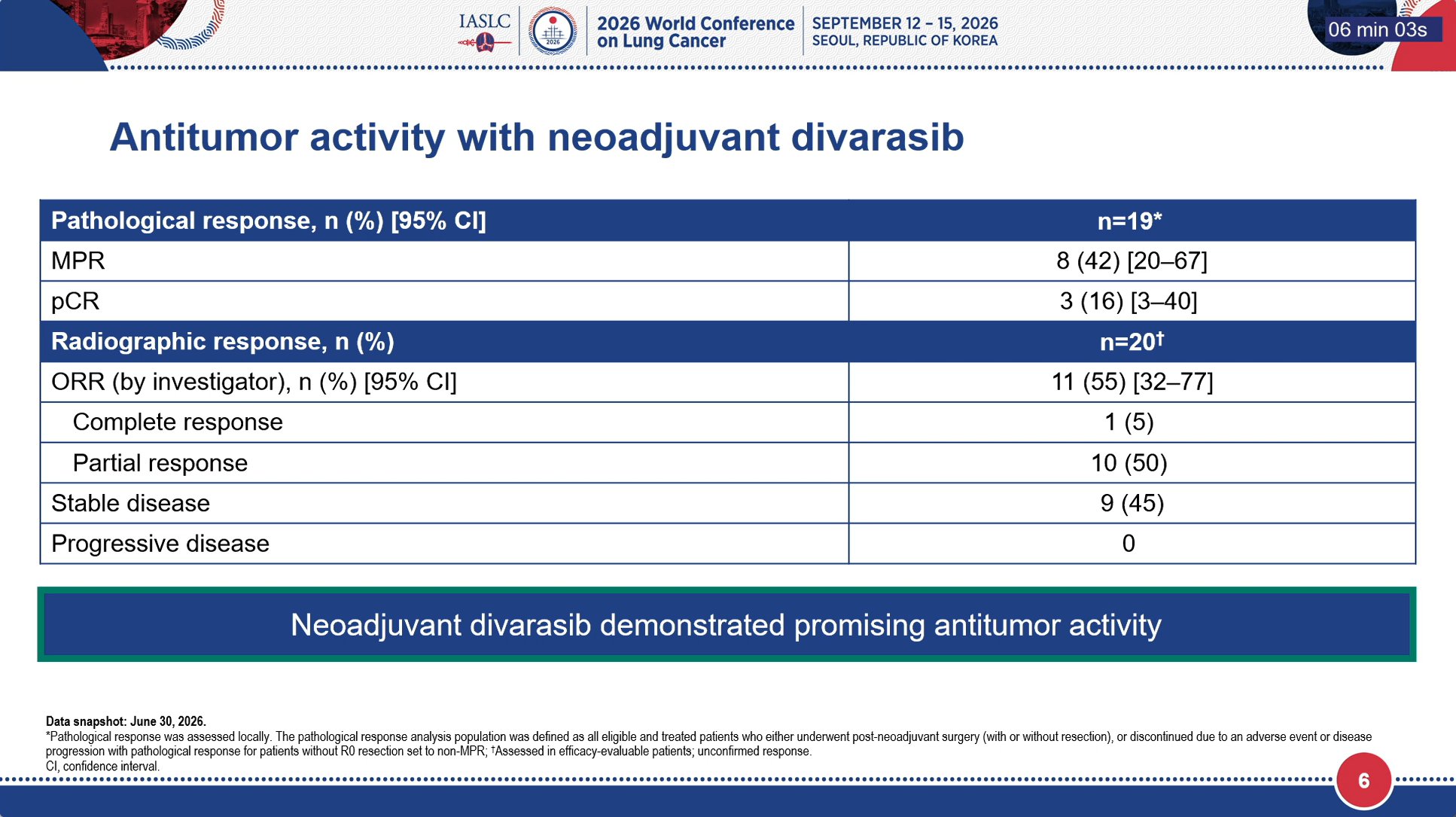
MPR 42% (8/19) and pCR 16% (3/19) after 8 weeks of neoadjuvant divarasib 400 mg daily; radiographic ORR 55% (11/20) with zero progressive disease. Clinical downstaging 45%, pathological nodal downstaging 35%, R0 resection in all patients who underwent surgery, and zero treatment discontinuations due to AEs. Presented by Jamie Chaft (MSK) on September 13, 2026. (WCLC26 Oral OA04.04, presentation data snapshot 30-Jun-2026)
NAUTIKA1’s ALK cohort (8 weeks of neoadjuvant alectinib; WCLC 2026 primary analysis: MPR 55.8%, 2-year EFS 94%) has its own profile — NAUTIKA1 ALK cohort. Both cohorts are distinct from Krascendo 1 (NCT06497556), the phase III divarasib trial in previously treated advanced NSCLC.
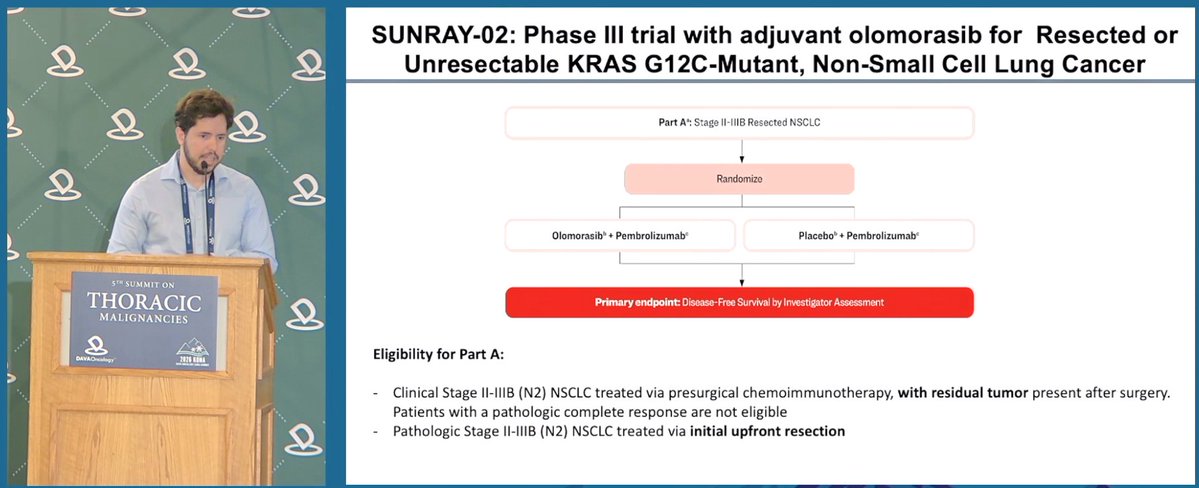
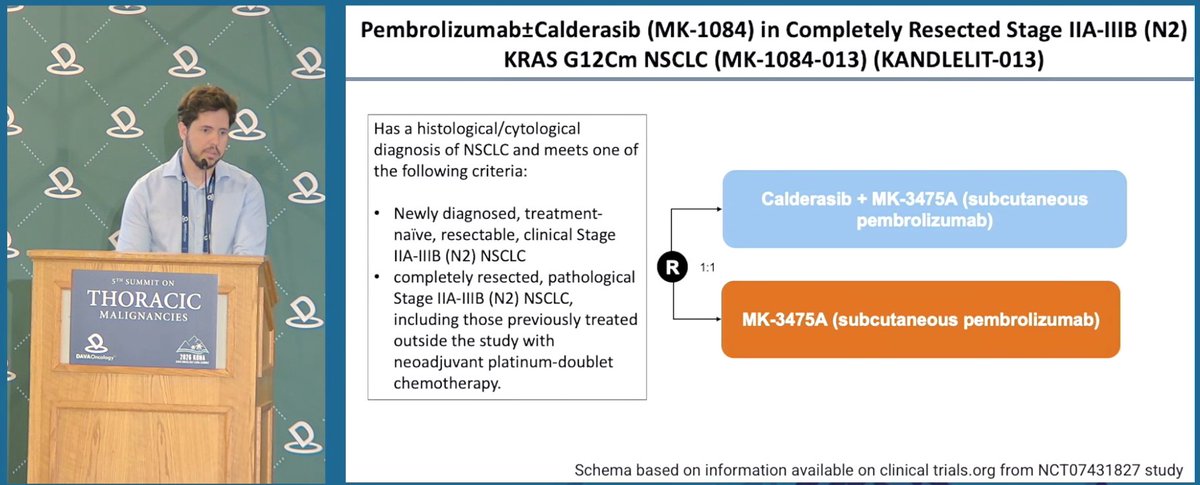
⚠️ Divarasib is investigational — not FDA approved in any setting; the phase III Krascendo 3 trial takes it forward as ADJUVANT therapy in resected stage II–IIIB disease, in patients without a pCR after neoadjuvant chemoimmunotherapy (NCT07541170). ✅ Alectinib (Alecensa) is FDA- and globally approved as adjuvant therapy for resected ALK+ NSCLC (ALINA); its neoadjuvant use in NAUTIKA1 is investigational. (WCLC26 Abstract; WCLC25 Slides; FDA)
Thoracic surgeon Jonathan Spicer called the divarasib results “Amazing” and “oddly reminiscent” of Patrick Forde’s first NEJM neoadjuvant nivolumab report; Forde called them “Impressive for 8 weeks of therapy” and framed the next question — next-gen G12C inhibitor monotherapy vs combination with anti-PD-1.
Create a free account, pick the tumor types you cover, and go beyond the tweet — the intelligence pharma teams use to map influence and prepare for engagement:


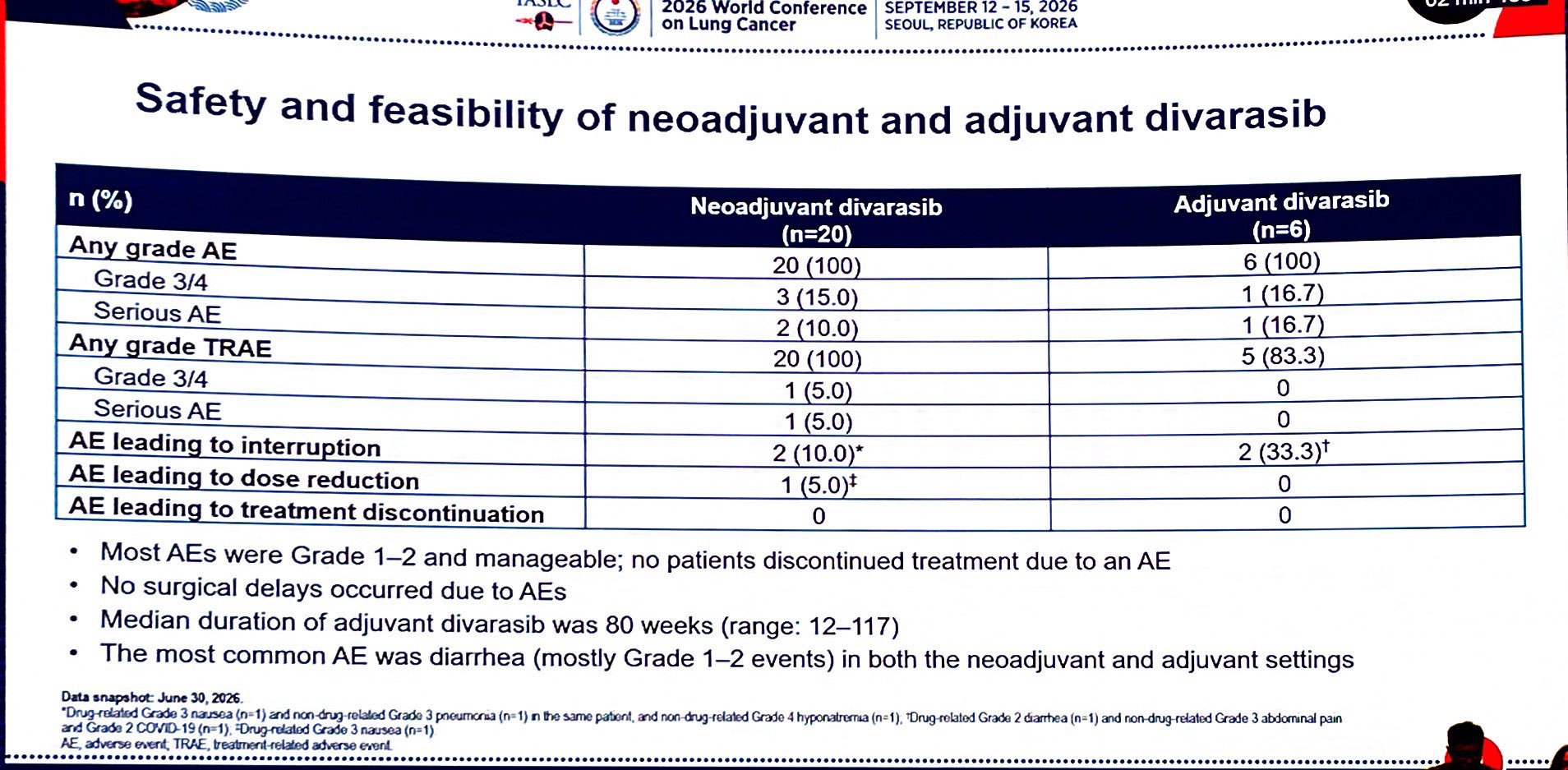
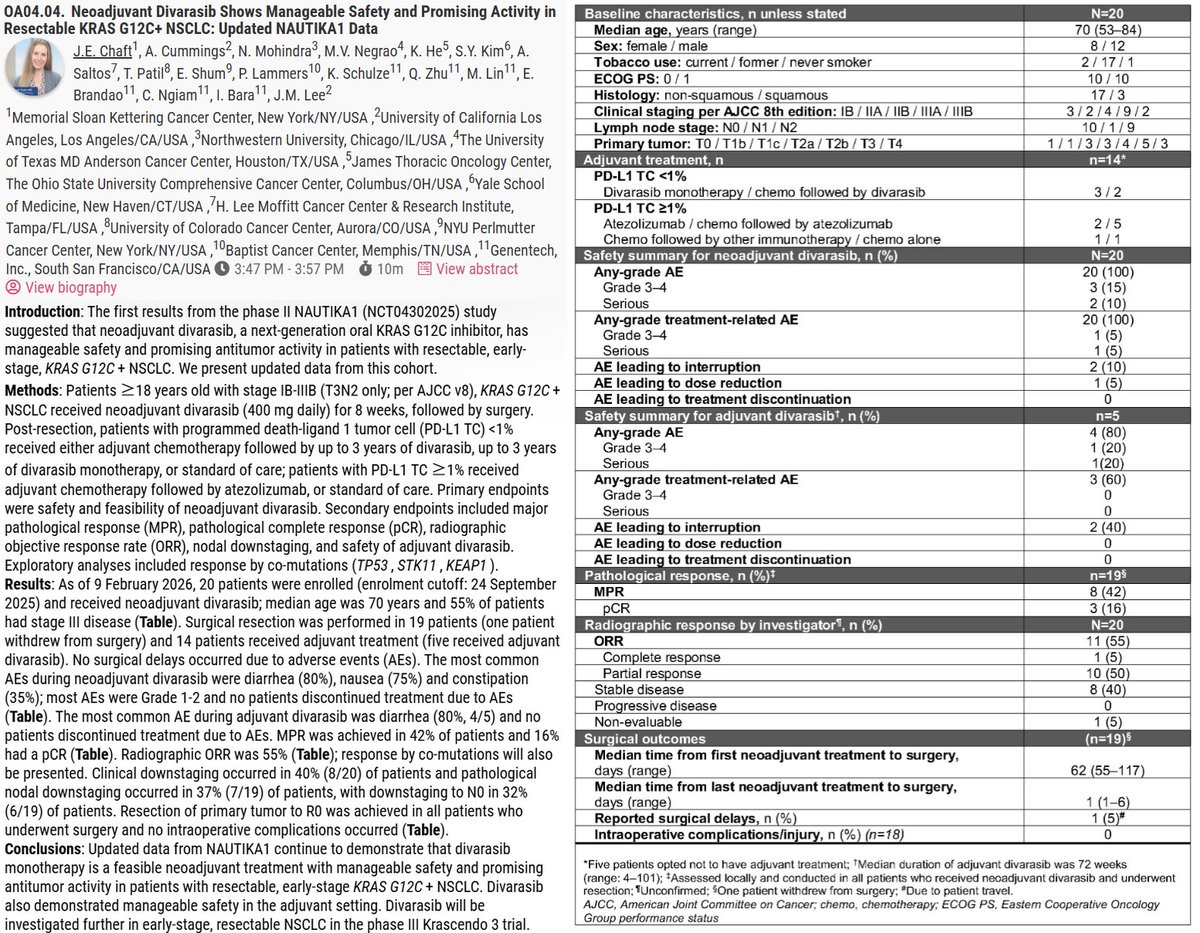


🆙#WCLC26 #LCSM Oral Session 🔥NAUTIKA1: Neoadjuvant Divarasib Shows Manageable Safety and Promising Activity in Resectable KRAS G12C+ NSCLC 🎙️ @ChaftJamie 🔢OA04.04 🎯MPR 42%, pCR 16% (n=19) 🎯Radiographic ORR 55% 🎯No Treatment Discontinuations Due to AEs ☑️NCT04302025 @OncoAlert @Larvol @IASLC @KRASKickers
Amazing results! Oddly reminiscent of your first NEJM @FordePatrick for Nivo monotherapy!
@DoctorJSpicer Impressive for 8 weeks of therapy! Will be interesting to see how next gen G12C mono vs combination with PD1 plays out. @drgandara will be presenting #wclc26 data on cemiplimab mono therapy in advanced Kras g12c that looks remarkably similar to G12Ci/PD1 combo data.
WCLC 2026 | NAUTIKA1 🇰🇷 Neoadjuvant KRAS G12C targeting is moving into early-stage NSCLC. Divarasib showed promising pathological activity without compromising the feasibility of surgery. @OncoAlert @weoncologists @GlopesMd @ManuelDomine @OpenMedKate https://t.co/epVqf6tpsf
9. NAUTIKA-1: divarasib cohort ⭐️ This is a very interesting dataset looking at neoadjuvant divarasib for stage IB-IIIB (T3N2 only; per KRAS G12C+ NSCLC 🗝️ KEY INSIGHTS: Among 20 patients enrolled, there was 42% MPR, 16% pCR, 55% ORR, and 100% R0 resection 🤔 The data are small, but provocative. For whom should we prioritize the KRAS G12Ci approach in the neoadjuvant setting, since many of these patients do respond quite well to neoadjuvant chemoIO? Should we consider KRAS G12Ci for PDL1 < 1%? Those with KEAP1 alterations? Those who are chemotherapy ineligible? Should there be a perioperative component? Should we combine with KRAS G12Ci with IO (or chemoIO)? This is hypothesis generating data! @KRASKickers @lcsmchat @YoungLungCancer @OncoAlert @MedwatchHQ
🫁 NAUTIKA1: neoadjuvant divarasib shows activity in KRAS G12C+ NSCLC. @ChaftJamie In this phase II cohort: • MPR: 42% • pCR: 16% • ORR: 55% • Pathologic nodal downstaging: 37% • R0 resection: 100% Divarasib was feasible without surgical delays or treatment discontinuations due to AEs. Most toxicities were grade 1-2. These results support further evaluation of KRAS G12C inhibition in resectable NSCLC, including the ph3 KRAScendo trial. #CánCare #NSCLC #KRAS #KRASG12C #ThoracicOncology #WCLC26 @IASLC
KRAS G12C BEFORE SURGERY: TARGET FIRST, OPERATE NEXT? NAUTIKA1 explores a simple concept: • Resectable KRAS G12C+ NSCLC → treat the driver before surgery with divarasib → then operate and look at what is actually left in the tumor. The signal is encouraging: 42% MPR and 16% pCR, with 19/20 patients undergoing surgery and no AE-related surgical delays. Take-home: KRAS G12C inhibition may have a role before surgery—not just in advanced disease. Promising proof of concept, but with only 20 patients, far too early to be practice-changing. Reference: Chaft JE et al. NAUTIKA1, OA04.04, IASLC WCLC 2026. #WCLC2026 #MVOnco #NSCLC #KRASG12C #Divarasib #NAUTIKA1
NAUTIKA1; KRAS G12C Divarasib neoadjuvant for 8w: n=20; pCR 16% MPR 42%; ORR 55%. Nodal downstaging seems significant: does not look good enough for SOC> reflected in KRASCENDO3 adjuvant P3 #WCLC26 https://t.co/Xklb91rdsC
NAUTIKA1: neo-adj divarasib KRAS G12C 👉 Ph2 ☂️ 👉 Adj chemo/diva (PDL1-) or atezo (PDL1+) 👉 n=19 🔺16% pCR, 42% MPR ✅35% nodal downstaging ✅100% R0 rate, proves feasibility ✅TRAEs good 🤔 ?best pathology marker: MPR pCR? Neo-adj chemoIO + adj Diva likely better #WCLC26 https://t.co/YuknqVv5HD
NAUTIKA1 (NCT04302025) is a multicenter, phase II, neoadjuvant and adjuvant umbrella study sponsored by Genentech that asks a simple question with broad reach: can patients with resectable stage IB–IIIB (T3N2 only) NSCLC harboring an actionable driver alteration benefit from receiving their matched targeted therapy before surgery? Instead of one drug and one biomarker, the study enrolls by local CLIA-certified molecular testing into parallel cohorts — alectinib for ALK, entrectinib for ROS1/NTRK, pralsetinib for RET, atezolizumab plus low-dose SBRT (8 Gy × 3, concurrent with Cycle 1) for PD-L1≥1%, divarasib for KRAS G12C, and a BRAF cohort (vemurafenib + cobimetinib) that closed without enrolling — each delivering roughly 8 weeks of neoadjuvant therapy followed by resection and biomarker-directed adjuvant treatment.
Jamie Chaft (MSK) presented the updated KRAS G12C divarasib data in the September 13 oral session at WCLC 2026 (OA04.04): MPR 42%, pCR 16%, and radiographic ORR 55% with 8 weeks of neoadjuvant divarasib monotherapy, clinical downstaging in 45%, zero discontinuations for toxicity, and R0 resection in every operated patient — data feeding the phase III Krascendo 3 trial named in the presented conclusions. Divarasib remains investigational; no KRAS G12C inhibitor is currently approved in the neoadjuvant setting. The umbrella’s ALK cohort (neoadjuvant alectinib) is covered on its own profile; the phase III Krascendo 1 trial of divarasib in previously treated advanced NSCLC is a different study.
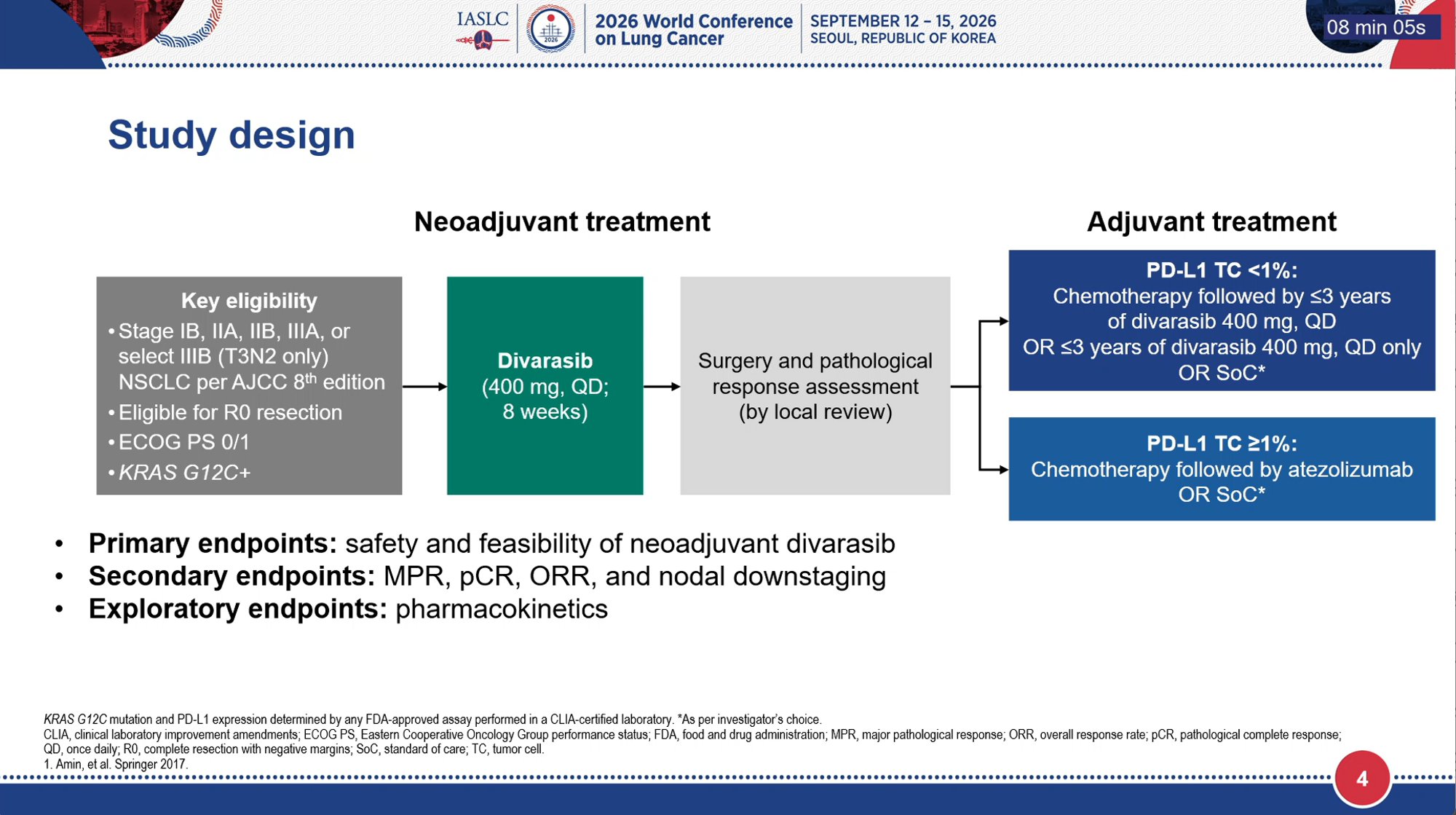
Phase II, multicenter, biomarker-directed umbrella: ~8 weeks neoadjuvant targeted therapy by driver alteration → surgical resection → biomarker-directed adjuvant phase. Primary endpoints: safety and feasibility (KRAS G12C cohort); locally assessed MPR (TKI cohorts: ALK, ROS1, NTRK, BRAF, RET). (CTgov; WCLC26 Abstract; WCLC25 Slides)
Resectable stage IB–IIIB (T3N2 only; AJCC 8th ed) NSCLC with a study-eligible driver by local CLIA-certified FISH, IHC, or NGS. KRAS G12C cohort: N=20, median age 70, 55% stage III. ALK cohort: N=33, median age 59, 63.6% N2. (WCLC26 Abstract; WCLC25 Slides)
KRAS G12C: divarasib 400 mg daily ×8 weeks, then adjuvant by PD-L1 (chemo → up to 3 years divarasib, divarasib mono, atezolizumab-based, or SoC). ALK: alectinib 600 mg BID ×8 weeks, then ≤4 cycles platinum chemo → ≤2 years alectinib. (WCLC26 Abstract; WCLC25 Slides)
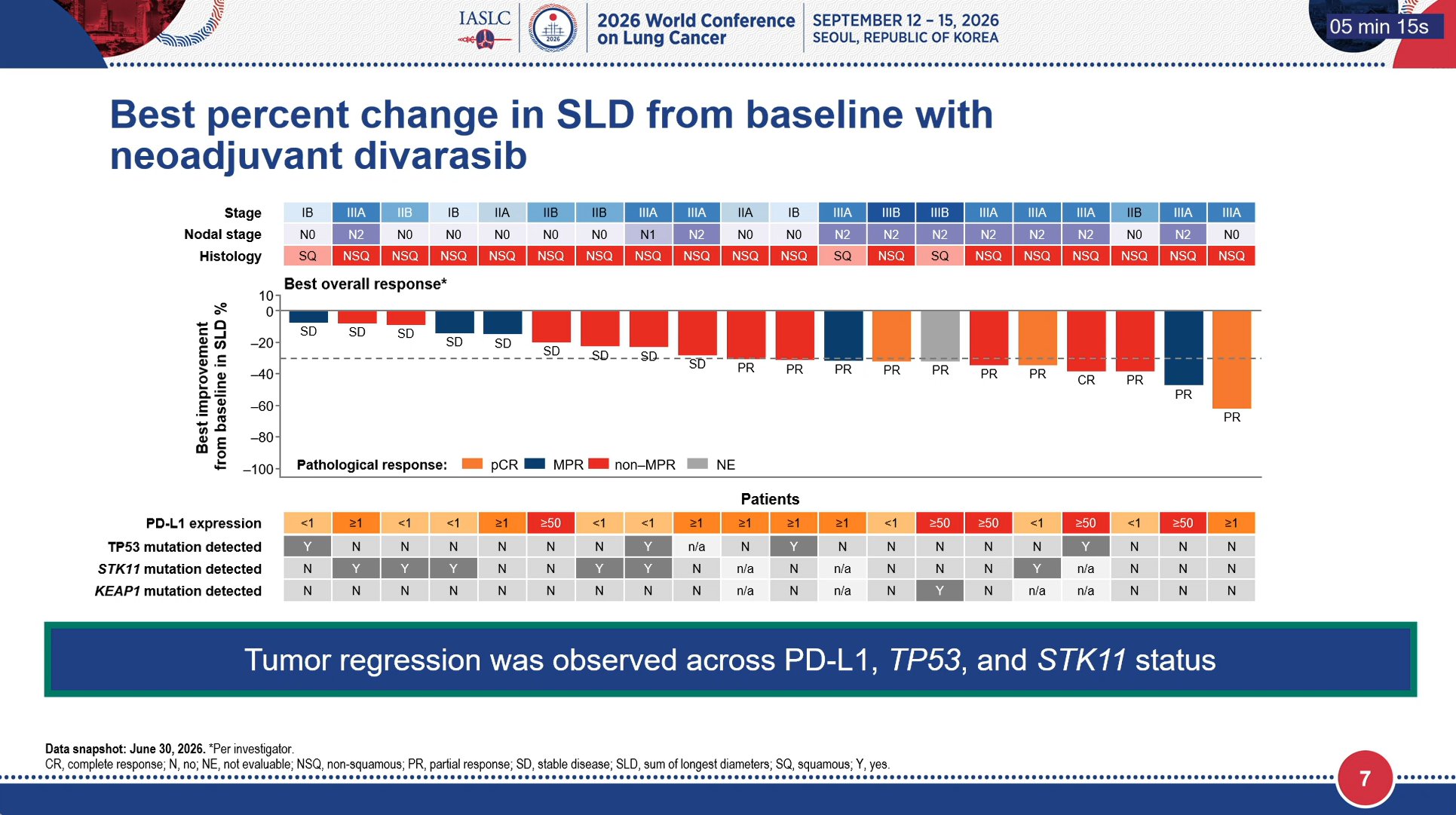
Safety/feasibility, MPR (≤10% residual viable tumor), pCR, radiographic ORR, nodal downstaging, adjuvant safety; exploratory response by co-mutations (TP53, STK11, KEAP1). (WCLC26 Abstract)
KRAS G12C cohort: Jamie Chaft, MD (MSK) — WCLC 2026 oral OA04.04. ALK cohort: Jay M. Lee, MD (UCLA) — WCLC 2025 oral. Study authors span MSK, UCLA, Northwestern, MD Anderson, Ohio State, Yale, Moffitt, Colorado, NYU, Baptist Memphis, and Genentech.
With 8 weeks of neoadjuvant divarasib monotherapy, MPR was achieved in 42% (8/19) [95% CI 20–67] and pCR in 16% (3/19) [95% CI 3–40] in the locally assessed pathological response analysis population — all eligible and treated patients who underwent post-neoadjuvant surgery (with or without resection) or discontinued due to an adverse event or disease progression, with patients without R0 resection conservatively set to non-MPR. One of 20 enrolled patients withdrew from surgery. (WCLC26 presentation slides, data snapshot 30-Jun-2026; point estimates unchanged from the abstract, DCO 09-Feb-2026)
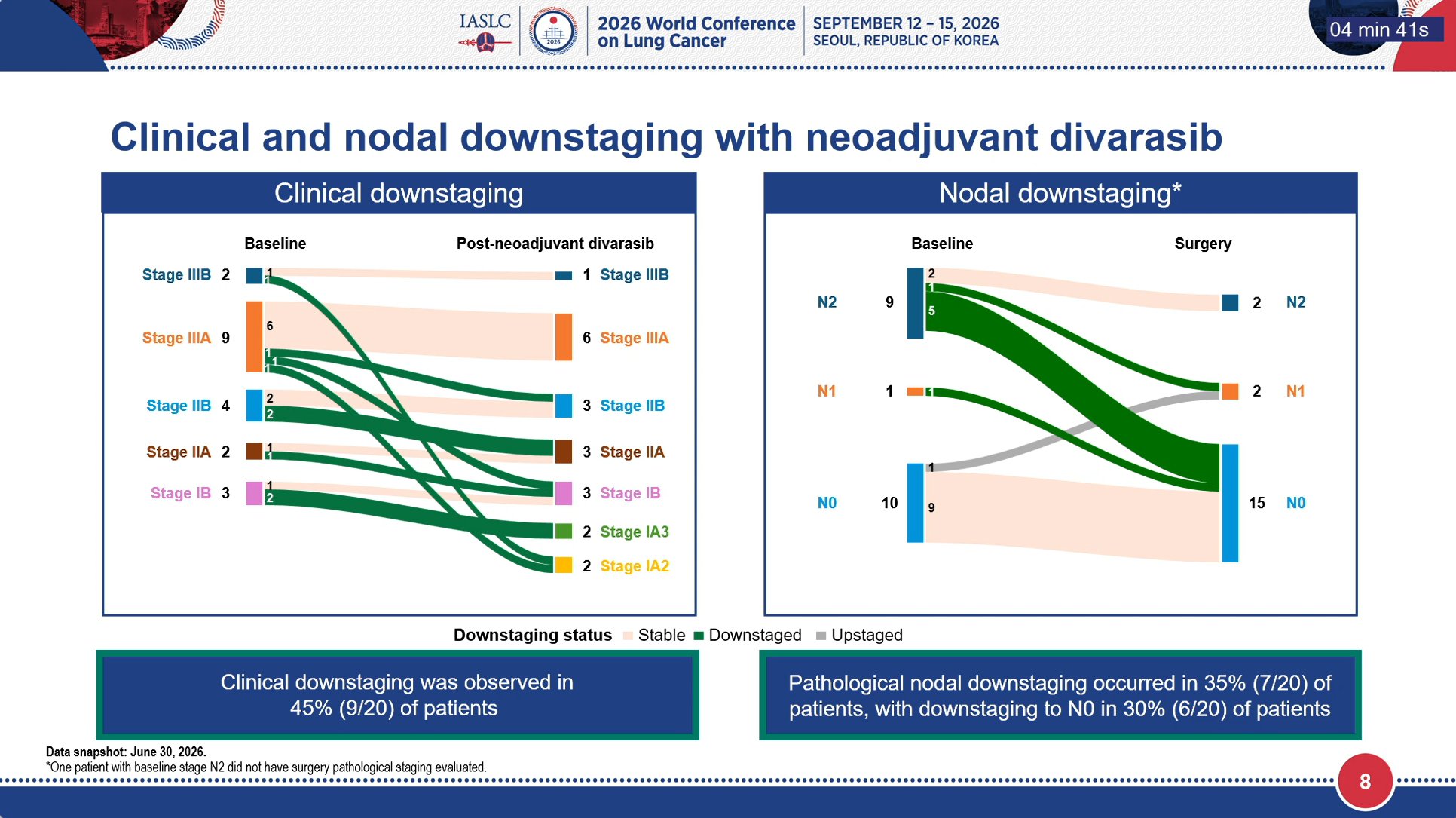
MPR 42% after 8 weeks of neoadjuvant divarasibPer the presentation slides (data snapshot 30-Jun-2026): investigator-assessed (unconfirmed) radiographic ORR 55% (11/20) [95% CI 32–77] — CR 5%, PR 50%, SD 45%, no progressive disease. Clinical downstaging occurred in 45% (9/20), pathological nodal downstaging in 35% (7/20), and downstaging to N0 in 30% (6/20). The earlier abstract cut (DCO 09-Feb-2026) reported clinical downstaging 40% (8/20), nodal downstaging 37% (7/19), and downstaging to N0 32% (6/19) — the clinical-downstaging numerator rose by one patient between cuts (8/20 → 9/20), while the nodal figures reflect a denominator change (7/19 → 7/20; 6/19 → 6/20); both cuts shown, never mixed.
ORR 55% · clinical downstaging 45% · zero PDPer the presentation safety slide (data snapshot 30-Jun-2026): every neoadjuvant patient had an AE of some grade (20/20); all-cause Grade 3/4 AEs occurred in 15% (3/20) and serious AEs in 10% (2/20), while treatment-related Grade 3/4 AEs occurred in 5% (1/20) — the 15% vs 5% difference is all-cause versus treatment-related within the same cut, not a change between cuts. AEs led to interruption in 10% and dose reduction in 5%, with zero discontinuations; no surgical delays were due to AEs and R0 resection was achieved in all operated patients. In the adjuvant phase (n=6 on divarasib, median duration 80 weeks, range 12–117), Grade 3/4 AEs occurred in 16.7% (1/6) with no Grade 3/4 treatment-related AEs and no discontinuations. The most common AE was diarrhea, mostly Grade 1–2, in both settings; the abstract cut (DCO 09-Feb-2026) additionally reported nausea in 75% and constipation in 35% of neoadjuvant patients.
0 discontinuations due to AEs · R0 in all resectedPhysician posts about this trial captured live during the IASLC 2026 World Conference on Lung Cancer (Seoul, September 12–15). Quotes are verbatim; each card links to the original post. Last updated 2026-09-14.
NAUTIKA1 (NCT04302025) is a Genentech-sponsored phase II umbrella study of neoadjuvant and adjuvant targeted therapy in biomarker-selected patients with resectable stage IB–IIIB (T3N2 only) NSCLC. Cohorts assign roughly 8 weeks of neoadjuvant targeted therapy by driver alteration — alectinib (ALK), entrectinib (ROS1/NTRK), pralsetinib (RET), atezolizumab plus low-dose SBRT (8 Gy × 3, concurrent with Cycle 1; PD-L1≥1%), divarasib (KRAS G12C), and a BRAF cohort (vemurafenib + cobimetinib) that closed without enrolling — followed by surgery and biomarker-directed adjuvant therapy.
In the oral presentation by Jamie Chaft (MSK) on September 13, 2026 (OA04.04, presentation data snapshot June 30, 2026), 20 patients with resectable KRAS G12C+ NSCLC received 8 weeks of neoadjuvant divarasib 400 mg daily: MPR 42% (8/19), pCR 16% (3/19), radiographic ORR 55% (11/20) with no progressive disease, clinical downstaging in 45%, and pathological nodal downstaging in 35%. No patients discontinued treatment due to adverse events, all resected patients achieved R0, and there were no intraoperative complications.
No. Divarasib is an investigational next-generation KRAS G12C inhibitor — it is not FDA-approved in any setting. NAUTIKA1 is a phase II study; divarasib will be investigated further in early-stage resectable NSCLC in the phase III Krascendo 3 trial. Alectinib (Alecensa) is FDA- and globally approved as adjuvant therapy for resected ALK+ NSCLC based on ALINA, but its neoadjuvant use in NAUTIKA1 remains investigational.
The ALK/alectinib readouts (WCLC 2025 interim; WCLC 2026 primary analysis MO06.01) come from a different cohort of the SAME umbrella protocol, NCT04302025 — covered on the NAUTIKA1 ALK cohort profile. Krascendo 1 (NCT06497556) is an entirely different study: a phase III trial of divarasib monotherapy versus sotorasib or adagrasib in previously treated ADVANCED or metastatic KRAS G12C+ NSCLC, which reported positive topline PFS and OS results in July 2026.
The divarasib data drew comparisons to landmark neoadjuvant work: thoracic surgeon Jonathan Spicer called the results “Amazing” and “oddly reminiscent” of Patrick Forde's first NEJM report of neoadjuvant nivolumab monotherapy, while Forde called them “Impressive for 8 weeks of therapy” and framed the open question of next-generation KRAS G12C inhibitor monotherapy versus combination with anti-PD-1 in the perioperative space.
Compiled and reviewed by the KOL Pulse research team, led by Brian Shields, Founder, KOL Pulse. Last updated September 13, 2026. Sources: WCLC 2026 oral OA04.04 presentation slides (data snapshot 30-Jun-2026) and abstract (data cutoff 09-Feb-2026), ClinicalTrials.gov NCT04302025, and verbatim physician posts on X.

