NAUTIKA1 ALK Cohort at a Glance
Design
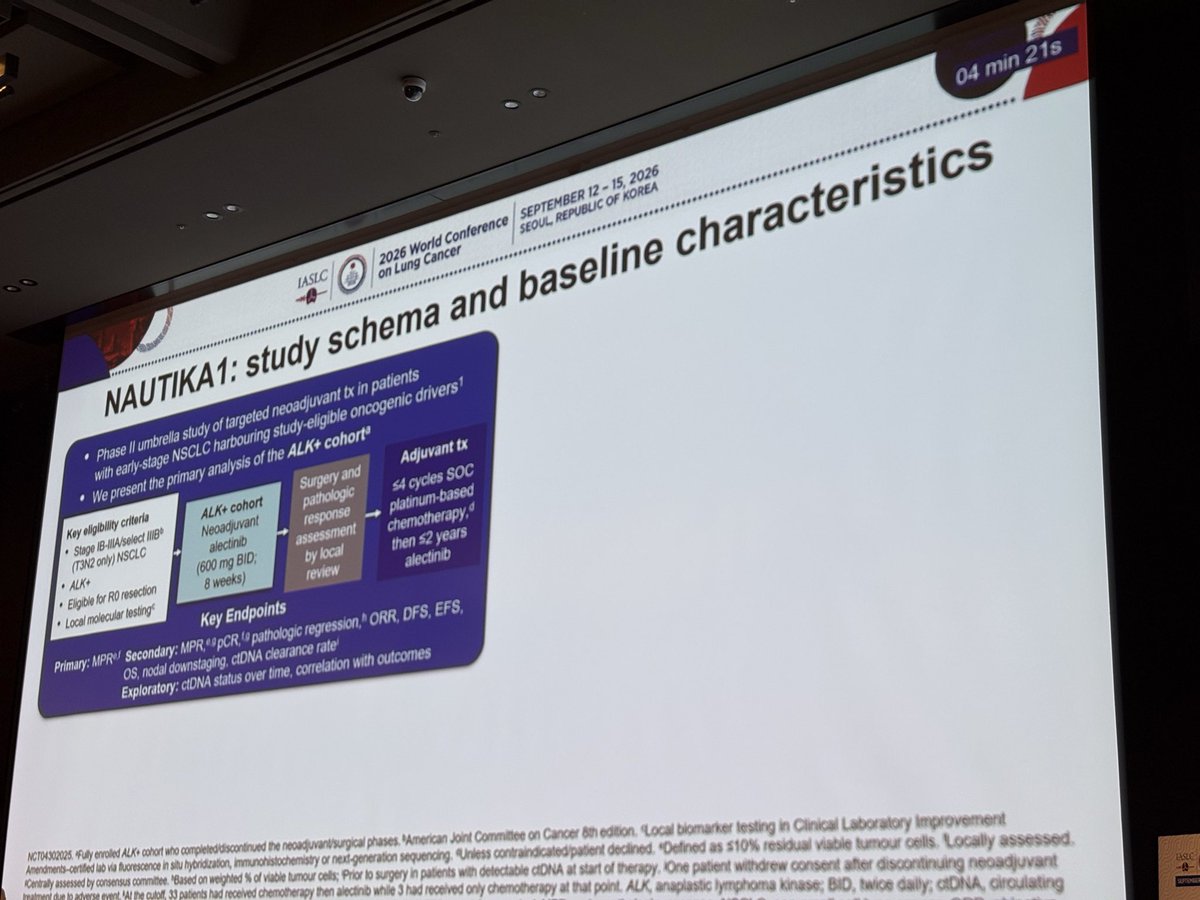
ALK+ cohort of the NAUTIKA1 phase II biomarker-directed umbrella (NCT04302025): 8 weeks of neoadjuvant alectinib 600 mg BID → surgery and locally assessed pathologic response → optional platinum chemotherapy (≤4 cycles) → up to 2 years of adjuvant alectinib, in resectable stage IB–IIIB (T3N2 only) ALK+ NSCLC. Primary endpoint: MPR. (ClinicalTrials.gov; WCLC25 Slides)
Primary analysis — WCLC 2026 (presented September 14, 2026)
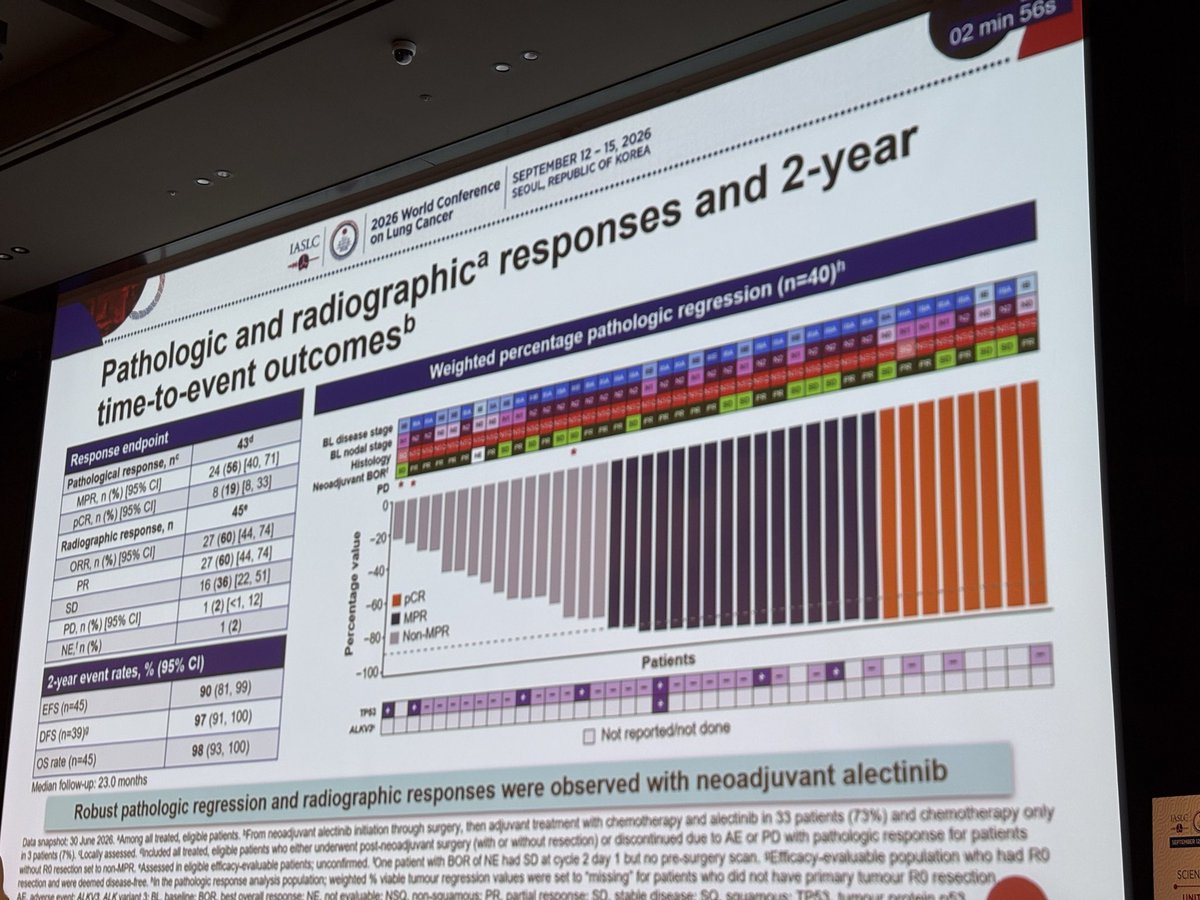
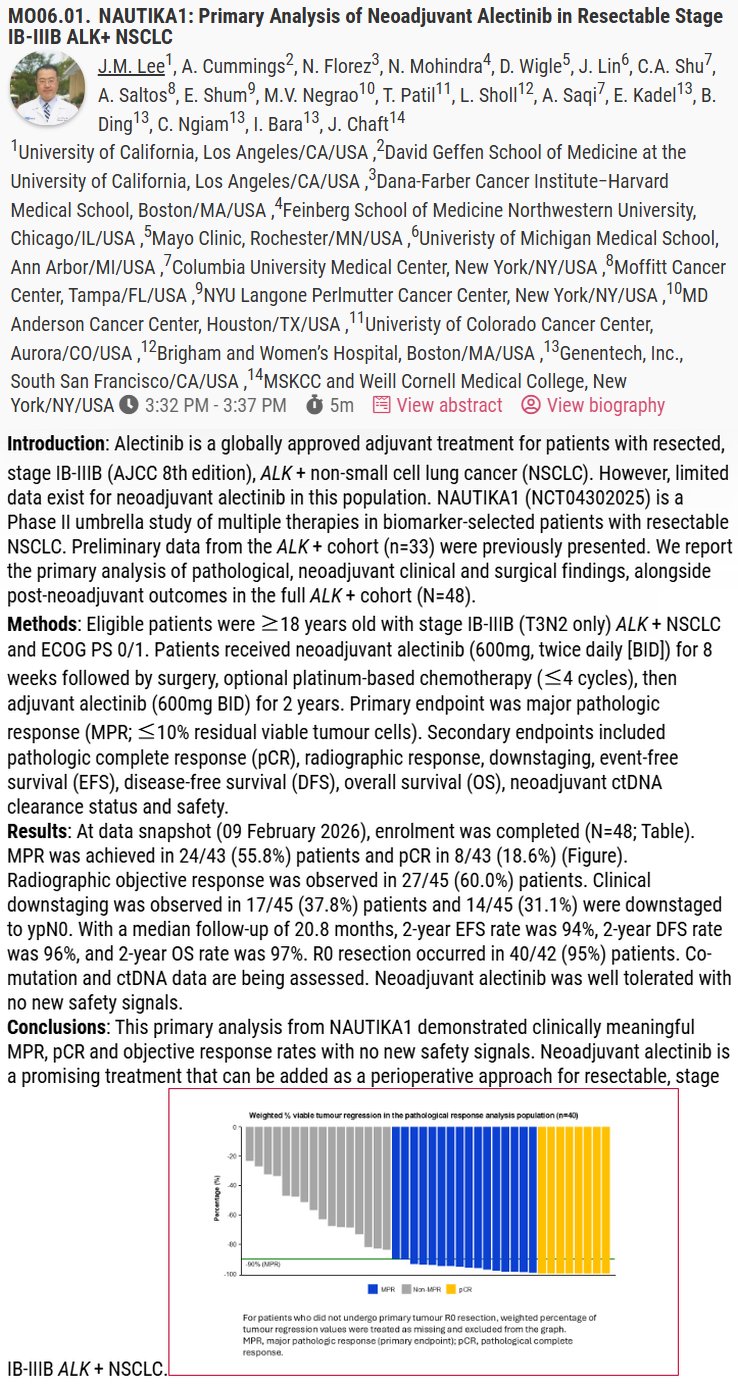
Per the presented slides (MO06.01, Jay M. Lee; data snapshot 30-Jun-2026, median follow-up 23.0 months; 48 enrolled, single-arm): MPR 56% (24/43; 95% CI 40–71), pCR 19% (8/43; 95% CI 8–33), radiographic response 60% (27/45, all PR; locally assessed, unconfirmed), and R0 resection in 95% (40/42). The presented Sankey prints 14/45 (31%) downstaged to ypN0; its downstaged bands total 17/45 (38%). 2-year EFS 90% (95% CI 81–99; n=45), DFS 97% (91–100; n=39, R0-resected and deemed disease-free), OS 98% (93–100; n=45) — the abstract’s earlier 20.8-month cut had reported 94%/96%/97%. Pre-surgery ctDNA clearance in 86% (24/28) of baseline ctDNA-positive patients with longitudinal samples. (WCLC26 presented slides MO06.01, DCO 30-Jun-2026)
WCLC 2025 interim
MPR 60.7% (17/28), pCR 25.0% (7/28), radiographic ORR 63.3% (19/30), radiographic downstaging 43.3% (13/30, presentation slides), pathologic nodal downstaging 33.3% (10/30, presentation slides; the JTO abstract reports 26.7%, 8/30) — in a cohort where 63.6% had N2 disease at diagnosis. No intraoperative complications. (WCLC25 presentation, Lee, DCO 02-Sep-2024)
Safety — presented detail
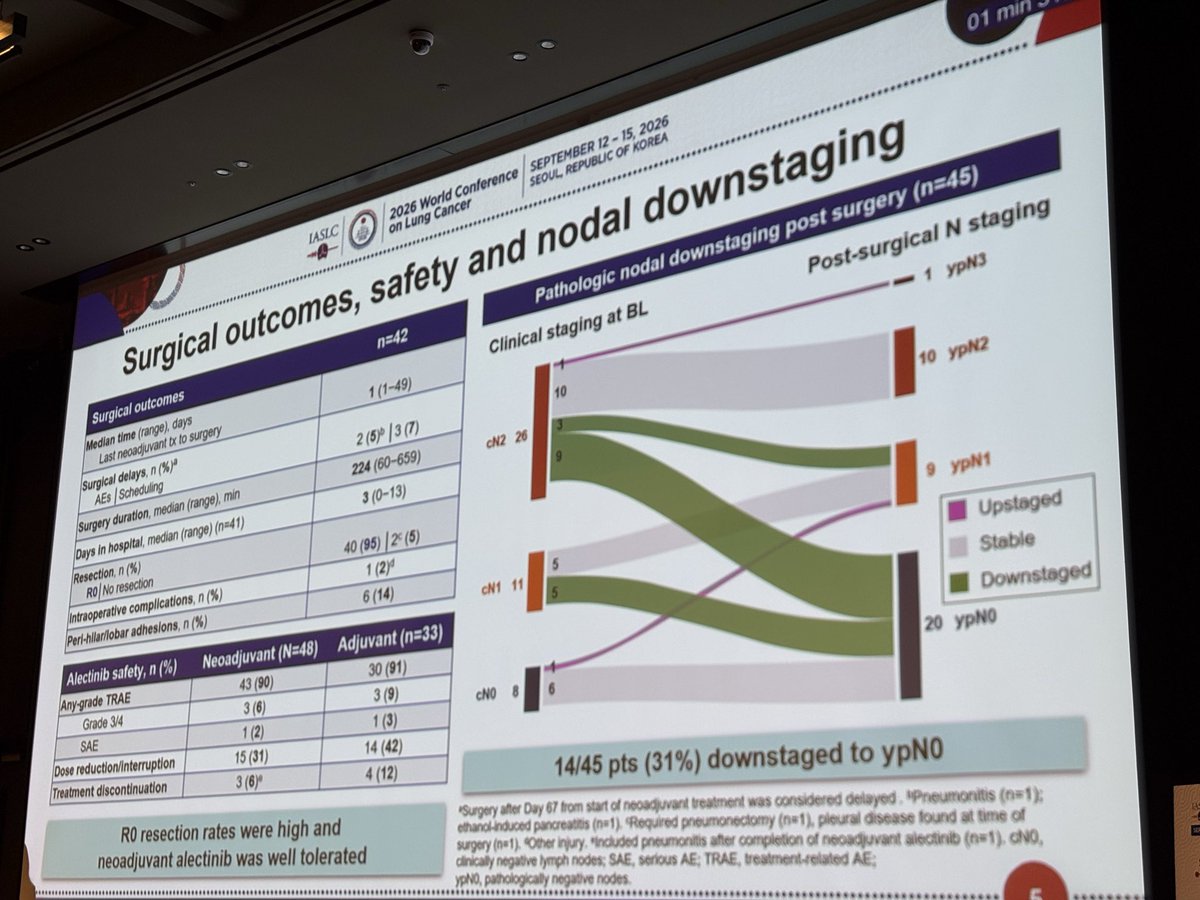
Neoadjuvant alectinib (N=48): any-grade treatment-related AEs 90%, grade 3/4 6%, serious AEs 2%, discontinuation 6%. Adjuvant alectinib (n=33): any-grade 91%, grade 3/4 9%, dose reduction/interruption 42%, discontinuation 12%. Intraoperative complications 2% (1/42). Per the presented banner: R0 resection rates were high and neoadjuvant alectinib was well tolerated. (WCLC26 presented slides MO06.01, DCO 30-Jun-2026)
Regulatory status
✅ Alectinib (Alecensa) is FDA-approved as ADJUVANT therapy following resection of ALK+ NSCLC with tumors ≥4 cm or node-positive disease (per the FDA label; ALINA staged by AJCC 7th edition, NAUTIKA1 by 8th — the ranges are not equivalent). ⚠️ Its NEOADJUVANT use in NAUTIKA1 is investigational. (FDA label; WCLC25 Slides)
KOL pulse
Ben Solomon: “Fabulous data… 60.7% MPR and 25% pCR(!) with 8 weeks of neoadjuvant alectinib.” Riyaz Shah: “impressive nodal downstaging; I think this is profound.” From the Sept 14 session, Urs Weber: “High rates of ctDNA clearance, which correlated with pathologic response… Periop TKI might be the way to go.”
KOLs Discussing the ALK Cohort


Key Slides & Data


What Physicians Said
Primary analysis of periop alectinib in resectable stage IB-IIIB NSCLC (NAUTIKA1) at @IASLC #WCLC26. pCR rate of 19%. 31% down-staging to ypN0. High rates of ctDNA clearance, which correlated with pathologic response. 2-year EFS 90%. Periop TKI might be the way to go. https://t.co/fNmk2VvkBb
Fabulous data presented by Jay Lee from the Nautika1 neoadjuvant study in resectable ALK+ NSCLC. 60.7% MPR and 25% pCR(!) with 8 weeks of neoadjuvant alectinib. @IASLC #WCLC2025
☑️#WCLC25 #LCSM Mini Oral Abstract🆙 🔥Nautika1: Clinical Outcomes and Pathologic Regression With Neoadjuvant Alectinib in Resectable Stage IB-IIIB ALK + NSCLC 🎯MPR 17/28 (60.7%), pCR 7/28 (25.0%) 🎙️ Dr. Jay M. Lee @OncoAlert @Larvol @IASLC
🆙#WCLC26 #LCSM Mini Oral Session 🔥NAUTIKA1: Primary Analysis of Neoadjuvant Alectinib in Resectable Stage IB-IIIB ALK+ NSCLC 🎙️Dr. Jay M. Lee 🔢MO06.01 🎯R0 Resection in 95% 🎯MPR 55.8%, pCR 18.6% (n=43) 🎯2-Yr EFS 94%, DFS 96%, OS 97% (n=48) ☑️NCT04302025 🔗 https://t.co/6rnqfaalhV @OncoAlert @Larvol @IASLC
NAUTIKA1; 2 neoadj cycles>s>adj chemo > adj alectinib; 64%N2; MPR 60%; pCR 25%; impressive nodal downstaging; I think this is profound #WCLC25 @BTOGORG @UKALK1
About the NAUTIKA1 ALK Cohort
NAUTIKA1 (NCT04302025) is a multicenter, phase II, neoadjuvant and adjuvant umbrella study sponsored by Genentech that enrolls patients with resectable stage IB–IIIB (T3N2 only) NSCLC by local CLIA-certified molecular testing into parallel cohorts by driver alteration. The ALK+ cohort — the study’s first headline readout — gives 8 weeks of neoadjuvant alectinib before surgery. The rationale, as presenter Jay M. Lee (UCLA) has explained: under the adjuvant-only ALINA paradigm, node-positive patients can wait 4–6 months after diagnosis before starting alectinib; moving it before surgery closes that gap.
At WCLC 2025 the interim readout showed MPR 60.7% and pCR 25.0%; the primary analysis, presented by Jay M. Lee at WCLC 2026 (MO06.01, September 14, 2026), reports the full cohort of 48 enrolled patients — MPR 56% (24/43), R0 resection 95% (40/42), 2-year EFS of 90% at 23.0 months median follow-up, and, in the exploratory ctDNA analysis, pre-surgery clearance in 86% (24/28) of baseline ctDNA-positive patients with longitudinal samples. The umbrella’s other headline readout is the KRAS G12C cohort (neoadjuvant divarasib, WCLC 2026 oral OA04.04) — covered on its own profile. Both are distinct from Krascendo 1, the phase III divarasib trial in previously treated advanced NSCLC.
Trial Methodology & Results
Study Design
Phase II umbrella cohort: 8 weeks neoadjuvant alectinib 600 mg BID → surgery → optional platinum chemo (≤4 cycles) → ≤2 years adjuvant alectinib. Primary: locally assessed MPR (≤10% residual viable tumor). (CTgov; WCLC25 Slides)
Population
Resectable stage IB–IIIB (T3N2 only; AJCC 8th ed) ALK+ NSCLC by local CLIA-certified FISH, IHC, or NGS. Primary analysis N=48; WCLC25 interim N=33 (median age 59, 63.6% N2). (WCLC26 MO06.01; WCLC25 Slides)
Endpoints
Primary: MPR (locally assessed). Secondary: MPR (centrally assessed), pCR, pathologic regression, ORR, DFS, EFS, OS, nodal downstaging, ctDNA clearance rate. Exploratory: ctDNA status over time and correlation with outcomes. (WCLC26 presented slides MO06.01)
Presenter
Jay M. Lee, MD — Surgical Director, Thoracic Oncology Program, UCLA. WCLC 2025 oral and WCLC 2026 Mini Oral MO06.01. Study authors span UCLA, Dana-Farber, Northwestern, Mayo, Michigan, Columbia, Moffitt, NYU, MD Anderson, Colorado, MSK, and Genentech.
Primary analysis — pathologic and radiographic response
MPR was achieved in 56% (24/43; 95% CI 40–71) and pCR in 19% (8/43; 95% CI 8–33); radiographic response occurred in 60% (27/45; 95% CI 44–74; locally assessed, unconfirmed; all partial responses, with SD 36% and PD 2% — the same all-PR pattern as the WCLC25 interim). The presented Sankey (pathologic nodal downstaging post surgery, n=45) prints 14/45 (31%) downstaged to ypN0, and its downstaged bands total 17/45 (38%) — matching the abstract’s 37.8% (17/45) downstaging figure. R0 resection in 95% (40/42). (WCLC26 presented slides MO06.01, DCO 30-Jun-2026)
MPR 56% (24/43) · R0 95% in the primary analysisSource: figures from the presented slides captured in Key Slides above · IASLC WCLC 2026 program listing (MO06.01) ↗
Primary analysis — survival (both cuts labeled)
Presented slides (DCO 30-Jun-2026, median follow-up 23.0 months): 2-year EFS 90% (95% CI 81–99; n=45), 2-year DFS 97% (91–100; n=39, R0-resected and deemed disease-free), and 2-year OS 98% (93–100; n=45). The publicly released abstract’s earlier cut (20.8 months median follow-up) had reported 2-year EFS 94%, DFS 96%, OS 97%. All are landmark estimates in a single-arm, non-comparative phase II cohort. (WCLC26 presented slides MO06.01, DCO 30-Jun-2026; WCLC26 abstract, 20.8-mo cut)
2-yr EFS 90% · DFS 97% · OS 98% at 23.0-mo median follow-up (presented)Source: figures from the presented slides captured in Key Slides above · IASLC WCLC 2026 program listing (MO06.01) ↗
ctDNA clearance — exploratory analysis, new in the presented slides
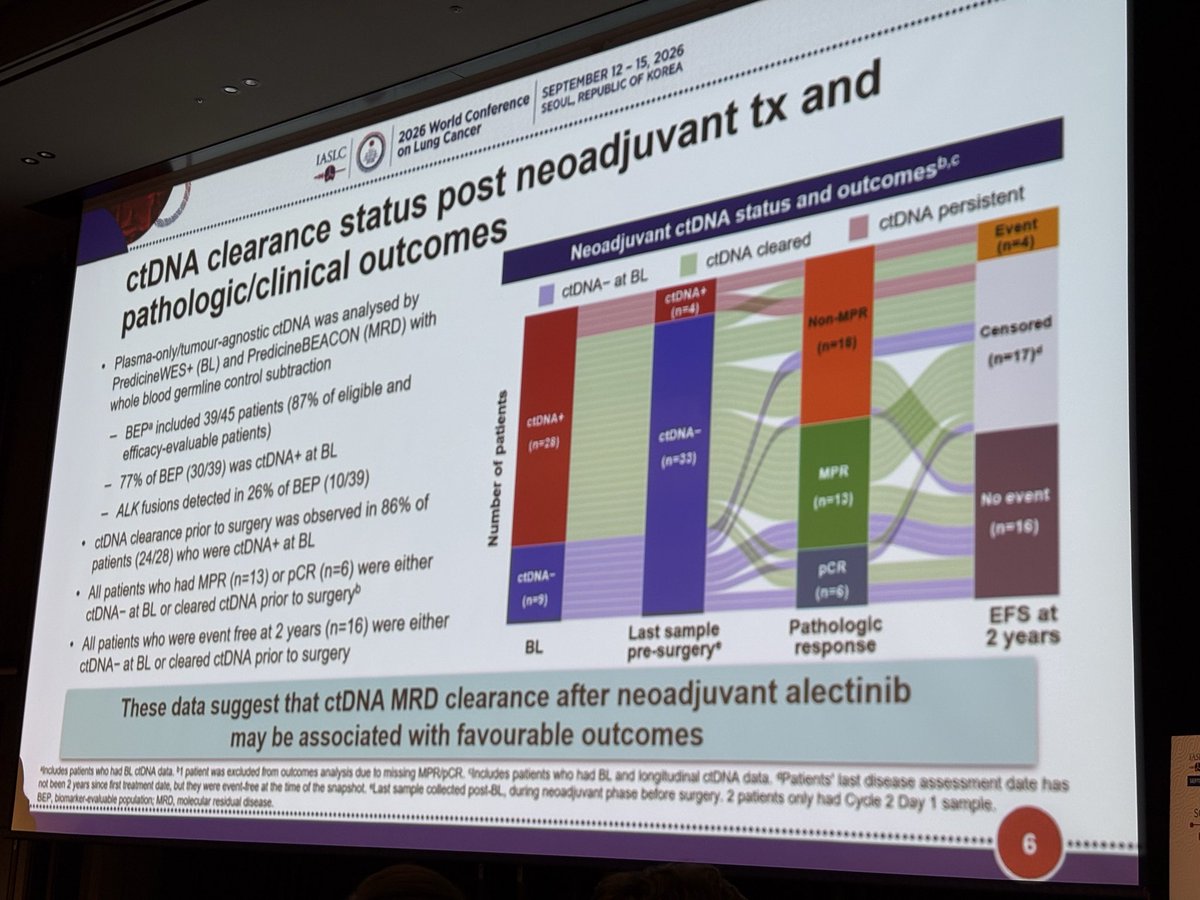
In the exploratory ctDNA analysis, plasma-only, tumor-agnostic ctDNA was analyzed with PredicineWES+ (baseline) and PredicineBEACON (MRD). The biomarker-evaluable population included 39/45 patients (87%); 77% (30/39) were ctDNA-positive at baseline, and ALK fusions were detected in ctDNA in 26% (10/39). ctDNA clearance before surgery occurred in 86% (24/28) of baseline-positive patients with longitudinal samples. Every patient with MPR (n=13) or pCR (n=6) in this subset — and every patient event-free at 2 years (n=16) — was either ctDNA-negative at baseline or cleared ctDNA before surgery. Per the presented conclusion, these data suggest ctDNA MRD clearance after neoadjuvant alectinib may be associated with favorable outcomes. (WCLC26 presented slides MO06.01, DCO 30-Jun-2026)
86% pre-surgery ctDNA clearance · exploratory endpointSource: figures from the presented slides captured in Key Slides above · IASLC WCLC 2026 program listing (MO06.01) ↗
Safety and surgical outcomes — presented detail
Neoadjuvant alectinib (N=48): any-grade treatment-related AEs 90% (43/48), grade 3/4 6% (3/48), serious AEs 2% (1/48), dose reduction/interruption 31% (15/48), discontinuation 6% (3/48, including one pneumonitis after completing neoadjuvant treatment). Adjuvant alectinib (n=33): any-grade TRAE 91%, grade 3/4 9%, dose reduction/interruption 42%, discontinuation 12%. Among 42 patients taken to surgery: R0 resection 95% (40/42), intraoperative complications 2% (1/42), median surgery duration 224 minutes, median hospital stay 3 days. Per the presented banner: R0 resection rates were high and neoadjuvant alectinib was well tolerated. (WCLC26 presented slides MO06.01, DCO 30-Jun-2026)
G3/4 TRAE 6% neoadjuvant / 9% adjuvant · discontinuation 6% / 12%Source: figures from the presented slides captured in Key Slides above · IASLC WCLC 2026 program listing (MO06.01) ↗
WCLC 2025 interim — for reference
MPR 60.7% (17/28), pCR 25.0% (7/28), radiographic ORR 63.3% (19/30, all PR), radiographic downstaging 43.3% (13/30, presentation slides), pathologic nodal downstaging 33.3% (10/30, presentation slides; the JTO abstract reports 26.7%, 8/30); no intraoperative complications and no new safety signals. Interim and primary-analysis figures come from different data cuts and denominators — shown separately, never mixed. (WCLC25 presentation, Lee, DCO 02-Sep-2024)
Interim: MPR 60.7% · pCR 25%Source: WCLC 2025 presentation (Genentech Medically) ↗
NAUTIKA1 ALK Cohort FAQ
What is the NAUTIKA1 ALK cohort?
NAUTIKA1 (NCT04302025) is a Genentech-sponsored phase II umbrella study of neoadjuvant and adjuvant targeted therapy in biomarker-selected patients with resectable stage IB–IIIB (T3N2 only) NSCLC. In its ALK+ cohort, patients receive 8 weeks of neoadjuvant alectinib 600 mg twice daily, then surgery, optional platinum-based chemotherapy (up to 4 cycles), and up to 2 years of adjuvant alectinib. The primary endpoint is locally assessed major pathologic response (MPR).
What did the NAUTIKA1 ALK primary analysis show?
In the primary analysis presented by Jay M. Lee (UCLA) at WCLC 2026 (Mini Oral MO06.01, September 14, 2026; data snapshot June 30, 2026; 48 enrolled, single-arm phase II): MPR 56% (24/43), pCR 19% (8/43), radiographic response 60% (27/45, all partial responses), 31% (14/45) downstaged to ypN0, and R0 resection in 95% (40/42). At a median follow-up of 23.0 months, 2-year EFS was 90% (95% CI 81–99), 2-year DFS 97% (91–100; n=39, R0-resected and deemed disease-free), and 2-year OS 98% (93–100); the earlier abstract cut (20.8 months) had reported 94%/96%/97%. In the exploratory ctDNA analysis, pre-surgery clearance occurred in 86% (24/28) of baseline ctDNA-positive patients with longitudinal samples. Any-grade treatment-related AEs occurred in 90% neoadjuvant (grade 3/4 6%, discontinuation 6%) and 91% adjuvant (grade 3/4 9%, discontinuation 12%). The WCLC 2025 interim (data cutoff September 2, 2024, N=33) had reported MPR 60.7% (17/28), pCR 25.0% (7/28), and radiographic ORR 63.3% (19/30).
Is neoadjuvant alectinib approved?
No. Alectinib (Alecensa, Genentech/Roche) is FDA-approved as ADJUVANT therapy following resection of ALK+ NSCLC with tumors ≥4 cm or node-positive disease, based on the phase III ALINA trial — but its NEOADJUVANT use in NAUTIKA1 is investigational. Per the WCLC 2025 presented conclusions, the NAUTIKA1 results suggest a potential role for neoadjuvant alectinib alongside the ALINA regimen as a perioperative approach.
Is this the same trial as the NAUTIKA1 divarasib data?
Same umbrella protocol, different cohort. NAUTIKA1 (NCT04302025) enrolls by driver alteration into parallel cohorts — alectinib (ALK), entrectinib (ROS1/NTRK), pralsetinib (RET), atezolizumab ± SBRT (PD-L1≥1%), and divarasib (KRAS G12C). This page covers the ALK/alectinib cohort; the KRAS G12C/divarasib cohort (WCLC 2026 oral OA04.04) has its own profile. Both are distinct from Krascendo 1 (NCT06497556), the phase III divarasib trial in previously treated advanced NSCLC.
Why do KOLs consider the ALK cohort results significant?
Ben Solomon called the WCLC 2025 readout “Fabulous data,” highlighting the 60.7% MPR and 25% pCR with only 8 weeks of neoadjuvant alectinib, and Riyaz Shah called the nodal downstaging “impressive… I think this is profound.” The rationale, as presenter Jay M. Lee has explained publicly, is that adjuvant-only alectinib (ALINA) can leave node-positive patients waiting 4–6 months after diagnosis before starting the best systemic agent — moving alectinib before surgery closes that gap.
Key KOL Sentiments
Track oncology’s top KOLs in your specialty
Create a free account, pick the tumor types you cover, and go beyond the tweet — the intelligence pharma teams use to map influence and prepare for engagement:
- ✓Enhanced KOL profiles
- ✓Pharma influence & potential advisory-board patterns
- ✓2025 Open Payments financial analysis
- ✓Social-media sentiment & trend signals
Compiled and reviewed by the KOL Pulse research team, led by Brian Shields, Founder, KOL Pulse. Last updated September 14, 2026. Sources: WCLC 2026 presented slides MO06.01 (primary analysis, data snapshot 30-Jun-2026, photographed at the September 14 session), WCLC 2026 abstract (20.8-month cut), WCLC 2025 ALK+ cohort presentation (data cutoff 02-Sep-2024, Genentech Medically), ClinicalTrials.gov NCT04302025, and verbatim physician posts on X.