NEW KCRS26 — Kidney Cancer Research Summit: top KOL voices, trial buzz & every slide, decoded View Full Coverage →
KOL Pulse

AI in Oncology — KOL Digest

KOL DigestMonday, August 10, 2026

AI is already in the clinic

In this edition: Aaron Goodman, MD on AI replacing UpToDate in daily use · Katy Beckermann, MD, PhD on AI tools in the community clinic · Estela Rodriguez, MD shares a personal AI story · Antonio Giordano, MD, PhD on AI-scored TROP2 · Andrew Pannu on AI in biopharma intelligence teams · Jame Abraham, MD on Cleveland Clinic's AI Summit, Aug 28.

Clinical decision supportAmbient documentationTrial matchingPatient-facing AIAI-derived biomarkersFDA oversight & model driftBiopharma CI/BD
Katy Beckermann, MD, PhD — profile photo, @katy_beckermann on X
Katy Beckermann, MD, PhD@katy_beckermann on X
GU medical oncologist. Chairs the GU disease group at OneOncology and leads GU clinical research at Tennessee Oncology. Advisor to OpenEvidence (her disclosure, in the post below).
Real upside to AI in a busy oncology clinic. Improved knowledge search tools such as @EvidenceOpen , ambient notes, trial matching that finds the right protocol. I am incorporating much of this daily.

🏥 These tools are already live in community practice
🔍 FDA clearance rests overwhelmingly on retrospective evidence
⚠️ Models drift. Performance at validation is not performance in your clinic.

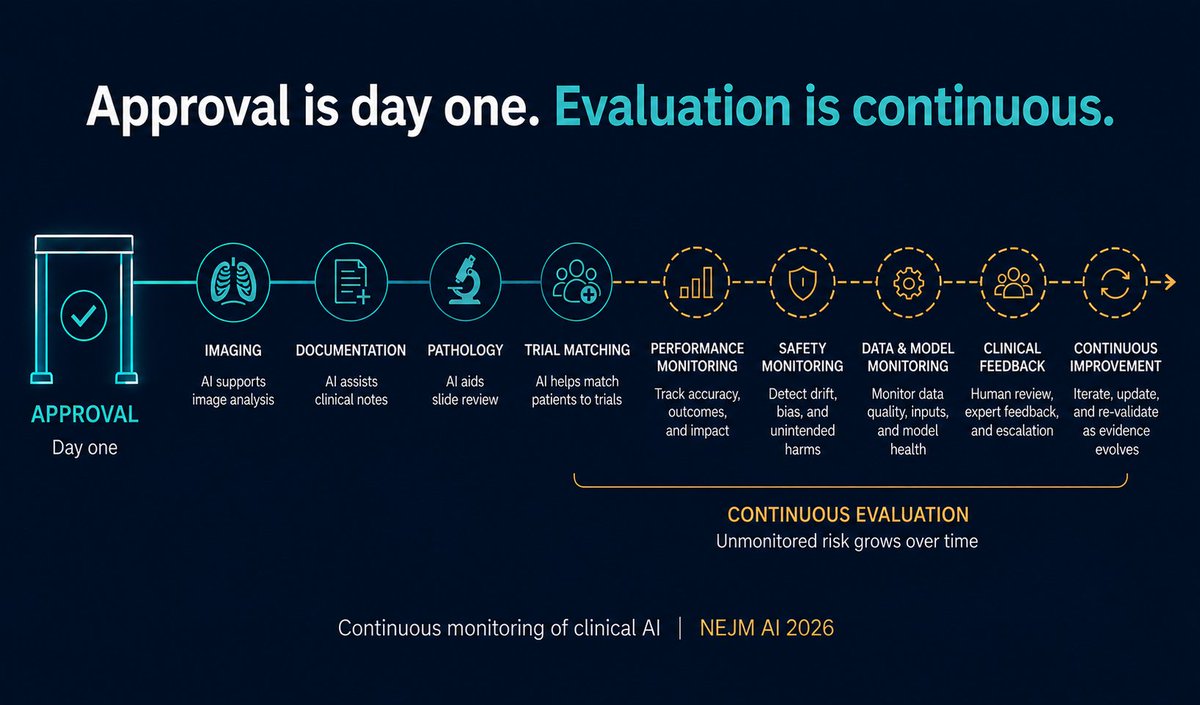
Great read from Agarwal, @kavitapmd and @RoxanaDaneshjou in NEJM AI: continuous monitoring and real-world evaluation may need different considerations for AI inside regulatory oversight. And probably someone at every practice still has to own the check.

👉bit.ly/Agarwal-Clinic… ↗

#ClinicalAI #AIinMedicine #AIoncology
Graphic headed 'Approval is day one. Evaluation is continuous.' showing a clinical AI lifecycle: approval on day one, then imaging, documentation, pathology and trial matching, followed by continuous evaluation — performance monitoring, safety monitoring, data and model monitoring, clinical feedback and continuous improvement — with the note that unmonitored risk grows over time. Credited to NEJM AI 2026.
View post on X ↗
Efficiently accessing the exact knowledge during the time frame (clinic visit) you need is often the challenge

🏥 @EvidenceOpen going into @OneOncology clinical applications across 1 mil patient visits
📊 NCCN and society guidance alongside visible trial data
🎯 Guideline concordance is a retrieval problem as much as a knowledge one

Excited for this partnership!

Disclosure: I chair the GU disease group at OneOncology and lead GU clinical research at Tennessee Oncology, a OneOncology practice and am advisor to openevidence.

#ClinicalAI #AIinMedicine #GUonc
View post on X ↗
Aaron Goodman, MD — profile photo, @Papa_Heme on X
Aaron Goodman, MD@Papa_Heme on X
Hematologist. BMT and cell therapy. Clinical Director, BMT/cell therapy, Sarah Cannon / MountainView, Las Vegas.
I was huge fan of UpToDate. My current usage has basically approached zero. They will need to rethink their strategy. It’s also very expensive.
View post on X ↗
I love when patients tell me they punched their history, blood work, pathology into AI and it agrees with exactly what I am telling them.
View post on X ↗
Estela Rodriguez, MD — profile photo, @Latinamd on X
Estela Rodriguez, MD@Latinamd on X
Thoracic medical oncologist. Associate Director, Community Outreach, Sylvester Comprehensive Cancer Center, University of Miami.
Medical school did not prepare me for the time when my 12 year old will check with an AI tool online my recommendations on how to handle constipation.

Also pretty scary that an AI tool can instruct a child with so much authority on how to “tell your mom right now that you are uncomfortable” with her medical recommendations without examining him and instruct him to go to the emergency room #DoctoringontheTimesofAI #Physicianmom
Screenshot of an AI chat assistant on a phone telling a child that taking another oral medication is highly unsafe because the enema and suppository already failed to clear the blockage, and instructing him to tell his mother right now that he is uncomfortable taking the overnight medication.
View post on X ↗
Free Access · KOL Pulse Intelligence

Track oncology’s top KOLs in your specialty

Create a free account, pick the tumor types you cover, and go beyond the tweet — the intelligence pharma teams use to map influence and prepare for engagement:

  • Enhanced KOL profiles
  • Pharma influence & potential advisory-board patterns
  • 2025 Open Payments financial analysis
  • Social-media sentiment & trend signals
Get free access — pick your specialty
Choose the tumor types you follow. No cost, unsubscribe anytime.
Antonio Giordano, MD, PhD — profile photo, @antgiorda on X
Antonio Giordano, MD, PhD@antgiorda on X
Breast medical oncologist, Dana-Farber Cancer Institute and Harvard Medical School.
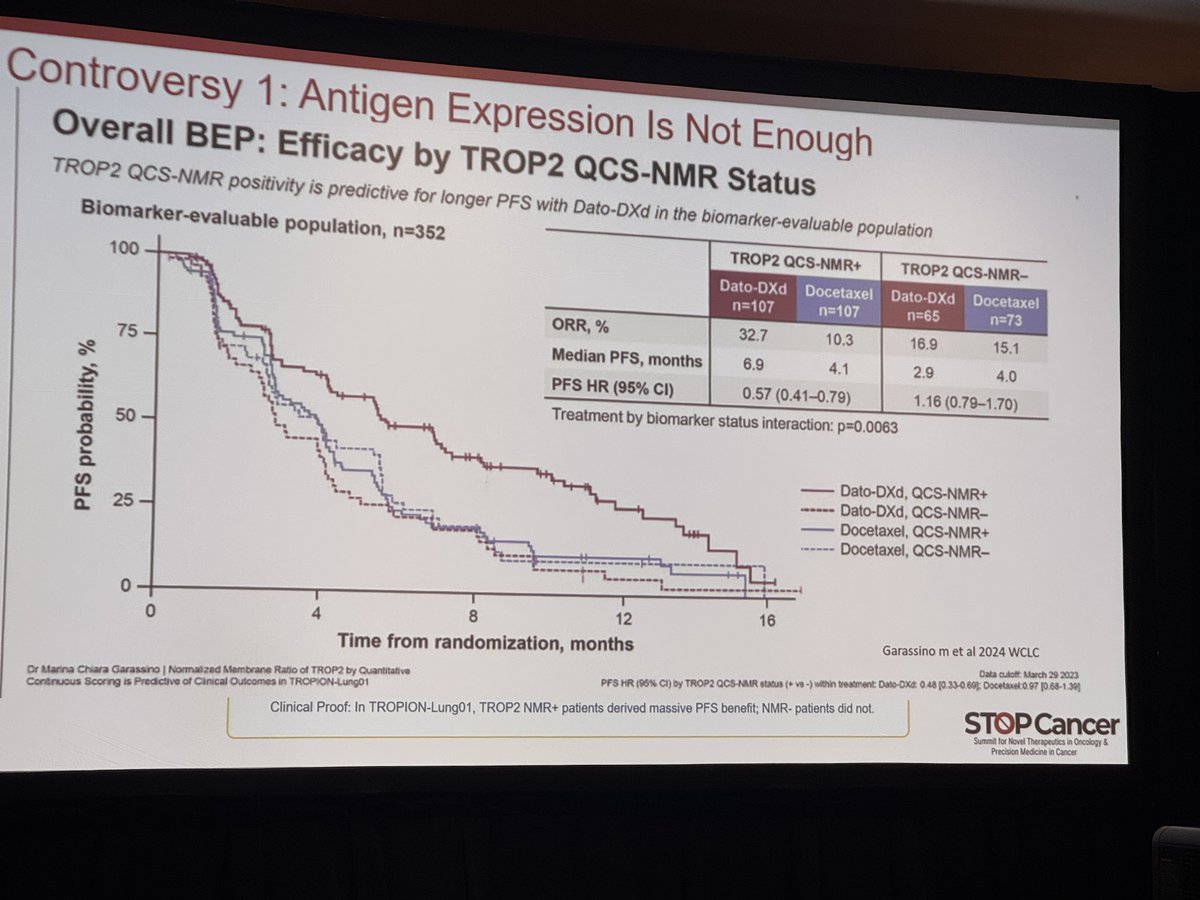
AI-enabled automated image analysis to quantitatively score how much TROP2 is membrane-bound, relative to the total TROP2. TROP2 QCS-NMR positivity is predictive of longer PFS in lung cancer. #STOP2026
Conference slide titled 'Controversy 1: Antigen Expression Is Not Enough — Overall BEP: Efficacy by TROP2 QCS-NMR Status', showing Kaplan-Meier progression-free survival curves and a results table for Dato-DXd versus docetaxel split by TROP2 QCS-NMR positive and negative status in the TROPION-Lung01 biomarker-evaluable population, n=352. Slide credits Garassino et al, WCLC 2024.
Slide credits Garassino et al, WCLC 2024. TROPION-Lung01, biomarker-evaluable population, n=352.
View post on X ↗
Andrew Pannu — profile photo, @andrewpannu on X
Andrew PannuIndustry voice@andrewpannu on X
Biotech and healthcare commentary. Founder, Sleuth Insights. Industry voice — not a clinician.
AI is being operationalized into biopharma CI / BD teams at different rates, but it's interesting observing the problems those furthest along focus on vs. those just getting started. It comes down to producing work vs. verifying it.

1. The cost to produce a credible-looking output is collapsing
2. So we see an explosion of knowledge work output
3. But there's always a system bottleneck, and now it's
(a) validating these outputs
(b) deciding what actually matters for the question at hand
(c) taking ownership

This is clearly a problem with knowledge work broadly, but Pharma CI is an interesting extreme case:

• The work is full of classifications that require domain expertise / judgement
• There's rarely a clean "ground truth" to benchmark against
• Sources are scattered, incomplete and frequently contradictory
• The feedback loop on whether you're right can be years long. A persuasive output (AI is great at this) and the correct output can look pretty indistinguishable for a long time.

The old days of taking days / weeks to aggregate data & draft an analysis isn't coming back, but it's clear now that one hidden function was that time spent building the output was in itself a verification layer. The analyst had to engage directly with the messy, raw data, make many inclusion decisions and ultimately understand how the answer came together. As a byproduct, they also got training on how to do the task better.

This process didn't mean the answer was correct or the output was high quality, but it did create a chain of custody. AI inverts this by separating the final output from the context required to defend it:

• Your agent returns 50 assets for a landscape. How do you know that was comprehensive?
• Your team fixes many edge cases. How do those judgements get inherited by the next 100 analyses across teams, rather than trapped in one chat?

The last mile to bridge output --> decision is everything now. Intelligence ≠ auditability.

To be clear, the answer is not to return to 100% manual research or require experts to check every AI-generated cell, essentially duplicating the work. It's to build systems that make verification scalable:

• Construct a tailored dataset for every decision
• Preserve the evidence trail behind every claim and classification
• Surface conflicts, uncertainty and material exceptions for expert review
• Capture the expert’s corrections and reasoning so they improve future work
• Keep the analysis current as new evidence changes the market

The model is an important part of that system. But the model alone is not the system.
Sleuth Insights diagram contrasting 'before AI', where humans collect, structure, analyze, verify and interpret and the bottleneck is producing the work over weeks, with 'after AI', where AI retrieval and a first pass take minutes and the new bottleneck is scoping, triaging, verifying and interpreting — labelled 'the part that often never happens' — and standing behind the output, still weeks.
View post on X ↗
Jame Abraham, MD, FACP — profile photo, @jamecancerdoc on X
Jame Abraham, MD, FACP@jamecancerdoc on X
Professor and Enterprise Chair, Department of Hematology and Medical Oncology, Cleveland Clinic. Deputy Editor, The ASCO Post and JCO Oncology Practice.
We are hosting the second @ClevelandClinic Artificial Intelligence Healthcare Conference for all Healthcare team members - from Medical Students to Executives - August 28th @ClevelandClinic. Please see the all star speakers list from @Google to @Stanford ccfcme.org/AISummit ↗
Flyer for Cleveland Clinic's 2nd annual A.I. Summit for Healthcare Professionals, August 28, 2026, InterContinental Hotel, Cleveland, Ohio and via live stream, listing featured speakers including Jonathan H. Chen of Stanford University, Pete Clardy of Google Health, Benjamin Kann of Harvard Medical School and Travis Zack of OpenEvidence.
Second page of the Cleveland Clinic A.I. Summit flyer showing the CEO Roundtable line-up, including Cleveland Clinic CEO Tomislav Mihaljevic, and the Cleveland Clinic activity directors led by Jame Abraham, Chair of Hematology and Medical Oncology.
View post on X ↗
Compiled and reviewed by the KOL Pulse research team, led by Brian Shields, Founder, KOL Pulse. Quotes are verbatim from physicians’ public posts on X. Last updated August 10, 2026.