LIVE #WCLC26 — live KOL coverage of the World Conference on Lung Cancer View Full Coverage →
KOL Pulse

AI in Oncology — KOL Digest

KOL DigestTuesday, August 25, 2026 All editions →

AI-read TILs, 'Peer-Unreviewed' in Annals, 66% physician adoption - and residents beating radiology AI

In this edition: Mali Barbi, MD asks whether AI-read TILs are the next PD-L1 · Ilana Schlam, MD shares AI TIL data from NSABP B-41 · Samer Al Hadidi, MD publishes 'Peer-Unreviewed' in Annals of Internal Medicine and Eric Topol, MD highlights it · Karun Neupane, MD on omission errors in AI summaries · Sawyer Bawek, DO on Doximity's 66% physician AI adoption · Laura Heacock, MD on residents outperforming radiology AI · Allan Pereira, MD, PhD on the LiON prospective AI reader in Nature Medicine · Hidehito Horinouchi, MD and Fabio Moraes, MD preview AI at WCLC26 · Zeke Emanuel, MD on AI's improvement curve · Anish Koka, MD debates the Khosla thesis · Andrew Portuguese, MD builds with local AI · Arturo Loaiza-Bonilla, MD on Amara's law and the AI Oncology Revolution podcast · Shiv Rao, MD on Abridge's thesis · Yair Einhorn on AI's limits in biotech R&D · Bo Wang on the AI-designed individualized vaccine trial · VJHemOnc on an ML six-gene myeloma signature

AI-read TILs'Peer-Unreviewed' (Annals)66% adoption (Doximity)Residents vs radiology AIWCLC26 AI previewProspective AI trials
Mali Barbi, MD MSc | Breast & Gyn Oncologist — profile photo, @DrBarbiOnc on X
Mali Barbi, MD MSc | Breast & Gyn Oncologist@DrBarbiOnc on X
Breast & gynecologic oncologist, Northwell Health Cancer Institute.
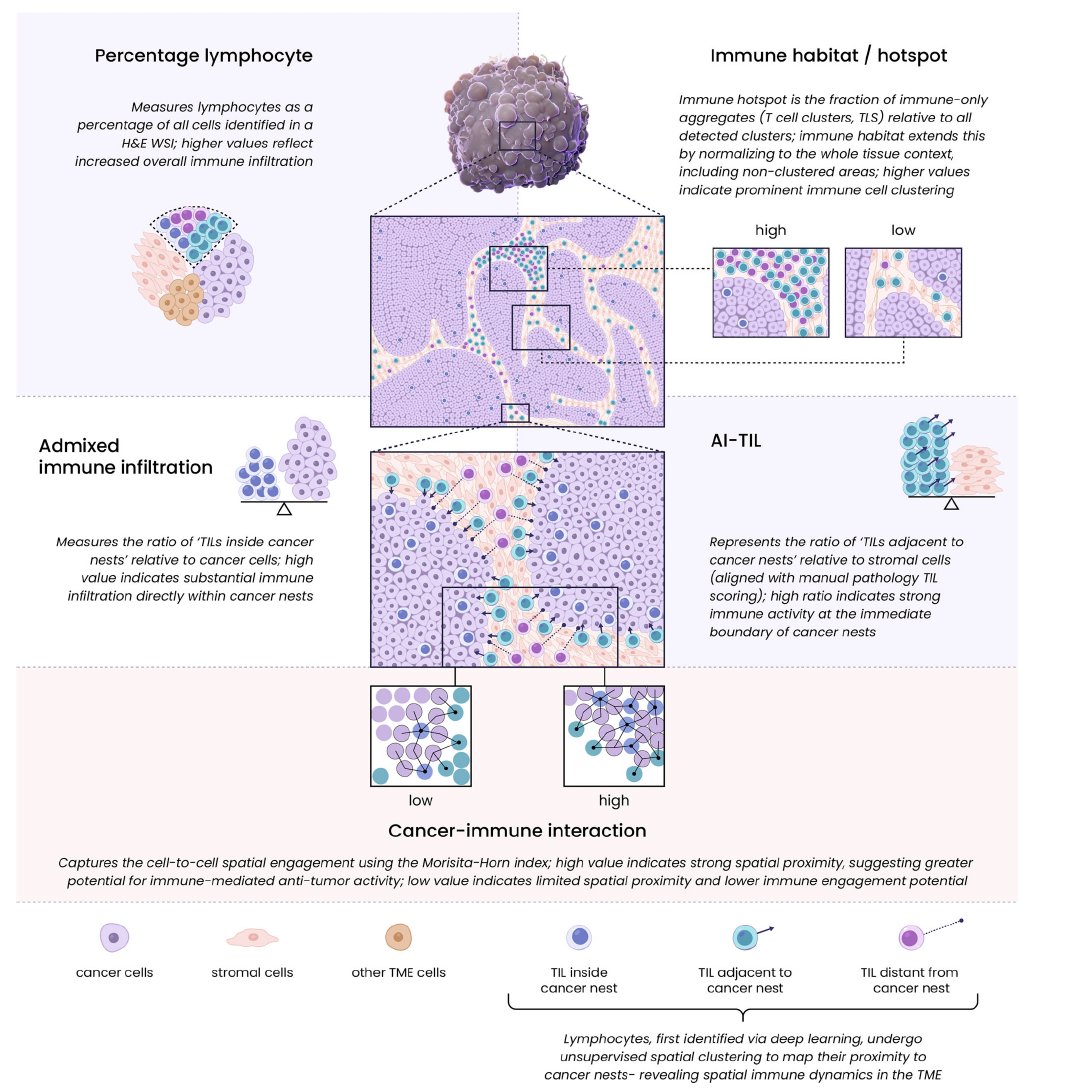
#TILs keep coming up. Every immuno talk, every biomarker slide. And the question underneath it is worth saying out loud: is this the next PD-L1? A marker we all cite, nobody standardizes the same way, that describes the tumor more than it changes what we do.
Two papers this month tested it. #CATALINA in TNBC, the #APHINITY analysis in HER2+. Same answer on counting: TILs are prognostic, but AI counting them faster adds nothing a pathologist and standard clinicopath don't already give you. Thermometer, not target...Sounds like density added nothing! The only thing that held up was how the lymphocytes were arranged (SPATIAL), not number. And that came from a secondary analysis, so it's a hint, not an answer.
For now TILs look a lot like PD-L1. Real signal, thin mechanism, mostly describing the tumor back to us. Whether spatial biology changes that is the actual question. The field is developing and I am here to post this out. #bcsm #MedOnc

Artificial intelligence-based tumour infiltrating lymphocyte quantification in patients with triple-negative breast cancer: an independent validation study - The Lancet Oncology thelancet.com/journals/lanon… ↗

thelancet.com/journals/lanon… ↗
View post on X ↗
Ilana Schlam — profile photo, @IlanaSchlam on X
Ilana Schlam@IlanaSchlam on X
Breast oncologist; first author of the NSABP B-41 AI-TILs analysis discussed in this edition.
Excited to share our new paper on AI and manual TILs in early HER2-positive breast cancer (NSABP B-41). AI-based TIL assessment was associated with pCR across ER subtypes and may complement manual TIL scoring

nature.com/articles/s4152… ↗

@khalidated @SandraSwainMD @DFCI_BreastOnc
View post on X ↗
Samer Al Hadidi, MD,MS,FACP — profile photo, @HadidiSamer on X
Samer Al Hadidi, MD,MS,FACP@HadidiSamer on X
Myeloma specialist, UT Southwestern; author of 'Peer-Unreviewed' in Annals of Internal Medicine.
Peer-Unreviewed: When the Thread Replaces the Paper | Annals of Internal Medicine @AnnalsofIM @utswcancer @HadidiSamer

The rise of social media and artificial intelligence (AI) has enabled the emergence of a real-time venue where research is shared, guidelines are debated, and clinical opinion is shaped.

This commentary discusses the potential negative effects of AI-assisted knowledge dissemination on clinical decisions and trainee behavior and steps that physicians and medical social media consumers can take to successfully navigate the landscape.

➡️ acpjournals.org/doi/10.7326/AN… ↗
View post on X ↗
Free Access · KOL Pulse Intelligence

Track oncology’s top KOLs in your specialty

Create a free account, pick the tumor types you cover, and go beyond the tweet — the intelligence pharma teams use to map influence and prepare for engagement:

  • Enhanced KOL profiles
  • Pharma influence & potential advisory-board patterns
  • 2025 Open Payments financial analysis
  • Social-media sentiment & trend signals
Get free access — pick your specialty
Choose the tumor types you follow. No cost, unsubscribe anytime.
Eric Topol — profile photo, @EricTopol on X
Eric Topol@EricTopol on X
Physician-scientist, Scripps Research; author of Super Agers and Ground Truths.
"Peer-Unreviewed"
The problem with some threads on #MedX and social media @AnnalsofIM by @HadidiSamer
acpjournals.org/doi/10.7326/AN… ↗
View post on X ↗
Karun Neupane, MD — profile photo, @KarunNeupaneMD on X
Karun Neupane, MD@KarunNeupaneMD on X
Chief hematology/oncology fellow, Moffitt Cancer Center.
While hallucinations are definitely a problem, omission is an equally/bigger & more common issue. A highly relevant fact omitted in AI "summary" can be as bad as hallucinations. We have been able to minimize/remove hallucinations (w/ RAG, fine tuning..)omission remains a problem x.com/HadidiSamer/st… ↗
View post on X ↗
Sawyer Bawek, DO — profile photo, @sawyer_bawek on X
Sawyer Bawek, DO@sawyer_bawek on X
Hematology/oncology fellow, Cleveland Clinic; Doximity AI Fellow.
💡New @doximity 2026 Physician Compensation Report just Dropped

👉66% of physicians now use #AI daily or weekly in clinical or admin work.

⭐️Breakdown by age:
• 73% of docs in their 30s
• 66% in their 40s
• 59% in their 50s
• 52% in their 60s

#OncTwitter #MedTwitter #MedX
View post on X ↗
Laura Heacock, MD — profile photo, @heacockmd on X
Laura Heacock, MD@heacockmd on X
Breast radiologist and deep-learning researcher, NYU Langone.
Soon, radiology residents will replace radiology AI models.

Pedrini et al (2026) looked at 3 months' worth of CT scans (2,153) interpreted by an on-call resident. 15.4% of them had intracranial hemorrhage (ICH).

The residents had a sensitivity of 96.4% and specificity of 99.6%. The same studies were given to directly to a commercial AI software, which generated heatmaps. The results and heatmaps were separately evaluated as part of the research protocol (aka not available at interpretation time) with sensitivity of 84% and specificity of 94.4%. Performance by AI improved with multiple hemorrhagic types or sites, but did not outperform the resident.

Of 12 FN reports by residents, 6 would have been caught by the model; the attending that overread the preliminary report obviously found all 12.

AI mislabeled 101 cases as FP for ICH. If these were autonomously read, this would have likely led to increased length of stay, follow-up imaging, or inappropriate treatment changes, including discontinuation or non-administration of thrombolytic therapy in patients with ischemia.

The study authors note that the AI FP "typically would not cause confusion with ICH for radiologists interpreting CT scans, as they are easily recognized as various hyperdense intracranial abnormalities not related to ICH."

Take-home points: 1) Clinical deployment studies are increasingly important for medical AI. The commercial model used here was good and well-validated. 2) Perhaps you should hire a Swiss radiology resident to read all your ICH cases, they seem pretty good.

link.springer.com/article/10.100… ↗
View post on X ↗
Allan Pereira, MD, PhD — profile photo, @DrAllanPereira on X
Allan Pereira, MD, PhD@DrAllanPereira on X
GI medical oncologist and researcher, Moffitt Cancer Center.
🔬 #2 - LiON: an AI reader that actually got a prospective trial
Nature Medicine · multicentre (China, France, UK) · NCT07153783

LiON is a contrast-enhanced-CT-based AI system for liver malignancy diagnosis

👥 Trained on 6,443 patients, validated across 22,251
📈 Retrospective validation AUC 0.975 (95% CI 0.971–0.979)

📊 Prospective single-arm trial, n=10,333, AI as an added reader in routine practice: AUC 0.952 (0.942–0.961), meeting its primary endpoint
📍 MAIN FINDING: Flagged 51 previously overlooked lesions - 15 of them malignant
🔁 Triggered 37 amended reports and 22 MDT escalations

The prospective component is what distinguishes it from the usual retrospective AI paper.

⚠️ The design limit is explicit: single-arm, with no randomized comparison against unaided radiologists, so the counterfactual detection rate is unknown.

#GIOnc #HCC #AI
doi.org/10.1038/s41591… ↗
View post on X ↗
Hidehito HORINOUCHI — profile photo, @HHorinouchi on X
Hidehito HORINOUCHI@HHorinouchi on X
Thoracic oncologist, National Cancer Center Hospital Japan.
🆙#WCLC26 #LCSM Oral Session
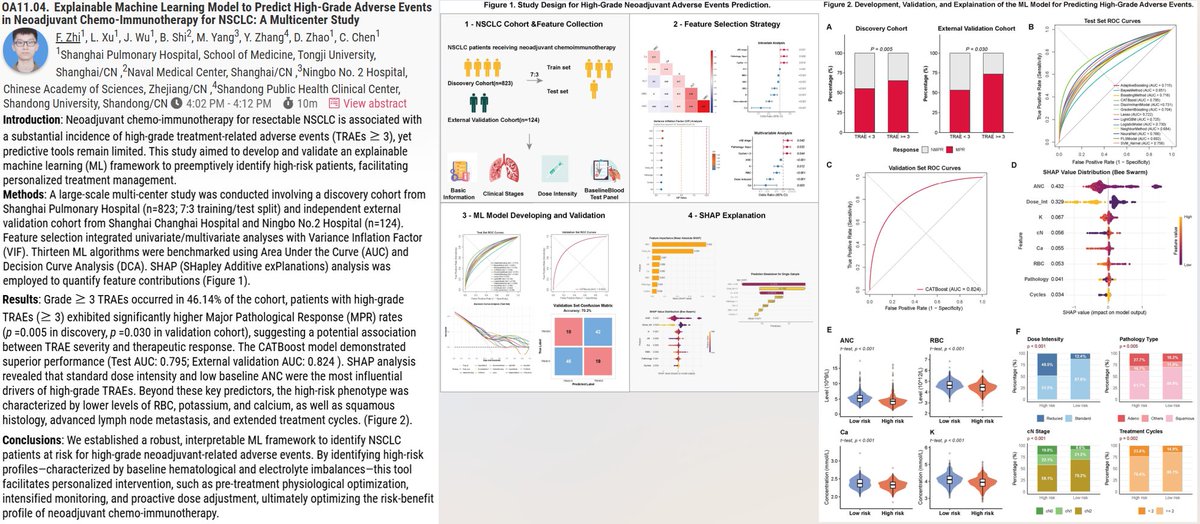
🔥Explainable Machine Learning Model to Predict High-Grade Adverse Events in Neoadjuvant Chemo-Immunotherapy for NSCLC: A Multicenter Study
🎙️Dr. F. Zhi
🔢OA11.04
🎯CATBoost Model Predicted Grade≥3 TRAEs (Test AUC 0.795, External Validation AUC 0.824)
🎯Low Baseline ANC and Standard Dose Intensity Key Drivers
🔗 cattendee.abstractsonline.com/meeting/21487/… ↗
@OncoAlert @Larvol @IASLC
WCLC26 abstract OA11.04 (Zhi et al., Shanghai Pulmonary Hospital): explainable machine learning model (CATBoost with SHAP) predicting Grade >=3 treatment-related adverse events in neoadjuvant chemo-immunotherapy for resectable NSCLC - test AUC 0.795, external validation AUC 0.824; Grade >=3 TRAEs in 46.1% of cohort
View post on X ↗
Dr. Fabio Moraes — profile photo, @fabiomoraesmd on X
Dr. Fabio Moraes@fabiomoraesmd on X
Radiation oncologist; WCLC26 plenary speaker on AI for clinical decision-making.
3 weeks to the #wclc26 @IASLC
I’m preparing a plenary talk on AI for Clinical Decision-Making — a #RadOnc perspective.

I want to make it practical, not another generic AI talk.

See the comments.

@DrAlexLouie @StephenVLiu @GlopesMd @DrewMoghanaki @oncology_bg @drdavidpalma
Fabio Moraes selfie graphic: 'WCLC 2026 in 3 weeks' with his AI framework - prompting asks AI for an answer, grounding connects it to evidence, verification tests trustworthiness, clinical judgment determines whether it applies to the patient
View post on X ↗
Zeke Emanuel — profile photo, @ZekeEmanuel on X
Zeke Emanuel@ZekeEmanuel on X
Oncologist and bioethicist, University of Pennsylvania.
AI is going to get better and better. When it comes into a field, it’s clunky, then improves, briefly loses to human-AI hybrids, then surpasses them. Medicine is next.

I laid that all out in my recent @JAMA_current paper with @vkhosla, @nealkhosla, and @AbeBakerButler.

My most serious worry: if we keep denying that AI can be autonomous, we're going to overlook how we make sure doctors don't become de-skilled.

Many disagree with me. That's why I debated @AmerMedicalAssn CEO @drjohnwhyte on the Lifers podcast hosted by @chrissyfarr.

We discussed his concerns about the studies I referenced, ethics of AI in medicine, and more. But I stand by my claim: AI and AI-physician hybrid will outperform physicians in core medical tasks.
View post on X ↗
Anish Koka, MD — profile photo, @anish_koka on X
Anish Koka, MD@anish_koka on X
Cardiologist.
Discussing current events with @DrDiGiorgio -- Will AI replace medical doctors as the Khosla's predict ? x.com/DRsLoungePod/s… ↗
View post on X ↗
Andrew Portuguese, MD — profile photo, @AJPortuguese on X
Andrew Portuguese, MD@AJPortuguese on X
Myeloma specialist, Fred Hutch / UW Medicine.
Local AI is getting GOOD! I built most of Marrow Defense in OpenCode with Qwen3.8 27B locally, then polished it in Codex with GPT-5.6-sol.

The best (and only?) CAR-T tower defense game. Vaguely educational. 🧬🎮

aportugu.github.io/marrow-defense/ ↗
#MultipleMyeloma #Myeloma #CARTCellTherapy
View post on X ↗
Arturo LoAIza-Bonilla, MD MSEd — profile photo, @DrArturoAI on X
Arturo LoAIza-Bonilla, MD MSEd@DrArturoAI on X
Hematologist-oncologist, St. Luke's; host of the AI Oncology Revolution podcast.
This is Amara’s law in full display: AI progress in healthcare is currently overestimated short-term but will deliver outsized long-term impact. This debate is necessary yet the writing is on the wall. @chrissyfarr x.com/chrissyfarr/st… ↗
View post on X ↗
It was my pleasure having a conversation with @DrMatasar linking applications of AI in hematological malignancies and beyond at @RutgersCancer - even better from a galaxy far, far away 🌌 ✨ x.com/cancernetwrk/s… ↗
CancerNetwork studio still: Arturo Loaiza-Bonilla interviewing Matthew Matasar of Rutgers Cancer Institute for the AI Oncology Revolution podcast
View post on X ↗
Shiv Rao, MD — profile photo, @ShivdevRao on X
Shiv Rao, MD@ShivdevRao on X
Cardiologist and CEO of Abridge. Physician-founder - commercial interest in ambient AI.
Our thesis at @AbridgeHQ has always been simple: the best technology in healthcare should help the technology disappear.

This is our opportunity to use AI to actually rethink and redesign the system.

Learn more here: abridge.com/vision?utm_sou… ↗ pic.x.com/nSOrsPhtdK ↗
View post on X ↗
Yair Einhorn — profile photo, @yaireinhorn on X
Yair EinhornIndustry voice@yaireinhorn on X
Biotech and pharma commentator. Not a clinician.
To those who wrongly believe that AI is about to obsolete the need for human intelligence in BioTech R&D I strongly advise to listen carefully to Prof. Jennifer Doudna - the co-inventor of CRISPR Cas9 Gene Editing, a Nobel Prize winner and the co-founder of $NTLA, $SCTX and $CRBU. Anthropic’s recent announcement that Claude had successfully designed novel protein binders from scratch and made a “de novo” design for 14 out of 15 chosen proteins is indeed a huge milestone. Having said that I absolutely agree with Prof. Doudna that it is important to remember that although AI is a powerful tool - it is still a tool, while true innovation and groundbreaking ideas only come from real life scientists. There is no substitute for human creativity and innovation!
View post on X ↗
Bo Wang — profile photo, @BoWang87 on X
Bo WangAI researcher@BoWang87 on X
Professor, University of Toronto; Chief AI Scientist, Xaira Therapeutics. Not a clinician.
Moderna/Merck just ran a 1,137-patient Phase 3 trial where every single dose was unique to that patient's tumor. It worked.

The pipeline: surgical resection → whole exome + RNA sequencing → ML neoantigen ranking → mRNA encoding up to 34 patient-specific targets → manufactured and shipped in 8 weeks. One drug, different sequence for every patient.

The ML step is worth to note: the algorithm ingests WES + RNA-seq to identify somatic mutations, then predicts which of those will actually be immunogenic, ie, displayed on tumor cell surface and trigger a T-cell response. It's designed to keep learning from accumulated clinical and immunogenicity data across patients, not just per-patient.

INTerpath-001 (Stage IIB-IV resected melanoma, 2:1 randomized): combination with pembrolizumab beat Keytruda alone on both primary (RFS) and key secondary (DMFS) at interim. Phase 2b at ASCO 2026 showed 49% reduction in recurrence/death, 59% in distant metastasis/death at 5 years. Phase 3 confirmed both.

What this validates:
— tumor-specific neoantigen prediction by ML works in a blinded trial at scale
— 8-week personalized mRNA manufacturing is operationally real
— effect is additive on PD-1 blockade, not redundant

This is first positive Ph3 for individualized neoantigen therapy. First positive Ph3 for any mRNA cancer therapeutic.

What a great time to live in!! This is the best time for AI & biotech!
View post on X ↗
VJHemOnc — profile photo, @VJHemOnc on X
VJHemOncPublication@VJHemOnc on X
Video Journal of Hematology & Hematological Oncology.
How could a machine learning-based six-gene signature help improve risk stratification in #MultipleMyeloma? 🧬

Click here to gain insight into this approach from Shahzad Raza of @ClevelandClinic:

🎥 ow.ly/heFl50ZzNZG ↗

#MMsm #Myeloma #HemOnc #ASCO26
View post on X ↗
Compiled and reviewed by the KOL Pulse research team, led by Brian Shields, Founder, KOL Pulse. Quotes are verbatim from their authors’ public posts on X. Last updated August 25, 2026.