Key expert feedback from the 17th Annual International Myeloma Working Group Summit (Stockholm, June 8–10, 2026) — 150+ global leaders debating consensus, not trial readouts. Organized into 7 topics from 24 voices and 93.3K impressions.


#mmsm #IMWG26 A glimpse on the future centred about cure in myeloma with limited duration therapy https://t.co/57ZCBrlLgl

#mmsm #IMWG26 Outcomes with standard quadruplets in myeloma Goal is to move for fixed duration therapy to achieve cure for more myeloma patients https://t.co/omg0D1Le6e

#mmsm #IMWG26 #IMFIMWG26 A great first day with exciting future for myeloma field and patients ➡️ Cure is no longer aspirational: it is the cornerstone of future drug development. Time limited therapy is the direction, moving away from indefinite treatment paradigms toward https://t.co/oTgdHiIRMH

@AjayNookaMD giving a great shout out to @theMMRF and the Horizon trial to limit exposure /duration of therapy for bispecific antibodies in myeloma. @IMFmyeloma #mmsm https://t.co/CneWxJysAE

#mmsm #IMWG26 One important discussion point brought by @VincentRK was to be careful about the assumption that PERSEUS study PFS will be 17 yrs While outcomes are great with quad based therapies in transplant eligible patients, such modeling need to be taken with grain of https://t.co/rDU7ccRV88

#mmsm #IMWG26 3️⃣Why overestimation happens? ➡️The "best fit" model chosen was exponential, which assumes the risk of progression never changes over time 🛑That's not how myeloma progression occurs. Hazard increases over time. Patients who are still in remission at year 5 are https://t.co/byyvAoAQx3
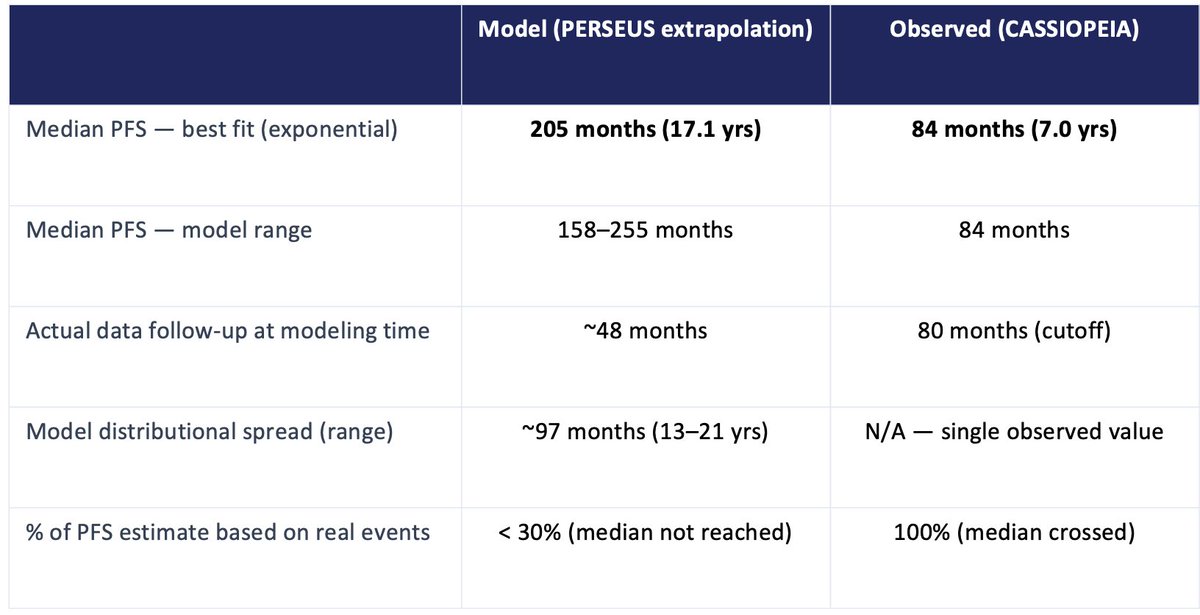
#mmsm #IMWG26 1️⃣The models are working almost entirely on extrapolation ➡️At ~4 years follow-up, median PFS hasn't even been reached yet in the Dara-VRd arm. That means the "17 years" figure is based on zero observed median events (it's pure mathematical projection) ➡️7 models https://t.co/6YnEIYxFwP
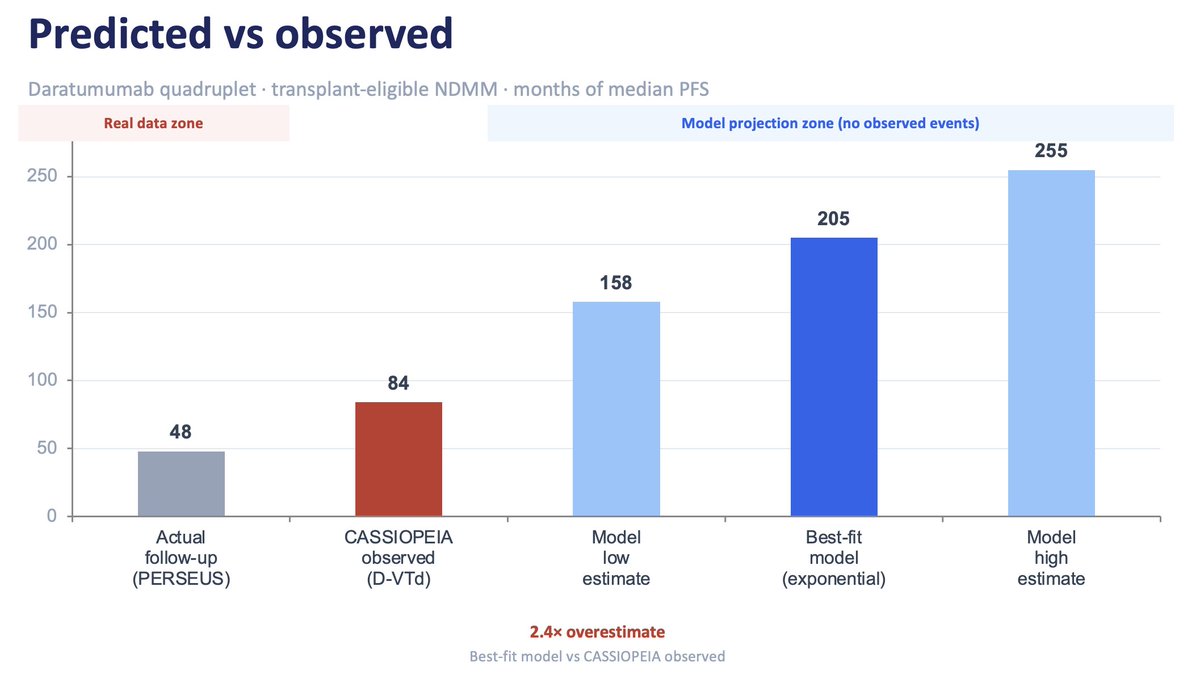
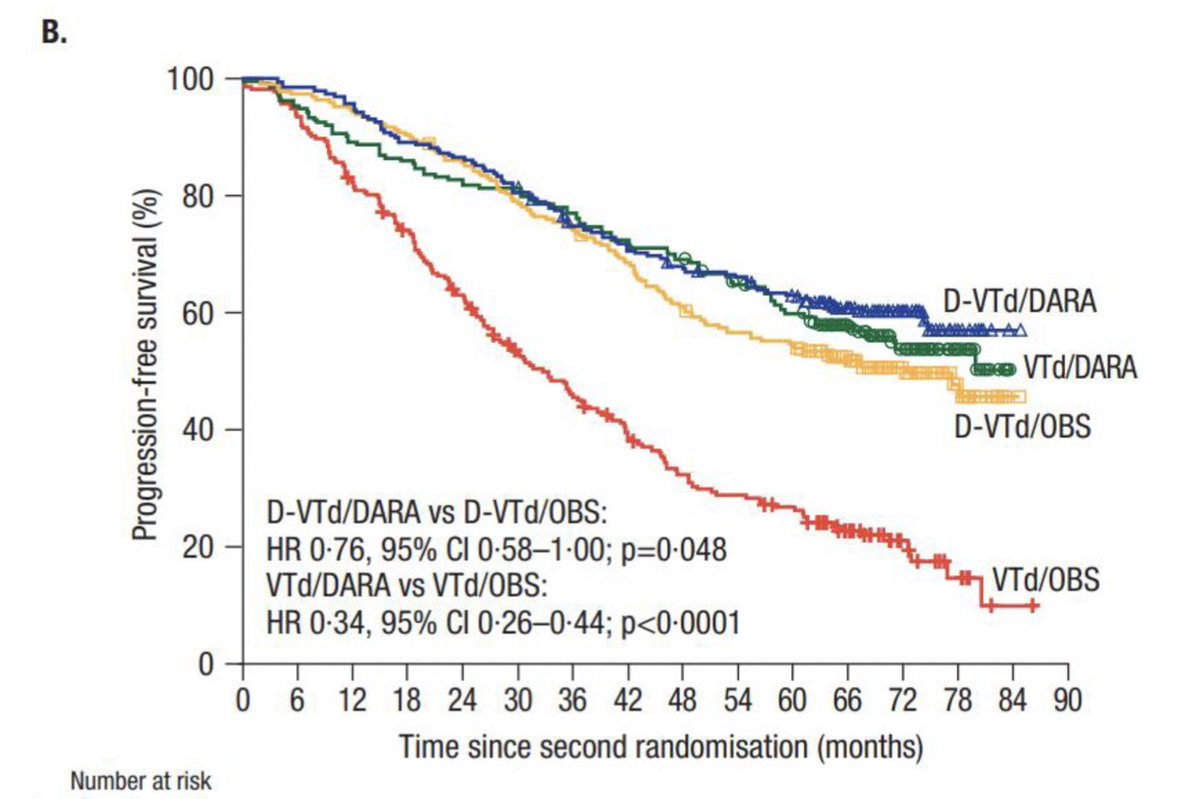
#mmsm #IMWG26 2️⃣CASSIOPEIA study (will have longer follow up soon) ➡️ ~7 years follow-up, the actual observed median PFS with Dara-VTd: 84 months (~7 years) ➡️That's maybe a 2.4× overestimate, Dara-VRd is arguably better than Dara-VTd and the duration/maintenance were https://t.co/q75QT2s4cJ
#mmsm #IMWG26 Nice presentation @SurbhiSidanaMD on infections with BsAb and CAR-T in myeloma https://t.co/Ei4H4YCX9d


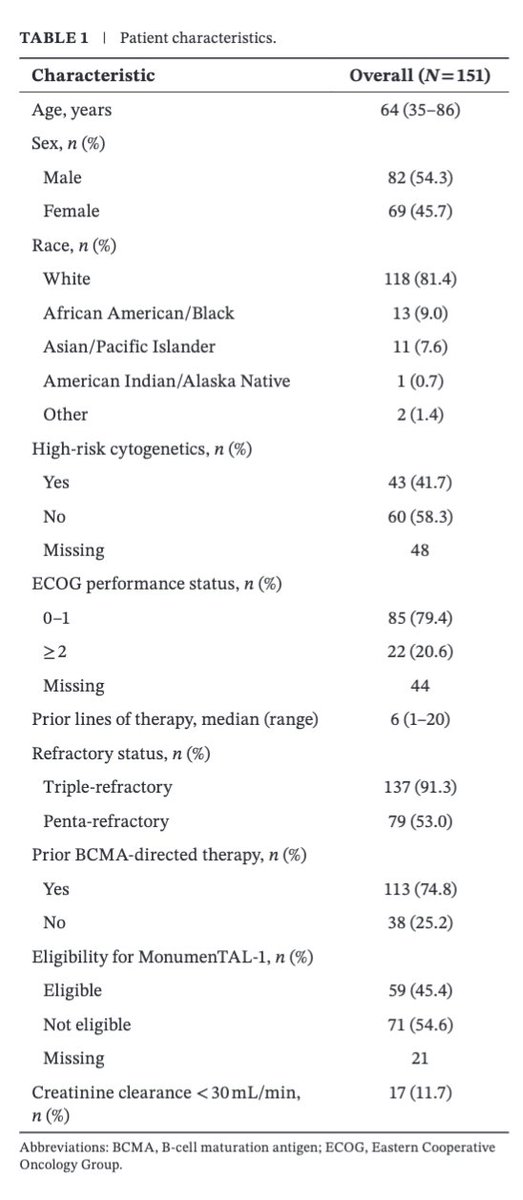
#Myeloma Paper of the Day: IMWG real-world analysis of talquetamab for RRMM finds skin tox 39.7%, nail 75.5%, dysgeusia 60.4%, oral tox 62.9%; platelets <50 (HR 1.8, 95% CI 1.15-2.83) assoc w/ inferior PFS; ORR 67.6%, PFS 7 months, 12-month OS 65%: https://t.co/INmK83hKoD. #mmsm https://t.co/EpWvUDGKgu


Check out: Six Years Since Selinexor Approval for Relapsed Multiple Myeloma: What Have We Learned? #mmsm @rajshekharucms "Selinexor’s approval may have represented hope for patients with limited options in 2019–2020. However, the oncology community must acknowledge when drugs https://t.co/C6wp1owJPj

Room full at our IMWG immunotherapy meeting, thank you everyone for the great discussions #IMWG2026 with @TomBmt133 @YiLinMDPhD https://t.co/2TxyLfGYhH

#IMWG26 inaugural Brian Durie Awardee @NoopurRajeMD speak on critical question #CART or #BsAb T cell engagers in 1st relapse #mmsm @IMFmyeloma @VincentRK https://t.co/EffChf4nJr

CAR-T is not dead! Bispecifics & CAR-T are highly effective. CAR-T allows pts to hv Tx free time while pts are on continuous Rx w/ bites. Both require supportive care for infxn prevention. And yes, rare toxicities are there w: ciltaacel that we need to study & find answers. https://t.co/0rfz2UZznL
🔹 Is There Still a Place for Mezigdomide in the Modern Myeloma Treatment Landscape? Let’s see what data we have before we jump to conclusions? 🧵 ASCO 2026 | SUCCESSOR-2: Mezigdomide + Kd : 1/🔬 let’s start with the study Design (very Critical) SUCCESSOR-2 randomized RRMM https://t.co/fuF6cXsdc6

Some of the most provocative q in IMWG- #IMWG26 - Do BsAb cause T cell exhaustion @NBahlis -What needs to be done more than IVIG replacement to prevent infections in BsAb- @SagarLonialMD -IEC colitis -@YiLinMDPhD @LMikkMD - Benchmarks for subsequent T cell or non T cell based
#Myeloma Paper of the Day: Need for early transfusion after CAR T indicates high inflammation and severe acute toxicity, whereas the need for late transfusion is associated with poor remission, higher non-relapse mortality, and shorter survival: https://t.co/ddtJaJyHNs. #mmsm https://t.co/PMRdgPqk9B
Navigating CAR T-Cell Therapy Use as a “Team Sport” in Multiple Myeloma by @szusmani from 2026 National ICE-T (Immune Cell Effector Therapy) Conference in Charlotte, North #mmsm #myeloma #MedEd #medtwitter #USMIRC @Larvol @USMIRCNEWS @US_HMC @MSKCancerCenter @MedwatchKate
CAR-T reaching myeloma we usually can't treat: cesni-cel (ARI0002h) in plasma cell leukemia and CNS MM. ORR 88%, 80% complete CNS response, median PFS 10.5 mo. Deep responses for patients have long been left out of trials. More work is needed. #mmsm #myeloma #MedTwitter #MedEd
#mmsm #IMWG26 Belantamab without the mafodotin maybe a new strategy as a naked BCMA antibody with better safety signal https://t.co/M1mhWUo5fX

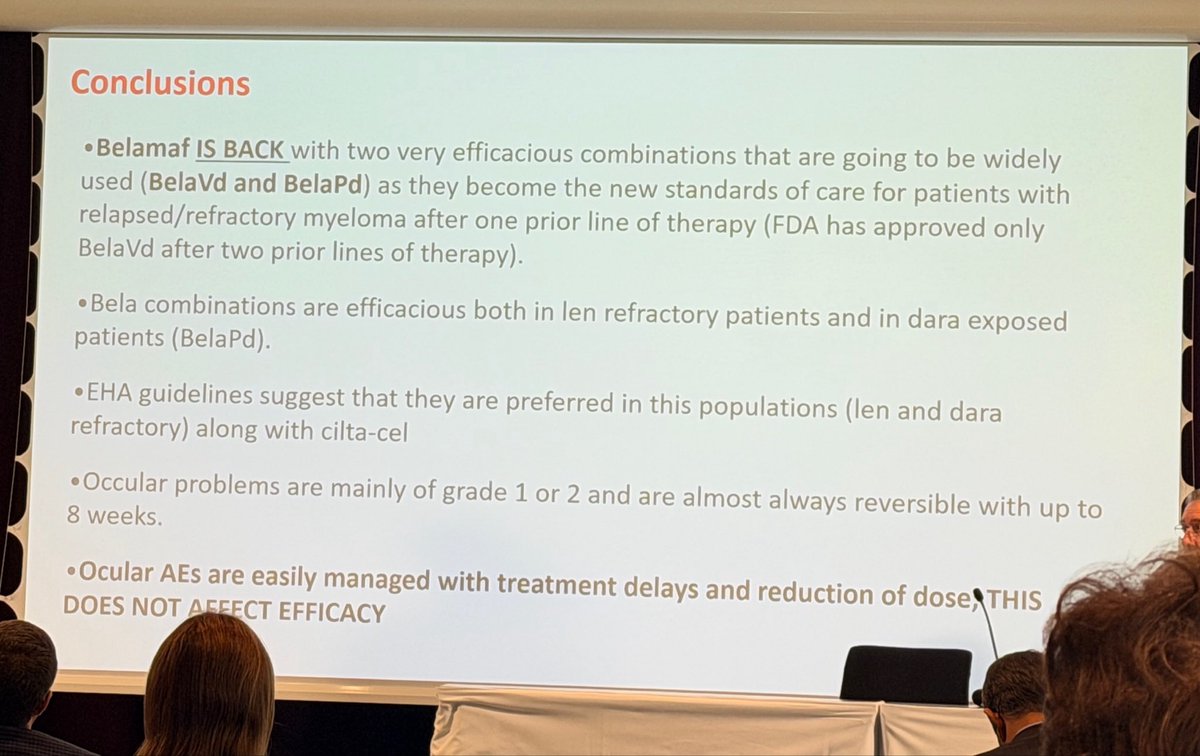
Engaging discussion regarding the utilization of belamaf - balance between accessibility, tolerability due to ocular AEs. Prof Einsele - ocular toxicities may become less of an issue due to adaptation of lower doses with less frequent dosing intervals. #IMWG26 #mmsm https://t.co/hnsrVuXT27

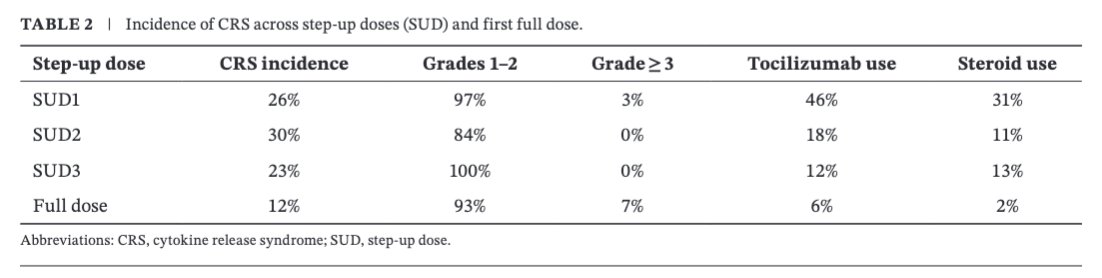
Pictures worth 1000 words - excellent 🇩🇰 #MMsm work in @AjHematology! ABCD study of prophylactic toci and analysis of primary IVIG PPx with BCMA bsAbs in myeloma. Answer clear as day: both PPx toci and PPx IVIG are essential safety interventions 💪🏻 We need to work on ⬇️ cost! https://t.co/4BQtHaaGSi
#Myeloma Paper of the Day: Symptomatic progression portends poor outcome in primary plasma cell leukemia (median TTNT after 1st-line therapy was 10 months) patients w/ anti-BCL-2 therapy in t(11;14) & BCMA CAR T-cell providing more durable control: https://t.co/bIWa8wFnR8. #mmsm https://t.co/yL1Ao7fjkw
2️⃣ 🚀 BCMA CAR-T outperformed BCMA bispecifics after prior BCMA exposure. ✅ ORR: 79% vs 51% ✅ Median OS: 30 vs 12 months 👉 When feasible, CAR-T appears to provide the deepest and most durable responses. #mmsm #myeloma #MedEd #Medtwitter #USMIRC @oncodaily @USMIRCNEWS https://t.co/YuaUiGndsl
3️⃣ 📉 Teclistamab after prior BCMA exposure demonstrated reduced efficacy. Compared with BCMA-naïve patients: 🔸 ORR: 53% vs 68% 🔸 Median PFS: 2.5 vs 9.7 months ➡️ Prior BCMA exposure clearly impacts subsequent outcomes. #mmsm #myeloma #MedEd #Medtwitter #USMIRC @oncodaily https://t.co/FFvFx3xcQk
9/ The future role of MeziKd needs to be defined in: 🔹 Triple-class refractory disease 🔹 Post-CAR-T relapse 🔹 Post-BCMA refractory disease 🔹 Post-GPRC5D refractory disease As BCMA- and GPRC5D-directed therapies move earlier in treatment, demonstrating efficacy in these
5️⃣ 🎯 Antigen switching works. Talquetamab maintained meaningful activity after BCMA failure: ✅ ORR: 68% ✅ ≥VGPR: 48% 📈 Responses were better when the treatment-free interval exceeded 6 months. #mmsm #myeloma #MedEd #Medtwitter #USMIRC @oncodaily @USMIRCNEWS @US_HMC https://t.co/Dur22vgznw
Recently published in Blood Advances below is our update of CEPHEUS showing improved rates of MRD negativity with anti-CD38 based quadruplet therapy in non-transplanted newly diagnosed #myeloma patients. #mmsm @Perlmutter_CC https://t.co/c7MXopZsBb
CEPHEUS phase 3 (PMID: 42234958): adding dara to VRd in transplant-ineligible NDMM — MRD-negativity improved PFS. Among patients who achieved MRD negativity, PFS trended in favor of D-VRd versus VRd. Maybe NOT all MRD-neg are equal! #mmsm #myeloma #MedTwitter #MedEd
#mmsm #IMWG26 Nice figure @myelomaMD on how to improve KM curve. Focus on improving outcomes for high risk disease https://t.co/UYHujyyhyI

#mmsm #IMWG26 TRIUMMpH trial design for high risk patients with myeloma which includes EMD https://t.co/iCGEJGUMSX

2/ 👥 Patient Characteristics 479 patients enrolled. Notable baseline features: ▪️ Median age: 68 years ▪️ Age ≥75 years: 25% ▪️ High-risk cytogenetics: 26% ▪️ Expanded high-risk cytogenetics: 57% ▪️ Soft tissue plasmacytomas: 25% A clinically relevant modern RRMM https://t.co/LTgtGsmhio
I have not seen this with Dara. whether this represents T-LGL i am unsure but I have seen benign T cell clonal proliferations in the elderly and I simply follow them over time. for deep dive in addition to the above ?ebv pcr in blood as i have seen that cause reactive T cell
🔬 Diagnosis of Multiple Myeloma (MM) – Latest IMWG Criteria Modern diagnosis is no longer based only on CRAB features. The addition of SLiM biomarkers (≥60% clonal bone marrow plasma cells, involved:uninvolved serum free light chain ratio ≥100, or >1 focal lesion ≥5 mm on https://t.co/StyEzWE6mX

I’m heading to the 17th Annual IMWG Summit— one of the most amazing meetings in medicine. It is a working meeting where we gather to discuss and brainstorm all things myeloma. It is one of a kind meeting. It is Team Work at its best! Team work in myeloma has in part been made https://t.co/WRLnuVd5Um

PRESS RELEASE International Myeloma Foundation (IMF) and International Myeloma Working Group (IMWG) to Honor 2026 Kyle and Durie Achievement Awardees, Dr. Hermann Einsele and Dr. Noopur Raje https://t.co/aLu7xfzi8T https://t.co/JcCJP3vEcd
#mmsm #IMWG26 One important discussion point brought by @VincentRK was to be careful about the assumption that PERSEUS study PFS will be 17 yrs While outcomes are great with quad based therapies in transplant eligible patients, such modeling need to be taken with grain of https://t.co/rDU7ccRV88
Packed room. Endless enthusiasm. The IMWG Meeting in Stockholm is a powerful reminder that the myeloma community remains united by one mission: delivering better outcomes for all patients. https://t.co/dlpZWesFgK
🔬 Diagnosis of Multiple Myeloma (MM) – Latest IMWG Criteria Modern diagnosis is no longer based only on CRAB features. The addition of SLiM biomarkers (≥60% clonal bone marrow plasma cells, involved:uninvolved serum free light chain ratio ≥100, or >1 focal lesion ≥5 mm on https://t.co/StyEzWE6mX
Room full at our IMWG immunotherapy meeting, thank you everyone for the great discussions #IMWG2026 with @TomBmt133 @YiLinMDPhD https://t.co/2TxyLfGYhH
#Myeloma Paper of the Day: IMWG real-world analysis of talquetamab for RRMM finds skin tox 39.7%, nail 75.5%, dysgeusia 60.4%, oral tox 62.9%; platelets <50 (HR 1.8, 95% CI 1.15-2.83) assoc w/ inferior PFS; ORR 67.6%, PFS 7 months, 12-month OS 65%: https://t.co/INmK83hKoD. #mmsm https://t.co/EpWvUDGKgu
#IMWG26 inaugural Brian Durie Awardee @NoopurRajeMD speak on critical question #CART or #BsAb T cell engagers in 1st relapse #mmsm @IMFmyeloma @VincentRK https://t.co/EffChf4nJr
I always enjoy talks from @myelomaMD He effortlessly boils down complex topics to clear roadmaps for clinicians to follow at the bedside. @IMFmyeloma #mmsm #IMWG26 https://t.co/zqK1CAM4ya


