Leadership & featured speakers
Key Faculty



Andrew Cowan, MD
Myeloma in 2030



From the lecture hall
Key Slides & OCR
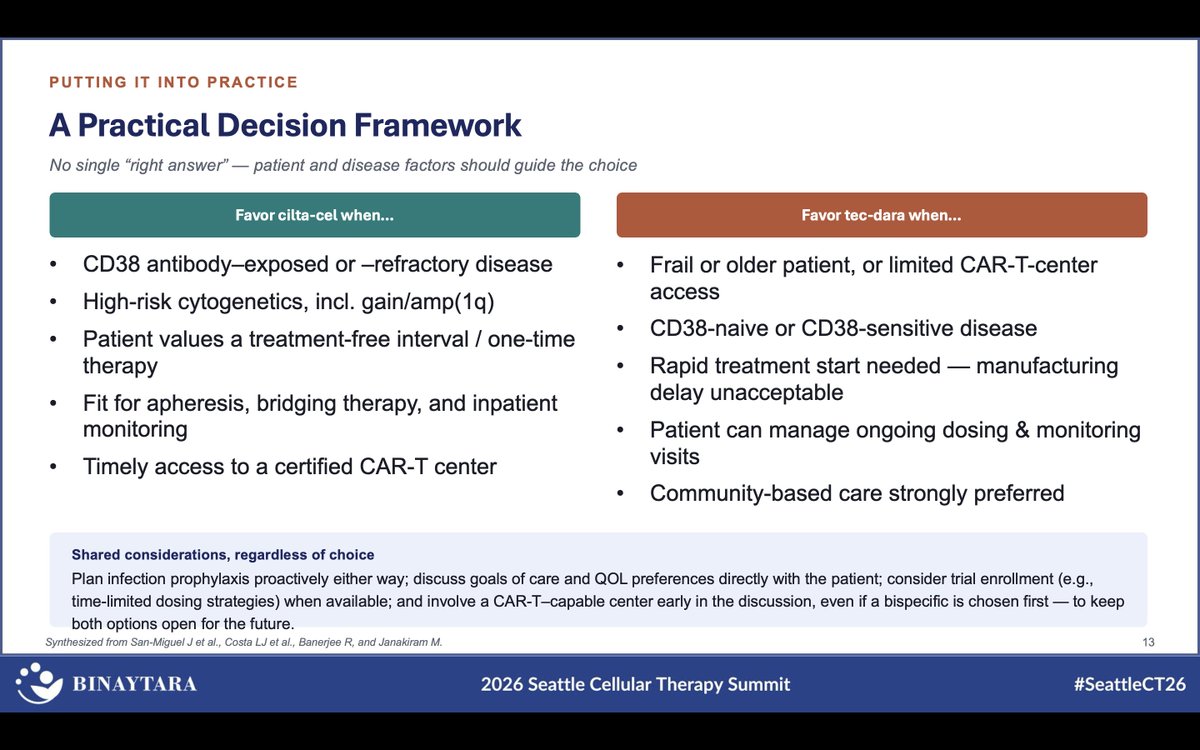
A Practical Decision Framework — cilta-cel vs tec-dara at first relapse
PUTTING IT INTO PRACTICE
A Practical Decision Framework
No single “right answer” — patient and disease factors should guide the choice
Favor cilta-cel when...
• CD38 antibody–exposed or –refractory disease
• High-risk cytogenetics, incl. gain/amp(1q)
• Patient values a treatment-free interval / one-time therapy
• Fit for apheresis, bridging therapy, and inpatient monitoring
• Timely access to a certified CAR-T center
Favor tec-dara when...
• Frail or older patient, or limited CAR-T-center access
• CD38-naive or CD38-sensitive disease
• Rapid treatment start needed — manufacturing delay unacceptable
• Patient can manage ongoing dosing & monitoring visits
• Community-based care strongly preferred
Shared considerations, regardless of choice
Plan infection prophylaxis proactively either way; discuss goals of care and QOL preferences directly with the patient; consider trial enrollment (e.g., time-limited dosing strategies) when available; and involve a CAR-T–capable center early in the discussion, even if a bispecific is chosen first — to keep both options open for the future.
Synthesized from San-Miguel J et al., Costa LJ et al., Banerjee R, and Janakiram M.
Persistent CAR T Expansion or Malignant Transformation?

Persistent CAR T Expansion or Malignant Transformation?
Feature | IEC-associated enterocolitis | Secondary CAR+ T cell lymphoma
CAR+ T cells in biopsy | Expected | Expected
Dominant TCR clone | Can occur | Usually present
CD8+ cytotoxic phenotype | Can occur | Can occur
Villous blunting/apoptosis | Can occur | Can occur
Clonal persistence | May occur | Usually persistent
Additional oncogenic mutations | Rare | Frequently identified
Progressive genetic evolution | Not expected | Characteristic
Final diagnosis: Indolent CAR+ T-cell lymphoma of the GI tract
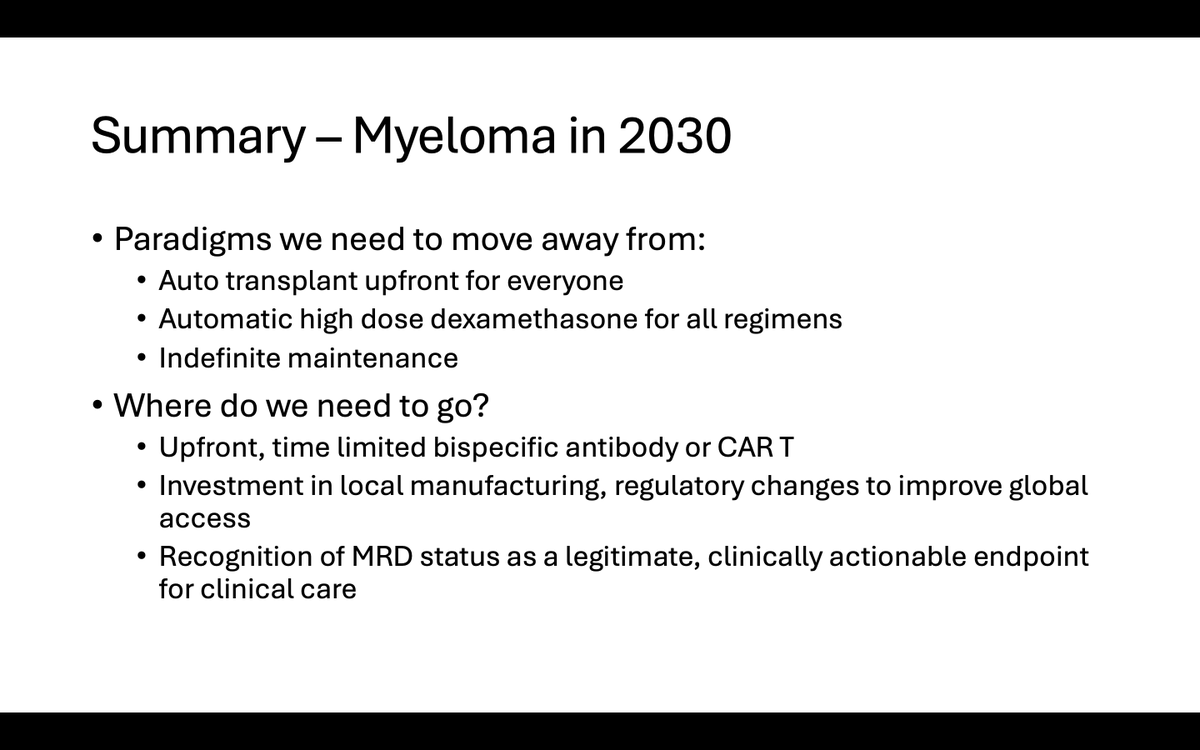
Summary — Myeloma in 2030
Summary – Myeloma in 2030
• Paradigms we need to move away from:
• Auto transplant upfront for everyone
• Automatic high dose dexamethasone for all regimens
• Indefinite maintenance
• Where do we need to go?
• Upfront, time limited bispecific antibody or CAR T
• Investment in local manufacturing, regulatory changes to improve global access
• Recognition of MRD status as a legitimate, clinically actionable endpoint for clinical care
The next generation of CAR-T for myeloma

The next generation of CAR-T for myeloma
• Better engineering
• Deep and durable responses
• Fewer severe and delayed neurologic toxicities
• Faster manufacturing (AZD0120)
• Novel targets
• Expanding beyond BCMA (GPRC5D)
• Earlier treatment
• Testing CAR-T as an alternative to upfront ASCT
• Remaining questions
• Are outcomes superior to current CAR-T?
• Will dual-targeting reduce relapse?
• What is the optimal sequencing with bispecific antibodies?
• Which patients should receive which CAR-T
Interim analysis of LimiTEC — limited-duration teclistamab in R/R myeloma
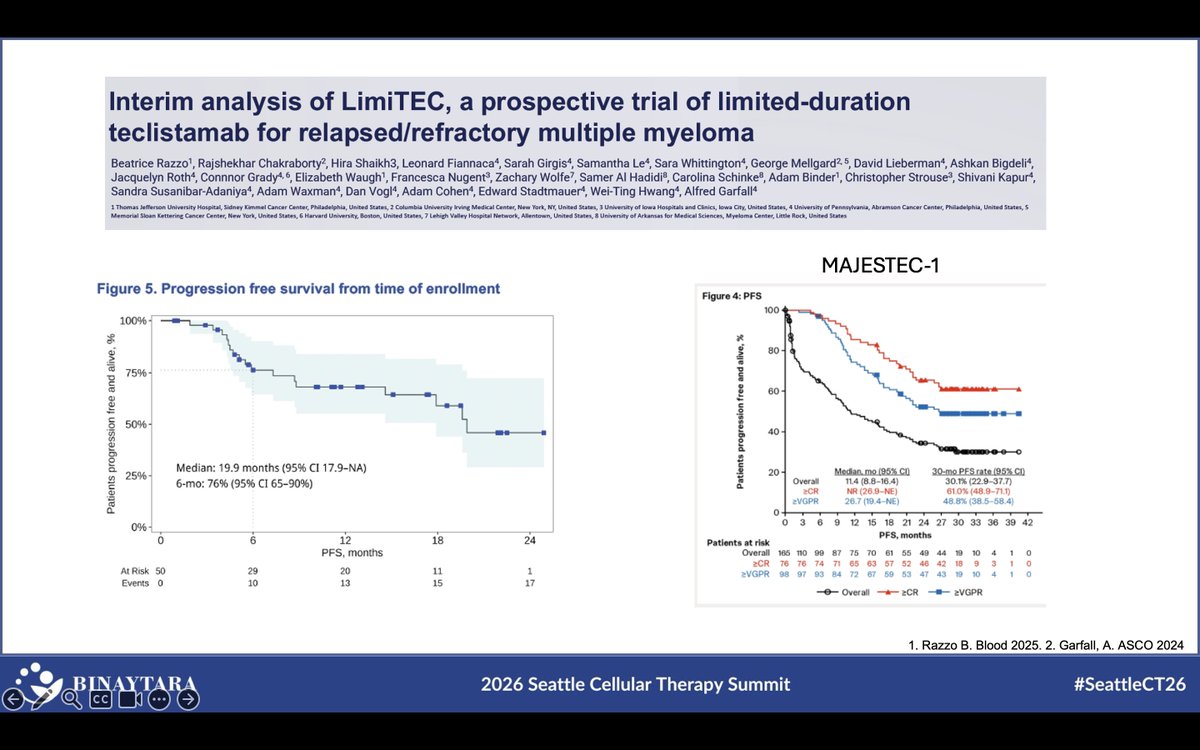
| Figure (as shown on slide) | Arm / group | Median PFS, mo (95% CI) | Landmark PFS (95% CI) | N |
|---|---|---|---|---|
| LimiTEC interim — PFS from enrollment | Limited-duration teclistamab | 19.9 (17.9–NA) | 6-mo: 76% (65–90%) | 50 |
| MAJESTEC-1 — Figure 4: PFS | Overall | 11.4 (8.8–16.4) | 30-mo: 30.1% (22.9–37.7) | 165 |
| ≥CR | NR (26.9–NE) | 30-mo: 61.0% (48.9–71.1) | 76 | |
| ≥VGPR | 26.7 (19.4–NE) | 30-mo: 48.8% (38.5–58.4) | 98 |
Interim analysis of LimiTEC, a prospective trial of limited-duration teclistamab for relapsed/refractory multiple myeloma
Beatrice Razzo, Rajshekhar Chakraborty, Hira Shaikh, … Alfred Garfall (Thomas Jefferson; Columbia; Iowa; Penn; MSK; Harvard; Lehigh Valley; Arkansas)
References: 1. Razzo B. Blood 2025. 2. Garfall A. ASCO 2024.
OBX-115 Mechanism of Action

OBX-115 Mechanism of Action
ACZ-regulated mbIL15 activates OBX-115 and other immune cells
[Diagram, labels as shown: Patient → Tumor → Isolated TIL → viral transduction of mbIL15-DRD transgene → OBX-115. ACZ ligand: basal state (unstable DRD, degraded mbIL15, proteasome) → ON state (ACZ-stabilized DRD, surface mbIL15). Cis-activation (IL2Rβ/IL2Rγ) + trans-activation of immune cells → direct killing of tumor cells; antigen-independent expansion & persistence; memory TIL. ACZ eliminates need for IL2.]
ACZ, acetazolamide; DRD, drug-responsive domain; IL2, interleukin 2; mbIL15, membrane-bound interleukin 15; TIL, tumor-infiltrating lymphocytes.
Allison Betof, ASCO 2026
VCAR33 — CD33 CAR-T after allogeneic HCT

VCAR33
• CD33 CAR-T after Allogeneic HCT
• N=15 patients
• Grade 3-4 CRS in 0 patients
• Grade 3-4 GVHD in 1 patient
• Grade 3 ICANs in 1 patient
• ORR 20%
• Study closed prior to completion
[Right panel partially out of frame: “VCAR33, a Donor-d… for AML Relaps…” — Mushtaq et al.; footer citation: Mushtaq. Blood. 2025.]
Who drove the conversation
Top Physician Voices
Verbatim
Posts from #SeattleCT26

Saurabh Dahiya
@SaurabhDahiya94
@SaurabhDahiya94
Excellent meeting organized by @KrishPatelMD and @mshadman, bringing together a terrific group to discuss advances and the future of cellular therapy. Terrific Stanford contingent! #SeattleCT26 https://t.co/Q4B69bky6K
 View on X ↗