Stage I-III rectal or stage II-III colon cancer with PI3K pathway alterations (adjuvant) — Karolinska Institutet (Sweden) / Scandinavian academic consortium. Funded by Swedish Research Council, Swedish Cancer Society, ALF (Stockholm County / Karolinska Institutet), Stockholm Cancer Society
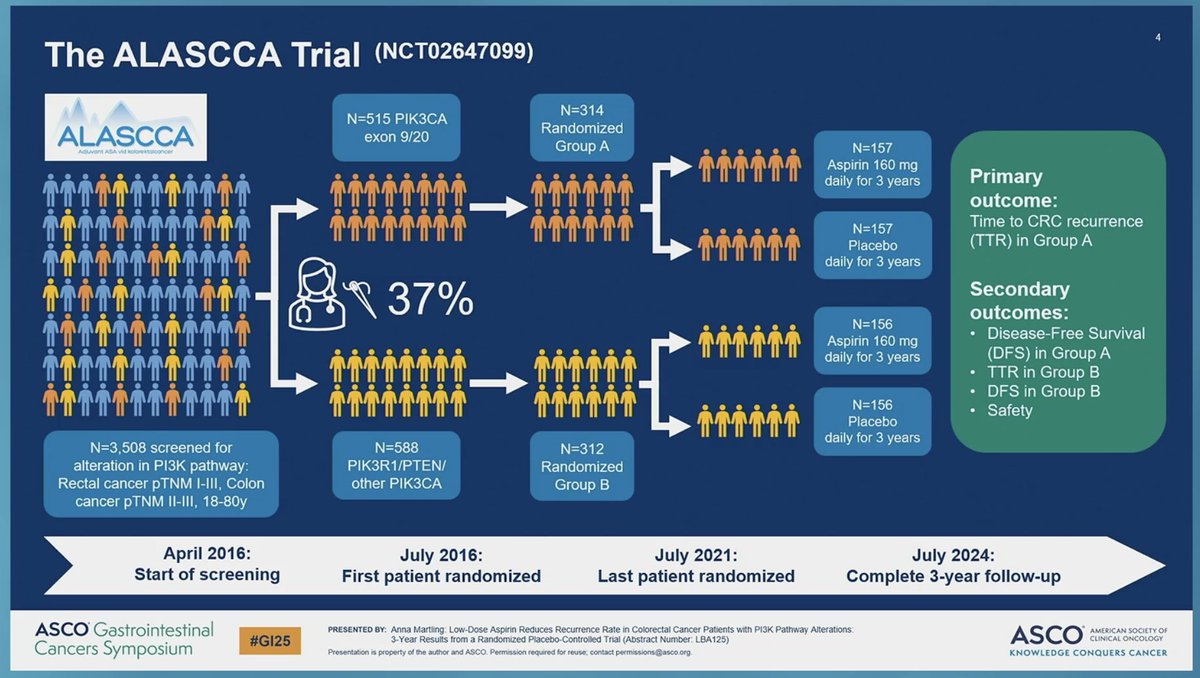
Discover KOL Sentiment on ALASCCA →Design - Phase 3 aspirin 160 mg daily x3 years vs placebo, resected stage I-III colorectal cancer with PI3K-pathway alterations (NCT02647099); biomarker-driven primary time-to-recurrence (ASCO GI 2025 LBA125 / JCO 2025).
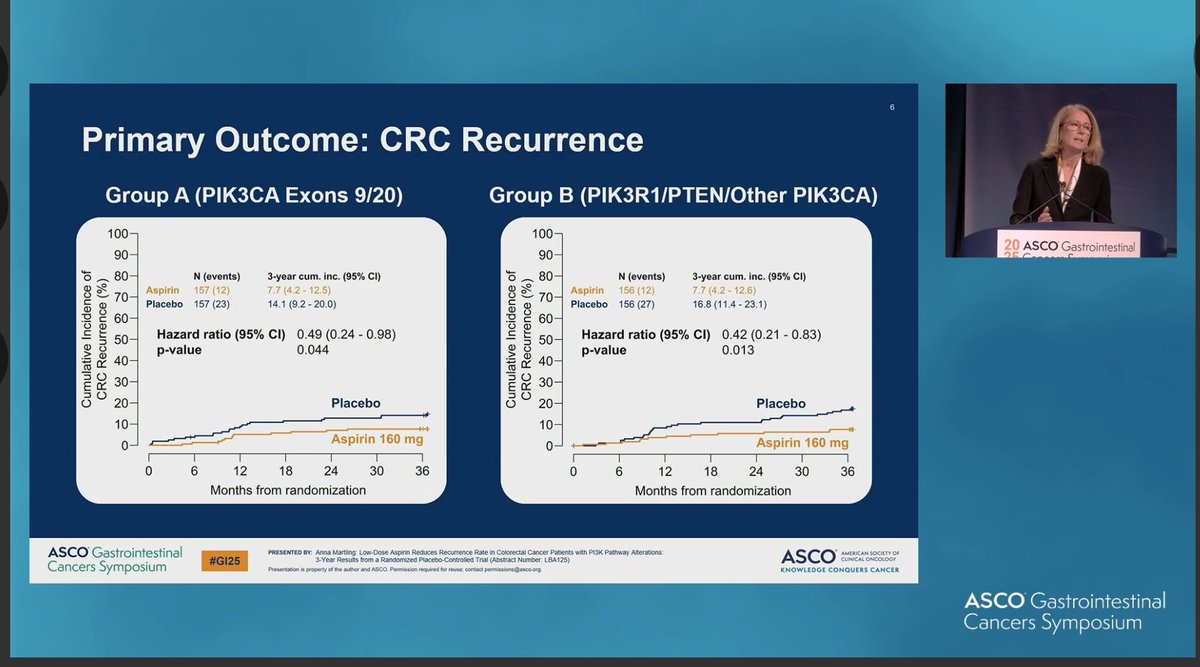
Group A (PIK3CA exon 9/20) - 3-year recurrence 7.7% (aspirin) vs 14.1% (placebo); HR 0.49 (95% CI 0.24-0.98), P=0.044 - primary endpoint met.
Group B (PIK3R1/PTEN/other PIK3CA) - DFS HR 0.51 (95% CI 0.29-0.88), P=0.017 - significant; 3-year DFS 89.1% vs 78.7%.
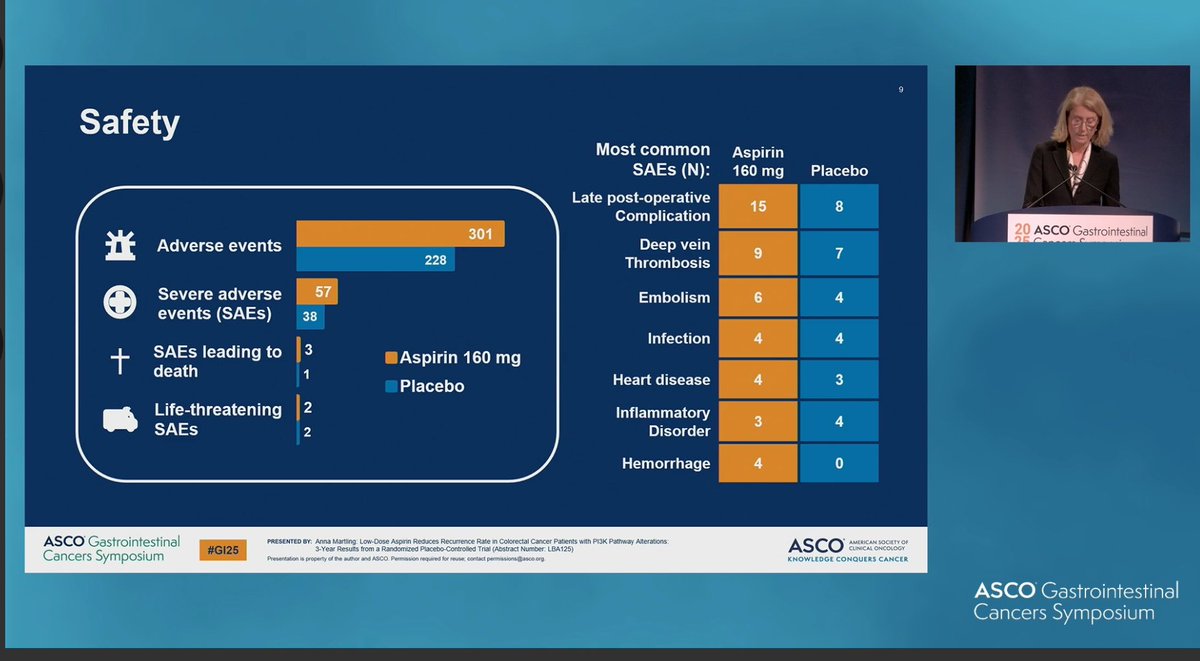
Safety - Excellent - only 3 aspirin-related serious AEs (1 GI bleed, 1 hematoma, 1 allergic reaction) in ~313 aspirin patients; no treatment-related deaths.
Regulatory - Investigational/repurposing - not an FDA drug approval; NCCN guidelines updated to recommend aspirin for PIK3CA-mutated colorectal cancer.
Sponsor / drug - Karolinska Institutet / Scandinavian consortium; acetylsalicylic acid (aspirin), 160 mg daily.
Compiled and reviewed by the KOL Pulse research team, led by Brian Shields, Founder, KOL Pulse. Last updated July 21, 2026.




Top tweets by impressions — click to view on X
Low-dose aspirin to reduce recurrence rate in CRC with PI3K pathway alterations#ASCOGI25
🔎3-year results from ALASCCA trial
👉first positive trial w/ Aspirin, HR = 0.49
👉Effect also in extended…
#GI25 @ASCO
🌟 Practice-changing ALASCCA ph3 trial 🇸🇪
📌 ASA 160mg in PIK3CA+ stage II-III #CRCsm
📌 PIK3CA+ in 37%
➡️ HR 0.42 for 3yr DFS!
@OncoAlert https://t.co/b4DR3HMFnd
@GillSharlene @ASCO @OncoAlert Very interesting data! Certainly practice changing. will @TempusAI 0r other platforms approve and run standard ngs for stage II & III patients , or do we need a…
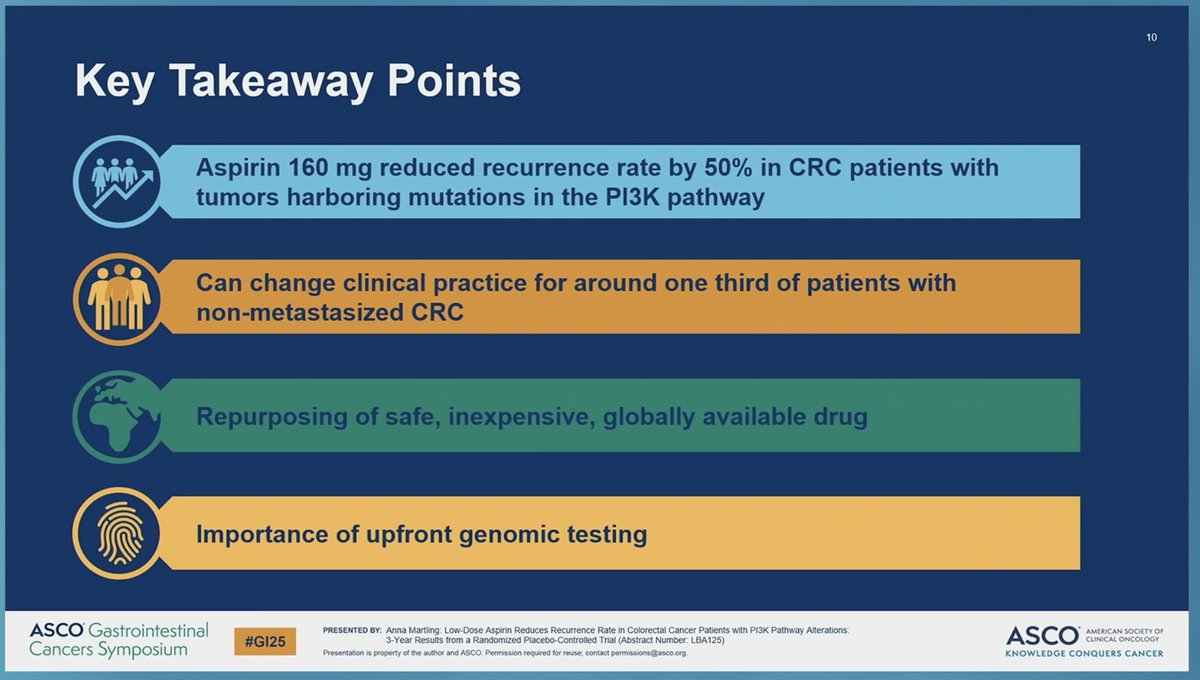
ALASCCA is the first biomarker-driven randomized trial showing daily aspirin prevents recurrence in PI3K pathway-altered CRC. Both Group A (PIK3CA exon 9/20) and Group B (PIK3R1/PTEN/other PIK3CA) met primary/secondary endpoints with 51-58% recurrence reduction. Expands the targetable population beyond classical PIK3CA mutations. NCCN Guidelines updated post-ASCO GI 2025. Will require upfront molecular profiling of early-stage CRC — a new clinical workflow. Repurposing of a cheap, globally available agent.
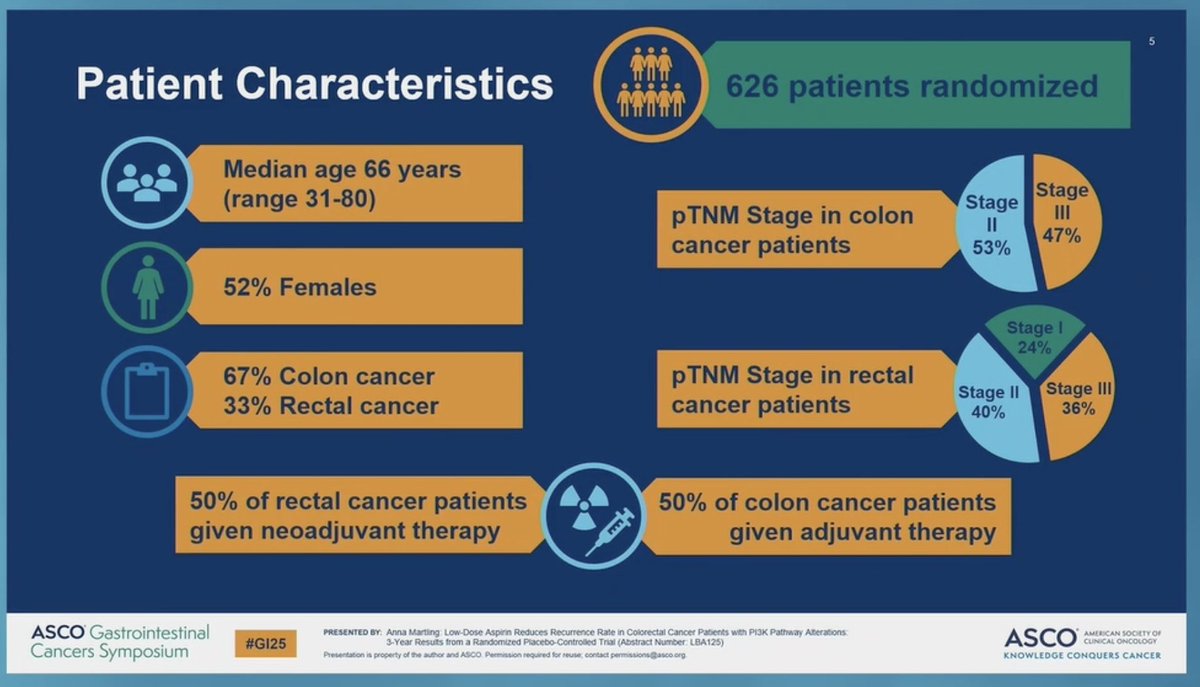
Median: 7.7 % 3-year recurrence (aspirin 160mg daily (Group A: PIK3CA exon 9/20)) vs. 14.1 % 3-year recurrence (placebo (Group A)). HR 0.49 (95% CI 0.24-0.98), P=0.044 Group A 3-yr recurrence rate: 7.7% (aspirin) vs. 14.1% (placebo). Group B 3-yr recurrence (PIK3R1/PTEN/other PIK3CA) rate: 7.7% (aspirin) vs. 16.8% (placebo). Group B DFS 3-yr rates rate: 89.1% (aspirin) vs. 78.7% (placebo). Phase 3 randomized, double-blind, placebo-controlled across 33 hospitals in Sweden, Denmark, Finland, Norway. Screened 3,508 patients; 1,103 (37%) had PI3K alterations; 626 randomized. Group A (PIK3CA exon 9/20): HR 0.49 (95% CI 0.24-0.98, P=0.044) — 51% recurrence reduction. Group B (PIK3R1/PTEN/other PIK3CA): HR 0.42 (95% CI 0.21-0.83, P=0.013) — 58% recurrence reduction. Primary endpoint MET. Adjuvant 160mg aspirin x3 years reduced recurrence in CRC patients with PI3K pathway alterations.
DFS: Group A HR 0.61 (95% CI 0.34-1.08, P=0.091) — not statistically significant; 3-year DFS 88.5% aspirin vs. 81.4% placebo. Group B HR 0.51 (95% CI 0.29-0.88, P=0.017) — SIGNIFICANT; 3-year DFS 89.1% vs. 78.7%. OS data still maturing. Findings expected to change clinical practice for ~1/3 of early-stage CRC patients.
Key AEs: 3 aspirin-related serious AEs total: 1 GI bleeding, 1 hematoma, 1 allergic reaction. Excellent safety profile: only 3 severe aspirin-related AEs in ~313 patients on aspirin. No treatment-related deaths. Aspirin is inexpensive, globally available, safe in most patients.
✅ Practice-changing: NCCN Guidelines now recommend aspirin for PIK3CA-mutated CRC. ALASCCA is the first biomarker-driven randomized trial showing daily aspirin prevents recurrence in PI3K pathway-altered CRC. Both Group A (PIK3CA exon 9/20) and Group B (PIK3R1/PTEN/other PIK3CA) met primary/secondary endpoints with 51-58% recurrence reduction. Expands the targetable population beyond classical PIK3CA mutations. NCCN Guidelines updated post-ASCO GI 2025. Will require upfront molecular profiling of early-stage CRC — a new clinical workflow. Repurposing of a cheap, globally available agent.
ALASCCA is a Phase 3 randomized, placebo-controlled academic trial (NCT02647099) testing whether low-dose aspirin (160 mg once daily for 3 years) reduces recurrence in patients with resected stage I-III colorectal cancer whose tumors carry PI3K-pathway (PIK3CA, PIK3R1, or PTEN) alterations. It was led by Karolinska Institutet and a Scandinavian academic consortium.
Aspirin significantly reduced recurrence in PI3K-pathway-altered colorectal cancer. In Group A (PIK3CA exon 9/20 mutations), the 3-year recurrence rate was 7.7% with aspirin versus 14.1% with placebo (HR 0.49; 95% CI 0.24-0.98; P=0.044). In Group B (PIK3R1/PTEN/other PIK3CA alterations), disease-free survival favored aspirin (HR 0.51; 95% CI 0.29-0.88; P=0.017).
No. ALASCCA is a positive academic repurposing trial, not an FDA registration study, and aspirin is not FDA approved as adjuvant colorectal-cancer therapy. However, on the strength of these results the NCCN guidelines were updated to recommend aspirin for PIK3CA-mutated colorectal cancer, so it can be used as guideline-supported care in the appropriate biomarker-defined setting.
Aspirin was very well tolerated. There were only 3 aspirin-related serious adverse events in approximately 313 patients on aspirin - one gastrointestinal bleed, one hematoma, and one allergic reaction - with no treatment-related deaths. Aspirin is also inexpensive and globally available, which makes the benefit especially impactful.
The benefit was seen in resected stage I-III colorectal cancer with PI3K-pathway alterations - PIK3CA exon 9/20 mutations (Group A) and PIK3R1/PTEN/other PIK3CA alterations (Group B). Tumor molecular testing is required to identify these patients; the data do not extend to biomarker-unselected colorectal cancer.