ARROS-1 Key Takeaways
Regulatory
FDA approved July 22, 2026 - Jideytro (zidesamtinib) for adults with locally advanced or metastatic ROS1-positive NSCLC who received a prior ROS1 TKI. Ahead of the Sept 18, 2026 target action date. FDA approved (2L+ ROS1+ NSCLC) Source: Nuvalent/GSK press release
WCLC 2026 - TKI-Naive Cohort (Investigational)
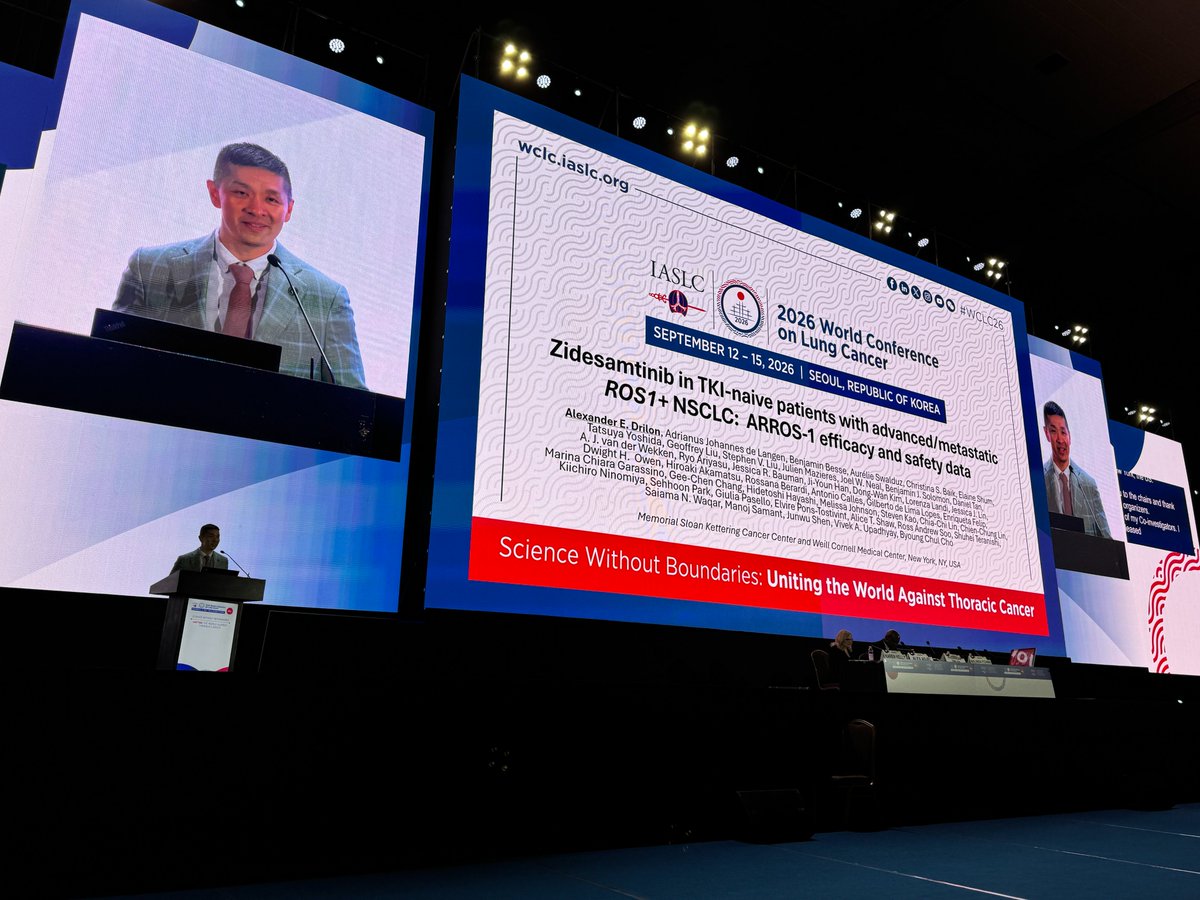
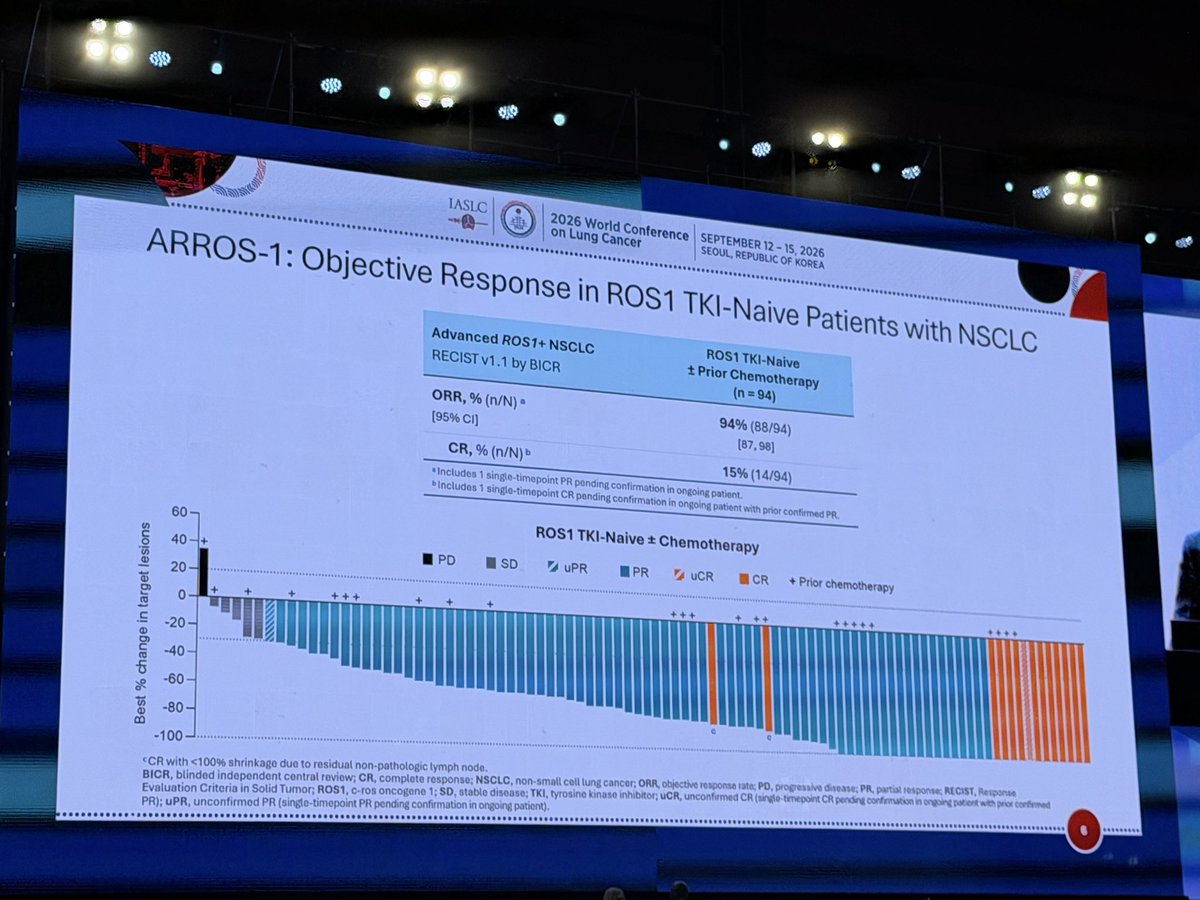
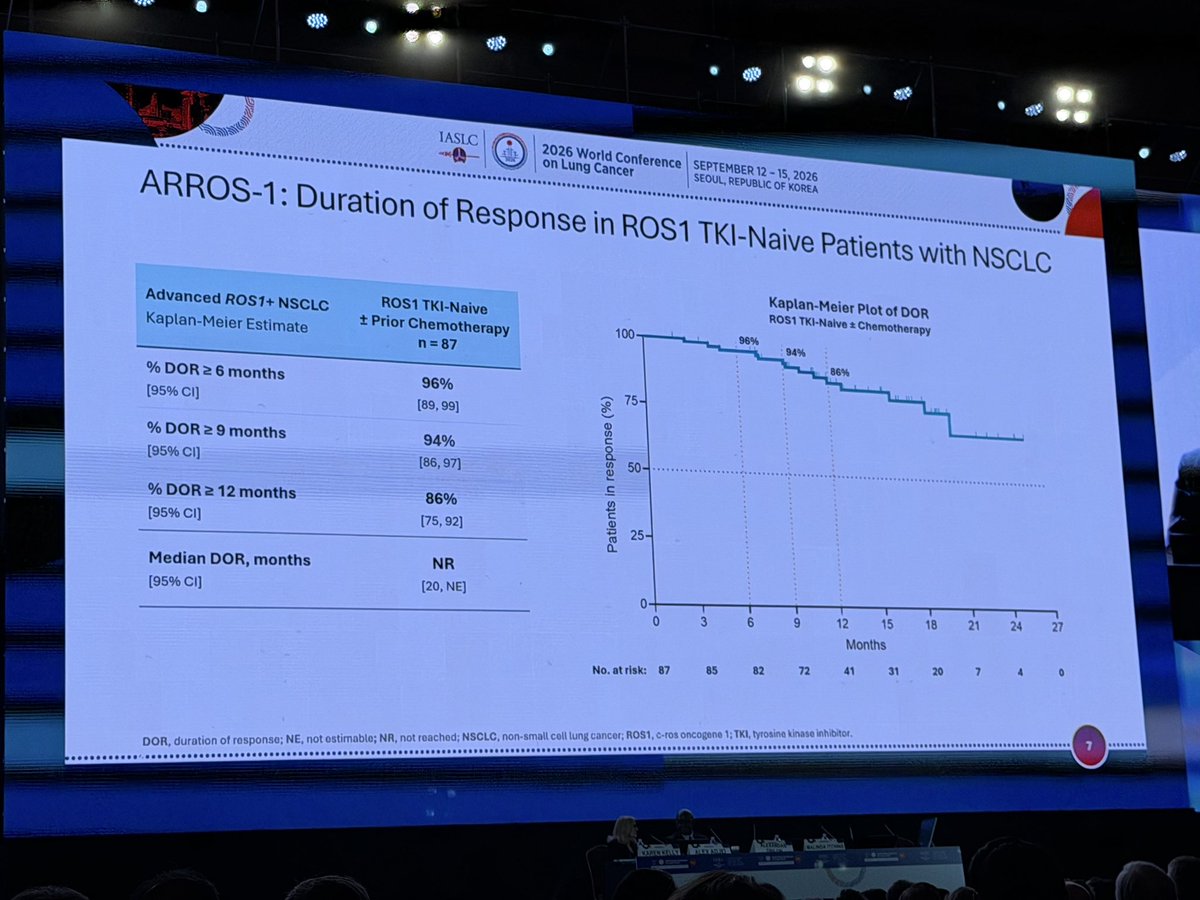
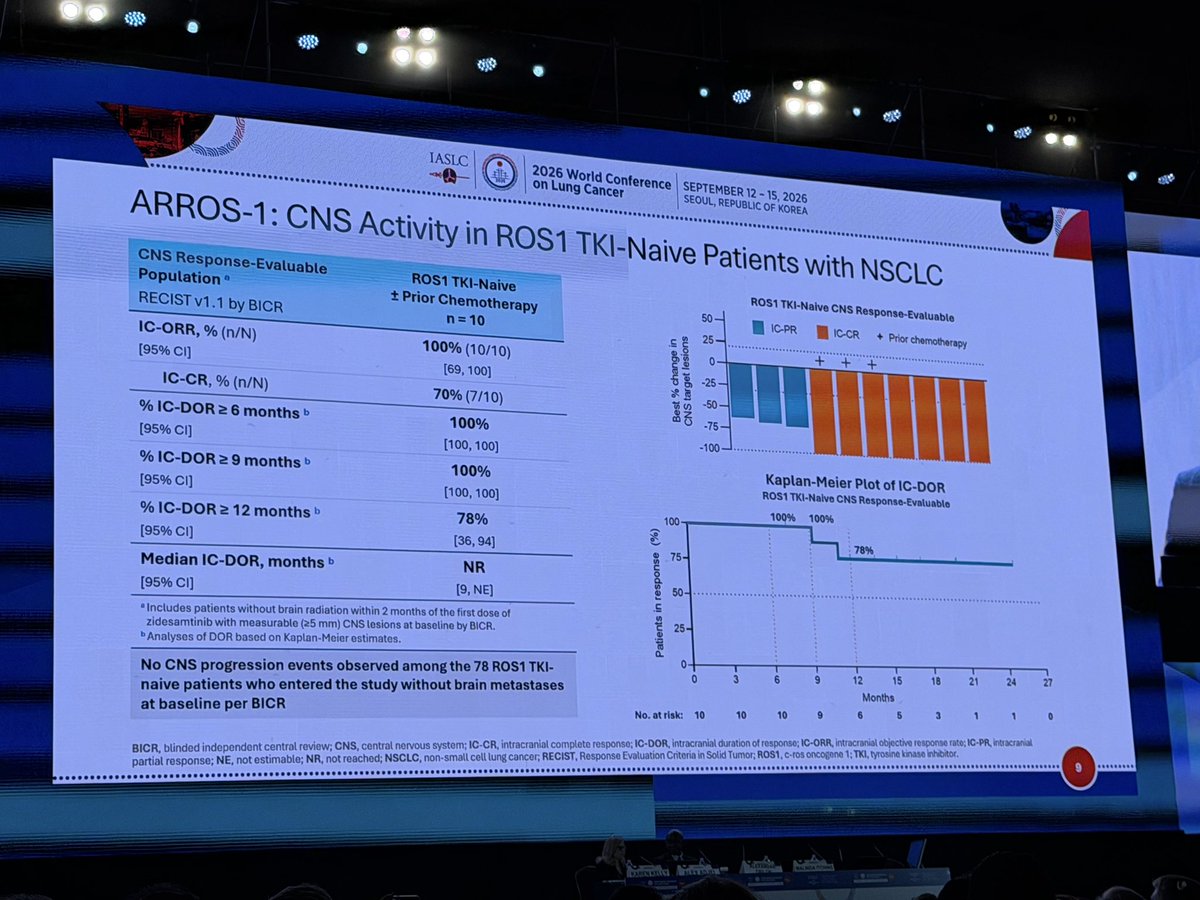
Presented by Dr. Alexander Drilon (Memorial Sloan Kettering) at the WCLC 2026 presidential symposium, Seoul, September 14, 2026 (abstract PL03.06; data cutoff 16-Apr-2026). In the ROS1 TKI-naive efficacy population (n=94, from 183 TKI-naive patients among 629 total enrolled; median follow-up 15.2 months), zidesamtinib delivered ORR 94% (88/94; 95% CI 87-98) with CR 15% (14/94); median duration of response not reached (12-month DoR 86%); median PFS not reached with 12-month PFS 90% (95% CI 81-95); intracranial ORR 100% (10/10) with IC-CR 70% in patients with measurable CNS metastases; and no CNS progression events among the 78 patients without baseline brain metastases. Grade 3 or higher adverse-event rates were low. Caveat: ARROS-1 is a single-arm Phase 1/2 study - first-line (TKI-naive) use is investigational and NOT FDA approved; randomized confirmation is needed before it defines a new standard. ORR 94% - mPFS NR - IC-ORR 100% (investigational 1L) Source: WCLC 2026 presidential symposium, Drilon et al - slide captures (S. Liu) Slide captures (M. Torasawa)
Design
Global registrational Phase 1/2 trial (NCT05118789); pivotal TKI-pretreated cohort n=117; primary endpoint objective response rate by blinded independent central review (BICR). Data cutoff March 21, 2025 (WCLC 2025).
Efficacy (pretreated, n=117)
ORR 44% (95% CI 34-53%); duration of response 82% at 6 months and 69% at 12 months (FDA label / Nuvalent PR). ORR 51% (28/55) after a single prior TKI (crizotinib or entrectinib); ORR 47% after prior repotrectinib and 43% after prior taletrectinib (ARROS-1, WCLC 2025, DCO 21-Mar-2025). ORR 44% - 12-mo DoR 69%
CNS activity
Intracranial ORR 48% (27/56, 95% CI 35-62) in patients with measurable CNS lesions; durable intracranial responses including after prior brain-penetrant TKIs; activity against the ROS1 G2032R resistance mutation (ARROS-1, WCLC 2025).
Tolerability
Generally well tolerated: dose reduction ~10%, treatment discontinuation ~2%; TRK-sparing design intended to reduce neurotoxicity (ARROS-1, WCLC 2025).
Approved vs. Investigational
The FDA approval covers prior-TKI (2L+) patients only. The front-line / TKI-naive data above (ORR 94%, WCLC 2026 - superseding the earlier interim ORR ~89% (31/35)) come from a single-arm Phase 1/2 cohort and are investigational and NOT part of the FDA-approved indication; front-line development is ongoing.
Track oncology’s top KOLs in your specialty
Create a free account, pick the tumor types you cover, and go beyond the tweet — the intelligence pharma teams use to map influence and prepare for engagement:
- ✓Enhanced KOL profiles
- ✓Pharma influence & potential advisory-board patterns
- ✓2025 Open Payments financial analysis
- ✓Social-media sentiment & trend signals
WCLC 2026: TKI-Naive Readout & KOL Reaction
On September 14, 2026, Dr. Alexander Drilon (Memorial Sloan Kettering) presented the ARROS-1 TKI-naive cohort at the WCLC 2026 presidential symposium in Seoul (abstract PL03.06), with discussion by Dr. Malinda Itchins: ORR 94% (CR 15%), median PFS not reached (12-month PFS 90%), and intracranial ORR 100% in patients with measurable CNS metastases. These first-line data come from a single-arm Phase 1/2 study and are investigational - the FDA-approved indication remains limited to patients who received a prior ROS1 TKI. Physician posts below were captured live during the conference (September 12–15). Quotes are verbatim; each card links to the original post. Last updated 2026-09-15.

Dr. @alexdrilon at #WCLC26 presents 1L cohort of ARROS-1 trial of zidesamtinib in pts with ROS1 NSCLC. What a waterfall plot. RR 94% with 15% CR. mPFS not reached, PFS at 6m was 96% and at 12m was 90%. Intracranial RR 100%. In 78 pts who did not have brain metastases at baseline, no CNS events occurred to date. These are fantastic outcomes.

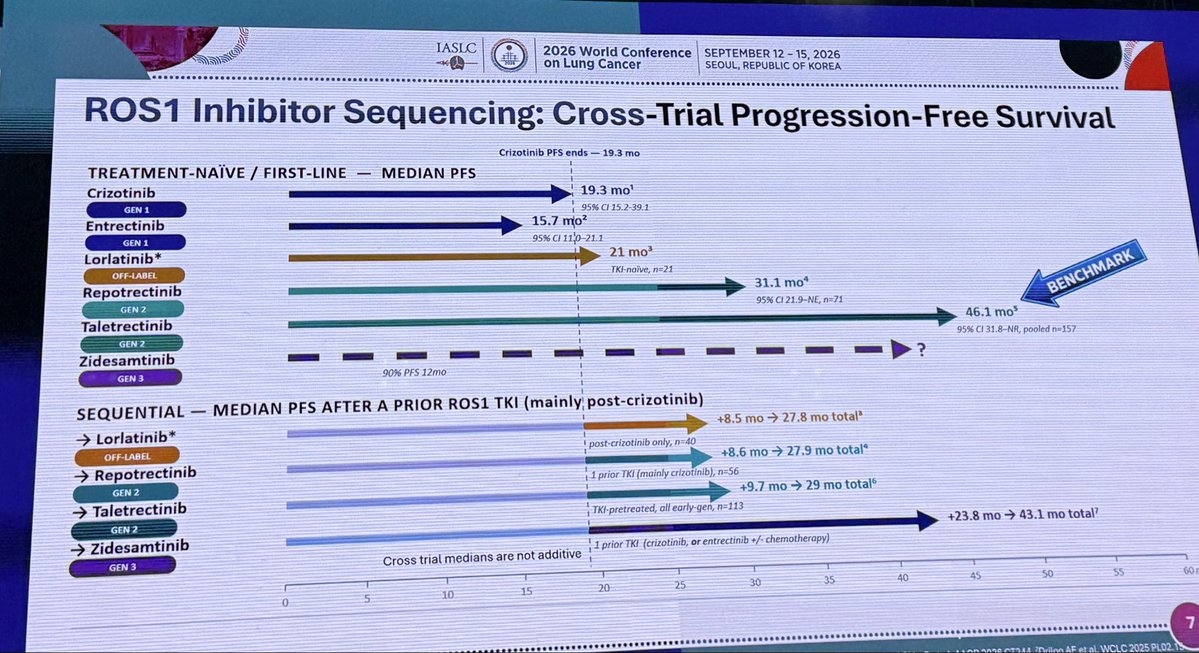
ARROS-1 update zidesamtinib in ROS1 TKI-naive NSCLC by @alexdrilon at #WCLC26 Take: ORR 94% is possible!!! in TKI-naive patients, with 86% still in response and 90% still progression-free at 12 months. DOR and PFS both not reached. The CNS data answers the open question from July: IC-ORR 100%, IC-CR rate 70%, median IC-DOR not reached, and no CNS progression events among patients without baseline brain mets. Safety consistent with prior reports, low discontinuation/dose-reduction rates. This is a materially stronger picture than the pretreated cohort behind the original approval (44% ORR). Discussion by @Mal_Itchins puts taletrectinib (TRUSTI/II) as the PFS benchmark to beat of 46 m. @ros1cancer #LCSM #lungcancer

#WCLC26 | ARROS-1 🧬 Zidesamtinib 100 mg QD in advanced ROS1+ NSCLC, focusing on ROS1 TKI-naïve patients (efficacy n=94; 27% had prior platinum ± IO) 🎯 ORR: 94% (95% CI 87–98) • CR: 15% • Median DoR: NR • 86% of responses ongoing ≥12 mo 📉 Median PFS: NR • 12-mo PFS: 90% 🧠 CNS activity: • IC-ORR: 100% (10/10) • IC-CR: 70% • 12-mo IC-DoR: 78% • No CNS progression among patients without baseline brain mets 🛡️ Safety: • Dose reduction: 12% • Discontinuation: 4% • Most common AE: peripheral edema (42%)

For a single-arm study w/ still-maturing follow-up… 94% ORR + 90% 1-y PFS + strong CNS control is a compelling signal from ARROS-1. However, IMO taletrectinib is still the benchmark for frontline management. But ABSOLUTELY great to have more options for our patients. #WCLC26 https://t.co/wjHbATbyTC https://t.co/wnAGOqgoUj

ARROS-1: 1L Zidesamtinib in ROS1+ Ph1/2, n=94 ✅ORR 94%, CR 15% ✅mPFS NR, 90% 1yr PFS ✅ icRR 100% ✅ Low Gr3+ AE 🤔 Impressive efficacy, better than Repo / Tale But need longer F/U & Ph3 Better tolerated than most other TKIs CNS activity ++ 👍 ❓sequencing #WCLC26 https://t.co/Gh029jLe4T

Drilon drillin’ us w amazing data on freshly approved resistance mutation-CNS active/TRK-sparing novel ROS TKI, zidesamtinib- tremendous activity and good tolerance for sure adding another fantastic agent to our treatment armamentarium What a speed for progress for our ROS+ pts as highlighted beautifully by discussant @Mal_Itchins since 1st discovery in 2007- less than 2 decades ago! A true time warp of discoveries!

Caveat: ARROS-1 is a single-arm phase 1/2 study. These data strongly support frontline development, but randomized confirmation matters before defining a new standard.

🆙#WCLC26 #LCSM Plenary Session 🔥ARROS-1: Zidesamtinib in TKI-naive Patients With Advanced/Metastatic ROS1+ NSCLC: Efficacy and Safety Data 🎙️ @alexdrilon 🔢PL03.06 ☑️NCT05253794 🔗 https://t.co/mYsNwaWQUZ @OncoAlert @Larvol @IASLC @ros1cancer https://t.co/KEwTHWEQ5A https://t.co/8rq3OuRfAi
5/6 ARROS-1 One I’m particularly looking forward to — and I’m pleased to be a co-author. Zidesamtinib is a next-generation ROS1 inhibitor designed for potent CNS activity and resistance coverage. Preliminary TKI-naïve ARROS-1 data were striking: ORR 89% Intracranial ORR 83% in a small evaluable CNS cohort. Now WCLC brings updated efficacy and safety in the TKI-naïve population. The big question: could zidesamtinib ultimately move into first-line ROS1+ NSCLC?

Updated ARROS-1 at #WCLC26 will be welcome data...... reimbursement in ROS1 definitely lagging behind in UK (crizo/entrectinib). Looking forward to access to the next gen of ROS1 TKI @BTOGORG https://t.co/voeuqmppiA

5. ARROS-1 ⭐️ The #ROS1 #lungcancer space is getting very competitive! @nuvalent will present data on zidesamtinib in TKI-NAIVE patients with metastatic #ROS1 #NSCLC. 1⃣The main published datasets are from TRIDENT-1 (repotrectinib) and the TRUST studies (taletrectinib) with an ORR of 79% and 89% respectively 2⃣The main benchmarks here will be ORR, CNS-ORR, acquired resistance coverage, and AE (which will be main differentiator for zidesamtinib, given minimal TRK binding) SOURCES 👉🏽https://t.co/q3EWgaDdMw 👉🏽https://t.co/PyebcLDjyn 👉🏽https://t.co/9KpMEtimar @ros1cancer @lcsmchat @OncoAlert @OncLive @OncogeneCancer @YoungLungCancer

WATCH: Jideytro FDA — ROS1+ NSCLC after prior TKI (ARROS-1) 🫁 👉 https://t.co/sfQKWEqasr 🔹 Zidesamtinib approved after ≥1 prior ROS1 TKI 🔹 ARROS-1 n=117: ORR 44%; DOR ≥6 mo in 82% of responders 🔹 100 mg PO daily — not interchangeable with taletrectinib Full data on OncologyTube. @OncoAlert @StephenVLiu @JackWestMD @OncBrothers @LUNGevity @Latinamd @Tony_Calles @lungoncdoc @RManochakian @alexdrilon @chulkimMD @hhorinouchi @FordePatrick @JulienMazieres @JessicaJLinMD @BenjaminBesseMD @DoctorDietrich @SWaliany @ipreeshagul @Joshua_Reuss @TejasPatilMD @bmassutis @ChristianRolfo @DRCamidge @JoelNealMD @MNagasaka @EnriquetaFelip @M_Torasawa @DrRiyazShah @mgonzalezvelMD @ros1cancer @FDAOncology @IASLC @JFreemanDaily @US_FDA @NarjustFlorezMD @GlopesMd @n8pennell @DrJNaidoo @CharuAggarwalMD #Jideytro #ARROS1 #ROS1 #NSCLC #LungCancer #FDA

@ozdogan_md @IASLC including a long-term taletrectinib update would have helped frame arros-1 around real-world clinical decision-making, rather than presenting zidesamtinib in a vacuum.

What does it take to stand out when effective therapies already exist? 💬 #Zidesamtinib, a next-generation ROS1 inhibitor for ROS1-positive NSCLC, offers a useful case study. 📊 In ARROS-1, the confirmed response rate was 44%, with 69% of responders maintaining their response for at least 12 months. But in a molecularly defined market, demonstrating activity is only the beginning. The bigger strategic questions are: 📌 How does the asset differentiate on sequencing, resistance, durability, and patient selection? 📌 And as the treatment landscape evolves, where does it ultimately fit? That is increasingly the challenge in precision oncology: not simply proving that a drug works, but defining why, when, and for whom it should be used. At Arc Nouvel Clinical Development Consulting, our team works with biotech and pharmaceutical companies to address these questions across clinical development and program strategy. 🎯 Meet the experts who can help pressure-test and advance your development program: https://t.co/f7kK2Pq5EY @nuvalent @GSK #PrecisionOncology #NSCLC #ROS1 #Biotech #ClinicalStrategy
@alexdrilon presents new #WCLC26 data in ROS1+ NSCLC from the ARROS-1 study, evaluating zidesamtinib in ROS1 TKI-naïve advanced NSCLC: ▫️ORR: 94% (88/94) ▫️CR: 15% ▫️Median DOR: not reached https://t.co/BBslgJ1CKy

@alexdrilon presents updates from ARROS-1 at @IASLC #WCLC26. The findings in the TKI-naive cohort are impressive! I’ve had the privilege of seeing firsthand how well and quickly this drug works in my clinic. Very exciting! https://t.co/R18ggyBB4k

Dr @alexdrilon presenting ARROS-1, Zidesamtinib for ROS1 NSCLC in 1L. - ORR 94%, PFS NR! #WCLC26 ‼️measurable CNS Mets n=10, IC-ORR 100% - Tox similar to other ROS1 TKIs. ⭐️Another efficacious option joins Taletrectinib! https://t.co/xgsJ0gw1mN

🫁 ARROS-1: Zidesamtinib in TKI-naive ROS1+ NSCLC. @alexdrilon Zidesamtinib demonstrated high response rates in TKI-naive pts with adv ROS1+ NSCLC: • ORR: 94% (87/94) • 12-month DoR: 86% • Intracranial ORR: 100% (10/10) • 12-month intracranial DoR: 78% The safety profile was consistent with previous reports, with 1% tx discontinuation and 11% requiring dose reduction. #CánCare #oncology #thoraciconcology #lungcancer #NSCLC #ROS1 #targetedtherapy #WCLC26 @IASLC

ARROS-1 at #WCLC26 Zidesamtinib showed promising activity in TKI-naïve advanced ROS1+ NSCLC: ORR 94%, with 15% CR 12-month PFS: 90%, median PFS not reached Responses were durable, with 86% maintaining response ≥12 months Notably, intracranial activity was also strong: IC-ORR 100% and IC-CR 70%. A promising emerging frontline option for ROS1+ NSCLC. @OncoAlert @StephenVLiu @GlopesMd @ManuelDomine @weoncologists @OpenMedKate

So happy and proud to see a true inspiration and a force of nature @JFreemanDaily mentioned during the discussion of ARROS-1 trial with Zidesamtinib @ros1cancer #WCLC26 #LCSM @IASLC 👏👏👏👏 https://t.co/EYjlxuow7y

Dr. @alexdrilon presents TKI-naive cohort from ph 1/2 ARROS-1 Trial. #WCLC26 ✅️ impressive ORR 94% ✅️ mPFS NR (early cutpoint) ☢️ dose reduction d/t AEs 23% (12% emergent, 11% related). 5% dc'd. Durability of systemic/intracranial efficacy will be 🔑 for 1st line choice https://t.co/BoF6ipBCLf

Dr. Malinda Itchins reviews the ARROS-1 trial and where zida fits into @ros1cancer space. Several options but zida appears to be the winner in terms of tolerability. @IASLC #WCLC26 #lcsm https://t.co/PbkPZyAJS7

@alexdrilon presenting ARROS-1 trial. You don’t often see ORR this high including CRs. Good response in CNS too. Low rates of tox. I think Zidesamtinib is a game changer for ROS-1 @ros1cancer #LCSM https://t.co/vTxgFAgfSA
My take on ARROS-1 & 1L ROS1 options (From LinkedIn) https://t.co/GXWabXnpPs

Dr. Alexander Drilon @alexdrilon presents the ARROS-1 study with zidesamtinib (NVL-520) in treatment naive ROS1+ NSCLC at @IASLC #WCLC26. Outstanding ORR 94% (15%) with mPFS not reached. Significant intracranial efficacy observed with sparing TRK inhibition. Toxicity notable for peripheral edema, neuropathy, and GI tox. New 1L agent for ROS1+ NSCLC? Waiting future OS data for this exciting agent. @ros1cancer @MSKCancerCenter @LUNGevity @OncoAlert @oncodaily @OncBrothers @lungoncdoc

🚨 ARROS-1: Zidesamtinib up front in ROS1+ NSCLC? In TKI-naïve advanced ROS1+ NSCLC, zidesamtinib showed striking early activity: ✦ ORR 93% — 87/94 patients ✦ 12-month PFS 90% ✦ Median PFS & DOR not reached ✦ Intracranial ORR 100% (10/10), including 70% intracranial CR The message is compelling: deep responses, durable control, and promising CNS activity. But perspective matters — this remains a single-arm Phase 1/2 study, with a small CNS-evaluable cohort. Longer follow-up and comparative data are needed before defining its place among first-line ROS1 TKIs. Promising up front? Absolutely. Practice defining? Not yet. #MVOnco #ARROS1 #Zidesamtinib #ROS1 #ROS1Positive #NSCLC #LungCancer #PrecisionOncology #TargetedTherapy #ThoracicOncology

What a lovely waterfall plot! Impressive ORR 94% for ROS1 inhibitor-ARROS1 #wclc26 https://t.co/JQoEY2bH9J

@alexdrilon #ARROS1 ✅️ focus of this trial is on TKI naive ROS1 NSCLC #WCLC26 https://t.co/ZVRCqGQ2ks
Sylvester Thoracic Working Group at #WCLC26 — co-authored presentation. ARROS-1: zidesamtinib in TKI-naïve advanced ROS1+ NSCLC. A next-generation ROS1 TKI with strong systemic activity, durable disease control, and meaningful CNS activity. https://t.co/BgOtiZhQED

ROS1 lung cancer shows why molecular testing can change everything. In ARROS 1, zidesamtinib produced a 94% response rate in TKI naïve ROS1 positive advanced NSCLC. Rare does not mean unimportant. Find the driver. Understand the biology. Match the treatment. Precision oncology keeps getting more precise. Educational information only.

DESTINY-Lung04 🚨 T-DXd in 1L HER2m NSCLC: ORR 70%. PFS, ✅ OS not ARROS-1 🔥 Zidesamtinib in TKI-naïve ROS1+ NSCLC: ORR 94%, CR 15%. Impressive activity. Durability, CNS control and PFS will define its place in 1L. @IASLC #WCLC26 @KolPulseAI @OncoAlert @Larvol @GlopesMd @StephenVLiu

#WCLC26 Day 2 Presidential Symposium 🔥#ARROS1: #Zidesamtinib in TKI-naive Patients With Advanced/Metastatic ROS1+ NSCLC: Efficacy and Safety Data 🎙️ @alexdrilon N=94 Phase 2, 15 mo f/u 💊100mg daily 🎯ORR 94% (95%CI 87-98) 🎯CR 15% (14/94) 🧠 CNS efficacy from 10 pts reported - excellent ORR 100% ⚠️CNS toxicity (⬇️TRK inhibition but still some) peripheral edema, CPK increase, weight increase, and AST increase Well tolerated - discontinuation (4%) and dose reductions (12%). 👉🏽👉🏽it’s great to have more options for patients, hard to decide which agent is best upfront when these drugs have all deep responses - toxicity profile will matter and longer f/u #lcsm @ros1cancer

4. #ARROS1: PhI/II, 1L in TKI naive ROS1+ mNSCLC, Zidesamtinib: - Approved in 2026 in 2L - In 1L, ORR: 94%! CR: 15% - PFS ≥ 12mos: 90% - Intracranial ORR: 100% 🤯 - Taltrectinib for now is the SoC. Awaiting approval and longer data with Zidesamtinib. 5/8 https://t.co/LXYorx5JbS https://t.co/QNB8khWDxr

An outstanding Presidential Symposium 2 at #WCLC26. ARROS-1 is evaluating zidesamtinib, an investigational next-generation ROS1 TKI, in advanced ROS1+ NSCLC across TKI-naïve and previously treated cohorts. With ORR by BICR as the primary endpoint, the study also assesses PFS, OS and intracranial activity—key data that may further inform treatment sequencing in ROS1-driven lung cancer. #LungCancer #NSCLC #ROS1
My take as a co-author: ARROS-1 is a very encouraging frontline dataset and makes zidesamtinib a serious contender for future 1L therapy. Important caveat: this remains a single-arm phase 1/2 study. Randomized confirmation is still needed before defining a new standard.
#WCLC26 Day 2 Presidential Symposium 🔥#ARROS1: in TKI-naive Patients With Advanced/Metastatic ROS1+ NSCLC: Efficacy and Safety Data 🎙️ @alexdrilon N=94 Phase 2, 15 mo f/u 💊100mg daily 🎯ORR 94% (95%CI 87-98) 🎯CR 15% (14/94) 🧠 CNS efficacy from 10 pts reported - excellent ORR 100% ⚠️CNS toxicity (leas TRK inhibition but still some) peripheral edema, CPK increase, weight increase, and AST increase Well tolerated - discontinuation (4%) and dose reductions (12%). 👉🏽👉🏽it’s great to have more options for patients, hard to decide which agent is best upfront when these drugs have all deep responses - toxicity profile will matter and longer f/u #lcsm @ros1cancer
Top KOLs Discussing ARROS-1












ARROS-1 Key Slides & Visuals








ARROS-1 Top Tweets

FDA Approval - Jideytro (Zidesamtinib)
KOL reaction to the approval
About the ARROS-1 Trial
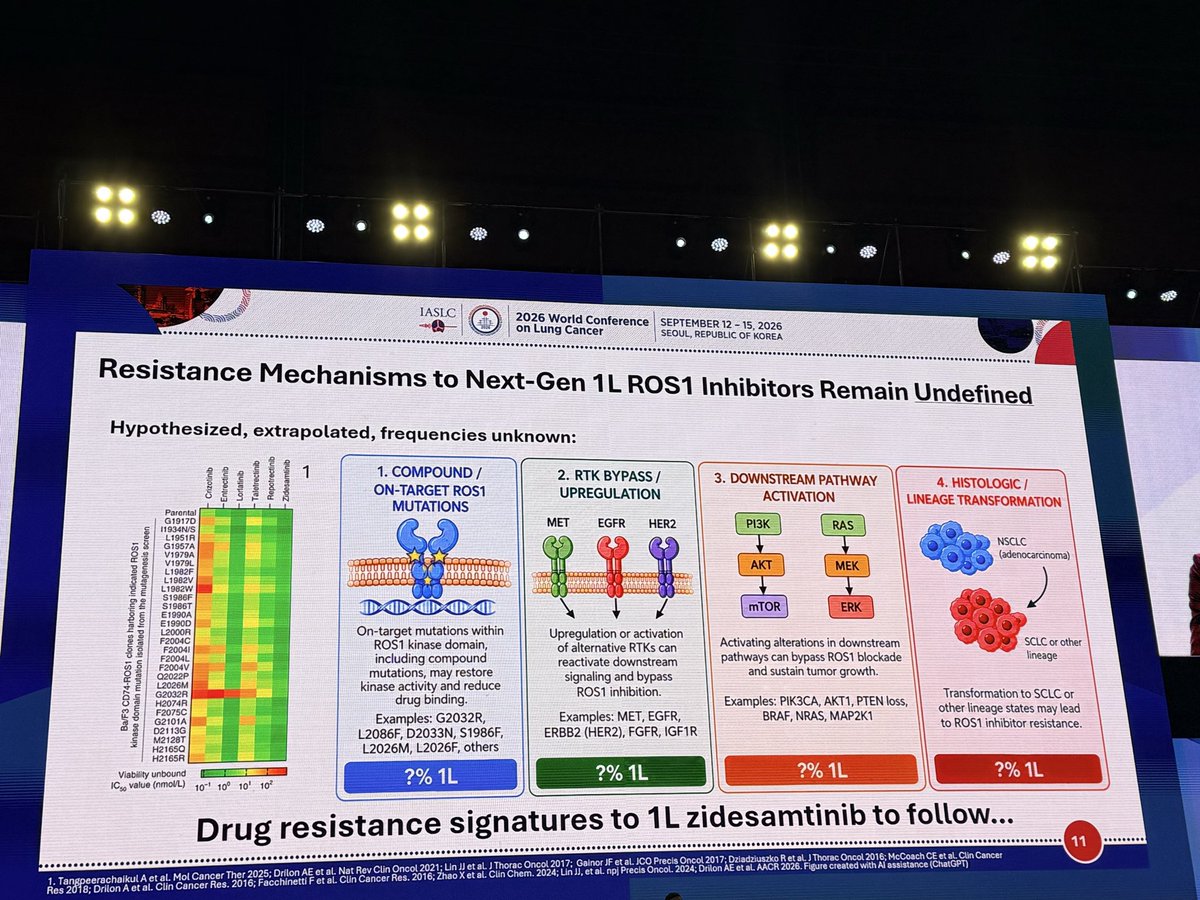
ARROS-1 (NCT05118789) is the global registrational Phase 1/2 study of zidesamtinib (Jideytro), a next-generation ROS1-selective kinase inhibitor engineered by Nuvalent to be brain-penetrant, to remain active against ROS1 resistance mutations (including G2032R), and to spare TRK - the mechanism behind the neurologic toxicity seen with earlier ROS1/TRK inhibitors. The pivotal cohort enrolled 117 patients with advanced or metastatic ROS1-positive NSCLC who had received one or more prior ROS1 TKIs (crizotinib, entrectinib, repotrectinib, or taletrectinib). Results were presented by Dr. Alexander Drilon at the 2025 World Conference on Lung Cancer (WCLC 2025) and formed the basis of the July 22, 2026 FDA approval. The trial also includes an encouraging TKI-naive (front-line) cohort that remains under investigation.
Trial Methodology & Results
Study Design
Global registrational Phase 1/2, open-label; response assessed by RECIST 1.1 and CNS response by BICR.
Population
Advanced/metastatic ROS1-positive NSCLC; pivotal cohort n=117 with 1-4 prior ROS1 TKIs (+/- chemotherapy).
Intervention
Zidesamtinib (Jideytro) 100 mg once daily - ROS1-selective, brain-penetrant, TRK-sparing TKI.
Primary Endpoint
Objective response rate (ORR) by BICR; key secondary endpoints DoR, intracranial ORR, PFS, safety.
Companion Dx
None co-approved; ROS1 fusion status determined by standard molecular testing.
Lead Investigator
Alexander Drilon, MD (presenter, WCLC 2025); Benjamin Besse, MD and colleagues.
Objective Response (pretreated)
ORR 44% (51/117; 95% CI 34-53%), CR 1% (1/117). ORR 51% (28/55) after a single prior TKI (crizotinib or entrectinib); 68% after prior crizotinib only. Responses after prior repotrectinib (ORR 47%, 8/17) and taletrectinib (ORR 43%, 3/7); ORR 38% (22/58) after >=2 prior ROS1 TKIs. ORR 44% (95% CI 34-53%) Source: ARROS-1, WCLC 2025 (DCO 21-Mar-2025)
Duration of Response
In the FDA-label pivotal population, DoR was 82% at 6 months and 69% at 12 months (Nuvalent/GSK press release / FDA label). The WCLC 2025 dataset (DCO 21-Mar-2025) reported a 12-month DoR of 78% in the any-prior-TKI cohort - a different analysis cut; the two are not mixed here. 12-month DoR 69% (FDA label) Source: Nuvalent/GSK press release
Intracranial Activity
Among patients with measurable CNS lesions, intracranial ORR was 48% (27/56; 95% CI 35-62) with IC-CR 20% (11/56). Durable CNS responses were observed, including in patients previously treated with the brain-penetrant TKIs entrectinib, lorlatinib, repotrectinib or taletrectinib (IC-ORR 37%, 16/43). No CNS progression occurred among patients without baseline brain metastases. Intracranial ORR 48% Source: ARROS-1, WCLC 2025 (DCO 21-Mar-2025)
Safety & Tolerability
Zidesamtinib was generally well tolerated, with a treatment discontinuation rate of ~2% and dose reduction ~10%. Its ROS1-selective, TRK-sparing design is intended to avoid the neurologic toxicity associated with TRK inhibition. Discontinuation ~2% Source: ARROS-1, WCLC 2025 (DCO 21-Mar-2025)
ARROS-1 in the News
ARROS-1 & Zidesamtinib FAQ
Is Jideytro (zidesamtinib) FDA approved?
Yes. On July 22, 2026, the U.S. FDA approved Jideytro (zidesamtinib), a ROS1-selective TKI from Nuvalent (now part of GSK), for adults with locally advanced or metastatic ROS1-positive non-small cell lung cancer (NSCLC) who received a prior ROS1 kinase inhibitor. The approval is based on the pivotal ARROS-1 Phase 1/2 trial.
What did ARROS-1 show at WCLC 2026?
At the WCLC 2026 presidential symposium (September 14, 2026, Seoul), Dr. Alexander Drilon presented the ROS1 TKI-naive cohort of ARROS-1 (data cutoff April 16, 2026). In the TKI-naive efficacy population (n=94), zidesamtinib showed an objective response rate of 94% (88/94; 95% CI 87-98) with a 15% complete response rate; median duration of response and median PFS were not reached (12-month PFS 90%); intracranial ORR was 100% (10/10) in patients with measurable CNS metastases, and no CNS progression events occurred among the 78 patients without baseline brain metastases. Grade 3 or higher adverse-event rates were low. ARROS-1 is a single-arm Phase 1/2 study: first-line (TKI-naive) use is investigational and not FDA approved - the approved indication remains limited to patients who received a prior ROS1 TKI.
What were the ARROS-1 efficacy results for zidesamtinib?
In the TKI-pretreated pivotal population (n=117), zidesamtinib showed an objective response rate (ORR) of 44% (95% CI 34-53%), with duration of response of 82% at 6 months and 69% at 12 months (FDA label / Nuvalent press release). At WCLC 2025 (data cutoff March 21, 2025), intracranial ORR was 48% (27/56, 95% CI 35-62) and ORR was 51% (28/55) after a single prior TKI (crizotinib or entrectinib).
Does zidesamtinib work against ROS1 resistance mutations and brain metastases?
Yes. ARROS-1 (WCLC 2025) reported activity against the ROS1 G2032R resistance mutation and responses after prior repotrectinib (ORR 47%, 8/17) and taletrectinib (ORR 43%, 3/7). Intracranial ORR was 48% (27/56), and durable CNS responses were seen in patients previously treated with brain-penetrant TKIs. Zidesamtinib is designed to spare TRK, reducing neurotoxicity.
Is zidesamtinib approved for first-line (TKI-naive) ROS1-positive NSCLC?
No. The FDA approval is limited to patients who received a prior ROS1 TKI. The TKI-naive front-line data reported at WCLC 2026 (ORR 94% (88/94), median PFS not reached) come from a single-arm Phase 1/2 cohort and are investigational - not part of the approved indication; front-line development is ongoing.
Who presented the ARROS-1 trial and where?
The pivotal TKI-pretreated ARROS-1 dataset was presented by Dr. Alexander Drilon at WCLC 2025, and Dr. Drilon returned to present the TKI-naive cohort at the WCLC 2026 presidential symposium (September 14, 2026, Seoul), with discussion by Dr. Malinda Itchins. The data have been discussed widely by lung-cancer KOLs including Stephen V. Liu, Patrick Forde, Julien Mazieres, Sarah Waliany and Chul Kim.