Breast Cancer
GeparDouze
About the GeparDouze Trial
The GeparDouze trial is a randomized controlled study investigating the addition of perioperative atezolizumab, a PD-L1 inhibitor, to standard neoadjuvant chemotherapy in patients with early triple-negative breast cancer (TNBC). The primary endpoint was event-free survival (EFS), with secondary endpoints including pathologic complete response (pCR) rate, overall survival (OS), and safety.
While the addition of atezolizumab significantly increased the pCR rate, this did not translate into an improvement in EFS. The safety profile observed was consistent with the known adverse effects of immunotherapy and chemotherapy. These findings, presented at the 2024 San Antonio Breast Cancer Symposium (SABCS), were extensively discussed by experts including Dr. José Sandoval and Dr. Matteo Lambertini, highlighting the complexities of integrating immunotherapy into early TNBC treatment paradigms.
GeparDouze at a Glance
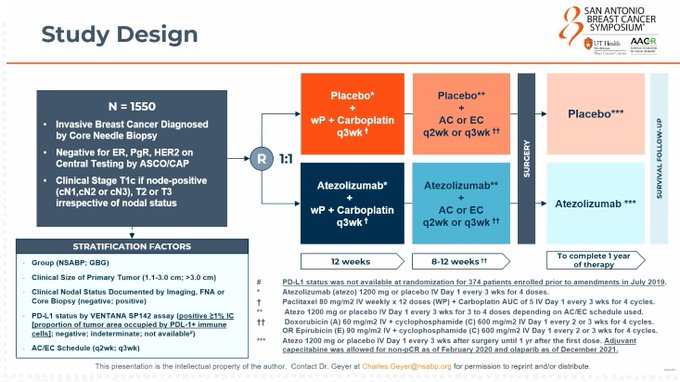
Design - Randomized, double-blind Phase III trial (NSABP Foundation, with the German Breast Group; NSABP B-59/GBG 96) in early triple-negative breast cancer: neoadjuvant chemotherapy plus atezolizumab or placebo, followed after surgery by adjuvant atezolizumab or placebo. Primary endpoint: event-free survival.
Pathologic response - The addition of atezolizumab significantly increased the pathologic complete response (pCR) rate versus placebo (SABCS 2024).
Event-free survival - The pCR gain did not translate into an improvement in event-free survival - the trial's primary endpoint was not met (SABCS 2024).
Safety - The safety profile was consistent with the known adverse effects of immunotherapy plus chemotherapy; no new safety signals were highlighted in the page's coverage (SABCS 2024).
Regulatory / sponsor - Atezolizumab (Tecentriq, Genentech) is not FDA-approved for early TNBC; its use here is investigational. Sponsored by NSABP Foundation Inc. Results were discussed at SABCS 2024 by experts including Dr. Jose Sandoval and Dr. Matteo Lambertini.
Compiled and reviewed by the KOL Pulse research team, led by Brian Shields, Founder, KOL Pulse. Last updated August 19, 2026.
GeparDouze Frequently Asked Questions
What is the GeparDouze trial?
GeparDouze (NSABP B-59/GBG 96, NCT03281954) is a randomized, double-blind Phase III trial led by NSABP Foundation Inc in patients with early-stage triple-negative breast cancer. Patients received neoadjuvant chemotherapy with atezolizumab or placebo, followed after surgery by adjuvant atezolizumab or placebo. The primary endpoint was event-free survival, with pCR, overall survival, and safety as secondary endpoints.
What did GeparDouze show?
Presented at SABCS 2024, GeparDouze showed that adding the PD-L1 inhibitor atezolizumab to neoadjuvant chemotherapy significantly increased the pathologic complete response rate, but this did not translate into an improvement in event-free survival, the trial's primary endpoint.
Is atezolizumab FDA approved for early triple-negative breast cancer?
No. Atezolizumab (Tecentriq) is not FDA-approved for early TNBC, and GeparDouze's EFS result does not support approval in this setting. Tecentriq holds FDA approvals in other cancers such as non-small cell lung cancer, small cell lung cancer, and hepatocellular carcinoma. The separately branded Tecentriq Hybreza (approved September 2024) is a subcutaneous atezolizumab formulation, not a different drug.
What is the safety profile of atezolizumab in GeparDouze?
The safety profile observed in GeparDouze was consistent with the known adverse effects of immunotherapy combined with chemotherapy. No unexpected safety signals were emphasized in the SABCS 2024 discussion covered on this page.
Why is the GeparDouze trial important?
GeparDouze is a key data point in the debate over checkpoint inhibitors in early TNBC: it demonstrated that a significant pCR improvement does not necessarily translate into an event-free survival benefit. Experts including Dr. Jose Sandoval and Dr. Matteo Lambertini discussed how the result complicates the integration of immunotherapy into early TNBC treatment, where pembrolizumab-based regimens are the established standard.