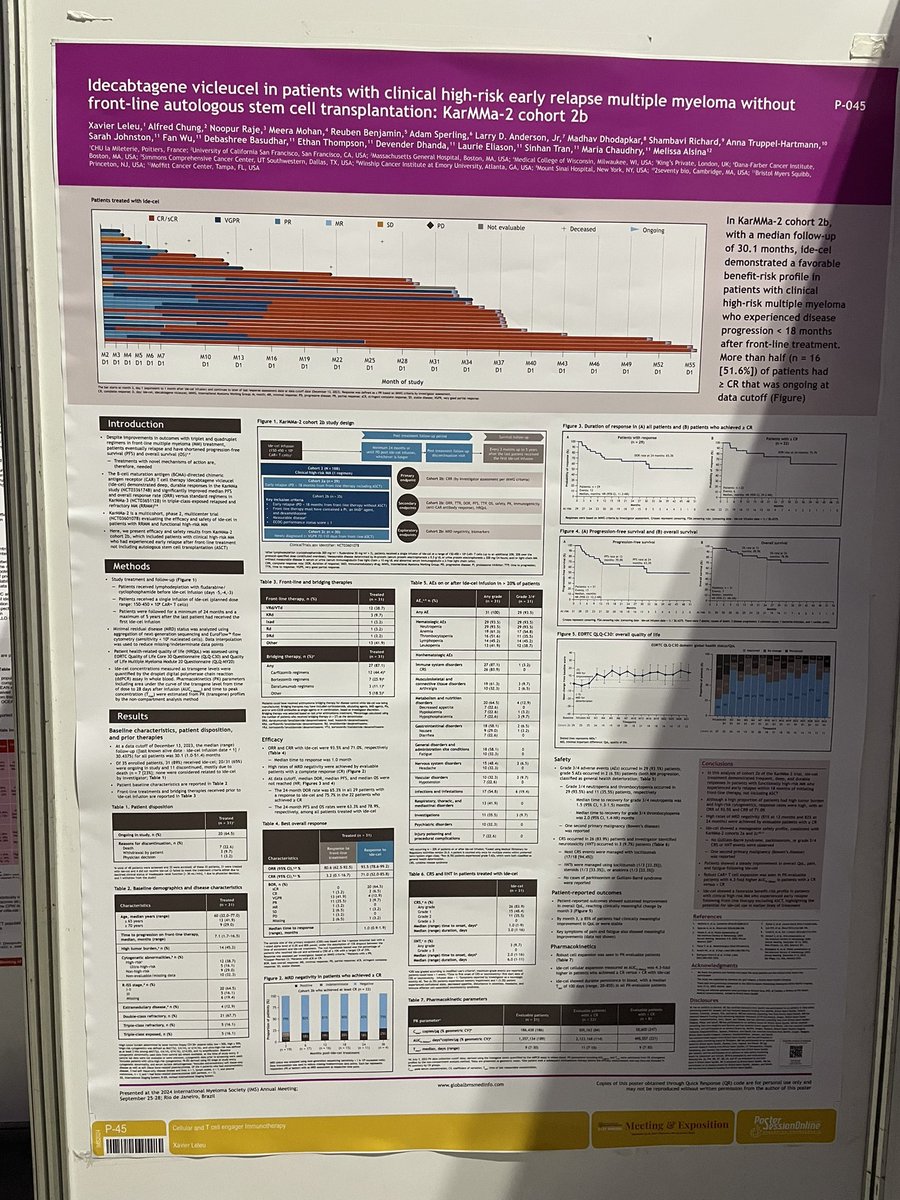
The KarMMa trial is a clinical study evaluating the efficacy and safety of ide-cel, a CAR T-cell therapy, in patients with multiple myeloma who have undergone multiple prior treatments. Designed to assess key endpoints such as overall response rate (ORR), progression-free survival (PFS), and overall survival (OS), the trial reported a 2-year PFS of 63%, indicating favorable outcomes, particularly in high-risk populations. Notably, baseline immune scores were predictive, with high-risk patients achieving a PFS of 25 months compared to just 6 months in low-risk counterparts. Data from the trial were presented at the ASH24 and IMS24 conferences, with notable contributions from experts including Bruno Paiva, Rahul Banerjee, MD, FACP, and Nico Gagelmann, who provided insights into the immune profiling and clinical implications of the findings.
Multiple Myeloma
KarMMa
About the KarMMa Trial
KarMMa at a Glance
Design - Phase II, open-label, single-arm, multicenter study (Celgene/Bristol Myers Squibb) of idecabtagene vicleucel (ide-cel, bb2121), a BCMA-directed CAR T-cell therapy, in relapsed/refractory multiple myeloma; 140 patients enrolled, 128 infused.
Response - Overall response rate 72%, with 28% of patients achieving a complete response, in the data supporting the FDA approval (FDA approval summary).
PFS / immune profiling - Correlative immune-profiling analyses of KarMMa patients (Paiva et al., presented at ASH 2024 and IMS 2024) found that baseline immune fitness scores were predictive of progression-free survival after ide-cel, separating longer- from shorter-PFS groups.
Safety - As a BCMA CAR T-cell therapy, ide-cel carries the class risks of cytokine release syndrome and neurologic toxicity described in its FDA labeling; see the FDA approval summary for trial-level safety detail.
Regulatory / sponsor - FDA approved (March 2021) as Abecma for RRMM after >=4 prior lines including an IMiD, a PI, and an anti-CD38 antibody - the first approved BCMA CAR-T. Sponsor: Celgene (Bristol Myers Squibb), developed with 2seventy bio. The 2024 expansion to >=2 prior lines was based on the separate KarMMa-3 trial.
Compiled and reviewed by the KOL Pulse research team, led by Brian Shields, Founder, KOL Pulse. Last updated August 19, 2026.
KarMMa Frequently Asked Questions
What is the KarMMa trial?
KarMMa (NCT03361748) is a Phase II, open-label, single-arm, multicenter study of idecabtagene vicleucel (ide-cel, bb2121), a BCMA-directed CAR T-cell therapy, in heavily pretreated relapsed and refractory multiple myeloma. The study enrolled 140 patients, of whom 128 received CAR T-cell infusion, and served as the registrational trial for Abecma.
What did the KarMMa trial show?
In the data supporting FDA approval, 72% of patients responded to ide-cel, including 28% with complete response - notable results in a population that had exhausted the major myeloma drug classes. Later correlative analyses presented at ASH 2024 and IMS 2024 (Paiva et al.) found baseline immune-profiling scores predictive of progression-free survival, helping define which patients benefit most from BCMA CAR T-cell therapy.
Is ide-cel (Abecma) FDA approved?
Yes. Based on KarMMa, the FDA approved idecabtagene vicleucel (Abecma) in March 2021 for adults with relapsed or refractory multiple myeloma after four or more prior lines of therapy including an immunomodulatory agent, a proteasome inhibitor, and an anti-CD38 monoclonal antibody - the first BCMA-targeted CAR T-cell therapy approved for myeloma. A 2024 label expansion to patients after at least two prior lines was based on the separate randomized KarMMa-3 trial.
What is the safety profile of ide-cel in KarMMa?
Ide-cel carries the recognized BCMA CAR-T class risks, including cytokine release syndrome and neurologic toxicity, which are described in its FDA labeling and approval summary. Patients are monitored closely after infusion; the therapy is given at authorized treatment centers.
Why is the KarMMa trial important?
KarMMa established BCMA CAR T-cell therapy as a viable option in triple-class-exposed myeloma and produced the first FDA approval of a CAR-T in this disease. Its ongoing correlative work - including the immune-profiling analyses from Bruno Paiva discussed at ASH 2024 and IMS 2024 with commentary from Dr. Rahul Banerjee and Dr. Nico Gagelmann - is helping define which patients benefit most from CAR-T.