Thread 1/9
Busy 48 hours for multicancer early detection.
The NHS-Galleri randomized trial is now in NEJM. Today an FDA advisory panel voted on Galleri. Our new medRxiv preprint is out, and my WSJ piece appeared today.
The evidence is neither a clear win nor a clear loss. https://t.co/ybUvfCzbX7
At a Glance
NHS-Galleri Key Takeaways
TL;DR
• Design: First randomized controlled trial of an MCED blood test — 142,318 asymptomatic adults aged 50–77 in England’s NHS enrolled (ClinicalTrials.gov); randomised analysis set 142,250 (LBA100 slide 6), randomized 1:1 to annual testing with GRAIL’s investigational MCED-V2 device + standard NHS screening vs standard screening alone, three annual rounds (ClinicalTrials.gov; ASCO 2026 LBA100).
• The device: the trial ran MCED-V2 (investigational). The commercial Galleri test is a different device (assay workflow, classifier, bioinformatics pipeline); its FDA-package effectiveness figures were bridged by re-running Galleri on frozen trial plasma from a weighted subset, while the FDA presents safety results from MCED-V2 and treats that primary safety analysis as an approximate estimate of Galleri’s safety profile (FDA Executive Summary, Sept 2026).
• Primary endpoint — NOT MET: no significant reduction in stage III/IV cancer incidence across 12 prespecified cancer types after 3 rounds — IRR 1.03 (95% CI 0.92–1.14), P=0.63 (NEJM, Sasieni et al., Sept 22, 2026; reported as p=0.6324 in ASCO 2026 LBA100 / GRAIL press release); driven by excess stage III diagnoses in the prevalent round (MCED-V2 data; round attribution is a KOL Pulse derivation from LBA100 slides 8 and 11).
• Key secondary signal: stage IV diagnoses down 14% overall (IRR 0.86, 95% CI 0.74–1.00; NEJM, Sept 22, 2026, which reports no P value for this endpoint), strengthening across rounds: −9% prevalent, −22% and −26% in incident rounds 2 and 3 (round-3 follow-up variable, 12–22 months; ASCO 2026 LBA100 slide 11 / GRAIL press release report the same overall 3-round result to three decimals, 95% CI 0.744–0.998, 342 vs 397 cancers; MCED-V2 data). Secondary — not a confirmed clinical benefit; mortality follow-up ongoing. FDA’s separate prevalent-round analysis: IRR 0.97 (0.78–1.21) all routinely staged / 0.87 (0.68–1.13) 12 types, no formal statistical testing (FDA Executive Summary).
• Test performance: PPV 52.0%, specificity 99.55%, CSO accuracy 92.5% across 3 rounds (GRAIL press release; MCED-V2 as run in trial); bridged-Galleri prevalent-round 12-month episode sensitivity 31.6%, stage I–II sensitivity 20.5% (FDA Executive Summary, Sept 2026; bridged Galleri data).
• Regulatory: Galleri is a multi-cancer early detection blood test by GRAIL — a prescription LDT in the US, not FDA cleared or approved; PMA modular submission completed Jan 29, 2026 (Breakthrough Device Designation 2018). The FDA’s Molecular and Clinical Genetics Panel met Sept 23, 2026 and voted 10–0 safe, 6–4 effective, and 7–2 (1 abstain) that benefits outweigh risks — a non-binding endorsement. Galleri is still not FDA approved; a PMA decision is expected in the coming months, and panel discussion favored dropping “early” from the indication (FDA Executive Summary; STAT, Sept 23, 2026; GRAIL press release, Sept 23, 2026).
• Sponsor / presenter: GRAIL, Inc., with the CRUK Cancer Prevention Trials Unit (QMUL); presented by Charles Swanton (Francis Crick Institute / UCL).
Free Access · KOL Pulse Intelligence
Track oncology’s top KOLs in your specialty
Create a free account, pick the tumor types you cover, and go beyond the tweet — the intelligence pharma teams use to map influence and prepare for engagement:
- ✓Enhanced KOL profiles
- ✓Pharma influence & potential advisory-board patterns
- ✓2025 Open Payments financial analysis
- ✓Social-media sentiment & trend signals
Get free access — pick your specialty
Choose the tumor types you follow. No cost, unsubscribe anytime.
The GRAIL Evidence Notebook
Every primary source behind this page — all six FDA advisory-committee briefing documents, GRAIL’s press releases and ASCO decks, journal abstracts, registry records, physician commentary and expert video — in one AI research notebook you can question directly, with cited answers.
Influence Leaders
Top KOLs Discussing NHS-Galleri

Charles Swanton
@CharlesSwanton
LBA100 Presenter

Harold J. Burstein, MD, PhD, FASCO
@DrHBurstein
23.6K impressions

gilberto lopes
@GlopesMd
20.9K impressions

Nicholas Hornstein
@GIMedOnc
10.5K impressions

Anirban Maitra
@Aiims1742
3.3K impressions

Paleoncologist
@PaleoOnc
3.0K impressions

Dr Amol Akhade
@SuyogCancer
3.0K impressions
KOL Threads, In Full
KOL Threads & Conversations — NHS-Galleri, Read in Full
gilberto lopes
@GlopesMd · Chief of Medical Oncology, Sylvester Comprehensive Cancer Center / University of Miami · posted the night of the Sept 23 FDA advisory committee vote (2026-09-24 UTC) · 9-post thread, verbatim and complete, plus two same-day follow-ups (leading reply-handles trimmed)
KOL Pulse context: the NHS-Galleri primary results were published as an NEJM Original Article on September 22, 2026 — Sasieni P et al., “Effect of Screening with Multicancer Early-Detection Test on Late-Stage Cancer Diagnosis,” N Engl J Med, DOI 10.1056/NEJMoa2505723 — alongside a distinct NEJM editorial (Hunter DJ, DOI 10.1056/NEJMe2611312) and the separate Nature Medicine test-performance companion (Neal RD et al., DOI 10.1038/s41591-026-04652-8). Three same-day publications; they are not interchangeable.
2/
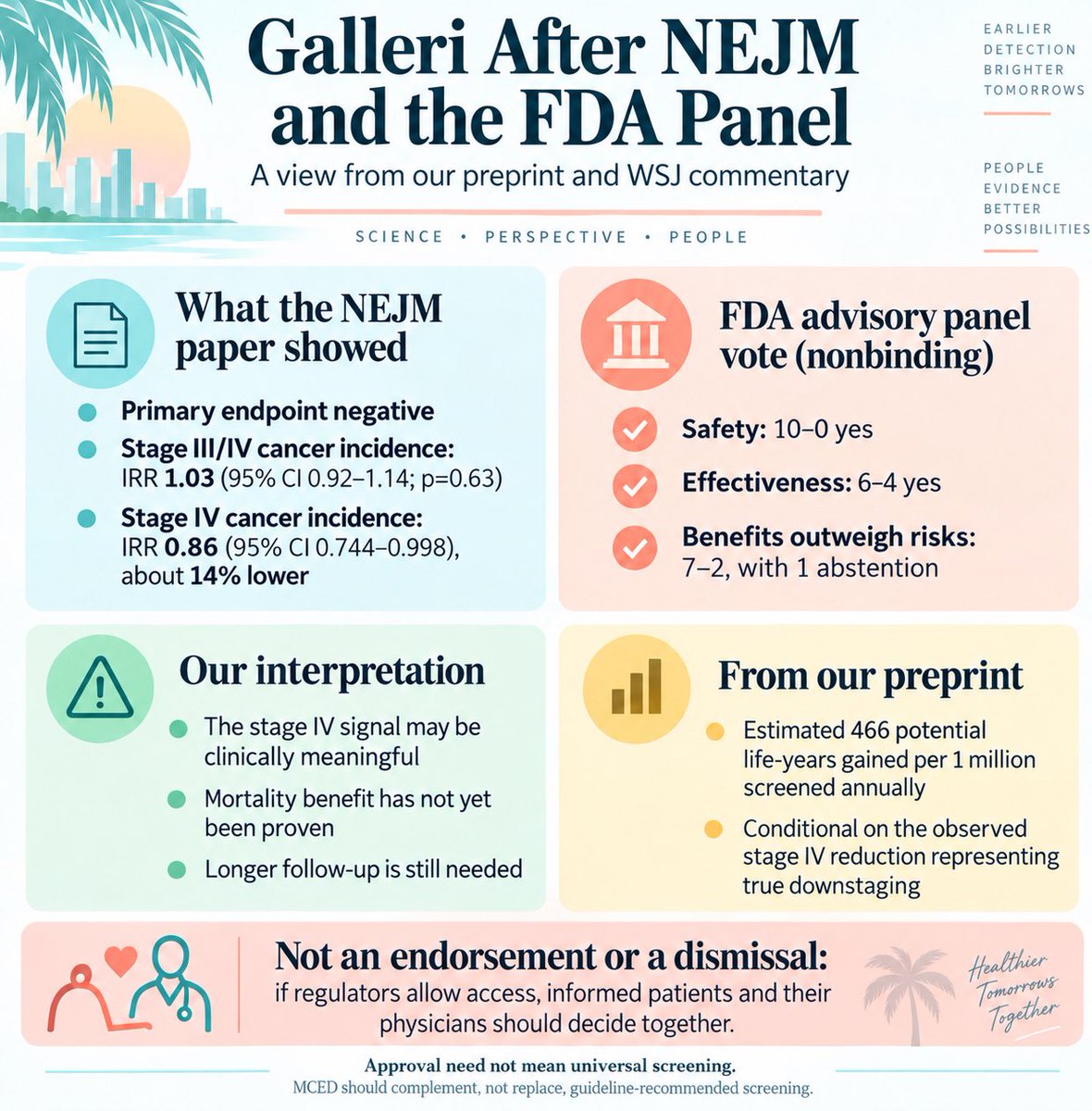
The primary NHS-Galleri endpoint was negative:
Stage III/IV cancer incidence
IRR 1.03
95% CI 0.92–1.14
P=0.63
So the trial did not show a significant reduction in combined late-stage cancer.
The primary NHS-Galleri endpoint was negative:
Stage III/IV cancer incidence
IRR 1.03
95% CI 0.92–1.14
P=0.63
So the trial did not show a significant reduction in combined late-stage cancer.
3/
But the key secondary endpoint tells a different story.
Stage IV cancer:
IRR 0.86
95% CI 0.74–1.00
That matters because stage III and metastatic stage IV disease are not clinically equivalent.
But the key secondary endpoint tells a different story.
Stage IV cancer:
IRR 0.86
95% CI 0.74–1.00
That matters because stage III and metastatic stage IV disease are not clinically equivalent.
KOL Pulse context: the stage IV interval Dr. Lopes quotes here (0.74–1.00) is the NEJM published rounding, which this page uses as its canonical citation for this endpoint. ASCO 2026 LBA100 slide 11 / the GRAIL press release report the same result to three decimals (0.744–0.998, 342 vs 397 cancers); that slide transcription is retained in the stage IV numbers table, labelled to its source. Same result, two roundings — each labelled, never mixed. It remains a key secondary endpoint, the primary endpoint was not met, and NEJM reports no P value for it.
4/
Our preprint asks:
If that stage IV reduction represents true downstaging, what could it mean?
We estimate about 466 potential life-years gained per million screened annually.
Important: this is a conditional model, not evidence that Galleri reduces mortality.
https://t.co/i3azlKpiQR
Our preprint asks:
If that stage IV reduction represents true downstaging, what could it mean?
We estimate about 466 potential life-years gained per million screened annually.
Important: this is a conditional model, not evidence that Galleri reduces mortality.
https://t.co/i3azlKpiQR
KOL Pulse context: the 466 life-years figure is from Dr. Lopes’ own medRxiv preprint — a conditional model, not an NHS-Galleri trial result. He states the caveat himself in this post. NHS-Galleri did not measure mortality or life-years, and no mortality benefit has been demonstrated for Galleri.
5/
Today’s FDA advisory vote captured the uncertainty:
Safety: 10–0 yes
Effectiveness: 6–4 yes
Benefits > risks: 7–2, 1 abstention
The FDA is not bound by the panel’s recommendation. https://t.co/cQ9legssUY
Today’s FDA advisory vote captured the uncertainty:
Safety: 10–0 yes
Effectiveness: 6–4 yes
Benefits > risks: 7–2, 1 abstention
The FDA is not bound by the panel’s recommendation. https://t.co/cQ9legssUY
6/
So I would resist both extremes.
The negative primary endpoint matters.
The stage IV signal also matters.
And neither proves whether MCED screening ultimately reduces cancer mortality.
We need longer follow-up.
So I would resist both extremes.
The negative primary endpoint matters.
The stage IV signal also matters.
And neither proves whether MCED screening ultimately reduces cancer mortality.
We need longer follow-up.
7/
We also need to weigh:
false positives
diagnostic procedures
cost
access
overdiagnosis
and the fact that MCED testing must complement, not replace, established screening.
We also need to weigh:
false positives
diagnostic procedures
cost
access
overdiagnosis
and the fact that MCED testing must complement, not replace, established screening.
8/
If regulators ultimately judge the evidence sufficient for access, I think the next decision belongs where many difficult medical decisions belong:
with informed patients and their physicians.
Approval need not mean universal screening.
If regulators ultimately judge the evidence sufficient for access, I think the next decision belongs where many difficult medical decisions belong:
with informed patients and their physicians.
Approval need not mean universal screening.
9/
My WSJ piece today:
“The Galleri Result That Could Matter Most”
https://t.co/j24ZZN0h7j
#MCED #Galleri #CancerScreening #FDA #CancerResearch #SharedDecisionMaking
My WSJ piece today:
“The Galleri Result That Could Matter Most”
https://t.co/j24ZZN0h7j
#MCED #Galleri #CancerScreening #FDA #CancerResearch #SharedDecisionMaking
I know but this pic is interesting - MCED detected more cancers than regular screen!!! https://t.co/3cn9lAw0iE

KOL Pulse context: the NEJM Figure 3 counts, in full: in the intervention group (N=3,637) 937 cancers were MCED-detected and 236 were detected by the NHS’s existing screening programs — but 2,464 were still clinically detected. Control group N=3,400 (3,110 clinically detected, 290 NHS screening-detected). A screen-detected count is a detection route, not a demonstrated benefit.
I know. Would love to see equivalent pic for pathfinder. Let me check. Haven’t had a chance to dig into that one yet
gilberto lopes
@GlopesMd · ASCO 2026 · May 31, 2026 · 8-post thread, verbatim and complete
Alright. It’s Sunday @ASCO
Everyone awake and alert?
The trial I most wanted to see -
NHS-Galleri at #ASCO26 (Swanton, LBA100): the first randomized trial of an MCED test in 142,000+ NHS participants.
Honest read: the primary endpoint was missed, but thets not the whole story.
The secondary signals make this neither the breakthrough nor the failure the headlines suggest. 🧵
#ASCO26 @OncoAlert @OncBrothers @StephenVLiu @Jani_Chinmay @asco @myESMO @glopesmd @SylvesterCancer @latinamd @iaslc @COlazagasti @openevidence @openmedicinehq @narjustflorezmd @lungoncdoc @drshieldsmd @jackwestmd @n8pennell @mtmdphd @drarturoai @larvol @onclive @rmanochakian @devikadasmd @dryukselurun @dan_morgen @ptarantinomd
@DrJNaidoo @NaglaAKarimMD @Lung_Cancers @DrSanjayPopat @tnewsomdavis @Tony_Calles @ns_chd @BalazsHalmosMD @dr_yakupergun @ipreeshagul @FordePatrick @OncNewsCentral @imedverse @acmoorephd @DipeshUpretyMD @Alfdoc2 @g_mountzios @dmavicente @drshieldsmd @DrRiyazShah
Everyone awake and alert?
The trial I most wanted to see -
NHS-Galleri at #ASCO26 (Swanton, LBA100): the first randomized trial of an MCED test in 142,000+ NHS participants.
Honest read: the primary endpoint was missed, but thets not the whole story.
The secondary signals make this neither the breakthrough nor the failure the headlines suggest. 🧵
#ASCO26 @OncoAlert @OncBrothers @StephenVLiu @Jani_Chinmay @asco @myESMO @glopesmd @SylvesterCancer @latinamd @iaslc @COlazagasti @openevidence @openmedicinehq @narjustflorezmd @lungoncdoc @drshieldsmd @jackwestmd @n8pennell @mtmdphd @drarturoai @larvol @onclive @rmanochakian @devikadasmd @dryukselurun @dan_morgen @ptarantinomd
@DrJNaidoo @NaglaAKarimMD @Lung_Cancers @DrSanjayPopat @tnewsomdavis @Tony_Calles @ns_chd @BalazsHalmosMD @dr_yakupergun @ipreeshagul @FordePatrick @OncNewsCentral @imedverse @acmoorephd @DipeshUpretyMD @Alfdoc2 @g_mountzios @dmavicente @drshieldsmd @DrRiyazShah

Primary endpoint (combined stage III+IV reduction across 12 cancers): 706 vs 688, IRR 1.03 (95% CI 0.92–1.14), p=0.63. A 3% INCREASE in the intervention arm. By the trial’s own predefined yardstick, this is a negative study. https://t.co/UUDAtwC6al
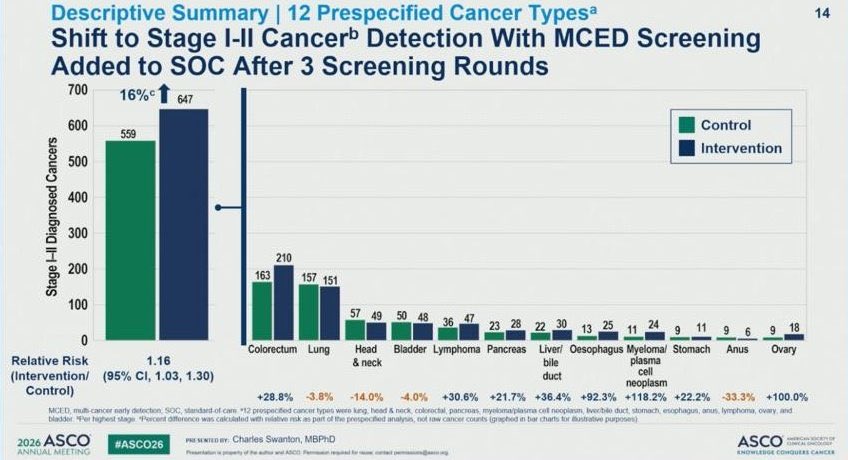
But the composite hides two opposing signals. Stage IV diagnoses fell — and the time trend matters: −9% in round 1, −22% in round 2, −26% in round 3. That’s the signature of a real effect strengthening with experience and time, not noise. Stage I–II detection rose 16%.
The endpoint missed because of an excess of STAGE III diagnoses, especially in the prevalent round. GRAIL argues some of this is stage IV→III shift plus diagnostic-pathway delays. Plausible, but unfalsifiable without the underlying data. A real asterisk, not a marketing-only issue.
The harder critique: stage shift ≠ mortality benefit. Finding cancers earlier can mean cure, OR overdiagnosis of indolent disease, OR lead-time bias. Stage-shift data alone can’t tell these apart. Most of us would say: not yet ready for guideline inclusion. https://t.co/uVIIKGXdch

What’s most encouraging on its own terms: a 25% reduction in cancers diagnosed through EMERGENCY presentation. That route carries some of the worst outcomes in oncology. If real, this benefit is harder to attribute to overdiagnosis — emergency presentations are rarely indolent. https://t.co/AZy5wLdjPN
So — will this translate to a survival benefit? My read: plausible, not yet proven. The stage IV trend (especially the round-3 26% drop) and the emergency-presentation signal are the strongest arguments for eventual mortality benefit, particularly in the no-screening cancers (pancreas, ovary, esophagus, liver, H&N).
I would focus on those moving forward.
I would focus on those moving forward.
What this trial actually changes: stage shift is not the right primary endpoint for MCED. Future trials need mortality (or at minimum stage IV–specific) endpoints and diagnostic pathways that don’t introduce stage slip. NHS-Galleri’s most lasting contribution may be that lesson, alongside an extended-follow-up readout to come.
I’ll eagerly wait for it!
#ASCO26 @OncoAlert @OncBrothers @StephenVLiu @Jani_Chinmay @asco @myESMO @glopesmd @SylvesterCancer @latinamd @iaslc @COlazagasti @openevidence @openmedicinehq @narjustflorezmd @lungoncdoc @drshieldsmd @jackwestmd @n8pennell @mtmdphd @drarturoai @larvol @onclive @rmanochakian @devikadasmd @dryukselurun @dan_morgen @ptarantinomd
@DrJNaidoo @NaglaAKarimMD @Lung_Cancers @DrSanjayPopat @tnewsomdavis @Tony_Calles @ns_chd @BalazsHalmosMD @dr_yakupergun @ipreeshagul @FordePatrick @OncNewsCentral @imedverse @acmoorephd @DipeshUpretyMD @Alfdoc2 @g_mountzios @dmavicente @drshieldsmd @DrRiyazShah
I’ll eagerly wait for it!
#ASCO26 @OncoAlert @OncBrothers @StephenVLiu @Jani_Chinmay @asco @myESMO @glopesmd @SylvesterCancer @latinamd @iaslc @COlazagasti @openevidence @openmedicinehq @narjustflorezmd @lungoncdoc @drshieldsmd @jackwestmd @n8pennell @mtmdphd @drarturoai @larvol @onclive @rmanochakian @devikadasmd @dryukselurun @dan_morgen @ptarantinomd
@DrJNaidoo @NaglaAKarimMD @Lung_Cancers @DrSanjayPopat @tnewsomdavis @Tony_Calles @ns_chd @BalazsHalmosMD @dr_yakupergun @ipreeshagul @FordePatrick @OncNewsCentral @imedverse @acmoorephd @DipeshUpretyMD @Alfdoc2 @g_mountzios @dmavicente @drshieldsmd @DrRiyazShah
Harold J. Burstein, MD, PhD, FASCO
@DrHBurstein · ASCO 2026 · May 30, 2026 · 3-post thread, verbatim and complete
1/ the @NHS-Galleri trial is 1st RCT for molecular screening for early cancer detection. 142K participants; found ~1400 cancers overall (i.e. 1% ). No sig reduction in incidence rates of stage III/IV cancers. No change in rate @ prevalent vs incident rds.
2/ ctDNA testing in @NHS-Galleri screening study did yield more diagnoses of stage 1 or 2 cancers, especially colorectal cancer (important to note that US has far more colon cancer screening than does UK, which may be contibutor here).
3/ Takeaway from @NHS-Galleri. Hugh screening study did not meet primary endpoints overall. Some signals of shift to asymptomatic detection but data limited by rate of colon ca. screening in UK. Many academic sites 'screening' this way but w/o RCT, outcomes not meaningful.

David Gandara
@drgandara · AdComm eve, Sept 22, 2026 · conversation with 3 physician replies, verbatim (leading reply-handles trimmed)
Re-Grail cancer screening test Galleri, difficult to understand why WSJ paints a rosy picture of this cancer screening test, able to "detect cancer in its infancy", when in fact, majority of cancers detected are advanced, ~stage 4, widespread, not stage 1. We need to do better. https://t.co/tUuOJ0RcYQ

Thanks David. A strange article in many ways. Anyone would think it hadn’t failed its’ primary endpoint
 Patrick C. Ma, MD
@PatrickCMa1 · Section Chief, Hem/Onc · LSU-LCMC Health Cancer Center2026-09-22
View on X ↗
Patrick C. Ma, MD
@PatrickCMa1 · Section Chief, Hem/Onc · LSU-LCMC Health Cancer Center2026-09-22
View on X ↗It's a topic that can and likely is already turning into a polarizing and emotional discussion, esp btw patients and researchers, esp in the era of stage 4 cancer disease being more and nore "treatable" with notably improved survival across many cancer types, lung included, even at stage 4.

Agreed. Earlier detection is the promise, but stage shift and ultimately mortality benefit are the real tests. Detecting more cancers is not enough if many are still found at an advanced stage.
Conference Presentations
NHS-Galleri Key Slides & Visuals


[Slide 1 — ASCO 2026 slide 5]
NHS-Galleri Is the Largest, First, and Only Randomised Controlled Clinical Utility Trial of an MCED Test to Date
Approximately 1.5 million individuals invited (NHS England) -> 142,826 consented participants aged 50-77 years with no cancer diagnosis or treatment in the past 3 years -> Blood sample collected -> Randomised 1:1 (blinded)
Intervention (71,122): MCED test performed. Positive: results are reported back to participant (unblinded) -> Referred to Diagnostic Pathway Through NHS (Outside of Trial) -> Cancer Diagnosed / No Cancer Diagnosed. Negative (blinded) -> Return for 1- and 2-year blood sample visits.
Control (71,128): sample stored (blinded).
Primary Endpoint: Significant reduction in incidence rate of late-stage cancer (stage III/IV) after 3 annual screening rounds — in a prespecified group of 12 primary cancer types; in all routinely staged cancer types (excluding and including prostate cancer).
Secondary Endpoints: Prespecified secondary endpoints of clinical interest — reduction in stage IV cancer incidence rate; proportion stage I/II cancers; safety (based on MCED test only); mortality (after longer follow-up); stage distribution by cancer type.
Exploratory/Adhoc Endpoints: route to diagnosis.
Participants passively monitored through national registry datasets.
MCED, multi-cancer early detection; NHS, National Health Service. 12 cancer types: lung, head & neck, colorectal, pancreas, myeloma/plasma cell neoplasm, liver/bile duct, stomach, esophagus, anus, lymphoma, ovary, and bladder. Sasieni P, et al. Cancers (Basel). 2022;14(19):4818.
Presented by: Charles Swanton, MBPhD — 2026 ASCO Annual Meeting #ASCO26
---
[Slide 2 — ASCO 2026 slide 8]
Primary Endpoint | 12 Prespecified Cancer Types
No Significant Reduction in Stage III/IV Cancers Observed in the Intervention Arm With the Current Follow-Up Window
Stage III/IV diagnosed cancers after 3 screening rounds: Control 688 vs Intervention 706 (3% up).
Incidence Rate Ratio (Intervention/Control): 1.03 (95% CI, 0.92, 1.14), p=0.6324.
Relative incidence of stage III/IV cancers decreased after the first screening round.
First Screening Round (prevalent): 211 vs 250, 19% up, IRR 1.19 (0.98, 1.43). Second Screening Round (incident): 189 vs 179, 5% down, IRR 0.95 (0.77, 1.17). Third Screening Round (incident): 243 vs 214, 12% down, IRR 0.88 (0.73, 1.07).
Footnote: 12 prespecified cancer types were lung, head & neck, colorectal, pancreas, myeloma/plasma cell neoplasm, liver/bile duct, stomach, esophagus, anus, lymphoma, ovary, and bladder. Percent difference was calculated with incidence rate ratios as part of the prespecified analysis, not raw cancer counts. Follow-up time was variable in the third screening round and ranged from 12 to 22 months.
---
[Slide 3 — ASCO 2026 slide 17]
Exploratory | All Detected Cancers
MCED Quadrupled the Number of Screening-Detected Cancers and Reduced Clinically Detected Cancers and Emergency Presentations
4x Screening-Detected. Control (n=290) vs Intervention (n=1173: MCED-detected n=937 + NHS screening-detected 236).
MCED-detected by stage: Stage I 202, Stage II 164, Stage III 274, Stage IV 232, Unstageable/Missing 65. Stages I-III: 68% of MCED-detected cancers.
21% reduction in clinically detected cancers — Control vs Intervention: 3110 vs 2464.
25% reduction in emergency presentation diagnoses — Control vs Intervention: 286 vs 213.
Footnote: supportive sensitivity analysis after targeted review of 39 participants with an MCED-positive result and Emergency Presentation route to diagnosis; 12 had documented evidence against Emergency Presentation and were no longer classified as Emergency Presentation in this analysis.
---
[Slide 4 — ASCO 2026 slide 2]
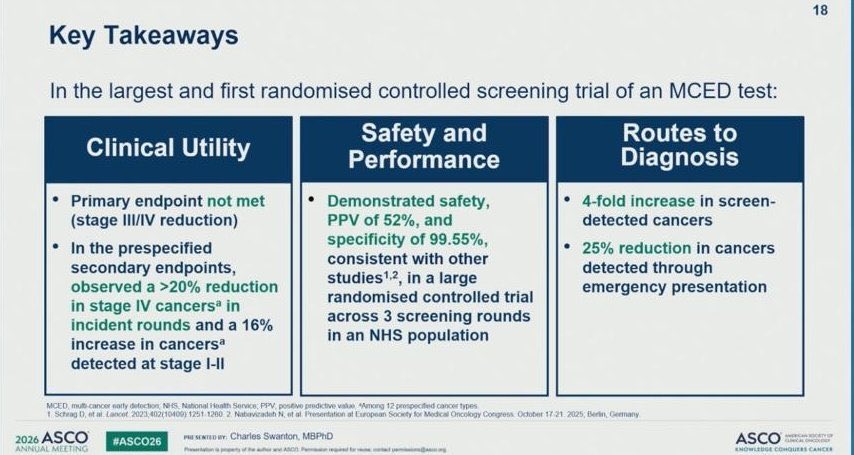
Key Takeaways — In the largest and first randomised controlled screening trial of an MCED test:
Clinical Utility: Primary endpoint not met (stage III/IV reduction). Observed reduction in stage IV cancers and increase in stage I-II cancers — both prespecified secondary endpoints.
Safety and Performance: Demonstrated safe implementation and robust performance across 3 screening rounds in an NHS population. Prevalent round performance was consistent with other prospective clinical studies (refs 1,2).
Routes to Diagnosis: 4-fold increase in screen-detected cancers. Reduction in cancers detected through emergency presentation.
Refs: 1. Schrag D, et al. Lancet. 2023;402(10409):1251-1260. 2. Nabavizadeh N, et al. Presentation at European Society for Medical Oncology Congress, October 17-21, 2025, Berlin, Germany.


[Slide 1 — ASCO 2026 slide 6]
Trial Arms Were Well Balanced and Retained Majority of Participants Over 3 Screening Rounds
Enrolment and Randomisation over ~10.5 months (Randomised Analysis Set) N=142,250. Intervention Arm n=71,122; Control Arm n=71,128. Not clinically eligible: n=50 (0.07%) / n=57 (0.08%); not clinically evaluable n=38 (0.05%) each. Clinically Eligible and Evaluable Sets: n=71,034 / n=71,033.
Participant retention was 91% in the second year and 88% in the third year of screening. Median follow-up of 17 months after last screen.
Baseline demographics (Intervention / Control): median age 66 (IQR 59, 71) both arms; age 50-59: 26.4%/26.6%; 60-69: 40.2%/40.5%; 70+: 33.4%/33.0%; female 50.2% both; White race/ethnicity 93.6% both; most deprived 22.6% both; least deprived 16.1%/16.0%; CSEs/O-Levels or lower 44.9%/45.2%; bachelor's degree or higher 25.0%/25.1%; former smoker 38.3%/38.2%; current smoker 6.7%/6.6%; prior cancer history 7.5% both.
---
[Slide 2 — ASCO 2026 slide 9]
Descriptive Summary | 12 Prespecified Cancer Types
No Significant Reduction in Stage III/IV Cancers Appears to Be Driven by Increase in Stage III Cancers Diagnosed
After 3 screening rounds: Control 688 vs Intervention 706 (3% up). Incidence Rate Ratio (Intervention/Control) 1.03 (95% CI, 0.92, 1.14), p=0.6324.
By stage: Stage III — Control 291 vs Intervention 364 (25% up). Stage IV — Control 397 vs Intervention 342 (14% down).
Footnote: percent difference calculated with raw cancer counts for illustrative purposes, not as part of a stage-shift endpoint.
---
[Slide 3 — ASCO 2026 slide 13]
Descriptive Summary | 12 Prespecified Cancer Types — Differences in Stage IV Diagnoses by Cancer Types
Stage IV cancers diagnosed in the intervention vs control arm during incident screening rounds (%):
Bladder 1 vs 5 (-80.0%); Liver/bile duct 4 vs 14 (-71.4%); Oesophagus 9 vs 21 (-57.1%); Head & neck 10 vs 16 (-37.5%); Colorectum 21 vs 32 (-34.4%); Lung 50 vs 73 (-31.5%); Stomach 6 vs 8 (-25.0%); Lymphoma 38 vs 37 (+2.7%); Ovary 8 vs 7 (+14.3%); Pancreas 33 vs 26 (+26.9%).
England 5-year net survival estimates: Stage IV 5.8% / 2.6% / 6.2% / 38.4% / 11.0% / 4.5% / 4.5% / 65.7% / 16.2% / 2.1%; Stage III 31.8% / 13.5% / 24.7% / 54.5% / 64.2% / 16.7% / 24.6% / 72.6% / 32.4% / 8.7%; Difference +26.0% / +10.9% / +18.5% / +16.1% / +53.2% / +12.2% / +20.1% / +6.9% / +16.2% / +6.6%.
Footnote: anus and myeloma/plasma cell neoplasms excluded from the graph due to having only 0 to 1 stage IV cancers in each arm. Survival: patients diagnosed in England 2018-2022 (all ages) by stage at diagnosis; Cancer Survival in England, cancers diagnosed 2018 to 2022, followed up to 2023; digital.nhs.uk, accessed May 19, 2026.
---
[Slide 4 — ASCO 2026 slide 17]
Exploratory | All Detected Cancers — MCED Quadrupled the Number of Screening-Detected Cancers and Reduced Clinically Detected Cancers and Emergency Presentations
4x Screening-Detected. Control (n=290) vs Intervention (n=1173): MCED-Detected (n=937) — Stage I 202, Stage II 164, Stage III 274, Stage IV 232, Unstageable/Missing 65; NHS Screening-Detected 236. Stages I-III: 68% of MCED-detected cancers.
21% reduction in clinically detected cancers (Control vs Intervention: 3110 vs 2464). 25% reduction in emergency presentation diagnoses (Control vs Intervention: 286 vs 213).


[Slide 1 — ASCO 2026 slide 5]
NHS-Galleri Is the Largest, First, and Only Randomised Controlled Clinical Utility Trial of an MCED Test to Date
Approximately 1.5 million individuals invited (NHS England); 142,826 consented participants aged 50-77 years with no cancer diagnosis or treatment in the past 3 years; blood sample collected; randomised 1:1. Intervention (71,122): MCED test performed; positive results reported back to participant (unblinded), referred to diagnostic pathway through NHS (outside of trial); negative blinded. Control (71,128): sample stored. Return for 1- and 2-year blood sample visits. Participants passively monitored through national registry datasets.
Primary endpoint: significant reduction in incidence rate of late-stage cancer (stage III/IV) after 3 annual screening rounds — in a prespecified group of 12 primary cancer types; in all routinely staged cancer types. Secondary endpoints: reduction in stage IV cancer incidence rate; proportion stage I/II cancers; safety (based on MCED test only); mortality (after longer follow-up); stage distribution by cancer type. Exploratory: route to diagnosis.
---
[Slide 2 — ASCO 2026 slide 6]
Trial Arms Were Well Balanced and Retained Majority of Participants Over 3 Screening Rounds
Randomised Analysis Set N=142,250; Intervention Arm n=71,122; Control Arm n=71,128; Clinically Eligible and Evaluable Sets n=71,034 / n=71,033. Participant retention 91% in the second year and 88% in the third year of screening. Median follow-up of 17 months after last screen. Median age 66 both arms; female 50.2%; White 93.6%; prior cancer history 7.5%.
---
[Slide 3 — ASCO 2026 slide 8]
Primary Endpoint | 12 Prespecified Cancer Types — No Significant Reduction in Stage III/IV Cancers Observed in the Intervention Arm With the Current Follow-Up Window
After 3 screening rounds: 688 (control) vs 706 (intervention), 3% up. Incidence Rate Ratio 1.03 (95% CI, 0.92, 1.14), p=0.6324. By round: first (prevalent) 211 vs 250, 19% up, IRR 1.19 (0.98, 1.43); second (incident) 189 vs 179, 5% down, IRR 0.95 (0.77, 1.17); third (incident) 243 vs 214, 12% down, IRR 0.88 (0.73, 1.07).
---
[Slide 4 — ASCO 2026 slide 11]
Secondary Endpoint | 12 Prespecified Cancer Types — 14% Reduction in Stage IV Cancers Observed in the Intervention Arm; >=22% Reduction in Incident Rounds
Cumulative probability of stage IV cancer curve (intervention vs control arms, months from randomisation; variable follow-up depending on enrolment date). [At-risk table values as per curve figure.]
Stage IV cancers diagnosed — Incidence Rate Ratio (Intervention vs Control) and % difference (n vs n): After 3 screening rounds: 0.86 (0.744, 0.998), 14% down, 342 vs 397. First Screening Round (Prevalent): 0.91 (0.71, 1.18), 9% down, 117 vs 128. Second Screening Round (Incident): 0.78 (0.57, 1.06), 22% down, 78 vs 100. Third Screening Round (Incident): 0.74 (0.57, 0.95), 26% down, 104 vs 142.
Relative incidence of stage IV cancers decreased each screening round.


[Slide 1 — ASCO 2026 slide 2, partial view]
Key Takeaways — In the largest and first randomised controlled screening trial of an MCED test:
Clinical Utility: Primary endpoint not met (stage III/IV reduction). In the prespecified secondary endpoints, observed a >20% reduction in stage IV cancers in incident rounds and a 16% increase in cancers detected at stage I-II.
Safety and Performance: Demonstrated safety, PPV of 52%, and specificity of 99.55%, consistent with other studies (refs 1,2), in a large randomised controlled trial across 3 screening rounds in an NHS population.
Routes to Diagnosis: 4-fold increase in screen-detected cancers. 25% reduction in cancers detected through emergency presentation.
Footnote: among 12 prespecified cancer types. Refs: 1. Schrag D et al. Lancet 2023;402(10409):1251-1260. 2. Nabavizadeh N, et al. ESMO Congress, October 17-21, 2025, Berlin, Germany.
---
[Slide 2 — ASCO 2026 slide 8]
Primary Endpoint | 12 Prespecified Cancer Types — No Significant Reduction in Stage III/IV Cancers Observed in the Intervention Arm With the Current Follow-Up Window
After 3 screening rounds: 688 vs 706 (3% up); IRR 1.03 (95% CI, 0.92, 1.14), p=0.6324. First round (prevalent) 211 vs 250, 19% up, 1.19 (0.98, 1.43); second round 189 vs 179, 5% down, 0.95 (0.77, 1.17); third round 243 vs 214, 12% down, 0.88 (0.73, 1.07).
---
[Slide 3 — ASCO 2026 slide 4]
Blood-Based Targeted Methylation MCED Test
The MCED test detects a cancer signal from cell-free DNA (cfDNA) in blood and predicts cancer signal origin (CSO) to guide diagnostic evaluation.
Tumor sheds cfDNA fragments into bloodstream -> blood plasma isolated (contains cfDNA fragments) -> targeted methylation analysis of cfDNA (sequencing, mapping, alignment) -> machine learning classifier -> Negative (no cancer signal detected) / Positive (cancer signal detected) -> Predicted CSO (e.g., head and neck, lymphoid).
Clinically validated in case-control and population-scale intended-use studies (refs 1-4). Clinical evidence program includes >380,000 participants across 9 studies in North America and the UK.
Refs: Liu MC et al. Ann Oncol 2020;31(6):745-759; Klein EA et al. Ann Oncol 2021;32(9):1167-1177; Schrag D et al. Lancet 2023;402(10409):1251-1260; Nabavizadeh N et al. ESMO 2025.


[Chart 1 — GRAIL NHS-Galleri fact sheet]
Percent Difference in Stage III/IV and Stage IV Cancers Diagnosed Between Intervention and Control Arms
Overall: Stage III/IV +3%; Stage IV -14%. First Screening Round: Stage III/IV +19%; Stage IV -9%. Second Screening Round: Stage III/IV -5%; Stage IV -22%. Third Screening Round: Stage III/IV -12%; Stage IV -26%.
---
[Chart 2 — GRAIL NHS-Galleri fact sheet]
Numbers of participants diagnosed at stage I-II (12 prespecified cancer types): Control 559 vs Intervention 647 — up 16%.

@DrRishabhOnco
@ChandrakanthMv

@ChandrakanthMv
Community Discussion
NHS-Galleri Top Tweets
𝕏GRAIL has had a strange life as a company.
Not because the idea is bad. Quite the opposite. They are trying to build something that could actually help people: a blood test that detects cancer before symptoms appear.
That is a very hard problem.
GRAIL was spun out of Illumina in 2016 with an initial approach focused on ultra-deep sequencing of circulating tumor DNA mutations. That quickly ran into a biological constraint. Early cancers often shed vanishingly small amounts of mutated DNA into the bloodstream.
So the company pivoted.
Instead of focusing on mutations, they moved toward genome-wide methylation patterns. Methylation carries a much larger signal and can also help infer tissue of origin. That pivot eventually became the basis for Galleri.
Whether multi-cancer early detection testing will ultimately work remains an open question. But at least they are trying to solve a real problem.
Which brings us to the NHS-Galleri Trial.
The study enrolled roughly 140,000 participants in the UK to test whether Galleri could shift cancer diagnoses earlier. The key idea was straightforward: detect cancers before they present clinically and reduce late-stage disease.
And this is where trial design matters. A lot.
The primary endpoint combined stage III and stage IV cancers into a single “late stage” category. The trial ultimately did not meet that endpoint.
But the results also suggest something more nuanced. There appears to be a reduction in stage IV cancers.
Those two things can coexist.
If a screening test moves cancers that would have presented as stage IV into stage III instead, that is arguably progress. Stage III disease is often curable. Stage IV usually is not. But if the endpoint lumps stage III and stage IV together, that improvement can disappear statistically.
Same biology. Different interpretation.
All because of how the endpoint was defined.
(Separately, the CEO of GRAIL just “retired” three weeks after the results. That now makes six CEOs in ten years.)
The bigger lesson here is not really about GRAIL.
Cancer screening is brutally difficult. Biology, statistics, lead-time bias, overdiagnosis… every piece of it fights you.
And sometimes the difference between a breakthrough and a failure is not the test.
It is the trial you chose to run.
10.5K impressions44 likes4 repostsRead full post ↗2026-03-13
𝕏Alright - totally “back of the envelope”, Claude-powered, non-stress tested and non-peer-reviewed calculation. What’s the likely benefit in Overall Survival if these results hold?
If the NHS-Galleri stage-shift signal proves durable at extended follow-up, the most defensible point estimate of cancer-specific mortality reduction at 5 years in the screened population is:
≈ 4% relative reduction in 12-cancer composite mortality
95% plausibility range: 1% to 9%
≈ 3,000 UK lives saved per year of screened-cohort incidence (range 900–6,500)
Methods note
Computational model: per-cancer 5-year deaths estimated as Σ (incidence × stage-fraction × (1 − stage-specific 5y relative survival)). Galleri intervention modeled as proportional reduction in distant-stage incidence, with shifted cases redistributed to localized:regional in the same ratio as baseline, after accounting for lead-time-bias fraction and overdiagnosis correction. SEER summary stages used as proxy for AJCC stages I-II/III/IV. UK incidence figures approximated to one significant figure for the screening-eligible band; precise per-tumor UK incidence would refine point estimates but not the order of magnitude or relative cancer ranking. Source data: SEER 2015–2021 5-year relative survival by summary stage (verified for pancreas, ovary, esophagus, stomach, head and neck via ASCO/ACS published values; remaining tumors anchored to standard published SEER ranges).
#ASCO26 @OncoAlert @OncBrothers @StephenVLiu @Jani_Chinmay @asco @myESMO @glopesmd @SylvesterCancer @latinamd @iaslc @COlazagasti @openevidence @openmedicinehq @narjustflorezmd @lungoncdoc @drshieldsmd @jackwestmd @n8pennell @mtmdphd @drarturoai @larvol @onclive @rmanochakian @devikadasmd @dryukselurun @dan_morgen @ptarantinomd
@DrJNaidoo @NaglaAKarimMD @Lung_Cancers @DrSanjayPopat @tnewsomdavis @Tony_Calles @ns_chd @BalazsHalmosMD @dr_yakupergun @ipreeshagul @FordePatrick @OncNewsCentral @imedverse @acmoorephd @DipeshUpretyMD @Alfdoc2 @g_mountzios @dmavicente @drshieldsmd @DrRiyazShah
3.7K impressions23 likes7 repostsRead full post ↗2026-05-31
𝕏The full NHS GALLERI randomized trial data has been released at #ASCO26 by @GrailBio.
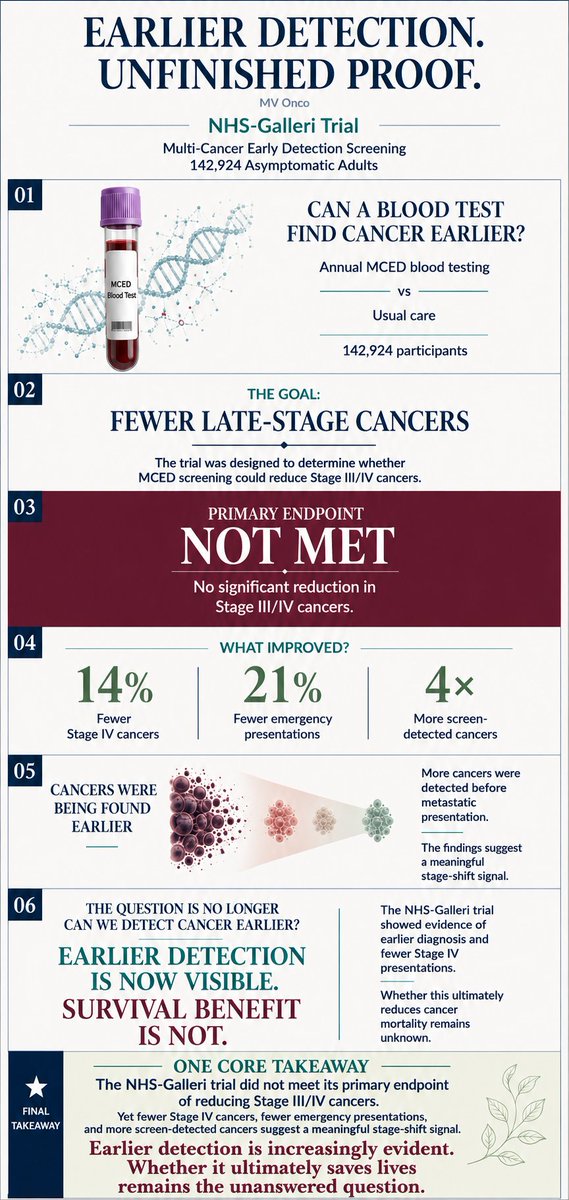
142,000 adults provided 3 blood samples over 2 years, for prevalent (baseline) & incident cancers. The trial did not meet its primary endpoint. Lots more data below:
https://mma.prnewswire.com/media/2991283/NHS_Galleri_Fact_Sheet.pdf?p=pdf
3.3K impressions16 likes10 repostsRead full post ↗2026-05-30
𝕏The NHS-Galleri trial reportedly failed its primary endpoint—a sobering reminder from @SullivanProf
and Dr Christopher Booth in this editorial at @JAMA_current
that technological elegance is no substitute for proven patient benefit. 🙂👇 @oncology_bg
https://jamanetwork.com/journals/jama/fullarticle/2849769
3.0K impressions25 likes13 repostsRead full post ↗2026-06-04
𝕏Wanted to do a deep dive on the Pathfinder2 and NHS-Galleri tests but I am not up to doing it justice
Besides, neither are really published yet.
We just have some charts from presentations at major meetings
I will just make a few points and leave it at that
The NHS-Galleri is a great study that is also a major missed opportunity
Props to performing a RANDOMIZED study of 140,000 people !!! 70k in each arm
But the primary endpoint studied was “reduction in diagnosis of stage 3/4 disease.
This was an ambitious but reasonable endpoint. Those are hard to cure diseases.
But the missed opportunity was that they should have done an overall mortality endpoint.
This was the NHS and they could’ve followed these folks for a decade or longer to get a read on whether serologic screening really made a difference at the population level
They did not go there. Probably did not want to
The fans were disappointed that the study missed its primary endpoint - no net reduction in stage III/IV disease
So they pivoted to the secondary endpoint, reduction is stage IV disease. This is not inconsequential since most stage IV cancers are INcurable, while stage IIIs are potentially curable, albeit at low rates.
They showed a modest reduction in stage IV disease downstages to stage III - about 25% reduction. This is fair, but for 70,000 people tested, that means about 100 theoretical patients were downstaged. And since a lot of stage threes are still not cured, like, lets say 50-75% are NOT cured, that means we only saved 25-50 patients.
Wonderful if that was you, but we had to screen 70,000 people to save 25 - NNT about 2500. I am not sure that is much to brag about, especially when you work in cost.
In the US, they did Pathfinder2, which is NOT a randomized study, so we can’t really learn anything in a comparative sense. Also, it is only the 1st year of a 3-year study.
This is important and a credit to them, because the first year you do a screening test you are assessing “prevalence’ - that is the whole population level of a disease (as detected by the modality). It tends to be higher.
Once you complete the prevalence round, you are only picking up “new” cancers and this is a more rational metric. Once a screening program is up and running, it is the incidence of NEW cancers per interval (typically a year) that matters most.
But since the “total number of cancers” is higher than “the number of new per year” the value of a screening program declines after year one. So kudos to them for checking this.
But we are in year one with 2 years to go.
Unfortunately, beyond a rough estimate of sensitivity and specificity of the test, we will not learn much about the impact on the population at large from mass screening
And lastly, without real long term follow-up, it will be hard to tell the impact of “over diagnosis”
This is the odds of finding a clinically irrelevant cancer.
One that is really cancer, but was never going to harm the patient.
Like the Korean thyroid cancer study. All those thyroids removed, and no extra lives saved
Without long term follow up, we can’t know if the test truly “migrates” stage 3s and 4s down to 1s and 2s … or if we are just finding 1’s (mostly) and some 2’s that are not clinically important
What were the bottom lines
Slightly different results from NHS-Galleri (UK) vs Pathfinder2 (North America)
NHS-Galleri (all three rounds)
True positive - 937
False negative (misses) 2114
False positive - 864
True negative 193,231
Positive predictive value about 50%
Half learned of a cancer diagnosis thanks to the test
Half were misinformed and went off on a work-up that was solely caused by the test
And 2114 received a false negative.
That’s a lot - that means that you can’t stop regular screening.
On the US side, slightly different
True positive 173
False negative (misses) 267
False positive - 114
True negative - 31,453
Positive predictive value about 60%.
Better than the UK, but remember this is year one.
The numbers will change after years 2-3
I don’t feel like crunching the numbers for a cost-benefit analysis but this is how you need to look at it
Costs
Raw cost of the tests at a population level
Add costs of working up positives
Tally the number of people harmed by diagnostic intervention
Benefits -
Again, we really can’t get benefits without a proper long term comparison arm
But the benefits ought to be lives saved from the test and advanced cancer treatments avoided
Sources -
https://grail.com/wp-content/uploads/2026/05/Pathfinder2_FactSheet_FINAL.pdf
https://grail.com/wp-content/uploads/2026/05/Giridhar.ASCO-2026.PF2-Primary.ORAL_FINAL-For-GRAIL-Website.pdf
https://grail.com/wp-content/uploads/2026/05/Swanton_ASCO-2026_NHS-Galleri_FINAL-Slides-05.26.2026.pdf
2.9K impressions6 likes0 repostsRead full post ↗2026-06-22
𝕏The issues here are more market than medical. To date, the test does not work to facilitate early detection of cancer. The study did not meet its primary endpoint. The biggest signal was in colorectal cancer but the UK (where study was done) does not have widespread screening colonoscopy, as does US, so meaning unclear for American health.
See @ASCO data slides for Galleri study:
https://grail.com/wp-content/uploads/2026/05/Swanton_ASCO-2026_NHS-Galleri_FINAL-Slides-05.26.2026.pdf
See Lancet editorial: https://www.thelancet.com/journals/lancet/article/PIIS0140-6736(26)01909-4/fulltext
2.2K impressions0 likes0 repostsRead full post ↗2026-09-22
 𝕏
𝕏MCED testing in pop screening
NHS-Galleri-RCT of 142,250 pts
➡️blood up to 3 visits
➡️aim to reduce stage III/IV
Med FU 17mths
❎primary endpt not met-but ⬇️in stg4
➡️52% PPV; 99.5% specificity
✅4 fold⬆️ in screen detected ca
Huge effort from NHS #ASCO26 @ASCO @OncoAlert
1.6K impressions11 likes10 repostsRead full post ↗2026-05-30
 𝕏
𝕏#ASCO26 🩸 Can a single blood test detect cancers before they become metastatic?
The NHS-Galleri trial just gave us the first large randomized look at MCED screening in the real world.
🔬 142,000+ asymptomatic adults
🧪 Annual cfDNA-based MCED testing vs standard screening
Key findings:
✅ Stage IV cancers reduced by 14%
✅ Screen-detected cancers quadrupled
✅ Emergency cancer presentations reduced by 21%
✅ Specificity: 99.5%
But…
❌ Primary endpoint not met
❌ No significant reduction in overall stage III/IV cancers
The signal here is fascinating:
MCED may not dramatically reduce all late-stage cancers yet, but it appears capable of shifting at least some cancers away from metastatic presentation.
This feels less like the “end of screening” and more like the beginning of a new hybrid screening era.
The big unanswered question:
Will this eventually translate into fewer cancer deaths?
📖 Full paper/data in comment ⬇️
#OncoTwitter #MedTwitter #CancerScreening #LiquidBiopsy @asco @OncoAlert @myesmo @esmo_open @larvol
1.5K impressions3 likes3 repostsRead full post ↗2026-05-30
 𝕏
𝕏#ASCO26: Dr C Swanton NHS-Galleri trial. 142,000 patients randomized to annual MCED x 3 vs. standard care resulted in decreased stage IV and increased stage III cancer dx across multiple cancer types. Effect on cancer mortality not yet reported.
1.0K impressions8 likes3 repostsRead full post ↗2026-05-30
 𝕏
𝕏Interesting vignette even if the value of early detection in lymphomas through screening is still unproven, especially for indolent disease.
We know that most common cancer type diagnosed by Galleri MCD during screening have historically and typically been lymphoid:
~50% of Galleri detected cancer diagnoses within PATHFINDER in ~6k adults were lymphomas, and
~25% of Galleri detected cancers in RWD in ~111k adults were also lymphomas (what changed?)
What % of screen detected cancers discovered in NHS-Galleri were lymphomas or myelomas?
@CharlesSwanton @jhuber
571 impressions4 likes0 repostsRead full post ↗2026-05-30
Trial Background
About the NHS-Galleri Trial
NHS-Galleri (NCT05611632; ISRCTN91431511) is the first randomized controlled trial of a multi-cancer early detection (MCED) blood test — and the largest interventional study ever run inside England’s National Health Service. 142,318 asymptomatic adults aged 50–77 were enrolled (ClinicalTrials.gov); the randomised analysis set of 142,250 (LBA100 slide 6) was randomized 1:1 to annual MCED blood testing added to standard NHS screening, or to standard screening alone, across three annual screening rounds; participants were passively followed through national registry datasets (ClinicalTrials.gov; ASCO 2026 LBA100). The test run in the trial was GRAIL’s investigational MCED-V2 device, which detects cancer-specific methylation patterns in cell-free DNA from a single blood draw and predicts the cancer signal origin. The commercial Galleri test is a different device — the FDA notes differences in assay workflow, classifier, and bioinformatics pipeline — whose performance in the FDA package was bridged by re-running Galleri on frozen trial plasma from a weighted subset (FDA Executive Summary, Sept 2026).
Full results, presented by Charles Swanton at ASCO 2026 (LBA100), showed the trial did not meet its primary endpoint: stage III/IV cancer incidence across 12 prespecified cancer types was not reduced after three screening rounds (IRR 1.03, p=0.6324; MCED-V2 data), with the shortfall driven by an excess of stage III diagnoses concentrated in the first (prevalent) round (a KOL Pulse derivation from LBA100 slides 8 and 11). Prespecified secondary analyses showed a 14% reduction in stage IV diagnoses that deepened to 22–26% in the incident rounds, a 16% increase in stage I–II diagnoses, a four-fold increase in screen-detected cancers, and 25% fewer cancers diagnosed through emergency presentation (ASCO 2026 LBA100 / GRAIL press release; MCED-V2 data). Physician reaction — captured in the threads on this page — split between the stage-IV promise and concerns about endpoint choice, overdiagnosis, and the absence of mortality data.
The JAMA editorial debate, via @SuyogCancer:
The NHS-Galleri trial reportedly failed its primary endpoint—a sobering reminder from @SullivanProf
— Dr Amol Akhade (@SuyogCancer) 2026-06-04
and Dr Christopher Booth in this editorial at @JAMA_current
that technological elegance is no substitute for proven patient benefit. 🙂👇 @oncology_bg
https://jamanetwork.com/journals/jama/fullarticle/2849769
Study Design
Trial Methodology & Results
Study Design
Randomized (1:1), controlled clinical-utility trial of MCED screening — the first of its kind. Three annual screening rounds; participants passively monitored via national registry datasets; median follow-up 17 months after last screen (ASCO 2026 LBA100).
Population
142,318 asymptomatic adults aged 50–77 in England’s NHS with no cancer diagnosis or treatment in the prior 3 years enrolled (ClinicalTrials.gov). Randomised analysis set 142,250: arms of 71,122 (intervention) and 71,128 (control); retention 91% in year 2 and 88% in year 3 (LBA100 slide 6).
Intervention
Annual MCED blood test — GRAIL’s investigational MCED-V2 device — added to standard-of-care NHS screening vs standard screening alone (control samples stored). Positive results referred into the NHS diagnostic pathway (LBA100 slides; FDA Executive Summary).
Endpoints
Primary: reduction in stage III/IV cancer incidence after 3 annual rounds in 12 prespecified cancer types. Prespecified secondary: stage IV incidence, stage I/II proportion, safety, mortality (after longer follow-up), stage distribution (LBA100 slides).
The Test (Device)
The trial ran MCED-V2 (investigational): NGS-based targeted-methylation analysis of cell-free DNA with a machine-learning classifier; returns Cancer Signal Detected / Not Detected plus predicted cancer signal origin (CSO). The commercial Galleri test is a different device (assay workflow, classifier, bioinformatics pipeline); its FDA-package performance was bridged from frozen trial plasma. Galleri is not FDA cleared or approved (FDA Executive Summary, Sept 2026).
Presenter
Charles Swanton, MBPhD — Francis Crick Institute / UCL — ASCO 2026 late-breaking abstract LBA100, presented May 30–31, 2026 weekend session.
Primary Endpoint: Stage III/IV Incidence — Not Met
After three annual screening rounds there was no significant reduction in stage III/IV diagnoses across the 12 prespecified cancer types: 706 vs 688 cancers, incidence rate ratio 1.03 (95% CI 0.92–1.14), P=0.63 (NEJM, Sasieni et al., Sept 22, 2026; reported as p=0.6324 in ASCO 2026 LBA100 / GRAIL press release; MCED-V2 data). The result was driven by an excess of stage III diagnoses (364 vs 291, +25% — a percent difference calculated with raw cancer counts for illustrative purposes, not as part of a stage-shift endpoint; LBA100 slide 9 footnote), concentrated in the prevalent round — a KOL Pulse derivation from LBA100 slides 8 and 11 (round-1 stage III: 133 intervention vs 83 control). Stage III/IV incidence trended lower in later rounds (round IRRs 1.19 → 0.95 → 0.88, all CIs crossing 1) (LBA100 slides).
Primary endpoint not metSource: NEJM (Sasieni et al., Sept 22, 2026) · ClinicalTrials.gov · GRAIL press release · ASCO 2026 LBA100
Key Secondary Endpoint: Stage IV Incidence
Stage IV diagnoses were 14% lower in the intervention arm overall (IRR 0.86, 95% CI 0.74–1.00 — NEJM, Sasieni et al., Sept 22, 2026, which reports no P value for this endpoint; the 342 vs 397 counts and the three-decimal interval 0.744–0.998 are as reported on ASCO 2026 LBA100 slide 11 / GRAIL press release; MCED-V2 data), with the effect strengthening in the incident rounds — the basis of GRAIL’s “>20% reduction” framing. Follow-up time in the third round was variable, ranging 12–22 months (LBA100 slide 8 footnote). Because the primary endpoint was missed, this is a hypothesis-strengthening secondary signal, not a confirmed clinical benefit; mortality is a prespecified secondary endpoint that requires longer follow-up.
| Stage IV cancers diagnosed (12 prespecified types; MCED-V2 data, ASCO 2026 LBA100) | IRR (intervention/control) | 95% CI | % difference (intervention n vs control n) |
|---|---|---|---|
| After 3 screening rounds | 0.86 | 0.744–0.998 | −14% (342 vs 397) |
| First screening round (prevalent) | 0.91 | 0.71–1.18 | −9% (117 vs 128) |
| Second screening round (incident) | 0.78 | 0.57–1.06 | −22% (78 vs 100) |
| Third screening round (incident) | 0.74 | 0.57–0.95 | −26% (104 vs 142) |
Transcribed from ASCO 2026 LBA100 slide 11 (MCED-V2 data). NEJM (Sasieni et al., Sept 22, 2026) reports the 3-round row as IRR 0.86, 95% CI 0.74-1.00 and does not report round-level figures.
FDA’s prevalent-round cut (labeled separately — do not mix with the 3-round analysis above): in the FDA executive summary’s analysis of the first screening round only, the stage IV incidence rate ratio was 0.97 (95% CI 0.78–1.21) for all routinely staged cancers and 0.87 (95% CI 0.68–1.13) for the 12 prespecified types — “No formal statistical testing was conducted for this analysis.” These data “can only be obtained from MCED-V2 (investigational device) because Galleri test results were not returned to study subjects or their providers.” The proposed Galleri indication includes no stage IV reduction claim, and the FDA “is not requesting feedback from the Panel on whether Galleri may reduce stage IV cancers” (FDA Executive Summary, Sept 2026; MCED-V2 data).
Secondary signal — strengthened to −26% by round 3 (variable 12–22-month follow-up; not the primary result)Source: NEJM (Sasieni et al., Sept 22, 2026) · GRAIL press release · ASCO 2026 LBA100 slide 11 · FDA Executive Summary (prevalent-round cut)
Detection & Test Performance (3 Rounds)
Adding the MCED-V2 test quadrupled screen-detected cancers (intervention vs control: 1,173 vs 290, exploratory), cut cancers found through emergency presentation by 25% (213 vs 286 — a supportive sensitivity analysis after targeted review of 39 participants with an MCED-positive result and an emergency-presentation route to diagnosis; LBA100 slide 17 footnote) and clinically detected cancers by 21% (2,464 vs 3,110), and increased stage I–II diagnoses of the 12 prespecified cancer types by 16% (647 vs 559) (ASCO 2026 LBA100 slides / GRAIL press release; MCED-V2 data). Across three rounds the in-trial MCED-V2 test showed PPV 52.0% (58.0% in round 1), specificity 99.55% (0.45% false-positive rate), cancer signal origin accuracy 92.5%, and episode sensitivity 54.7% for the 12 prespecified cancers / 30.7% across all cancer types (GRAIL press release; MCED-V2 data). GRAIL reported safe implementation across all three rounds (GRAIL press release).
4x screen-detected cancers · PPV 52% · specificity 99.55% (MCED-V2, in-trial)Source: GRAIL press release · ASCO 2026 LBA100 slides
FDA Prevalent-Round Analysis: Bridged Galleri Data (PMA Review)
These are Galleri figures, obtained by bridging — not the trial-run results. Because the trial ran the investigational MCED-V2 device (and NHS-Galleri results were not returned to participants), Galleri’s performance for the FDA review was determined by re-running the Galleri test on frozen plasma samples from a weighted subset of prevalent (first) round participants (FDA Executive Summary, Sept 2026). In that bridged analysis — among 820 participants diagnosed with cancer within 12 months in the Galleri Analyzable Set — 12-month episode sensitivity was 31.6% (95% CI 28.5–34.8), specificity 99.74%, PPV 66.2%, and NPV 98.89%; sensitivity for stage I–II cancers was 20.5% (97/474) (FDA Executive Summary, Sept 2026; bridged Galleri data). The parallel bridged PATHFINDER 2 analysis showed 12-month sensitivity of 35.0% (106/303) with specificity 99.85% and PPV 77.0% (FDA Executive Summary; bridged Galleri data). The FDA also noted that in PATHFINDER 2, “In general, for each cancer type with guideline recommended screening, the Galleri 12-month episode sensitivity was higher in individuals not eligible for screening than those eligible for screening” (FDA Executive Summary, Table 9).
Reconciling the two sets of numbers: GRAIL’s as-run trial metrics (NHS-Galleri three-round PPV 52.0% / specificity 99.55%) come from the investigational MCED-V2 device across all three rounds, while the FDA-package figures above come from the bridged Galleri test on a prevalent-round weighted subset — different device, different analysis set, different window; the two must never be mixed. PATHFINDER 2 figures reconcile the same way: PPV 60.3% is the as-run MCED-V2 result (440 cancers among 32,007 analyzable, GRAIL 12-month primary analysis; the PPV itself is 173 cancers among 287 cancer-signal-detected participants), while PPV 77.0% is the bridged Galleri estimate (303 cancers, weighted N = 21,418, data cutoff Dec 31, 2024; FDA Executive Summary). Per the FDA, safety results are presented for MCED-V2 — the agency considers that primary safety analysis “an approximate estimate” of Galleri’s safety profile — while effectiveness results are presented for Galleri from the bridged frozen-plasma testing.
Source: FDA Executive Summary, Molecular and Clinical Genetics Panel, Sept 23, 2026Regulatory Status
FDA Review: Advisory Panel Endorsed Galleri — Still Not FDA Approved
September 23, 2026 — FDA advisory committee vote: the panel endorsed Galleri; the FDA has not approved it
The FDA’s Molecular and Clinical Genetics Panel of the Medical Devices Advisory Committee met on September 23, 2026 and voted on the three questions posed verbatim in the FDA Executive Summary:
• Q1 — “Is there reasonable assurance that Galleri is safe for use in patients who meet the criteria specified in the proposed indication?” 10 yes · 0 no · 0 abstain
• Q2 — “Is there reasonable assurance that Galleri is effective for use in patients who meet the criteria specified in the proposed indication?” 6 yes · 4 no
• Q3 — “Do the benefits of Galleri outweigh the risk for use in patients who meet the criteria specified in the proposed indication?” 7 yes · 2 no · 1 abstain
Question wording: FDA Executive Summary, Sept 2026. Vote tallies: STAT (Herper), Sept 23, 2026 and GRAIL press release, Sept 23, 2026; corroborated by firsthand accounts from the meeting. FDA minutes and the meeting transcript will be the authoritative record.
What the vote does — and does not — mean. The panel endorsed Galleri on benefit–risk, but an advisory committee recommendation is non-binding: the FDA is not required to follow its panels, though it usually does. No FDA approval has occurred. Galleri remains unapproved and uncleared, available in the US as a prescription laboratory-developed test, and the FDA is expected to decide on the PMA in the coming months (GRAIL press release, Sept 23, 2026). STAT’s Matthew Herper characterized the outcome as an endorsement that was “fairly tepid.”
The indication wording is in play. Panel discussion converged on calling the product a “multi-cancer detection” test rather than a “multi-cancer early detection” test — dropping “early” from the proposed indication. That is precisely the alternative the FDA had put to the panel in question 3b, which asked whether performance by stage supports the proposed “early” characterization or instead “an alternate indication for the detection of multiple types of cancer, absent the ‘early’ characterization” (FDA Executive Summary, panel questions). Proposed labeling language was wordsmithed during the meeting; final labeling, if the FDA approves, is the FDA’s to set.
None of this changes the trial record. NHS-Galleri’s primary endpoint was not met (stage III/IV IRR 1.03, p=0.6324); the stage IV reduction is a prespecified secondary, not formally tested in the FDA’s own prevalent-round analysis; PATHFINDER 2 is single-arm and cannot speak to survival or mortality; and both trials ran the investigational MCED-V2 device, with commercial Galleri assessed by bridging from frozen plasma (FDA Executive Summary, Sept 2026).
Source: STAT — FDA advisory panel endorses Grail blood test, saying benefits outweigh risks (Herper, Sept 23, 2026) →Source: GRAIL press release — FDA Advisory Committee votes in favor of approval (Sept 23, 2026) →
Source: FDA Executive Summary — voting questions, Galleri PMA (Sept 2026) →
Where Galleri Stands With the FDA
The Galleri test has not been cleared or approved by the FDA (GRAIL press release); it is available in the US as a prescription laboratory-developed test. GRAIL completed a modular premarket approval (PMA) submission on January 29, 2026 under a Breakthrough Device Designation granted in 2018 (GRAIL press release). The FDA’s Molecular and Clinical Genetics Panel of the Medical Devices Advisory Committee met on September 23, 2026 — the FDA’s first advisory committee review of an MCED test PMA — with the application supported by 25,490 PATHFINDER 2 participants with one year of follow-up and 70,000+ participants from the NHS-Galleri intervention arm’s prevalent round (GRAIL press release; FDA meeting notice). The proposed indication for use: “Galleri is intended for screening for the early detection of multiple types of cancer, in adults aged 50 years or older,” with prediction of cancer signal origin to guide diagnostic workup (FDA voting questions document). The FDA is not bound by its advisory committees’ recommendations.
The same proposed labeling carries explicit limits: “A test result of No Cancer Signal Detected does not rule out the presence of cancer, and individuals should continue with guideline-recommended single-cancer screening tests,” and, among the proposed Precautions and Limitations, “The Galleri test is not a replacement for existing recommended single-cancer screening tests or diagnostic modalities for cancer” (FDA Executive Summary / proposed indications for use). The panel’s questions also put the indication’s wording itself in play: question 3b asked the panel to discuss whether Galleri’s performance by stage supports the proposed “early” detection indication — and, if not, whether performance supports “an alternate indication for the detection of multiple types of cancer, absent the ‘early’ characterization” (FDA Executive Summary, panel questions). Note the trial data before the panel were generated by the investigational MCED-V2 device: the FDA presents safety results from MCED-V2 — and considers that primary safety analysis an approximate estimate of Galleri’s safety profile — while Galleri’s effectiveness figures were obtained by bridging from frozen trial plasma (FDA Executive Summary).
Source: FDA meeting notice · FDA Executive Summary · GRAIL press releaseAhead of the panel — @NeilVasan’s critical read of the FDA summary (full thread on X):
3/ NHS-Galleri (142,000 people, randomized) had one prespecified primary endpoint: fewer stage III/IV cancers. It missed. "Four times as many cancers detected" is a screen-detected count, not a benefit. Total cancers were 3,637 vs 3,400. Most would have been diagnosed anyway, and some of the excess is overdiagnosis.
— Neil Vasan (@NeilVasan) 2026-09-21
From the room, September 23, 2026 — verbatim
Posts below are reproduced verbatim and in full from each author’s public account on the day of the advisory committee meeting. Dr. Vasan and Dr. Burstein are practising oncologists; Matthew Herper is STAT’s senior medical writer; Jessica Adams (@RxRegA) is a regulatory-affairs commentator, quoted here for meeting procedure and voting-comment color, not clinical assessment.
Dr. Neil Vasan (Columbia) reporting the three tallies from the panel room:
A holy GRAIL for MCED and cancer diagnostics.
— Neil Vasan (@NeilVasan) Sep 23, 2026
Q1 Safety. 10-0
Q2 Efficacy. 6-4
Q3 Benefit-risk. 7-2-1
There will be enormous discussions and debate over the next months re operationalization for both individuals (pts, docs, PCPs, surgeons, oncologists) and populations (hospital systems, professional orgs, reimbursements).
Hoping all stakeholders come to the table with the same care this AdComm panel showed today.
@RuxandraTeslo @adamfeuerstein @AlecStapp
@matthewherper @ZacharyBrennan @anish_koka @venkmurthy @DrMarcSiegel @WSJopinion @nytimes @AACR @SABCSSanAntonio @BCRFcure @Perlmutter_CC
The safety vote, called live:
$GRAL: FDA advisory committee meeting vote on GRAIL’s Galleri multi-cancer detection test, vote on safety (1 of 3 voting questions):
— Jessica Adams (@RxRegA) Sep 23, 2026
10-Yes
0-No
0-Abstain
STAT’s Matthew Herper on the outcome:
FDA advisory panel endorses Grail blood test for cancer, saying benefits outweigh risks
— Matthew Herper (@matthewherper) Sep 23, 2026
The endorsement was fairly tepid. Story here:
$GRAL
https://t.co/DT1qPrcG1V
On the naming consensus that emerged during the discussion:
Panel just reached what appears to be a consensus that the FDA should call this a "multi-cancer detection" test not a "Multi-cancer early detection test" -- minor setback for Grail, perhaps.
— Matthew Herper (@matthewherper) Sep 23, 2026
Regulatory-affairs commentary from Jessica Adams (@RxRegA), listening to the voting comments — an observer’s reading of the panel’s reasoning, not a physician assessment of the test:
Well, today’s 7–2 (1 abstain) vote on GRAIL’s Galleri looks a little different when you listen to the voting comments.
— Jessica Adams (@RxRegA) Sep 23, 2026
You could arguably move 3 of the yes votes closer to no based on the rationale: one was essentially yes, but with serious concerns; one said that perhaps his yes was a hopeful yes rather than an accurate one; and one yes explicitly referred to the “potential benefits.”
Keep the "hard-call" yes that wants postmarket confirmation as a yes, and the underlying sentiment is more like 4–5 (1 abstain).
The general gist of the discussion also seemed to be to remove “early” from the proposed indication.
On the public testimony heard before the vote:
@FDA @GrailBio Public comments at an AdComm are important because they pull you out of the population curves and back to individual people. Heard some moving testimony today from patients whose cancers were caught early. If they’d waited for symptoms, it would almost certainly have been fatal.
— Neil Vasan (@NeilVasan) Sep 23, 2026
Dr. Harold Burstein (Dana-Farber) on the NEJM editorial published the same week:
Editorial in today’s @nejm underscores the gap between expert medical and public health opinion and the commercial enthusiasm for the test based on available data
— Harold J. Burstein, MD, PhD, FASCO (@DrHBurstein) Sep 23, 2026
On the clinical use of this test: https://t.co/fQfvfEePfP https://t.co/9atnI8jHlQ
A dissenting physician read of the endorsement:
This is CRAZY. The test didn’t meet its endpoint and the study was not designed to assess harm and showed no benefit.
— Ade Adamson, MD MPP (@AdeAdamson) Sep 23, 2026
https://t.co/WQT8rbDEZb
Companion publication — NHS-Galleri test performance (Nature Medicine, Sept 22, 2026)
The day before the panel, Nature Medicine published the NHS-Galleri test-performance companion paper (Neal RD et al., “Performance of a multi-cancer early detection test in the randomized controlled NHS-Galleri trial,” published September 22, 2026; DOI 10.1038/s41591-026-04652-8). These are prespecified secondary test-performance endpoints, analyzed descriptively with no hypothesis testing — they do not alter the missed primary endpoint. In round 1, positive results were returned for 722 of 70,325 participants (1.03%) and the positive predictive value was 58.0% (419/722); across rounds 1–3 PPV was 58.0%, 50.4% and 45.8%, specificity ranged 99.50–99.60%, episode sensitivity ranged 26.7–37.2% for all cancers (47.6–63.4% for the 12 prespecified types), and CSO accuracy ranged 91.1–93.6%. In aggregate 937 participants had MCED-detected primary cancers (Neal et al., Nature Medicine, Sept 22, 2026; MCED-V2 as run in trial — not bridged Galleri figures, and never to be mixed with them).
Source: Nature Medicine — Performance of an MCED test in the randomized controlled NHS-Galleri trial →Dr. Hidehito Horinouchi (National Cancer Center Hospital, Tokyo) on the companion paper:
🔥MCED test performance in the NHS-Galleri RCT — companion paper
— Hidehito HORINOUCHI (@HHorinouchi) Sep 23, 2026
🔙 @NatureMedicine
☑N=70,325 (round 1); PPV 58.0%; specificity 99.5-99.6%; episode sensitivity 26.7-37.2% (all cancers); CSO accuracy 91.1-93.6%
🎯937 MCED-detected cancers across 3 rounds
🎯Performance insights in real-world NHS screening
🎙 @richarddneal @CharlesSwanton
@OncoAlert @Larvol #LiquidBiopsy
Major Media & Publications
NHS-Galleri in the News
PRESS
GRAIL Reports Full Results From NHS-Galleri Trial Demonstrating Substantial Reduction in Stage IV Cancer Diagnoses
PUB
NHS-Galleri: Primary results from a randomised controlled trial of an MCED test in population screening (LBA100)
MEDIA
Annual Galleri Screening Reduced Stage IV Cancer Diagnoses but Missed Primary Endpoint in First Randomized MCED Trial
PUB
Multicancer Detection Tests: Promise, Hype, and Reality (Sullivan & Booth editorial)
PRESS
GRAIL Announces FDA Advisory Committee Meeting to Review Premarket Approval Application for the Galleri Test
FDA
Molecular and Clinical Genetics Panel of the Medical Devices Advisory Committee - Meeting Announcement
FDA
FDA Executive Summary: GRAIL Inc., Galleri (advisory committee briefing document)
MEDIA
Inside the Major Findings From the NHS-Galleri Trial
FDA
FDA advisory panel endorses Grail blood test for cancer, saying benefits outweigh risks (10-0 safe, 6-4 effective, 7-2-1 benefit-risk)
PRESS
FDA Advisory Committee Votes In Favor of Approval of GRAIL's Galleri Multi-Cancer Early Detection Test
PUB
Performance of a multi-cancer early detection test in the randomized controlled NHS-Galleri trial (Neal et al.)
PUB
Effect of Screening with Multicancer Early-Detection Test on Late-Stage Cancer Diagnosis (Sasieni et al.) - primary results
PUB
A Step in the Search for the Elusive Holy Grail of Early Detection of Cancer (Hunter, editorial)
Frequently Asked Questions
NHS-Galleri FAQ
What is the NHS-Galleri trial?
NHS-Galleri (NCT05611632; ISRCTN91431511) is the first randomized controlled trial of a multi-cancer early detection (MCED) blood test. Sponsored by GRAIL, Inc. with the Cancer Research UK Cancer Prevention Trials Unit, it enrolled 142,318 asymptomatic adults aged 50-77 in England's NHS (ClinicalTrials.gov); 142,250 formed the randomised analysis set (ASCO 2026 LBA100), randomized 1:1 to annual blood testing with GRAIL's investigational MCED-V2 device plus standard NHS screening versus standard screening alone for three annual rounds. Full results were presented by Charles Swanton at ASCO 2026 (LBA100).
Did the NHS-Galleri trial meet its primary endpoint?
No. The primary endpoint - a significant reduction in the incidence of stage III/IV cancers across 12 prespecified cancer types after three annual screening rounds - was not met: incidence rate ratio 1.03 (95% CI 0.92-1.14), P=0.63 (NEJM, Sasieni et al., Sept 22, 2026; reported as p=0.6324 in ASCO 2026 LBA100 / GRAIL press release; MCED-V2 data). The result was driven by more stage III diagnoses, concentrated in the first (prevalent) screening round (a KOL Pulse derivation from LBA100 slides 8 and 11).
Did MCED screening reduce stage IV cancer diagnoses in NHS-Galleri?
In a prespecified secondary analysis - not the primary endpoint - stage IV diagnoses were 14% lower in the intervention arm overall (IRR 0.86, 95% CI 0.74-1.00; NEJM, Sasieni et al., Sept 22, 2026, which reports no P value for this endpoint), with reductions of 22% and 26% in the second and third (incident) screening rounds (ASCO 2026 LBA100 slide 11 / GRAIL press release report the same overall 3-round result to three decimals, 95% CI 0.744-0.998, 342 vs 397 stage IV cancers; MCED-V2 data; round-3 follow-up was variable, 12-22 months). The FDA's separate prevalent-round analysis found stage IV IRR 0.97 (95% CI 0.78-1.21) for all routinely staged cancers and 0.87 (0.68-1.13) for the 12 prespecified types, with no formal statistical testing; the proposed Galleri indication includes no stage IV reduction claim, and the FDA is not asking its panel whether Galleri may reduce stage IV cancers (FDA Executive Summary, Sept 2026; MCED-V2 data). Because the primary endpoint was missed, the stage IV signal is hypothesis-strengthening rather than a confirmed clinical benefit; mortality follow-up is ongoing.
Is the Galleri blood test FDA approved?
No. Galleri has not been cleared or approved by the FDA. It is available in the US as a prescription laboratory-developed test (LDT). GRAIL completed a modular premarket approval (PMA) submission on January 29, 2026 under a 2018 FDA Breakthrough Device Designation. On September 23, 2026 the FDA's Molecular and Clinical Genetics Panel reviewed the application and voted 10-0 safe, 6-4 effective, and 7-2 with 1 abstention that benefits outweigh risks - endorsing the test, but the FDA is not bound by advisory committee recommendations and no approval has been granted. A PMA decision is expected in the coming months (FDA Executive Summary; STAT and GRAIL press release, Sept 23, 2026).
What did the FDA advisory committee decide about Galleri on September 23, 2026?
The FDA's Molecular and Clinical Genetics Panel of the Medical Devices Advisory Committee met on September 23, 2026 and voted 10-0 that there is reasonable assurance Galleri is safe, 6-4 that there is reasonable assurance it is effective, and 7-2 with 1 abstention that its benefits outweigh its risks for the proposed indication (voting-question wording: FDA Executive Summary, Sept 2026; tallies: STAT and GRAIL press release, Sept 23, 2026). The panel therefore endorsed the test on benefit-risk, and panel discussion converged on calling it a 'multi-cancer detection' test rather than a 'multi-cancer early detection' test - dropping 'early' from the proposed indication. The recommendation is non-binding: the FDA is not required to follow its advisory committees, although it usually does. Galleri is still not FDA approved, and a PMA decision is expected in the coming months. The vote does not change the NHS-Galleri result - the primary endpoint was not met (stage III/IV IRR 1.03, p=0.6324) and the stage IV reduction remains a prespecified secondary.
What is MCED-V2, and how does it differ from Galleri?
MCED-V2 is the investigational multi-cancer early detection device GRAIL actually ran in the NHS-Galleri and PATHFINDER 2 trials; in NHS-Galleri its results were not returned to participants or their providers. Per the FDA, 'The Galleri test is a different device from MCED-V2' - differences include the assay workflow, classifier, and bioinformatics pipeline. Galleri's effectiveness figures in the FDA package were obtained by bridging: the Galleri test was re-run on frozen plasma samples from a weighted subset of trial participants. The FDA presents safety results from MCED-V2 and considers that primary safety analysis an approximate estimate of Galleri's safety profile (FDA Executive Summary, Sept 2026).
How accurate was the MCED test in NHS-Galleri?
Across three screening rounds with the in-trial MCED-V2 device, GRAIL reported a positive predictive value of 52.0%, specificity of 99.55%, and cancer signal origin accuracy of 92.5% (GRAIL press release / ASCO 2026 LBA100; MCED-V2 data). The commercial Galleri test was assessed by bridging - re-running Galleri on frozen prevalent-round plasma from a weighted subset (Galleri Analyzable Set, 820 cancers): 12-month episode sensitivity 31.6% (95% CI 28.5-34.8) across all cancers - 20.5% for stage I-II cancers - with specificity 99.74% and PPV 66.2% (FDA Executive Summary, Sept 2026; bridged Galleri data). The two sets of figures come from different devices and analysis sets and should not be mixed.
Physician Opinions