RMC-9805-001 at a Glance
- Design: Phase I, single-arm, dual RAS(ON) inhibitor doublet (zoldonrasib + daraxonrasib) in 60 previously treated RAS G12D metastatic PDAC patients (30 2L, 30 3L+). Data cutoff Feb 9, 2026 (ESMO GI 2026, Abstract 341O).
- ORR / DCR: 2L - 50% ORR / 97% DCR. 3L+ - 47% ORR / 90% DCR.
- PFS / OS: mPFS 9.6 mo (2L) vs 7.6 mo (3L+); 2L mOS not yet estimable (89% 6-mo OS), 3L+ mOS 10.5 mo (82% 6-mo OS).
- Biomarker: RAS G12D mutation (most common KRAS alteration in PDAC, ~40% of cases).
- Regulatory: Investigational; not FDA-approved. Daraxonrasib holds FDA Breakthrough Therapy + Orphan Drug Designation for previously treated PDAC with G12 mutations.
- Sponsor / drugs: Revolution Medicines (Nasdaq: RVMD) - zoldonrasib (RMC-9805, G12D-selective) + daraxonrasib (RMC-6236, RAS multi-selective).
Track oncology’s top KOLs in your specialty
Create a free account, pick the tumor types you cover, and go beyond the tweet — the intelligence pharma teams use to map influence and prepare for engagement:
- ✓Enhanced KOL profiles
- ✓Pharma influence & potential advisory-board patterns
- ✓2025 Open Payments financial analysis
- ✓Social-media sentiment & trend signals
KOLs Discussing RMC-9805-001


Top Tweets on RMC-9805-001
 𝕏
𝕏
Small numbers but even a few years back, who would have imagined survival curves like this in 2nd & 3rd line metastatic PANCREATIC cancer? Amazing!
 𝕏
𝕏
🎯 ORR 50% in 2L and 47% in ≥3L || DCR 97% and 90%
💥 mPFS 9.6 mo in 2L, with a favorable safety profile and no
 𝕏
𝕏
🚀 Zoldonrasib + daraxonrasib showed encouraging activity in KRAS G12D PDAC:
📈 ORR 50% (2L) | 47% (3L+)
⏳ mPFS 9.6 vs 7.6 months
✅ Manageable safety profile.
Phase III RASolute 309 is next.
@OncoAlert
 𝕏
𝕏
Rash 90%, 12% G3; No DLT
🤩ORR 50% 2L / 47% 3L
mPFS 9.6m 2L / 7,6m 3L
mOS NE 2L / 10.5m 3L
🎊BPhase III RASolute 309 coming!
🤞🏻May we have a#ChemoFree option?
#ESMOAmbassadors
 𝕏
𝕏
@ ESMO-Gi
😍>90% DCR in 2nd/3rd line therapy
👉tox driven by daraxonrasib, only 5% treatment discontionuation
👉amazing..
@myESMO @ASCO
 𝕏
𝕏
➡️Ph1 RMC-9805-001 Daraxonrasib+ zoldonrasib (pan-RASi + G12Di)
✅ 60 pts 2nd/ 3rd+ line
✅ ORR 47-50%; DCR 90-97%
✅ PFS 2nd line 9.6mths ; mOS NE
❗️Zoldonrasib very well tolerated
@myESMO @OncoAlert
 𝕏
𝕏
proffered paper #ESMOGI26
2L
✅ORR 50%
✅mPFS: 9.6 mo
#cancer #oncology #MedX #pancreatic
@OncoAlert
 𝕏
𝕏
Zoldonrasib/setidegrasib NSCLC and PDAC data suggest meaningful activity
Durability, combinations,QoL remain key
Great discussion by Dr. @KCArbourMD
 𝕏
𝕏
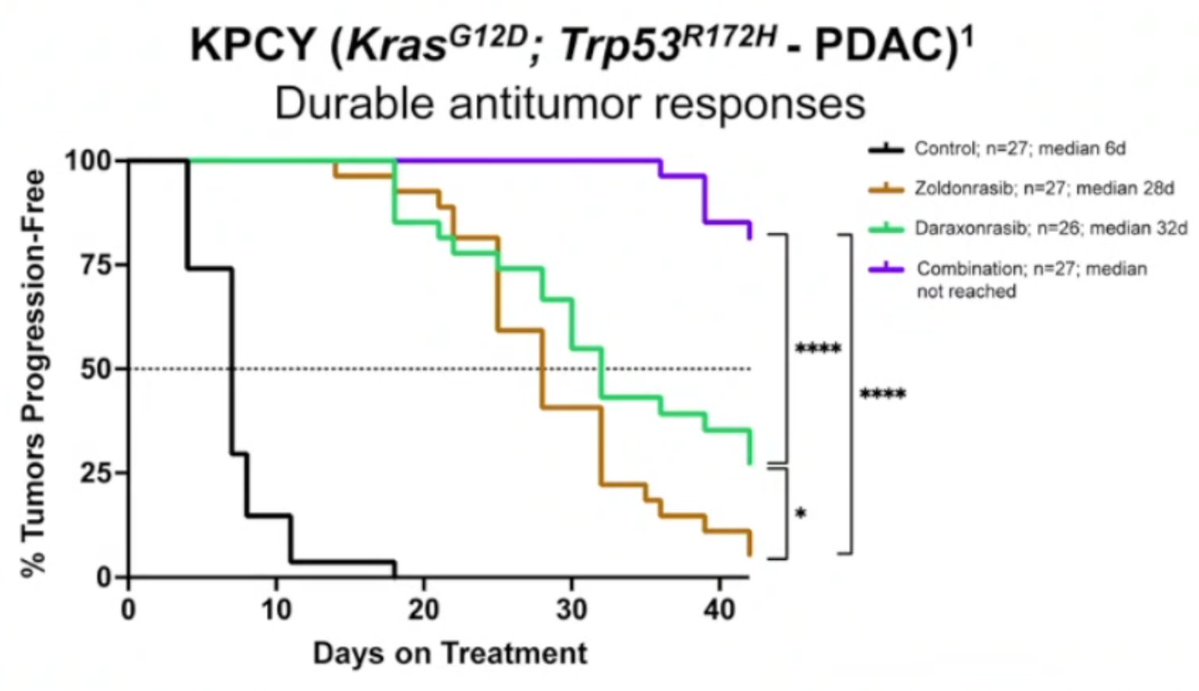
Daraxonrasib already doubles average survival vs. standard care chemotherapy in pancreatic cancer (metastatic, second line) but if Daraxonrasib and Zoldonrasib are used together, responses look (cross trial!) even stronger:
Study Design & Population
Study Design
Phase I trial (NCT06040541) evaluating zoldonrasib 1200 mg once daily plus daraxonrasib 300 mg once daily, the recommended Phase II dose, in advanced solid tumors with RAS G12D mutations. This analysis focuses on the RAS G12D metastatic PDAC cohort. Abstract 341O, presented by Nilofer Azad, MD (Johns Hopkins Sidney Kimmel Comprehensive Cancer Center), ESMO GI 2026, July 2, 2026.
Population
60 patients with RAS G12D metastatic pancreatic ductal adenocarcinoma (PDAC) who had received one or more prior lines of therapy - 30 in the second-line (2L) cohort and 30 in the third-line-or-later (3L+) cohort. Median follow-up was 12.0 months (2L) and 12.6 months (3L+).
Interventions
Zoldonrasib (RMC-9805), an oral RAS(ON) G12D-selective covalent tri-complex inhibitor, combined with daraxonrasib (RMC-6236), an oral RAS(ON) multi-selective non-covalent tri-complex inhibitor - a chemotherapy-free doublet designed to deepen RAS pathway inhibition and delay resistance.
Endpoints
Primary assessments: treatment-related adverse events, dose modifications, objective response rate (ORR), disease control rate (DCR), progression-free survival (PFS), and overall survival (OS).
Results
Efficacy - Objective Response & Disease Control
The zoldonrasib plus daraxonrasib combination demonstrated antitumor activity in both cohorts. In the 2L cohort (n=30): ORR 50% (95% CI 31-69%), DCR 97% (95% CI 83-100%). In the 3L+ cohort (n=30): ORR 47% (95% CI 28-66%), DCR 90% (95% CI 74-98%). This is an early-phase, single-arm study; results should be interpreted cautiously until confirmed in larger randomized trials.
Progression-Free & Overall Survival
Median PFS was 9.6 months (95% CI 7.1-NE) in the 2L cohort, with a 6-month PFS rate of 71%, and 7.6 months (95% CI 4.6-10.5) in the 3L+ cohort, with a 6-month PFS rate of 59%. Median OS was not yet estimable in the 2L cohort (6-month OS rate 89%); in the 3L+ cohort, median OS was 10.5 months (95% CI 6.7-NE; 6-month OS rate 82%).
Safety
Any-grade treatment-related adverse events (TRAEs) occurred in 97% of patients (58/60); Grade 3 or higher TRAEs occurred in 35%. Most common any-grade TRAEs: rash (90%), diarrhea (63%), nausea (57%), stomatitis/mucositis (53%), fatigue (28%), vomiting (28%), anemia (20%). Most common Grade 3+ events: rash (12%), anemia (10%), stomatitis/mucositis (7%). No Grade 4 TRAEs were reported; one Grade 5 TRAE (intestinal perforation) occurred. Discontinuation due to TRAEs was low: 2% (n=1) for zoldonrasib, 5% (n=3) for daraxonrasib. Mean dose intensity was 88% (zoldonrasib) and 76% (daraxonrasib). The safety profile was broadly consistent with established daraxonrasib monotherapy safety.
Source: Revolution Medicines press release, ESMO GI 2026 (Abstract 341O, data cutoff Feb 9, 2026)
Investigational - Not FDA-Approved
RMC-9805-001 is a chemotherapy-free proof-of-concept study supporting the planned Phase III RASolute 309 trial (zoldonrasib + daraxonrasib vs. gemcitabine/nab-paclitaxel, untreated RAS G12D PDAC). It is separate from the already-published Phase III RASolute 302 (daraxonrasib monotherapy/combo vs. chemotherapy, 2L PDAC, NEJM May 2026) and the ongoing Phase III RASolute 305 (zoldonrasib + chemotherapy, 1L PDAC).
Source: Revolution Medicines, "Revolution Medicines Presents Phase 1/2 Clinical Data for Zoldonrasib Combination Regimens," July 2, 2026Physician Sentiment on RMC-9805-001
Frequently Asked Questions
Is RMC-9805-001 an FDA-approved treatment?
No. RMC-9805-001 is an early-phase (Phase I) investigational trial. No targeted therapy is currently FDA-approved for RAS G12D-mutant pancreatic cancer. Daraxonrasib holds FDA Breakthrough Therapy and Orphan Drug Designations for previously treated metastatic PDAC with G12 mutations, and was selected for the FDA Commissioner's National Priority Voucher pilot program, but neither drug is approved.
What did RMC-9805-001 show in second-line (2L) pancreatic cancer?
In the 2L cohort (n=30), zoldonrasib plus daraxonrasib produced an objective response rate (ORR) of 50% (95% CI 31-69%), disease control rate (DCR) of 97% (95% CI 83-100%), and median progression-free survival (mPFS) of 9.6 months (95% CI 7.1-NE), with a 6-month PFS rate of 71% (ESMO GI 2026, Abstract 341O; data cutoff Feb 9, 2026).
What did RMC-9805-001 show in third-line-plus (3L+) pancreatic cancer?
In the 3L+ cohort (n=30), ORR was 47% (95% CI 28-66%), DCR was 90% (95% CI 74-98%), and mPFS was 7.6 months (95% CI 4.6-10.5), with a 6-month PFS rate of 59% and median OS of 10.5 months (ESMO GI 2026, Abstract 341O).
What is the safety profile of zoldonrasib plus daraxonrasib?
Any-grade treatment-related adverse events occurred in 97% of patients (58/60); Grade 3+ TRAEs occurred in 35%. The most common any-grade TRAEs were rash (90%), diarrhea (63%), nausea (57%), and stomatitis/mucositis (53%). The most common Grade 3+ events were rash (12%) and anemia (10%). There were no Grade 4 TRAEs and one Grade 5 TRAE (intestinal perforation). Discontinuation due to TRAEs was low: 2% for zoldonrasib, 5% for daraxonrasib.
How does RMC-9805-001 relate to the Phase III RASolute trials?
RMC-9805-001 is a chemotherapy-free proof-of-concept doublet study supporting the planned Phase III RASolute 309 trial (zoldonrasib + daraxonrasib vs. gemcitabine/nab-paclitaxel in untreated RAS G12D PDAC). It is distinct from RASolute 302 (Phase III daraxonrasib monotherapy/combo vs. chemotherapy, 2L PDAC, published in NEJM May 2026) and RASolute 305 (Phase III zoldonrasib + chemotherapy, 1L PDAC, ongoing).