3 min read
How I Built a Claude Science Skill That Writes Its Own FDA-Approval Comparison Tables

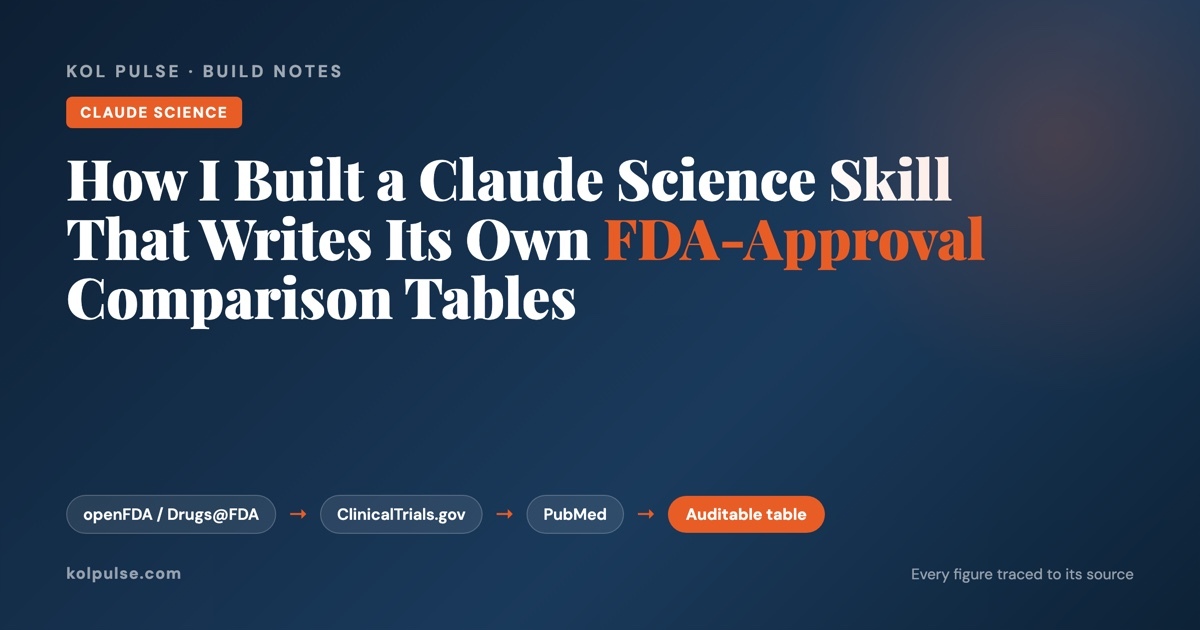
At the end of June, Anthropic shipped something that quietly changes how clinical and scientific analysts can work: Claude Science. It's brand new, so before I show you the first thing I built with it — a skill that generates auditable FDA-approval comparison tables — let me start where it should start: what Claude Science is, and how to get it.
What is Claude Science?
Claude Science is Anthropic's AI workbench for scientific research — a desktop app that connects to the data sources, tools, and systems research teams use across R&D, clinical operations, and regulatory affairs. Instead of toggling between a database, a code terminal, a literature search, and a document editor, you work in one place. Crucially, it runs the analysis locally on your own machine and produces auditable artifacts — traceable and reproducible, which is exactly what regulated science demands.
It builds on Claude for Life Sciences (Anthropic's Oct 2025 platform) and gives you two things that made my project possible:
- Connectors — live links to scientific sources over the Model Context Protocol: openFDA/Drugs@FDA, ClinicalTrials.gov, PubMed, plus Benchling, 10x Genomics, bioRxiv/medRxiv, ChEMBL, Open Targets and more. Claude queries the real databases and returns answers with source citations.
- Agent Skills — reusable folders (a
SKILL.mdof instructions + helper code) that teach Claude a procedure it runs the same way every time.
How to get it
Claude Science is available in beta. You'll need macOS 13+ or Linux (x64) and a Claude.ai account on Pro, Max, Team, or Enterprise (on Team/Enterprise, an admin enables it for your org first).
- macOS: download the installer from claude.com/product/claude-science and double-click. First launch sets up the local runtime, then opens in your browser.
- Linux: run the one-line install script from the Claude Science docs, then start the local server with
claude-science serve.
Sign in, and a setup wizard walks you through enabling connectors and skills.
That's the tool. Here's what I did with it.
The problem: cross-trial tables are where analysts get burned
Line up the trials behind a drug class — say the ADCs in metastatic triple-negative breast cancer — and four errors show up again and again:
- Numbers from memory. A hazard ratio typed from recall instead of the paper.
- Wrong approval year. A trial reads out in 2025 but the FDA action lands in 2026 — people quote the readout.
- Companion-diagnostic soup. "PD-L1 CPS ≥10 by 22C3" and "IC ≥1% by SP142" get blurred together, even though the assays aren't interchangeable — and a clinical criterion like "not a candidate for PD-1/PD-L1 therapy" gets mislabeled as a biomarker test.
- The informative rows get dropped. Withdrawn and negative trials — the ones that explain the landscape — vanish because they don't have a tidy approval to cite.
The one rule that makes the skill trustworthy
The whole skill is built around a single discipline I wrote into the first page of the instructions: never populate a cell from memory. Every column has exactly one authoritative, live source.
| Column | Source of truth |
|---|---|
| Indication text, biomarker & companion-diagnostic wording | openFDA SPL drug labels |
| FDA approval dates + BLA/NDA numbers | Drugs@FDA submission history (the "AP" actions) |
| NCT, enrollment, sponsor, phase, endpoints | ClinicalTrials.gov API |
| Median PFS / OS, HR, CI, p-values | PubMed — transcribed verbatim from the abstract |
How it runs — six steps
Point the skill at a drug class and it works through a fixed workflow:
(1) scope the class — including the negative and withdrawn trials;
(2) pull the FDA labels and approval dates first;
(3) fetch trial metadata from ClinicalTrials.gov;
(4) find the pivotal publications and transcribe the exact efficacy numbers from the abstracts;
(5) assemble one row per trial;
(6) render a hyperlinked, viewport-fit HTML table where every FDA action, PMID, and NCT links back to its primary source.
The discipline is in the details the skill refuses to skip: it reconciles the registry enrollment against the publications, it labels exploratory subgroups as exploratory, and it flags "positive" results that were never formally tested in the statistical hierarchy.
A real result
I ran it on metastatic TNBC. The output is a single page comparing eleven FDA-registration trials — from the 2026 Trop-2 ADC and pembrolizumab-combo approvals back to the PARP inhibitors — with the withdrawn atezolizumab indication and the failed confirmatory trials kept in as the rows that actually explain the field. Every hazard ratio traces to its paper; every approval date to Drugs@FDA.
See the live mTNBC comparison table →
When I spot-checked the newest citations against PubMed afterward, every 2025–2026 PMID resolved to the right trial and the hazard ratios matched the abstracts verbatim. That's the point of building it as a skill instead of a one-off: the rigor is baked in, not re-earned each time.
Self-contained by design
One nice touch: the FDA layer runs on openFDA's public API, so the skill needs no special connector setup to reproduce — anyone can run it and get the same auditable table. That's the KOL Pulse thesis in miniature: clinical intelligence you can click through to the source, generated fast enough to keep up with the field.