IGNYTE Key Takeaways
Design — Open-label, single-arm Phase 1/2 (NCT03767348); intratumoral RP1 + nivolumab; registrational cohort = 140 patients with unresectable advanced cutaneous melanoma progressing on an anti-PD-1-based regimen. (FDA SBRA, Aug 6, 2026)
Published efficacy — ORR 33.6% (95% CI 25.8–42.0), CR 16.4%, median DOR 24.8 months, n=140. (Applicant-reported, IRC per RECIST v1.1)
Labeled efficacy — ORR 24.2% (95% CI 15.8–34.3), median DOR 14.1 months, n=91 evaluable — FDA's own analysis after excluding 49 patients with every target lesion injected or no baseline target lesions. FDA's strict ITT analysis was 15.7%. (FDA SBRA Table 4 / Statistical Review)
Safety — Warnings & Precautions unique to a live oncolytic HSV-1: accidental exposure, herpetic infection/reactivation, and visceral injury (incl. pneumothorax with visceral injections). Two deaths considered possibly treatment-related. Most common ARs: fatigue, pyrexia, chills, infections, injection-site reactions. (FDA SBRA)
Regulatory — ✅ Accelerated approval Aug 6, 2026 (TUDRIQEV + nivolumab) after CRLs on Jul 21, 2025 and Apr 10, 2026 and a 10–3 CTGTAC vote; the primary clinical review team did not recommend approval. Continued approval contingent on IGNYTE-3. (FDA SBRA / OCE Review)
Confirmatory bar — IGNYTE-3 (RP1-104, NCT06264180): randomized Phase 3, ~400 patients, OS primary, analysis due by Sept 2030; only 10% enrolled at approval — failure to conduct with due diligence can trigger expedited withdrawal. (FDA OCE Review)
Compiled and reviewed by the KOL Pulse research team, led by Brian Shields, Founder, KOL Pulse. Last updated September 3, 2026.
Track oncology’s top KOLs in your specialty
Create a free account, pick the tumor types you cover, and go beyond the tweet — the intelligence pharma teams use to map influence and prepare for engagement:
- ✓Enhanced KOL profiles
- ✓Pharma influence & potential advisory-board patterns
- ✓2025 Open Payments financial analysis
- ✓Social-media sentiment & trend signals
Top KOLs Discussing IGNYTE







The Label vs. the Publications
The approved TUDRIQEV labeling does not carry the efficacy results that appeared in journals and at ASCO/ESMO. After identifying five categories of methodological concern that “artificially inflate the Applicant's reported ORR and DOR,” FDA based the approval on its own analysis of the 91 patients in whom a systemic effect could actually be assessed.
| Analysis | N | ORR (95% CI) | Median DOR (95% CI) |
|---|---|---|---|
| Published / applicant-reported | 140 | 33.6% (25.8–42.0) | 24.8 mo (14.1–NR) |
| FDA primary analysis (ITT) | 140 | 15.7% (10.1–22.8) | 14.1 mo (10.7–NR) |
| FDA sensitivity analysis — the labeled basis | 91 | 24.2% (15.8–34.3) | 14.1 mo (10.7–NR) |
Why 140 patients became 91
FDA excluded 49 patients whose every target lesion was directly injected with RP1 or who had no baseline target lesions — populations in which RECIST v1.1 cannot distinguish a systemic immune effect from the local physical effect of injecting a tumor. Over half of the reported responders (53%) fell into this category, and 18 of the 23 reported complete responders had all target lesions injected. One FDA memorandum reports the sensitivity analysis as 24.7% (16.2–35.0); the Summary Basis for Regulatory Action and Statistical Review carry 24.2% (15.8–34.3), which this page treats as canonical.
Label ORR 24.2% · published ORR 33.6% · FDA ITT 15.7%Source: FDA Summary Basis for Regulatory Action (Aug 6, 2026); Statistical Review Memorandum (BLA 125827)
The KOL Pulse FDA briefing (video)
A 2:20 walkthrough of the FDA record — the audit findings, the label math, and the confirmatory-trial stakes — with the primary FDA documents on screen.
The FDA Record — Key Exhibits
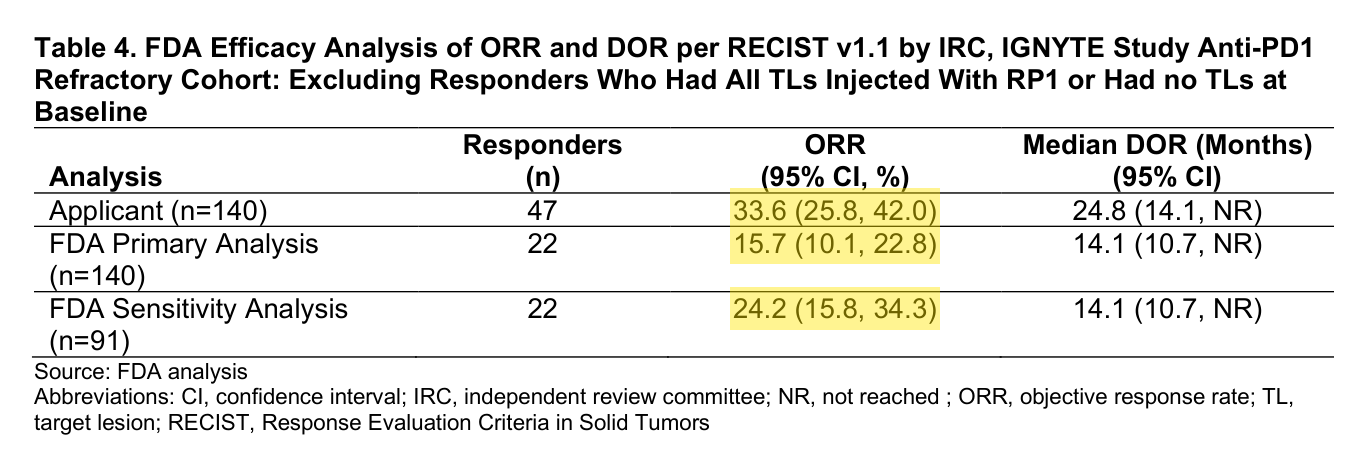
Applicant-reported ORR 33.6% vs FDA primary 15.7% vs the FDA sensitivity analysis (24.2%) that the approval rests on.
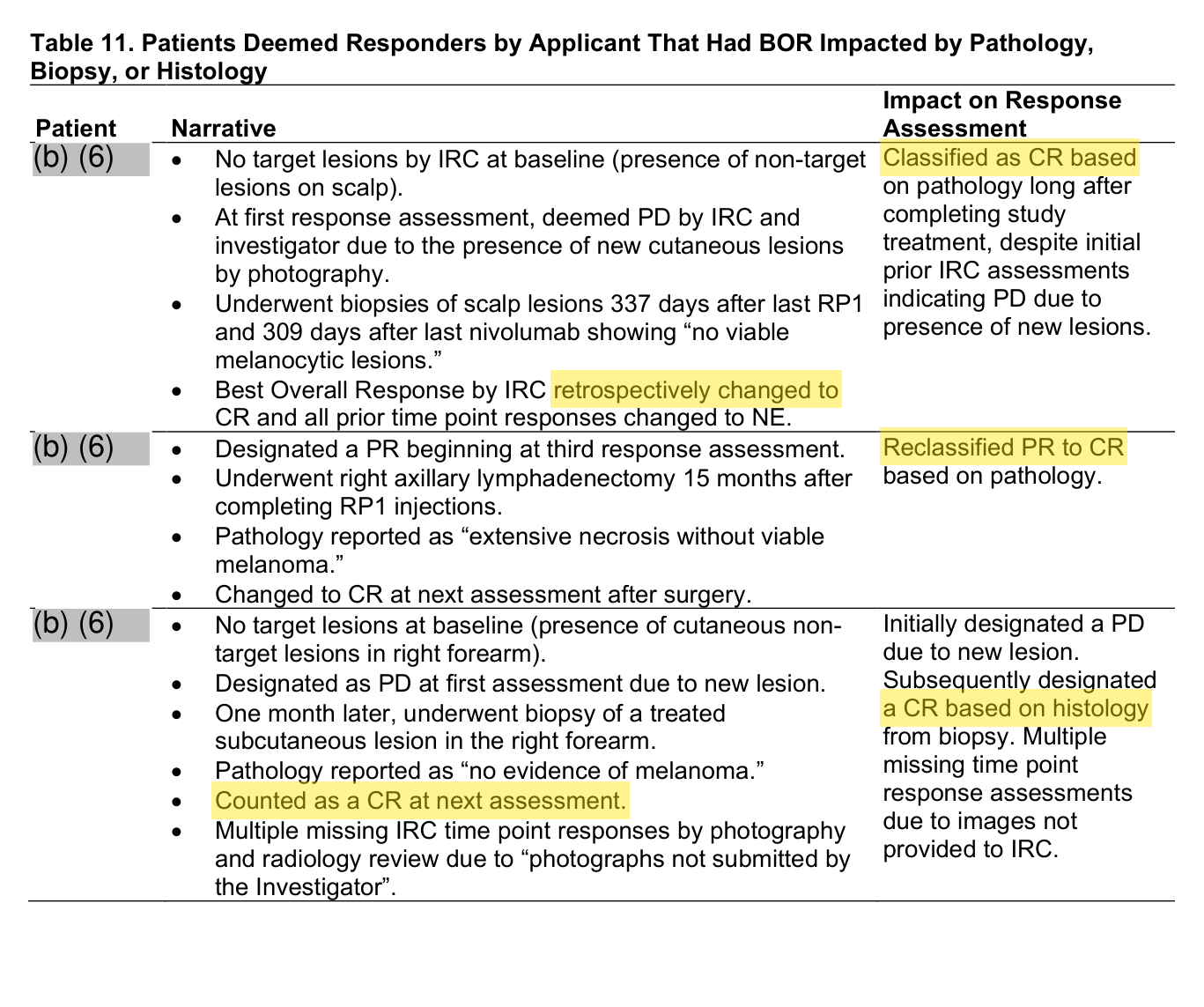
Seven patients (15% of reported responders) had best overall response reclassified based on unblinded local pathology.
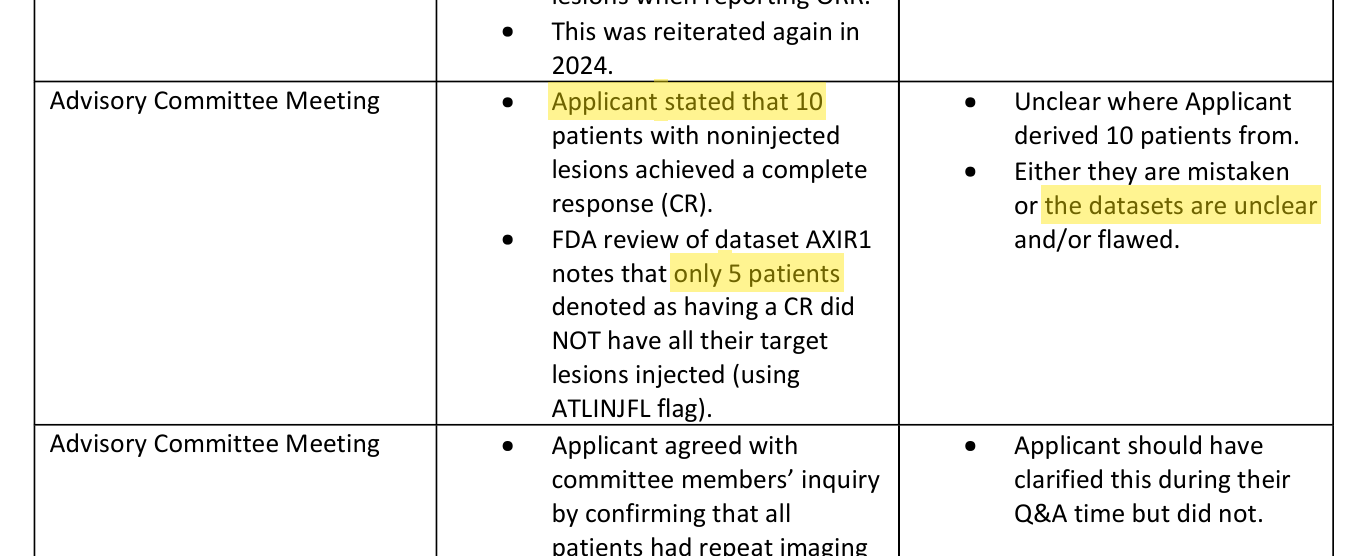
The sponsor told the AdComm 10 complete responders had non-injected lesions; FDA's audit of dataset AXIR1 found 5.
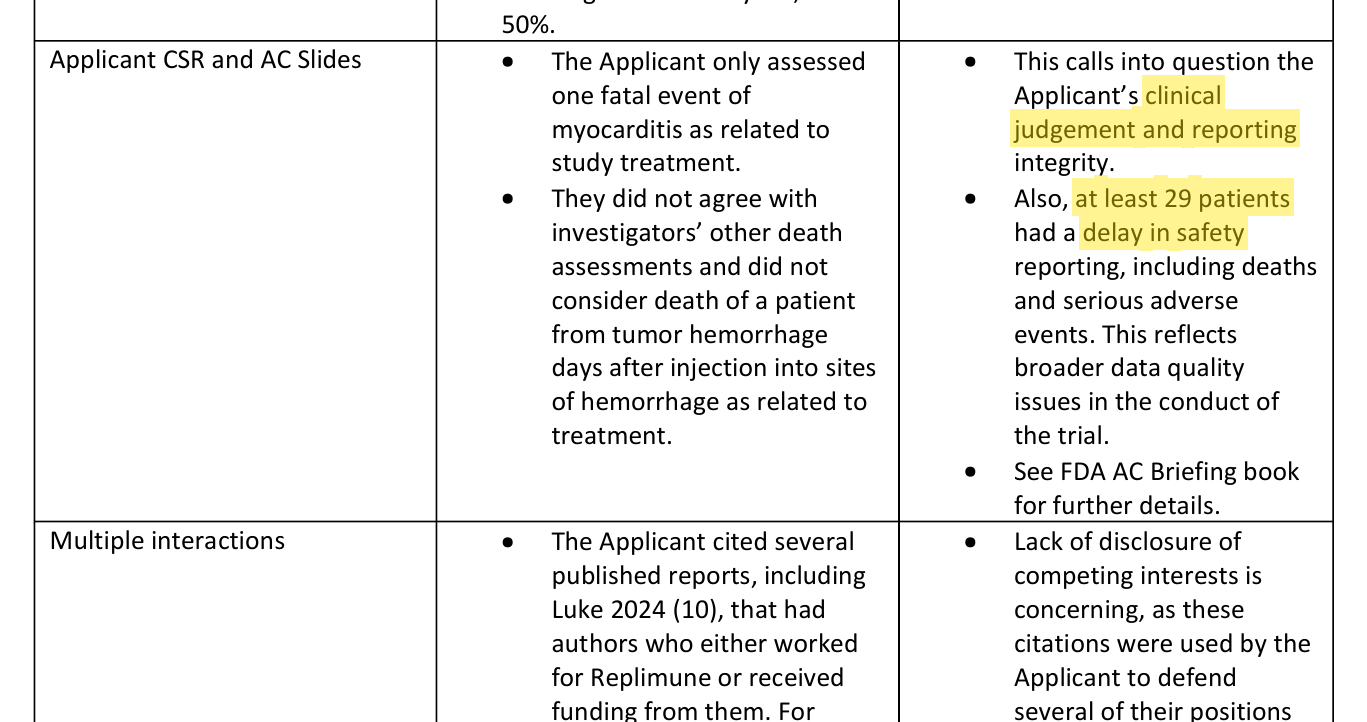
At least 29 patients had delayed safety reporting, including deaths and serious adverse events.
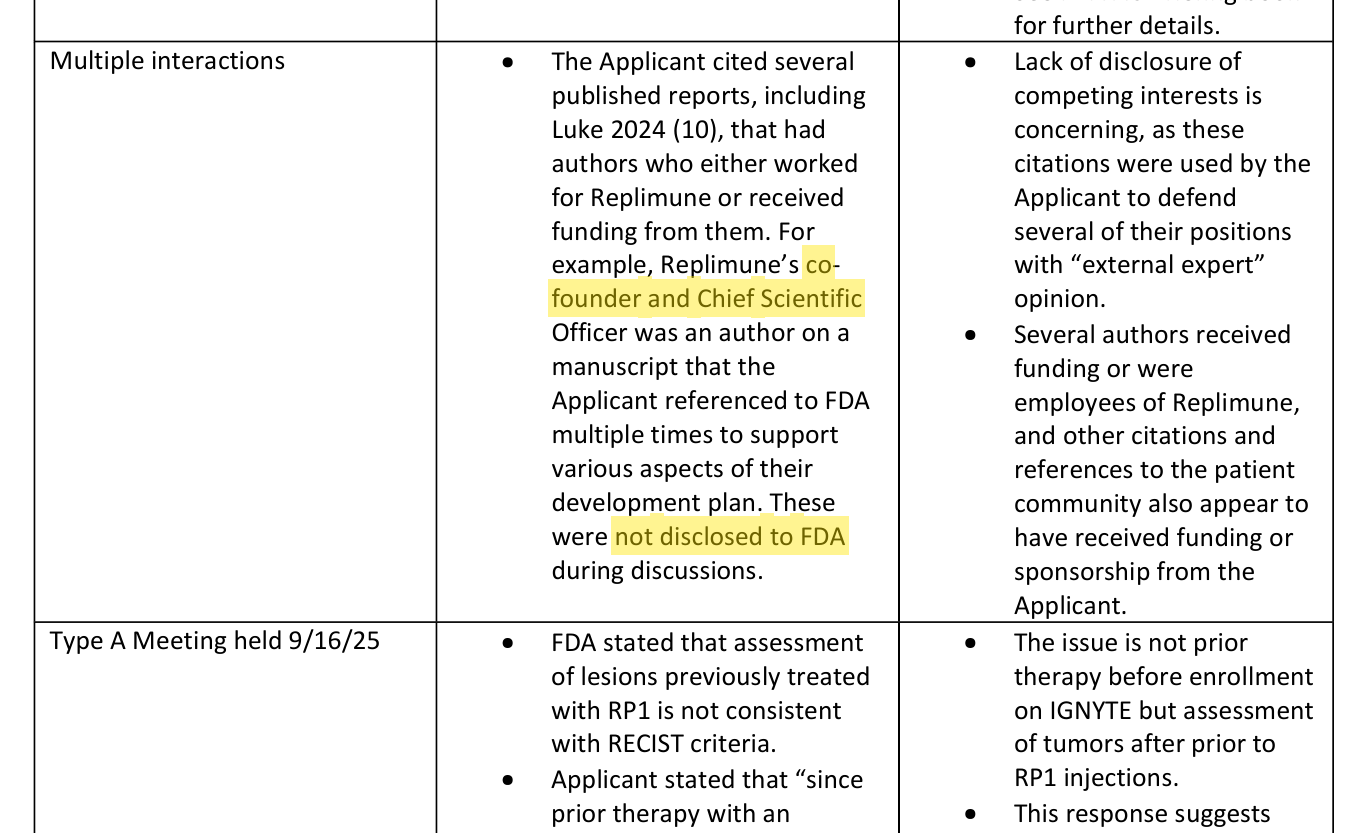
Literature cited to FDA as independent expert opinion included authorship by Replimune's co-founder and Chief Scientific Officer.
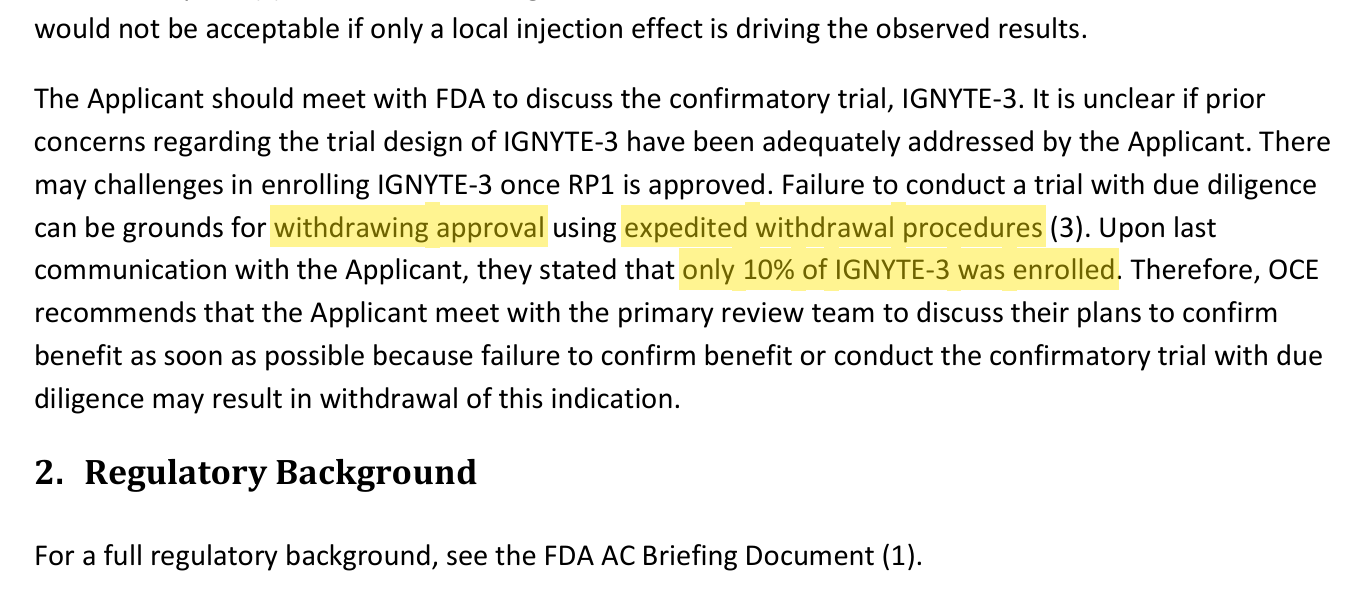
Only 10% of the confirmatory IGNYTE-3 trial was enrolled at approval; failure to conduct it with due diligence can trigger expedited withdrawal.


Regulatory Timeline
Nov 21, 2024 — BLA 125827 submitted
Replimune files for accelerated approval of RP1 + nivolumab based on the single-arm IGNYTE anti-PD-1-failed melanoma cohort (n=140): applicant-reported ORR 33.6%, CR 16.4%, mDOR 24.8 months.
Source: Replimune news release, Nov 21, 2024 →Jul 21, 2025 — Complete Response Letter #1
FDA cites unreliable response-assessment methodology, inability to isolate RP1's contribution without a control arm, and lack of a reliable historical control. The melanoma community pushes back publicly - Dr. Mohammed Milhem (the trial's highest-enrolling investigator) writes to the FDA Commissioner; Allison Betof Warner's post sharing it reaches 57,000 impressions.
Source: Replimune news release, Jul 22, 2025 →Sep 16, 2025 — Type A meeting
FDA reiterates the deficiencies and states IGNYTE's response criteria were not consistent with RECIST v1.1. Replimune provides the written assurance that histology overrides 'do not apply' to this cohort - a claim FDA's later audit found to be untrue.
Source: Replimune news release, Sep 18, 2025 (meeting held Sep 16) →Apr 10, 2026 — Complete Response Letter #2
The first resubmission is rejected on the same core deficiencies. RFK Jr. publicly defends the decision: 'Marty made the correct decision to not approve that drug.'
Source: Replimune news release, Apr 10, 2026 →Jun 2, 2026 — Second resubmission
Adds a 3-year OS analysis but, per FDA, 'did not introduce substantive new efficacy data to resolve the deficiencies.'
Source: FDA approval letter, BLA 125827 (acknowledges the Jun 2, 2026 amendment) →Jul 30, 2026 — Advisory Committee votes 10-3
The CTGTAC votes that IGNYTE's efficacy results are evaluable and clinically meaningful, citing unmet need, biological plausibility, and durable responses - while acknowledging the methodological limitations. FDA's post-meeting audit contradicts sponsor statements made at the meeting (10 vs 5 systemic complete responders).
Source: Replimune news release, Jul 30, 2026; CTGTAC meeting materials →Aug 6, 2026 — Accelerated Approval
OCE leadership approves over the primary review team's recommendation, on FDA's own sensitivity analysis (ORR 24.2%, n=91). Brand name TUDRIQEV. Continued approval contingent on IGNYTE-3.
Source: FDA approval notice, Aug 6, 2026 →Sep 2030 — IGNYTE-3 OS analysis due
The randomized Phase 3 confirmatory trial (~400 patients, OS primary) must be completed with due diligence - only 10% enrolled at approval; failure can trigger expedited withdrawal.
Source: FDA approval letter, BLA 125827 (post-marketing requirement: completion Sep 2030, final report Mar 2031) →IGNYTE Top Tweets
𝕏
 𝕏
𝕏
 𝕏
𝕏
 𝕏
𝕏
𝕏
𝕏
 𝕏
𝕏
𝕏
𝕏
𝕏
𝕏
𝕏
𝕏
𝕏
𝕏
IGNYTE / TUDRIQEV FAQ
Why does the TUDRIQEV label report a lower response rate than the published IGNYTE data?
The published IGNYTE results reported an ORR of 33.6% with a median duration of response of 24.8 months in 140 patients. FDA's review found that over half of responders had every target lesion directly injected (or no baseline target lesions), so a systemic effect could not be assessed, and at least 7 responders (15%) were reclassified via unblinded local pathology. The approval therefore rests on FDA's own analysis of the 91 evaluable patients: ORR 24.2% (95% CI 15.8-34.3) with median DOR 14.1 months - the labeled figures.
Is TUDRIQEV (RP1) FDA-approved?
Yes - accelerated approval on August 6, 2026, in combination with nivolumab for adult patients with unresectable advanced cutaneous melanoma who experienced disease progression on a PD-1-blocking antibody-based regimen. Continued approval may be contingent on verification of clinical benefit in the confirmatory IGNYTE-3 trial.
Why did the FDA reject IGNYTE twice before approving?
Two Complete Response Letters (July 21, 2025 and April 10, 2026) cited unreliable response-assessment methodology, inability to establish RP1's contribution to the combination without a concurrent control, and lack of a reliable historical control. The second resubmission added a 3-year OS analysis but no substantive new efficacy data; the primary clinical review team did not recommend approval, and OCE leadership approved on the accelerated pathway after the advisory committee's 10-3 vote.
What did the FDA advisory committee vote?
On July 30, 2026, the Cellular, Tissue, and Gene Therapies Advisory Committee voted 10-3 that the efficacy results from IGNYTE are evaluable and clinically meaningful, citing unmet need, biological plausibility, and durable responses - while acknowledging the study's significant methodological limitations.
What happens if IGNYTE-3 is not completed?
Only 10% of the confirmatory Phase 3 IGNYTE-3 trial (RP1-104, NCT06264180; ~400 patients, primary endpoint overall survival, analysis due by September 2030) was enrolled at approval. FDA noted that failure to confirm benefit or to conduct the trial with due diligence can be grounds for withdrawing the approval using expedited withdrawal procedures.