RECAP DAVA Hawaii Lung 2026 — top KOL voices, trial buzz & every conference slide, decoded View Full Coverage →
FDA Approved · Multiple Myeloma

IRAKLIA Trial

IRAKLIA is a Phase 3, randomized non-inferiority trial from Sanofi testing subcutaneous Sarclisa Escena (isatuximab-irfc) delivered via the CirCLIQ on-body injector versus IV Sarclisa, both with pomalidomide and dexamethasone, in relapsed/refractory multiple myeloma. It met co-primary endpoints — ORR 71.1% vs 70.5% IV (non-inferior) — and was FDA approved July 10, 2026.

FDA Approved — Jul 10, 2026 Phase III NCT05405166 Sanofi R/R + NDMM CirCLIQ On-Body Injector
Discover KOL Sentiment on IRAKLIA →Read the FDA Approval Release

IRAKLIA at a Glance

Study Design

Phase 3, randomized, open-label, non-inferiority trial: Sarclisa SC via the CirCLIQ on-body injector at a fixed flat dose vs weight-based Sarclisa IV, both plus pomalidomide and dexamethasone (Pd), in relapsed/refractory multiple myeloma. (Sanofi Press / ASCO 2025)

Efficacy — ORR Non-Inferiority (Co-Primary)

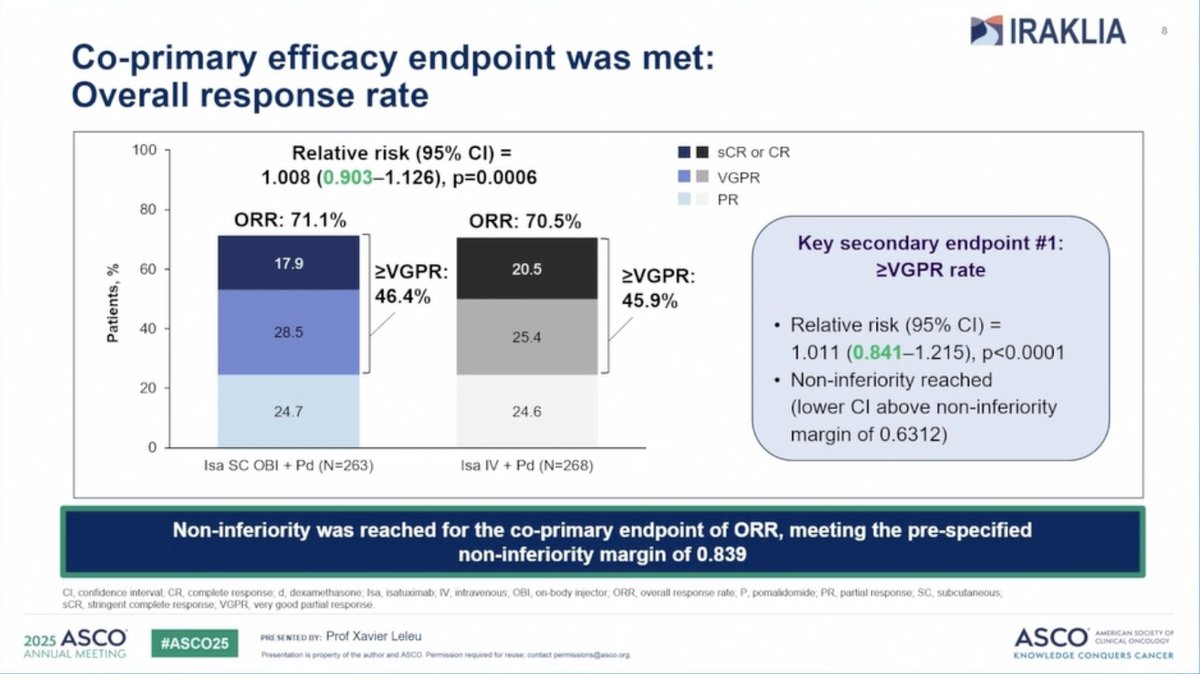
ORR 71.1% (187/263) with Sarclisa SC-Pd vs 70.5% (189/268) with Sarclisa IV-Pd; non-inferiority established (relative risk 1.008, 95% CI 0.903–1.126, p=0.0006). Observed Ctrough co-primary also met. (Sanofi Press / ASCO 2025 abstract 7506)

Safety

Systemic (infusion-related) reactions occurred in 1.5% of SC-Pd patients vs 25% of IV-Pd patients. Injection-site reactions were low-grade at 0.4% of OBI injections (19/5,145). No new safety concerns. (Sanofi Press)

Device

CirCLIQ on-body injector (Enable Injections, enFuse platform): sterile single-use wearable, no batteries/electronics, flat dose (no body-weight adjustment), hands-free, hidden ~30-gauge needle, 10 mL volume, individualized flow rate. (ASCO 2025 slide)

Regulatory

FDA approved July 10, 2026 — Sarclisa (isatuximab-irfc) Escena SC, the first anticancer treatment administered via an on-body injector, across all existing Sarclisa IV indications (Isa-VRd, Isa-Pd, Isa-Kd). (Sanofi Press, Jul 10 2026)

Sponsor & Drug

Sanofi. Drug: isatuximab-irfc (brand Sarclisa; SC formulation branded Sarclisa Escena), an anti-CD38 monoclonal antibody. (Sanofi Press)

Top KOLs Discussing IRAKLIA

IRAKLIA Key Slides & Visuals

Full IRAKLIA primary-analysis deck from ASCO 2025 (#ASCO25), shared by KOLs. Each slide includes the transcribed data — click View OCR Text.

Samer Al Hadidi, MD avatar
Samer Al Hadidi, MD @HadidiSamer
Study Design — Phase 3, N=531
ASCO 2025 (#ASCO25) · Jun 3, 2025
View Post
Study design. RRMM, at least 18 years, at least 1 prior line of therapy (LOT); N=531. Randomization 1:1, stratified by MM isotype, body weight, and number of prior LOTs. Arms: Isa IV + Pd vs Isa SC OBI + Pd; treatment until progressive disease, unacceptable AEs, patient withdrawal, or other reason. Dosing: Isa IV 10 mg/kg; Isa SC OBI 1400 mg (flat dose); pomalidomide 4 mg/day PO on days 1-21; dexamethasone 40 mg PO (20 mg for patients 75 years or older). Cycle 1: Isa weekly (days 1, 8, 15, 22); Cycle 2 onwards: Isa on days 1 and 15. Co-primary endpoints: ORR and Ctrough (predose at C6D1). Key secondary endpoints: at least VGPR rate; Ctrough (predose at C2D1); IR incidence rate; patient satisfaction (PESQ; C5D15). IRAKLIA (NCT05405166) is a Phase 3, randomized, international, open-label, non-inferiority study in patients with RRMM receiving Isa SC OBI or IV combined with Pd. Presented by Prof Xavier Leleu, 2025 ASCO Annual Meeting (#ASCO25).
Samer Al Hadidi, MD avatar
Samer Al Hadidi, MD @HadidiSamer
Background — Isa Across the MM Continuum
ASCO 2025 (#ASCO25) · Jun 3, 2025
View Post
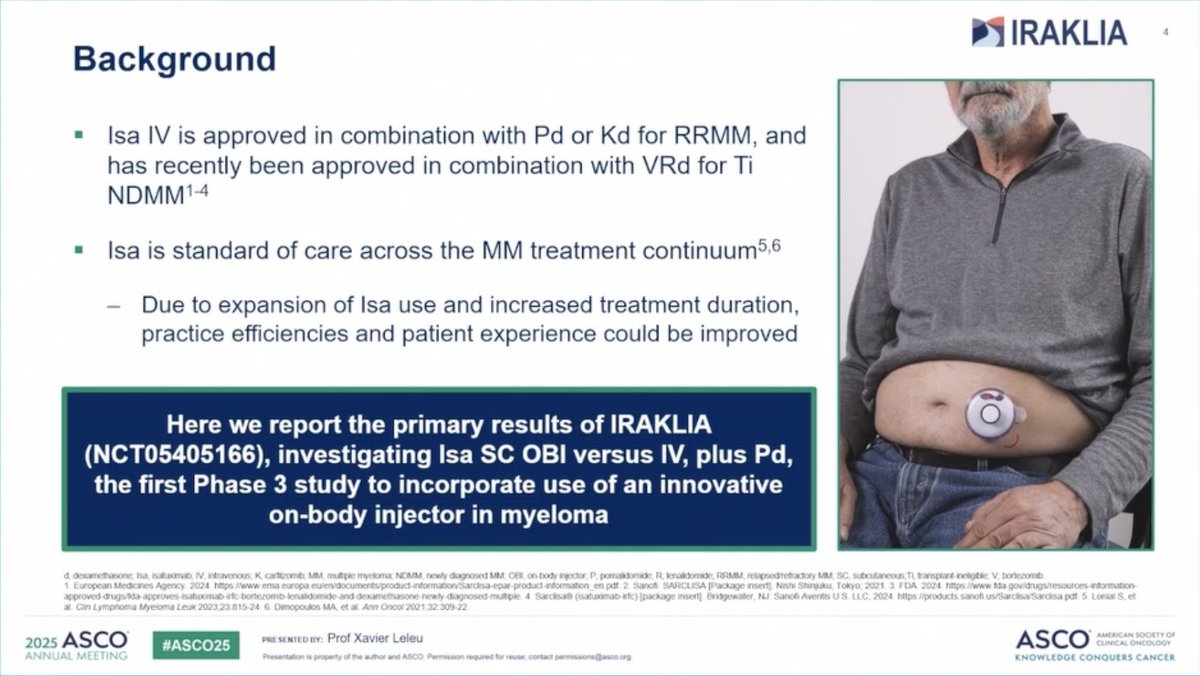
Background. Isa IV is approved in combination with Pd or Kd for RRMM, and has recently been approved in combination with VRd for transplant-ineligible NDMM. Isa is standard of care across the MM treatment continuum. Due to expansion of Isa use and increased treatment duration, practice efficiencies and patient experience could be improved. Here we report the primary results of IRAKLIA (NCT05405166), investigating Isa SC OBI versus IV, plus Pd, the first Phase 3 study to incorporate use of an innovative on-body injector in myeloma.
Samer Al Hadidi, MD avatar
Samer Al Hadidi, MD @HadidiSamer
Baseline Characteristics
ASCO 2025 (#ASCO25) · Jun 3, 2025
View Post
Baseline characteristics (Isa SC OBI + Pd, N=263 vs Isa IV + Pd, N=268). Age, median (range): 66 (36-86) vs 66 (31-85). Race: White 70% vs 69%; Black or African American 3% vs 5%; Asian 20% vs 22%. Male: 52% vs 58%. ECOG PS 0: 53% vs 58%; PS 1: 41% vs 38%; PS 2: 5% vs 4.4%. Baseline weight: 65 kg or less 32%/32%; over 65 to 85 kg 45%/43%; over 85 kg 24%/24%. eGFR under 60: 32% vs 23%. Plasmacytoma (per IRC): 28% vs 23%. Serum LDH above ULN: 21% vs 17%. IgG myeloma: 59% vs 60%. ISS stage I 56%/63%; II 28%/25%; III 14%/10%. Cytogenetic high-risk 19% vs 22%; standard risk 59% vs 55%. Prior lines of therapy, median (range): 2 (1-8) in both arms; 1 line 29%/31%; 2 lines 35%/31%; 3 or more lines 36%/37%. Prior proteasome inhibitor 100%/100%; prior immunomodulatory drugs 100%/100%; prior anti-CD38 agents 14%/11%. Refractory to lenalidomide 85% vs 82%. Baseline characteristics were generally well balanced between arms.
Samer Al Hadidi, MD avatar
Samer Al Hadidi, MD @HadidiSamer
Co-Primary Endpoint Met — Overall Response Rate
ASCO 2025 (#ASCO25) · Jun 3, 2025
View Post
Co-primary efficacy endpoint was met: Overall response rate. ORR 71.1% (Isa SC OBI + Pd, N=263) vs 70.5% (Isa IV + Pd, N=268). Relative risk (95% CI) = 1.008 (0.903-1.126), p=0.0006. Response breakdown, SC OBI: sCR or CR 17.9%, VGPR 28.5%, PR 24.7% (at least VGPR 46.4%). IV: sCR or CR 20.5%, VGPR 25.4%, PR 24.6% (at least VGPR 45.9%). Key secondary endpoint #1 (at least VGPR rate): relative risk 1.011 (95% CI 0.841-1.215), p<0.0001; non-inferiority reached (lower CI above non-inferiority margin of 0.6312). Non-inferiority was reached for the co-primary endpoint of ORR, meeting the pre-specified non-inferiority margin of 0.839.
Samer Al Hadidi, MD avatar
Samer Al Hadidi, MD @HadidiSamer
Co-Primary PK Endpoint Met — Ctrough at Steady State
ASCO 2025 (#ASCO25) · Jun 3, 2025
View Post
Co-primary PK endpoint was met: Ctrough of Isa at steady state (predose at C6D1). Geometric mean Ctrough: Isa SC OBI + Pd = 426 micrograms/mL (N=121) vs Isa IV + Pd = 278 micrograms/mL (N=121). Geometric mean ratio (90% CI) = 1.532 (1.316-1.784). Non-inferiority of the co-primary endpoint of Ctrough of Isa at steady state was reached, with the lower CI of the geometric means ratio above the non-inferiority margin of 0.8.
Samer Al Hadidi, MD avatar
Samer Al Hadidi, MD @HadidiSamer
Flat Dose — Consistent ORR Across Body Weight
ASCO 2025 (#ASCO25) · Jun 3, 2025
View Post
The flat dose of Isa SC OBI showed consistent ORR across body weight subgroups. All patients: 187/263 (SC OBI) vs 189/268 (IV), relative risk 1.008 (95% CI 0.903-1.126). By body weight: 65 kg or less 55/84 vs 60/85, RR 0.928 (0.748-1.144); over 65 to 85 kg 82/117 vs 82/118, RR 1.009 (0.850-1.197); over 85 kg 50/62 vs 47/65, RR 1.115 (0.915-1.372).
Samer Al Hadidi, MD avatar
Samer Al Hadidi, MD @HadidiSamer
Patient Satisfaction With Delivery Method
ASCO 2025 (#ASCO25) · Jun 3, 2025
View Post
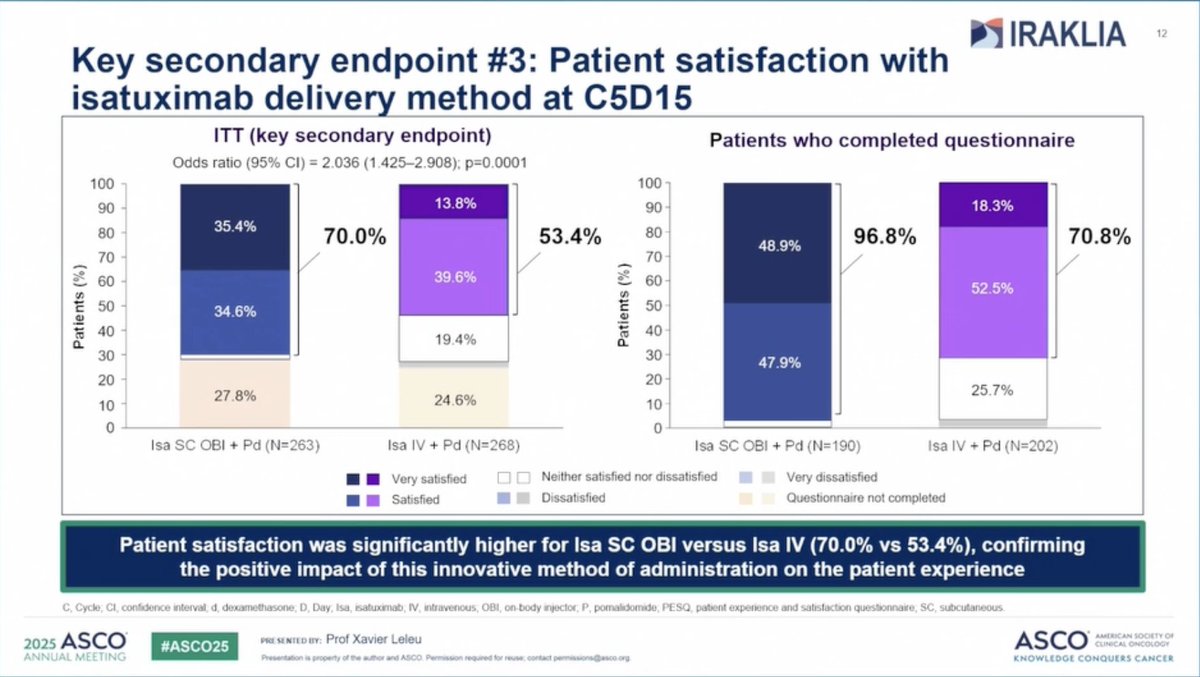
Key secondary endpoint #3: Patient satisfaction with isatuximab delivery method at C5D15. ITT (key secondary endpoint): satisfied (very satisfied plus satisfied) 70.0% for Isa SC OBI + Pd (N=263) vs 53.4% for Isa IV + Pd (N=268). Odds ratio (95% CI) = 2.036 (1.425-2.908), p=0.0001. Among patients who completed the questionnaire: 96.8% (SC OBI, N=190) vs 70.8% (IV, N=202). Patient satisfaction was significantly higher for Isa SC OBI versus Isa IV (70.0% vs 53.4%), confirming the positive impact of this innovative method of administration on the patient experience.
Samer Al Hadidi, MD avatar
Samer Al Hadidi, MD @HadidiSamer
Infusion Reactions & Injection-Site Reactions
ASCO 2025 (#ASCO25) · Jun 3, 2025
View Post
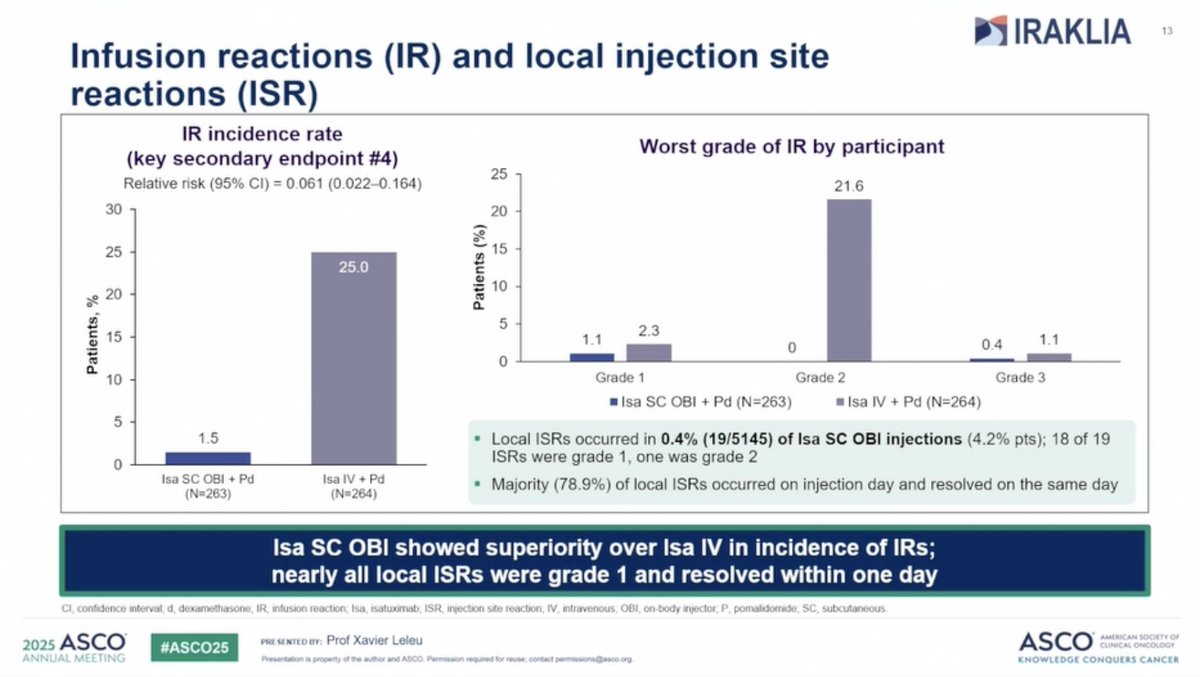
Infusion reactions (IR) and local injection site reactions (ISR). IR incidence rate (key secondary endpoint #4): 1.5% for Isa SC OBI + Pd (N=263) vs 25.0% for Isa IV + Pd (N=264). Relative risk (95% CI) = 0.061 (0.022-0.164). Worst grade of IR by participant: Grade 1 1.1% vs 2.3%; Grade 2 0% vs 21.6%; Grade 3 0.4% vs 1.1%. Local ISRs occurred in 0.4% (19/5,145) of Isa SC OBI injections (4.2% of patients); 18 of 19 ISRs were grade 1, one was grade 2. Majority (78.9%) of local ISRs occurred on injection day and resolved on the same day. Isa SC OBI showed superiority over Isa IV in incidence of IRs; nearly all local ISRs were grade 1 and resolved within one day.
Rafael Fonseca, MD avatar
CirCLIQ On-Body Injector — Device Attributes
ASCO 2025 (#ASCO25) · Jun 3, 2025
View Post
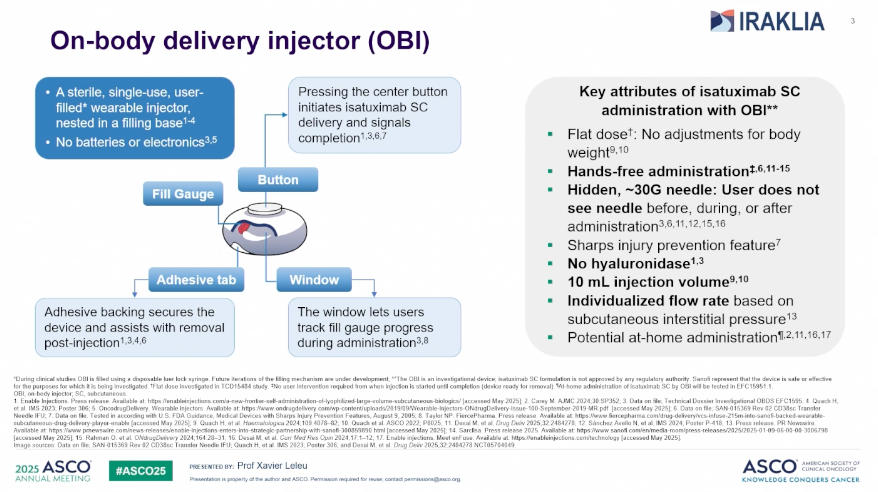
On-body delivery injector (OBI). A sterile, single-use, user-filled wearable injector nested in a filling base; no batteries or electronics. Pressing the center button initiates isatuximab SC delivery and signals completion. Components: Fill Gauge, Button, Adhesive tab, Window (lets users track fill-gauge progress). Adhesive backing secures the device and assists with removal post-injection. Key attributes of isatuximab SC administration with OBI: Flat dose — no adjustments for body weight; Hands-free administration; Hidden ~30G needle (user does not see the needle before, during, or after administration); Sharps injury prevention feature; No hyaluronidase; 10 mL injection volume; Individualized flow rate based on subcutaneous interstitial pressure; Potential at-home administration. Presented by Prof Xavier Leleu — 2025 ASCO Annual Meeting (#ASCO25).
Nico Gagelmann, MD avatar
Nico Gagelmann, MD @NicoGagelmann
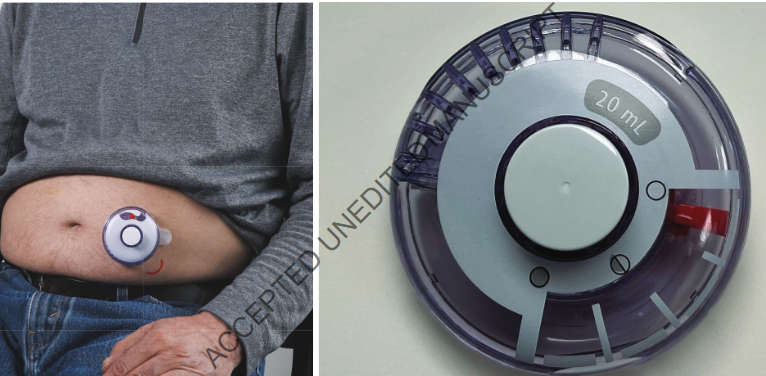
On-Body Injector — Device Photograph
Jun 4, 2025
View Post

IRAKLIA Top Tweets

Top physician voices discussing IRAKLIA — click to view on X

C. Ola Landgren, M.D.
C. Ola Landgren, M.D.@DrOlaLandgren

Press Release: New Sarclisa subcutaneous formulation met co-primary endpoints in the IRAKLIA phase 3 study in multiple myeloma

#mmsm @IMFmyeloma @theMMRF @HealthTree @LLSusa

https://t.co/WGsMD5NSYA

👁 1,389Jan 11, 2025
Nico Gagelmann, MD
Nico Gagelmann, MD@NicoGagelmann

On-body isatuximab matches IV in myeloma, with fewer reactions❗️

The phase 3 IRAKLIA trial showed that subcutaneous isatuximab delivered via on-body delivery system (OBDS) is non-inferior to intravenous (IV) isatuximab when combined with pomalidomide and dexamethasone in https://t.co/4wBtMyPeSu

👁 1,102Jun 4, 2025
Michael Tomasson, MD
Michael Tomasson, MD@MTomasson

Bravo to the teams involved! It's a challenging road to be second in class, but
- more options for patients
- competition we can hope will bring prices down, and
- we can ask if there are any clinical differences with Dara that might be exploited
#mmsm #cancersucks https://t.co/Tka6h3Irpe

👁 762Jan 12, 2025
Samer Al Hadidi, MD
Samer Al Hadidi, MD@HadidiSamer

#mmsm #ASCO25 oral myeloma sessions

IRAKLIA study of OBI device of Isa

Cool device to deliver Isa

Study schema https://t.co/knuY1Ks0te

👁 708Jun 3, 2025
Rahul Banerjee, MD
Rahul Banerjee, MD@RahulBanerjeeMD

3/ #ASCO25 #MMsm newly Dx'ed:

7506 IRAKLIA (Ailawadhi): subQ isa via auto-injector (no slow RN push): non-inferior to IV Isa. Only 0.4% ISRs!

Plus ⬆️ pt satisfaction (albeit only 70% vs 53%, will need to see why not 100%). COLUMBA-like approval soon?

https://t.co/u7r6TtRdAZ https://t.co/uMkNK4sjY1

👁 348May 22, 2025
Rafael Fonseca, MD
Rafael Fonseca, MD@Rfonsi1

IRAKLIA study shows on body delivery system is safe, effective and preferred by patients. Cool fearture that time of administration depends on tissue resistance.
Called "escargot" in France! Less infusion/injection reactions (1.5 vs 25%)
#ASCO25 https://t.co/abwbFApAWv

👁 281Jun 3, 2025
Robert Z. Orlowski, MD
Robert Z. Orlowski, MD@Myeloma_Doc

#Myeloma Paper of the Day: Phase 3 IRAKLIA study shows Isatuximab (+Pom/dex) w/ on-body delivery system shows similar efficacy & pharmacokinetic non-inferiority versus Isa-iv/Pom/dex w/ no unexpected safety signal and lower infusion reaction rate: https://t.co/r10pHr405g. #mmsm https://t.co/Vp7A3kCIqj

👁 204Jun 4, 2025
Charles Milrod, MD
Charles Milrod, MD@CharlesMilrod

Nice to see subQ isatuximab approved!

*But* reminds me of this study👇 from @majorajay- subQ forms (this was for BsAbs) didn’t lead to the time convenience I would have expected https://t.co/h2cxkuDEp3 https://t.co/XPqiBaENbM

👁 22Dec 26, 2025

FDA Approval

FDA APPROVEDJuly 10, 2026 — Sarclisa (isatuximab-irfc) Escena

The FDA approved Sarclisa (isatuximab-irfc) Escena — the subcutaneous formulation delivered via the CirCLIQ on-body injector — the first anticancer treatment administered via an on-body injector. It is approved across all existing Sarclisa IV indications:

Isa-VRd: in combination with bortezomib, lenalidomide, and dexamethasone in newly diagnosed multiple myeloma patients not eligible for autologous stem cell transplant.

Isa-Pd: in combination with pomalidomide and dexamethasone in relapsed/refractory multiple myeloma patients who received at least 2 prior therapies.

Isa-Kd: in combination with carfilzomib and dexamethasone in relapsed/refractory multiple myeloma patients who received 1–3 prior lines.

“The comparable efficacy observed across multiple studies and the patient-centric design of the OBI offers an opportunity to impact the patient experience.” — Sikander Ailawadhi, MD

Source: Sanofi press release (Jul 10, 2026)
Source: ClinicalTrials.gov NCT05405166

About the IRAKLIA Trial

IRAKLIA (NCT05405166) is a Phase 3, randomized, open-label, international non-inferiority study from Sanofi evaluating subcutaneous Sarclisa (isatuximab-irfc), delivered at a fixed flat dose via the CirCLIQ on-body injector, versus weight-based intravenous Sarclisa, both combined with pomalidomide and dexamethasone (Pd), in adults with relapsed/refractory multiple myeloma. The trial enrolled 531 patients and met both co-primary endpoints — overall response rate (71.1% SC-Pd vs 70.5% IV-Pd; non-inferior) and observed Ctrough at steady state — while systemic (infusion-related) reactions fell from 25% with IV to 1.5% with the on-body injector. On the strength of these data, the subcutaneous formulation, branded Sarclisa Escena, became the first anticancer treatment administered via an on-body injector and was FDA approved on July 10, 2026 across all existing Sarclisa IV indications.

Trial Methodology & Results

Study Design

Phase 3, randomized, open-label, non-inferiority study (NCT05405166) comparing Sarclisa SC via the CirCLIQ on-body injector at a fixed flat dose vs weight-based Sarclisa IV.

Population

Adults with relapsed/refractory multiple myeloma who received at least 1 prior line of therapy; all received a pomalidomide + dexamethasone (Pd) backbone.

Interventions

Isatuximab SC via CirCLIQ on-body injector (or manual SC injection) + Pd, versus weight-based isatuximab IV + Pd.

Endpoints

Co-primary: (1) ORR by IMWG 2016 (Independent Review Committee) and (2) observed Ctrough at steady state (pre-dose cycle 6 day 1). Both met.

Device

CirCLIQ on-body injector (Enable Injections, enFuse platform): sterile single-use wearable; flat dose; hands-free; hidden ~30-gauge needle; no hyaluronidase; 10 mL volume; individualized flow rate; potential at-home administration. Now FDA approved (Jul 10, 2026).

Lead Author / PI

Sikander Ailawadhi, MD (Mayo Clinic, Jacksonville, FL), principal investigator; ASCO 2025 primary analysis (abstract 7506) presented by Xavier Leleu, MD; senior author Philippe Moreau, MD.

Overall Response Rate (Co-Primary Endpoint)

ORR was 71.1% (187/263) with Sarclisa SC-Pd vs 70.5% (189/268) with Sarclisa IV-Pd, establishing non-inferiority (relative risk 1.008, 95% CI 0.903–1.126, p=0.0006). Median on-body-injector administration was 13 minutes, identical in the clinic and at home. Source

Non-inferiority established: ORR 71.1% SC vs 70.5% IV (RR 1.008, p=0.0006)
Source: Sanofi press release + IRAKLIA ASCO 2025 abstract 7506 (ClinicalTrials.gov NCT05405166)

Pharmacokinetics — Ctrough at Steady State (Co-Primary Endpoint)

Geometric mean Ctrough at steady state (predose C6D1) was 426 µg/mL with Sarclisa SC-Pd (N=121) vs 278 µg/mL with Sarclisa IV-Pd (N=121); geometric mean ratio 1.532 (90% CI 1.316–1.784), with the lower CI above the non-inferiority margin of 0.8 — establishing pharmacokinetic non-inferiority. Where home administration was permitted, all OBI injections were completed (100%) with no new safety signals. Source

Ctrough 426 vs 278 µg/mL — GMR 1.532 (PK non-inferior)
Source: IRAKLIA ASCO 2025 abstract 7506 (ClinicalTrials.gov NCT05405166)

Safety & Tolerability

Systemic administration (infusion-related) reactions occurred in 25% of IV-Pd patients vs 1.5% of SC-Pd patients (relative risk 0.061, 95% CI 0.022–0.164). Injection-site reactions were low-grade and occurred in 0.4% of on-body injector injections (19/5,145 injections). The overall safety profile was consistent with established Sarclisa IV-Pd, with no new safety concerns. Grade ≥3 hematologic lab abnormalities (OBI vs IV): neutropenia 84.7% vs 74.3%, thrombocytopenia 26.1% vs 23.0%, anemia 17.6% vs 19.5%. Grade ≥3 non-hematologic AEs: pneumonia 14.8% vs 15.5%, COVID-19 2.7% vs 1.9%, upper respiratory tract infection 1.5% in both arms. Source

Infusion-related reactions: 1.5% SC vs 25% IV (RR 0.061)
Source: Sanofi press release (Jul 10, 2026)

Patient Preference — Supportive Phase 2 IZALCO Study (NCT05704049)

In the Phase 2 IZALCO study (NCT05704049) — a separate patient-preference study of subcutaneous isatuximab via the on-body injector — after experiencing both methods, 74.5% of patients preferred the on-body injector over manual SC injection (17% preferred manual; 8.5% no preference; p=0.0004). In IRAKLIA itself, patient satisfaction (very satisfied plus satisfied) at C5D15 was 70.0% for Sarclisa SC-Pd vs 53.4% for IV-Pd (odds ratio 2.036, 95% CI 1.425–2.908, p=0.0001). Source

IZALCO: 74.5% preferred the on-body injector (p=0.0004)
Source: IZALCO — ClinicalTrials.gov NCT05704049

IRAKLIA in the News

Key KOL Sentiments - IRAKLIA

KOLCommentSentiment
C. Ola Landgren, M.D.
@DrOlaLandgren
Press Release: New Sarclisa subcutaneous formulation met co-primary endpoints in the IRAKLIA phase 3 study in multiple myeloma

#mmsm @IMFmyeloma @theMMRF @HealthTree @LLSusa

https://t.co/WGsMD5NSYA
Positive
The Myeloma Teacher
@MyelomaTeacher
#ASH25 -Love this! https://t.co/gymQd8BcK7 Positive
Nico Gagelmann, MD
@NicoGagelmann
On-body isatuximab matches IV in myeloma, with fewer reactions❗️

The phase 3 IRAKLIA trial showed that subcutaneous isatuximab delivered via on-body delivery system (OBDS) is non-inferior to intravenous (IV) isatuximab when combined with pomalidomide and dexamethasone in https://t.co/4wBtMyPeSu
Positive
Michael Tomasson, MD
@MTomasson
Bravo to the teams involved! It's a challenging road to be second in class, but
- more options for patients
- competition we can hope will bring prices down, and
- we can ask if there are any clinical differences with Dara that might be exploited
#mmsm #cancersucks https://t.co/Tka6h3Irpe
Positive
The Myeloma Teacher
@MyelomaTeacher
IRAKLIA- On-Body Isatuximab Matches IV Delivery = More Convenient Care| ... https://t.co/T2sERG8gSH #mmsm #myeloma #Eha25 #EHA2025 @DottorClaudio Positive
Rahul Banerjee, MD
@RahulBanerjeeMD
3/ #ASCO25 #MMsm newly Dx'ed:

7506 IRAKLIA (Ailawadhi): subQ isa via auto-injector (no slow RN push): non-inferior to IV Isa. Only 0.4% ISRs!

Plus ⬆️ pt satisfaction (albeit only 70% vs 53%, will need to see why not 100%). COLUMBA-like approval soon?

https://t.co/u7r6TtRdAZ https://t.co/uMkNK4sjY1
Positive
Rafael Fonseca, MD
@Rfonsi1
IRAKLIA study shows on body delivery system is safe, effective and preferred by patients. Cool fearture that time of administration depends on tissue resistance.
Called "escargot" in France! Less infusion/injection reactions (1.5 vs 25%)
#ASCO25 https://t.co/abwbFApAWv
Positive
Oncology Brothers
@OncBrothers
Isatuximab subcutaneously with the on-body delivery system is now @US_FDA ✅ for multiple myeloma

✅ Isa-VRd in NDMM
✅ Isa-Pd in RRMM
✅ Isa-Kd in RRMM

#Mmsm #HemeTwitter #HappyFriday @OncUpdates https://t.co/n2WdzCZVkL
Positive
Robert Z. Orlowski, MD
@Myeloma_Doc
#Myeloma Paper of the Day: Phase 3 IRAKLIA study shows Isatuximab (+Pom/dex) w/ on-body delivery system shows similar efficacy & pharmacokinetic non-inferiority versus Isa-iv/Pom/dex w/ no unexpected safety signal and lower infusion reaction rate: https://t.co/r10pHr405g. #mmsm https://t.co/Vp7A3kCIqj Positive
Samer Al Hadidi, MD
@HadidiSamer
#mmsm #ASCO25 oral myeloma sessions

IRAKLIA study of OBI device of Isa

More neutropenia with the device, though thought to be related to baseline neutropenia per presentation

Flat dose used with good patient satisfaction and comparable outcomes with IV

Great to use https://t.co/SabtQ95ryS
Positive
Samer Al Hadidi, MD
@HadidiSamer
#mmsm #ASCO25 oral myeloma sessions

IRAKLIA study of OBI device of Isa

Imp slide, more pts likes this technique of drug delivery

For those who completed questionnaire, high satisfaction

Nice low rate of infusion reaction and also low injection site AEs- pain at site of https://t.co/rHhgNZH0Pu
Positive
Samer Al Hadidi, MD
@HadidiSamer
#mmsm #ASCO25 oral myeloma sessions

IRAKLIA study of OBI device of Isa

The 1ry endpoint met, this OBI device was non-inferior to IV https://t.co/AtWikKlMGy
Positive
Charles Milrod, MD
@CharlesMilrod
Nice to see subQ isatuximab approved!

*But* reminds me of this study👇 from @majorajay- subQ forms (this was for BsAbs) didn’t lead to the time convenience I would have expected https://t.co/h2cxkuDEp3 https://t.co/XPqiBaENbM
Positive
Samer Al Hadidi, MD
@HadidiSamer
#mmsm #ASCO25 oral myeloma sessions

IRAKLIA study of OBI device of Isa

Cool device to deliver Isa

Study schema https://t.co/knuY1Ks0te
Neutral

Frequently Asked Questions

Is subcutaneous Sarclisa FDA approved?

Yes. On July 10, 2026, the FDA approved Sarclisa (isatuximab-irfc) Escena — the subcutaneous formulation delivered via the CirCLIQ on-body injector — for multiple myeloma. It is the first anticancer treatment administered via an on-body injector, approved across all existing Sarclisa IV indications.

What is the CirCLIQ on-body injector?

The CirCLIQ on-body injector (OBI), made by Enable Injections on its enFuse platform, is a sterile, single-use, user-filled wearable device with no batteries or electronics. It delivers a flat dose of isatuximab SC hands-free, using a hidden ~30-gauge needle, a 10 mL injection volume, and an individualized flow rate based on subcutaneous interstitial pressure, with potential for at-home administration.

How did SC compare to IV in IRAKLIA?

In the Phase 3 IRAKLIA non-inferiority trial, Sarclisa SC (via on-body injector) plus pomalidomide and dexamethasone met both co-primary endpoints. ORR was 71.1% (187/263) with SC-Pd vs 70.5% (189/268) with IV-Pd — non-inferiority established (relative risk 1.008, 95% CI 0.903–1.126, p=0.0006) — and observed Ctrough at steady state was non-inferior. Systemic (infusion-related) reactions occurred in 1.5% of SC-Pd patients vs 25% of IV-Pd patients.

Which regimens are approved?

Sarclisa Escena SC is approved across all existing Sarclisa IV indications: Isa-VRd (with bortezomib, lenalidomide, and dexamethasone) in newly diagnosed MM patients not eligible for autologous stem cell transplant; Isa-Pd (with pomalidomide and dexamethasone) in R/R MM patients who received at least 2 prior therapies; and Isa-Kd (with carfilzomib and dexamethasone) in R/R MM patients who received 1–3 prior lines.

Who sponsored IRAKLIA?

IRAKLIA (NCT05405166) was sponsored by Sanofi. The principal investigator and lead author was Sikander Ailawadhi, MD (Mayo Clinic, Jacksonville, FL); the ASCO 2025 primary analysis (abstract 7506) was presented by Xavier Leleu, MD, with senior author Philippe Moreau, MD.

Compiled and reviewed by the KOL Pulse research team, led by Brian Shields, Founder, KOL Pulse. Last updated July 10, 2026.