2 min read
Can OpenEvidence Keep Up With This Weekend's Lung Cancer KOLs?

This past weekend, some of the sharpest minds in thoracic oncology gathered for the DAVA Summit on Thoracic Malignancies (#DAVALung) in Hawaii. The meeting is strictly invite-only. But DAVA Oncology (@DAVAOnc) did something generous: they shared the presenters' slides and key takeaways on X with the lung cancer social-media (#LCSM) community.
That matters more than it might sound. As of Friday, a corpus of elite, curated lung-cancer insight did not exist in any accessible form. By Sunday night, it did — scattered across a weekend of posts, but real. The curated slide decks and the candid treatment-controversy debates among these top-tier KOLs are pure gold. And most of the field will never see them.
That's a corpus that didn't exist on Friday. The question is what you do with it before it scrolls away.
So here's a question I keep circling back to: can a broad clinical AI like OpenEvidence keep up with a hyper-curated, bespoke corpus built from exactly what experts just said on stage? There's only one honest way to find out — build your own, and benchmark it head to head. With NotebookLM, that takes about five minutes.
Build your own OpenEvidence-style supplement
Seven steps, roughly five minutes, zero cost to start.
- Open a free NotebookLM account. Sign in with any Google account at notebooklm.google.com. There's a free tier — you don't need anything paid to run this exercise.
- Create the notebook. Name it something you'll actually come back to — "Thoracic Oncology: DAVA Insider." The name sets the frame for every question you'll ask it.
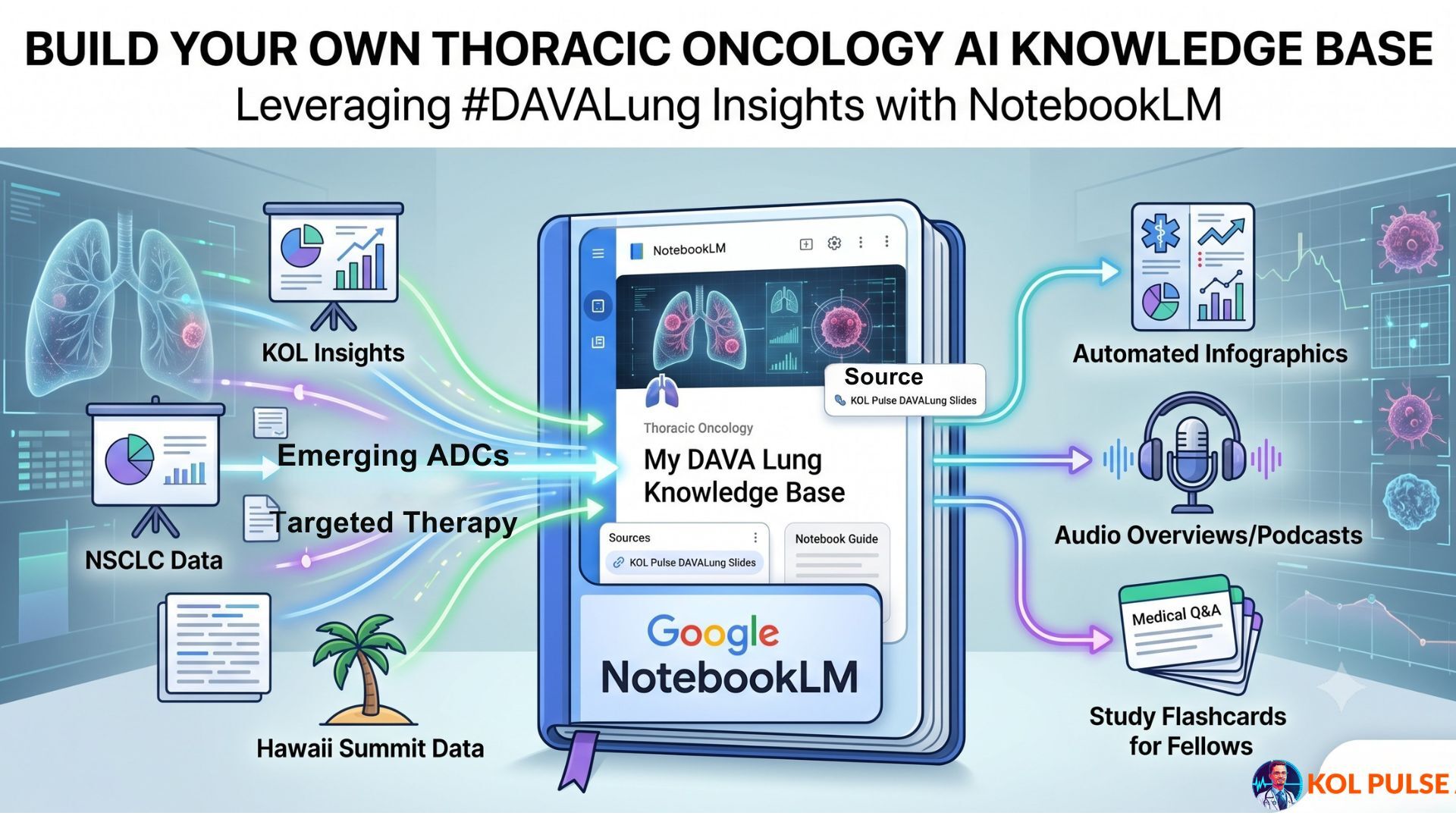
- Start with one data-enriched source. Seed it with the curated #DAVALung slide decks, organized and transcribed on this AI-native KOL Pulse page: the DAVA Lung 2026 KOL page. One strong source beats ten weak ones — this is the spine of your corpus.
- Interrogate the data — don't just read it. This is where it stops being a folder and starts being a tool. Ask it to extract clinical trial endpoints into a data table, generate a podcast on the key ADC trials in NSCLC, or auto-build study flashcards for your fellows. Push on it.
- Scale the engine. Layer in more sources: YouTube commentary from the Oncology Brothers (NotebookLM auto-transcribes it), PDF abstracts and publications, and live KOL sentiment from KOL Pulse trial pages. NotebookLM will even help you discover and auto-load additional sources.
- Run the benchmark. Now the real test. Put the same clinical question to your hyper-curated notebook and to OpenEvidence, side by side. Watch where a bespoke, elite dataset outperforms a broad clinical AI — and, just as instructive, where it doesn't. Then try the other outputs: reports, slide decks, podcasts, videos, data tables.
- Add the Gemini integration. Pull your custom notebook into the Google Gemini app — it's a simple dropdown. Now you can cross-reference this summit's data against live web search, building a specialized workflow that's genuinely yours.
Where this wins — and where it doesn't
I'm genuinely curious about the boundary here, not just the win. A curated corpus should be sharper on the specific controversies these KOLs debated this weekend; a broad model should be steadier on settled, widely-published fundamentals. Finding that line is the whole point of the exercise.
Take five minutes and try it. Share your outputs — or the questions that stumped it — in the comments. I want to see where the curated corpus wins and where it falls short, because that boundary is where the interesting work is.
The bigger idea
NotebookLM is an incredible tool. KOL Pulse is designed to sit underneath it — giving you AI-native, data-enriched KOL insight you can build your own research engine on top of. The DAVA page is one seed. There's a library of trial and conference pages ready to be the next source in your notebook.