KOL Pulse — Trial Profile

A-BRAVE Trial

High-risk early triple-negative breast cancer (TNBC), post-surgery + (neo)adjuvant chemotherapy — University of Padova (Department of Surgery, Oncology and Gastroenterology); drug supply and financial support from Merck KGaA

High-risk early triple-negative breast cancer (TNBC), post-surgery + (neo)adjuvant chemotherapyBavencioASCO 2024 LBA500 / Annals of Oncology 2025
Visit Interactive Trial Page →

Top KOLs Discussing A-BRAVE

Harold J. Burstein, MD, PhD, FASCO
@DrHBurstein
14.9K impressions
Dr Amol Akhade
Dr Amol Akhade
@SuyogCancer
6.1K impressions
Sara Tolaney
Sara Tolaney
@stolaney1
5.1K impressions
Paolo Tarantino
Paolo Tarantino
@PTarantinoMD
4.8K impressions
Erika Hamilton, MD
Erika Hamilton, MD
@ErikaHamilton9
3.6K impressions
Elisabetta Bonzano MD, PhD
@to_be_elizabeth
3.5K impressions

A-BRAVE Key Slides & Visuals

Official trial slides and relevant visuals shared by KOLs at ASCO 2024 LBA500 / Annals of Oncology 2025. Click any image to expand.

Paolo Tarantino
Paolo Tarantino @PTarantinoMD
A-BRAVE Data
4.8K impressions · 45 likes · Jun 3, 2024
View on X ↗
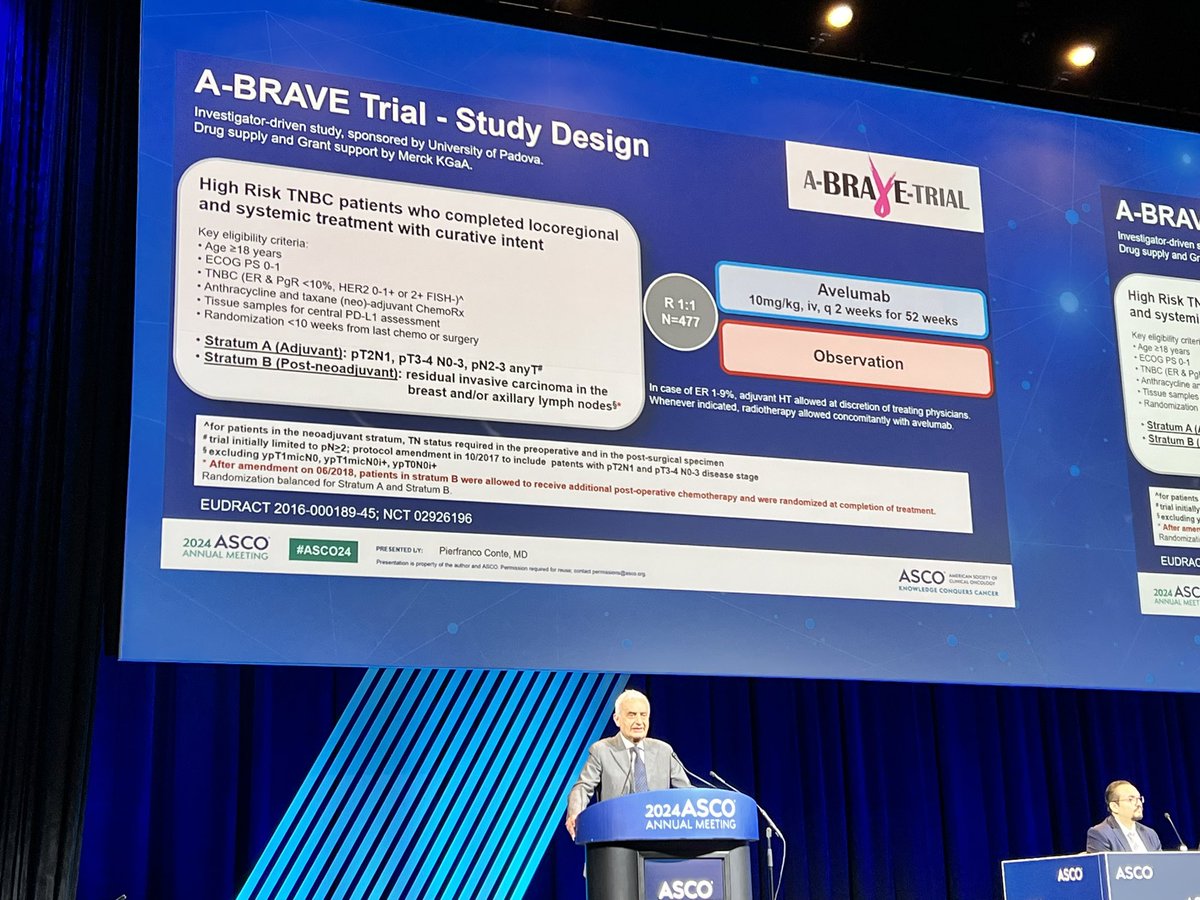
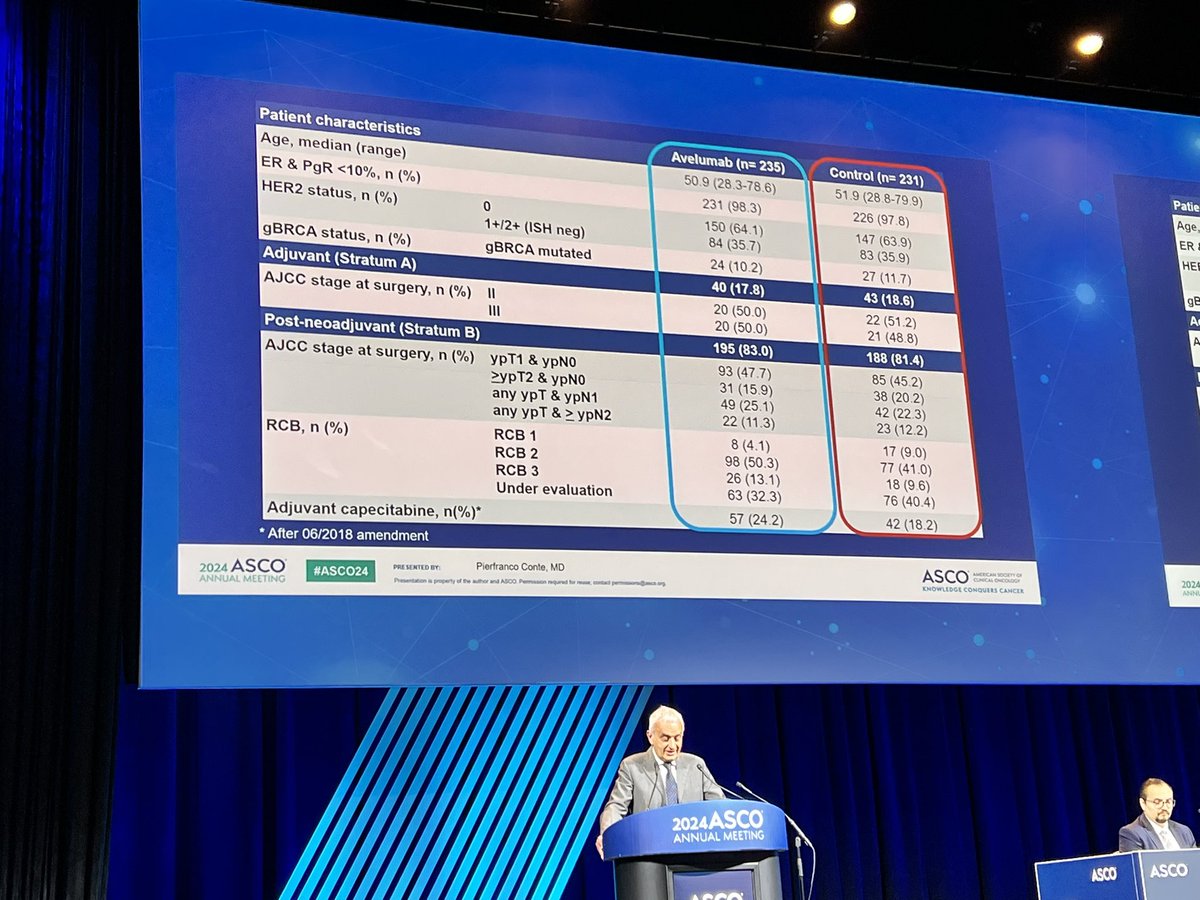
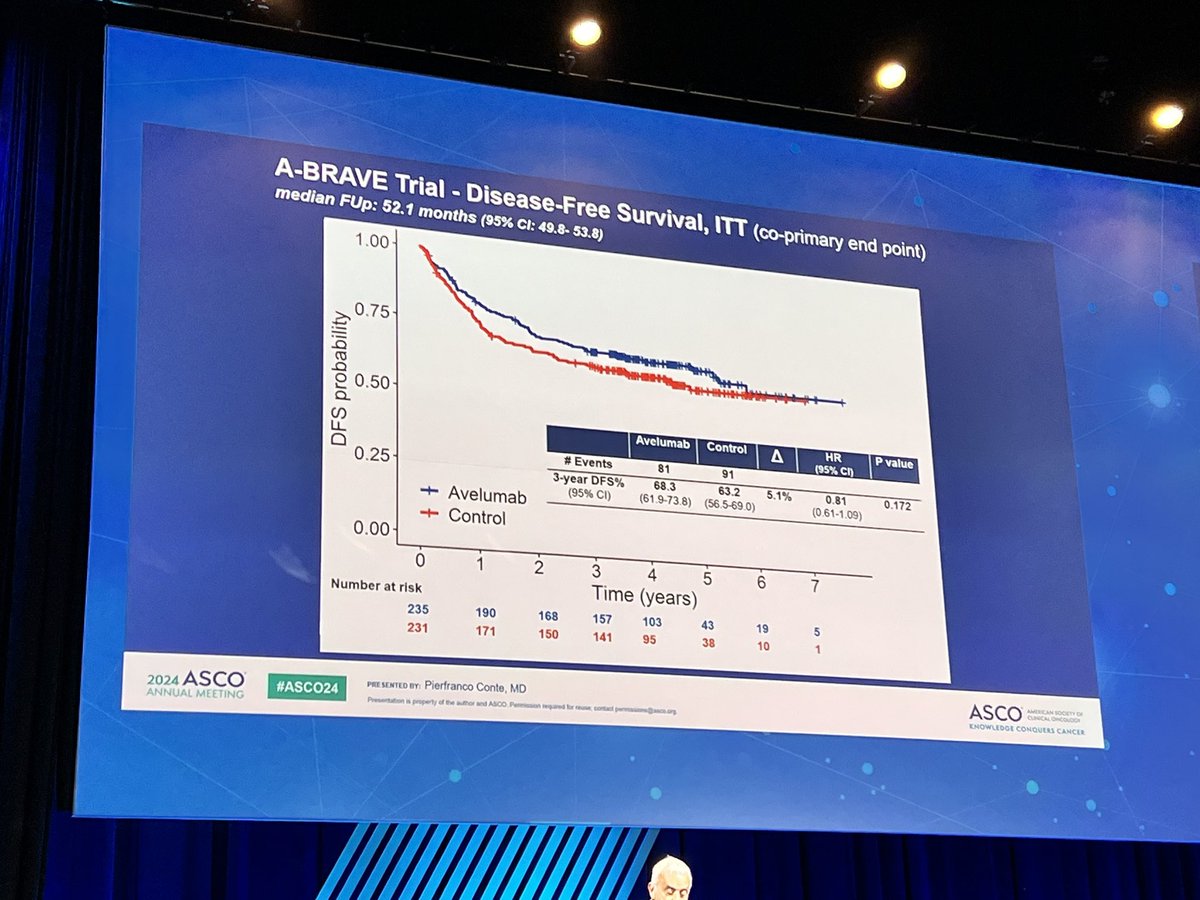
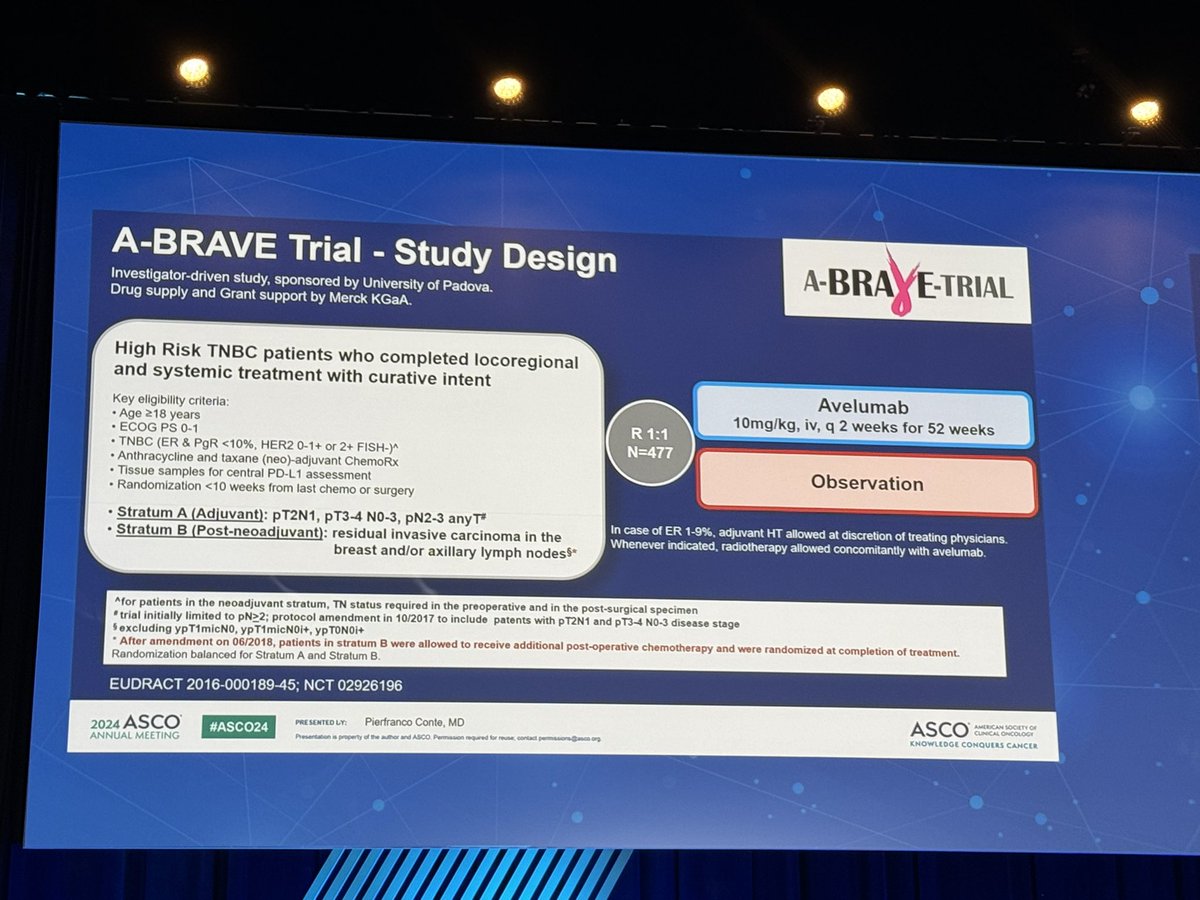
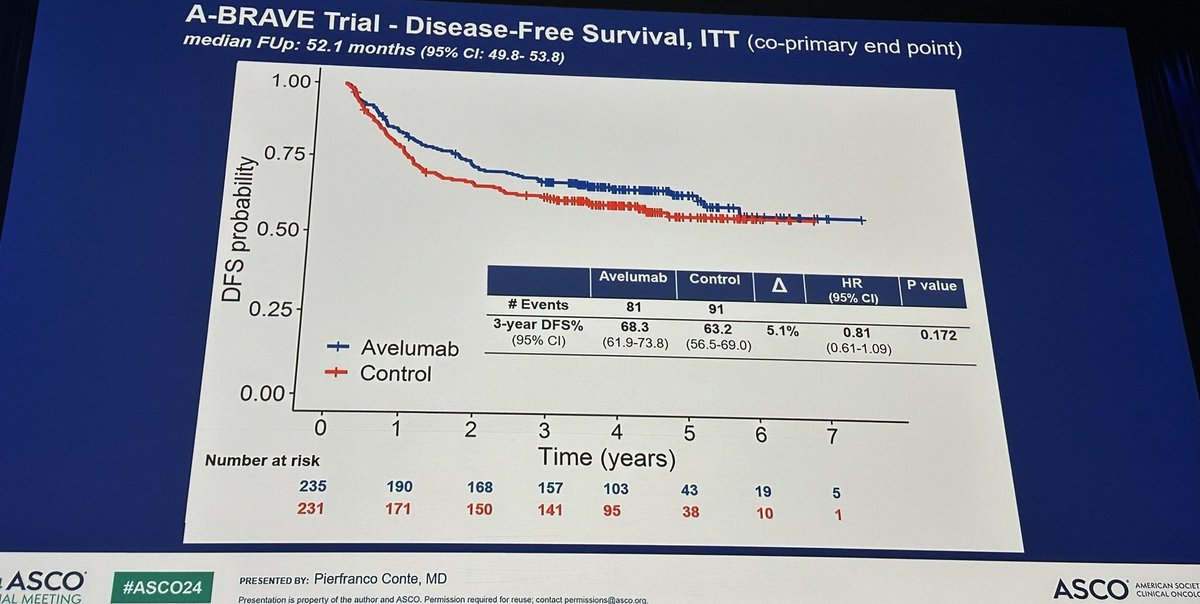
[Slide 1] A-BRAVE Trial - Study Design Investigator-driven study, sponsored by University of Padova. A-BRA E-TRIAL A- Drug supply and Grant support by Merck KGaA. Invest Drug High Risk TNBC patients who completed locoregional and systemic treatment with curative intent Hi Avelumab an Key eligibility criteria: Age >18 years 10mg/kg, iv, q 2 weeks for 52 weeks ECOG PS 0-1 R 1:1 TNBC (ER & PgR <10% HER20-1+or 2+ FISH-)^ N=477 Anthracycline and taxane (neo)-adjuvant ChemoRx Tissue samples for central PD-L1 assessment Observation Randomization <10 weeks from last chemo or surgery Stratum A (Adjuvant): pT2N1, pT3-4 N0-3, pN2-3 anyT* Stratum B (Post-neoadjuvant): residual invasive carcinoma in the In case of ER 1-9% adjuvant HT allowed at discretion of treating physicians Whenever indicated, radiotherapy allowed concomitantly with avelumab breast and/or axillary lymph nodest ^for patients in the neoadjuvant stratum, TN status required in the preoperative and in the post-surgical specimen # trial initially limited to pN>2; protocol amendment in 10/2017 to include patents with pT2N1 and pT3-4 NO- disease stage $ excluding ypTimicN0, ypTimicN0i+, ypTONOi+ After amendment on 06/2018, patients in stratum B were allowed to receive additional post-operative chemotherapy and were randomized at completion of treatment Randomization balanced for Stratum A and Stratum B EUDRACT 2016-000189-45; NCT 02926196 2024 ASCO Pierfranco Conte, MD ASCO AMERICAN SOCIETY OF PRESENTED LY CUNICAL ONCOUNCIL #ASCO24 ANNUAL MEETING property KNOWLEDGE CONQUERS CANCER --- [Slide 2] A-BRAVE Trial - Study Design A-B A-BRA E-TRIAL Investigato Investigator-driven study, sponsored by University of Padova. Drug suppl Drug supply and Grant support by Merck KGaA. High Risk TNBC patients who completed locoregional High Ri and sys and systemic treatment with curative intent Avelumab Key eligibilit Key eligibility criteria: 10mg/kg, iv, q 2 weeks for 52 weeks Age 218 y Age >18 years R 1:1 ECOG PS ECOG PS 0-1 TNBC (ER & PgR <10%, HER2 0-1+ or 2+ FISH-)^ N=477 TNBC (ER Anthracycl Anthracycline and taxane (neo)-adjuvant ChemoRx Observation Tissue san Tissue samples for central PD-L1 assessment Randomiza Randomization <10 weeks from last chemo or surgery Stratum Stratum A (Adjuvant): pT2N1, pT3-4 NO-3, pN2-3 anyT* In case of ER 1-9%, adjuvant HT allowed at discretion of treating physicians. Stratum Stratum B (Post-neoadjuvant): residual invasive carcinoma in the Whenever indicated, radiotherapy allowed concomitantly with avelumab. breast and/or axillary lymph nodes *for patient ^for patients in the neoadjuvant stratum, TN status required in the preoperative and in the post-surgical specimen *trial initial # trial initially limited to pN>2; protocol amendment in 10/2017 to include patents with pT2N1 and pT3-4 NO-3 disease stage excluding $ excluding T1micN0, ypT1micN0i+, ypTON0i+ After ame . After amendment on 06/2018, patients in stratum B were allowed to receive additional post-operative chemotherapy and were randomized at completion of treatment. Randomizal Randomization balanced for Stratum A and Stratum B. EUDRAC EUDRACT 2016-000189-45; NCT 02926196 ASCO AMERICAN SOCIETY OF 2024 ASC CUNICAL DISCOLOGY PRE SENTED Pierfranco Conte, MD ANNUAL MEET 2024 ASCO #ASCO24 KNOWLEDGE CONQUERS CANCER Presentation property author and ASCO Permission required for - contact ANNUAL MEETING K 2024ASCO ANNUAL MEETING --- [Slide 3] Patient characteristics Avelumab (n= 235) Control (n= 231) Age, median (range) 50.9 (28.3-78.6) 51.9 (28.8-79.9) ER & PgR <10%, n (%) 231 (98.3) 226 (97.8) HER2 status, n (%) 0 150 (64.1) 147 (63.9) 1+/2+ (ISH neg) 84 (35.7) 83 (35.9) gBRCA status, n (%) gBRCA mutated 24 (10.2) 27 (11.7) Adjuvant (Stratum A) 40 (17.8) 43 (18.6) AJCC stage at surgery, n (%) II 20 (50.0) 22 (51.2) III 20 (50.0) 21 (48.8) Post-neoadjuvant (Stratum B) 195 (83.0) 188 (81.4) AJCC stage at surgery, n (%) ypT1 & ypN0 93 (47.7) 85 (45.2) >ypT2 & ypN0 31 (15.9) 38 (20.2) any ypT & ypN1 49 (25.1) 42 (22.3) any ypT & ≥ ypN2 22 (11.3) 23 (12.2) RCB, n (%) RCB 1 8 (4.1) 17 (9.0) RCB 2 98 (50.3) 77 (41.0) RCB 3 26 (13.1) 18 (9.6) Under evaluation 63 (32.3) 76 (40.4) Adjuvant capecitabine, n(%)* 57 (24.2) 42 (18.2) * After 06/2018 amendment Pierfranco Conte, MD ASCO AMERICAN SOCIETY CLINICAL DECOLOGY 2024 ASCO PRE SENTED BY: #ASCO24 ANNUAL MEETING Presentation property the author and ASCO Permission required If - contact KNOWLEDGE CONQUERS CANCER --- [Slide 4] A-BRAVE Trial - Disease-Free Survival, ITT (co-primary end point) median FUp: 52.1 months (95% CI: 49.8- 53.8) 1.00 0.75 DFS probability 0.50 Avelumab Control Д HR P value (95% CI) # Events 81 91 0.25 3-year DFS% 68.3 63.2 5.1% 0.81 0.172 (95% CI) (61.9-73.8) (56.5-69.0) (0.61-1.09) Avelumab Control 0.00 0 1 2 3 4 5 6 7 Number at risk Time (years) 235 190 168 157 103 43 19 5 231 171 150 141 95 38 10 1 2024 ASCO PRE SENTED BY: Pierfranco Conte, MD ASCO #ASCO24 Presentation a property of the author and ASCO Permission required for reuse contact permissions@ass.org KNOWLEDGE c ANNUAL MEETING --- [Slide 5] A-BRAVE Trial Overall Survival, ITT (secondary endpoint) 1.00 0.75 OS probability 0.50 0.25 Avelumab Control Д HR P (95% CI) value Avelumab # Events 46 62 3-year OS% 84.8 76.3 8.5% 0.66 0.035 Control (95% CI) (79.5-88.8) (70.1-81.3) (0.45-0.97) 0.00 0 1 2 3 4 5 6 7 Number at risk Time (years) 235 220 201 191 123 55 22 5 231 209 187 161 107 43 13 2 2024 ASCO PRE SENTED BY: Pierfranco Conte, MD #ASCO24 ASCO ANNUAL MEETING Presentation . property of the author and ASCO Permission required for - contact KNOWLEDGE cc
Erika Hamilton, MD
Erika Hamilton, MD @ErikaHamilton9
A-BRAVE Data
3.6K impressions · 41 likes · Jun 3, 2024
View on X ↗
[Slide 1] A-BRAVE Trial - Safety irAEs Avelumab Control irAE Any grade Grade > 3 Any grade Grade > 3 N. of patients (%) N. of patients (%) N. of patients (%) N. of patients (%) Hypothyroidism 31 (13.2) - 5 (2.2) - Hyperthyroidsm 11 (4.7) - 1 (0.4) - Adrenal insufficiency 2 (0.8) - - - Colitis/diarrhea 17 (7.2) 1 (0.4) 1 (0.4) - Hypertransaminases 11 (4.7) 3 (1.3) 2 (0.9) - Lipase increase 5 (2.1) 3 (1.3) - - Amilase increase 4 (1.7) 3 (1.3) - - Myocarditis 1 (0.4) - - - Uveitis 1 (0.4) - - - 2024 ASCO #ASCO24 PRESENTED BY: Pierfranco Conte, MD ASCO AMERICAN soc CLINICAL ONC ANNUAL MEETING Presentation is property of the author and ASCO Permission required for reuse contact permissions@asco.org KNOWLEDGE CONQUERS CA --- [Slide 2] A-BRAVE Trial - Study Design A-BRA E-TRIAL Investigator-driven study, sponsored by University of Padova. Drug supply and Grant support by Merck KGaA. High Risk TNBC patients who completed locoregional and systemic treatment with curative intent Avelumab Key eligibility criteria: 10mg/kg, iv, q 2 weeks for 52 weeks Age >18 years R 1:1 ECOG PS 0-1 TNBC (ER & PgR <10%, HER2 0-1+ or 2+ FISH-)^ N=477 Anthracycline and taxane (neo)-adjuvant ChemoRx Tissue samples for central PD-L1 assessment Observation Randomization <10 weeks from last chemo or surgery Stratum A (Adjuvant): pT2N1, pT3-4 N0-3, pN2-3 anyT* In case of ER 1-9%, adjuvant HT allowed at discretion of treating physicians. Stratum B (Post-neoadjuvant): residual invasive carcinoma in the Whenever indicated, radiotherapy allowed concomitantly with avelumab. breast and/or axillary lymph nodes ^for patients in the neoadjuvant stratum, TN status required in the preoperative and in the post-surgical specimen # trial initially limited to pN>2; protocol amendment in 10/2017 to include patents with pT2N1 and pT3-4 NO-3 disease stage 9 excluding ypT1micN0, ypT1micN0i+, ypTONOi+ . After amendment on 06/2018, patients in stratum B were allowed to receive additional post-operative chemotherapy and were randomized at completion of treatment. Randomization balanced for Stratum A and Stratum B. EUDRACT 2016-000189-45; NCT 02926196 2024 ASCO #ASCO24 PRE SENTED LY: Pierfranco Conte, MD ASCO AMERICAN SOCIETY OF CLINICAL ONCOLOGY ANNUAL MEETING Presentation . property of the author and ASCO Permission required for - contact permissions@ascom KNOWLEDGE CONQUERS CANCER --- [Slide 3] A-BRAVE Trial - Overall Survival, ITT (secondary endpoint) 1.00 0.75 OS probability 0.50 Avelumab Control HR P 0.25 (95% CI) value Avelumab # Events 46 62 3-year OS% 84.8 76.3 8.5% 0.66 0.035 Control (95% CI) (79.5-88.8) (70.1-81.3) (0.45-0.97) 0.00 0 1 2 3 4 5 6 7 Number at risk Time (years) 235 220 201 191 123 55 22 5 231 209 187 161 107 43 13 2 24 ASCO PRESENTED BY: Pierfranco Conte, MD #ASCO24 ASCO INUAL MEETING Presentation is property of the author and ASCO Permission required for reuse, contact permasions@asco.org KNOWLEDGE --- [Slide 4] A-BRAVE Trial - Distant disease-free survival, ITT (post-hoc exploratory analysis) 1.00 0.75 DDFS probability 0.50 Avelumab Control HR 0.25 P (95% CI) value # Events Avelumab 66 85 3-year DDFS% 75.4 67.9 7.5% 0.70 0.0277 Control (95% CI) (69.3-80.4) (61.4-73.5) (0.50-0.96) 0.00 0 1 2 3 4 5 6 7 Defined accord Number at risk Time (years) updated STEEP 235 204 183 171 115 53 20 6 criteria [Tolaney S 231 183 163 148 101 40 14 2 J Clin Oncol. 2021 A 20,39(24):2720-273 2024 ASCO #ASCO24 PRESENTED BY: Pierfranco Conte, MD ASCO AMERICAN ANNUAL MEETING Presentation is property of the author and ASCO Permission required for reuse, contact permissions@asco.org CLINICAL - 0 KNOWLEDGE CONQUERS --- [Slide 5] A-BRAVE Trial - Safety irAEs Avelumab Control irAE Any grade Grade ≥ 3 Any grade Grade ≥ 3 N. of patients (%) N. of patients (%) N. of patients (%) N. of patients (%) Hypothyroidism 31 (13.2) - 5 (2.2) - Hyperthyroidsm 11 (4.7) - 1 (0.4) - Adrenal insufficiency 2 (0.8) - - - Colitis/diarrhea 17 (7.2) 1 (0.4) 1 (0.4) - Hypertransaminases 11 (4.7) 3 (1.3) 2 (0.9) - Lipase increase 5 (2.1) 3 (1.3) - - Amilase increase 4 (1.7) 3 (1.3) - - Myocarditis 1 (0.4) - - - Uveitis 1 (0.4) - - - 2024 ASCO PRESENTED BY: #ASCO24 Pierfranco Conte, MD ASCO AMERICAN SOCIETY OF CLINICAL ONCOLOGY ANNUAL MEETING Presentation is property of the author and ASCO. Permission required for reuse, contact permissions@asco.org KNOWLEDGE CONQUERS CANCER
Elisabetta Bonzano MD, PhD
Elisabetta Bonzano MD, PhD @to_be_elizabeth
A-BRAVE Data
3.5K impressions · 12 likes · Jun 3, 2024
View on X ↗
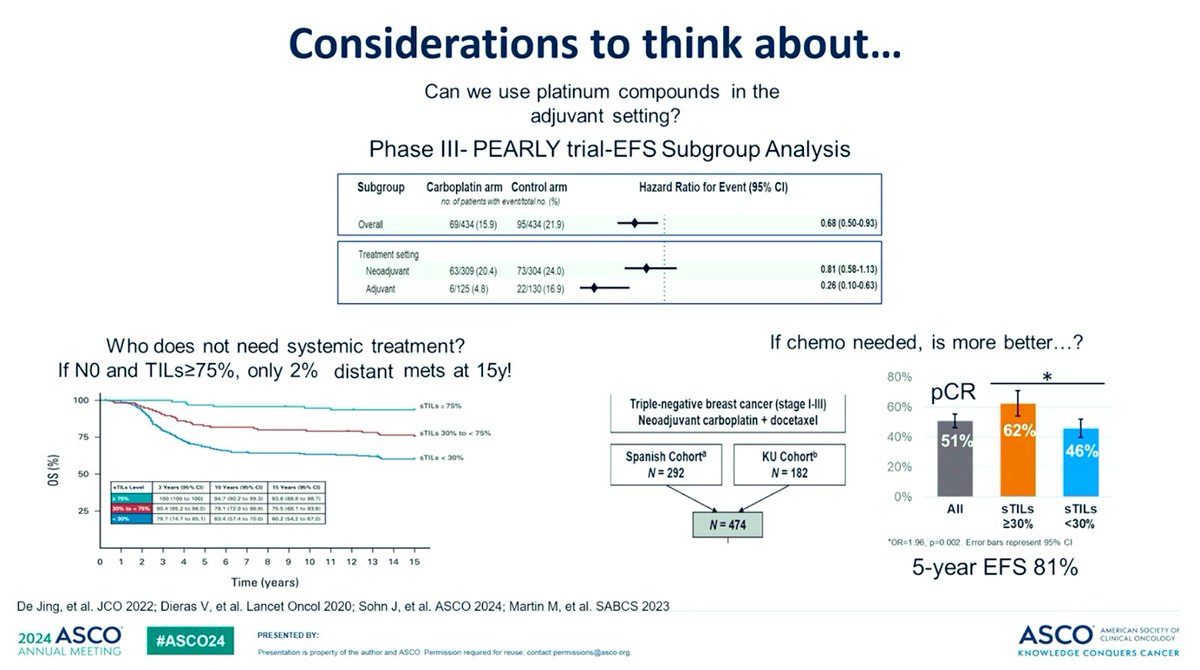
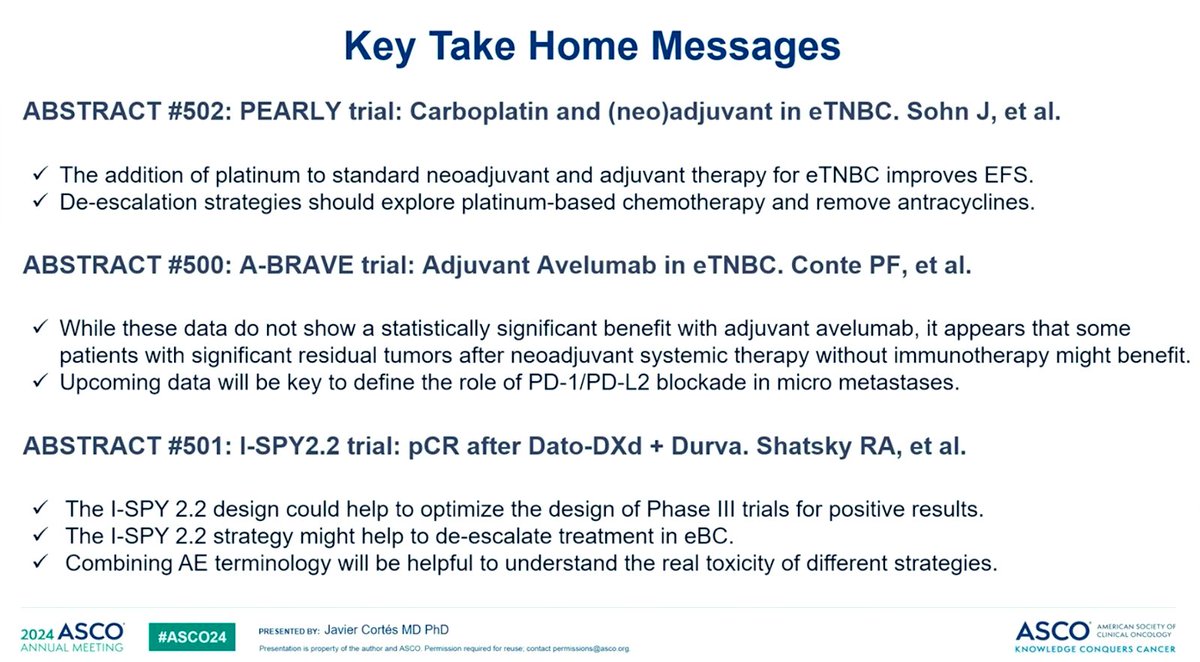
[Slide 1] Key Take Home Messages ABSTRACT #502: PEARLY trial: Carboplatin and (neo)adjuvant in eTNBC. Sohn J, et al. The addition of platinum to standard neoadjuvant and adjuvant therapy for eTNBC improves EFS. De-escalation strategies should explore platinum-based chemotherapy and remove antracyclines. ABSTRACT #500: A-BRAVE trial: Adjuvant Avelumab in eTNBC. Conte PF, et al. While these data do not show a statistically significant benefit with adjuvant avelumab, it appears that some patients with significant residual tumors after neoadjuvant systemic therapy without immunotherapy might benefit. Upcoming data will be key to define the role of PD-1/PD-L2 blockade in micro metastases. ABSTRACT #501: I-SPY2.2 trial: pCR after Dato-DXd + Durva. Shatsky RA, et al. The I-SPY 2.2 design could help to optimize the design of Phase III trials for positive results. The I-SPY 2.2 strategy might help to de-escalate treatment in eBC. Combining AE terminology will be helpful to understand the real toxicity of different strategies. 2024 ASCO PRESENTED BY: Javier Cortés MD PhD #ASCO24 ASCO AMERICAN SOCIETY OF CLINICAL ONCOLOGY ANNUAL MEETING Presentation is property of the author and ASCO Permission required for reuse contact permissions@asco. KNOWLEDGE CONQUERS CANCER
Hope Rugo
Hope Rugo @hoperugo
A-BRAVE Data
2.8K impressions · 28 likes · Jun 3, 2024
View on X ↗
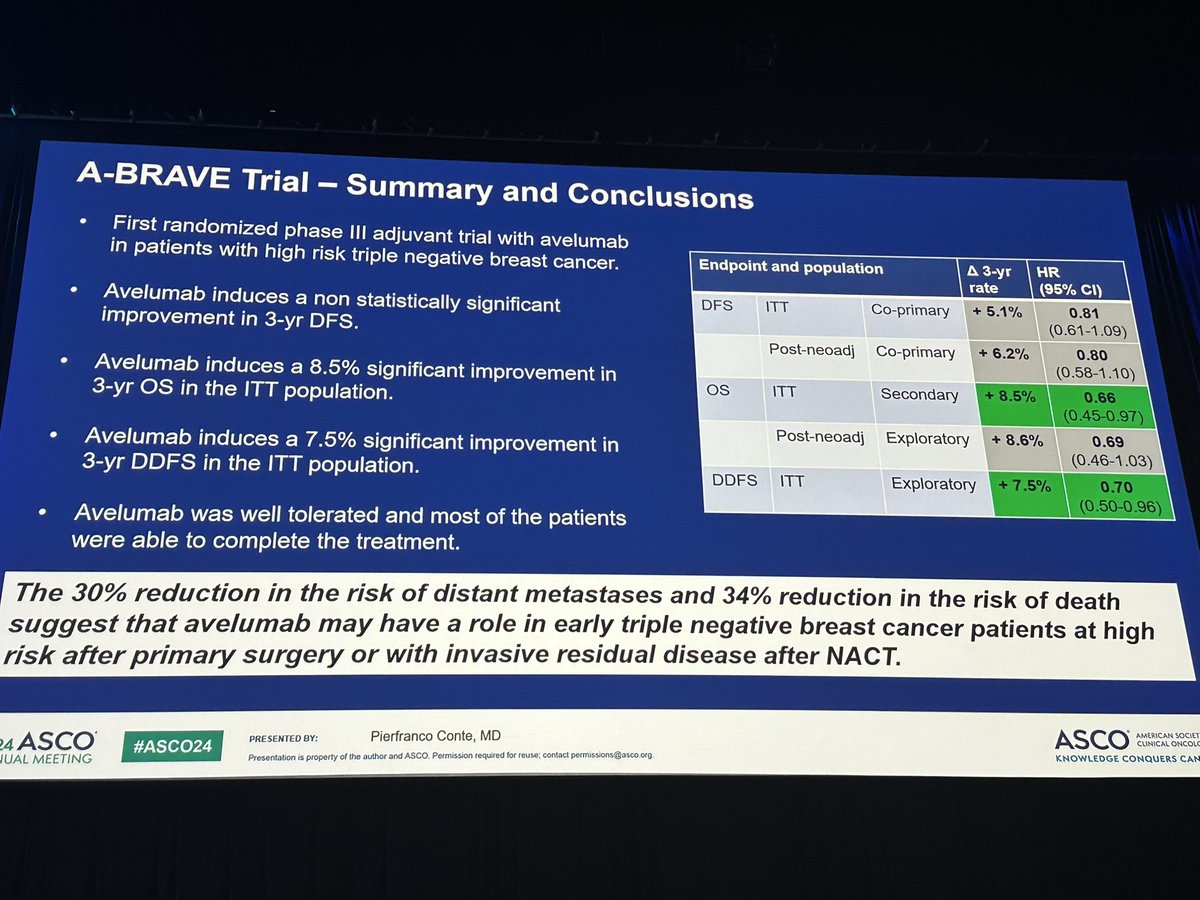
[Slide 1] A-BRAVE Trial — Summary and Conclusions First randomized phase III adjuvant trial with avelumab in patients with high risk triple negative breast cancer. Endpoint and population A 3-yr HR rate (95% CI) Avelumab induces a non statistically significant DFS ITT Co-primary + 5.1% 0.81 (0.61-1.09) improvement in 3-yr DFS. Post-neoadj Co-primary + 6.2% 0.80 (0.58-1.10) Avelumab induces a 8.5% significant improvement in OS ITT Secondary + 8.5% 0.66 3-yr OS in the ITT population. (0.45-0.97) Post-neoadj Exploratory + 8.6% 0.69 Avelumab induces a 7.5% significant improvement in (0.46-1.03) 3-yr DDFS in the ITT population. DDFS ITT Exploratory + 7.5% 0.70 (0.50-0.96) Avelumab was well tolerated and most of the patients were able to complete the treatment. The 30% reduction in the risk of distant metastases and 34% reduction in the risk of death suggest that avelumab may have a role in early triple negative breast cancer patients at high risk after primary surgery or with invasive residual disease after NACT. 4 ASCO PRESENTED BY: Pierfranco Conte, MD #ASCO24 ASCO AMERICAN SOCIET CLINICAL ONCOLO UAL MEETING Presentation is property of the author and ASCO. Permission required for reuse; contact permissions@asco.org KNOWLEDGE CONQUERS CAN --- [Slide 2] A-BRAVE Trial - Disease-Free Survival, ITT (co-primary end point) median FUp: 52.1 months (95% Cl: 49.8- 53.8) 1.00 0.75 DFS probability 0.50 Avelumab Control Д HR P value (95% CI) # Events 81 91 0.25 3-year DFS% 68.3 63.2 5.1% 0.81 0.172 (95% CI) (61.9-73.8) (56.5-69.0) (0.61-1.09) Avelumab Control 0.00 0 1 2 3 4 5 6 7 Number at risk Time (years) 235 190 168 157 103 43 19 5 231 171 150 141 95 38 10 1 ASCO PRESENTED BY: Pierfranco Conte, MD ASCO AMERICAN #ASCO24 CLINICAL AL MEETING Presentation is property of the author and ASCO. Permission required for reuse; contact permissions@asco.org KNOWLEDGE CONQUERS --- [Slide 3] A-BRAVE Trial - Distant disease-free survival, ITT (post-hoc exploratory analysis) 1.00 0.75 DDFS probability 0.50 Avelumab Control 0.25 Д HR P (95% CI) value # Events 66 85 Avelumab 3-year DDFS% 75.4 67.9 7.5% 0.70 0.0277 Control (95% CI) (69.3-80.4) (61.4-73.5) (0.50-0.96) 0.00 0 1 2 3 4 5 6 7 Defined according Number at risk Time (years) updated STEEP 2. 235 204 183 171 115 53 20 6 criteria [Tolaney SM, 231 183 163 148 101 40 14 2 J Clin Oncol. 2021 Aug 20;39(24):2720-2731]. 024 ASCO PRESENTED BY: Pierfranco Conte, MD #ASCO24 ASCO AMERICAN so CLINICAL ON NNUAL MEETING Presentation is property of the author and ASCO. Permission required for reuse: contact permissions@asco.org. KNOWLEDGE CONQUERS --- [Slide 4] A-BRAVE Trial - Overall Survival, ITT (secondary endpoint) 1.00 0.75 OS probability 0.50 0.25 Avelumab Control Д HR P (95% CI) value Avelumab # Events 46 62 3-year OS% 84.8 76.3 8.5% 0.66 0.035 Control (95% CI) (79.5-88.8) (70.1-81.3) (0.45-0.97) 0.00 0 1 2 3 4 5 6 7 Number at risk Time (years) 235 220 201 191 123 55 22 5 231 209 187 161 107 43 13 2 ASCO #ASCO24 PRESENTED BY: Pierfranco Conte, MD ASCO AMERICAN SOCIETY O AL MEETING Presentation is property of the author and ASCO. Permission required for reuse; contact permissions@asco.org. CLINICAL ONCOLOGY KNOWLEDGE CONQUERS CANCI
Dr Amol Akhade
Dr Amol Akhade @SuyogCancer
A-BRAVE Data
2.5K impressions · 9 likes · Jun 4, 2024
View on X ↗
[Slide 1] A-BRAVE Trial - Overall Survival, ITT (secondary endpoint) 1.00 0.75 0.50 Avelumab Control A HR P 0.25 (95% CI) value Avelumab # Events 46 62 3-year OS% 84.8 76.3 8.5% 0.66 0.035 Control (95% CI) (79.5-88.8) (70.1-81.3) (0.45-0.97) 0.00 . 0 1 2 3 4 5 6 7 Number at risk Time (years) 235 220 201 191 123 55 22 5 231 209 187 161 107 43 13 2 o PRESENTED Pierfranco Conte, MD AS #ASCO24 - --- [Slide 2] A-BRAVE Trial - Disease-Free Survival, ITT (co-primary end point) median FUp: 52.1 months (95% Cl: 49.8- 53.8) 1.00 0.75 DFS probability 0.50 Avelumab Control HR P value (95% CI) # Events 81 91 0.25 3-year DFS% 68.3 63.2 5.1% 0.81 0.172 (95% CI) (61.9-73.8) (56.5-69.0) (0.61-1.09) Avelumab Control 0.00 0 1 2 3 4 5 6 7 Number at risk Time (years) 235 190 168 157 103 43 19 5 231 171 150 141 95 38 10 1 ASCO PRESENTED BY: Pierfranco Conte, MD ASCO AMERICAN SOCIE #ASCO24 CLINICAL ONCOL --- [Slide 3] A-BRAVE Trial - - Overall Survival, ITT (secondary endpoint) 1.00 0.75 os probability 0.50 0.25 Avelumab Control A HR P (95% CI) value Avelumab # Events 46 62 3-year OS% 84.8 76.3 8.5% 0.66 0.035 Control (95% CI) (79.5-88.8) (70.1-81.3) (0.45-0.97) 0.00 0 1 2 3 4 5 6 7 Number at risk Time (years) 235 220 201 191 123 55 22 5 231 209 187 161 107 43 13 2 PRESENTED em: Pierfrance Conte, MD #ASCO24 ASCO Presentation - property - - - - ASCO Permission required - - - KNOWLEDGE COS

A-BRAVE Top Tweets

Top tweets by impressions — click to view on X

Harold J. Burstein, MD, PhD, FASCO
Harold J. Burstein, MD, PhD, FASCO@DrHBurstein

A-BRAVE adjuvant avelumab in TNBC.
Misses primary endpoint 5% 🔼PFS
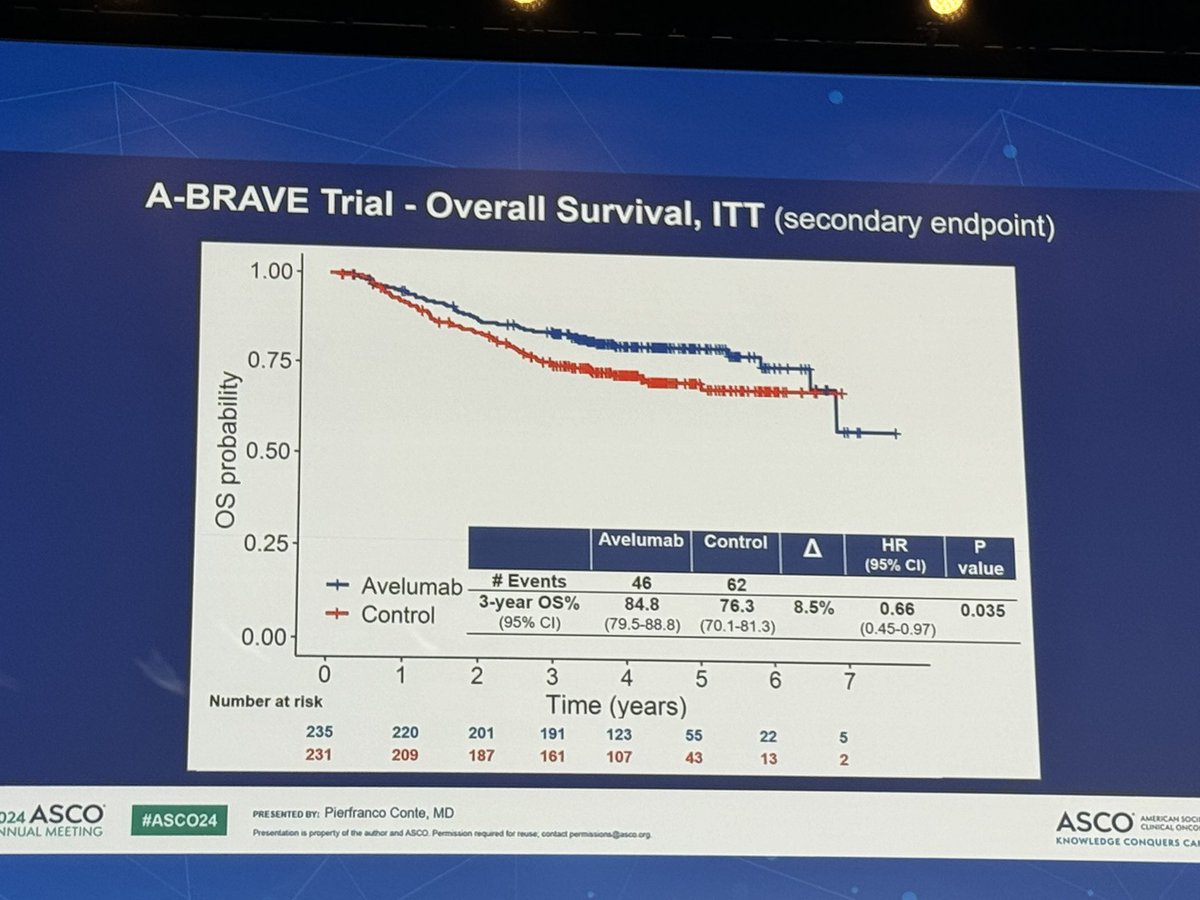
Hits secondary endpoint 8.5% 🔼OS
What to do?
If you ‘reject” b/c of surrogate of PFS, you forsake a + result in more important…

👁 5.7K ♡ 23 ↻ 7 Jun 3, 2024
Harold J. Burstein, MD, PhD, FASCO
Harold J. Burstein, MD, PhD, FASCO@DrHBurstein

A-BRAVE adjuvant avelumab in TNBC.
Misses primary endpoint 5% 🔼PFS
Hits secondary endpoint 8.5% 🔼OS
What to do?
If you ‘reject” b/c of surrogate of PFS, you forsake a + result in more important…

👁 5.7K ♡ 23 ↻ 7 Jun 3, 2024
Sara Tolaney
Sara Tolaney@stolaney1

ABRAVE trial: Adj avelumab x 1yr in TNBC, n=477
2 strata: Adj tx, B: post preop tx
24% adj Cape

3 yr DFS: 63.2 vs 68.3%, HR 0.81, p=0.17
3 yr DFS in Stratum B; 60.7 vs 66.9, NS
3 yr DDFS 67.9 vs…

👁 5.1K ♡ 16 ↻ 5 Jun 3, 2024
Paolo Tarantino
Paolo Tarantino@PTarantinoMD

A-BRAVE phase 3: among pts with TNBC and (mostly) RD after NACT, adjuvant avelumab for 1 year did not sign improve DFS (68.3% vs 63.2%, p=0.1) but did improve DDFS and OS (84.8% vs 76.3%, p=0.02),…

👁 4.8K ♡ 45 ↻ 16 Jun 3, 2024
Erika Hamilton, MD
Erika Hamilton, MD@ErikaHamilton9

A-BRAVE: adjuvant aveulmab after definitive treatment for high risk TNBC

❌DFS not significantly improved~5% numerically diff

✅ OS 8.5 months better!

✅ DDFS 7.5% better, HR 0.70

#ASCO24
#bcsm

👁 3.6K ♡ 41 ↻ 14 Jun 3, 2024
Dr Amol Akhade
Dr Amol Akhade@SuyogCancer

So apart from plenary sessions - what intresting Data coming up for Breast cancer at #asco24 @ASCO
1- postMONARCH trial - Abemaciclib post progression on CDK4/6 inhibitors in MBC .
Can we give…

👁 3.6K ♡ 17 ↻ 10 Apr 29, 2024
Elisabetta Bonzano MD, PhD
Elisabetta Bonzano MD, PhD@to_be_elizabeth

Is More Better? Customizing Systemic Therapy for High-Risk, Nonmetastatic Breast Cancer ➡️ Outstanding discussion 🔛 PEARLY trial, A-BRAVE trial and ISPY2.2 trial by @JavierCortesMD 👏🏻👏🏻👏🏻
#ASCO24

👁 3.5K ♡ 12 ↻ 7 Jun 3, 2024
Hope Rugo
Hope Rugo@hoperugo

#ASCO24 Conte describes results of ABrave. Adjuvant and post neoadjuvant Avelumab. Did not meet primary DFS endpoint but improved OS. Intriguing data. @OncoAlert https://t.co/Tj5hUz50wh

👁 2.8K ♡ 28 ↻ 10 Jun 3, 2024
Dr Amol Akhade
Dr Amol Akhade@SuyogCancer

Another trial with NO DFS benifit ( Hr -0.81 , p value - 0.172 but OS benifit. HR - 0.66 - p value 0.035 ) A -Brave trial.
Is this not happening more often now a days ? @Timothee_MD @VPrasadMDMPH

👁 2.5K ♡ 9 ↻ 5 Jun 4, 2024
Oncology Brothers
Oncology Brothers@OncBrothers

#ABRAVE: PhIII, Adj Avelumab in TNBC after NACT:

- Did not meet PFS end point but met OS secondary endpoint.

- 3yr OS84.8% w/ Avelumab vs. 76.3% (HR 0.66)

- KN522 as SoC, how does this fit in?…

👁 2.4K ♡ 9 ↻ 2 Jun 3, 2024

About the A-BRAVE Trial

A-BRAVE is an unusual trial in that it missed both co-primary DFS endpoints but showed a statistically significant 34% OS reduction as a secondary endpoint — a discrepancy that raises interpretive questions. In the current era where KEYNOTE-522 (neoadjuvant pembro+chemo) is SOC for high-risk early TNBC, A-BRAVE may apply to the real-world 'miss-the-window' population: patients who received neoadjuvant chemo alone (no pembro) and had residual disease at surgery. The OS signal suggests adjuvant IO may still benefit these patients. Discussant noted PD-L1 status data should be explored. SWOG S1418 (pembrolizumab adjuvant in TNBC residual disease post-neoadj) is the most directly comparable ongoing trial.

Trial Methodology & Results

Disease-Free Survival (DFS) — Co-Primary Endpoints (ITT + Stratum A/post-neoadjuvant)

Median: 68.3 % 3-yr DFS (avelumab ITT) vs. 63.4 % 3-yr DFS (control (observation) ITT). HR 0.82 (95% CI 0.61-1.11), P=0.193 3-yr DFS ITT rate: 68.3% (avelumab) vs. 63.4% (control). 3-yr DFS Stratum A (post-neoadjuvant) rate: 66.9% (avelumab) vs. 61.0% (control). A-BRAVE did NOT meet its co-primary DFS endpoints. ITT DFS: HR 0.82 (95% CI 0.61-1.11, P=0.193); 3-yr DFS 68.3% vs. 63.4%. Stratum A (post-neoadjuvant, n=378): HR 0.81 (95% CI 0.58-1.11, P=0.194); 3-yr DFS 66.9% vs. 61.0%. N=477 randomized (64 Italian + 6 UK centers). 11 patients withdrew consent post-randomization. Stratum A = invasive residual disease after neoadjuvant chemo (83%); Stratum B = high-risk post-primary-surgery (17%). Median follow-up 52.1 months. Conte et al., Ann Oncol 2025;36(12):1492-1502.

❌ DFS endpoints MISSED (HR 0.82 ITT, P=0.193)

📄 Source: KOL commentary on X →

Overall Survival (OS)

HR 0.66 (95% CI 0.44-0.98), P=0.041 Secondary OS endpoint SIGNIFICANTLY IMPROVED in ITT: median OS HR 0.66 (95% CI 0.44-0.98, P=0.041) — 34% reduction in risk of death. 3-yr OS 85.2% vs. 78.2% (ITT); 83.1% vs. 76.6% (Stratum A). Post-hoc analysis showed fewer distant disease events (48 vs. 58) and fewer deaths before documented DFS event (1 vs. 4) with avelumab. Discrepancy between DFS (negative) and OS (positive) signals is an ongoing point of scientific discussion; DFS was driven partly by non-BC events and may have been underpowered for magnitude of effect observed.


📄 Source →

Safety & Tolerability

Key AEs: hypothyroidism (13.2%), colitis/diarrhea (7.2%), hyperthyroidism (4.7%), increased transaminases (4.7%). Well tolerated: 72% of patients completed 1 year of avelumab treatment. Grade ≥3 immune-related AEs occurred in only 1.3% of patients. No treatment-related deaths were reported.

✓ 72% completed 1yr avelumab; Grade ≥3 irAEs only 1.3%

📄 Source →

Clinical Implications

Negative primary (DFS) but positive secondary (OS). Mixed signal; role unclear post-KEYNOTE-522. A-BRAVE is an unusual trial in that it missed both co-primary DFS endpoints but showed a statistically significant 34% OS reduction as a secondary endpoint — a discrepancy that raises interpretive questions. In the current era where KEYNOTE-522 (neoadjuvant pembro+chemo) is SOC for high-risk early TNBC, A-BRAVE may apply to the real-world 'miss-the-window' population: patients who received neoadjuvant chemo alone (no pembro) and had residual disease at surgery. The OS signal suggests adjuvant IO may still benefit these patients. Discussant noted PD-L1 status data should be explored. SWOG S1418 (pembrolizumab adjuvant in TNBC residual disease post-neoadj) is the most directly comparable ongoing trial.

A-BRAVE in the News

Key KOL Sentiments — A-BRAVE

DoctorSentimentComment
Harold J. Burstein, MD, PhD, FASCO ● POSITIVE A-BRAVE adjuvant avelumab in TNBC. Misses primary endpoint 5% 🔼PFS Hits secondary endpoint 8.5% 🔼OS What to do? If you ‘reject” b/c of surrogate of PFS, you forsake a + result in more important endpoint of OS. Challenges idea that ‘adjuvant’ IO doesn't work. https://t.co/gXGG4mERsv
Paolo Tarantino ● POSITIVE A-BRAVE phase 3: among pts with TNBC and (mostly) RD after NACT, adjuvant avelumab for 1 year did not sign improve DFS (68.3% vs 63.2%, p=0.1) but did improve DDFS and OS (84.8% vs 76.3%, p=0.02), with low rate of AE. Impressive academic effort with extremely interesting results. https://t.co/DvBZIEWPgl
Elisabetta Bonzano MD, PhD ● POSITIVE Is More Better? Customizing Systemic Therapy for High-Risk, Nonmetastatic Breast Cancer ➡️ Outstanding discussion 🔛 PEARLY trial, A-BRAVE trial and ISPY2.2 trial by @JavierCortesMD 👏🏻👏🏻👏🏻 #ASCO24 @OncoAlert #BreastCancer https://t.co/QMXogCkbHh
Oncology Brothers ● POSITIVE #ABRAVE: PhIII, Adj Avelumab in TNBC after NACT: - Did not meet PFS end point but met OS secondary endpoint. - 3yr OS84.8% w/ Avelumab vs. 76.3% (HR 0.66) - KN522 as SoC, how does this fit in? Importantly, who can we forego IO in adj (if pCR)? @stolaney1 @PTarantinoMD 5/5 https://t.co/85UfE8yc5A https://t.co/zeZybNMs4h
Harold J. Burstein, MD, PhD, FASCO ● POSITIVE Excellent discussion by @JavierCortesMD So how would you vote? Consider his case of a patient with clinical stage 1 TNBC, found to have nodal involvement at surgery. https://t.co/qU60566Ppn
Yakup Ergün ● POSITIVE @SuyogCancer @Timothee_MD @VPrasadMDMPH @ASCO I think the study was positive for some patients and we need to know what the results were, especially with respect to PD-L1 status. Unfortunately, these data were not presented. Possible scenarios (BRCA wild)👇 Started with KN-522➡️ no pCR➡️ pembrolizumab+/-Cape Started with… https://t.co/cNdiqqVF64
Harold J. Burstein, MD, PhD, FASCO ● NEUTRAL A-BRAVE adjuvant avelumab in TNBC. Misses primary endpoint 5% 🔼PFS Hits secondary endpoint 8.5% 🔼OS What to do? If you ‘reject” b/c of surrogate of PFS, you forsake a + result in more important endpoint of OS. Challenges idea that ‘adjuvant’ IO doesn't work. https://t.co/gXGG4mERsv
Erika Hamilton, MD ● NEUTRAL A-BRAVE: adjuvant aveulmab after definitive treatment for high risk TNBC ❌DFS not significantly improved~5% numerically diff ✅ OS 8.5 months better! ✅ DDFS 7.5% better, HR 0.70 #ASCO24 #bcsm https://t.co/g1dceKCl4I
Dr Amol Akhade ● NEUTRAL So apart from plenary sessions - what intresting Data coming up for Breast cancer at #asco24 @ASCO 1- postMONARCH trial - Abemaciclib post progression on CDK4/6 inhibitors in MBC . Can we give Abemaciclib after progression on cdk inhibitors? 2- PEARLY trial -Korean trial… https://t.co/VXjyA66xhC https://t.co/vY2NMAMGAU https://t.co/xsW5GGFjmR
Hope Rugo ● NEUTRAL #ASCO24 Conte describes results of ABrave. Adjuvant and post neoadjuvant Avelumab. Did not meet primary DFS endpoint but improved OS. Intriguing data. @OncoAlert https://t.co/Tj5hUz50wh
Harold J. Burstein, MD, PhD, FASCO ● NEUTRAL Here are the data https://t.co/gRkFkMZmrk https://t.co/qU60566Ppn
Sara Tolaney ● NEGATIVE ABRAVE trial: Adj avelumab x 1yr in TNBC, n=477 2 strata: Adj tx, B: post preop tx 24% adj Cape 3 yr DFS: 63.2 vs 68.3%, HR 0.81, p=0.17 3 yr DFS in Stratum B; 60.7 vs 66.9, NS 3 yr DDFS 67.9 vs 75.4% HR 0.7, p=0.0277 OS: 76.3 vs 84.8%, HR 0.66, p=0.035 @OncoAlert #ASCO24
Dr Amol Akhade ● NEGATIVE Another trial with NO DFS benifit ( Hr -0.81 , p value - 0.172 but OS benifit. HR - 0.66 - p value 0.035 ) A -Brave trial. Is this not happening more often now a days ? @Timothee_MD @VPrasadMDMPH @ASCO #ASCO24 https://t.co/EKJxd9lPRx
M. Bolton ● NEGATIVE @SuyogCancer @Timothee_MD @VPrasadMDMPH @ASCO I wonder how much of this is measurement error around RECIST 🤔