Transplant-ineligible NDMM - Janssen
Discover KOL Sentiment on CEPHEUS →Design - Phase 3, open-label, multicenter, randomized trial (NCT03652064) of subcutaneous daratumumab (Darzalex Faspro) plus VRd (D-VRd) versus VRd alone in 395 patients with transplant-ineligible or transplant-deferred NDMM. Lead sponsor: Janssen Research & Development.
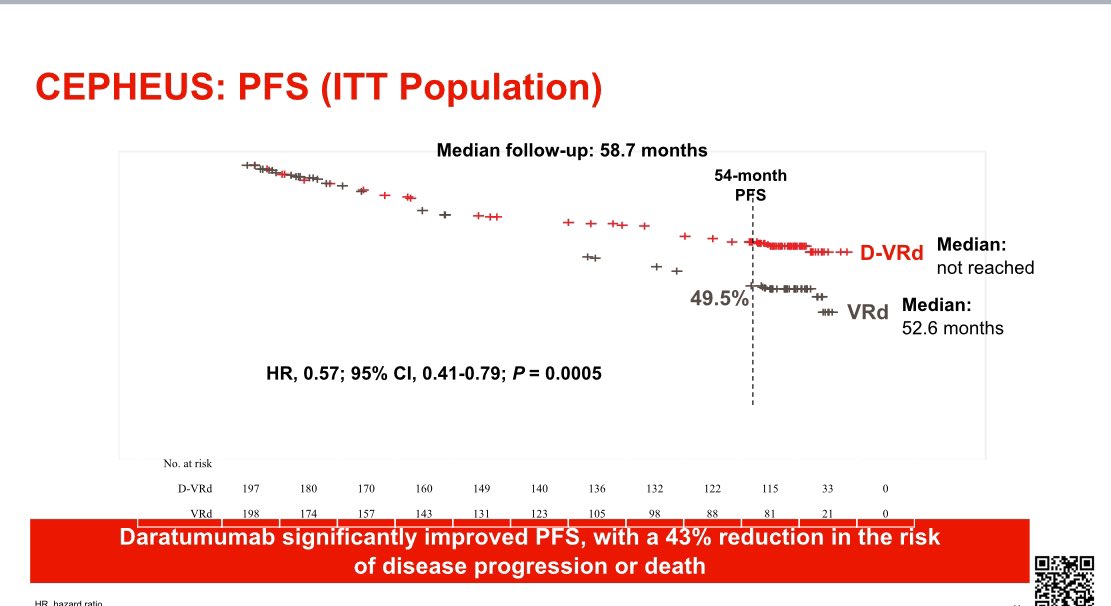
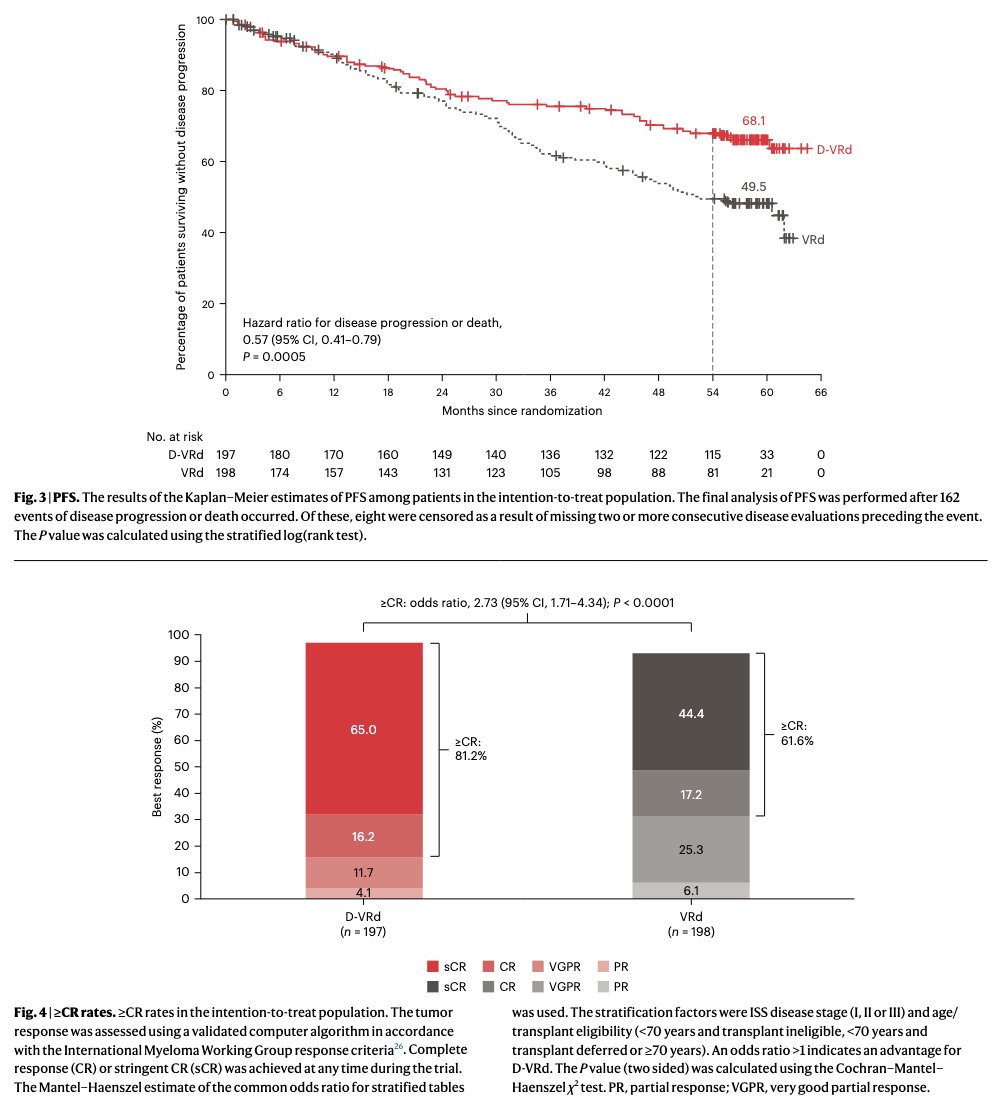
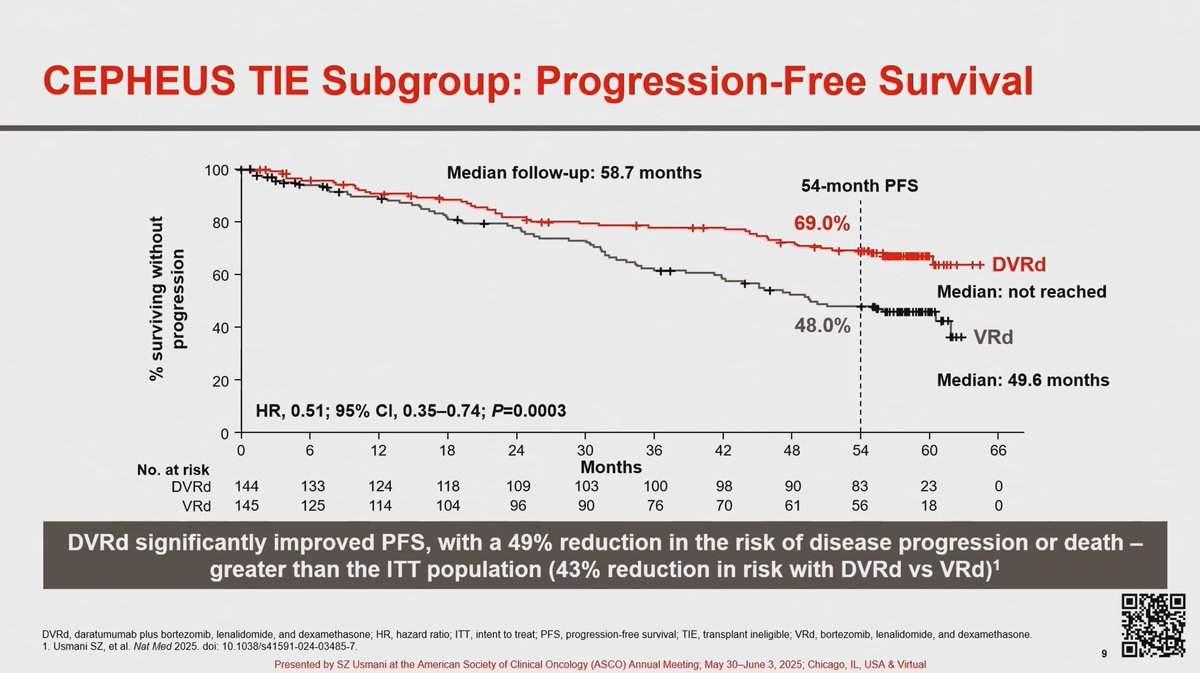
Efficacy / PFS - Final PFS analysis (median follow-up 58.7 months): HR 0.57 (95% CI 0.41-0.79; p=0.0005), a 43% risk reduction. MRD negativity 60.9% vs 39.4% (OR 2.37; p<0.0001); CR or better 81.2% vs 61.6%; sustained MRD negativity at 12 months 48.7% vs 26.3%. TIE subgroup: PFS HR 0.51, median NR vs 49.6 months. FDA-assessed efficacy: MRD negativity 52.3% vs 34.8% (p=0.0005); PFS HR 0.60 (95% CI 0.41-0.88; p=0.0078).
Overall survival - OS data are immature but trend favors D-VRd (HR 0.66; HR 0.55 when adjusting for COVID-19 deaths). In the TIE subgroup, total deaths were lower with D-VRd (22.9% vs 32.4%).
Safety - Grade 3/4 neutropenia 44.2% vs 29.7%; thrombocytopenia 28.4% vs 20.0%; peripheral neuropathy comparable (11.2% vs 10.8%); G3/4 COVID-19 9.7% vs 3.5%. Notably, discontinuation due to AEs was LOWER with D-VRd (7.6% vs 15.9%).
Regulatory / sponsor - FDA approved Darzalex Faspro + VRd for ASCT-ineligible NDMM on January 27, 2026 (12th Faspro indication, 5th in NDMM). Effectiveness not established in patients who refused ASCT as initial therapy. Together with PERSEUS, establishes D-VRd across transplant eligibility.
Compiled and reviewed by the KOL Pulse research team, led by Brian Shields, Founder, KOL Pulse. Last updated August 19, 2026.









Top 10 by impressions - click to view on X
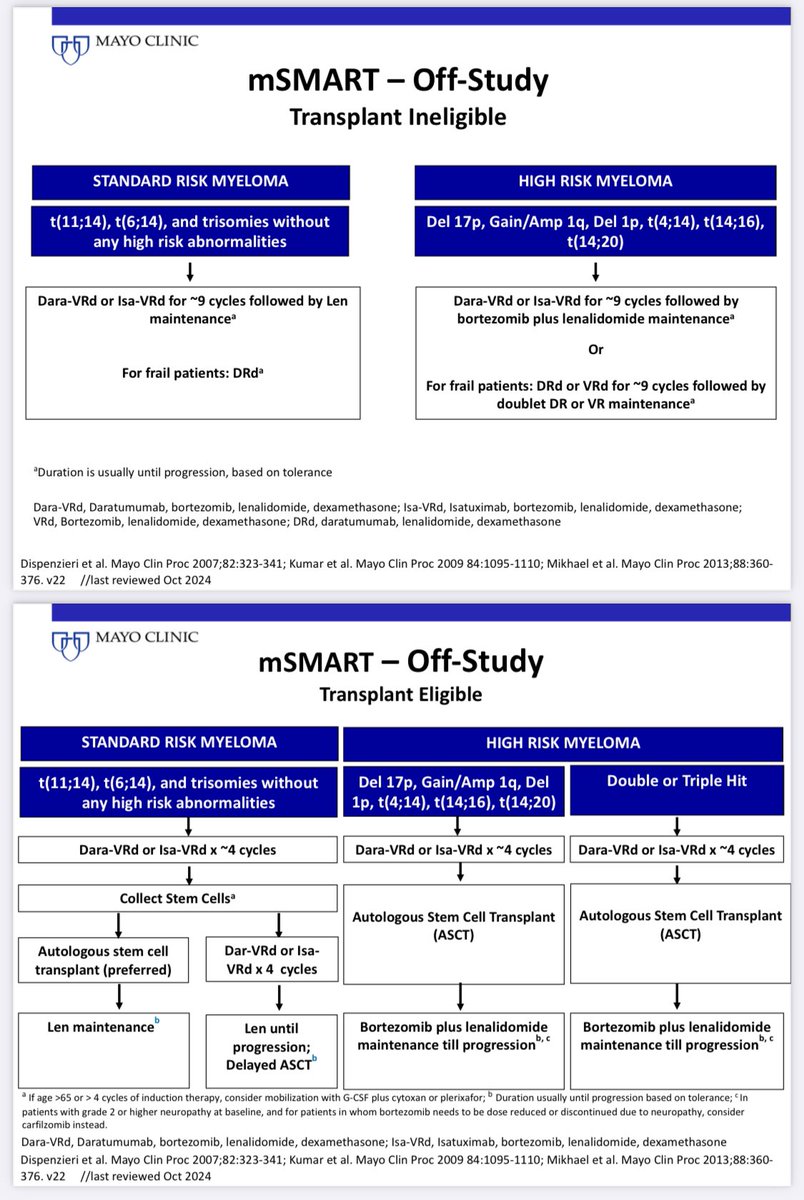
Just out: mSMART Updated guidelines for newly diagnosed myeloma. Main Change: We recommend quadruplets as initial therapy for all newly diagnosed patients who are not frail. Update based on IMROZ,...
Just out: Results of the CEPHEUS trial presented by @szusmani @MSKCancerCenter at the Plenary Session @Myeloma_Society Significant improvement in PFS with Dara-VRd...
CEPHEUS out! 👏 @szusmani et al. PFS ⬆️ ⬆️ with quad in ø ASCT #MMsm. Nice discussion of similarities (many) & differences (few) vs IMROZ. 📢 CD38-VRd now the norm...
CEPHEUS supports use of quads as initial therapy in transplant ineligible patients who are not frail, complementing data from the IMROZ trial which used Isatuximab-VRd.
CEPHEUS presented by @szusmani at #IMS24: Dara-VRd vs VRd in transplant deferred patients with myeloma. 🥇endpoint: MRD neg + CR as best response 👵👴Over 50% patients aged...

President’s address #IMS2025: Impressive projected #PFS 8.3. Years!! #mmsm #multiple #myeloma

@BonumCe @BloodCancerCME @Global_CME @RahulBanerjeeMD @PlasmaCellPete @SagarLonialMD @DoctorAKrishnan @NoopurRajeMD...

In the phase 3 CEPHEUS trial, patients with multiple myeloma were treated with subcutaneous daratumumab plus bortezomib, lenalidomide and dexamethasone, which led to a deeper and more durable...

#Myeloma Paper of the Day: Phase 3 CEPHEUS study of Dara+VRd vs. VRd finds MRD-negativity 60.9% for quad vs. 39.4% w/ VRd; ≥CR rates 81.2% vs. 61.6%; sustained MRD negativity (≥12...
CONGRESS | #ASCO25 | Saad Usmani @szusmani @MSKCancerCenter shared a subgroup analysis of transplant-ineligible patients with NDMM treated with DVRd in the phase...
CEPHEUS is a Phase III, open-label, multicenter, randomized trial evaluating the addition of subcutaneous daratumumab (Darzalex Faspro) to bortezomib, lenalidomide, and dexamethasone (D-VRd) versus VRd alone in patients with transplant-ineligible or transplant-deferred newly diagnosed multiple myeloma. The trial enrolled 395 patients and demonstrated that the D-VRd quadruplet significantly improved MRD negativity rates, depth of response, and progression-free survival. Together with PERSEUS, CEPHEUS establishes D-VRd as a new standard of care for NDMM regardless of transplant eligibility.
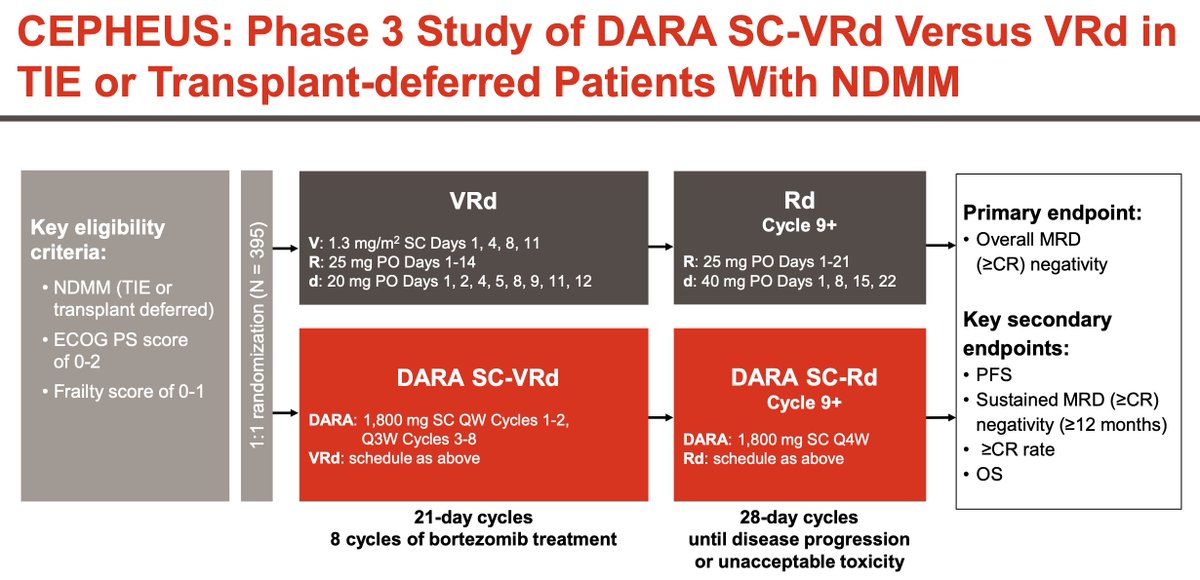
Phase III, open-label, 1:1 randomized, multicenter trial (NCT03652064). Patients received 8 cycles of D-VRd or VRd induction/consolidation (21-day cycles with bortezomib), followed by D-Rd or Rd maintenance (28-day cycles) until progression or unacceptable toxicity. Stratified by ISS stage and age/transplant eligibility (<70 years ineligible, <70 years deferred, and 70 years or older).
Adults with transplant-ineligible or transplant-deferred NDMM, ECOG PS 0-2, IMWG frailty score 0-1. Bortezomib dosed at 1.3 mg/m2 SC on days 1, 4, 8, 11 during induction cycles 1-8. Lenalidomide 25 mg PO days 1-14 during induction, 25 mg days 1-21 during maintenance. Daratumumab SC 1,800 mg weekly cycles 1-2, every 3 weeks cycles 3-8, every 4 weeks during maintenance.
Arm A: Darzalex Faspro + bortezomib + lenalidomide + dexamethasone (D-VRd) for 8 induction cycles, then D-Rd maintenance. Arm B: VRd for 8 cycles, then Rd maintenance. Treatment until progression or unacceptable toxicity.
Primary endpoint: overall MRD negativity rate (with CR or better) at 10-5 by NGS. Key secondary endpoints: PFS by independent review committee, CR or better rate, sustained MRD negativity (12 and 24 months), OS, and safety.
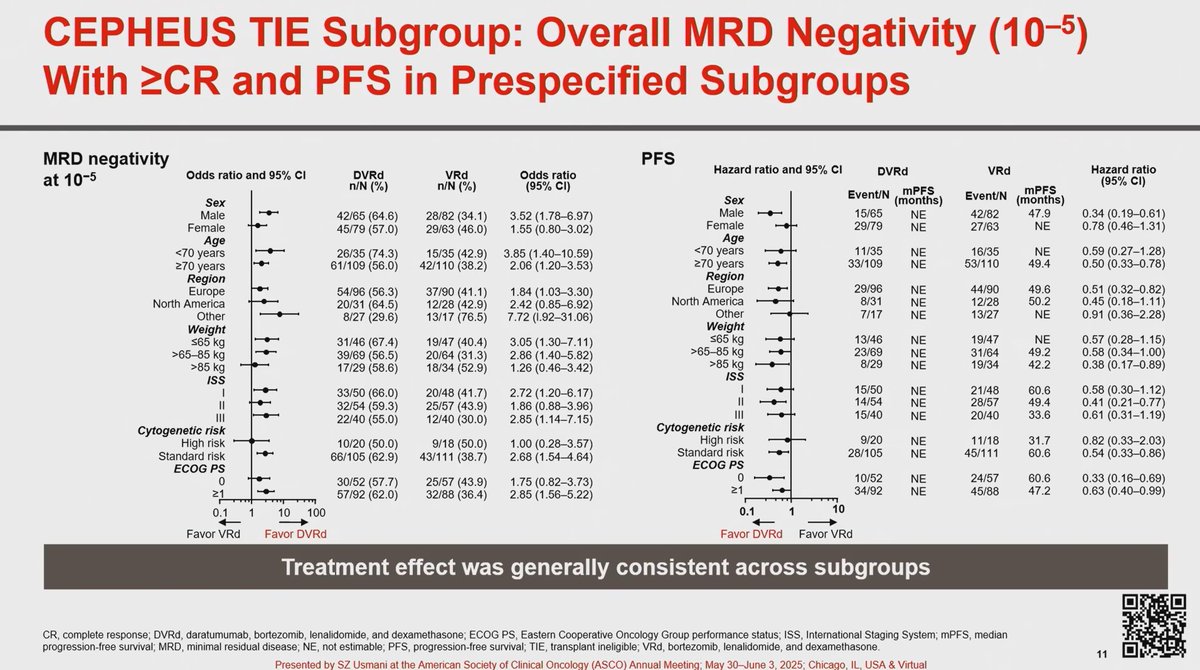
At the final PFS analysis (median follow-up 58.7 months), D-VRd demonstrated a significant PFS benefit with HR 0.57 (95% CI 0.41-0.79; p=0.0005), representing a 43% reduction in disease progression or death. MRD negativity was 60.9% vs 39.4% (OR 2.37; p<0.0001). CR or better rate was 81.2% vs 61.6% (p<0.0001). Sustained MRD negativity at 12 months was 48.7% vs 26.3% (p<0.0001). In the TIE subgroup, PFS HR was 0.51 (95% CI 0.35-0.74; p=0.0003) with median PFS NR vs 49.6 months. FDA-assessed efficacy: MRD negativity 52.3% vs 34.8% (p=0.0005); PFS HR 0.60 (95% CI 0.41-0.88; p=0.0078).
Overall survival data are immature but show a trend favoring D-VRd with OS HR 0.66. When adjusting for COVID-19 deaths, the trend strengthens to HR 0.55. In the TIE subgroup, total deaths were lower with D-VRd (22.9%) than VRd (32.4%), with exposure-adjusted grade 5 TEAE rates similar between arms (0.27 vs 0.31 per 100 patient-months).
Grade 3/4 neutropenia was higher with D-VRd (44.2% vs 29.7%). Thrombocytopenia G3/4: 28.4% vs 20.0%. Peripheral neuropathy G3/4: comparable at 11.2% vs 10.8%. Pneumonia G3/4: 13.9% vs 12.0%. COVID-19 G3/4: 9.7% vs 3.5% (G5 COVID: 4.2% vs 0.7%). SAEs: 72.2% vs 69.7%. Notably, treatment discontinuation due to AEs was lower with D-VRd (7.6%) than VRd (15.9%), likely reflecting the PFS benefit keeping patients on therapy longer.
CEPHEUS establishes D-VRd as the standard of care for transplant-ineligible NDMM, complementing PERSEUS data in the transplant-eligible setting. The FDA approved Darzalex Faspro + VRd for TI-NDMM on January 27, 2026, based on these results. Key clinical debates include whether weekly vs twice-weekly bortezomib dosing (as increasingly used in real-world practice) maintains comparable efficacy, management of frail/elderly patients who may not tolerate the quadruplet, and whether MRD-guided treatment discontinuation could reduce treatment burden while maintaining outcomes.
CEPHEUS (NCT03652064) is a Phase 3, open-label, multicenter, randomized trial evaluating subcutaneous daratumumab (Darzalex Faspro) added to bortezomib, lenalidomide, and dexamethasone (D-VRd) versus VRd alone in patients with transplant-ineligible or transplant-deferred newly diagnosed multiple myeloma. The trial enrolled 395 patients, with MRD negativity and progression-free survival as key endpoints. The lead sponsor is Janssen Research & Development.
At the final PFS analysis (median follow-up 58.7 months), D-VRd reduced the risk of progression or death by 43% (HR 0.57; 95% CI 0.41-0.79; p=0.0005). MRD negativity was 60.9% vs 39.4% (OR 2.37; p<0.0001), CR or better was 81.2% vs 61.6%, and sustained MRD negativity at 12 months was 48.7% vs 26.3%. OS is immature but trends favor D-VRd (HR 0.66; 0.55 adjusting for COVID-19 deaths).
Yes. On January 27, 2026 the FDA approved Darzalex Faspro in combination with bortezomib, lenalidomide, and dexamethasone for adults with newly diagnosed multiple myeloma ineligible for autologous stem cell transplant, based on CEPHEUS. It is the 12th indication for Darzalex Faspro and the 5th in NDMM; the FDA noted effectiveness has not been established in patients who refused ASCT as initial therapy.
Grade 3/4 neutropenia was higher with D-VRd (44.2% vs 29.7%), as were thrombocytopenia (28.4% vs 20.0%) and grade 3/4 COVID-19 (9.7% vs 3.5%). Peripheral neuropathy was comparable (11.2% vs 10.8%). Treatment discontinuation due to AEs was actually lower with D-VRd (7.6% vs 15.9%), likely reflecting the PFS benefit keeping patients on therapy longer.
CEPHEUS establishes the D-VRd quadruplet as a standard of care for transplant-ineligible NDMM, complementing PERSEUS in the transplant-eligible setting - making D-VRd a new standard regardless of transplant eligibility. Open clinical questions include weekly vs twice-weekly bortezomib dosing, management of frail or elderly patients who may not tolerate the quadruplet, and whether MRD-guided discontinuation could reduce treatment burden.