DESTINY-Breast11 Key Takeaways
Design — Phase 3, open-label; neoadjuvant T-DXd->THP vs ddAC-THP, high-risk HER2+ early breast cancer (NCT05113251). (ESMO 2025)
pCR (primary) — 67.3% vs 56.3% (delta 11.2%; p=0.003). (ESMO 2025, Harbeck)
RCB-0+I (updated) — 81.3% vs 69.1% favoring T-DXd-THP. (ESMO Breast 2026, Pusztai)
Safety — Better than ddAC-THP: Grade >=3 AEs 37.5% vs 55.8%; serious AEs 10.6% vs 20.2%; all-grade LV dysfunction 1.3% vs 6.1%. (ESMO 2025)
Regulatory — FDA approved May 15, 2026 (neoadjuvant HER2+ Stage II-III, followed by THP). (FDA.gov)
Sponsor / Drug — Daiichi Sankyo / AstraZeneca; T-DXd (Enhertu), a HER2-directed antibody-drug conjugate. (FDA label)
Compiled and reviewed by the KOL Pulse research team, led by Brian Shields, Founder, KOL Pulse. Last updated July 21, 2026.
Top KOLs Discussing DESTINY-Breast11



DESTINY-Breast11 Key Slides & Visuals
Trial slides shared by KOLs at SABCS 2025 / ESMO Breast 2026. Click any image to expand. OCR text extracted via AWS Textract.


[Slide 1]
What We Have Learned
A neoadjuvant ADC-based regimen, T-DXd-THP, with less chemotherapy improves
pathologic response compared to ddAC-THP in high-risk HER2+ early breast cancer
This is the 4th trial to show anthracyclines do not improve pCR in high-risk HER2+
Sara Hurvitz
early breast cancer
Invited Discussant 2910
Anthracyclines are less safe than non-anthracycline, T-DXd-based regimens
Without a better way to select patients, use of an ADC as the sole source of
chemotherapy is inadequate neoadjuvant treatment for high-risk HER2+ early BC
congress
ESMO
Content of this presentation 8 copynght and responsibility of the author Permission is required for re use

---

[Slide 2]
DESTINY-Breast11:
The FIRST Phase 3 Trial of Neoadjuvant T-DXd in HER2+ eBC
ITT population* (primary endpoint)
HR-positive
HR-negative
A11.2%
A16.1%
100
(95% CI 4.0, 18.3; P=0.0031)
(95% CI 3.0, 28.8)
A9.1%
80
67.3
83.1
(95% C102. 17.9)
56.3
67.1
60
61.4
pCR (%)*
52.3
Sara Hurvitz
40
Invited Discussant 2910
20
216/321
180/320
145/236
123/235
69/83
57/85
0
T-DXd-THP
ddAC-THP
T-DXd-THP
ddAC-THP
T-DXd-THP
ddAC-THP
pCR significantly improved in T-DXd-THP arm!
Control arm performed as predicted
First phase III evidence that replacing chemotherapy with an ADC in neoadjuvant setting improves pCR
congress
ESMO
Content of this presentation is copyright and responsibility of the author Permission is required for re-use
Sara Hurvitz, MD

---

[Slide 3]
Would T-DXd-THP have beat TCHP?
pCR in Phase III Trials of Neoadjuvant Taxane/Carbo/HP
Regimen/ Study
N
pCR
pCR HR-
pCR HR+
TCHP X 6
KRISTINE-TRIO-021/Hurvitz, et al.
221
56%
73%
44%
Lancet Oncol 2018
TCHP X 6
HELEN-006/Chen X-C et al. Lancet
337
58%
70%
48%
Oncol. 2025;26(1):27-36.
Sara Hurvitz
TCHP X 6 (T=q3 weekly docetaxel,
Invited Discussant 2910
paclitaxel or nab-paclitaxel)
387
66%
78%
59%
neoCARHP/Wang K et al. ASCO 2025
Paclitaxel/Carbo/HP X 9 cycles
TRAIN-2/van Ramshorst et al.
206
67%
84%
55%
Lancet Oncol 2018
Presenter: Sara A. Hurvitz, MD. FACP
ESMO
Content of this presentation 13 copyrighted and responsibility of the author Permission a required for re-use

---

[Slide 4]
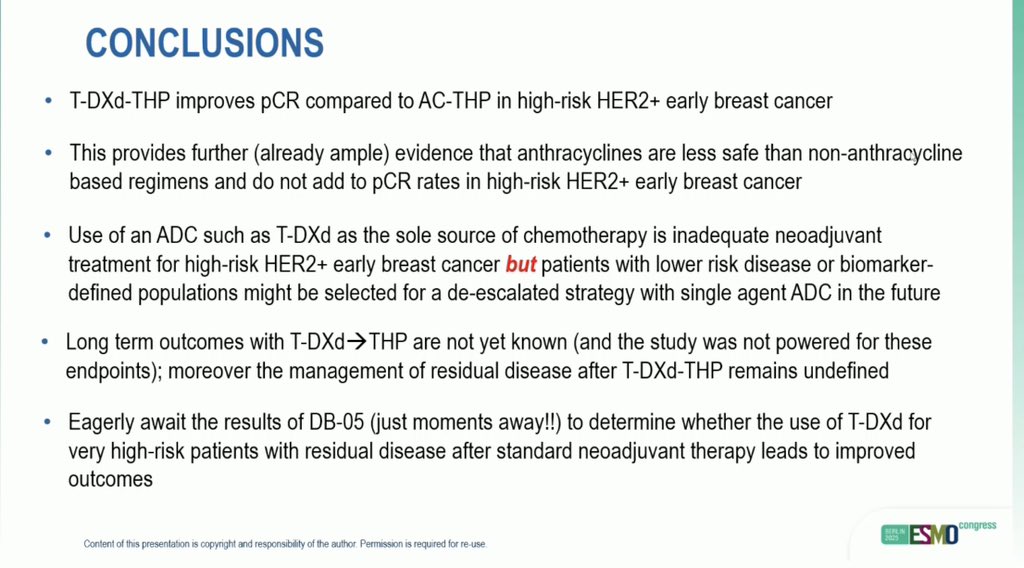
CONCLUSIONS
T-DXd-THP improves pCR compared to AC-THP in high-risk HER2+ early breast cancer
This provides further (already ample) evidence that anthracyclines are less safe than non-anthracycline
based regimens and do not add to pCR rates in high-risk HER2+ early breast cancer
Use of an ADC such as T-DXd as the sole source of chemotherapy is inadequate neoadjuvant
treatment for high-risk HER2+ early breast cancer but patients with lower risk disease or biomarker-
defined populations might be selected for a de-escalated strategy with single agent ADC in the future
Long term outcomes with T-DXd
THP are not yet known (and the study was not powered for these
endpoints); moreover the management of residual disease after T-DXd-THP remains undefined
Eagerly await the results of DB-05 (just moments away!!) to determine whether the use of T-DXd for
very high-risk patients with residual disease after standard neoadjuvant therapy leads to improved
outcomes
congress
ESMO
Content of this presentation is copyright and responsibility of the author Permission is required for re-use

[Slide 1]
No pCR Benefit with Addition of Anthracycline to
Neoadjuvant Trastuzumab-Based Regimen in HER2+ BC
Study
pCR Anthracycline
pCR Non-Anthracycline
TRYPHAENA/Schneeweiss Ann Oncol
2013;24:2778-84
56%
64%
(FECHPx3
THPx3 vs TCHPx6)
TRAIN-2/van Ramshorst et al, Lancet
Oncol 2018;19
67%
68%
(FECx3
TCHPx6 vs TCHPx9)
neo-CARH/Gao HF, et al. Ther Adv
Med Oncol. 2021;13;
37%
56%
(EC-TH vs TCH)
DESTINY-Breast11/Harbeck ESMO 2025
(ACx4
THPx4 VS T-DXdx4
THPx4)
56%
67%
Presenter: Sara A. Hurvitz, MD, FACP
ESMO
Content of this presentation is copyrighted and responsibility of the author Permission is required for re-use

[Slide 1]
16:30 - 18:15 Presidential Symposium |
CHAIRS: GIUSEPPE CURIGLIANO, BRIGETTE MA
FUTURE STUDIES NEEDED
HOW COULD WE INTEGRATE DB11 AND DB05?
Can we use a response-guided approach?
HP
pCR
X 14 cycles
ctDNA
cT≥3 or cN+
THP
Breast MRI
undetectable
Surgery
TDXd
HER2+ BC
x12 wks
(at C2D1)
response
RD
x14 cycles
Any HR status
Sara Tolaney
Check ctDNA:
If no response
Baseline &
Baseline breast MRI
Cycle Day 1
HP
Invited Discussant LBA1
for all patients
ctDNA
pCR
T-DXd for 4
X 14 cycles
Baseline tumor-informed
detectable
cycles
Surgery
ultrasensitive ctDNA for
(at C2D1)
RCB2/3
all patients
RD
ACx4-T-DM1x
Plasma samples for serial ctDNA testing
14 cycles
RCB1
"
"
T-DM1 X 14 cycles
Baseline
C2d1
(week 0)
(week 3)
Side adapted from Bia Sequi/Ada Waks
BERLIN AUDITORIUM - HUB 27


[Slide 1]
DESTINY-Breast11 study design
A randomized, global, multicenter, open-label, Phase 3 study
(NCT05113251)
Data cutoff:
March 12, 2025
n=321
T-DXd*
THP
Recommended
Primary endpoint
Patient population
4 + 4 cycles
post-neoadjuvant
pCR (ypTO/is ypN0) by blinded
Previously untreated
central review
treatment per study
HER2+ eBC
protocol
Secondary endpoints
HR-positive or
n=320
HR-negative
Randomized
ddAC THP$
Surgery
pCR: radiotherapy and
pCR (ypTO ypN0) by blinded
concomitant trastuzumab +
central review
1:1:1
4 + 4 cycles
High-risk defined as:
pertuzumab for up to 1 year
EFS
- ≥cT3 and NO-3 or
No pCR: radiotherapy and
Safety
cT0-4 and N1-3
T-DM1 for up to 14 cycles
Pharmacokinetics and
n=286
T-DXd*
- Inflammatory BC
HR-positive: endocrine
immunogenicity
8 cycles
therapy
Invasive disease-free survival
Overall survival
Stratification factors
Health-related quality of life
HR status: ER and/or
The T-DXd alone arm closed on March 13 2024, following
Additional outcome
PR-positive or negative
Independent Data Monitoring Committee recommendation
measures
HER2 status: (IHC 3+ or
The reasons were multifactorial, including a lower pCR rate, low likelihood
Residual cancer burden (RCB)
ISH+ in the absence of
that T-DXd alone would be superior to ddAC-THP, and the timing of surgery
IHC 3+ status)
High-resolution computed tomography chest scans were performed every 6 weeks during treatment; if IL Dipneumonitis was suspected while receiving T-DXd. treatment was interrupted and a full investigation completed. Echocardiograms or multigated acquisition scans
were performed during screening (<28 days prior to randomization). during treatment (<3 days before Cycle 5). and at end of treatment to assess left ventricular ejection fraction *5 mg/kg Q3W; pacitaxel (80 mg/m2 QW) trastuzumab (6 mg/kg Q3W) pertuzumab (840 mg
loading dose followed by 420 mg Q3W): dexorubicin (60 mg/m2 Q2W) cyclophosphamide (600 mg/m2 Q2W): paclitaxel (80 mg/m3 QW) trastuzumab (8 mg/kg loading dose followed by 6 mg/kg Q3W) perfuzumab (840 mg loading dose followed by 420 mg Q3W): "the recommended
window for surgery was 3-6 weeks following administration of the last dose of neoadjuvant study treatment administered as part of the patient's SOC at the investigator's discretion cT, clinical tumor stage; ER estrogen receptor; IHC. immunohistochemistry: ILD interstitial lung disease:
ISH+ in situ hybridization-positive; N, nodal stage PR, progesterone receptor QXW every X weeks: T-DM1 trastuzumab emtansine ypT0/is ypN0 absence of invasive cancer in the breast and axillary nodes; ypT0 ypN0. absence of invasive and in-situ cancer in the breast and axillary nodes
Nadia Harbeck, MD
congress
DESTINY-Breast11
BERLIN
2025
ESMO
Content of this presentation is copyright and responsibility of the author. Permission is required for re-use.

---

[Slide 2]
pCR (ypTO/is ypN0): primary endpoint
ITT population+ (primary endpoint)
HR-positive
HR-negative
16.1%
11.2%
(95% CI 3.0, 28.8)
Д9.1%
100
(95% CI 4.0, 18.3; P=0.003*)
(95% CI 0.2, 17.9)
83.1
80
67.1
67.3
61.4
56.3
52.3
pCR (%)*
60
40
20
216/321
180/320
145/236
123/235
69/83
57/85
0
T-DXd-THP
ddAC-THP
T-DXd-THP
ddAC-THP
T-DXd-THP
ddAC-THP
Neoadjuvant T-DXd-THP demonstrated a statistically significant and
clinically meaningful improvement in pCR vs ddAC-THP
Improvement was observed in both the HR-positive and HR-negative subgroups
For the ITT population, treatment effects were estimated by the difference in pCR with 95% Cls and P-values based on the stratified Miettinen and Nurminen's method, with strata weighting by sample size (ie Mantel-Haenszel weights)
Patients with no valid records regarding pCR status for any reason were considered to be non-responders (including but not limited to withdrawal from the study progression of disease or death before surgery lack of surgical specimen or defined as not evaluable by the central pathologist)
Subgroup analyses were unstratified "By blinded central review; 1pCR responders were defined as patients who only received randomized study treatment (at least one dose) and had pCR; two-sided P-value crossed the 0 03 prespecified boundary ITT. intent-to-treat
Nadia Harbeck, MD
DESTINY-Breast11
BERLIN
2025
ESMO
congress
Content of this presentation is copyright and responsibility of the author. Permission is required for re-use.

---

[Slide 3]
pCR (ypTO/is ypN0) by subgroups
pCR rate, % (n/N)
T-DXd-THP
ddAC-THP
ApCR, % (95% CI)
(n=321)
(n=320)
All patients
67.3 (216/321)
56.3 (180/320)
11.2 (4.0, 18.3)
<65 years
66.7 (188/282)
58.0 (167/288)
8.7 (0.7, 16.5)
Age at baseline
>65 years
71.8 (28/39)
40.6 (13/32)
31.2 (8.0, 51.4)
Asia
66.5 (101/152)
56.6 (86/152)
9.9 (-1.1, 20.6)
Western Europe
75.4 (52/69)
62.3 (48/77)
13.0 (-2.2, 27.5)
Geographical region
North America
74.4 (32/43)
36.6 (15/41)
37.8 (16.8, 55.7)
Rest of world*
54.4 (31/57)
62.0 (31/50)
-7.6 (-25.7, 11.2)
Eastern Cooperative Oncology
0
68.7 (191/278)
55.7 (156/280)
13.0 (5.0, 20.9)
Group performance status score
1
58.1 (25/43)
60.0 (24/40)
-1.9 (-22.6, 19.1)
Post
68.8 (86/125)
56.9 (87/153)
11.9 (0.5, 23.0)
Menopausal status
Pre
66.9 (123/184)
55.2 (90/163)
11.6 (1.4, 21.7)
IHC 3+
71.1 (199/280)
61.5 (174/283)
9.6 (1.8, 17.3)
HER2 status
Other
42.5 (17/40)
16.7 (6/36)
25.8 (5.2, 44.4)
Positive
61.4 (145/236)
52.3 (123/235)
9.1 (0.2, 17.9)
HR status
Negative
83.1 (69/83)
67.1 (57/85)
16.1 (3.0, 28.8)
American Joint Committee on
II-IIIA
65.7 (163/248)
56.4 (146/259)
9.4 (0.9, 17.7)
Cancer clinical stage
IIIB-IIIC
72.2 (52/72)
55.7 (34/61)
16.5 (0.1, 32.3)
NO
57.7 (15/26)
57.1 (20/35)
0.6 (-24.2, 24.8)
Nodal status
N+
68.3 (196/287)
56.6 (159/281)
11.7 (3.8, 19.5)
60
40
20
0
-20
-40
Favors T-DXd-THP
Favors ddAC-THP
Improvement in pCR for T-DXd-THP vs ddAC-THP was observed across most pre-specified subgroups
Size of circle is proportional to the total sample size in a subgroup "Brazil Bulgaria Peru Poland Russia and Saudi Arabia
Nadia Harbeck, MD
congress
DESTINY-Breast11
BERLIN
2025
ESMO
Content of this presentation is copyright and responsibility of the author. Permission is required for re-use.

---

[Slide 4]
Post-neoadjuvant treatments
Patients with pCR*
Patients without pCR*
T-DXd-THP
ddAC-THP
T-DXd-THP
ddAC-THP
n (%)
(n=226)
(n=190)
(n=95)
(n=130)
Any adjuvant treatment+
224 (99.1)
187 (98.4)
85 (89.5)
107 (82.3)
Any cytotoxic chemotherapy-containing regimen
13 (5.8)
11 (5.8)
10 (10.5)
12 (9.2)
Any T-DM1-containing regimen
4 (1.8)
4 (2.1)
50 (52.6)
74 (56.9)
Any trastuzumab-containing regimen
213 (94.2)
174 (91.6)
37 (38.9)
34 (26.2)
Post-neoadjuvant treatments were generally well balanced between T-DXd-THP and ddAC-THP arms
In both arms, more than half of patients without pCR received post-neoadjuvant T-DM1
Patients may have had at least one anti-cancer therapy and were counted once per therapy. "By local pCR result Texcludes patients who withdrew consent or did not receive surgery; also excludes treatment given in the metastatic setting
Nadia Harbeck, MD
DESTINY-Breast11
BERLIN
2025
ESMO
congress
Content of this presentation is copyright and responsibility of the author. Permission is required for re-use.
[Slide 1]
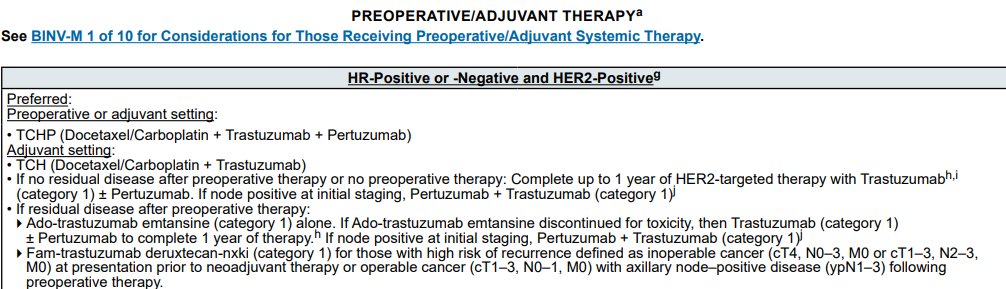
PREOPERATIVE/ADJUVANT THERAPY
See BINV-M 1 of 10 for Considerations for Those Receiving Preoperative/Adjuvant Systemic Therapy.
HR-Positive or -Negative and HER2-Positive9
Preferred:
Preoperative or adjuvant setting:
TCHP (Docetaxel/Carboplatin + Trastuzumab + Pertuzumab)
Adjuvant setting:
TCH (Docetaxel/Carboplatin + Trastuzumab)
If no residual disease after preoperative therapy or no preoperative therapy: Complete up to 1 year of HER2-targeted therapy with Trastuzumabh
(category 1) + Pertuzumab. If node positive at initial staging, Pertuzumab + Trastuzumab (category 1)
If residual disease after preoperative therapy:
Ado-trastuzumab emtansine (category 1) alone. If Ado-trastuzumab emtansine discontinued for toxicity, then Trastuzumab (category 1)
+ Pertuzumab to complete 1 year of therapy. If node positive at initial staging, Pertuzumab + Trastuzumab (category 1)J
Fam-trastuzumab deruxtecan-nxki (category 1) for those with high risk of recurrence defined as inoperable cancer (cT4, N0-3, M0 or cT1-3, N2-3,
M0) at presentation prior to neoadjuvant therapy or operable cancer (cT1-3, N0-1, M0) with axillary node-positive disease (ypN1-3) following
preoperative therapy.


[Slide 1]
DESTINY-Breast11 study design
A randomized, global, multicenter, open-label, Phase 3 study
(NCT05113251)
Data cutoff:
March 12, 2025
n=321
T-DXd* THP
Recommended
Primary endpoint
Patient population
4 + 4 cycles
post-neoadjuvant
pCR (ypTO/is ypN0) by blinded
Previously untreated
central review
treatment per study
HER2+ eBC
protocol
Secondary endpoints
HR-positive or
n=320
Randomized
ddAC THPS
HR-negative
Surgery
pCR: radiotherapy and
pCR (ypTO ypN0) by blinded
concomitant trastuzumab :
central review
1:1:1
4 + 4 cycles
High-risk defined as:
pertuzumab for up to 1 year
EFS
>cT3 and NO-3 or
No pCR: radiotherapy and
Safety
Nadia Harbeck
cT0-4 and N1-3
T-DM1 for up to 14 cycles
Pharmacokinetics and
n=286
T-DXd*
- Inflammatory BC
HR-positive: endocrine
immunogenicity
DESTINY-Breast11: Neoadjuvant trastuzumab
8 cycles
therapy
Invasive disease-free survival
Overall survival
deruxtecan alone (T-DXd) or followed by
Stratification factors
Health-related quality of life
paclitaxel + trastuzumab + pertuzumab (T-DXd-
HR status: ER and/or
The T-DXd alone arm closed on March 13 2024. following
Additional outcome
THP) vs SOC for high-risk HER2+ early breast
PR-positive or negative
Independent Data Monitoring Committee recommendation
measures
HER2 status: (IHC 3+ or
The reasons were multifactorial, including a lower pCR rate, low likelihood
cancer (eBC)
Residual cancer burden (RCB)
ISH+ in the absence of
that T-DXd alone would be superior to ddAC-THP. and the timing of surgery
IHC 3+ status)
High resolution computed tomography chest scans were performed every works during treatment; Dipneumonitis was suspected while receiving T DXd. treatment was interrupted and full investigation completed chocardiograms or multigated acquisition scans
were
performed
during
screening
(+28
days
prior
to
during
treatment
(<)
days
before
Cycle
5),
and
at
end
of
to
assess
left
ventricular
ejection
fraction
mgkg
Q3W
pacitaxel
80
mg/m2
QW)
restruzumab
mgkg
Q3W)
perfuzumab
(840
mg
loading dose followed 420 mg Q3W): doxonubicin 60 mg/m3 Q2W) clophosphamide (600 mg/ml Q2W) pacitaxel (B) mg/m2 QW) trasturumab mgkg loading dose followed mg kg perfuzumab 540 mg loading dose followed by 420 mg Q3W) the recommended
window
for
surgery
was
weeks
following
administration
the
last
dose
of
neceduvant
study
treatment
administered
as
part
the
patient's
SOC
the
investigator
discretion
et
clinical tumor
I
I
ER
estrogen
I
IHC
I
ILD
interstitial
lung
disease
ISH+ in situ hybridization-positive N modal stage PR progesterone receptor QXW every weeks T-DM1 trasturumab emtansine Dis ypNo absence of invasive cancer in the treast and accilary nodes ypTo yphis absence of invasive and in-situ cancer in the breast and axillary nodes
Nadia Harbeck, MD
congress
DESTINY-Breast11
ESMO
Content of this presentation is copyright and responsibility of the author. Permission is required for re-use.

---

[Slide 2]
pCR (ypTO/is ypN0): primary endpoint
ITT population+ (primary endpoint)
HR-positive
HR-negative
16.1%
11.2%
(95% CI 3.0, 28.8)
Д9.1%
100
(95% CI 4.0, 18.3; P=0.003*)
(95% CI 0.2, 17.9)
83.1
80
67.1
67.3
61.4
56.3
52.3
pCR (%)*
60
40
20
216/321
180/320
145/236
123/235
69/83
57/85
0
T-DXd-THP
ddAC-THP
T-DXd-THP
ddAC-THP
T-DXd-THP
ddAC-THP
Neoadjuvant T-DXd-THP demonstrated a statistically significant and
clinically meaningful improvement in pCR vs ddAC-THP
Improvement was observed in both the HR-positive and HR-negative subgroups
For the ITT population, treatment effects were estimated by the difference in pCR with 95% Cls and P-values based on the stratified Miettinen and Nurminen's method, with strata weighting by sample size (ie Mantel-Haenszel weights)
Patients with no valid records regarding pCR status for any reason were considered to be non-responders (including but not limited to withdrawal from the study progression of disease or death before surgery lack of surgical specimen or defined as not evaluable by the central pathologist)
Subgroup analyses were unstratified "By blinded central review 1pCR responders were defined as patients who only received randomized study treatment (at least one dose) and had pCR two-sided P-value crossed the 0.03 prespecified boundary ITT intent-to-treat
Nadia Harbeck, MD
congress
DESTINY-Breast11
ESMO
Content of this presentation is copyright and responsibility of the author. Permission is required for re-use.

---

[Slide 3]
T-DXd alone arm: efficacy summary
On March 13, 2024, the T-DXd alone arm closed following Independent Data Monitoring Committee recommendation.*
Patients who were still receiving T-DXd alone could remain on therapy or immediately switch to local SOC
pCR rate
EFS
1.0
T-DXd
ddAC-THP
94.4%
%
(n=286)
(n=320)
(95% CI 90.5, 96.7)
EFS events
Primary analysis
15/286
Switch to local SOC classified as non-pCR
pCR+
43.0
56.3
Probability of EFS
0.9
93.1%
EFS events
(95% CI 88.7, 95.8)
18/320
Hazard ratio
0.82
A (95% CI)
-13.2 (-20.8, -5.4)
(95% CI 0.41, 1.62)
Prespecified supplementary analysis
At data cutoff (March 12, 2025),
Switch to local SOC not automatically classified as non-pCR
0.8
EFS event maturity was 5.4%
pCRt
51.4
57.2
0
0
3
6
9
12
15
18
21
24
27
30
33
36
39
Number of
A (95% CI)
-5.8 (-13.4, 1.9)
patients at risk
Time from randomization (months)
T-DXd alone
286
280
276
271
240
208
199
175
134
95
43
14
2
0
ddAC-THP 320
303
296
285
231
199
187
163
124
72
35
14
1
0
T-DXd alone showed inferior but robust pCR compared with the five-agent ddAC-THP
EFS data were similar for T-DXd alone and ddAC-THP
Treatment effects were estimated by the difference in pCR with 95% Cls based on the stratified Miettinen and Nurminen's method, with strata weighting by sample size (ie Mantel-Haenszel weights). Median duration of follow up was 24.9 months (T-DXd) and
23.6 months (ddAC-THP) Analyses are reported in the ITT population "The reasons were multifactorial including 5 lower pCR rate, low likelihood that T-DXd alone would be superior to ddAC-THP and the timing of surgery; by blinded central review
Nadia Harbeck, MD
congress
DESTINY-Breast11
BERLIN
2025
ESMO
Content of this presentation is copyright and responsibility of the author. Permission is required for re-use.

---

[Slide 4]
Conclusions
In DESTINY-Breast11, T-DXd-THP showed the highest reported pCR rate in
pCR rate
HER2+ eBC for a registrational study in the neoadjuvant setting, despite a high
prevalence of HR-positive disease and a high-risk population
67.3%
T-DXd-THP showed a statistically significant and clinically meaningful improvement
More than two thirds
in pCR rate VS ddAC-THP: 11.2% (95% CI 4.0, 18.3)
of patients in the
- pCR benefit for T-DXd-THP VS ddAC-THP was independent of HR status and
T-DXd-THP arm
disease stage
had a pCR
An early positive trend in EFS was observed, favoring T-DXd-THP vs ddAC-THP
HR-positive: 61.4%
- Hazard ratio: 0.56 (95% CI 0.26, 1.17)
HR-negative: 83.1%
The safety profile of T-DXd-THP was favorable vs ddAC-THP
- Lower rates of Grade ≥3 AEs, serious AEs, and AEs leading to dose interruptions
- Lower rates of hematological AEs, left-ventricular dysfunction, and fatigue
- ILD rates were low and similar between arms
DESTINY-Breast11 results support T-DXd-THP as a more effective and less toxic
neoadjuvant treatment compared with ddAC-THP, and it may
become a preferred regimen for patients with high-risk HER2+ eBC
"Historical pCR rates (defined by ypT0/is ypN0) from other registrational studies for neoadjuvant SOC treatments in HER2+ eBC ranged from 39 3% to 62 7% and HR positive prevalence ranged from 46 7% to 62 4%¹-¹
1. Huober J. et al J Clin Oncol 2022:40 2946-2956;2 Hurvitz SA et al Lancet Oncol 2018,19.115-126:3 Gianni L, et al Lancet Oncol 2012:13:25-32
Nadia Harbeck, MD
congress
DESTINY-Breast11
2025
ESMO
Content of this presentation is copyright and responsibility of the author. Permission is required for re-use.


[Slide 1 — SABCS 2025 Conclusions slide]
In DESTINY-Breast11, the safety profile of T-DXd-THP was manageable and less toxic than ddAC-THP.
Rates of adjudicated drug-related ILD/pneumonitis were low across arms, and there were fewer Grade ≥3 events with T-DXd-THP than ddAC-THP.
- Rates remained stable (T-DXd-THP) and were higher (ddAC-THP) in the THP phase (Cycles 5-8) vs Cycles 1-4.
Rates of overall and Grade ≥3 left ventricular dysfunction were lower with T-DXd-THP than ddAC-THP.
- There were no events of cardiac failure in the T-DXd-containing arms.
Rates of nausea and vomiting were higher with T-DXd-THP than ddAC-THP, highlighting the importance of following guideline recommendations for antiemetics; however, events were generally low grade.
Rates of hematologic toxicities were lower in the T-DXd-THP arm than the ddAC-THP arm.
Most peripheral neuropathy events occurred during the THP phase (Cycles 5-8) and were non-serious and generally low grade.
DESTINY-Breast11 safety results support T-DXd-THP as a potential neoadjuvant treatment option for patients with high-risk HER2+ eBC.

[Slide 2 — Adjudicated drug-related ILD/pneumonitis: discontinuations, interruptions, reductions, and SAEs]
                                              T-DXd-THP    ddAC-THP    T-DXd
                                              (N=320)      (N=312)     (N=283)
Leading to treatment discontinuation:         6 (1.9%)     7 (2.2%)    9 (3.2%)
  Grade 1                                     0            0           2 (0.7%)
  Grade 2                                     5 (1.6%)     4 (1.3%)    7 (2.5%)
  Grade 3                                     0            3 (1.0%)    0
  Grade 5                                     1 (0.3%)     0*          0
Leading to treatment interruption:            3 (0.9%)     6 (1.9%)    3 (1.1%)
  Grade 1                                     1 (0.3%)     2 (0.6%)    0
  Grade 2                                     1 (0.3%)     0           3 (1.1%)
  Grade 3                                     1 (0.3%)     4 (1.3%)    0
Leading to dose reduction                     0            0           0
SAE                                           2 (0.6%)     9 (2.9%)    1 (0.4%)

*One Grade 5 event in ddAC-THP arm, however, the patient died prior to decision to discontinue treatment.
Incidence of treatment discontinuations and interruptions due to ILD/pneumonitis were low across treatments, with no dose reductions; more SAEs in the ddAC-THP arm vs T-DXd-THP and T-DXd arms.

[Slide 3 — DESTINY-Breast 05 (companion presentation) Conclusions]
IDFS improvement with T-DXd compared with T-DM1 was consistent across subgroups regardless of: prior NACT (anthracyclines or platinum-based therapy); HER2 status (IHC 3+ or HER2 IHC 2+/1+ and ISH+).
Timing of adjuvant RT did not impact incidence or severity of adjudicated drug-related ILD.
Most patients who experienced ILD had recovered or were recovering by DCO.
Overall, T-DXd demonstrated a generally manageable safety profile with both sequential and concurrent adjuvant RT.
T-DXd over T-DM1 in the post-neoadjuvant HER2+ eBC residual invasive disease setting, supporting T-DXd as a potential new standard-of-care.

Source: SABCS 2025 (Dec 9-12, 2025) — Loibl S, Curigliano G, presenters. Tweet capture via @hoperugo (5,704 imp).DESTINY-Breast11 Top Tweets


Top Discussion Threads
Highest-engagement tweets about this trial, ranked by KOL discussant count (replies + quote-tweets). Replies in green, quote-tweets in blue. Wall Street, stock-promo, and non-substantive replies excluded.
Ask any breast oncologist today, and they’ll tell you they prefer anthracycline-free regimens in HER2-positive breast cancer — and that anthracyclines don’t improve response rates. So how did we accept a control arm containing anthracyclines in the DESTINY-Breast11 trial, which h

Anthracylines aren't so much of a problem if delivered with pre|cision technology. #silentinthebloodstream #AVCT #Avacta

As long as physicians receive direct or indirect payments from industry for clinical trial participation, true scientific equipoise is impossible. What did you expect? In such a system, research ethics can’t flourish dec

I’m glad someone like you has the courage to point this out. I was a sub investigator and didn’t have equipoise for these arms so didn’t enroll anyone—and I got nagged constantly about it because it costs a lot of money

Anthracycline-containing arms are still standard.

Would you avoid anthracyclines for very large tumours / inoperable and high nodal risk as well ?

Not harsh at all. I can think of several late game decisions by regulators refuse to consider a trial that did not assess the standard of care

Indeed. Aldoxorubicin’s P2 trial was intentionally ‘played’ to support the progression into P3, only for it to fall spectacularly. The safety and effectiveness of the drug was clear from the P1 data. Waste of time, mon

100%! Thank you for pointing this out!

Of course standard is TCH+P so this was due to achieving better score. It is similar to last year Niagara where neoadjuvant control chemotherapy was GC not M-VAC
Just a joke Yakup 😊

Totally agree, I really feel sad when someone uses 4 AC against the 4 DC in early breast cancer.

in this context, among patients with Top2-alpha mutations, aren't anthracyclines more effective than taxanes? If no clinical literature, feel free to look into preclinical literature. Thanks.

IT IS NOT HARSH,YOU HAVE CALLED A SPADE….

Anthracyclines were included because this reflected what was being offered in many countries. Not all countries have access to non-Anthracyclines regimens such as TCHP!
Harbeck is very unethical Indeed. She is also hiding in adaptcycle trial that ribociclib triggers much more toxic events than chemo over thé first 6 months: hématologic and hepatic toxicities. She state the reverse And s
Indeed, but the investigators always treat us as Guinea pigs; especially in the ribolaris trial where they force their victims to pursue exposure to ribociclib against the décision of the French authorities! To get paid





 +4
+4
DB-11 abstract just released. In high-risk (≥T3, N+, or IBC) HER2+ eBC, neoadjuvant T-DXd-THP outperformed ddAC-THP (pCR rate 67% vs 56%, p=0.003), with reduction in cardiotoxicity (LVD 1.9 vs 9%) and low rate of ILD (4.4 vs 5.1%). The last nail in the coffin for anthracyclines.

The only time I use anthracyclines in Her2 positive disease is pregnancy!!!
Glad to see these results however I don’t think Anthracyclines are going away quite yet! Still useful in TNBC and with regards to this patient population many parts of the world will not have access to T-DXd-THP due to c




 +4
+4
#ESMO25 DESTINY-Breast11-Positive✅ but Current standard: 6× THP or TCbHP, already short & anthracycline-free. pCR ↑ 11% is notable — but if residual disease remains, then what? Will we give T-DM1, which is weaker than T-DXd? Or extrapolate from DB-05 and use adjuvant T-DXd ht

More data needed regarding non PCR , is TDM1 is the right choice as we know that TDXD is outperforming it also in this situation?

It may come down to initial risk (large node positive tumors) and we need other tools like HER2DX pCR to potentially help choose.

@_NachoG12

A new era in early HER2+ breast cancer. At #ESMO25, T-DXd outperformed T-DM1 in the adjuvant DESTINY-Breast05 and Surpassed standard ddAC-THP in the neoadjuvant DESTINY-Breast11 Bringing ADCs into the curative setting. Lung monitoring remains essential. #BreastCancer #TDXd h





 +4
+4
📌 ✨DESTINY-Breast11✨ Neoadjuvant trastuzumab deruxtecan alone or followed by paclitaxel + trastuzumab + pertuzumab vs SOC for high-risk HER2+ early breast cancer @Prof_Nadia_H Presidential Symposium #ESMO25 @OncoAlert #OncoAlertAF https://t.co/Kn5FkVro6O




 +4
+4
@dr_yakupergun @SuyogCancer @AnisToumeh @drsarahsam @stolaney1 @OncBrothers @oncologician @PTarantinoMD @JAMouabbi @DrSGraff Go with Tolaney approach to spare unnecessary Rx. https://t.co/C4lvMqBK0t


About the DESTINY-Breast11 Trial
DESTINY-Breast11 is a Phase 3 multicentre, open-label randomized trial that evaluates neoadjuvant trastuzumab deruxtecan (T-DXd) followed by paclitaxel + trastuzumab + pertuzumab (T-DXd-THP) versus standard-of-care dose-dense doxorubicin/cyclophosphamide followed by THP (ddAC-THP) in patients with previously untreated, high-risk HER2-positive early breast cancer. The primary pCR endpoint analysis was reported at ESMO 2025 (T-DXd-THP 67.3% vs ddAC-THP 56.3%, Δ11.2%, p=0.003). At ESMO Breast 2026, an updated RCB (Residual Cancer Burden) analysis was presented, showing higher RCB-0+I rates with T-DXd-THP across all subgroups, deepening the prognostic case for the regimen.
FDA Approval — Enhertu (T-DXd) in HER2+ Early Breast Cancer
KOL Reactions on FDA Approval (May 15-16, 2026)
The HER2+ breast cancer community greeted the dual approval as a clear standard-of-care shift. Top voices, ranked by impressions:
- @PTarantinoMD (Paolo Tarantino) · 14,829 imp · 64 likes · 24 RT · 2026-05-15:
“Since the first phase 1 trial of T-DXd, it was clear that this drug could be transformative when taken to the curative setting. Today, the FDA approved T-DXd for the neoadjuvant or adjuvant treatment of HER2+ eBC, marking a major advancement in the field.” - @drsarahsam (Dr Sarah Sammons) · 3,323 imp · 42 likes · 15 RT · 2026-05-15:
“Major FDA news today for early-stage HER2+ breast cancer. T-DXd approved for two separate indications: neoadjuvant Stage II/III disease (T-DXd x4 followed by THP x4), and adjuvant treatment for residual invasive disease after neoadjuvant HER2-targeted therapy. The data are” - @ErikaHamilton9 (Erika Hamilton, MD, FASCO) · 2,634 imp · 53 likes · 17 RT · 2026-05-15:
“Wow- big month for breast approvals so far...and it's only May 15th! #TDXd approved for neoadjuvant and adjuvant HER-2+ #bcsm Our @US_FDA breast colleagues have been very busy, thank you!” - @OncBrothers (Oncology Brothers) · 2,554 imp · 39 likes · 16 RT · 2026-05-15:
“TDXd now @US_FDA ✅ in neoadjuvant and adjuvant high risk residual HER2+ breast cancer based off DESTINYBreast05 and DESTINYBreast11: - ⬆️ pCR & iDFS w/ TDXd - Timings of RT did NOT impact the incidence or severity of ILD - New Soc for high risk disease! #bcsm #OncTwitter” - @DrChoueiri (Toni Choueiri, MD) · 1,965 imp · 22 likes · 12 RT · 2026-05-15:
“JUST IN: @FDA approves Neoadjuvant Trastuzumab deruxtecan (TdXD) for Her-2 + breast cancer and post residual disease , based upon Destiny breast 011/05 trials.” - @SuyogCancer (Dr Amol Akhade) · 544 imp · 12 likes · 3 RT · 2026-05-15:
“Trastuzumab deruxtecan gets @US_FDA approval for NACT and for post NACT residual disease , based upon Destiny breast 011 and 05 trials . Expected approval especially for DB 05 setting . @stolaney1 @ErikaHamilton9 @dr_yakupergun @PTarantinoMD @elmayermd @OncoAlert” - @dr_yakupergun (Yakup Ergün) · 467 imp · 6 likes · 6 RT · 2026-05-16:
“In 1998, the approval of trastuzumab began to change the poor prognosis of HER2-positive breast cancer for the better. Over the following nearly 30 years, anti-HER2 therapy evolved step by step: trastuzumab, pertuzumab, T-DM1, and now T-DXd. With the latest anti-HER2 ADC data,” - @OncoAlert (OncoAlert) · 317 imp · 12 likes · 8 RT · 2026-05-16:
“FDA Approval based on DESTINY-Breast11 and DESTINY-Breast05 in #BreastCancer The FDA approved fam-trastuzumab deruxtecan-nxki for two HER2-positive early-stage breast cancer indications: neoadjuvant therapy for Stage II/III disease followed by THP, and” - @DrRishabhOnco (Dr Rishabh Jain) · 173 imp · 5 likes · 3 RT · 2026-05-16:
“🚨 FDA expands the role of Enhertu in curative-intent HER2+ early breast cancer. AstraZeneca + Daiichi Sankyo’s trastuzumab deruxtecan is now approved in the US in BOTH: 🔹 Neoadjuvant setting (DESTINY-Breast11) 🔹 Adjuvant residual disease setting (DESTINY-Breast05) Key data”
Discussion Threads: TCHP vs T-DXd-THP Neoadjuvant SOC Debate (May 15, 2026)
Immediately after the FDA approval, a thread between Oncology Brothers, Bijoy Telivala, Paolo Tarantino, Stephanie Graff, and S Premji opened the practice-question:
- @OncBrothers (155 imp, 5/15): “I do think for that high risk residual disease, this is definitely the new SoC. But is this going to be used broadly in neoadjuvant settings??”
- @BijoyTelivala (43 imp, 5/15): “Suspect T-DXd followed by THP will be the chosen regimen based on Destiny-Breast 11.”
- @OncBrothers (30 imp, 5/15): “Inflammatory disease… absolutely! Bulky nodes/N2… yes!! But for node negative… I feel TCHP might do a good job (especially when we have TDXd in adjuvant settings and this ends up declaring more aggressive disease than what I was anticipating), no?”
- @BijoyTelivala (25 imp, 5/15): “Breast cancer and Myeloma — 2 diseases where treatment paradigms change on surrogate points very quickly. I will wait to hear from experts why TCHP was not an arm in the trial?”
Open clinical questions surfacing: (1) Will T-DXd-THP replace TCHP universally, or only for high-risk subgroups (inflammatory, N2, bulky disease)? (2) For node-negative disease, is TCHP still preferred — preserving T-DXd for adjuvant residual disease? (3) Comparative trial vs TCHP arm absent.
DESTINY-Breast11 Methodology & Results
Population: Previously untreated HER2-positive early breast cancer with high-risk features: clinical stage T3+ with N0-3, OR cT0-4 with N1-3, OR inflammatory breast cancer. Both HR+ and HR- enrolled. 81.3% IHC 3+; remainder 'other' (IHC 2+/ISH+ or 1+/ISH+).
Interventions: T-DXd-THP arm: T-DXd 5.4 mg/kg every 3 weeks × 4 cycles → paclitaxel 80 mg/m² weekly × 12 + trastuzumab + pertuzumab. Control: ddAC × 4 cycles (doxorubicin 60 mg/m² + cyclophosphamide 600 mg/m² Q2W) → paclitaxel + trastuzumab + pertuzumab. Adjuvant T-DM1 or T-DXd per standard practice based on residual disease.
Endpoints: Primary: pCR (ypT0/is N0) by ITT. Secondary: EFS, RCB distribution (analysis presented at ESMO Breast 2026), DFS, OS, safety. Translational: HER2 IHC subgroup analysis, biomarker correlatives.
Efficacy — pCR 67.3% vs 56.3% (Δ11.2%, p=0.003) · RCB-0+I 81.3% vs 69.1%
Primary endpoint: T-DXd-THP achieved pCR in 67.3% vs 56.3% with ddAC-THP (Δ11.2%, 95% CI 4.0-18.3; p=0.003). Benefit consistent across HR status (HR+: 61.4% vs 52.3%, Δ9.1%; HR-: 83.1% vs 67.1%, Δ16.1%). At ESMO Breast 2026, RCB-0+I rates were higher with T-DXd-THP across all subgroups: 81.3% vs 69.1% overall (Δ12.2%). By disease stage: Stage II 83.6% vs 71.7%; Stage III 78.9% vs 66.0%. By HER2 IHC subgroup: 3+ 82.9% vs 74.2%; "other" (IHC 2+/ISH+ or 1+/ISH+) 72.5% vs 30.6% — striking 41.9-point absolute differential in this lower-HER2-expression subgroup. Continuous RCB index favours T-DXd-THP (p=0.0059). Early EFS trend favours T-DXd-THP (HR 0.56, 95% CI 0.26-1.17) at ~24 months follow-up — immature.
Safety & Tolerability — Better safety profile than ddAC-THP: G≥3 AEs 37.5% vs 55.8%; all-grade LV dysfunction 1.3% vs 6.1%
T-DXd-THP demonstrated a markedly better safety profile than ddAC-THP: grade ≥3 AEs 37.5% vs 55.8%; serious AEs 10.6% vs 20.2%; AE-related dose interruptions 37.8% vs 54.5%. Left ventricular dysfunction was less frequent with T-DXd-THP: all-grade 1.3% vs 6.1%; Grade ≥3 0.3% vs 1.9% (no Grade 5 events) [Annals Oct 2025]. ILD/pneumonitis was infrequent and similar between arms (4.4% vs 5.1%). Three treatment-related deaths total: 1 in T-DXd-THP arm (drug-related pneumonitis); 2 in ddAC-THP arm (drug-related bacterial encephalitis + drug-related pneumonitis). One Grade 5 ILD/pneumonitis event in each arm [Annals Oct 2025]. Importantly, no AE prevented surgical intervention.
Clinical Implications
Paolo Tarantino voiced “high expectations from #CompassHER2pCR and #DESTINYBreast11 to expand our anthracycline-free treatment options… for a future where most patients can be cured with less alopecia, fatigue, neutropenia, cardiotoxicity and secondary leukemias.” Erika Hamilton called it “the FIRST positive T-DXd trial in the early-stage setting.” Yakup Ergün dissented: “Ask any breast oncologist today, and they’ll tell you they prefer anthracycline-free regimens — and that anthracyclines don’t improve response rates,” questioning the ddAC-THP control. Gaia Griguolo flagged three open questions: how T-DXd-THP compares to TCbHP, whether T-DM1 or T-DXd is better post-neoadjuvant in residual disease, and whether low ILD rates reflect short treatment duration vs strict surveillance. Hope Rugo highlighted SABCS25 safety data (Sybille Loibl) showing no ILD increase when T-DXd is given through adjuvant RT. Madeleine Armstrong (Apex Onco), writing across the paired DB-05 and DB-11 ESMO 2025 readouts, flagged ILD vigilance: “Enhertu’s perioperative Destiny beckons, but watch out for ILD.” Stephanie Graff polled the overlap problem with DESTINY-Breast05 (“what are we doing in the overlapping population?”). Luca Reccoschi noted that 53% of voters would opt for TCHP→T-DXd sequencing while awaiting further DB-11 and DB-05 updates.
DESTINY-Breast11 FAQ
What is the DESTINY-Breast11 trial?
DESTINY-Breast11 is a Phase 3, multicentre, open-label, randomized trial (NCT05113251) of neoadjuvant trastuzumab deruxtecan (T-DXd) followed by paclitaxel + trastuzumab + pertuzumab (T-DXd-THP) versus dose-dense doxorubicin/cyclophosphamide followed by THP (ddAC-THP) in previously untreated, high-risk HER2-positive early breast cancer.
Is neoadjuvant T-DXd (Enhertu) FDA approved?
Yes. On May 15, 2026 the FDA approved Enhertu as neoadjuvant treatment of adults with HER2-positive (IHC 3+ or ISH+) Stage II or III breast cancer, followed by a taxane, trastuzumab, and pertuzumab (THP), based on DESTINY-Breast11. The same approval action also covers adjuvant Enhertu for HER2+ residual disease (DESTINY-Breast05).
What were the DESTINY-Breast11 pCR results?
The primary pathologic complete response (pCR) rate was 67.3% with neoadjuvant T-DXd-THP versus 56.3% with ddAC-THP (an 11.2 percentage-point improvement; p=0.003), reported at ESMO 2025.
What did the updated Residual Cancer Burden analysis show?
At ESMO Breast 2026, an updated Residual Cancer Burden analysis showed RCB-0+I rates of 81.3% with T-DXd-THP versus 69.1% with ddAC-THP, reinforcing the primary pCR result.
How did the safety of T-DXd-THP compare with ddAC-THP?
Neoadjuvant T-DXd-THP had a markedly better safety profile than ddAC-THP: grade >=3 adverse events 37.5% versus 55.8%, serious AEs 10.6% versus 20.2%, and all-grade left-ventricular dysfunction 1.3% versus 6.1%.