ImmunoPRISM at a Glance
Design
Multicenter randomized phase 2 platform study (Immuno-PRISM): after a six-patient safety run-in, patients with high-risk smoldering myeloma were randomized 2:1 to fixed-duration teclistamab (amended from 24 to a maximum of 12 cycles) or lenalidomide-dexamethasone for 2 years. Sites: Dana-Farber, Oregon Blood Cancer Institute, Knight Cancer Institute. Primary endpoint: complete response rate. (Nature Medicine)
“Excited to see the ImmunoPRISM trial published with Omar Nadeem and @IrenemGhobrial! Teclistamab induced deep responses in high-risk smoldering multiple myeloma. Next: understanding these responses in depth through ongoing translational studies.”
— David Cordas dos Santos (@DavidCdSMD), verbatim ↗Efficacy
As of the May 26, 2026 data cutoff (59 treated: 45 teclistamab, 14 Rd; median follow-up 24.5 months): CR 77.8% vs 0% (all treated; 74% in the randomized-only primary-endpoint analysis, 29/39); ≥VGPR 86.7% vs 14.3%; MRD negativity at 10⁻⁵ in 82.2% vs 0%; median PFS not reached vs 20.3 months; estimated 2-year PFS 92% (95% CI 84–100) vs 49% (26–91), log-rank P=0.002; Cox HR 0.15 (95% CI 0.04–0.59), P=0.007. (Nature Medicine full text, DCO 26-May-2026)
“Randomized phase 2 ImmunoPRISM in high-risk SMM. Teclistamab vs Rd: CR≥ 77.8% vs 0% MRD− 10⁻⁵: 82.2% vs 0% 2-y PFS: 92% vs 49% HR 0.15 (95% CI 0.04–0.59). Powerful immune-interception signal; phase 3 validation needed. #mmsm”
— Breno Moreno de Gusmão (@morenodegusmao), verbatim ↗Safety
Cytokine release syndrome in 71.1% — grade 1 in 64.4%, grade 2 in 6.7%, none Grade 3+; tocilizumab given after CRS onset in 11.1%; no neurotoxicity. Grade 3 infections were NOT increased versus Rd (20% vs 21%), with no grade 4 or fatal infections and no deaths in either arm. (Nature Medicine full text)
“#mmsm ImmunoPRISM trial: Teclistamab vs. lenalidomide-dexamethasone in SMM ➡️ Teclistamab n=45 vs Rd n=14 ➡️ 64% high-risk by IMWG 20-2-20 ➡️ ~19% had prior SMM directed therapy With Teclistamab: ➡️93% had any grade infections despite 100% use of IVIG ➡️ 20% had grade 3 infections ➡️ 36% had grade 3/4 neutropenia ➡️ 71% achieved sCR/CR or VGPR with 7% were primary nonresponders ➡️ 40% CRS related hospitalization https://t.co/QPhMOmDJO7 High % of infections despite the universal use of IVIG in asymptomatic population”
— Samer Al Hadidi, MD, MS, FACP (@HadidiSamer), verbatim ↗Regulatory status
⚠️ Teclistamab (Tecvayli, Johnson & Johnson) is approved only for relapsed/refractory multiple myeloma after ≥4 prior lines; its use in smoldering myeloma is investigational. Longer follow-up must show whether interception prevents rather than delays myeloma. (FDA label; Nature Medicine discussion)
KOL pulse
Breno Moreno de Gusmão: “Powerful immune-interception signal; phase 3 validation needed.” Henry C. Fung weighed it directly against daratumumab and cilta-cel interception strategies: “Three very different approaches to early immune interception.”
KOLs Discussing ImmunoPRISM


What Physicians Said
High-risk smoldering multiple myeloma: Dara vs Carvykti vs teclistamab MY BET. MY EDUCATED GUESS. Three very different approaches to early immune interception.
Encouraging myeloma news @NatureMedicine * Teclistamab, a BCMA bispecific that redirects T cells to myeloma cells, was tested against lenalidomide/dexamethasone in the phase 2 ImmunoPRISM trial in high-risk smoldering multiple myeloma, an asymptomatic precursor state that can progress to active myeloma. Results were striking: 78% achieved a complete response with teclistamab vs 0% with standard therapy, and 82% had no detectable residual disease by sensitive testing vs 0%. At 2 years, 92% of patients on teclistamab had not progressed, compared with 49% on lenalidomide/dexamethasone. A common immune side effect called cytokine release syndrome occurred in 71%, but all cases were low grade, and no neurotoxicity was seen. The trial included 59 patients and longer follow-up is needed to know whether this truly prevents myeloma or mainly delays its development. Still, a compelling proof of concept for cancer interception rather than waiting for overt disease. Proud to see this work from @IrenemGhobrial , who helped shape my early research training at DFCI.
Glad to be part of this huge effort! Results of #ImmunoPRISM Randomized PhII trial of #Teclistamab vs LEN/DEX in high-risk #smolderingMM now in @NatureMedicine. Congratulations to @IreneMGhobrial, @ OmarNadeem, @DavidCdSMD and all
Excited to see the ImmunoPRISM trial published with Omar Nadeem and @IrenemGhobrial! Teclistamab induced deep responses in high-risk smoldering multiple myeloma. Next: understanding these responses
#mmsm ImmunoPRISM trial: Teclistamab vs. lenalidomide-dexamethasone in SMM ➡️ Teclistamab n=45 vs Rd n=14 ➡️ 64% high-risk by IMWG 20-2-20 ➡️ ~19% had prior SMM directed therapy
Randomized phase 2 ImmunoPRISM in high-risk SMM. Teclistamab vs Rd: CR≥ 77.8% vs 0% MRD− 10⁻⁵: 82.2% vs 0% 2-y PFS: 92% vs 49% HR 0.15 (95% CI 0.04–0.59). Powerful immune-interception signal; phase 3 validation needed. #mmsm
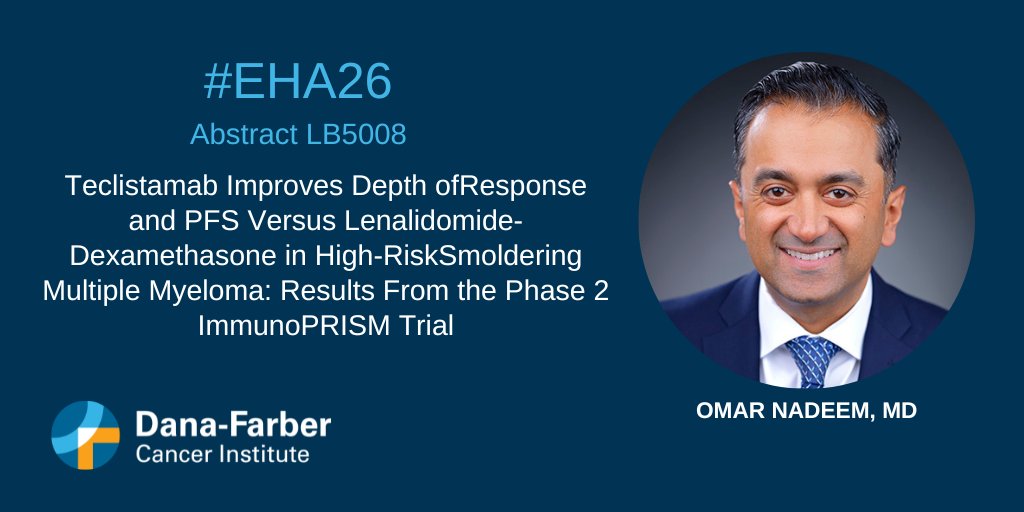
Key Slides — EHA 2026 Late-Breaker (LB5008)


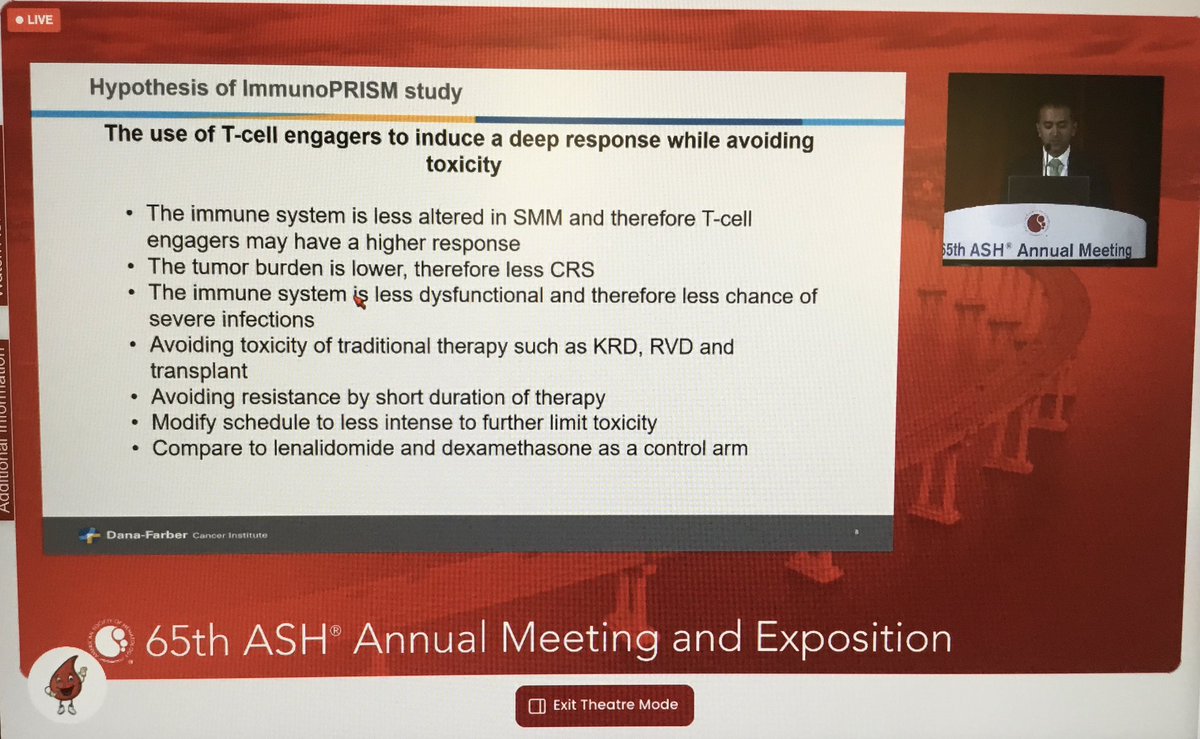
ASH 2023 — the first readout (safety run-in era)




The Cost of Interception
The toxicity counterweight to the efficacy story, verbatim: Dr. Samer Al Hadidi’s breakdown of the infection and neutropenia burden, and the skeptical reply it drew.
#mmsm ImmunoPRISM trial: Teclistamab vs. lenalidomide-dexamethasone in SMM ➡️ Teclistamab n=45 vs Rd n=14 ➡️ 64% high-risk by IMWG 20-2-20 ➡️ ~19% had prior SMM directed therapy With Teclistamab: ➡️93% had any grade infections despite 100% use of IVIG ➡️ 20% had grade 3 infections ➡️ 36% had grade 3/4 neutropenia ➡️ 71% achieved sCR/CR or VGPR with 7% were primary nonresponders ➡️ 40% CRS related hospitalization https://t.co/QPhMOmDJO7 High % of infections despite the universal use of IVIG in asymptomatic population

@HadidiSamer I look at this study as a negative study putting all the price has to be paid for asymptomatic patients
About the ImmunoPRISM Trial
Smoldering multiple myeloma sits between diagnosis and disease: high-risk patients face a substantial chance of progressing to symptomatic myeloma. For years the options were observation or lenalidomide-based delay; in November 2025, subcutaneous daratumumab (DARZALEX FASPRO) became the first FDA-approved treatment for high-risk smoldering myeloma, on the AQUILA data (PFS HR 0.49 vs active monitoring). ImmunoPRISM — part of Dana-Farber's PRISM interception platform led by Irene Ghobrial and Omar Nadeem — is the first randomized trial to put a T-cell-engaging bispecific against that paradigm, on the hypothesis that a less exhausted immune system and lower tumor burden make the precursor stage the best moment for immunotherapy.
The result published in Nature Medicine is the deepest response profile yet reported in the precursor setting, achieved with fixed-duration therapy. The open questions physicians raised within hours: durability beyond the 24.5-month median follow-up, small and uneven arms (45 vs 14), and where bispecifics sit against daratumumab-based interception (AQUILA — FDA-approved for high-risk SMM since November 2025) and CAR-T interception (the companion CAR-PRISM cilta-cel study, presented at AACR in April 2026 and published in Nature Medicine) — three different bets on the same biology.
Trial Methodology & Results
Study Design
Randomized phase 2 platform, 2:1 after safety run-in: fixed-duration teclistamab (max 12 cycles, amended from 24) vs lenalidomide-dexamethasone (2 years). Primary endpoint: CR rate. (Nature Medicine)
Population
High-risk smoldering multiple myeloma (IMWG 20-2-20-based criteria; 64% high-risk per physician read); 59 treated across three US centers. (Nature Medicine; verbatim KOL reads)
Endpoints
CR (primary); MRD negativity (10⁻⁵/10⁻⁶), ≥VGPR, PFS, safety. (Nature Medicine)
Data cut
May 26, 2026; median follow-up 24.5 months per the Nature Medicine full text. The earlier DFCI/EHA communication reports a 23.4-month-follow-up cut — the two cuts are labeled separately on this page and never mixed. (Nature Medicine; DFCI PR)
Response and MRD
Complete response in 77.8% with teclistamab versus 0% with Rd; ≥VGPR 87% vs 14%; MRD negativity at 10⁻⁵ in 82.2% vs 0% — with MRD-negative rates deepening over successive timepoints in the published figure (37/45 → 11/11 at the 33.9-month timepoint among evaluable patients). (Nature Medicine, DCO 26-May-2026; figure panels vision-verified)
CR 77.8% vs 0% · MRD-neg 82.2%Source: Nature Medicine (Sept 11, 2026) ↗
Progression-free survival
Per the Nature Medicine full text (median follow-up 24.5 months): median PFS not reached with teclistamab versus 20.3 months with Rd; estimated 2-year PFS 92% (95% CI 84–100) versus 49% (26–91), two-sided log-rank P=0.002; Cox model HR 0.15 (95% CI 0.04–0.59), P=0.007. The earlier DFCI/EHA data cut (median follow-up 23.4 months) reported the control 2-year estimate as ~51%, with 7% versus 36% of patients progressed — a different, earlier cut, not a rounding difference. (Nature Medicine full text; DFCI press release, labeled per cut)
2-yr PFS 92% vs 49% · HR 0.15Source: Nature Medicine · DFCI press release ↗
Safety in an asymptomatic population
CRS occurred in 71.1% of teclistamab patients (grade 1: 64.4%; grade 2: 6.7%) with no Grade ≥3 CRS and no neurotoxicity; tocilizumab was given after CRS onset in 11.1% (none prophylactically). Grade 3 infections were not increased versus Rd — 20% versus 21% — with no grade 4 or fatal infections and no deaths in either arm; every teclistamab patient received IVIG replacement per protocol. The key bar for treating people who feel well. (Nature Medicine full text)
CRS 71.1%, all low grade · Gr3 infections 20% vs 21%Source: Nature Medicine (verbatim physician reads) ↗
ImmunoPRISM FAQ
What is the ImmunoPRISM trial?
ImmunoPRISM (Immuno-PRISM, NCT05469893) is a Dana-Farber-led multicenter randomized phase 2 platform study testing select immunotherapies in high-risk smoldering multiple myeloma. Its published cohort compared fixed-duration teclistamab — a BCMA×CD3 bispecific T-cell engager — against lenalidomide plus dexamethasone, randomized 2:1 after a safety run-in, with complete response rate as the primary endpoint.
What did ImmunoPRISM show?
In Nature Medicine (September 11, 2026; data cutoff May 26, 2026; median follow-up 24.5 months; 59 treated patients): complete responses in 77.8% of all teclistamab-treated patients versus 0% with Rd (74% in the randomized-only primary analysis), MRD negativity at 10⁻⁵ in 82.2% versus 0%, median PFS not reached versus 20.3 months, and estimated 2-year progression-free survival of 92% versus 49% (log-rank P=0.002; Cox HR 0.15, 95% CI 0.04–0.59). Cytokine release syndrome occurred in 71.1% but was uniformly low grade, with no neurotoxicity and no increase in grade 3 infections versus Rd (20% vs 21%).
Is teclistamab approved for smoldering myeloma?
No. Teclistamab (Tecvayli, Johnson & Johnson) is approved for relapsed/refractory multiple myeloma after at least four prior lines of therapy. Its use in smoldering myeloma is investigational, and the authors note longer follow-up is needed to know whether early treatment prevents myeloma or mainly delays it.
How does this compare with other interception strategies?
Three approaches to high-risk smoldering myeloma are now in play: daratumumab-based therapy (the phase 3 AQUILA trial), CAR-T interception (the companion CAR-PRISM study of cilta-cel, presented at AACR in April 2026, with all 20 patients MRD-negative by two months — but at the cost of grade 3/4 cytopenias in 90%, CRS in all patients at grade 1–2, and neurologic toxicity in 7 patients including 4 cranial-nerve palsies), and bispecific interception with teclistamab in ImmunoPRISM. KOLs are openly debating which — if any — should define early intervention, and all agree phase 3 validation is the gate.
What are the trial's limitations?
A small randomized cohort (45 vs 14) with uneven arms, limited follow-up (median 24.5 months), an Rd comparator some argue understates modern alternatives, and the unresolved question of whether deep MRD-negative responses in a precursor state translate into prevented — not postponed — myeloma.
Key KOL Sentiments
Track oncology’s top KOLs in your specialty
Create a free account, pick the tumor types you cover, and go beyond the tweet — the intelligence pharma teams use to map influence and prepare for engagement:
- ✓Enhanced KOL profiles
- ✓Pharma influence & potential advisory-board patterns
- ✓2025 Open Payments financial analysis
- ✓Social-media sentiment & trend signals
Compiled and reviewed by the KOL Pulse research team, led by Brian Shields, Founder, KOL Pulse. Last updated September 13, 2026. Every statistic carries its source label in place; every quote is verbatim from the physician's own post.