LIVE ASCO 2026 Live — KOL insights, hot abstracts & $TICKER finance buzz View Live Updates →
KOL Pulse - Trial Profile

OPTIMA Trial

Test-directed chemo de-escalation in clinically high-risk, node-positive HR+/HER2- early breast cancer - UK NIHR / UCL / Warwick CTU

HR+/HER2- Early Breast Cancer Node-positive (up to pN2) Prosigna PAM50 ROR · Veracyte ($VCYT) ASCO 2026 Plenary
Explore Trial Data

Top KOLs Discussing OPTIMA

OncoAlert
OncoAlert
@oncoalert
16.1K impressions
Mali Barbi, MD MSc | Breast & Gyn Oncologist
@drbarbionc
4.1K impressions
Dr Rishabh Jain
Dr Rishabh Jain
@drrishabhonco
3.1K impressions
Dra. María Natalia Gandur Quiroga
@nataliagandur
2.8K impressions
Andres Meraz-Brenez
Andres Meraz-Brenez
@iandresmeraz
2.2K impressions
Mirrors of Medicine
Mirrors of Medicine
@mirrorsmed
1.5K impressions
Hope Rugo
Hope Rugo
@hoperugo
855 impressions
Dr Sarah Sammons
Dr Sarah Sammons
@drsarahsam
773 impressions

OPTIMA Key Slides & Visuals

Trial slides and infographics shared by KOLs around the ASCO 2026 plenary presentation (Robert Stein, UCL, May 30 2026). Click any image to expand.

Hope Rugo
Hope Rugo @hoperugo
OPTIMA Data · #ASCO26
May 30, 2026
View Tweet ↗
[Slide 1] X OPTIMA design Main eligibility criteria Nodes: *0-9N+, Women & men age >40 with excised breast cancer minimum T-size requirement if NO/ N1mi 2026ASCO ANNUAL MEETING ER-pos (IHC>10%) & HER2-neg Neoadjuvant chemotherapy prohibited Control arm chemo. endocrine II Prosigna* informed blinded to randomisation 1 R consent 1 high score chemo. endocrine Prosigna ROR>60 Test-directed RORS60 endocrine low score ET includes OFS for All other treatment SoC premenopausal patients "Control - Prosigns testing used for analysis only UK control am losting performed following recrudinent completion 2026 ASCO PRESENTED.ER Prof. Robert C. Stein #ASCO26 ASCO ANNUAL MEETING I I I CONQUERS CANCER 2026 ASCO ANNUAL MEETING --- [Slide 2] IBCFS vs menopausal status: low ROR score population Premenopausal Postmenopausal 2026ASCO ANNUAL MEETING 100 100 Invasive breast cancer free survival (%) 75 events at 5 years 25 Control arm 25 Invasive breast cancer free survival (%) 75 HR 1.04; 95% CI 0.60-1.80 HR 1.14; 95% CI 0.76-1.71 50 50 No. %IBCFS (95% CI) No. %IBCFS (95% CI) events at 5 years 25 95.5 (92.6-97.3) Control arm 42 94.5 (92.2-96.2) Test-directed arm 26 94.2 (91.0-96.2) Test-directed arm 50 93.2 (90.6-95.0) 0 0 0 1 2 3 4 5 6 0 1 2 3 4 5 6 Years from trial entry Years from trial entry Number - Number at mk Control 541 481 400 334 254 200 $40 Control 791 721 631 522 414 304 197 test described 559 487 410 347 256 195 as lest directed 854 206 473 156 437 007 207 1.3% observed 5-year difference -favors chemotherapy 1.3% observed 5-year difference -favors chemotherapy 2026 ASCO Prof. Robert C. Stein #ASCO26 ASCO ANNUAL MEETING ABOO - - - contact CONDUERS CANCER 2026 ASCO ANNUAL MEETING --- [Slide 3] Distant Recurrence Free Interval V Complete Per Protocol population ROR <60 subpopulation 2026ASCO 100 100 ANNUAL MEETING Distant recurrence free interval (%) 75 Adjusted HR 1.04; 90% CI 0.83-1.30 50 Distant recurrence free interval (%) 75 Adjusted HR 1.17; 90% CI 0.82-1.66 50 No. %DRFI (95% CI) No. %DRFI (95% CI) events at 5 years events at 5 years 25 25 Control arm 104 94.1 (92.7-95.3) Control arm 40 97.0 (95.6-98.0) Test-directed arm 108 93.3 (91.7-94.5) Test-directed arm 49 96.0 (94.5-97.1) 0 0 0 1 2 3 4 $ 6 0 1 2 3 4 $ 6 Years from trial entry Years from trial entry Number risk: Number stank Control 2050 1822 1968 1204 1904 744 489 Control 1358 1209 1046 665 676 507 340 Sest directed 2004 1863 1500 5311 993 732 487 test directed 1421 1262 1093 111 696 ses 346 0.8% observed 5-year difference -favors chemotherapy 1.0% observed 5-year difference -favors chemotherapy Prof. Robert C. Stein 2026 ASCO #ASCO26 - NEWTER ASCO ANNUAL MEETING - - - KNOWLEDGE CONQUERS CANCER 2026 ASC ANNUAL MEET --- [Slide 4] Conclusions OPTIMA has demonstrated that the 50-gene Prosigna test 2026ASCO identifies a patient group with minimal if any chemotherapy benefit ANNUAL MEETING At most, 2 recurrences will be prevented for every 100 patients The 50-gene test can assist safe adjuvant chemotherapy decisions for: premenopausal women aged at least 40 years treated with ovarian function suppression patients with 4 to 9 involved lymph nodes or stage IIIA tumors 2026 ASCO Prof. Robert C. Stein #ASCO26 ASCO ANNUAL MEETING - - - - - - contact CONQUERS CANCER 2026 ASCO ANNUAL MEETING
Dr Sarah Sammons
Dr Sarah Sammons @drsarahsam
OPTIMA Data · #ASCO26
May 30, 2026
View Tweet ↗
[Slide 1] Chemotherapy benefit among patients clinically high risk with « low risk » genomic assays a) â 50 years or premenopausal Tailor-X MINDACT RX-ponder OPTIMA at 9 years at 8 years at 5 years at 5 years Distant recurrences DMFS iDFS iBCFS 0.57 0.54 0.60 0.96 0.28 1.11 0.30 0.98 0.43 0.83 0.56 1.67 1.00 1.00 1.00 1.00 0.30 2.00 0.30 2.00 0.30 2.00 0.30 2.00 CT + ET better ET better 6.1% vs 12.3% 93.6% vs 88.6% 93.9% vs 89% 95.5% vs 94.2% (N = 517) (N = 464) (N = 1665) (N = 1120)* 6.2% CT benefit 5% CT benefit 4.9% CT benefit 1.3% CT benefit Martine Piccart . ROR score ≤ 60 subpopulation 2026 ASCO PRE IT: Martine Piccart ASCO - #ASCO26 ANNUAL MEETING for sontact perrissions@asco.org KNOWLEDGE CONQUERS CANCER
Yakup Ergün
Yakup Ergün @dr_yakupergun
OPTIMA Data · #ASCO26
May 30, 2026
View Tweet ↗
[Slide 1] 2026 ASCO ANNUAL MEETING First results from the OPTIMA phase III randomized non-inferiority trial of test-directed chemotherapy in patients with high clinical risk ER-positive HER2-negative early breast cancer. a pre-planned time-driven analysis Robert C. Stein, Andreas Makris, lain R. Macpherson, Luke Hughes-Davies, Andrea Marshall, Sarah E. Pinder, Abeer Shaaban, Karen J. Taylor, Carmel Conefrey, Mary Rose Falzon, Bjorn Naume, Belinda Emma Kiely, David A. Cameron, Helena Margaret Earl, Daniel William Rea, Peter S. Hall, Adrienne Morgan, Stuart McIntosh, John M.S. Bartlett, Janet Dunn, OPTIMA Investigators and Trial Management Group OPTIMA is registered as ISRCTN42400492 (US registry: NCT02027441) 2026 ASCO PRESENTED BY: Prof. Robert C. Stein #ASCO26 ASCO AMERICAN SOCIETY OF CLINICAL ONCOLOGY ANNUAL MEETING Presentation is property of the author and ASCO Permission required for reuse, contact permissions@asco.org KNOWLEDGE CONQUERS CANCER --- [Slide 2] Patient and tumor characteristics (PP population) Characteristic Control arm Test directed arm Total number PP 2059 2094 4153 age (range) 55 (40-84) 56 (40-82) 56 (40-84) premenopausal 776 (38%) 775 (37%) 1551 (37%) postmenopausal 1265 (61%) 1302 (62%) 2567 (62%) men 18 (1%) 17 (1%) 35 (1%) grade 1-2 1417 (69%) 1465 (70%) 2862 (69%) grade 3 642 (31%) 629 (30%) 1271 (31%) tumor size <30 mm 1104 (54%) 1128 (54%) 2232 (54%) tumor size ≥30 mm 955 (46%) 966 (46%) 3050 (46%) nodes: 0 / micromets 160 (8%) 167 (8%) 327 (8%) 1-3* 1515 (74%) 1534 (73%) 3049 (73%) 4-9 384 (18%) 393 (19%) 777 (19%) *39% of pN1 tumors had a sentinel node biopsy only 2026 ASCO PRE SENTED BY: Prof. Robert C. Stein ASCO AMERICAN SOCIETY OF #ASCO26 CLINICAL ONCOLOGY ANNUAL MEETING Presentation is property of the author and ASCO. Permission required for reuse, contact permissions@asco.org KNOWLEDGE CONQUERS CANCER --- [Slide 3] Invasive Breast Cancer Free Survival Complete Per Protocol population ROR ≤60 subpopulation 100 100 Invasive breast cancer free survival (%) 75 50 No. %IBCFS (95% CI) events at 5 years 25 Invasive breast cancer free survival (%) 75 Adjusted HR 1.03; 90% CI 0.85-1.25, Adjusted HR 1.06; 90% CI 0.80-1.40, p(3%noninferiority) = 0.006 50 p(3.5%noninferiority) = 0.003 No. %IBCFS (95% CI) events at 5 years 25 — Control arm 148 91.8 (90.1- 93.2) — Control arm 68 94.8 (93.1- 96.1) — Test-directed arm 153 — 90.3 (88.5- 91.8) Test-directed arm 76 93.6 (91.7- 95.0) 0 0 0 1 2 3 4 5 6 0 1 2 3 4 5 6 Years from trial entry Years from trial entry Number atrisk: Number atrisk: Control 2059 1818 1563 1283 999 741 485 Control 1358 1207 1043 862 672 504 337 Test-directed 2094 1857 1591 1303 989 724 481 Test-directed 1421 1257 1086 905 694 503 342 Demonstrated non-inferiority limit = 2% Demonstrated non-inferiority limit = 2% No certainty of chemotherapy benefit No certainty of chemotherapy benefit 1.5% observed 5-year difference -favors chemotherapy 1.2% observed 5-year difference -favors chemotherapy 2026 ASCO PRESENTED BY: Prof. Robert C. Stein ASCO AMERICAN SOCIETY or #ASCO26 CLINICAL ONCOLOGY ANNUAL MEETING Presentation is property of the author and ASCO Permission required for reuse, contact permissions@asco.org KNOWLEDGE CONQUERS CANCER
Dr Rishabh Jain
Dr Rishabh Jain @DrRishabhOnco
OPTIMA Data · #ASCO26
May 30, 2026
View Tweet ↗
[Slide 1] Conclusions - how does OPTIMA change my clinical practice for early luminal BC ? 2026 ASCO ANNUAL MEETING 1. I will now recommend a genomic assay for all post and premenopausal women (>40 y) with any number of positive nodes 2. A "low risk" genomic test result will trigger shared decision-making based on "trade-off" regarding CT Yes or No in the presence of optimal endocrine therapy Current knowledge indicates a very low (if any) CT benefit independent of nodal burden and menopausal status Some uncertainty remains in view of relatively small key sub populations and short follow-up in the OPTIMA trial 2026 ASCO PRESENTED BY: Martine PICCART #ASCO26 ASCO CONCAL ONCOLOGY ANNUAL MEETING Presentation property of the who will ASCO Permission required for - contact KNOWLEDGE CONQUERS CANCER
Kazuki Nozawa, MD
Kazuki Nozawa, MD @kazuki_nozawa
OPTIMA Data · #ASCO26
May 30, 2026
View Tweet ↗
[Slide 1] A lay summary of OPTIMA The OPTIMA trial was designed to reduce unnecessary chemotherapy use for 2026ASCO ANNUAL MEETING people with newly diagnosed hormone sensitive breast cancer. OPTIMA recruited more than 4400 patients over 9 years from 6 countries. The trial compared the number of breast cancer recurrences and deaths in patients treated with standard chemotherapy with those having a chemotherapy decision made using the Prosigna test. Everybody received hormone therapy. Prosigna is a 50-gene test performed on cancer tissue removed at surgery. OPTIMA showed that at most 2% of patients with low test-score tumors benefit from chemotherapy. Everybody gets chemotherapy side-effects. This includes premenopausal women aged 40 or older and patients with more than 3 involved lymph nodes. 2026 ASCO no SENIED DY: Prof. Robert C. Stein #ASCO26 ASCO AMERICAN - - ANNUAL MEETING Procentation N property of the who and MICO Parmission required for reuse, contact KNOWLEDGE CONQUERS CANCER 2026 ASCO
Luca Arecco, MD
Luca Arecco, MD @Lucarecco
OPTIMA Data · #ASCO26
May 30, 2026
View Tweet ↗
[Slide 1] OPTIMA design Main eligibility criteria Nodes: 0-9N+, Women & men age ≥40 with excised breast cancer minimum T-size requirement if NO/ N1mi ER-pos (IHC>10%) & HER2-neg Neoadjuvant chemotherapy prohibited Control arm chemo. endocrine informed 1 R consent 1 high score chemo. endocrine Test-directed Prosigna ROR>60 ROR≤60 endocrine low score 2026 ASCO PRESENTED BY: Prof. Robert C. Stein ASCO AMERICAN SOCIETY or #ASCO26 COMICAL ONCOLOGY ANNUAL MEETING Presentation is property of the author and ASCO Permission required for rouse, contact permissions@asco org. KNOWLEDGE CONQUERS CANCER
Yara Abdou, MD, MSCR
OPTIMA Data · #ASCO26
May 30, 2026
View Tweet ↗
[Slide 1] Distant Recurrence Free Interval ROR ≤60 subpopulation Complete Per Protocol population 100 100 75 Distant recurrence free interval (%) 75 Adjusted HR 1.04; 90% CI 0.83-1.30 events at 5 years Distant recurrence free interval (%) Adjusted HR 1.17; 90% CI 0.82-1.66 50 50 No. %DRFI (95% CI) No. %DRFI (95% CI) events at 5 years 25 25 94.1 (92.7-95.3) — Control arm 40 97.0 (95.6-98.0) — Control arm 104 - Test-directed arm 49 96.0 (94.5-97.1) — Test-directed arm 108 93.3 (91.7-94.5) 0 0 5 6 0 1 2 3 4 5 6 0 1 2 3 4 Years from trial entry Years from trial entry Number atrisk: Number at risk: 2059 1822 1568 1286 1004 746 489 Control 1358 1209 1046 865 676 507 340 Control 1863 1599 1311 993 732 487 Test-directed 1421 1262 1093 911 696 509 346 Test-directed 2094 0.8% observed 5-year difference -favors chemotherapy 1.0% observed 5-year difference -favors chemotherap Prof. Robert C. Stein 6 ASCO PRESENTED BY: #ASCO26 ASCO AMERICAN SOCIETY OF CLINICAL ONCOLOGY UAL MEETING Presentation is property of the author and ASCO. Permission required for reuse; contact permissions@as.co.org KNOWLEDGE CONQUERS CANCER
Elisabetta Bonzano MD, PhD
Elisabetta Bonzano MD, PhD @to_be_elizabeth
OPTIMA Data · #ASCO26
May 30, 2026
View Tweet ↗
[Slide 1] Patients were recruited between January 2017 and December 2025 Trial flow Randomized (n=4429) Control arm (n=2215) Test-directed arm (n=2214) 2026ASCO Treatment not allocated by trial (n=50; 2.2%) Treatment not allocated by trial (n=38; 1.7%) ANNUAL MEETING Ineligible (n=11) / declined treatment allocation Ineligible (n=6) / declined treatment allocation (n=18)/ (n=23)/ withdrawal (n=16) withdrawal (n=14) Test failure - considered high score (n=11) Test failure - considered high score (n=20) *Non-luminal & ER-/HER2+ - other Rx (n=1) *Non-luminal & ER-/HER2+ - other Rx (n=14) Treatment allocation (n=2165; 97.7%) Treatment allocation (n=2176; 98.3%) Excluded from PP population (n=106 4.8%) Excluded from PP population (n=82, 3.7%) Ineligible (n=3)/ declined allocated treatment (n=71)/ Ineligible (n=5)/ declined allocated treatment (n=48)/ withdrawal (n=32) withdrawal (n=29) "Tumors with non- Per-protocol population (n=2059; 93.0%) Per-protocol population (n=2094; 94.6%) luminal (HER2-enriched/ Basal-like) subtypes underwent reflex ER & HER2 testing. If found *Other Rx Chemo-endocrine Chemo-endocrine Endocrine therapy "Other Rx ineligible given tumor appropriate treatment (n=1) therapy (n=2058) therapy (n=660) (n=1421) (n=13) 2026 ASCO PSE SENTED BY BY. Prof. Robert C. Stein ASCO SOCIETY OF #ASCO26 CUNICAL ONCOLOGY ANNUAL MEETING Presentation property of The author and ASCO Permission required for reuse, contact permissions@asco.org KNOWLEDGE CONQUERS CANCER
Dr Sarah Sammons
Dr Sarah Sammons @drsarahsam
OPTIMA Data · #ASCO26
May 30, 2026
View Tweet ↗
[Slide 1] Statistical first results of OPTIMA IBCFS Subgroup analysis in the low ROR population does not suggest heterogeneity in the CT effect Premenopausal patients 4-9 involved nodes (N=1120) (N=511) - 79. - 19 I I 1.00 0.00-1.80 10 to - No I 25 Control - - Central Teld R - R . . - 1 . 5 . $ . . : 2 1 . $ . - from I hears entry - - 208 - = - 114 in - - NOT - - - - - - - Observed 5-year chemotherapy benefit 13% Observed 5-year chemotherapy benefit 1.6% 395 premenopausal patients reached 5 years follow-up Caution: only 37 events total and 170 patients reaching 5 years follow-up 2026 ASCO #ASCO26 Martine Plocart ASCO ANNUAL MEETING |
Susan G. Komen
Susan G. Komen @SusanGKomen
OPTIMA Data · #ASCO26
May 30, 2026
View Tweet ↗
[Slide 1] The OPTIMA result OPTIMA demonstrates that the 50-gene Prosigna test 2026ASCO ANNUAL MEETING identifies a group of about 2/3 of patients with ER-positive HER2-negative early breast cancer who do not have a meaningful chance of benefit from adjuvant chemotherapy. Our study population included women aged 40 or older and patients with up to 9 involved lymph nodes. 2026 ASCO Prof Robert C. Stein #ASCO26 PRESENTED BY ASCO - ANNUAL MEETING property KNOWLEDGE CONQUERS CANCER 2026 ASCO ANNUAL MEETING
Naoto T Ueno, MD, PhD
Naoto T Ueno, MD, PhD @teamoncology
OPTIMA Data · #ASCO26
May 30, 2026
View Tweet ↗
[Slide 1] Endocrine therapy (ET)NOT INFERIOR to ET + Chemotherapy in the presence of a favorable multigene expression assay* N = 18,108 women recruited in 4 academic trials over 25 years 9y iDFS HR = 1.08 (95% CI 0.94 - 1.24) Tailor-X(1) 2006- 5y DMFS for ET alone in High Absolute difference= 1% 2010 clin/ low gen risk= 95.1% (N= 6517 out of (95% CI 93.1) 96.6%) 9719) MINDACT (2) OPTIMA(4) 2007 - 2011 Required:92% 2017-2025 (N= 2144 out of 5y iBCFS (N=4429) 6693) Overall HR 1.03 (90% CI Randomized non inferiority trials RX-ponder (3) (power > 80%) 0.85-1.25) for control vs test 2011-2017 "Single arm" de-escalation trial arm (N= 5018) Trial testing an interaction Absolute difference= 1.5% Node - 1-3N+ 1-9 N + Increasing tumor burden Non-significant interaction between * ONCOTYPE DX®: Tailor-X RX, ponder RS and CTX benefit (p= 0.35) * MammaPrint®: MINDACT Overall 5y iDFS (ET + CTX) * Prosigna®: Optima Absolute difference = 1.2% (1) Sparano, NEJM 2018 (2) Piccart, Lancet 2021 (3) Kalinsky, NEJM 2021 (4) Stein, ASCO 2026 2026 ASCO PRESENTED BY: Martine PICCART ASCO AMERICAN SOCIETY Of #ASCO26 CUNICAL OHICOLOGY ANNUAL MEETING Presentation a property of the author and ASCO. Permission required for reuse, contact permissions@asco.org KNOWLEDGE CONQUERS CANCER
Gaia Griguolo
Gaia Griguolo @GaiaGriguolo
OPTIMA Data · #ASCO26
May 30, 2026
View Tweet ↗
[Slide 1] Subgroup analysis: low ROR score population Subgroup Test directed Control HR (95% CI) No of events/No of patients Overall 76/1421 68/1358 1.06 (0 77 to 1.48) Menopausual status Pre-menopausal 26/559 25/561 1.04 (0.60 to 1.80) Post-menopausal 50/858 42/791 1.14 (0 76 to 1.71) Grade 1 or 2 60/1184 48/1126 1.22 (0.84 to 1.78) 3 16/237 20/232 0.78 (0.40 to 1.50) Turnour size <=30mm 39/809 28/770 1.30 (0.81 to 2.10) >30mm 37/612 40/588 0.93 (0.60 to 1.46) Nodal status pN1(+/-sn) 56/1063 48/1015 1.11 (0. 76 to 1.64) pN2 20/268 17/243 1.19 (0.62 to 2.29) Intended Chemotherapy Anthracycline containing 6/176 6/163 0.89 (0.29 to 2.76) Taxane containing 5/163 5/142 1.05 (0.30 to 3.65) Anthracycline+Taxane 65/1082 57/1053 1.12 (0.79 to 1.60) 0.1 0.5 1 2 5 Test directed Better Control Better 2026 ASCO #ASCO26 PRESENTED D DY Prof. Robert C. Stein ASCO
Mali Barbi, MD MSc | Breast & Gyn Oncologist
OPTIMA Per Protocol IBCFS · #ASCO26
May 30, 2026
View Tweet ↗
[Slide 1] Invasive Breast Cancer Free Survival Complete Per Protocol population ROR ≤60 subpopulation 100 100 Invasive breast cancer free survival (%) 75 Invasive breast cancer free survival (%) 75 Adjusted HR 1.03; 90% CI 0.85-1.25, Adjusted HR 1.06; 90% CI 0.80-1.40, 50 p(3%noninferiority) = 0.006 50 p(3.5%noninferiority) = 0.003 No. %IBCFS (95% CI) No. %IBCFS (95% CI) events at 5 years events at 5 years 25 25 — Control arm 148 91.8 (90.1- 93.2) — Control arm 68 94.8 (93.1- 96.1) — Test-directed arm 153 90.3 (88.5- 91.8) — Test-directed arm 76 93.6 (91.7- 95.0) 0 0 0 1 2 3 4 5 6 0 1 2 3 4 5 6 Years from trial entry Years from trial entry Number at trisk: Number at risk: Control 2059 1818 1563 1283 999 741 485 Control 1358 1207 1043 862 672 504 337 Test-directed 2094 1857 1591 1303 989 724 481 Test-directed 1421 1257 1086 905 694 503 342 Demonstrated non-inferiority limit = 2% Demonstrated non-inferiority limit = 2% No certainty of chemotherapy benefit No certainty of chemotherapy benefit 1.5% observed 5-year difference -favors chemotherapy 1.2% observed 5-year difference -favors chemotherapy 2026 ASCO #ASCO3E PRESENTED BY: Prof. Robert C. Stein ASCO AMERICAN SOCIETY OF CUNICAL
KOL-Made Infographics
Self-authored summary graphics from KOLs · #ASCO26 · click any to enlarge
Dr Rishabh Jain — OPTIMA infographic (@drrishabhonco)
@drrishabhonco
Mirrors of Medicine — OPTIMA infographic (@mirrorsmed)
@mirrorsmed
Dr Rishabh Jain — OPTIMA infographic (@drrishabhonco)
@drrishabhonco
Dr Rishabh Jain — OPTIMA infographic (@drrishabhonco)
@drrishabhonco

OPTIMA Top Tweets

Latest KOL reactions surfaced first, then top tweets by impressions — click to view on X

Mali Barbi, MD MSc | Breast & Gyn Oncologist
Mali Barbi, MD MSc | Breast & Gyn Oncologist@DrBarbiOnc
NEW

#OPTIMA addresses a real and long-standing tension in how we treat premenopausal node-positive ER+ breast cancer. The signal is meaningful: PAM50 ROR<60 patients who received adequate OFS did not appear to benefit from chemotherapy. That is a hypothesis worth taking seriously.

👁 Just posted May 30, 2026
Eleonora Teplinsky, MD, FASCO
Eleonora Teplinsky, MD, FASCO@drteplinsky
NEW

Such important information answering an important question. Question I have is how these results will guide our choice of genomic assay going forward in this patient population.

👁 Just posted May 30, 2026
OncoAlert
OncoAlert@oncoalert

🚨 The OncoAlert #BreastCancer faculty’s TOP 10 abstracts for #ASCO26 — selected by our leads and finalized through a Delphi voting process with senior breast cancer experts. 1️⃣ 500 — OPTIMA Test-directed chemotherapy in high-risk ER+/HER2- early BC 2️⃣ LBA1006 — PERSEVERA BC https://t.co/FJSHDjv3Ln

👁 16.1K ♡ 65 ↻ 39 May 25, 2026
Mali Barbi, MD MSc | Breast & Gyn Oncologist
Mali Barbi, MD MSc | Breast & Gyn Oncologist@drbarbionc

#ASCO26 | We've been sparing node-negative #breastcancer patients from chemo using #Oncotype. #OPTIMA just did it in the population we've been most afraid to touch. 4,400+ patients. ER+/HER2−. Node-positive, up to pN2. #Prosigna_ROR: ≤60 → no chemo. 5-year IBCFS: 90.4% vs

👁 4.1K ♡ 51 ↻ 21 May 22, 2026
Dra. María Natalia Gandur Quiroga
Dra. María Natalia Gandur Quiroga@nataliagandur

💫🌟🚨 Top 10 #BreastCancer abstracts for #ASCO26 — selected by our leads and finalized via a Delphi voting process 🗳️🔬 1️⃣ 500 — OPTIMA 2️⃣ LBA1006 — PERSEVERA BC 3️⃣ 507 — KEYNOTE-522 final analysis 4️⃣ LBA1007 — SERENA-6 5️⃣ 502 — LIDERA BC 6️⃣ LBA1000 — ASCENT-04 7️⃣ 501 — NATALEE https://t.co/3BPHgMO1ct

👁 2.8K ♡ 23 ↻ 14 May 25, 2026
Dr Rishabh Jain
Dr Rishabh Jain@drrishabhonco

#ASCO26 Can genomic testing safely spare chemotherapy in high-risk ER+/HER2- early breast cancer? The phase III OPTIMA trial says yes. 🧬 4,429 pts 🧪 Prosigna (PAM50)-guided strategy 🎯 Majority node-positive disease Key finding: Low-risk ROR (≤60) patients had excellent https://t.co/22ZadcSpgb https://t.co/cL8NHWlJqh

👁 2.3K ♡ 33 ↻ 12 May 26, 2026
Andres Meraz-Brenez
Andres Meraz-Brenez@iandresmeraz

🧬 OPTIMA is a major de-escalation signal in mostly node-positive HR+/HER2− early breast cancer. In >4,400 pts, Prosigna/PAM50-guided chemotherapy decisions met non-inferiority vs standard chemo for 5-year IBCFS: 90.4% vs 91.5%, HR 0.99. This included premenopausal pts on OFS

👁 2.2K ♡ 33 ↻ 14 May 25, 2026
Mirrors of Medicine
Mirrors of Medicine@mirrorsmed

First results from the OPTIMA phase III randomized non-inferiority trial of test-directed chemotherapy in patients with high clinical risk ER-positive HER2-negative early breast cancer. #ASCO26 Abstract Preview https://t.co/vm2tCjbnd8 The OPTIMA trial evaluated Prosigna https://t.co/tLC2NO2dw9

👁 1.5K ♡ 18 ↻ 8 May 25, 2026
Hope Rugo
Hope Rugo@hoperugo

#asco26. Stein presents data from optima. Using Prosigna to determine chemo benefit in early HR+ BC. Premenopausal women <40 where we stillneed info excluded. Shows Prosigna identifies N+ pts unlikely to benefit from chemo. IMP! 1500 older premen pts included. @OncoAlert https://t.co/MeAaes5bL9

👁 855 ♡ 15 ↻ 13 May 30, 2026
Dr Sarah Sammons
Dr Sarah Sammons@drsarahsam

Dr Piccart reinforces that OPTIMA for the first time prospectively shows the chemo benefit for premenopausal low GEP women, is mostly due to chemotherapy induced ovarian suppression. https://t.co/QNSOtlyjqm

👁 638 ♡ 12 ↻ 8 May 30, 2026
Yakup Ergün
Yakup Ergün@dr_yakupergun

#ASCO26 OPTIMA does not teach us a completely new biology; it reinforces the Oncotype DX-era message with Prosigna/PAM50 at a phase III level. What makes it important is the population: clinically high-risk ER+/HER2− EBC, frequent nodal positivity, 19% pN2 disease, and 37% https://t.co/qaIrXJTs0P

👁 457 ♡ 7 ↻ 4 May 30, 2026
Dr Rishabh Jain
Dr Rishabh Jain@DrRishabhOnco

How will OPTIMA change our practice ? #ASCO26 @OncoAlert @ASCO https://t.co/c0yCb5l39T https://t.co/vzmDSkv0ZO

👁 452 ♡ 6 ↻ 5 May 30, 2026
Kazuki Nozawa, MD
Kazuki Nozawa, MD@kazuki_nozawa

OPTIMA Trial #ASCO26 The 50-gene Prosigna test identifies ~2/3 of ER+/HER2− early breast cancer patients — including those with node-positive disease &amp; premenopausal women ≥40 — who derive no meaningful benefit from adjuvant chemotherapy. 5-yr IBCFS: 90.3% vs 91.8% → https://t.co/8TRrnqdsBK

👁 391 ♡ 2 ↻ 1 May 30, 2026

About the OPTIMA Trial

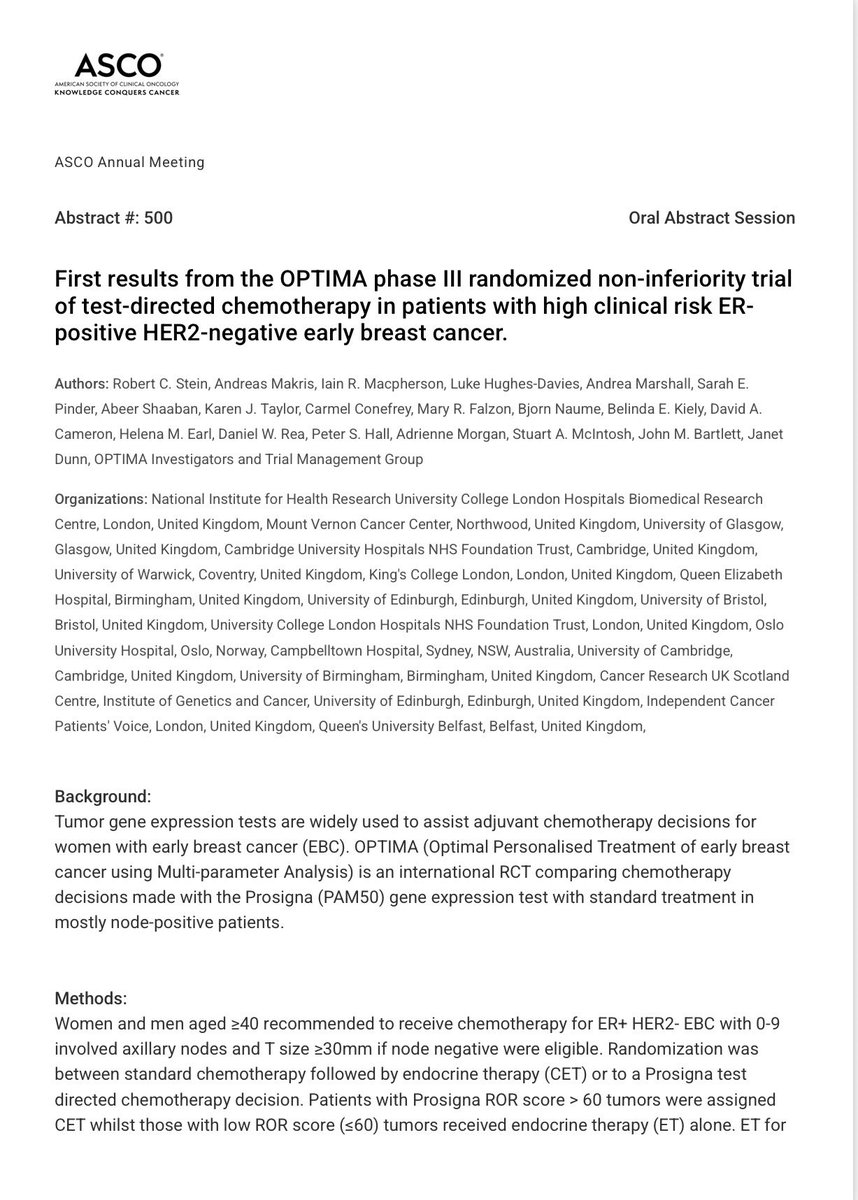
OPTIMA asks a long-standing clinical de-escalation question: can biology-guided genomic testing safely spare adjuvant chemotherapy in women with clinically high-risk, node-positive ER+/HER2- early breast cancer — a population where adjuvant chemo has historically been the default? Earlier de-escalation trials (TAILORx, RxPONDER) addressed node-negative and limited node-positive disease using Oncotype DX. OPTIMA extends the question into a higher-risk, more chemotherapy-committed population (up to nine involved nodes, including pN2) and uses a different assay — the 50-gene Prosigna PAM50 ROR (Risk of Recurrence) test — to identify a low-risk biology subgroup that may not benefit from chemotherapy.

The trial is a UK NIHR-funded, investigator-led Phase III non-inferiority study coordinated by the Warwick Clinical Trials Unit and University College London, with Robert Stein (UCL) presenting first results at the ASCO 2026 Plenary Session on May 30, 2026. Roughly 4,400 clinically high-risk patients were randomised. Patients found to be Prosigna ROR-low were randomised to omit adjuvant chemotherapy and receive endocrine therapy alone, versus the conventional standard of chemotherapy followed by endocrine therapy. The primary question is whether the test-directed (chemo-sparing) strategy is non-inferior to standard-of-care chemo-plus-endocrine therapy at 5 years.

The result is being discussed by KOLs as a potential practice-changing chemo de-escalation signal for a much larger, higher-risk population than previous genomic tests have validated — while also drawing nuanced commentary from Martine Piccart, Dr Sarah Sammons, Yakup Ergün and others on subgroup limits (particularly N2 disease, where event counts remain low) and on the practical question of how widely the strategy will be adopted given existing competing assays.

Trial Methodology & Results

Study Design

UK NIHR-funded, investigator-led, multicentre Phase III randomised non-inferiority trial (NCT02027441). Coordinated by Warwick Clinical Trials Unit and UCL. Eligible patients had Prosigna PAM50 testing performed on the primary tumour; those with a ROR score ≤60 ("low-risk" by PAM50 biology) were randomised 1:1 to test-directed therapy (omit adjuvant chemotherapy → endocrine therapy alone) versus standard-of-care (adjuvant chemotherapy followed by endocrine therapy). Patients with high-ROR tumours received chemotherapy and were not randomised.

Population

Clinically high-risk, ER+/HER2- early breast cancer, age ≥40, node-positive disease (1-9 involved nodes, including pN2). Both pre- and post-menopausal women were eligible. Approximately 4,400 patients enrolled across UK sites. Notably, this is a substantially higher-risk and more node-positive population than TAILORx or RxPONDER.

Assay

Prosigna 50-gene PAM50 Risk of Recurrence (ROR) signature (Veracyte). Test performed on primary tumour. Low-risk threshold pre-specified as ROR ≤60. Per the trial slides, approximately two-thirds of clinically high-risk patients were identified as Prosigna low-risk and therefore eligible for chemotherapy omission.

Primary Endpoint

5-year invasive breast cancer-free interval / distant disease-free survival in the ROR-low randomised cohort, with a pre-specified non-inferiority margin. Key secondary endpoints: distant recurrence, overall survival, quality of life, and treatment-related toxicity.

Test-Directed Strategy Met Non-Inferiority

At a median follow-up of 4 years, the 5-year IBCFS (invasive breast cancer-free survival) from the Kaplan-Meier curves was 91.8% control vs 90.3% test-directed, hazard ratio 1.03 (90% CI 0.85-1.25, p=0.006 non-inferiority) — meeting the pre-specified 3% non-inferiority margin. In the Prosigna ROR-low cohort (ROR ≤ 60, the population randomised to omit chemo), 5-year IBCFS was 94.8% control vs 93.6% test-directed, HR 1.06 (90% CI 0.80-1.40, p=0.003). Source: Stein et al., ASCO 2026 oral (Abstract #500); numbers per @stolaney1's verbatim post from the live presentation. The trial therefore supports the interpretation that, in clinically high-risk node-positive HR+/HER2- early breast cancer with a Prosigna low-ROR profile, adjuvant chemotherapy can be safely omitted in this biology subgroup.

Non-inferiority met — ROR-low cohort, 5-year outcomes

Clinical Reach — How Many High-Risk Patients Could Avoid Chemo

According to the trial slides shared by multiple KOLs (Nozawa, Griguolo, Lucarecco), the Prosigna ROR-low result identified roughly two-thirds (~68%) of clinically high-risk, node-positive ER+/HER2- patients as biologically low-risk — meaning a majority of this previously "obligate-chemo" population could potentially be spared adjuvant chemotherapy under a test-directed strategy. This is the headline that KOLs are pointing to as the practice-changing element of OPTIMA: not the absolute survival numbers, but the size of the population the trial reclassifies.

Nuance — The N2 Subgroup & Open Questions

Multiple KOLs (Dr Sarah Sammons, Martine Piccart in the discussion, Yakup Ergün) flagged the still-low event count in the pN2 (4-9 nodes) subgroup as the principal interpretive caveat — the headline non-inferiority result is most robust in the 1-3-node population. Piccart's invited discussion framed OPTIMA as the first prospective demonstration that Prosigna can de-escalate chemotherapy in node-positive disease, but emphasised continued follow-up, longer-term recurrence data, and direct comparison with competing assays as outstanding questions. Several US-based KOLs (Hamilton, Tolaney) raised the practical question of how rapidly the Prosigna ROR-guided strategy will be adopted in a US market where Oncotype DX already dominates node-positive decision-making.

Source: Stein et al., ASCO 2026 oral presentation (Abstract #500), May 30 2026; OPTIMA trial slides shared on X by Rugo, Nozawa, Griguolo, Lucarecco, Y. Abdou, To Be Elizabeth.

OPTIMA in the News

Primary publications, sponsor & institutional press releases, and major oncology media coverage around the Stein/UCL ASCO 2026 oral presentation.

Key KOL Sentiments - OPTIMA

PI & Discussant Voices
Prof. Robert C. Stein
UCL Cancer Institute · OPTIMA Chief Investigator
“OPTIMA addresses a long-standing challenge in breast cancer care: identifying who truly benefits from chemotherapy and who does not. Our findings show that many patients can safely avoid chemotherapy without compromising their outcomes.”
Source: EurekAlert / UCL  ·  May 30 2026 ↗
Prof. Martine Piccart
Jules Bordet Institute · ASCO 2026 Invited Discussant
“I will now recommend a genomic assay for all post- and premenopausal women (≥40 y) with any number of positive nodes. A low-risk genomic result triggers shared decision-making.”
Source: Piccart discussant slide, ASCO 2026 (captured via Rishabh Jain slide OCR)

All 31 curated OPTIMA-related tweets from #ASCO26 and pre-conference commentary, sorted positive → neutral → negative. Text is verbatim from each KOL.

DoctorSentimentComment
Elisa Agostinetto
@ElisaAgostinett
● POSITIVE Brilliant discussion at #ASCO26 by Prof Martine Piccart from @JulesBordet One important take home message for our clinical practice from the OPTIMA trial ⬇️⬇️⬇️ @OncoAlert https://t.co/EUpMyIMTY7
Veracyte, Inc.
@Veracyte
● POSITIVE We are proud to announce results from the landmark independent #OPTIMA (Optimal Personalised Treatment of early breast cancer using Multi-parameter Analysis) trial, led by University College London (@ucl). The results, which will be presented at the #ASCO26 Annual Meeting, https://t.co/MZ83em7Flz
Dr Michelle Li
@michelle_li
● POSITIVE Very excited to see results from OPTIMA reported at #ASCO26. Prosigna assay could help guide safe omission of chemotherapy in women >40yo with HR+/HER2- breast cancer, particularly those who are (a) premenopausal and/or (b) have 4-9 involved nodes or stage IIIA disease.
Naoto T Ueno, MD, PhD
@teamoncology
● POSITIVE I love the historical summary of Dr Piccart. She recommends a genomic assay to all node positive, age 40. https://t.co/IeNw32aANV
Dr Rishabh Jain
@drrishabhonco
● POSITIVE #ASCO26 Can genomic testing safely spare chemotherapy in high-risk ER+/HER2- early breast cancer? The phase III OPTIMA trial says yes. 🧬 4,429 pts 🧪 Prosigna (PAM50)-guided strategy 🎯 Majority node-positive disease Key finding: Low-risk ROR (≤60) patients had excellent https://t.co/22ZadcSpgb https://t.co/cL8NHWlJqh
Andres Meraz-Brenez
@iandresmeraz
● POSITIVE 🧬 OPTIMA is a major de-escalation signal in mostly node-positive HR+/HER2− early breast cancer. In >4,400 pts, Prosigna/PAM50-guided chemotherapy decisions met non-inferiority vs standard chemo for 5-year IBCFS: 90.4% vs 91.5%, HR 0.99. This included premenopausal pts on OFS
Hope Rugo
@hoperugo
● POSITIVE #asco26. Stein presents data from optima. Using Prosigna to determine chemo benefit in early HR+ BC. Premenopausal women <40 where we stillneed info excluded. Shows Prosigna identifies N+ pts unlikely to benefit from chemo. IMP! 1500 older premen pts included. @OncoAlert https://t.co/MeAaes5bL9
Luca Arecco, MD
@Lucarecco
● POSITIVE #ASCO26 oral eBC: OPTIMA trial supports chemo de-escalation in high-risk ER+/HER2− EBC. A prosigna-directed tx was non-inferior to standard chemo for 5-yr IBCFS, allowing pts with ROR ≤60 to avoid CT, incl. premenopausal pts receiving OFS and N+ disease @ASCO @OncoAlert https://t.co/h8A9wBqrRX
TxMaverickMH
@Hensley1552
● POSITIVE Love this graphic detailing the landmark #OPTIMA trial coming soon at #ASCO26 🔥🔥🔥 https://t.co/ag6BXVE5Aw
● POSITIVE OPTIMA at #ASCO26 met non-inferiority, suggesting many patients with high-risk HR+/HER2- early breast cancer — including premenopausal patients with node-positive disease and low ROR scores — did not derive meaningful benefit from chemotherapy. Important step toward biologically https://t.co/HrLuLWAXtJ
Willem Lybaert
@WLybaert
● POSITIVE Seems practice-changing😇
Gaia Griguolo
@GaiaGriguolo
● POSITIVE #Asco26 OPTIMA trial: PROSIGNA identifies HR+HER2- BC not benefiting from adj chemo in pts aged 40 or above (including premenopausal receiving OFS) Pts with pN2 included but numerically small subgroup @OncoAlert https://t.co/il2PLruUUP
● POSITIVE #OPTIMA addresses a real and long-standing tension in how we treat premenopausal node-positive ER+ breast cancer. The signal is meaningful: PAM50 ROR&lt;60 patients who received adequate OFS did not appear to benefit from chemotherapy. That is a hypothesis worth taking seriously. https://t.co/m0YBV3LIzh
Erika Hamilton, MD, FASCO
@ErikaHamilton9
● POSITIVE Agree- this is the takeaway. Previously, the 🙋‍♀️ has been how much of the premeno chemo benefit was chemo itself and how much was chemo-induced ovarian failure? #OPTIMA mandated OFS, so eliminated this variable and suggests that the OFS was the majority of benefit. #ASCO26 https://t.co/j7Du1IHv1V
Naoto T Ueno, MD, PhD
@teamoncology
● POSITIVE OPTIMA study is the most practice changing for breast cancer at #ASCO26. No chemotherapy for low ROS score, 50 gene Prosigna by @Veracyte, for much more advanced early breast cancer compared to OncotypeDx indication by @ExactSciences. https://t.co/doMgW9boAP
OncoAlert
@oncoalert
● NEUTRAL 🚨 The OncoAlert #BreastCancer faculty’s TOP 10 abstracts for #ASCO26 — selected by our leads and finalized through a Delphi voting process with senior breast cancer experts. 1️⃣ 500 — OPTIMA Test-directed chemotherapy in high-risk ER+/HER2- early BC 2️⃣ LBA1006 — PERSEVERA BC https://t.co/FJSHDjv3Ln
● NEUTRAL #ASCO26 | We've been sparing node-negative #breastcancer patients from chemo using #Oncotype. #OPTIMA just did it in the population we've been most afraid to touch. 4,400+ patients. ER+/HER2−. Node-positive, up to pN2. #Prosigna_ROR: ≤60 → no chemo. 5-year IBCFS: 90.4% vs
● NEUTRAL 💫🌟🚨 Top 10 #BreastCancer abstracts for #ASCO26 — selected by our leads and finalized via a Delphi voting process 🗳️🔬 1️⃣ 500 — OPTIMA 2️⃣ LBA1006 — PERSEVERA BC 3️⃣ 507 — KEYNOTE-522 final analysis 4️⃣ LBA1007 — SERENA-6 5️⃣ 502 — LIDERA BC 6️⃣ LBA1000 — ASCENT-04 7️⃣ 501 — NATALEE https://t.co/3BPHgMO1ct
Mirrors of Medicine
@mirrorsmed
● NEUTRAL First results from the OPTIMA phase III randomized non-inferiority trial of test-directed chemotherapy in patients with high clinical risk ER-positive HER2-negative early breast cancer. #ASCO26 Abstract Preview https://t.co/vm2tCjbnd8 The OPTIMA trial evaluated Prosigna https://t.co/tLC2NO2dw9
Yakup Ergün
@dr_yakupergun
● NEUTRAL #ASCO26 OPTIMA does not teach us a completely new biology; it reinforces the Oncotype DX-era message with Prosigna/PAM50 at a phase III level. What makes it important is the population: clinically high-risk ER+/HER2− EBC, frequent nodal positivity, 19% pN2 disease, and 37% https://t.co/qaIrXJTs0P
Dr Rishabh Jain
@DrRishabhOnco
● NEUTRAL How will OPTIMA change our practice ? #ASCO26 @OncoAlert @ASCO https://t.co/c0yCb5l39T https://t.co/vzmDSkv0ZO
Kazuki Nozawa, MD
@kazuki_nozawa
● NEUTRAL OPTIMA Trial #ASCO26 The 50-gene Prosigna test identifies ~2/3 of ER+/HER2− early breast cancer patients — including those with node-positive disease &amp; premenopausal women ≥40 — who derive no meaningful benefit from adjuvant chemotherapy. 5-yr IBCFS: 90.3% vs 91.8% → https://t.co/8TRrnqdsBK
Dr Rishabh Jain
@drrishabhonco
● NEUTRAL #ASCO26 Abstract #500 OPTIMA phase III trial - Test-directed chemotherapy in high clinical risk ER+/HER2- early breast cancer. https://t.co/D2JTC41yd7
Elisabetta Bonzano MD, PhD
@to_be_elizabeth
● NEUTRAL 📌First results from the OPTIMA phase Ill randomized non-inferiority trial of test-directed chemotherapy in patients with high clinical risk ER-positive HER2-negative early breast cancer. ✨Robert C. Stein at #ASCO26 🔗 OPTIMA demonstrates that the 50-gene Prosigna test https://t.co/5QI1xj6u3k
Susan G. Komen
@SusanGKomen
● NEUTRAL Can some people safely avoid chemo in higher-risk early breast cancer? 🤔 OPTIMA phase 3 tests a genomic-guided strategy vs standard of care in HR+/HER2- #breastcancer. Robert Stein, PhD presents first results at #ASCO26. @ASCO https://t.co/lFAJPbXafk
Elvina Almuradova
@Dr_ElvinaA
● NEUTRAL Fascinating data from the OPTIMA trial #ASCO26 Looking at Prosigna ROR scores to guide chemo decisions in premenoposal node-positive, ER+/HER2- breast cancer. The 5-year outcomes show highly comparable, excellent survival rates across sub-populations. 📈 #OncoTwitter #BCSM https://t.co/2AvNxzJ3G3
Sara Tolaney
@stolaney1
● NEUTRAL OPTIMA: High risk ER+ pts, age≥40 Chemo--> ET vs Test-directed (chemo-->ET or ET) OFS requ'd for all premenop pts 38% premenop, 19% 4-9 LN+ Median f/u 4 yrs IBCFS 91.8 vs 90.3, HR 1.03 ROR≤60: 94.8 vs 93.6 HR 1.06 @OncoAlert #ASCO26
● NEUTRAL Such important information answering an important question. Question I have is how these results will guide our choice of genomic assay going forward in this patient population.
Dr Sarah Sammons
@drsarahsam
● NEUTRAL Dr Piccart reinforces that OPTIMA for the first time prospectively shows the chemo benefit for premenopausal low GEP women, is mostly due to chemotherapy induced ovarian suppression. https://t.co/QNSOtlyjqm
Dr Sarah Sammons
@drsarahsam
● CAUTIOUS OPTIMA, still low number of events in N2 disease patients. #asco26 https://t.co/Rultuu2Pj8
Naoto T Ueno, MD, PhD
@teamoncology
● CAUTIOUS The issue with the OPTIMA study is that it doesn’t include a limited non-white population. Does this truly apply to all patient populations? #ASCO26